

Paper Menu >>
Journal Menu >>
 J. Biomedical Science and Engineering, 2011, 4, 511-515 doi:10.4236/jbise.2011.47065 Published Online July 2011 (http://www.SciRP.org/journal/jbise/ JBiSE ). Published Online July 2011 in SciRes. http://www.scirp.org/journal/JBiSE HLA allele frequencies in Iranian opticospinal multiple sclero- sis patients ——HLA in Opticospinal MS Hossein Kalanie1, Malihe Kamgooyan2, Yadollah Kholghie3, Ali Amini Harandi4*, Zahra Hos seinzadeh5 1MS Research Center, Mehr and Loghman Hospital Shahid Beheshti, University of Medical Sciences,Tehran, Iran; 2Bahar Medical Laboratory, Department of Immunology and Transplantation, Tehran, Iran; 3Loghman Hospital, Shahid Beheshti University of Medical Sciences, Tehran, Iran; 4Loghman Hospital, Shahid Beheshti University of Medical Sciences, Tehran, Iran; 5Mehr Hospital, Zartosht Street Tehran, Iran. Email: *[email protected] Received 4 May 2011; revised 26 May 2011; accepted 12 June 2011. ABSTRACT Background: In Iranian patients with opticospinal multiple sclerosis (OSMS), a paucity of brain lesions and short spinal cord lesions extending less than three spinal segments are characteristic findings on magnetic resonance imaging (MRI). It also shows a relatively benign course with negative CSF oligo- coonal bands. Objective: We aimed to clarify the pos- sible relationship between clinical phenotype and MRI features of OSMS and human leucocyte antigen (HLA) system in Iran. Methods: Genotyping of HLA class II allele frequencies in 20 patients with OSMS were done, using polymerase chain reaction se- quence-specific primer amplification method. Blood samples were extracted and typed for HLA-DRB, DQA, and DQB loci and compared with 100 controls. Results: Significant positive association was observed in DRB1*03, DQA1*0201, DQA1*03, DQB1*0201, and DQB1*0611, while DQB1*0602 was ab sent in our patients. Conclusion: These finding suggest that HLA-DRB association pattern in OSMS is different from conventional MS in Iran which is mostly asso- ciated with DRB1*1501 and from similar Japanese OSMS who are negative for brain lesions fulfilling the Barkhof criteria and negative for the presence of longitudinally extensive spinal cord lesions who car- ries the DRB*0405 allele. OSMS is immunogeneti- cally heterogeneous. Also absence of DQB1*0602 al- lele may negatively be associated with the absence of Barkhof brain lesion. Keywords: Epidemiology, HLA-Class II Allele Frequency, Opticospinal Multiple Sclerosis; Neuromyelitis Optica; NMO-IgG Antibody; Devic’s Neuromyelitis Optica; Iranian; Demyelinating Disease 1. INTRODUCTION The etiology of multiple sclerosis (MS) is unknown, and pathogenesis of the disease encompasses multiple in- flammatory as well as apoptotic process in the central nervous system [1-3]. Epidemiological studies indicate both genetic and environmental component in MS sus- ceptibility [4]. The human leucocyte antigen (HLA) sys- tem provides a set of genetic loci which lend themselves to systematic study. In fact both linkage and whole ge- nome association screens revealed a prominent role for alleles of the major histocompatibility complex class II gene HLA-DRB1 [5]. Of interest, in northern Euro- pean-descended populations, association with this gene was identified only within families that carried the HLA DRB1*1501 allele [6]. This observation demonstrates that only a portion of familial MS is associated with al- lelic variation in this gene. Therefore other genes must contribute prominently to MS susceptibility of DRB1. The fact that familial MS has at least 2 forms, the variety associated with HLA-DRB1 and the form without this association, onclusively demonstrates that MS is immu- nogenetically heterogenesis. In Asia, the diversity of MS has been a topic of de- bates for years and there are wide variations in the clini- cal presentation [7], and the prominence of Opticospinal MS (OSMS) in Asian populations has long been recog- nized. Many authors have divided MS into opticospinal and conventional forms, base on their differential clini- cal phenotypes. Kira et al. [8] considered these to be differential entities and have also shown immunogenetic differences between the types. They found an association between conventional MS and DRB1*1501 and  H. Kalanie et al. / J. Biomedical Science and Engineering 4 (2011) 511-515 512 DRB5*0501 was found to play an important role in the development of MS in general but not in OSMS [9,10]. On the basis of the presence or absence of brain lesions fulfilling the Barkhof criteria and the longitudinally ex- tensive spinal cord lesions (LESCLs) recently Matsuoka et al. [11] have shown that OSMS in Japan is heteroge- neous. One third of Japanese OSMS have Barkhof (-) LESCLs (-) vairant of the disease and interestingly enough this type of presentation is so far from the only known presentation of the disease in Iran [12]. Although, OSMS is reported to be common in Japan and some other Asian countries [13-20], it is an uncom- mon presentation of MS in Iran [12,21]. The aim of this study is to clarify the possible relationship between clini- cal phenotype and magnetic resonance imaging (MRI) features of OSMS and HLA system in Iran. 2. MATERIALS AND METHOD HLA-Class II allele frequencies were studied in 20 pa- tients with OSMS whose demographic data, clinical course, MRI findings and cerebro-spinal fluid (CSF) changes have been recently published [22] and were compared with 100 healthy controls. There were 14 women and 6 men with gender ratio of 2.3:1. The age of onset ranged from 10 to 50 years with the mean of 24 ± 8.2 and the mean disease duration of 8 ± 4.4 years. The annual relapse rate was 0.66 ± 0.84 and the EDSS ranged from 0 to 6 with the mean of 2.5 ± 1.3 with the number of exacerbation of 5.25 ± 5.1. All 20 patients had 1 to 5 hemispheric T2 lesion in brain MRI and spinal cord lesions that extending below three vertebral seg- ments (short lesions) in sagittal planes with peripheral white matter location and central sparing on the axial plane. CSF contained normal cell count and protein level with normal IgG index and negative oligocolonal bands. Genomic DNA was extracted from EDTA blood sam- ple by QIA DNA Mini Kits (QIA Gen) and DNA extrac- tion kits of protrans. HLA-DRB, DQA and DQB typing were performed using PCR-SSP method. Medium Reso- lution Kit used for typing these loci was supplied by Protrans and CTS of Heidelberg University and Taq DNA polymerase enzyme by Roche Company (Basle, Switzerland). The PCR reaction was carried out in 10 ul volumes by thermal cyclers (Techne-Genius). Amplifi- cation was followed after initial denaturation with 94 cycles (CS) for 2 minutes (including 10 CS for 15 sec- onds, 65 CS for 60 seconds, 20 CS for 15 seconds, 61 CS for 50 seconds, and 72 CS for 30 seconds). After running PCR products on agarose gel and observation of specific bands using UV transilluminator, the results were interpreted and alleles assigned [23,24]. The same processes were performed for 100 healthy persons as control group who were volunteers of organ transplanta- tion. Statistical analysis was performed using Chi-Square and Fisher’s Exact Test. A p value less than 0.05 was considered statistically significant and analysis was done by SPSS version 11.0 software (SPSS Inc., Chicago, IL). 3. RESULTS The HLA class II allele frequencies for DRB, DQA and DQB in 20 OSMS patients comparing to 100 healthy subjects are shown in Table 1, 2 and 3, respectively. There were strong positive association between DRB1*03 (70% vs. 16%; P-value = 0.009), DQA1*0201 (35% vs. 10%; P-value = 0.01), DQA1*03 (45% vs. 10%; P-value = 0.009), DQB1*0201 (90% vs. 19%; P-value = 0.009), and DQB1*0611(30% vs. 7%; P-value = 0.009) and OSMS patients, while DQB1*0602 (0% vs. 10%; P-value = 0.210) and DRB1*11 (20% vs. 46%; P-value = 0.045) haplotype were negatively associated with our patients. Interestingly enough, no significant association was found between OSMS and HLA- DRB1*1501 which is the most common HLA class II [5,7,9,22] in conventional MS patients in Iran and other countries. The HLA-DRB1*0103, DRB1*09, DRB1*12, DRB1*14 were not observed in our OSMS patients, so was for HLA-DQA1*03011 and DQA1*04011. 4. DISCUSSION While OSMS is a common clinical presentation of MS in oriental countries including Japan [13-20] with dis- tinct reported features [8] and immunogenetic differ- ences with conventional MS (CNMS), it is an uncom- mon clinical presentation of the disease in Iran [12,21]. Heterogeneity in the clinical course and MRI findings [12,25,26] may indicate to the presence of possible ge- netic contributing factors and in fact previously it has been shown that HLA-DRB1*1501 which plays an im- portant role in the development of MS in general are not observed in OSMS. On the basis of presence or absence of brain lesions fulfilling the Barkhof criteria ± LESCLs, have shown that Barkhof (-) patients had remarkably lower frequency of HLA-DRB1*0901, despite this being the most common allele in Japanese [27]. This allele also was not presented in our patients, however it is not a common allele in Iranian population. In contrast our cases showed negative association with DQB1*0602 allele (0.0% vs. 10%). Therefore, absence of this allele along with paucity of DRB1*1501 may negatively be associated with the absence of Barkhof brain lesions in our patients. In Matsouka’s study [27] the Barkhof (-) LESCLs (-) patients which are in close similarity to our study group, as a unique subtype of OSMS in Asian showed a significant increase in the frequency of DRB1*0405 compared with controls. But in our patients C opyright © 2011 SciRes. JBiSE 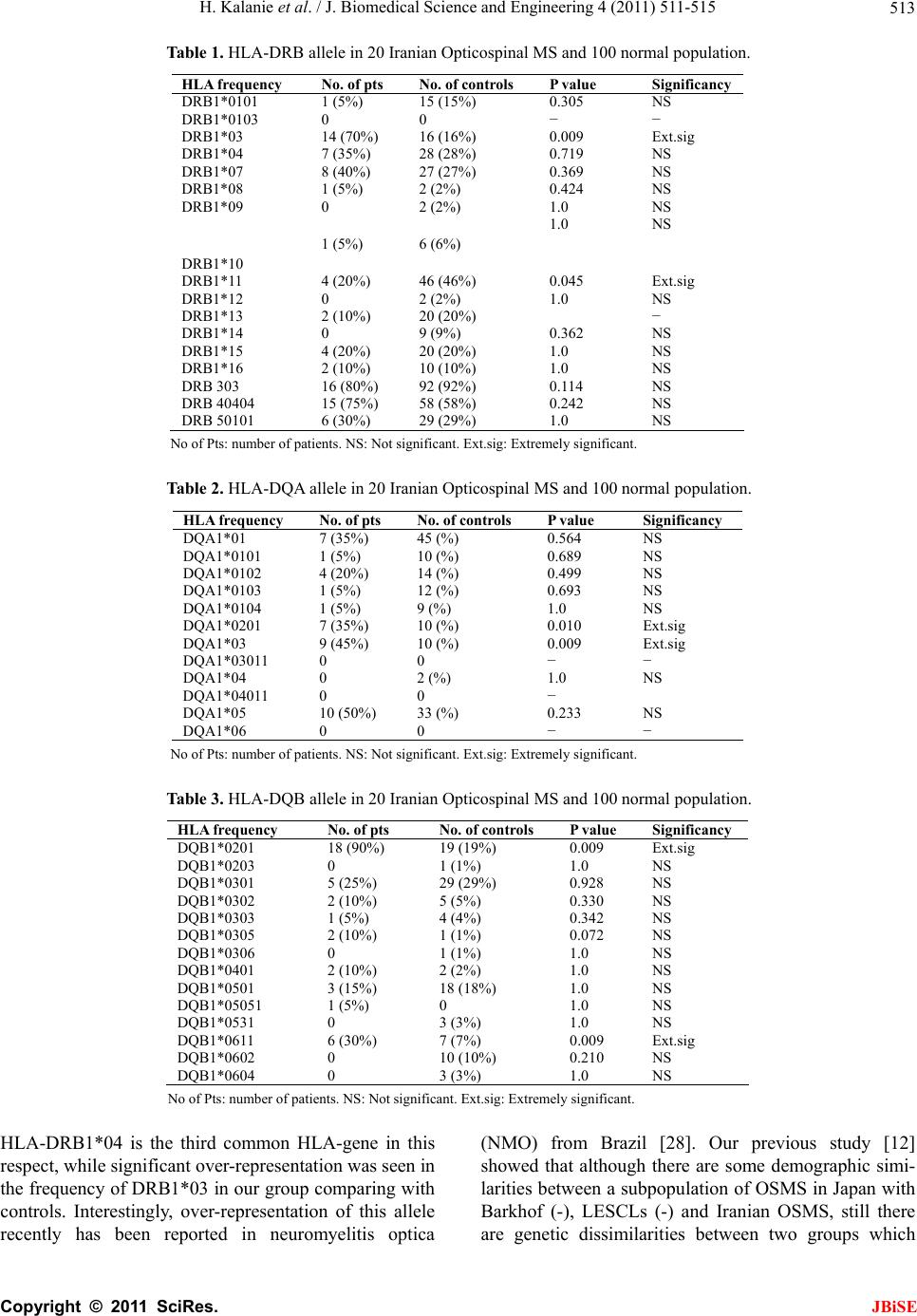 H. Kalanie et al. / J. Biomedical Science and Engineering 4 (2011) 511-515 513 Table 1. HLA-DRB allele in 20 Iranian Opticospinal MS and 100 normal population. HLA frequency No. of pts No. of controls P value Significancy DRB1*0101 1 (5%) 15 (15%) 0.305 NS DRB1*0103 0 0 − − DRB1*03 14 (70%) 16 (16%) 0.009 Ext.sig DRB1*04 7 (35%) 28 (28%) 0.719 NS DRB1*07 8 (40%) 27 (27%) 0.369 NS DRB1*08 1 (5%) 2 (2%) 0.424 NS DRB1*09 0 2 (2%) 1.0 NS DRB1*10 1 (5%) 6 (6%) 1.0 NS DRB1*11 4 (20%) 46 (46%) 0.045 Ext.sig DRB1*12 0 2 (2%) 1.0 NS DRB1*13 2 (10%) 20 (20%) − DRB1*14 0 9 (9%) 0.362 NS DRB1*15 4 (20%) 20 (20%) 1.0 NS DRB1*16 2 (10%) 10 (10%) 1.0 NS DRB 303 16 (80%) 92 (92%) 0.114 NS DRB 40404 15 (75%) 58 (58%) 0.242 NS DRB 50101 6 (30%) 29 (29%) 1.0 NS No of Pts: number of patients. NS: Not significant. Ext.sig: Extremely significant. Table 2. HLA-DQA allele in 20 Iranian Opticospinal MS and 100 normal population. HLA frequency No. of pts No. of controls P value Significancy DQA1*01 7 (35%) 45 (%) 0.564 NS DQA1*0101 1 (5%) 10 (%) 0.689 NS DQA1*0102 4 (20%) 14 (%) 0.499 NS DQA1*0103 1 (5%) 12 (%) 0.693 NS DQA1*0104 1 (5%) 9 (%) 1.0 NS DQA1*0201 7 (35%) 10 (%) 0.010 Ext.sig DQA1*03 9 (45%) 10 (%) 0.009 Ext.sig DQA1*03011 0 0 − − DQA1*04 0 2 (%) 1.0 NS DQA1*04011 0 0 − DQA1*05 10 (50%) 33 (%) 0.233 NS DQA1*06 0 0 − − No of Pts: number of patients. NS: Not significant. Ext.sig: Extremely significant. Table 3. HLA-DQB allele in 20 Iranian Opticospinal MS and 100 normal population. HLA frequency No. of pts No. of controls P value Significancy DQB1*0201 18 (90%) 19 (19%) 0.009 Ext.sig DQB1*0203 0 1 (1%) 1.0 NS DQB1*0301 5 (25%) 29 (29%) 0.928 NS DQB1*0302 2 (10%) 5 (5%) 0.330 NS DQB1*0303 1 (5%) 4 (4%) 0.342 NS DQB1*0305 2 (10%) 1 (1%) 0.072 NS DQB1*0306 0 1 (1%) 1.0 NS DQB1*0401 2 (10%) 2 (2%) 1.0 NS DQB1*0501 3 (15%) 18 (18%) 1.0 NS DQB1*05051 1 (5%) 0 1.0 NS DQB1*0531 0 3 (3%) 1.0 NS DQB1*0611 6 (30%) 7 (7%) 0.009 Ext.sig DQB1*0602 0 10 (10%) 0.210 NS DQB1*0604 0 3 (3%) 1.0 NS No of Pts: number of patients. NS: Not significant. Ext.sig: Extremely significant. HLA-DRB1*04 is the third common HLA-gene in this respect, while significant over-representation was seen in the frequency of DRB1*03 in our group comparing with controls. Interestingly, over-representation of this allele recently has been reported in neuromyelitis optica (NMO) from Brazil [28]. Our previous study [12] showed that although there are some demographic simi- larities between a subpopulation of OSMS in Japan with Barkhof (-), LESCLs (-) and Iranian OSMS, still there are genetic dissimilarities between two groups which C opyright © 2011 SciRes. JBiSE  H. Kalanie et al. / J. Biomedical Science and Engineering 4 (2011) 511-515 514 pinpoints to further heterogeneity of the disease in this respect. Nowadays, with the availability of NMO im- munoglobulin G (NMO-IgG) which targets the water channel protein aquaporin-4, NMO spectrum of disorder is wider than previously known and covers some cases of Asian OSMS [29-31]. At present, probably the type of OSMS in Iran [12] and a subpopulation of OSMS in Japan according to Matsuoka et al. [11,27] with Barkhof (-), LESCLs (-) MRI features, lower female to male ratio, low annual relapse rate and lower number of exacerba- tion and lower EDSS scores is the best candidate to be nominated as pure opticospinal MS (POSMS). 5. CONCLUSIONS Since evaluation of NMO-IgG was not feasible in our country, it is our main study limitation. We wish to em- phasize that the present study is a preliminary one as a result of small number of patients involved due to low prevalence of the disease in Iran. Nonetheless the find- ings are encouraging enough to warrant further study of these patients on a larger scale both in Iran and other Asian countries. REFERENCES [1] Hafler, D.A. (2004) Multiple sclerosis. Journal of Clini- cal Investigation, 113, 788-794. [2] Barnett, M.H. and Prineas, J.W. (2004) Relapsing and remitting multiple sclerosis: Pathology of the newly forming lesion. Annals of Neurology, 55, 458-468. doi:10.1002/ana.20016 [3] Kornek, B. and Lassmann, H. (2003) Neuropathology of multiple sclerosis-new concepts. Brain Research Bulletin, 61, 321-326. doi:10.1016/S0361-9230(03)00095-9 [4] Hogancamp, W.E., Rodriguez, M. and Weinshenker, B.G. (1997) The epidemiology of multiple sclerosis. Mayo Clinic Proceedings, 72, 871-878. doi:10.4065/72.9.871 [5] Olerup, O. and Hillert, J. (1991) HLA class II-associated genetic susceptibility in multiple sclerosis: A critical evaluation. Tissue Antigens, 38, 1-15. doi:10.1111/j.1399-0039.1991.tb02029.x [6] Akesson, E., Oturai, A., Berg, J., Fredrikson, S., Ander- sen, O., Harbo, H.F., Laaksonen, M., Myhr, K.M., Nyland, H.I., Ryder, L.P., Sandberg-Wollheim, M., Sorensen, P.S., Spurkland, A., Svejgaard, A., Holmans, P., Compston, A., Hillert, J. and Sawcer, S. (2002) A ge- nome-wide screen for linkage in Nordic sib-pairs with multiple sclerosis. Genes Immunity, 3, 279-285. doi:10.1038/sj.gene.6363866 [7] Wasay, M., Khatri, I.A., Khealani, B. and Sheerani, M. (2006) MS in Asian countries. International MS Journal, 13, 58-65. [8] Kira, J., Yamasaki, K., Horiuchi, I., Ohyagi, Y., Taniwaki, T. and Kawano, Y. (1999) Changes in the clinical pheno- types of multiple sclerosis during the past 50 years in Ja- pan. Journal of the Neurological Sciences, 166, 53-57. doi:10.1016/S0022-510X(99)00115-X [9] Kira, J., Kanai, T., Nishimura, Y., Yamasaki, K., Matsu- shita, S., Kawano, Y., Hasuo, K., Tobimatsu, S. and Ko- bayashi, T. (1996) Western versus Asian types of multiple sclerosis: Immunogenetically and clinically distinct dis- orders. Annals of Neurology, 40, 569-574. doi:10.1002/ana.410400405 [10] Fukazawa, T., Kikuchi, S., Miyagishi, R., Miyazaki, Y., Yabe, I., Hamada, T. and Sasaki, H. (2006) HLA- dPB1*0501 is not uniquely associated with opticospinal multiple sclerosis in Japanese patients. Important role of DPB1*0301. Multiple Sclerosis, 12, 19-23. doi:10.1191/135248506ms1252oa [11] Matsuoka, T., Matsushita, T., Osoegawa, M., Ochi, H., Kawano, Y., Mihara, F., Ohyagi, Y. and Kira, J. (2008) Heterogeneity and continuum of multiple sclerosis in Japanese according to magnetic resonance imaging find- ings. Journal of the Neurological Sciences, 266, 115-125. doi:10.1016/j.jns.2007.09.010 [12] Kalanie, H., Kholghie, Y., Shamsai, G.R. and Ghorbani, M. (2009) Opticospinal multiple sclerosis in Iran. Jour- nal of the Neurological Sciences, 276, 130-132. doi:10.1016/j.jns.2008.09.038 [13] Kuroiwa, Y., Igata, A., Itahara, K., Koshijima, S. and Tsubaki, T. (1975) Nationwide survey of multiple sclero- sis in Japan. Clinical analysis of 1084 cases. Neurology, 25, 845-851. [14] Houzen, H., Niino, M., Kikuchi, S., Fukazawa, T., Nogoshi, S., Matsumoto, H. and Tashiro, K. (2003) The prevalence and clinical characteristics of MS in northern Japan. Journal of the Neurological Sciences, 211, 49-53. [15] Zhao, B. X., Liu, X. Q., Guo, Y. P., Yang, Y. C. and Huang, H. F. (1981) Multiple sclerosis. A clinical study of 70 cases. European Neurology, 20, 394-400. [16] Hung, T.P., Landsborough, D. and Hsi, M.S. (1976) Mul- tiple sclerosis amongst Chinese in Taiwan. Journal of the Neurological Sciences, 27, 459-484. doi:10.1016/0022-510X(76)90214-8 [17] Das, A. and Puvanendran, K. (1998) A retrospective re- view of patients with clinically definite multiple sclerosis. Annals, Academy of Medicine, Singapore, 27, 204-209. [18] Jitpimolmard, S. and Vejjajiva, A. (1994) Clinical fea- tures and clinical course of multiple sclerosis in Thai pa- tients: A report of 50 cases. Journal of The Medical As- sociation of Thailand, 77, 239-243. [19] Kurtzke, J.F., Park, C.S. and Oh, S.J. (1968) Multiple sclerosis in Korea. Clinical features and prevalence. Journal of the Neurological Sciences, 6, 463-481. doi:10.1016/0022-510X(68)90031-2 [20] Tan, C.T. (1998) Multiple sclerosis in Malaysia. Archives of Neurology, 45, 624-627. [21] Kalanie, H., Gharagozli, K. and Kalanie, A.R. (2003) Multiple sclerosis: Report on 200 cases from Iran. Multi- ple Sclerosis, 9, 36-38. doi:10.1191/1352458503ms887oa [22] Kalanie, H., Kamgooyan, M., Sadeghian, H. and Kalanie A.R. (2000) Histocompatibility antigen (HLA) associa- tions with multiple sclerosis in Iran. Multiple Sclerosis, 6, 317-319. [23] Massey, H.D. and McPherson, R.A. (2007) The major histocompatibility complex of man. In: McPherson R.A. and Pincus M.R. Eds., Henry’s clinical diagnosis and management by laboratory methods. 21st Edition, Saun- C opyright © 2011 SciRes. JBiSE  H. Kalanie et al. / J. Biomedical Science and Engineering 4 (2011) 511-515 Copyright © 2011 SciRes. 515 JBiSE ders Elsevier, Beijing, 876-893. [24] Julio, C.D. and Edmond, J.Y. (2007) The Major Histo- compatibility Complex and Disease. In Henry’s Clinical Diagnosis and Management by Laboratory Methods. 21st Edition, Saunders-Elsevier, 8, 894-902. [25] Misu, T., Fujihara, K., Nakashima, I., Miyazawa, I., Okita, N., Takase, S. and Itoyama, Y. (2002) Pure op- tic-spinal form of multiple sclerosis in Japan. Brain, 125, 2460-2468. doi:10.1093/brain/awf260 [26] Nakashima, I., Fukazawa, T., Ota, K., Nohara, C., Warabi, Y., Ohashi, T., Miyazawa, I., Fujihara, K. and Itoyama, Y. (2007) Two subtypes of optic-spinal form of multiple sclerosis in Japan: Clinical and laboratory features. Jour- nal of Neurology, 254, 488-492. doi:10.1007/s00415-006-0400-z [27] Matsuoka, T., Matsushita, T., Osoegawa, M., Kawano, Y., Minohara, M., Mihara, F., Nishimura, Y., Ohyagi, Y. and Kira, J. (2008) Association of the HLA-DRB1 alleles with characteristic MRI features of Asian multiple scle- rosis. Multiple Sclerosis, 14, 1181-1190. doi:10.1177/1352458508097818 [28] Brum, D.G., Barreira, A.A., Santos dos, A.C., Kai- men-Maciel, D.R., Matiello, M., Costa, R.M., Deghaide, N.H., Costa, L.S., Louzada-Junior, P., Diniz, P.R., Comini-Frota, E.R., Mendes-Junior, C.T. and Donadi, E.A. (2010) HLA-DRB association in neuromyelitis op- tica is different from that observed in multiple sclerosis. Multiple Sclerosis, 16, 21-29. doi:10.1177/1352458509350741 [29] Weinshenker, B.G. and Wingerchuk, D.M. Neuromyelitis optica: Clinical syndrome and the NMO-IgG autoanti- body marker. Current Topics in Microbiology and Im- munology, 318, 343-356. doi:10.1007/978-3-540-73677-6_14 [30] Kira, J. (2008) Neuromyelitis optica and Asian pheno- type of multiple sclerosis. Annals of the New York Academy of Sciences, 1142, 58-71. doi:10.1196/annals.1444.002 [31] Nandhagopal, R., Al-Asmi, A. and Gujjar, A.R. (2010) Neuromyelitis optica: An overview. Postgraduate Medi- cal Journal, 86, 153-159. doi:10.1136/pgmj.2009.091389 |