

Paper Menu >>
Journal Menu >>
 Pharmacology & Pharmacy, 2011, 2, 164-167 doi:10.4236/pp.2011.23023 Published Online July 2011 (http://www.scirp.org/journal/pp) Copyright © 2011 SciRes. PP Laxative Effect of Eugenia jambolana Crude Leaf Bud Extract A. Sivakumar1*, T. Panneer Selvam2 1School of Bio Science and Technology, VIT University, Tamilnadu, India; 2Department of Pharmacy, Srinivas College of Pharmacy, Karnataka, India. Email: *[email protected], si[email protected] Received May 17th, 2011; revised June 20th, 2011; accepted June 30th, 2011. ABSTRACT The therapeutic value of Eugenia jambolana Lam. commonly known as ‘Jamun’ has been recognized in different system of traditional medication for the treatment of different diseases and ailments. It contains several phytoconstituents be- longing to category of alkaloids, glucosides, flavonoides and volatile oils. It has been reported as digestive, astringent to the bowels, anthelmintic, sore throat, bronchitis, asthma, thirst, biliousness, dysentery, blood purifier, ulcers and diabetes. There are few reports available on clinical uses of Eugenia jambolana in diabetes that have shown promising results. In south India ayurvedic practitioners were using the leaf buds of Eugenia jambolana to induce laxative effect and to clean up the intestinal contents before starting any medication. The result showed that of E. jambolana stimu- lates the contractile action of frog and mice through an acetylcholine-like mechanism and effectively stimulates gastro- intestinal motility in mice and frogs. In this paper we have discussed the laxative effect of Eugenia jambolana leaf bud extract which was never reported scientifically. Keywords: Eugenia jambolana, Traditional Medicine, Laxative 1. Introduction Traditional or indigenous drugs used by different ethnic groups of the world for the treatment of diseases have special significance of having been tested on long time scale. They are relatively safe, easily available and af- fordable to masses. Eugenia jambolana Lam belonging to the family Myrtaceae is a large evergreen tree up to 30 m high. It is widely distributed through out India, and known as Jamun. It has been valued in Ayurveda and Unani system of medication for possessing variety of therapeutic properties. Most of the plant parts of E. jam- bolana are used in traditional system of medicine in In- dia. According to Ayurveda, its bark is acrid, sweet, di- gestive, and astring ent to the bowels, anthelmintic and in good for sore throat, bronchitis, asthma, thirst, bilious- ness, dysentery, blood impurities and to cure ulcers [1-8]. The fruits are acrid and sweet, cooling, dry and astrin- gent to bowels. The seeds are sweet, astringent to bowels and good for diabetes. The sprouts are refrigerant, car- minatives & astringent to bowels. Its bark, with or with- out the addition of other astringents like cardamom and cinnamon, is used as decoction in case of chronic diar- rhoea and dysentery. Juice of the tender leaves of E. jambolana together with mango leaves and myrobalan is administered along with goat’s milk and honey to cure dysentery with bloody discharge (Chakardata) where as juice of tender leaves alone or in combination with car- minatives is given along with goat’s milk to cure diar- rhoea in children. Timbola et al., isolated quercetin (0.0085%), myricetin (0.023%), myricitrin (0.009%), and a flavonol glycosides myricetin 3-O-(4”-acetyl)-α-L- rhamnopyranosides (0.059%) from its leaves. Traditional Ayurvedic practioners in tamil nadu used the E. jambo- lana leaf bud as purgative/laxative to clean up gastro intestinal tract before starting any other medication or treatment. Literature survey revealed that the plant ex- tract has yet not been screened for its traditional laxative and purgative effects in experimental animals. Therefore the present study was carried out to provide pharmacol- ogical evidence for the folkore medicinal consideration of leaf bud crude extract as laxative. 2. Results 2.1. Effect of E. jambolana on Gastrointestinal Motility and Laxative Effect The effect of E. jambolana on the gastrointestinal motil- 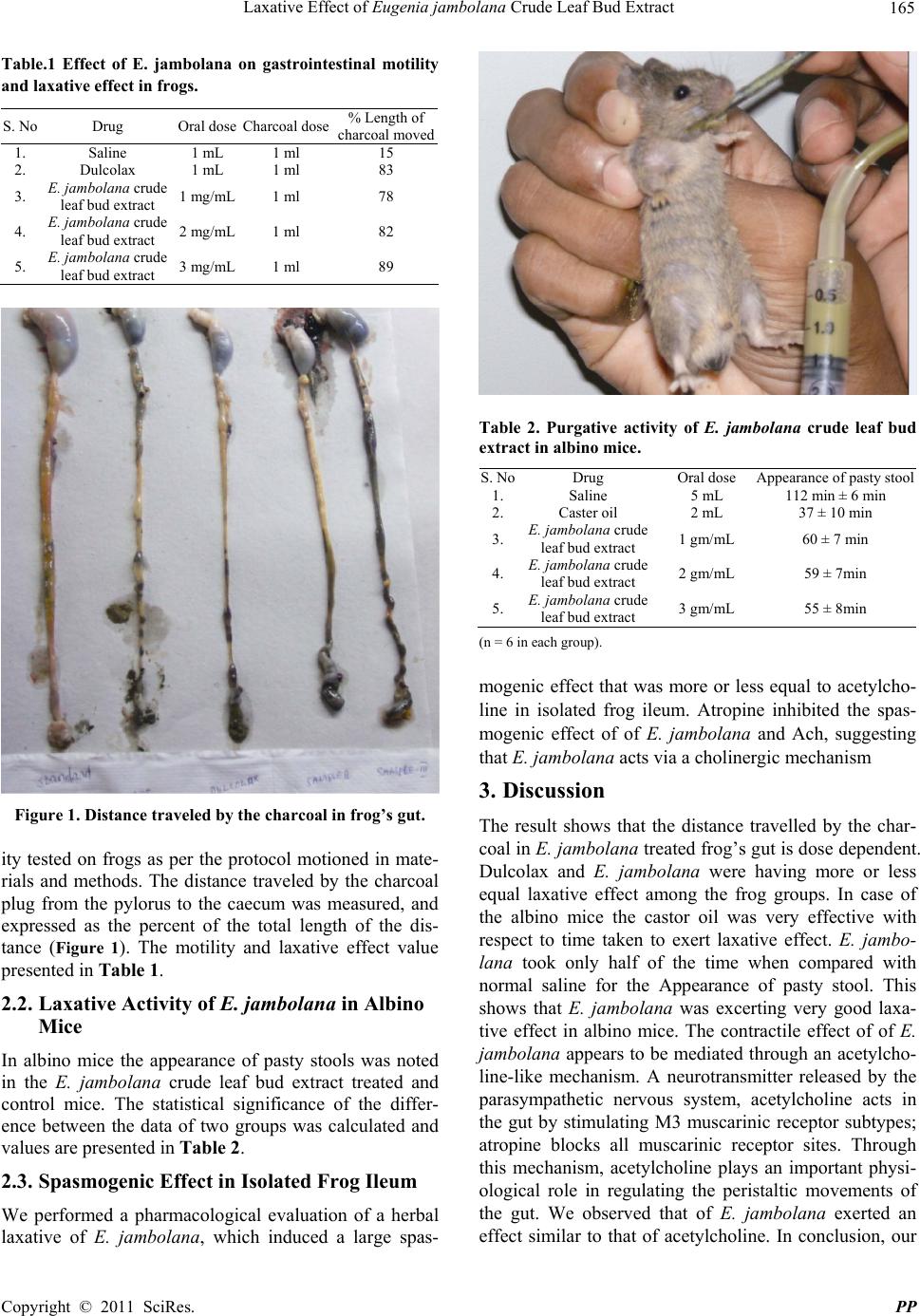 Laxative Effect of Eugenia jambolana Crude Leaf Bud Extract 165 Table.1 Effect of E. jambolana on gastrointestinal motility and laxative effect i n frogs . S. No Drug Oral doseCharcoal dose % Length of charcoal moved 1. Saline 1 mL 1 ml 15 2. Dulcolax 1 mL 1 ml 83 3. E. jambolana crude leaf bud extract 1 mg/mL1 ml 78 4. E. jambolana crude leaf bud extract 2 mg/mL1 ml 82 5. E. jambolana crude leaf bud extract 3 mg/mL1 ml 89 Figure 1. Distance traveled by the charcoal in frog’s gut. ity tested on frogs as per the protocol motioned in mate- rials and methods. The distance traveled by the charcoal plug from the pylorus to the caecum was measured, and expressed as the percent of the total length of the dis- tance (Figure 1). The motility and laxative effect value presented in Table 1. 2.2. Laxative Activity of E. jambolana in Albino Mice In albino mice the appearance of pasty stools was noted in the E. jambolana crude leaf bud extract treated and control mice. The statistical significance of the differ- ence between the data of two groups was calculated and values are presented in Table 2. 2.3. Spasmogenic Effect in Isolated Frog Ileum We performed a pharmacological evaluation of a herbal laxative of E. jambolana, which induced a large spas- Table 2. Purgative activity of E. jambolana crude leaf bud extract in albino mice. S. NoDrug Oral dose Appearance of pasty stool 1.Saline 5 mL 112 min ± 6 min 2.Caster oil 2 mL 37 ± 10 min 3. E. jambolana crude leaf bud extract 1 gm/mL 60 ± 7 min 4. E. jambolana crude leaf bud extract 2 gm/mL 59 ± 7min 5. E. jambolana crude leaf bud extract 3 gm/mL 55 ± 8min (n = 6 in each group). mogenic effect that was more or less equal to acetylcho- line in isolated frog ileum. Atropine inhibited the spas- mogenic effect of of E. jambolana and Ach, suggesting that E. jambolana acts via a cholinergic mechanism 3. Discussion The result shows that the distance travelled by the char- coal in E. jambolana treated frog’s gut is dose dependent. Dulcolax and E. jambolana were having more or less equal laxative effect among the frog groups. In case of the albino mice the castor oil was very effective with respect to time taken to exert laxative effect. E. jambo- lana took only half of the time when compared with normal saline for the Appearance of pasty stool. This shows that E. jambolana was excerting very good laxa- tive effect in albino mice. The contractile effect of of E. jambolana appears to be mediated through an acetylcho- line-like mechanism. A neurotransmitter released by the parasympathetic nervous system, acetylcholine acts in the gut by stimulating M3 muscarinic receptor subtypes; atropine blocks all muscarinic receptor sites. Through this mechanism, acetylcholine plays an important physi- ological role in regulating the peristaltic movements of the gut. We observed that of E. jambolana exerted an effect similar to that of acetylcholine. In conclusion, our Copyright © 2011 SciRes. PP 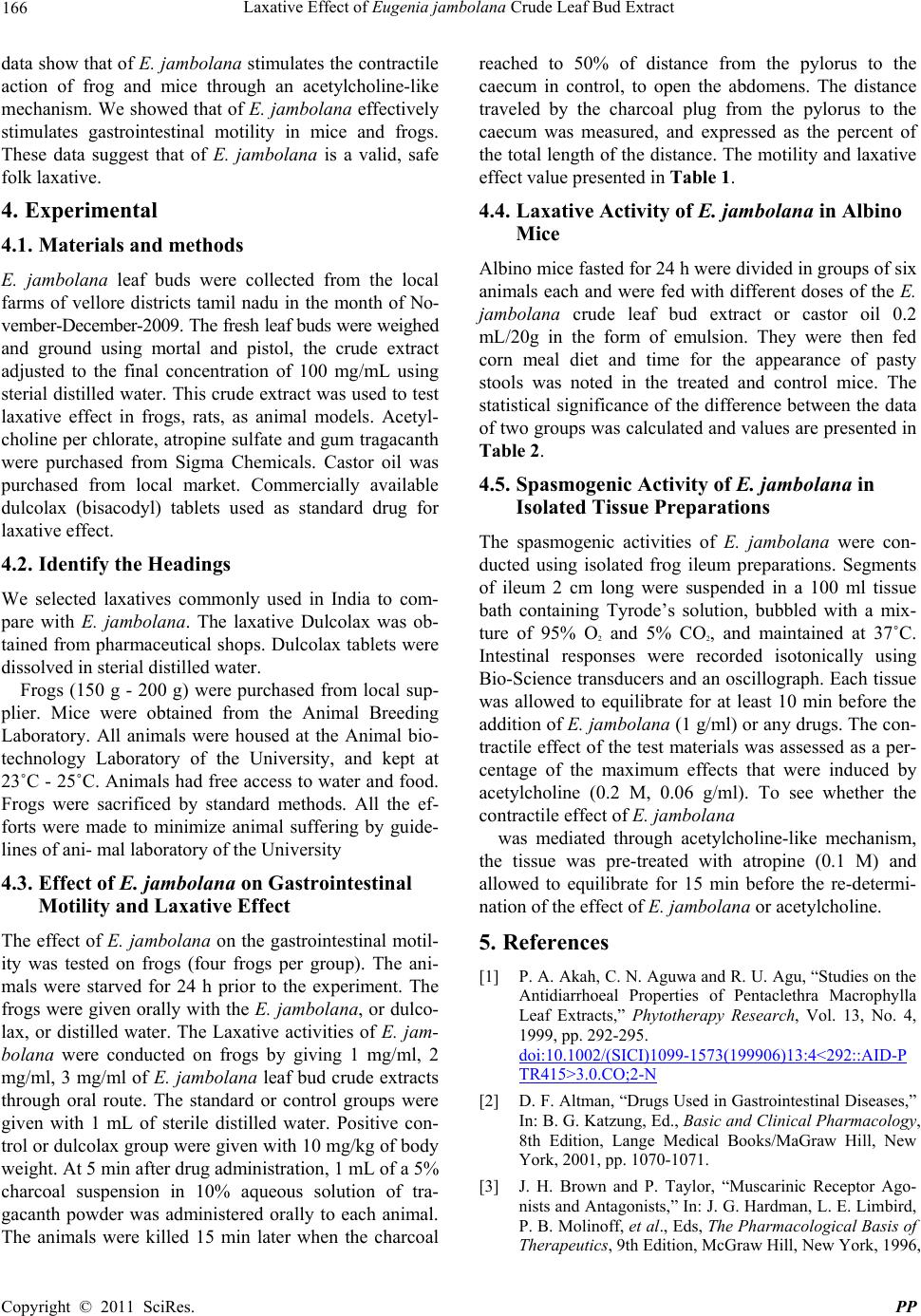 166 Laxative Effect of Eugenia jambolana Crude Leaf Bud Extract data show that of E. jambolana stimulates the contractile action of frog and mice through an acetylcholine-like mechanism. We showed that of E. jambolana effectively stimulates gastrointestinal motility in mice and frogs. These data suggest that of E. jambolana is a valid, safe folk laxative. 4. Experimental 4.1. Materials and methods E. jambolana leaf buds were collected from the local farms of vellore districts tamil nadu in the month of No- vember-December-2009. The fresh leaf buds were weighed and ground using mortal and pistol, the crude extract adjusted to the final concentration of 100 mg/mL using sterial distilled water. This crude extract was u sed to test laxative effect in frogs, rats, as animal models. Acetyl- choline per chlorate, atropine sulfate and gum tragacanth were purchased from Sigma Chemicals. Castor oil was purchased from local market. Commercially available dulcolax (bisacodyl) tablets used as standard drug for laxative effect. 4.2. Identify the Headings We selected laxatives commonly used in India to com- pare with E. jambolana. The laxative Dulcolax was ob- tained from pharmaceutical shops. Dulcolax tablets were dissolved in sterial distilled water. Frogs (150 g - 200 g) were purchased from local sup- plier. Mice were obtained from the Animal Breeding Laboratory. All animals were housed at the Animal bio- technology Laboratory of the University, and kept at 23˚C - 25˚C. Animals had free access to water and food. Frogs were sacrificed by standard methods. All the ef- forts were made to minimize animal suffering by guide- lines of ani- mal laboratory of the University 4.3. Effect of E. jambolana on Gastrointestinal Motility and Laxative Effect The effect of E. jambolana on the gastrointestinal motil- ity was tested on frogs (four frogs per group). The ani- mals were starved for 24 h prior to the experiment. The frogs were given orally with the E. jambolana, or du lco- lax, or distilled water. The Laxative activities of E. jam- bolana were conducted on frogs by giving 1 mg/ml, 2 mg/ml, 3 mg/ml of E. jambolana leaf bud crude extracts through oral route. The standard or control groups were given with 1 mL of sterile distilled water. Positive con- trol or dulco lax group were give n with 10 mg /kg of bod y weight. At 5 min after drug administration, 1 mL of a 5% charcoal suspension in 10% aqueous solution of tra- gacanth powder was administered orally to each animal. The animals were killed 15 min later when the charcoal reached to 50% of distance from the pylorus to the caecum in control, to open the abdomens. The distance traveled by the charcoal plug from the pylorus to the caecum was measured, and expressed as the percent of the total length of the d istance. The motility and laxativ e effect value presented in Table 1. 4.4. Laxative Activity of E. jambolana in Albino Mice Albino mice fasted for 24 h were divided in groups of six animals each and were fed with different doses of the E. jambolana crude leaf bud extract or castor oil 0.2 mL/20g in the form of emulsion. They were then fed corn meal diet and time for the appearance of pasty stools was noted in the treated and control mice. The statistical significance of the difference between the data of two groups was calculated and values are presented in Table 2. 4.5. Spasmogenic Activity of E. jambolana in Isolated Tissue Preparations The spasmogenic activities of E. jambolana were con- ducted using isolated frog ileum preparations. Segments of ileum 2 cm long were suspended in a 100 ml tissue bath containing Tyrode’s solution, bubbled with a mix- ture of 95% O2 and 5% CO2, and maintained at 37˚C. Intestinal responses were recorded isotonically using Bio-Science tran sducers and an oscillograph. Each tissue was allowed to equilibrate for at least 10 min before the addition of E. jambolana (1 g/ml) or an y drugs. Th e con- tractile effect of the test materials was assessed as a per- centage of the maximum effects that were induced by acetylcholine (0.2 M, 0.06 g/ml). To see whether the contractile effect of E. jambolana was mediated through acetylcholine-like mechanism, the tissue was pre-treated with atropine (0.1 M) and allowed to equilibrate for 15 min before the re-determi- nation of the effect of E. jambolana or acetylcholine. 5. References [1] P. A. Akah, C. N. Aguwa and R. U. Agu, “Studies on the Antidiarrhoeal Properties of Pentaclethra Macrophylla Leaf Extracts,” Phytotherapy Research, Vol. 13, No. 4, 1999, pp. 292-295. doi:10.1002/(SICI)1099-1573(199906)13:4<292::AID-P TR415>3.0.CO;2-N [2] D. F. Altman, “Drugs Used in Gastrointestinal Diseases,” In: B. G. Katzung, Ed., Basic and Clinical Pharmacology, 8th Edition, Lange Medical Books/MaGraw Hill, New York, 2001, pp. 1070-1071. [3] J. H. Brown and P. Taylor, “Muscarinic Receptor Ago- nists and Antagonists,” In: J. G. Hardman, L. E. Limbird, P. B. Molinoff, et al., Eds, The Pharmacological Basis of Therapeutics, 9th Edition, McGraw Hill, New York, 1996, C opyright © 2011 SciRes. PP  Laxative Effect of Eugenia jambolana Crude Leaf Bud Extract Copyright © 2011 SciRes. PP 167 pp. 141-159. [4] H. J. Chi and H. S. Kim, “Studies on the Components of Umbelliferae Plants in Korea: Pharmacological Study of Decursin, Decursinol and Nodakenin,” Korean Journal of Pharmacognosy, Vol. 1, 1970, pp. 25-32. [5] L. C. Chiang, W. Chiang, M. Y. Chang and C. C Lin, “In Vitro Cytotoxic, Antiviral and Immunomodulatory Ef- fects of Plantago Major and Plantago Asiatica,” American Journal Chinese Medicine, Vol. 31, No. 2, 2003, pp. 225-234. doi:10.1142/S0192415X03000874 [6] J. E. Everhart, V. L. Go, R. S. Johannes, S. C. Fitzsim- mons, H. P. Roth and L. R. White, “A Longitudinal Sur- vey of Self-Reported Bowel Habits in the United States,” Digestive Diseases and Sciences, Vol. 34, No. 8, 1989, pp. 1153-1162. doi:10.1007/BF01537261 [7] W. G. Le, “Anti-diarrheal and Spasmolytic Activities and Acute Toxicity Study of Soonkijangquebo, a Herbal Anti- Diarrheal Formula,” Journal of Ethno pharmacol, Vol. 91, No. 1, 2004, pp. 75-80. doi:10.1016/j.jep.2003.11.019 [8] L. R. Schiller, “The Therapy of Constipation,” Aliment Pharmacol Therapeutics, Vol . 1 5 , N o. 6 , 2 00 1 , p p. 749-763. doi:10.1046/j.1365-2036.2001.00982.x |