

Paper Menu >>
Journal Menu >>
 Pharmacology & Pharmacy, 2011, 2, 146-150 doi:10.4236/pp.2011.23020 Published Online July 2011 (http://www.scirp.org/journal/pp) Copyright © 2011 SciRes. PP Comparison of the Anthelmintic Efficacy of Three Commercial Products against Ascarids and Capillaria SPP. in Fighting Cocks Froylán Ibarra-Velarde, Cristina Guerrero-Molina, Yolanda Vera-Montenegro, Yazmín Alcalá-Canto, Evangelina Romero-Callejas Departamento de Parasitología, Facultad de Medicina Veterinaria y Zootecnia de la, Universidad Nacional Autónoma de Mexico, Coyoacán, México City, Mexico. Email: [email protected] Received February 9th, 2011; March 20th, 2011; April 20th, 2011. ABSTRACT The aim of the present study was to evalua te the anthelmintic efficacy of three commercial comp ounds against asca rids and Capillaria spp. in naturally infected fighting cocks from Mexico. First experiment—Forty cocks were selected on the basis of eggs per gram (EPG) counts quantified by the McMaster method. On day 0 the birds were divided into four groups of 10 cocks, each subjected to th e treatments. Group 1 received a single oral dose of 1 mg of ivermectin, 25 mg of praziquantel and 40 mg of fenbendazole given in tablets according to body weight (b.w). Group 2 was treated with a single oral dose of 1 mg of ivermectin, 25 mg of praziquantel and 40 mg of fenbendazole given in tablets/b.w. but formulated with a different excipient. Group 3 received a single tablet containing 0.2 mg of abamectin and 30 mg of albendazole. Group 4 served as a non-treated control. Fecal analyses were carried out on days 0 (day of trea tment), 7, 14, 21 and 28, being collected from the floor where the cocks were individually caged. Efficacy was measured on the percentage of egg reduction from day 0 with respect the EPG counts from the control group. In a second experiment the study was similarly performed using another cock-farm located at approximately 300 km away from the first one. Results indicated an overall effica cy of 100%, 94.0% and 100% for groups 1, 2 and 3 in the first experiment and 100%, 100%, 100% for groups 1, 2 and 3 of the 2nd experiment, respectively. It is concluded that all drugs used exerted high efficacy in fighting co cks naturally infected with helminths. Keywords: Anthelmintic Efficacy, Commercial Drugs, Fighting Cocks 1. Introduction In Mexico the cockfight is a popular activity frequently carried out in places for combat called “palenques”. The fights generally take place on holidays, national festivities or week-ends throughout the country. Important to note is the fact that the cockfight is also a growing industry which provides employment and involves thousands of people engaged in the gambling on the outcome of of this festive activity. However, one of the important factors which hampers the aggressive performance of fighting cocks at the time of combat is the decrease of energy commonly caused by different parasitic infections. On the other hand, there is very limited information on the use of drugs that can remove helminths from the cocks. The present study was aimed at the evaluation of the antelmintic efficacy of three commercial compounds against Ascarids and Capi- llaria spp. in fighting cocks from two different farms. 2. Material and Methods 2.1. First Experiment 2.1.1. Location of the Study This study was carried out at the farm “El Colorado”, located in the municipality of Tulancingo, in the state of Hidalgo, Mexico, (central part of Mexico). 2.1.2. Study Ani m al s Forty adult and young fighting cocks with no deworming background of at least 6 months were selected for inclu- sion in the trial. They were chosen on the basis of egg counts per gram (EPG) by using the quantitative Mc- Master method. All animals were individually caged, 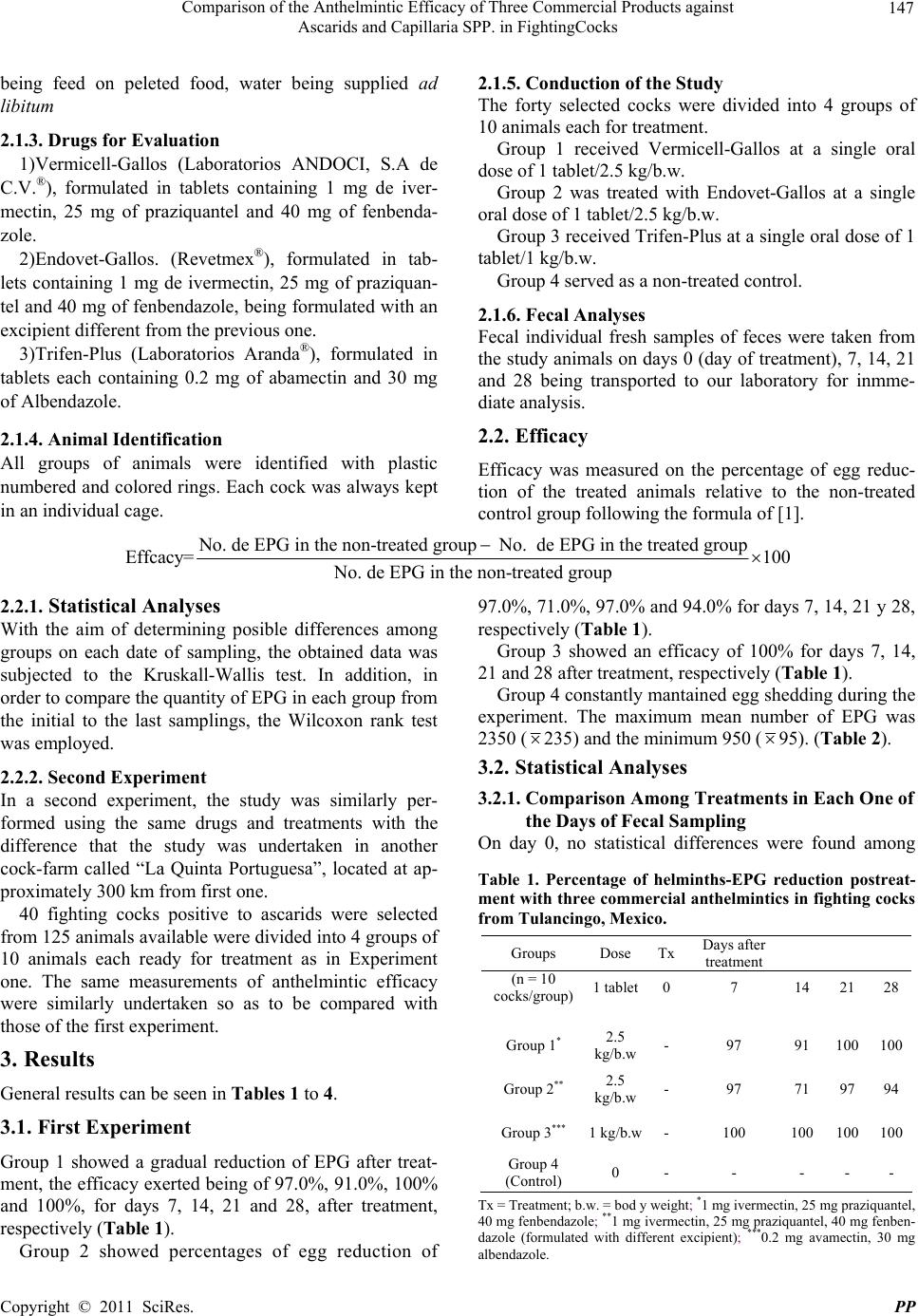 Comparison of the Anthelmintic Efficacy of Three Commercial Products against Ascarids and Capillaria SPP. in FightingCocks 147 being feed on peleted food, water being supplied ad libitum 2.1.3. Drugs f or E v al u ation 1)Vermicell-Gallos (Laboratorios ANDOCI, S.A de C.V.®), formulated in tablets containing 1 mg de iver- mectin, 25 mg of praziquantel and 40 mg of fenbenda- zole. 2)Endovet-Gallos. (Revetmex®), formulated in tab- lets containing 1 mg de ivermectin, 25 mg of praziquan- tel and 40 mg of fenbendazole, being formulated with an excipient different from the previous one. 3)Trifen-Plus (Laboratorios Aranda®), formulated in tablets each containing 0.2 mg of abamectin and 30 mg of Albendazole. 2.1.4. Animal Identification All groups of animals were identified with plastic numbered and colored rings. Each cock was always kept in an individual cage. 2.1.5. Cond uction of the Stu dy The forty selected cocks were divided into 4 groups of 10 animals each for treatment. Group 1 received Vermicell-Gallos at a single oral dose of 1 tablet/ 2.5 kg/b .w. Group 2 was treated with Endovet-Gallos at a single oral dose of 1 tablet/2.5 kg/b.w. Group 3 received Trifen-Plus at a single oral dose of 1 tablet/1 kg/b.w. Group 4 served as a non-treated control. 2.1.6. Fecal A na l yses Fecal individual fresh samples of feces were taken from the study animals on days 0 (day of treatment), 7, 14, 21 and 28 being transported to our laboratory for inmme- diate analysis. 2.2. Efficacy Efficacy was measured on the percentage of egg reduc- tion of the treated animals relative to the non-treated control group following the formula of [1]. No. de EPG in the non-treated group No. de EPG in the treated group Effcacy= 100 No. de EPG in the non-treated group 2.2.1. Statistical Analyses With the aim of determining posible differences among groups on each date of sampling, the obtained data was subjected to the Kruskall-Wallis test. In addition, in order to compare the quantity of EPG in each group from the initial to the last samplings, the Wilcoxon rank test was employed. 2.2.2. Second Experiment In a second experiment, the study was similarly per- formed using the same drugs and treatments with the difference that the study was undertaken in another cock-farm called “La Quinta Portuguesa”, located at ap- proximately 300 km from first one. 40 fighting cocks positive to ascarids were selected from 125 animals available were divided into 4 groups of 10 animals each ready for treatment as in Experiment one. The same measurements of anthelmintic efficacy were similarly undertaken so as to be compared with those of the first experiment. 3. Results General results can be seen in Tables 1 to 4. 3.1. First Experiment Group 1 showed a gradual reduction of EPG after treat- ment, the efficacy exerted being of 97.0%, 91.0%, 100% and 100%, for days 7, 14, 21 and 28, after treatment, respectively (Table 1). Group 2 showed percentages of egg reduction of 97.0%, 71.0%, 97 .0% and 9 4.0% for d ays 7, 14, 21 y 28, respectively (Table 1). Group 3 showed an efficacy of 100% for days 7, 14, 21 and 28 after treatment, respectively (Table 1). Group 4 constantly mantained egg shedding during the experiment. The maximum mean number of EPG was 2350 ( 235) and the minimum 950 (95). (Table 2). 3.2. Statistical Analyses 3.2.1. Comparison Among Treatments in Each One of the Days of Fecal Sampling On day 0, no statistical differences were found among Table 1. Percentage of helminths-EPG reduction postreat- ment with three commercial anthelmintics in fighting cocks from Tulancingo, Mexico. Groups DoseTxDays after treatment (n = 10 cocks/group) 1 tablet0 7 14 21 28 Group 1* 2.5 kg/b.w - 97 91 100100 Group 2** 2.5 kg/b.w - 97 71 97 94 Group 3*** 1 kg/b.w- 100 100 100100 Group 4 (Control) 0 - - - - - Tx = Treatment; b.w. = bod y weight; *1 mg ivermectin, 25 mg praziquantel, 40 mg fenbendazole; **1 mg ivermectin, 25 mg praziquantel, 40 mg fenben- dazole (formulated with different excipient); ***0.2 mg avamectin, 30 mg albendazole. Copyright © 2011 SciRes. PP 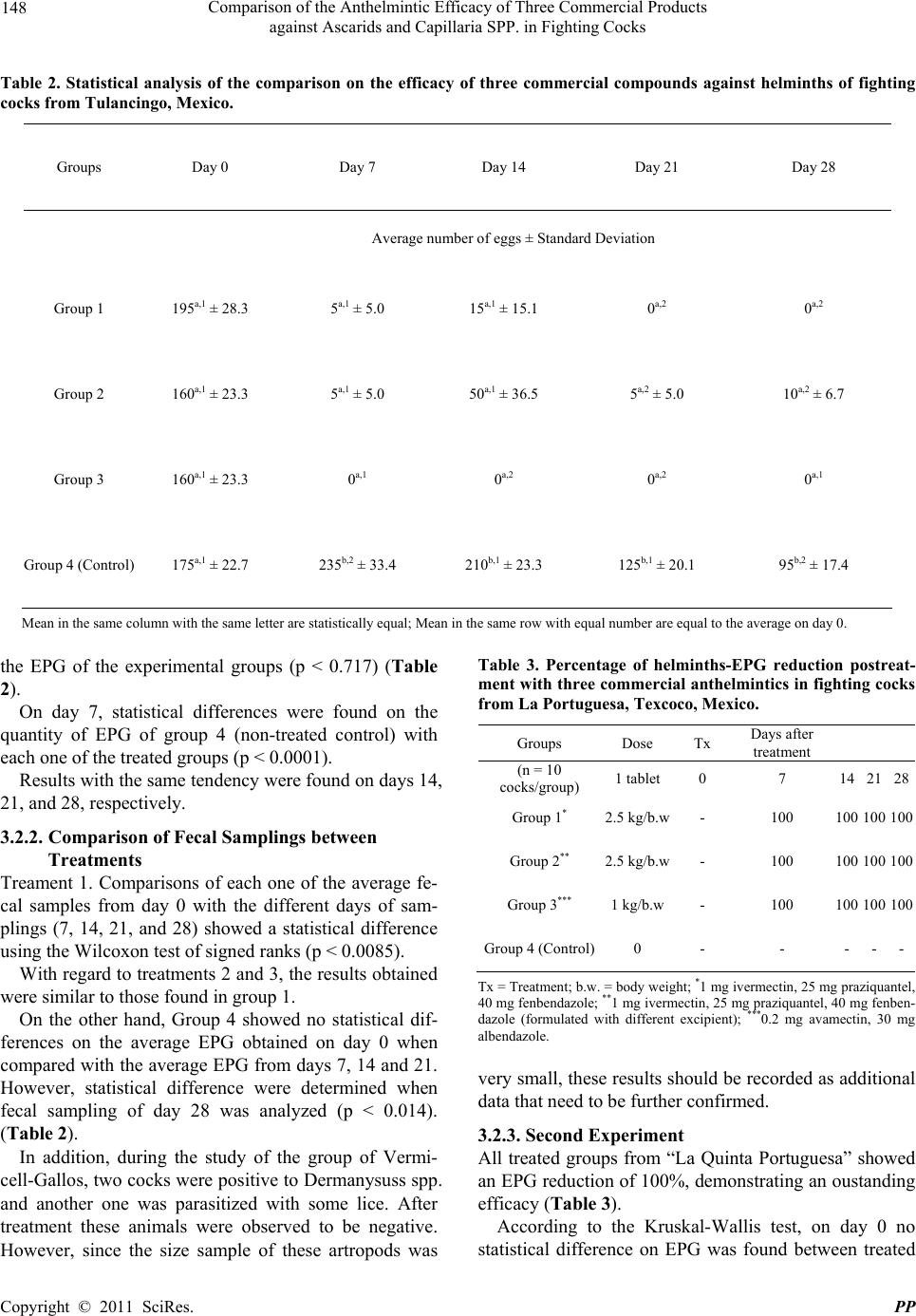 Comparison of the Anthelmintic Efficacy of Three Commercial Products against Ascarids and Capillaria SPP. in Fighting Cocks 148 Table 2. Statistical analysis of the comparison on the efficacy of three commercial compounds against helminths of fighting cocks from Tulancingo, Mexico. Groups Day 0 Day 7 Day 14 Day 21 Day 28 Average number of eggs ± Standard Deviation Group 1 195a,1 ± 28.3 5a,1 ± 5.0 15a,1 ± 15.1 0a,2 0 a,2 Group 2 160a,1 ± 23.3 5a,1 ± 5.0 50a,1 ± 36.5 5a,2 ± 5.0 10a,2 ± 6.7 Group 3 160a,1 ± 23.3 0a,1 0 a,2 0 a,2 0 a,1 Group 4 (Control) 175a,1 ± 22.7 235b,2 ± 33.4 210b,1 ± 23.3 125b,1 ± 20.1 95b,2 ± 17.4 Mean in the same column with the same lette r are statistically equal; Mean in the same row with equal number are equal to the average on day 0. the EPG of the experimental groups (p < 0.717) (Table 2). On day 7, statistical differences were found on the quantity of EPG of group 4 (non-treated control) with each one of the treated groups (p < 0.0001). Results with the same tendency were found on days 14, 21, and 28, re spectively. 3.2.2. Comparison of Fecal Samplings between Treatments Treament 1. Comparisons of each one of the average fe- cal samples from day 0 with the different days of sam- plings (7, 14, 21, and 28) showed a statistical difference using the Wilcoxo n test of si g ned ran ks (p < 0.00 8 5) . With regard to treatments 2 and 3, the results obtained were similar to those found in group 1. On the other hand, Group 4 showed no statistical dif- ferences on the average EPG obtained on day 0 when compared with the average EPG from days 7, 14 and 21. However, statistical difference were determined when fecal sampling of day 28 was analyzed (p < 0.014). (Table 2). In addition, during the study of the group of Vermi- cell-Gallos, two cocks were positive to Derman ysuss spp. and another one was parasitized with some lice. After treatment these animals were observed to be negative. However, since the size sample of these artropods was Table 3. Percentage of helminths-EPG reduction postreat- ment with three commercial anthelmintics in fighting cocks from La Portuguesa, Texcoco, Mexico. Groups Dose Tx Days after treatment (n = 10 cocks/group) 1 tablet0 7 142128 Group 1* 2.5 kg/b.w- 100 100100100 Group 2** 2.5 kg/b.w- 100 100100100 Group 3*** 1 kg/b.w - 100 100100100 Group 4 (Control)0 - - --- Tx = Treatment; b.w. = body weight; *1 mg ivermectin, 25 mg praziquantel, 40 mg fenbendazole; **1 mg ivermectin, 25 mg praziquantel, 40 mg fenben- dazole (formulated with different excipient); ***0.2 mg avamectin, 30 mg albendazole. very small, these results should be recorded as additional data that need to be furt her confirmed. 3.2.3. Second Experiment All treated groups from “La Quinta Portuguesa” showed an EPG reduction of 100%, demonstrating an oustanding efficacy (Table 3). According to the Kruskal-Wallis test, on day 0 no tatistical difference on EPG was found between treated s C opyright © 2011 SciRes. PP 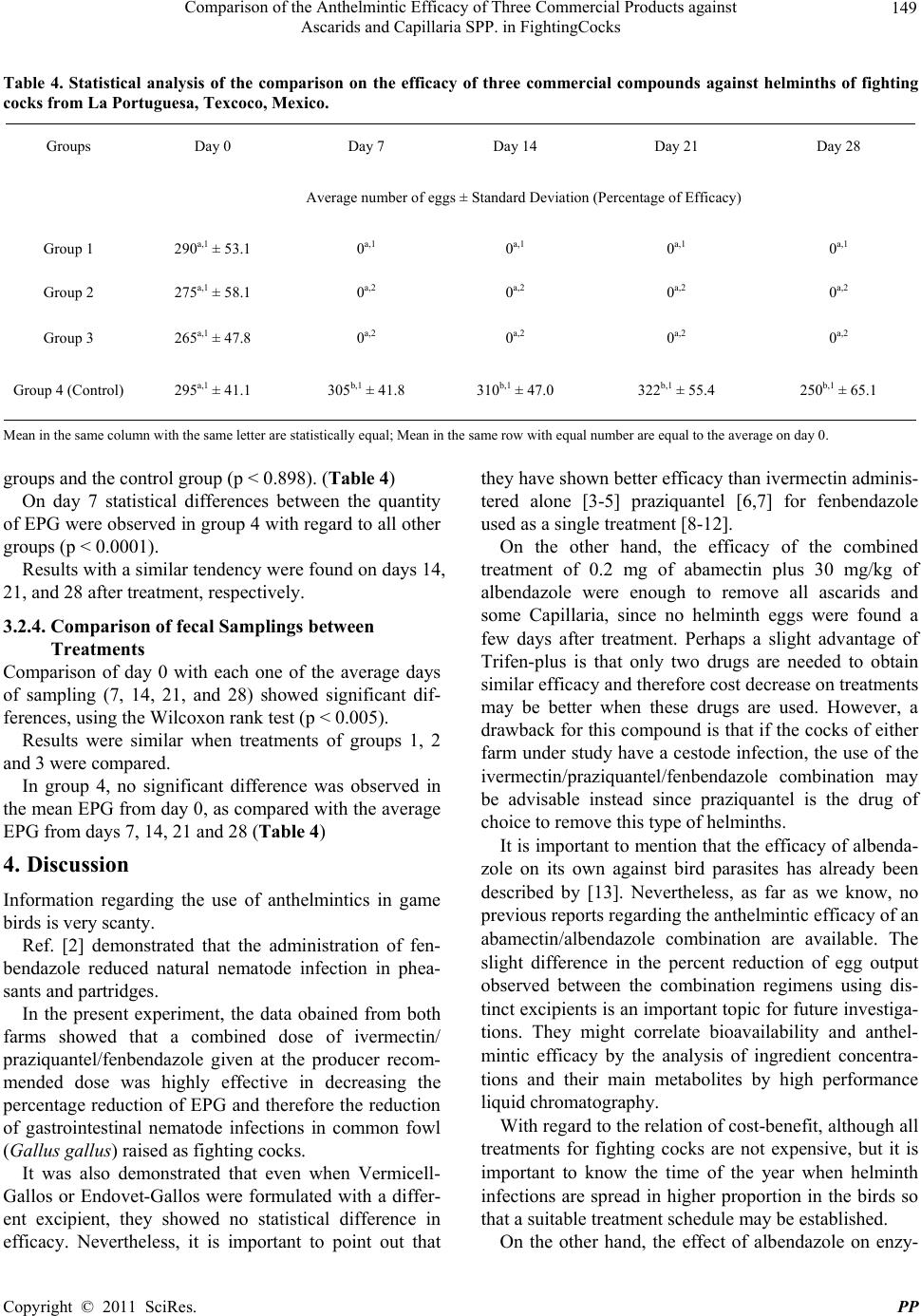 Comparison of the Anthelmintic Efficacy of Three Commercial Products against Ascarids and Capillaria SPP. in FightingCocks 149 Table 4. Statistical analysis of the comparison on the efficacy of three commercial compounds against helminths of fighting cocks from La Portuguesa, Texcoco, Mexico. Groups Day 0 Day 7 Day 14 Day 21 Day 28 Average number of eggs ± Standard Deviation (Percentage of Efficacy) Group 1 290a,1 ± 53.1 0a,1 0 a,1 0 a,1 0 a,1 Group 2 275a,1 ± 58.1 0a,2 0 a,2 0 a,2 0 a,2 Group 3 265a,1 ± 47.8 0a,2 0 a,2 0 a,2 0 a,2 Group 4 (Control) 295a,1 ± 41.1 305b,1 ± 41.8 310b,1 ± 47.0 322b,1 ± 55.4 250b,1 ± 65.1 Mean in the same column with the same letter are statistically equal; Me an in the same row with equal n umber are equal to the average on day 0. groups and the control group (p < 0.898). (Table 4) On day 7 statistical differences between the quantity of EPG were observed in grou p 4 with regard to all other groups (p < 0.00 01). Results with a similar tendency were found on days 14, 21, and 28 after treatment, respectively. 3.2.4. Comparison of fecal Samplings between Treatments Comparison of day 0 with each one of the average days of sampling (7, 14, 21, and 28) showed significant dif- ferences, using the Wilcoxon rank test (p < 0.005). Results were similar when treatments of groups 1, 2 and 3 were compared. In group 4, no significant difference was observed in the mean EPG from day 0, as compared with the average EPG from days 7, 14, 21 and 28 (Table 4) 4. Discussion Information regarding the use of anthelmintics in game birds is very scant y . Ref. [2] demonstrated that the administration of fen- bendazole reduced natural nematode infection in phea- sants and partridges. In the present experiment, the data obained from both farms showed that a combined dose of ivermectin/ praziquantel/fenbendazole given at the producer recom- mended dose was highly effective in decreasing the percentage reduction of EPG and therefore the reduction of gastrointestinal nematode infections in common fowl (Gallus gallus) raised as fighting cocks. It was also demonstrated that even when Vermicell- Gallos or Endovet-Gallos were formulated with a differ- ent excipient, they showed no statistical difference in efficacy. Nevertheless, it is important to point out that they have shown better efficacy than ivermectin adminis- tered alone [3-5] praziquantel [6,7] for fenbendazole used as a single treatment [8-12]. On the other hand, the efficacy of the combined treatment of 0.2 mg of abamectin plus 30 mg/kg of albendazole were enough to remove all ascarids and some Capillaria, since no helminth eggs were found a few days after treatment. Perhaps a slight advantage of Trifen-plus is that only two drugs are needed to obtain similar efficacy and therefore cost decrease on treatments may be better when these drugs are used. However, a drawback for this compound is that if the cocks of either farm under study have a cestode infection, the use of the ivermectin/praziquantel/fenbendazole combination may be advisable instead since praziquantel is the drug of choice to remove this type of helminths. It is important to mention that the efficacy of albenda- zole on its own against bird parasites has already been described by [13]. Nevertheless, as far as we know, no previous reports regarding the anthelmintic efficacy of an abamectin/albendazole combination are available. The slight difference in the percent reduction of egg output observed between the combination regimens using dis- tinct excipients is an important to pic for future investiga- tions. They might correlate bioavailability and anthel- mintic efficacy by the analysis of ingredient concentra- tions and their main metabolites by high performance liquid chromatography. With regard to th e relation of co st-ben efit, although all treatments for fighting cocks are not expensive, but it is important to know the time of the year when helminth infections are spread in higher proportion in the birds so that a suitable treatment schedule may be established. On the other hand, the effect of albendazole on enzy- Copyright © 2011 SciRes. PP  Comparison of the Anthelmintic Efficacy of Three Commercial Products against Ascarids and Capillaria SPP. in Fighting Cocks 150 mes from common species of poultry-infecting nema- todes has been demonstrated [13]; however, as far as we know, combination regimes employing an ivermectin/ praziquantel/fenbendazole formulation with these anthel- mintics in fighting cocks have not as yet been reported. These results have demonstrated that combined dosing of some commercial anthelmintics provides highly pro- mising efficacy against gastrointestinal nematodes on fighting cooks maintaining good health status, which is highly required for better performance in the fighting arena. 5. Conclusions The combined administration of either ivermectin/prazi- quantel/fenbendazole or abamectin/albendazole adminis- tered in tablets at the producer’s recommended dose ex- erted high efficacy against Ascarids and Capillaria spp. in naturally infected fighting cocks 6. Acknowledgements Study financially supported by Laboratorios ANDOCI, S.A. de C.V. 7. References [1] J. Eckert, G. Schneiter, K. Wolf, “Fasinex (Triclabenda- zole)—A New Fasciolicide,” Berl Munch Tierarztl Wo- chenschr, Vol. 91, 1984, pp. 349-326. [2] R. Kirsch, “Treatment of Nematodiasis in Poultry and Game Birds with Fenbendazole,” Avian Diseases, Vol. 28, No. 2, 1984, pp. 311-318. doi:10.2307/1590337 [3] A. Oksanen, S. Nikander, “Ivermectin as a Bird Anthel- mintictrials with Naturally Infected Domestic Fowl,” Zentralbl Veterinarmed Reihe B, Vol. 36, No. 7, 1989, pp. 495-499. [4] R. W. Miller, “Use of Ivermectin to Control the Lesser Mealworm (Coleoptera: Tenebrionidae) in a Simulated Poultry Broiler House,” Poultry Science, Vol. 69, Vol. 8, 1990, pp. 1281-1284. [5] R. L. Sharma, T. K. Bhat, “Short communication Anthel- mintic Activity of Ivermectin against Experimental As- caridia galli Infection in Chickens,” Veterinary Parasi- tology, Vol. 37, No. 3-4, 1990, pp. 307-314. doi:10.1016/0304-4017(90)90014-3 [6] M. Rajendran, A. M. Nadakal, “The Efficacy of Prazi- quantel (Droncit R) against Raillietina tetragona (Molin, 1958) in Domestic Fowl,” Veterinary Parasitology, Vol. 26 No. 3-4, 1988, pp. 253-260. doi:10.1016/0304-4017(88)90093-3 [7] I. E. Nurelhuda, E. E. Elowni, T. Hassan, “Anthelmintic Activity of Praziquantel on Raillietina tetragona in Chickens,” Parasitology Research, Vol. 75, No. 8, 1989, pp. 655-656. doi:10.1007/BF00930965 [8] G. S. Senyonga, “Efficacy of Fenbendazole against Hel- Minth Parasites of Poultry in Uganda,” Tropical Animal Health and Production, Vol. 14, Vol. 3, 1982, pp . 163-166. doi:10.1007/BF02242148 [9] T. A. Yazwinski, P. Andrews, H. Holtzen, B. Presson, N. Wood, Z. Johnson, “Dose-titration of Fenbendazole in the Treatment of Poultry Nematodiasis,” Avian Diseases, Vol. 30, No. 4, 1986, pp. 716-718. doi:10.2307/1590574 [10] S. M. Taylor, J. Kenny, A. Houston, S. A. Hewitt, “Effi- cacy, Pharmacokinetics and Effects on Egg-Laying and Hatchability of Two dose Rates of In-Feed Fenbendazole for the Treatment of Capillaria Species Infections in Chickens,” Veterinary Record, Vol. 133, No. 21, 1993, pp. 519-521. doi:10.1136/vr.133.21.519 [11] J. E. Sander, R. D. Schwartz, “Evaluation of Three Wa- ter-Suspensible Formulations of Fenbendazole against Ascaridia galli Infection in Broiler Chickens,” Avian Diseases, Vol. 38, No. 2, 1994, pp. 350-353. doi:10.2307/1591961 [12] L. M. Pote, C. E. Couvillion, R. W. Keirs, R. D. Schwartz, R. F. Taylor, J. H. Hackathorn, L. K. Johnson, “Dose Ti- tration to Confirm the Level of Fenbendazole for Control of Raillietina cesticillus in Broiler Chickens,” Avian Diseases, Vol. 36, No. 3, 1992, pp. 722-724. doi:10.2307/1591772 [13] R. K. Sharma, K. Singh, K. K. Saxena, “The Effect of Le- Vamisole and Albendazole on Some Enzymes of Ascaridia galli and Heterakis gallinae,” Veterinary Parasitology, Vol. 30, No. 3, 1989, pp. 213-222. doi:10.1016/0304-4017(89)90017-4 C opyright © 2011 SciRes. PP |