

Paper Menu >>
Journal Menu >>
 Modern Economy, 2011, 2, 340-343 doi:10.4236/me.2011.23037 Published Online July 2011 (http://www.SciRP.org/journal/me) Copyright © 2011 SciRes. ME A Note on Wage Inequality, Technology, and Trade Chu-Ping Lo Department of Agricultural Economics, National Ta iwan University, Chinese Taibei E-mail: [email protected] Received February 24, 2011; revised April 5, 2011; accepted April 25, 2011 Abstract Zeira (2007) presents a two-country model of endogenous technology and trade, illustrating that trade liber- alization reduces wage inequality in developing countries. The result contrasts the current outsourcing trade literature; the conflict is due to the critical assumption made in his model that “the most rewarding technolo- gies are invested first.” If we relax this assumption, or allow the technology frontier to foster labor gains in all existing industries, then Zeira’s model is, in fact, consistent with the current outsourcing trade literature. Keywords: Wage Inequality, International Outsourcing Trade 1. Introduction In a two-country model, Zeira (2007) shows that trade liberalization reduces wage inequality in a developing country bur increases wage inequality in a developed country. The technological progress that occurs in the developed country generates a skill-biased technology change in the developed country, but no impact on the labor market in the developing country. The trade liber- alization mentioned in Zeira’s model can be referred to as international outsourcing trade, because an increase in trade liberalization leads to greater trade in intermediate goods in his model. However, in the literature on inter- national outsourcing trade1, an increase in international outsourcing trade or technology development leads to a widening wage inequality not only in the developed countries but also in the less deve loped countries. I argue that this conflict between Zeira’s (2007) model and the current outsourcing trade literature in terms of the labor market in the less developed countries, may be derived from the critical assumption in Zeira’s (2007) model: “the most rewarding technologies are invested first” and that the technology frontier is irrelevant to the developing country. If we allow “the most rewarding technologies are inv ested lately” or allow the technolog y frontier to foster labor gains in all existing industries, then the wage inequality o f the less developed country is likely to increase with trade ex pansion. The next section provides an introduction to Zeira’s (2007) model. However, I redefin e the relative labor gain in his model and reach a new equilibrium in Section 3. The final section concludes. 2. The Zeira Model Zeira (2007) assumes that there is one final good pro- duced for consumption that is not tradable. This final good is produced by a continuum of tradable intermedi- ate goods. The tradable intermediate goods are produ ced using two alternative technologies: either unskilled labor or skilled labor. No intermediate good is prod uced with a combination of skilled and unskilled labor. The devel- oped and less developed countries trade the intermediate goods with each other based on their comparative ad- vantages. More specifically, the set of traded intermediate goods is t M , which is distributed uniformly over t M , meas- ured for trade openness as t tM. Technology adoption, human capital acquisition, and trade patterns are determined endogenously. The production of one unit of intermediate good using skilled technologies re- quires dmi i s ia units of skilled labor in the developed country and () s i in the less developed country. Zeira (2007) also specifies a variable f to represent the technology frontier, which measures the level of technological progress available to a range of intermedi- ate goods 0, f . He assumes that the populations of the developed and less developed countries are given exo- genously by and A L B L, respectively. The developed 1See Feenstra and Hanson (196), Antràs et al. (2006), and Ethier (2005) for theoretical analysis, and Epifani and Gancia (2008), Attanasio et al. (2004), Beyer et al. (1999), and Feenstra and Hanson (1997) for em- p irical analysis. All of these studies found that openness exacerbates the wage inequality between skilled and unskilled labor in less developed countries. 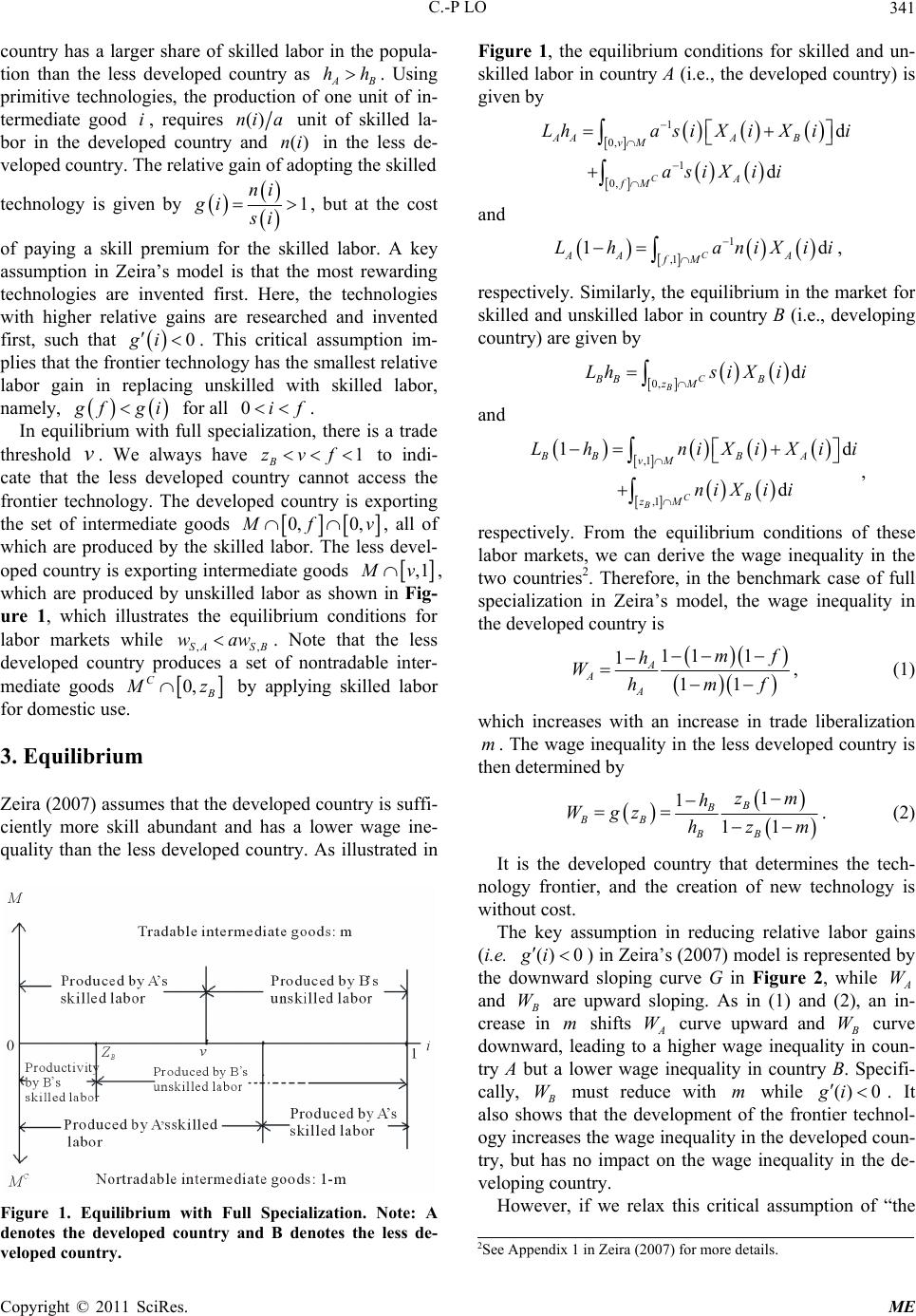 C.-P LO341 country has a larger share of skilled labor in the popula- tion than the less developed country as AB . Using primitive technologies, the production of one unit of in- termediate good , requires hh i()ni a unit of skilled la- bor in the developed country and in the less de- veloped country. The relative ga in of adopting the skilled ()ni technology is given by 1 ni gi si , but at the cost of paying a skill premium for the skilled labor. A key assumption in Zeira’s model is that the most rewarding technologies are invented first. Here, the technologies with higher relative gains are researched and invented first, such that . This critical assumption im- plies that the frontier technology has the smallest relative labor gain in replacing unskilled with skilled labor, namely, 0 gi g fgi for all 0. if zv In equilibrium with full specialization, there is a trade threshold . We always have B to indi- cate that the less developed country cannot access the frontier technology. The developed country is exporting the set of intermediate goods v1f 0, 0, M fv, all of which are produced by the skilled labor. The less devel- oped country is expor ting intermediate goods ,1 M v, which are produced by unskilled labor as shown in Fig- ure 1, which illustrates the equilibrium conditions for labor markets while ,,SA SB wa. Note that the less developed country produces a set of nontradable inter- mediate goods w 0, C B M z by applying skilled labor for domest i c use. 3. Equilibrium Zeira (2007) assumes that the developed country is suffi- ciently more skill abundant and has a lower wage ine- quality than the less developed country. As illustrated in Figure 1. Equilibrium with Full Specialization. Note: A denotes the developed country and B denotes the less de- veloped country. Figure 1, the equilibrium conditions for skilled and un- skilled labor in country A (i.e., the developed country) is given by 1 0, 1 0, d d C AAA B vM A fM Lha siXiXii asiXi i and 1 ,1 1d C AA A fM Lh aniXi i , respectively. Similarly, the equilibrium in the market for skilled and unskilled labor in country B (i.e., developing country) are g iven by 0, d C B BB B zM Lhsi Xii and ,1 ,1 1d d C B BBB A vM B zM LhniXi Xii niXi i , respectively. From the equilibrium conditions of these labor markets, we can derive the wage inequality in the two countries2. Therefore, in the benchmark case of full specialization in Zeira’s model, the wage inequality in the developed country is 11 1 1 11 A AA mf h Whmf , (1) which increases with an increase in trade liberalization . The wage inequality in the less developed country is then determined by m 1 1 11 B B BBBB zm h Wgz hzm . (2) It is the developed country that determines the tech- nology frontier, and the creation of new technology is without cost. The key assumption in reducing relative labor gains (i.e. () 0gi ) in Zeira’s (2 007) model is represented by the downward sloping curve G in Figure 2, while A and W B Wm are upward sloping. As in (1) and (2), an in- crease in shifts A W curve upward and B W curve downward, leading to a higher wage inequality in coun- try A but a lower wage inequality in country B. Specifi- cally, B W must reduce with while m()gi0 . It also shows that the development of the frontier technol- ogy increases the wage inequality in the developed coun- try, but has no impact on the wage inequality in the de- veloping country. However, if we relax this critical assumption of “the 2See Appendix 1 in Zeira (2007) for more details. Copyright © 2011 SciRes. ME 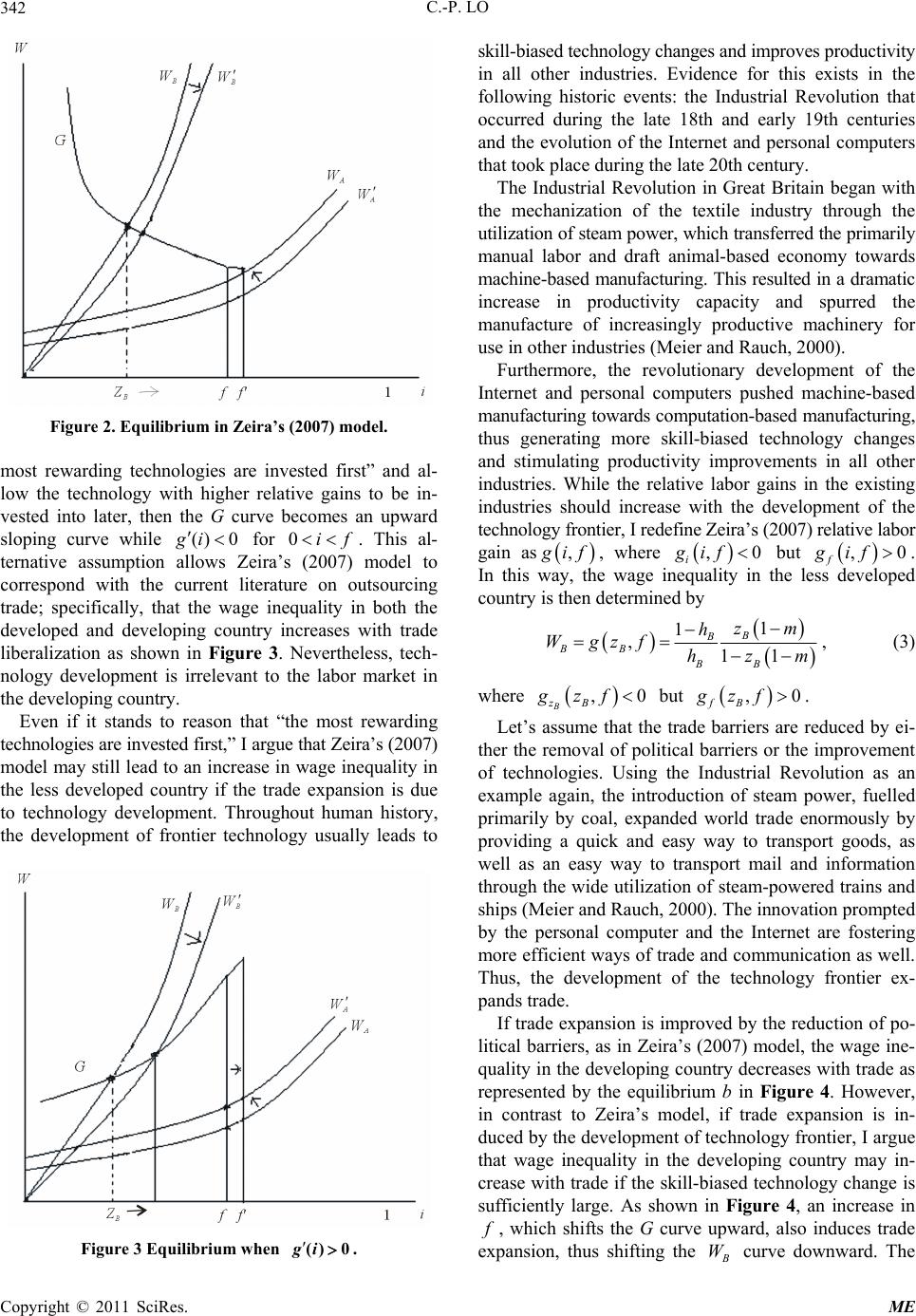 C.-P. LO 342 Figure 2. Equilibrium in Zeira’s (2007) model. most rewarding technologies are invested first” and al- low the technology with higher relative gains to be in- vested into later, then the G curve becomes an upward sloping curve while for . This al- ternative assumption allows Zeira’s (2007) model to correspond with the current literature on outsourcing trade; specifically, that the wage inequality in both the developed and developing country increases with trade liberalization as shown in Figure 3. Nevertheless, tech- nology development is irrelevant to the labor market in the developing country. () 0gi 0if E ven if it stands to reason that “the most rewarding technologies are invested first,” I argue that Zeira’s (2007) model may still lead to an increase in wage inequality in the less developed country if the trade expansion is due to technology development. Throughout human history, the development of frontier technology usually leads to Figure 3 Equilibrium when skill-biase proves productivity began with th of the In ()0gi. d technology changes and im in all other industries. Evidence for this exists in the following historic events: the Industrial Revolution that occurred during the late 18th and early 19th centuries and the evolution of the Internet and personal computers that took place during the late 20th century. The Industrial Revolution in Great Britain e mechanization of the textile industry through the utilization of steam power, which transferred the primarily manual labor and draft animal-based economy towards machine-based manufacturing. This resulted in a dramatic increase in productivity capacity and spurred the manufacture of increasingly productive machinery for use in other industries (Meier and Rauch, 2000). Furthermore, the revolutionary development ternet and personal computers pushed machine-based manufacturing towards computation-based manufacturing, thus generating more skill-biased technology changes and stimulating productivity improvements in all other industries. While the relative labor gains in the existing industries should increase with the development of the technology frontier, I redefine Zeira’s (2007) relative labor gain as , g if , where ,0 i gif but ,0 f gif. In this way, te wage inthe le country is then determined by h equality in ss developed 1 1B h ,11 B BB BB zm Wgzf hzm , (3) where ,0 B zB gzf but . assume that te barriers are ced by ei- th nsion is improved by the reduction of po- lit ,0 fB gzf Let’s he tradredu er the removal of political barriers or the improvement of technologies. Using the Industrial Revolution as an example again, the introduction of steam power, fuelled primarily by coal, expanded world trade enormously by providing a quick and easy way to transport goods, as well as an easy way to transport mail and information through the wide utilization of steam-powered trains and ships (Meier and Rauch, 2000). The innovation prompted by the personal computer and the Internet are fostering more efficient ways of trade and communication as well. Thus, the development of the technology frontier ex- pands trade. If trade expa ical barriers, as in Zeira’s (2007) model, the wage ine- quality in the developing country decreases with trade as represented by the equilibrium b in Figure 4. However, in contrast to Zeira’s model, if trade expansion is in- duced by the development of technology frontier, I argue that wage inequality in the developing country may in- crease with trade if the skill-biased technology change is sufficiently large. As shown in Figure 4, an increase in f , which shifts the G curve upward, also induces trade expansion, thus shifting the B W curve downward. The Copyright © 2011 SciRes. ME 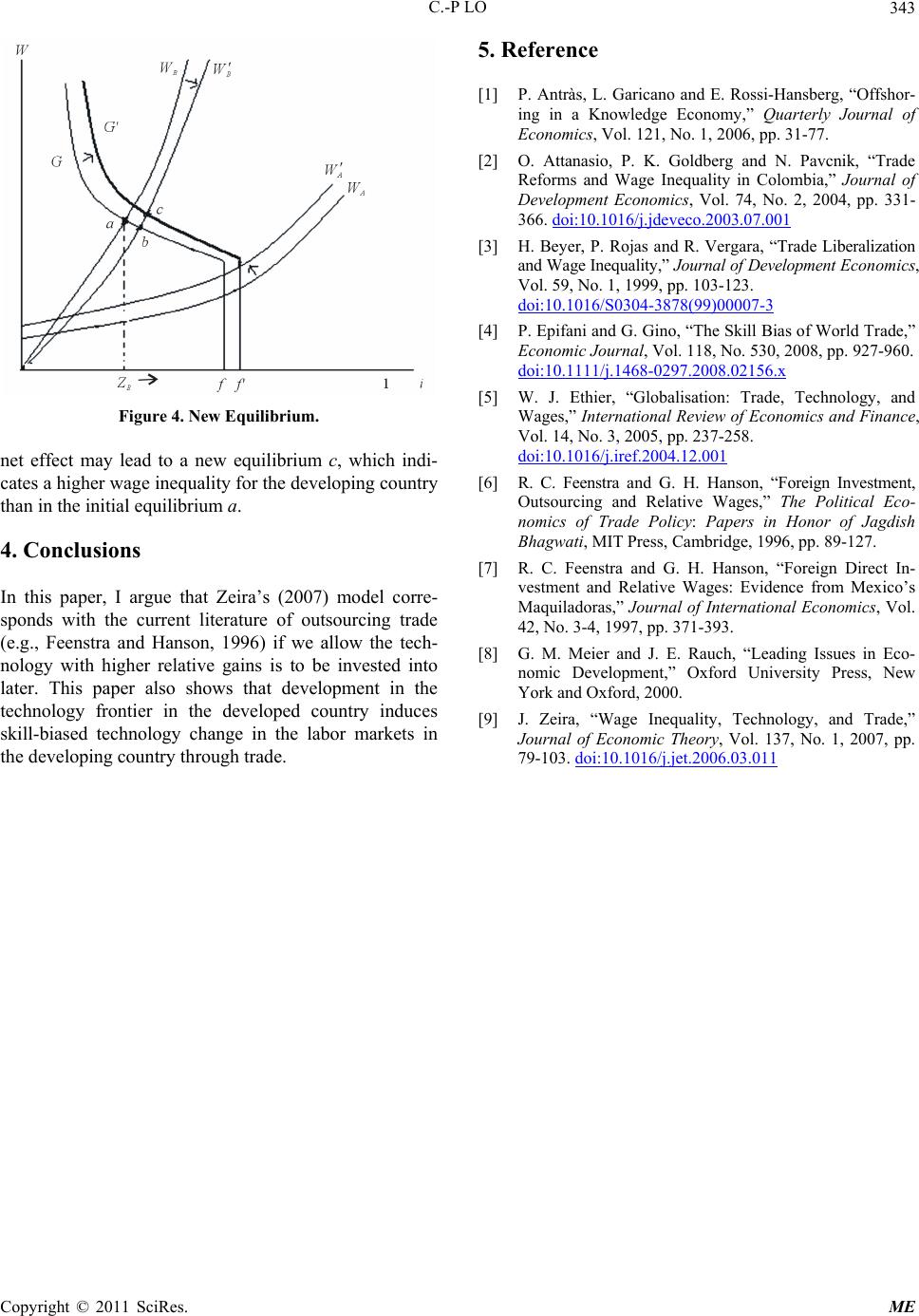 C.-P LO Copyright © 2011 SciRes. ME 343 5. Reference [1] P. Antràs, L. Garicano and E. Rossi-Hansberg, “Offshor- ing in a Knowledge Economy,” Quarterly Journal of Economics, Vol. 121, No. 1, 2006, pp. 31-77. [2] O. Attanasio, P. K. Goldberg and N. Pavcnik, “Trade Reforms and Wage Inequality in Colombia,” Journal of Development Economics, Vol. 74, No. 2, 2004, pp. 331- 366. doi:10.1016/j.jdeveco.2003.07.001 [3] H. Beyer, P. Rojas and R. Vergara, “Trade Liberalization and Wage Inequality ,” Journal of Development E conomics, Vol. 59, No. 1, 1999, pp. 103-123. doi:10.1016/S0304-3878(99)00007-3 [4] P. Epifani and G. Gino, “The Skill Bias of World Trade,” Economic Journal, Vol. 118, No. 530, 2008, pp. 927-960. doi:10.1111/j.1468-0297.2008.02156.x [5] W. J. Ethier, “Globalisation: Trade, Technology, and Wages,” International Review of Economics and Finance, Vol. 14, No. 3, 2005, pp. 237-258. doi:10.1016/j.iref.2004.12.001 Figure 4. New Equilibrium. net effect may, which indi- ates a higher wage inequality for the developing country ue that Zeira’s (2007) model corre- sponds with the current literature of outsourcing trade lead to a new equilibrium c c [6] R. C. Feenstra and G. H. Hanson, “Foreign Investment, Outsourcing and Relative Wages,” The Political Eco- nomics of Trade Policy: Papers in Honor of Jagdish Bhagwati, MIT P ress, Cam bridg e, 1996, pp. 89-127. than in the initial equilibrium a. 4. Conclusions [7] R. C. Feenstra and G. H. Hanson, “Foreign Direct In- vestment and Relative Wages: Evidence from Mexico’s Maquiladoras,” Journal of International Economics, Vol. 42, No. 3-4, 1997, pp. 371-393. In this paper, I arg (e.g., Feenstra and Hanson, 1996) if we allow the tech- nology with higher relative gains is to be invested into later. This paper also shows that development in the technology frontier in the developed country induces skill-biased technology change in the labor markets in the developing country through trade. [8] G. M. Meier and J. E. Rauch, “Leading Issues in Eco- nomic Development,” Oxford University Press, New York and Oxford, 2000. [9] J. Zeira, “Wage Inequality, Technology, and Trade,” Journal of Economic Theory, Vol. 137, No. 1, 2007, pp. 79-103. doi:10.1016/j.jet.2006.03.011 |