

Paper Menu >>
Journal Menu >>
 Vol.3, No.7, 566-572 (2011) Natural Science http://dx.doi.org/10.4236/ns.2011.37079 Copyright © 2011 SciRes. OPEN ACCESS A new approach for reduction of methylene green with ascorbic acid by de-oxygenation through carbon dioxide Rafia Azmat1*, Noshab Qamar2, Raheela Naz2 1Department of Chemistry, University of Karachi, Karachi, Pakistan; *Corresponding Author: [email protected] 2Department of Chemistry, Jinnah University for Women, Nazimabad Karachi, Pakistan. Received 11 March 2011; revised 18 April 2011; accepted 25 April 2011. ABSTRACT Reduction kinetics of the methylene green (MG) with ascorbic acid (AA) in acidic medium at max 660 nm was monitored through visible spectro- photomtry in absence and presence of sodium carbonate. CO2 release through reaction of so- dium carbonate and oxalic acid, created de- oxygenated atmosphere for reduction of dye which greatly boosted the reaction rate. Initially slow reaction in presence of atmospheric oxy- gen proceeded rapidly when sodium carbonate was added. The reaction followed fractional or- der kinetics with AA and zero order kinetics with MG. The rate of reaction shows no linear de- pendence on [H+] concentration as an acidic medium. The rate of reaction is directly related with the elevated concentration of salt, which suggests that the two same charged species are involved in the rate determining step. Secondary reactions at elevated temperature showed com- plex kinetics. Keyw ords: Ascorbic Acid; Methylene Green; Sodium Carbonate; Charged Species; Secondary Reactions; Elevated Temperature 1. INTRODUCTION Ascorbic acid (AA),a form of Vitamin C and water soluble which comes primarily from fruit and vegetables is an important micronutrient and plays many physio- logical roles. It occurs as l-ascorbic acid (AA) and its oxidized form, dehydro-l-ascorbic acid (DHAA), both of which are biologically active. The formula of which is C6H8O6, behaves as a vinylogous carboxylic acid, where in the double bond (“vinyl”) transmits, electron pairs between the hydroxyl and the carbonyl [1-2]. Cooper et al. [3] reported the photo electrochemical analysis of ascorbic acid in aqueous solution at a plati- num channel electrode, using the dissolved phenothiaz- ine dyes methylene blue and methylene green. This is achieved by measuring the current produced by immedi- ate electro-oxidation of the reduced form of the dyes produced during the 1:1 photoreaction between the dyes and ascorbic acid induced by visible light of a wave- length of 620 - 625 nm. Strizhak [4] propose a kinetic scheme for reduction of methylene blue by ascorbic acid, characterized by the existence of two pathways: outer- sphere reduction of methylene blue according to a sec- ond-order reaction, and reduction through formation of a 1:1 complex with ascorbic acid. Strizhak [5] reported the reduction of methylene blue by ascorbic acid in the presence of copper (II) ions. The introduction of copper (II) ions increases the reaction rate, owing to the in- creased concentration of ascorbic acid radicals in the solution. It is shown that the inhibition of the reaction that is observed with low concentrations of copper (II) is a result of redox reactions proceeding in the system, in- volving oxygen dissolved in the water. Yusuf and Giirel [6] used methylene blue (MB), incorporated into tita- nium phosphate for determination of AA and showed that reaction can be helpful in some pharmaceutical products and are for the detection of AA as the procedure involving the reaction between triiodide and AA. AA has been determined by photo bleaching of methylene blue using continuous and FI systems, both procedures de- termination of AA based on its photooxidation sensitized by Toluidine Blue [7,8]. Cooper et al., [9] discussed the photoelectrochemical analysis of AA and decolorizing efficiency of AA to different synthetic dyes using Co/ H2O2 system [10]. Detail literature search showed that few reports were available on the reduction of methlyene green with or- ganic reductants but no reports were available on reduc- tion of MG and AA in presence and absence of sodium carbonate in acidic medium. This procedure is shown to be a good alternative to routine vitamin C analysis in pharmaceutical preparations, fruit juices and soft drinks. 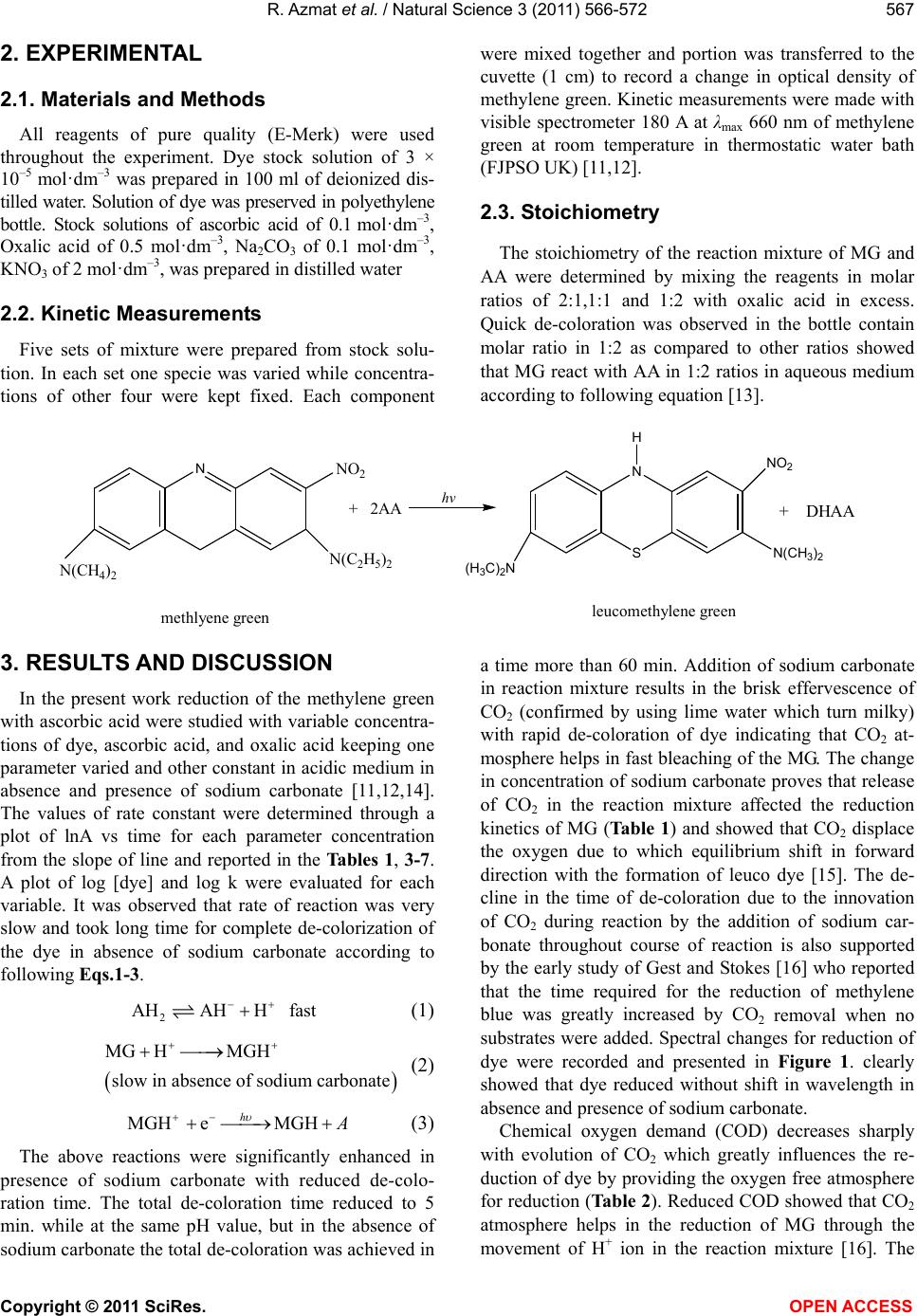 R. Azmat et al. / Natural Science 3 (2011) 566-572 Copyright © 2011 SciRes. OPEN ACCESS 567 2. EXPERIMENTAL 2.1. Materials and Methods All reagents of pure quality (E-Merk) were used throughout the experiment. Dye stock solution of 3 × 10⁻⁵ mol·dm–3 was prepared in 100 ml of deionized dis- tilled water. Solution of dye was preserved in polyethylene bottle. Stock solutions of ascorbic acid of 0.1 mol ·dm–3, Oxalic acid of 0.5 mol·dm–3, Na2CO3 of 0.1 mol·dm–3, KNO3 of 2 mol·dm–3, was prepared in distilled water 2.2. Kinetic Measurements Five sets of mixture were prepared from stock solu- tion. In each set one specie was varied while concentra- tions of other four were kept fixed. Each component were mixed together and portion was transferred to the cuvette (1 cm) to record a change in optical density of methylene green. Kinetic measurements were made with visible spectrometer 180 A at λmax 660 nm of methylene green at room temperature in thermostatic water bath (FJPSO UK) [11,12]. 2.3. Stoichiometry The stoichiometry of the reaction mixture of MG and AA were determined by mixing the reagents in molar ratios of 2:1,1:1 and 1:2 with oxalic acid in excess. Quick de-coloration was observed in the bottle contain molar ratio in 1:2 as compared to other ratios showed that MG react with AA in 1:2 ratios in aqueous medium according to following equation [13]. N N(C2H5)2 NO2 N(CH4)2 S NNO2 N(CH3)2 H (H3C)2N + 2AA+ DHAA hv methlyene greenleucomethylene green 3. RESULTS AND DISCUSSION In the present work reduction of the methylene green with ascorbic acid were studied with variable concentra- tions of dye, ascorbic acid, and oxalic acid keeping one parameter varied and other constant in acidic medium in absence and presence of sodium carbonate [11,12,14]. The values of rate constant were determined through a plot of lnA vs time for each parameter concentration from the slope of line and reported in the Tables 1, 3-7. A plot of log [dye] and log k were evaluated for each variable. It was observed that rate of reaction was very slow and took long time for complete de-colorization of the dye in absence of sodium carbonate according to following Eqs.1-3. 2 AHAHH fast (1) MG HMGH slow in absence of sodium carbonate (2) MGH eMGH h A (3) The above reactions were significantly enhanced in presence of sodium carbonate with reduced de-colo- ration time. The total de-coloration time reduced to 5 min. while at the same pH value, but in the absence of sodium carbonate the total de-coloration was achieved in a time more than 60 min. Addition of sodium carbonate in reaction mixture results in the brisk effervescence of CO2 (confirmed by using lime water which turn milky) with rapid de-coloration of dye indicating that CO2 at- mosphere helps in fast bleaching of the MG. The change in concentration of sodium carbonate proves that release of CO2 in the reaction mixture affected the reduction kinetics of MG (Table 1) and showed that CO2 displace the oxygen due to which equilibrium shift in forward direction with the formation of leuco dye [15]. The de- cline in the time of de-coloration due to the innovation of CO2 during reaction by the addition of sodium car- bonate throughout course of reaction is also supported by the early study of Gest and Stokes [16] who reported that the time required for the reduction of methylene blue was greatly increased by CO2 removal when no substrates were added. Spectral changes for reduction of dye were recorded and presented in Figure 1. clearly showed that dye reduced without shift in wavelength in absence and presence of sodium carbonate. Chemical oxygen demand (COD) decreases sharply with evolution of CO2 which greatly influences the re- duction of dye by providing the oxygen free atmosphere for reduction (Table 2). Reduced COD showed that CO2 atmosphere helps in the reduction of MG through the movement of H+ ion in the reaction mixture [16]. The 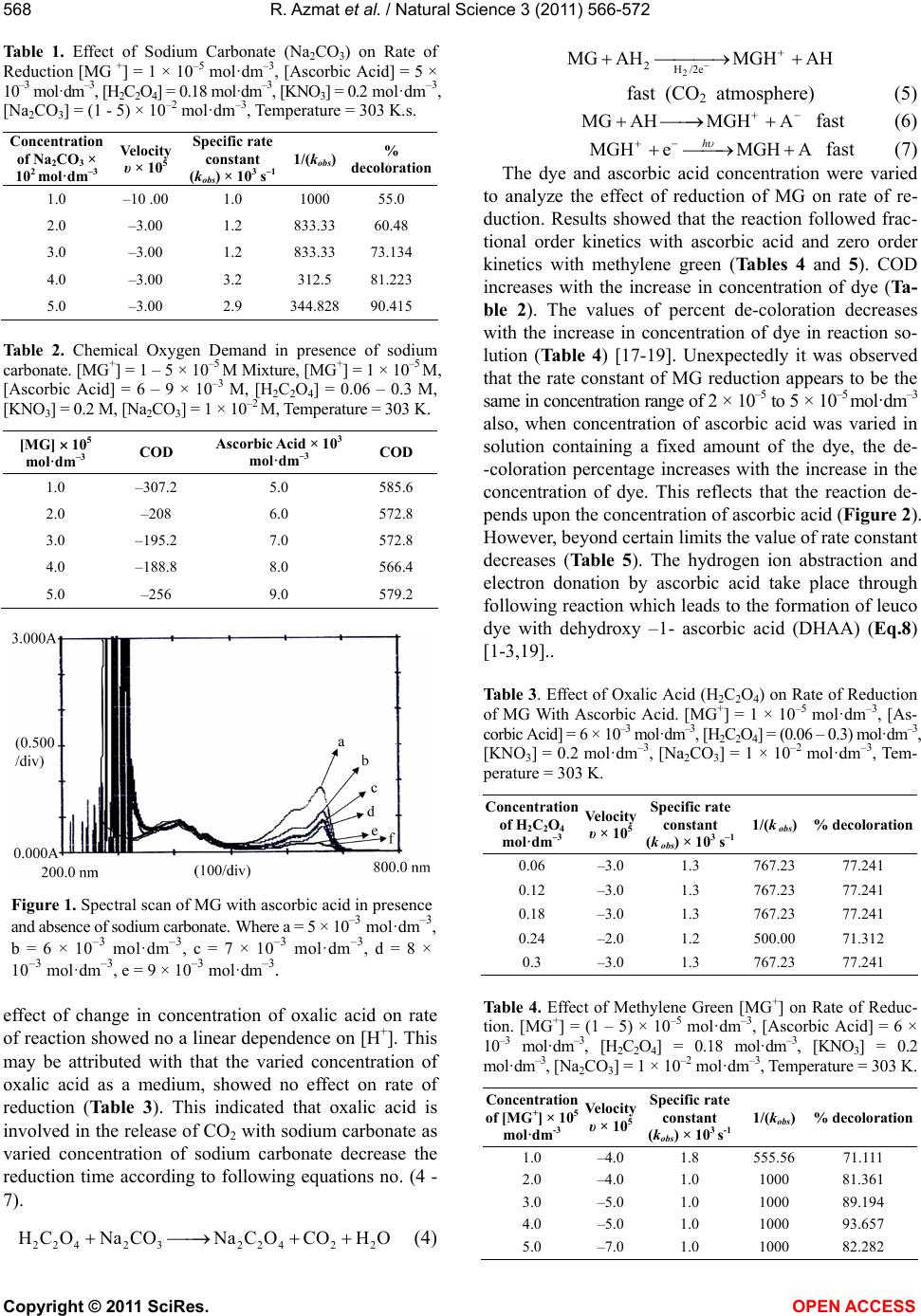 R. Azmat et al. / Natural Science 3 (2011) 566-572 Copyright © 2011 SciRes. OPEN ACCESS 568 Table 1. Effect of Sodium Carbonate (Na2CO3) on Rate of Reduction [MG +] = 1 × 10⁻⁵ mol·dm–3, [Ascorbic Acid] = 5 × 10⁻³ mol·dm–3, [H2C2O4] = 0.18 mol·dm–3, [KNO3] = 0.2 mol·dm–3, [Na2CO3] = (1 - 5) × 10–2 mol·dm–3, Temperature = 303 K.s. Concentration of Na2CO3 × 102 mol· dm–3 Velocity υ × 105 Specific rate constant (kobs) × 103 s–1 1/(kobs) % decoloration 1.0 –10 .00 1.0 1000 55.0 2.0 –3.00 1.2 833.33 60.48 3.0 –3.00 1.2 833.33 73.134 4.0 –3.00 3.2 312.5 81.223 5.0 –3.00 2.9 344.828 90.415 Table 2. Chemical Oxygen Demand in presence of sodium carbonate. [MG+] = 1 – 5 × 10⁻⁵ M Mixture, [MG+] = 1 × 10⁻⁵ M, [Ascorbic Acid] = 6 – 9 × 10⁻³ M, [H2C2O4] = 0.06 – 0.3 M, [KNO3] = 0.2 M, [Na2CO3] = 1 × 10⁻² M, Temperature = 303 K. [MG] 105 mol·dm–3 COD Ascorbic Acid × 103 mol·dm–3 COD 1.0 –307.2 5.0 585.6 2.0 –208 6.0 572.8 3.0 –195.2 7.0 572.8 4.0 –188.8 8.0 566.4 5.0 –256 9.0 579.2 Figure 1. Spectral scan of MG with ascorbic acid in presence and absence of sodium carbonate. Where a = 5 × 10⁻³ mol·dm–3, b = 6 × 10⁻³ mol·dm–3, c = 7 × 10⁻³ mol·dm–3, d = 8 × 10⁻³ mol·dm–3, e = 9 × 10⁻³ mol·dm–3. effect of change in concentration of oxalic acid on rate of reaction showed no a linear dependence on [H+]. This may be attributed with that the varied concentration of oxalic acid as a medium, showed no effect on rate of reduction (Table 3). This indicated that oxalic acid is involved in the release of CO2 with sodium carbonate as varied concentration of sodium carbonate decrease the reduction time according to following equations no. (4 - 7). 2242 322422 HCONaCONaCO COHO (4) 2 2H/2e MG AHMGHAH fast (CO2 atmosphere) (5) MG AHMGHA fast (6) MGHeMGHA h fast (7) The dye and ascorbic acid concentration were varied to analyze the effect of reduction of MG on rate of re- duction. Results showed that the reaction followed frac- tional order kinetics with ascorbic acid and zero order kinetics with methylene green (Tables 4 and 5). COD increases with the increase in concentration of dye (Ta- ble 2). The values of percent de-coloration decreases with the increase in concentration of dye in reaction so- lution (Table 4) [17-19]. Unexpectedly it was observed that the rate constant of MG reduction appears to be the same in concentration range of 2 × 10⁻⁵ to 5 × 10⁻⁵ mol·dm–3 also, when concentration of ascorbic acid was varied in solution containing a fixed amount of the dye, the de- -coloration percentage increases with the increase in the concentration of dye. This reflects that the reaction de- pends upon the concentration of ascorbic acid (Figure 2). However, beyond certain limits the value of rate constant decreases (Table 5). The hydrogen ion abstraction and electron donation by ascorbic acid take place through following reaction which leads to the formation of leuco dye with dehydroxy –1- ascorbic acid (DHAA) (Eq.8 ) [1-3,19].. Table 3. Effect of Oxalic Acid (H2C2O4) on Rate of Reduction of MG With Ascorbic Acid. [MG+] = 1 × 10⁻⁵ mol·dm–3, [As- corbic Acid] = 6 × 10⁻³ mol·dm–3, [H2C2O4] = (0.06 – 0.3) mol·dm–3, [KNO3] = 0.2 mol·dm–3, [Na2CO3] = 1 × 10⁻² mol·dm–3, Tem- perature = 303 K. Concentration of H2C2O4 mol·dm–3 Velocity υ × 105 Specific rate constant (k obs) × 103 s–1 1/(k obs) % decoloration 0.06 –3.0 1.3 767.23 77.241 0.12 –3.0 1.3 767.23 77.241 0.18 –3.0 1.3 767.23 77.241 0.24 –2.0 1.2 500.00 71.312 0.3 –3.0 1.3 767.23 77.241 Table 4. Effect of Methylene Green [MG+] on Rate of Reduc- tion. [MG+] = (1 – 5) × 10–5 mol·dm–3, [Ascorbic Acid] = 6 × 10⁻³ mol·dm–3, [H2C2O4] = 0.18 mol·dm–3 , [KNO3] = 0.2 mol·dm–3, [Na2CO3] = 1 × 10⁻² mol·dm–3, Temperature = 303 K. Concentration of [MG+] × 105 mol·dm-3 Velocity υ × 105 Specific rate constant (kobs) × 103 s-1 1/(kobs) % decoloration 1.0 –4.0 1.8 555.56 71.111 2.0 –4.0 1.0 1000 81.361 3.0 –5.0 1.0 1000 89.194 4.0 –5.0 1.0 1000 93.657 5.0 –7.0 1.0 1000 82.282 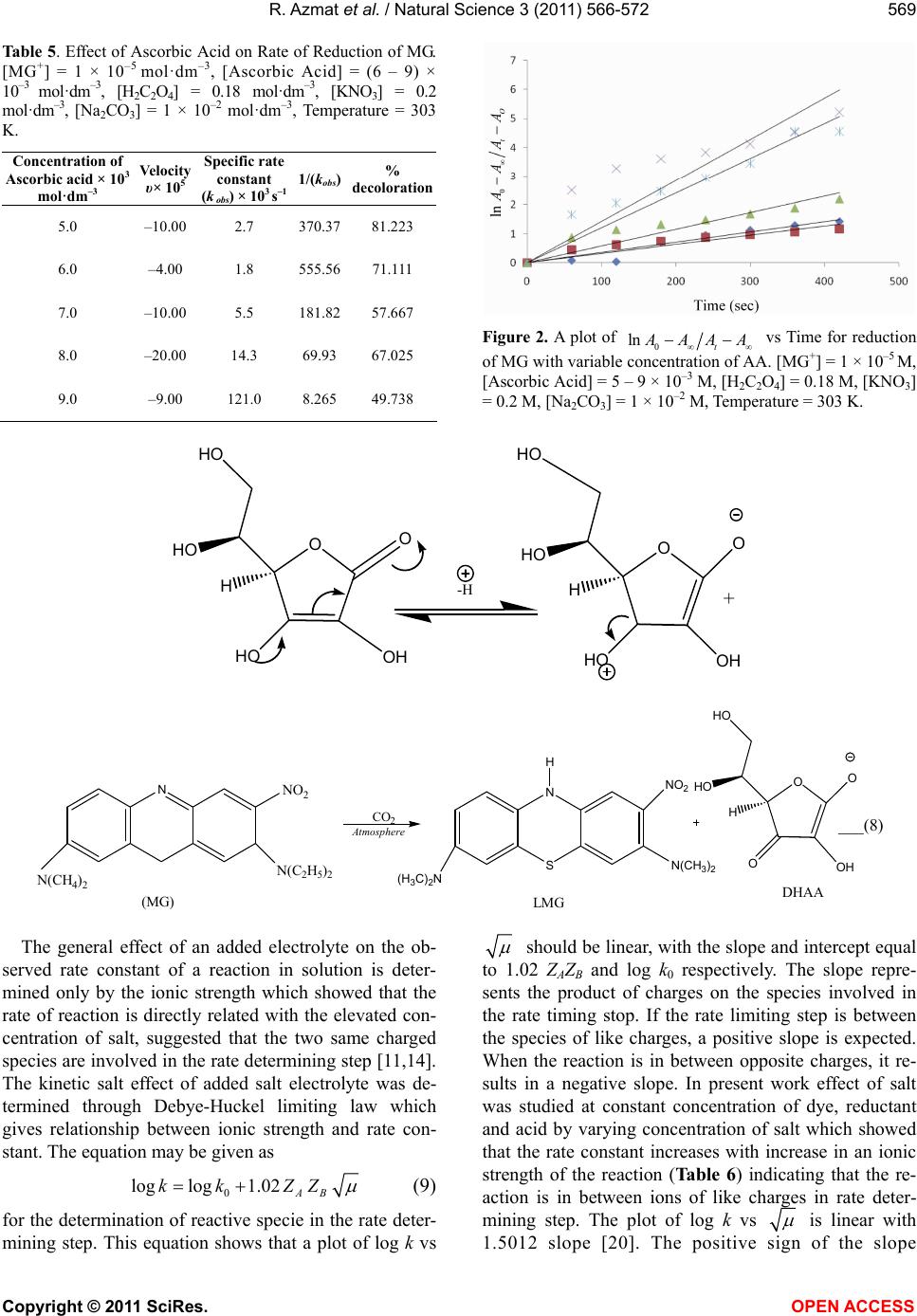 R. Azmat et al. / Natural Science 3 (2011) 566-572 Copyright © 2011 SciRes. OPEN ACCESS 569 Table 5. Effect of Ascorbic Acid on Rate of Reduction of MG. [MG+] = 1 × 10⁻⁵ mol·dm–3, [Ascorbic Acid] = (6 – 9) × 10–3 mol·dm–3, [H2C2O4] = 0.18 mol·dm–3, [KNO3] = 0.2 mol·dm–3, [Na2CO3] = 1 × 10⁻² mol·dm–3, Temperature = 303 K. Concentration of Ascorbic acid × 103 mol·dm–3 Velocity υ× 105 Specific rate constant (k obs) × 103 s–1 1/(kobs) % decoloration 5.0 –10.00 2.7 370.37 81.223 6.0 –4.00 1.8 555.56 71.111 7.0 –10.00 5.5 181.82 57.667 8.0 –20.00 14.3 69.93 67.025 9.0 –9.00 121.0 8.265 49.738 Figure 2. A plot of 0 ln t A AA A vs Time for reduction of MG with variable concentration of AA. [MG+] = 1 × 10⁻⁵ M, [Ascorbic Acid] = 5 – 9 × 10⁻³ M, [H2C2O4] = 0.18 M, [KNO3] = 0.2 M, [Na2CO3] = 1 × 10⁻² M, Temperature = 303 K. OO HO OH H HO HO OO HO OH H HO HO -H + OO OOH H HO HO N N(C2H5)2 NO2 N(CH4)2 S NNO2 N(CH3)2 H (H3C)2N CO2 Atmosphere ___(8) (MG) LMG DHAA The general effect of an added electrolyte on the ob- served rate constant of a reaction in solution is deter- mined only by the ionic strength which showed that the rate of reaction is directly related with the elevated con- centration of salt, suggested that the two same charged species are involved in the rate determining step [11,14]. The kinetic salt effect of added salt electrolyte was de- termined through Debye-Huckel limiting law which gives relationship between ionic strength and rate con- stant. The equation may be given as 0 loglog1.02 AB kk ZZ (9) for the determination of reactive specie in the rate deter- mining step. This equation shows that a plot of log k vs should be linear, with the slope and intercept equal to 1.02 ZAZB and log k0 respectively. The slope repre- sents the product of charges on the species involved in the rate timing stop. If the rate limiting step is between the species of like charges, a positive slope is expected. When the reaction is in between opposite charges, it re- sults in a negative slope. In present work effect of salt was studied at constant concentration of dye, reductant and acid by varying concentration of salt which showed that the rate constant increases with increase in an ionic strength of the reaction (Table 6) indicating that the re- action is in between ions of like charges in rate deter- mining step. The plot of log k vs is linear with 1.5012 slope [20]. The positive sign of the slope 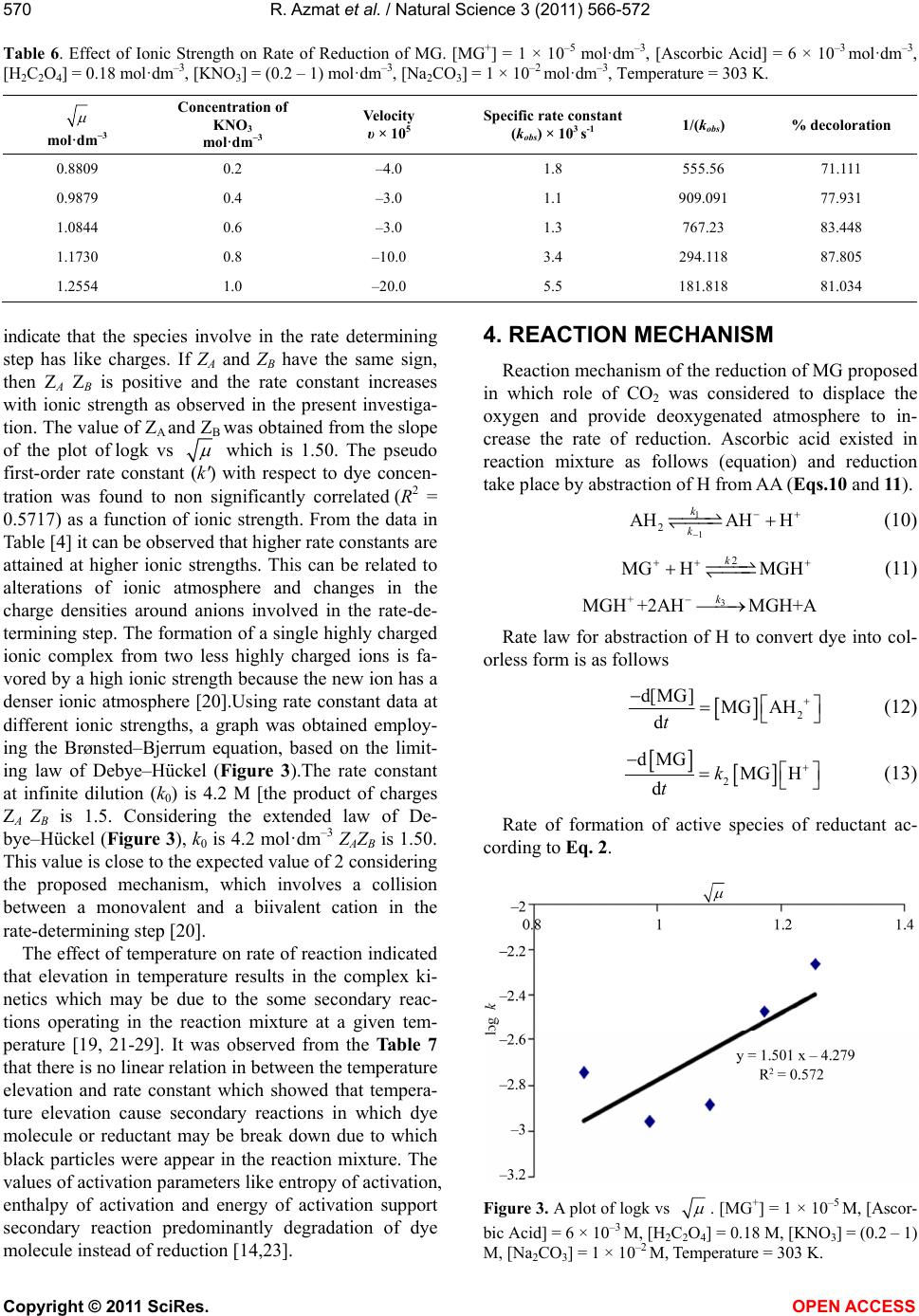 R. Azmat et al. / Natural Science 3 (2011) 566-572 Copyright © 2011 SciRes. OPEN ACCESS 570 Table 6. Effect of Ionic Strength on Rate of Reduction of MG. [MG+] = 1 × 10⁻⁵ mol·dm–3, [Ascorbic Acid] = 6 × 10⁻³ mol·dm–3, [H2C2O4] = 0.18 mol·dm–3, [KNO3] = (0.2 – 1) mol·dm–3, [Na2CO3] = 1 × 10⁻² mol·dm–3, Temperature = 303 K. mol·dm–3 Concentration of KNO3 mol·dm–3 Velocity υ × 105 Specific rate constant (kobs) × 103 s-1 1/(kobs) % decoloration 0.8809 0.2 –4.0 1.8 555.56 71.111 0.9879 0.4 –3.0 1.1 909.091 77.931 1.0844 0.6 –3.0 1.3 767.23 83.448 1.1730 0.8 –10.0 3.4 294.118 87.805 1.2554 1.0 –20.0 5.5 181.818 81.034 indicate that the species involve in the rate determining step has like charges. If ZA and ZB have the same sign, then ZA Z B is positive and the rate constant increases with ionic strength as observed in the present investiga- tion. The value of ZA and ZB was obtained from the slope of the plot of logk vs which is 1.50. The pseudo first-order rate constant (k') with respect to dye concen- tration was found to non significantly correlated (R2 = 0.5717) as a function of ionic strength. From the data in Table [4] it can be observed that higher rate constants are attained at higher ionic strengths. This can be related to alterations of ionic atmosphere and changes in the charge densities around anions involved in the rate-de- termining step. The formation of a single highly charged ionic complex from two less highly charged ions is fa- vored by a high ionic strength because the new ion has a denser ionic atmosphere [20].Using rate constant data at different ionic strengths, a graph was obtained employ- ing the Brønsted–Bjerrum equation, based on the limit- ing law of Debye–Hückel (Figure 3).The rate constant at infinite dilution (k0) is 4.2 M [the product of charges ZA ZB is 1.5. Considering the extended law of De- bye–Hückel (Figure 3), k0 is 4.2 mol·dm–3 ZAZB is 1.50. This value is close to the expected value of 2 considering the proposed mechanism, which involves a collision between a monovalent and a biivalent cation in the rate-determining step [20]. The effect of temperature on rate of reaction indicated that elevation in temperature results in the complex ki- netics which may be due to the some secondary reac- tions operating in the reaction mixture at a given tem- perature [19, 21-29]. It was observed from the Table 7 that there is no linear relation in between the temperature elevation and rate constant which showed that tempera- ture elevation cause secondary reactions in which dye molecule or reductant may be break down due to which black particles were appear in the reaction mixture. The values of activation parameters like entropy of activation, enthalpy of activation and energy of activation support secondary reaction predominantly degradation of dye molecule instead of reduction [14,23]. 4. REACTION MECHANISM Reaction mechanism of the reduction of MG proposed in which role of CO2 was considered to displace the oxygen and provide deoxygenated atmosphere to in- crease the rate of reduction. Ascorbic acid existed in reaction mixture as follows (equation) and reduction take place by abstraction of H from AA (Eqs.10 and 11). 1 1 2 AHAH H k k (10) 2 MG HMGH k (11) 3 + MGH +2AHMGH+A k Rate law for abstraction of H to convert dye into col- orless form is as follows 2 d[MG] MG AH dt (12) 2 dMGMG H dk t (13) Rate of formation of active species of reductant ac- cording to Eq. 2. Figure 3. A plot of logk vs . [MG+] = 1 × 10⁻⁵ M, [Ascor- bic Acid] = 6 × 10⁻³ M, [H2C2O4] = 0.18 M, [KNO3] = (0.2 – 1) M, [Na2CO3] = 1 × 10⁻² M, Temperature = 303 K. 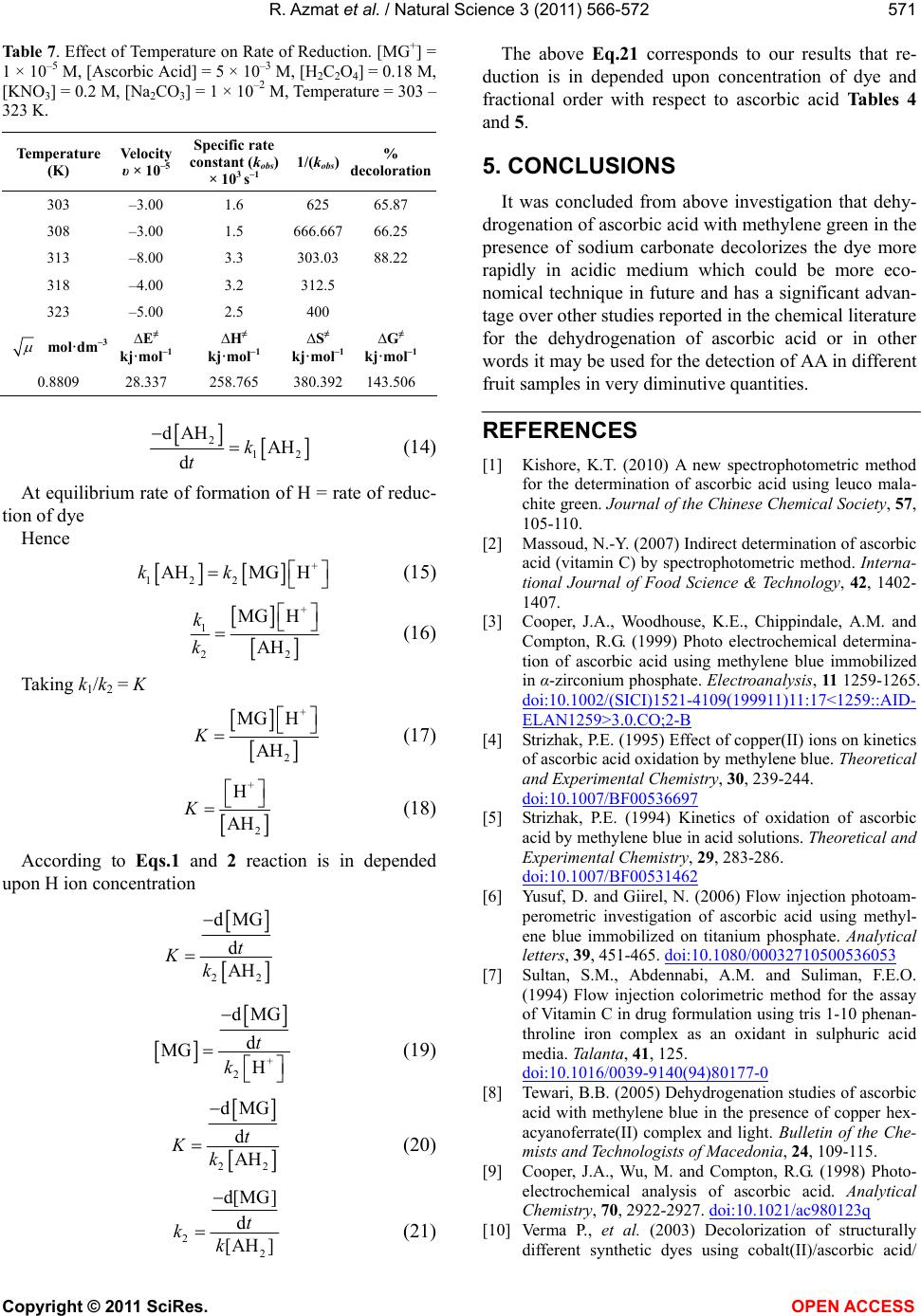 R. Azmat et al. / Natural Science 3 (2011) 566-572 Copyright © 2011 SciRes. OPEN ACCESS 571 Table 7. Effect of Temperature on Rate of Reduction. [MG+] = 1 × 10⁻⁵ M, [Ascorbic Acid] = 5 × 10⁻³ M, [H2C2O4] = 0.18 M, [KNO3] = 0.2 M, [Na2CO3] = 1 × 10⁻² M, Temperature = 303 – 323 K. Temperature (K) Velocity υ × 10–5 Specific rate constant (kobs) × 103 s–1 1/(kobs) % decoloration 303 –3.00 1.6 625 65.87 308 –3.00 1.5 666.667 66.25 313 –8.00 3.3 303.03 88.22 318 –4.00 3.2 312.5 323 –5.00 2.5 400 mol· dm–3 ∆E≠ kj·mol–1 ∆H≠ kj·mol–1 ∆S≠ kj·mol–1 ∆G≠ kj·mol–1 0.8809 28.337 258.765 380.392 143.506 2 12 dAHAH dk t (14) At equilibrium rate of formation of H = rate of reduc- tion of dye Hence + 122 AHMG Hkk (15) + 1 22 MG H AH k k (16) Taking k1/k2 = K + 2 MG H AH K (17) + 2 H AH K (18) According to Eqs.1 and 2 reaction is in depended upon H ion concentration 22 dMG d AH t Kk + 2 dMG d MG H t k (19) 22 dMG d AH t Kk (20) 2 2 d[M G] d [AH ] t kk (21) The above Eq.21 corresponds to our results that re- duction is in depended upon concentration of dye and fractional order with respect to ascorbic acid Tables 4 and 5. 5. CONCLUSIONS It was concluded from above investigation that dehy- drogenation of ascorbic acid with methylene green in the presence of sodium carbonate decolorizes the dye more rapidly in acidic medium which could be more eco- nomical technique in future and has a significant advan- tage over other studies reported in the chemical literature for the dehydrogenation of ascorbic acid or in other words it may be used for the detection of AA in different fruit samples in very diminutive quantities. REFERENCES [1] Kishore, K.T. (2010) A new spectrophotometric method for the determination of ascorbic acid using leuco mala- chite green. Journal of the Chinese Chemical Society, 57, 105-110. [2] Massoud, N.-Y. (2007) Indirect determination of ascorbic acid (vitamin C) by spectrophotometric method. Interna- tional Journal of Food Science & Technology, 42, 1402- 1407. [3] Cooper, J.A., Woodhouse, K.E., Chippindale, A.M. and Compton, R.G. (1999) Photo electrochemical determina- tion of ascorbic acid using methylene blue immobilized in α-zirconium phosphate. Electroanalysis, 11 1259-1265. doi:10.1002/(SICI)1521-4109(199911)11:17<1259::AID- ELAN1259>3.0.CO;2-B [4] Strizhak, P.E. (1995) Effect of copper(II) ions on kinetics of ascorbic acid oxidation by methylene blue. Theoretical and Experimental Chemistry, 30, 239-244. doi:10.1007/BF00536697 [5] Strizhak, P.E. (1994) Kinetics of oxidation of ascorbic acid by methylene blue in acid solutions. Theoretical and Experimental Chemistry, 29, 283-286. doi:10.1007/BF00531462 [6] Yusuf, D. and Giirel, N. (2006) Flow injection photoam- perometric investigation of ascorbic acid using methyl- ene blue immobilized on titanium phosphate. Analytical letters, 39, 451-465. doi:10.1080/00032710500536053 [7] Sultan, S.M., Abdennabi, A.M. and Suliman, F.E.O. (1994) Flow injection colorimetric method for the assay of Vitamin C in drug formulation using tris 1-10 phenan- throline iron complex as an oxidant in sulphuric acid media. Talanta, 41, 125. doi:10.1016/0039-9140(94)80177-0 [8] Tewari, B.B. (2005) Dehydrogenation studies of ascorbic acid with methylene blue in the presence of copper hex- acyanoferrate(II) complex and light. Bulletin of the Che- mists and Technologists of Macedonia, 24, 109-115. [9] Cooper, J.A., Wu, M. and Compton, R.G. (1998) Photo- electrochemical analysis of ascorbic acid. Analytical Chemistry, 70, 2922-2927. doi:10.1021/ac980123q [10] Verma P., et al. (2003) Decolorization of structurally different synthetic dyes using cobalt(II)/ascorbic acid/ 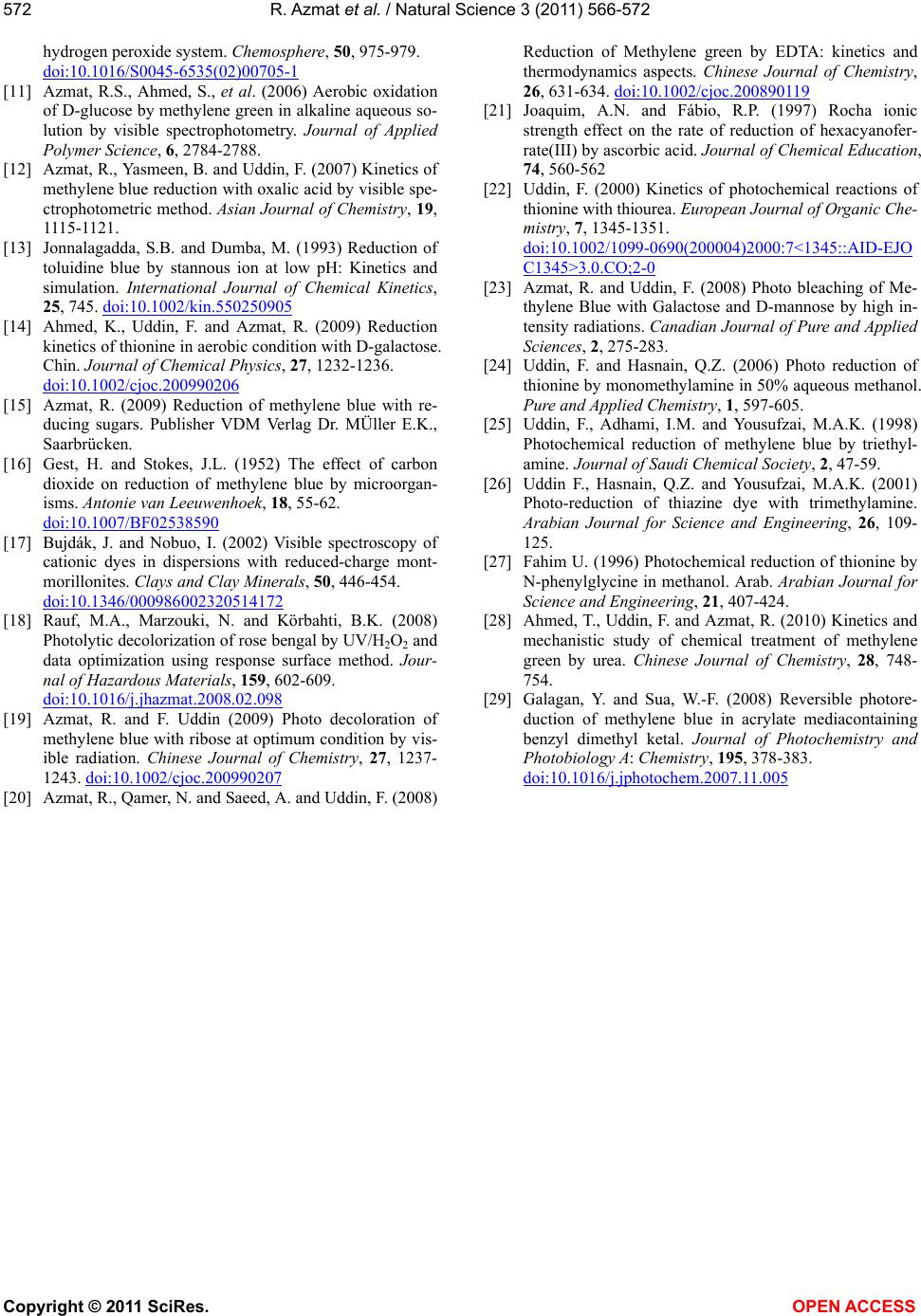 R. Azmat et al. / Natural Science 3 (2011) 566-572 Copyright © 2011 SciRes. OPEN ACCESS 572 hydrogen peroxide system. Chemosphere, 50, 975-979. doi:10.1016/S0045-6535(02)00705-1 [11] Azmat, R.S., Ahmed, S., et al. (2006) Aerobic oxidation of D-glucose by methylene green in alkaline aqueous so- lution by visible spectrophotometry. Journal of Applied Polymer Science, 6, 2784-2788. [12] Azmat, R., Yasmeen, B. and Uddin, F. (2007) Kinetics of methylene blue reduction with oxalic acid by visible spe- ctrophotometric method. Asian Journal of Chemistry, 19, 1115-1121. [13] Jonnalagadda, S.B. and Dumba, M. (1993) Reduction of toluidine blue by stannous ion at low pH: Kinetics and simulation. International Journal of Chemical Kinetics, 25, 745. doi:10.1002/kin.550250905 [14] Ahmed, K., Uddin, F. and Azmat, R. (2009) Reduction kinetics of thionine in aerobic condition with D-galactose. Chin. Journal of Chemical Physics, 27, 1232-1236. doi:10.1002/cjoc.200990206 [15] Azmat, R. (2009) Reduction of methylene blue with re- ducing sugars. Publisher VDM Verlag Dr. MÜller E.K., Saarbrücken. [16] Gest, H. and Stokes, J.L. (1952) The effect of carbon dioxide on reduction of methylene blue by microorgan- isms. Antonie van Leeuwenhoek, 18, 55-62. doi:10.1007/BF02538590 [17] Bujdák, J. and Nobuo, I. (2002) Visible spectroscopy of cationic dyes in dispersions with reduced-charge mont- morillonites. Clays and Clay Minerals, 50, 446-454. doi:10.1346/000986002320514172 [18] Rauf, M.A., Marzouki, N. and Körbahti, B.K. (2008) Photolytic decolorization of rose bengal by UV/H2O2 and data optimization using response surface method. Jour- nal of Hazardous Materials, 159, 602-609. doi:10.1016/j.jhazmat.2008.02.098 [19] Azmat, R. and F. Uddin (2009) Photo decoloration of methylene blue with ribose at optimum condition by vis- ible radiation. Chinese Journal of Chemistry, 27, 1237- 1243. doi:10.1002/cjoc.200990207 [20] Azmat, R., Qamer, N. and Saeed, A. and Uddin, F. (2008) Reduction of Methylene green by EDTA: kinetics and thermodynamics aspects. Chinese Journal of Chemistry, 26, 631-634. doi:10.1002/cjoc.200890119 [21] Joaquim, A.N. and Fábio, R.P. (1997) Rocha ionic strength effect on the rate of reduction of hexacyanofer- rate(III) by ascorbic acid. Journal of Chemical Education, 74, 560-562 [22] Uddin, F. (2000) Kinetics of photochemical reactions of thionine with thiourea. European Journal of Organic Che- mistry, 7, 1345-1351. doi:10.1002/1099-0690(200004)2000:7<1345::AID-EJO C1345>3.0.CO;2-0 [23] Azmat, R. and Uddin, F. (2008) Photo bleaching of Me- thylene Blue with Galactose and D-mannose by high in- tensity radiations. Canadian Journal of Pure and Applied Sciences, 2, 275-283. [24] Uddin, F. and Hasnain, Q.Z. (2006) Photo reduction of thionine by monomethylamine in 50% aqueous methanol. Pure and Applied Chemistry, 1, 597-605. [25] Uddin, F., Adhami, I.M. and Yousufzai, M.A.K. (1998) Photochemical reduction of methylene blue by triethyl- amine. Journal of Saudi Chemical Society, 2, 47-59. [26] Uddin F., Hasnain, Q.Z. and Yousufzai, M.A.K. (2001) Photo-reduction of thiazine dye with trimethylamine. Arabian Journal for Science and Engineering, 26, 109- 125. [27] Fahim U. (1996) Photochemical reduction of thionine by N-phenylglycine in methanol. Arab. Arabian Journal for Science and Engineering, 21, 407-424. [28] Ahmed, T., Uddin, F. and Azmat, R. (2010) Kinetics and mechanistic study of chemical treatment of methylene green by urea. Chinese Journal of Chemistry, 28, 748- 754. [29] Galagan, Y. and Sua, W.-F. (2008) Reversible photore- duction of methylene blue in acrylate mediacontaining benzyl dimethyl ketal. Journal of Photochemistry and Photobiology A: Chemistry, 195, 378-383. doi:10.1016/j.jphotochem.2007.11.005 |