

Paper Menu >>
Journal Menu >>
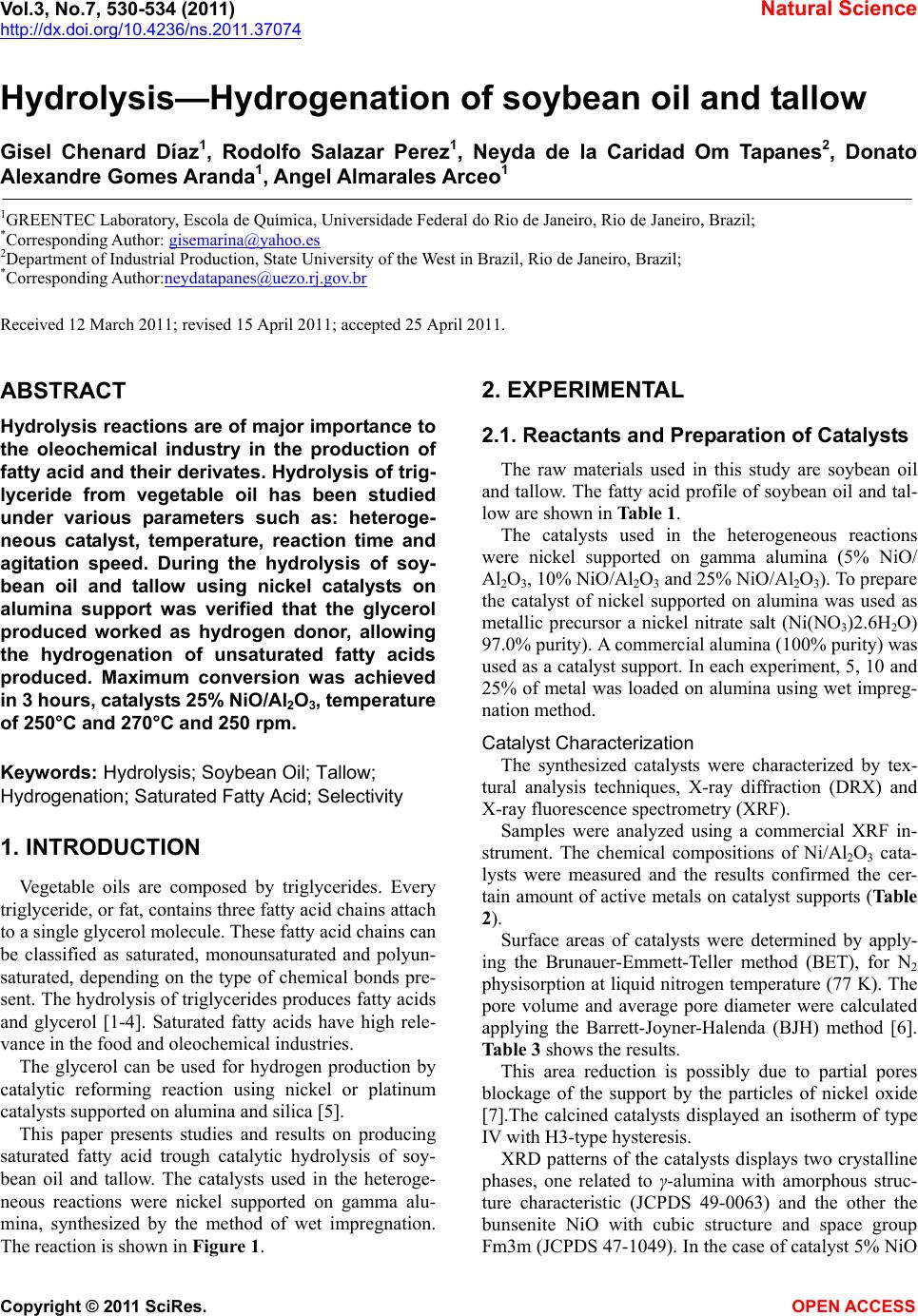 Vol.3, No.7, 530-534 (2011) Natural Science http://dx.doi.org/10.4236/ns.2011.37074 Copyright © 2011 SciRes. OPEN ACCESS Hydrolysis—Hydrogenation of soybean oil and tallow Gisel Chenard Díaz1, Rodolfo Salazar Perez1, Neyda de la Caridad Om Tapanes2, Donato Alexandre Gomes Aranda1, Angel Almarales Arceo1 1GREENTEC Laboratory, Escola de Química, Universidade Federal do Rio de Janeiro, Rio de Janeiro, Brazil; *Corresponding Author: [email protected] 2Department of Industrial Production, State University of the West in Brazil, Rio de Janeiro, Brazil; *Corresponding Author:[email protected] Received 12 March 2011; revised 15 April 2011; accepted 25 April 2011. ABSTRACT Hydrolysis reactions are of major importance to the oleochemical industry in the production of fatty acid and their derivates. Hydrolysis of trig- lyceride from vegetable oil has been studied under various parameters such as: heteroge- neous catalyst, temperature, reaction time and agitation speed. During the hydrolysis of soy- bean oil and tallow using nickel catalysts on alumina support was verified that the glycerol produced worked as hydrogen donor, allowing the hydrogenation of unsaturated fatty acids produced. Maximum conversion was achieved in 3 hours, catalysts 25% NiO/Al2O3, temperature of 250°C and 270°C and 250 rpm. Keywords: Hydrolysis; Soybean Oil; Tallow; Hydrogenation; Saturated Fatty Acid; Selectivity 1. INTRODUCTION Vegetable oils are composed by triglycerides. Every triglyceride, or fat, contains three fatty acid chains attach to a single glycerol molecule. These fatty acid chains can be classified as saturated, monounsaturated and polyun- saturated, depending on the type of chemical bonds pre- sent. The hydrolysis of triglycerides produces fatty acids and glycerol [1-4]. Saturated fatty acids have high rele- vance in the food and oleochemical industries. The glycerol can be used for hydrogen production by catalytic reforming reaction using nickel or platinum catalysts supported on alumina and silica [5]. This paper presents studies and results on producing saturated fatty acid trough catalytic hydrolysis of soy- bean oil and tallow. The catalysts used in the heteroge- neous reactions were nickel supported on gamma alu- mina, synthesized by the method of wet impregnation. The reaction is shown in Figure 1. 2. EXPERIMENTAL 2.1. Reactants and Preparation of Catalysts The raw materials used in this study are soybean oil and tallow. The fatty acid profile of soybean oil and tal- low are shown in Table 1. The catalysts used in the heterogeneous reactions were nickel supported on gamma alumina (5% NiO/ Al2O3, 10% NiO/Al2O3 and 25% NiO/Al2O3). To prepare the catalyst of nickel supported on alumina was used as metallic precursor a nickel nitrate salt (Ni(NO3)2.6H2O) 97.0% purity). A commercial alumina (100% purity) was used as a catalyst support. In each experiment, 5, 10 and 25% of metal was loaded on alumina using wet impreg- nation method. Catalyst Characterization The synthesized catalysts were characterized by tex- tural analysis techniques, X-ray diffraction (DRX) and X-ray fluorescence spectrometry (XRF). Samples were analyzed using a commercial XRF in- strument. The chemical compositions of Ni/Al2O3 cata- lysts were measured and the results confirmed the cer- tain amount of active metals on catalyst supports (Table 2). Surface areas of catalysts were determined by apply- ing the Brunauer-Emmett-Teller method (BET), for N2 physisorption at liquid nitrogen temperature (77 K). The pore volume and average pore diameter were calculated applying the Barrett-Joyner-Halenda (BJH) method [6]. Table 3 shows the results. This area reduction is possibly due to partial pores blockage of the support by the particles of nickel oxide [7].The calcined catalysts displayed an isotherm of type IV with H3-type hysteresis. XRD patterns of the catalysts displays two crystalline phases, one related to γ-alumina with amorphous struc- ture characteristic (JCPDS 49-0063) and the other the bunsenite NiO with cubic structure and space group Fm3m (JCPDS 47-1049). In the case of catalyst 5% NiO 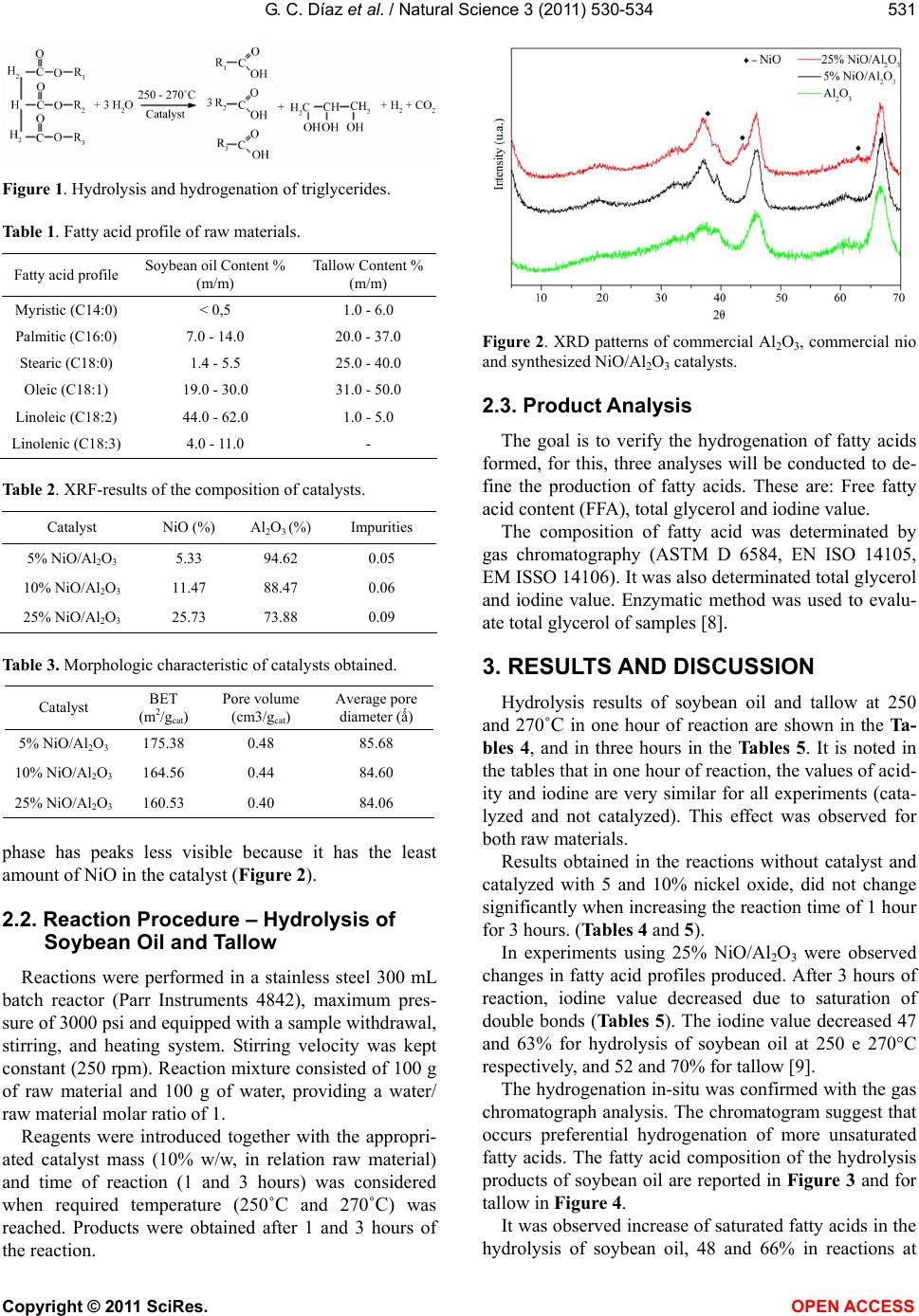 G. C. Díaz et al. / Natural Science 3 (2011) 530-534 Copyright © 2011 SciRes. OPEN ACCESS 531 Figure 1. Hydrolysis and hydrogenation of triglycerides. Table 1. Fatty acid profile of raw materials. Fatty acid profile Soybean oil Content % (m/m) Tallow Content % (m/m) Myristic (C14:0) < 0,5 1.0 - 6.0 Palmitic (C16:0) 7.0 - 14.0 20.0 - 37.0 Stearic (C18:0) 1.4 - 5.5 25.0 - 40.0 Oleic (C18:1) 19.0 - 30.0 31.0 - 50.0 Linoleic (C18:2) 44.0 - 62.0 1.0 - 5.0 Linolenic (C18:3) 4.0 - 11.0 - Table 2. XRF-results of the composition of catalysts. Catalyst NiO (%) Al2O3 (%) Impurities 5% NiO/Al2O3 5.33 94.62 0.05 10% NiO/Al2O3 11.47 88.47 0.06 25% NiO/Al2O3 25.73 73.88 0.09 Table 3. Morphologic characteristic of catalysts obtained. Catalyst BET (m2/gcat) Pore volume (cm3/gcat) Average pore diameter (ǻ) 5% NiO/Al2O3 175.38 0.48 85.68 10% NiO/Al2O3 164.56 0.44 84.60 25% NiO/Al2O3 160.53 0.40 84.06 phase has peaks less visible because it has the least amount of NiO in the catalyst (Figure 2). 2.2. Reaction Procedure – Hydrolysis of Soybean Oil and Tallow Reactions were performed in a stainless steel 300 mL batch reactor (Parr Instruments 4842), maximum pres- sure of 3000 psi and equipped with a sample withdrawal, stirring, and heating system. Stirring velocity was kept constant (250 rpm). Reaction mixture consisted of 100 g of raw material and 100 g of water, providing a water/ raw material molar ratio of 1. Reagents were introduced together with the appropri- ated catalyst mass (10% w/w, in relation raw material) and time of reaction (1 and 3 hours) was considered when required temperature (250˚C and 270˚C) was reached. Products were obtained after 1 and 3 hours of the reaction. Figure 2. XRD patterns of commercial Al2O3, commercial nio and synthesized NiO/Al2O3 catalysts. 2.3. Product Analysis The goal is to verify the hydrogenation of fatty acids formed, for this, three analyses will be conducted to de- fine the production of fatty acids. These are: Free fatty acid content (FFA), total glycerol and iodine value. The composition of fatty acid was determinated by gas chromatography (ASTM D 6584, EN ISO 14105, EM ISSO 14106). It was also determinated total glycerol and iodine value. Enzymatic method was used to evalu- ate total glycerol of samples [8]. 3. RESULTS AND DISCUSSION Hydrolysis results of soybean oil and tallow at 250 and 270˚C in one hour of reaction are shown in the Ta- bles 4, and in three hours in the Tables 5. It is noted in the tables that in one hour of reaction, the values of acid- ity and iodine are very similar for all experiments (cata- lyzed and not catalyzed). This effect was observed for both raw materials. Results obtained in the reactions without catalyst and catalyzed with 5 and 10% nickel oxide, did not change significantly when increasing the reaction time of 1 hour for 3 hours. (Tables 4 and 5). In experiments using 25% NiO/Al2O3 were observed changes in fatty acid profiles produced. After 3 hours of reaction, iodine value decreased due to saturation of double bonds (Tables 5). The iodine value decreased 47 and 63% for hydrolysis of soybean oil at 250 e 270C respectively, and 52 and 70% for tallow [9]. The hydrogenation in-situ was confirmed with the gas chromatograph analysis. The chromatogram suggest that occurs preferential hydrogenation of more unsaturated fatty acids. The fatty acid composition of the hydrolysis products of soybean oil are reported in Figure 3 and for tallow in Figure 4. It was observed increase of saturated fatty acids in the hydrolysis of soybean oil, 48 and 66% in reactions at 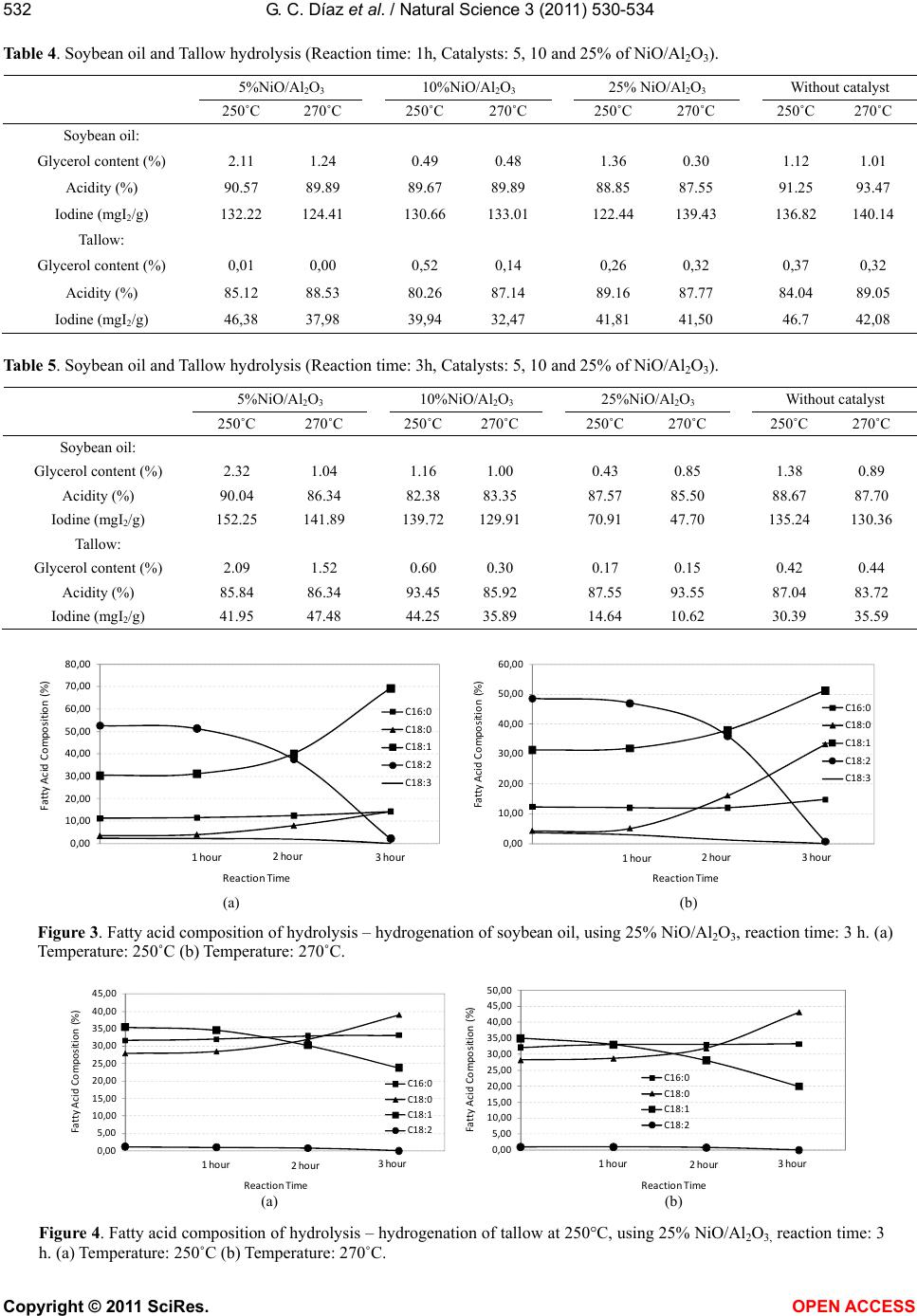 G. C. Díaz et al. / Natural Science 3 (2011) 530-534 Copyright © 2011 SciRes. OPEN ACCESS 532 Table 4. Soybean oil and Tallow hydrolysis (Reaction time: 1h, Catalysts: 5, 10 and 25% of NiO/Al2O3). 5%NiO/Al2O3 10%NiO/Al2O3 25% NiO/Al2O3 Without catalyst 250˚C 270˚C 250˚C 270˚C 250˚C 270˚C 250˚C 270˚C Soybean oil: Glycerol content (%) 2.11 1.24 0.49 0.48 1.36 0.30 1.12 1.01 Acidity (%) 90.57 89.89 89.67 89.89 88.85 87.55 91.25 93.47 Iodine (mgI2/g) 132.22 124.41 130.66 133.01 122.44 139.43 136.82 140.14 Tallow: Glycerol content (%) 0,01 0,00 0,52 0,14 0,26 0,32 0,37 0,32 Acidity (%) 85.12 88.53 80.26 87.14 89.16 87.77 84.04 89.05 Iodine (mgI2/g) 46,38 37,98 39,94 32,47 41,81 41,50 46.7 42,08 Table 5. Soybean oil and Tallow hydrolysis (Reaction time: 3h, Catalysts: 5, 10 and 25% of NiO/Al2O3). 5%NiO/Al2O3 10%NiO/Al2O3 25%NiO/Al2O3 Without catalyst 250˚C 270˚C 250˚C 270˚C 250˚C 270˚C 250˚C 270˚C Soybean oil: Glycerol content (%) 2.32 1.04 1.16 1.00 0.43 0.85 1.38 0.89 Acidity (%) 90.04 86.34 82.38 83.35 87.57 85.50 88.67 87.70 Iodine (mgI2/g) 152.25 141.89 139.72129.91 70.91 47.70 135.24 130.36 Tallow: Glycerol content (%) 2.09 1.52 0.60 0.30 0.17 0.15 0.42 0.44 Acidity (%) 85.84 86.34 93.45 85.92 87.55 93.55 87.04 83.72 Iodine (mgI2/g) 41.95 47.48 44.25 35.89 14.64 10.62 30.39 35.59 0,00 10,00 20,00 30,00 40,00 50,00 60,00 70,00 80,00 C16:0 C18:0 C18:1 C18:2 C18:3 3ho u r1hour 2hour ReactionTime FattyAc i dComposition(% ) 0,00 10,00 20,00 30,00 40,00 50,00 60,00 C16:0 C18:0 C18:1 C18:2 C18:3 3hour 1hour 2hour ReactionTime Fat tyAci dCompositio n(% ) (a) (b) Figure 3. Fatty acid composition of hydrolysis – hydrogenation of soybean oil, using 25% NiO/Al2O3, reaction time: 3 h. (a) Temperature: 250˚C (b) Temperature: 270˚C. 0,00 5,00 10,00 15,00 20,00 25,00 30,00 35,00 40,00 45,00 C16:0 C18:0 C18:1 C18:2 3hour 1hour 2hou r ReactionTime Fat t yAc i dC ompo s ition(%) 0,00 5,00 10,00 15,00 20,00 25,00 30,00 35,00 40,00 45,00 50,00 C16:0 C18:0 C18:1 C18:2 3ho ur 1hour 2ho ur ReactionTime FattyAc i dComposition(%) (a) (b) Figure 4. Fatty acid composition of hydrolysis – hydrogenation of tallow at 250C, using 25% NiO/Al2O3, reaction time: 3 h. (a) Temperature: 250˚C (b) Temperature: 270˚C. 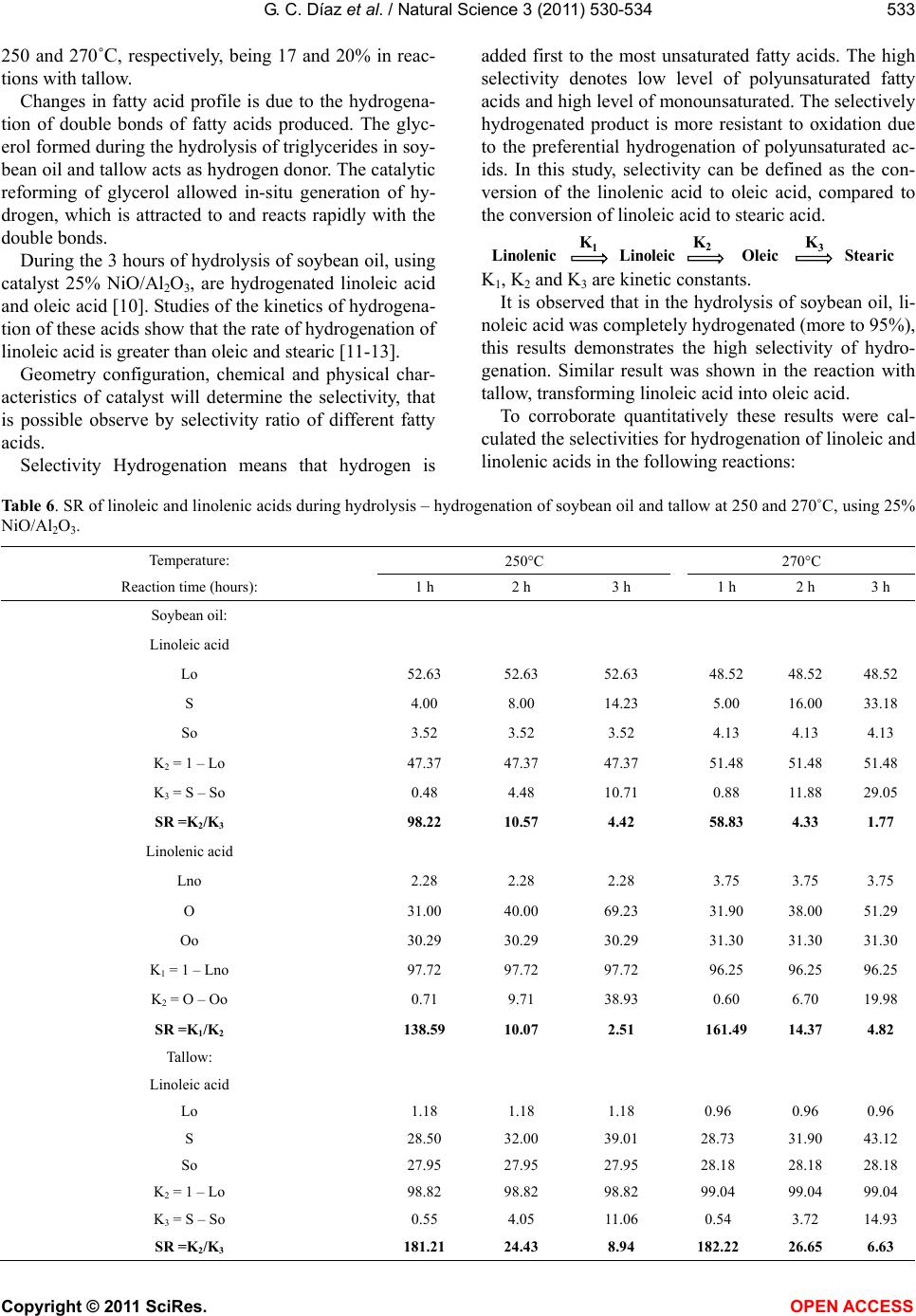 G. C. Díaz et al. / Natural Science 3 (2011) 530-534 Copyright © 2011 SciRes. OPEN ACCESS 533 250 and 270˚C, respectively, being 17 and 20% in reac- tions with tallow. Changes in fatty acid profile is due to the hydrogena- tion of double bonds of fatty acids produced. The glyc- erol formed during the hydrolysis of triglycerides in soy- bean oil and tallow acts as hydrogen donor. The catalytic reforming of glycerol allowed in-situ generation of hy- drogen, which is attracted to and reacts rapidly with the double bonds. During the 3 hours of hydrolysis of soybean oil, using catalyst 25% NiO/Al2O3, are hydrogenated linoleic acid and oleic acid [10]. Studies of the kinetics of hydrogena- tion of these acids show that the rate of hydrogenation of linoleic acid is greater than oleic and stearic [11-13]. Geometry configuration, chemical and physical char- acteristics of catalyst will determine the selectivity, that is possible observe by selectivity ratio of different fatty acids. Selectivity Hydrogenation means that hydrogen is added first to the most unsaturated fatty acids. The high selectivity denotes low level of polyunsaturated fatty acids and high level of monounsaturated. The selectively hydrogenated product is more resistant to oxidation due to the preferential hydrogenation of polyunsaturated ac- ids. In this study, selectivity can be defined as the con- version of the linolenic acid to oleic acid, compared to the conversion of linoleic acid to stearic acid. Linolenic LinoleicOleicStearic K 1 K 2 K 3 K1, K2 and K3 are kinetic constants. It is observed that in the hydrolysis of soybean oil, li- noleic acid was completely hydrogenated (more to 95%), this results demonstrates the high selectivity of hydro- genation. Similar result was shown in the reaction with tallow, transforming linoleic acid into oleic acid. To corroborate quantitatively these results were cal- culated the selectivities for hydrogenation of linoleic and linolenic acids in the following reactions: Table 6. SR of linoleic and linolenic acids during hydrolysis – hydrogenation of soybean oil and tallow at 250 and 270˚C, using 25% NiO/Al2O3. Temperature: 250C 270C Reaction time (hours): 1 h 2 h 3 h 1 h 2 h 3 h Soybean oil: Linoleic acid Lo 52.63 52.63 52.63 48.52 48.52 48.52 S 4.00 8.00 14.23 5.00 16.00 33.18 So 3.52 3.52 3.52 4.13 4.13 4.13 K2 = 1 – Lo 47.37 47.37 47.37 51.48 51.48 51.48 K3 = S – So 0.48 4.48 10.71 0.88 11.88 29.05 SR =K2/K3 98.22 10.57 4.42 58.83 4.33 1.77 Linolenic acid Lno 2.28 2.28 2.28 3.75 3.75 3.75 O 31.00 40.00 69.23 31.90 38.00 51.29 Oo 30.29 30.29 30.29 31.30 31.30 31.30 K1 = 1 – Lno 97.72 97.72 97.72 96.25 96.25 96.25 K2 = O – Oo 0.71 9.71 38.93 0.60 6.70 19.98 SR =K1/K2 138.59 10.07 2.51 161.49 14.37 4.82 Tallow: Linoleic acid Lo 1.18 1.18 1.18 0.96 0.96 0.96 S 28.50 32.00 39.01 28.73 31.90 43.12 So 27.95 27.95 27.95 28.18 28.18 28.18 K2 = 1 – Lo 98.82 98.82 98.82 99.04 99.04 99.04 K3 = S – So 0.55 4.05 11.06 0.54 3.72 14.93 SR =K2/K3 181.21 24.43 8.94 182.22 26.65 6.63  G. C. Díaz et al. / Natural Science 3 (2011) 530-534 Copyright © 2011 SciRes. OPEN ACCESS 534 - Hydrolysis of soybean oil at 250˚C and 270˚C, using 25% NiO/Al2O3 as catalyst, at 1, 2 and 3 hours of reac- tion time. - Hydrolysis of tallow at 250˚C and 270˚C, using 25% NiO/Al2O3 as catalyst, at 1, 2 and 3 hours of reaction time. Linoleic and linolenic acids selectivity was estimated from the selectivity ratio (SR). SR was calculated using Allen’s method [14] as original proposed by Albright [15]. SR is defined as K2/K3, where K2 = l – Lo, K3 = S – So. Lo and So represent the linoleic and stearic acid contents in the original raw material and L and S in the hydro- genated sample. In the same manner the selectivity ratio (SR) regarding linolenic acid is calculated by: SR=K1/K 2, K1 = 1 – Lno, K2= O – Oo, Lno and Oo represent the lino- lenic and oleic acid contents in the original raw material and Ln and O in the hydrogenated sample. The results for soybean oil and tallow are reported in Table 6. During the hydrogenation of raw materials the selec- tivity ratios (SR) were high, thus can be assumed that the reactions were selective under these conditions. The selectivity can be increased with the temperature, or by increasing the pressure and agitation. Analyzing the influence of temperature on SR, it is observed that increasing the temperature of the reaction of soybean oil using catalyst 25% NiO/Al2O3 decreases the selectivity of linoleic acid and increases the selectivity of linolenic acid. In comparison, the temperature has not significant influence on the reaction with tallow. Results of high selectivity in hydrogenation of linoleic acid and linolenic acid were observed only in reactions catalyzed by 25% NiO/Al2O3, it is known that commer- cially employed Ni catalyst has a limited linoleic selec- tivity [15]. 4. CONCLUSIONS The hydrolysis of soybean oil and tallow were studied in this paper. Hydrogenation occurs in-situ during the hydrolysis, producing large amount of saturated and mono unsaturated fatty acids, such as stearic and oleic acids. These effects were best manifested under 3 hours of the reaction and with the catalysts 25% NiO/Al2O3. The glycerol formed during the hydrolysis behaves as a hydrogen donor. The reform of the glycerol generates the in-situ hydrogen, hydrogenating the fatty acids pro- duced. High hydrogenation selectivity of linoleic and linolenic acid were observed in the reactions using 25% NiO/Al2O3. It was not observed hydrogenation of un- saturated fatty acids during the hydrolysis using 5 and 10% NiO/Al2O3. REFERENCES [1] Patil, T.A., Butala, D.N., Raghunathan, T.S. and Shankar, H.S. (1988) Thermal hydrolysis of vegetable oils and fats. Journal Industrial & Engineering Chemistry Research, 27, 727-735. [2] Mills, V. and McClain, H.K. (1949) Fat hydrolysis. Journal of Industrial and Engineering Chemistry, 47, 1982. [3] Sturzenegger, A. and Sturm, H. (1951) Hydrolysis of fats at high temperatures. Journal of Industrial and Engi- neering Chemistry, 43, 510-515. [4] Lascaray, L.J. (1952) Industrial fat splitting. Journal of the American Oil Chemists’ Society, 29, 362-366. [5] Manfro, R.L. (2009) Produção de hidrogênio a partir da Reforma em fase liquida do glicerol e do hidrolisado do bagaço de canade açúcar. Dissertação de Mestrado, Universidade Federal de Rio de Janeiro, Rio de Janeiro. [6] Barret, E.P., Joyner, L.G. and Halenda, P.P. (1951) The determination of pore volume and area distributions in porous substances. Journal of the American Oil Chem- ists’ Society, 73, 373-380. [7] Chary, K.V.R., Rao, P.V.R. and Rao, V.V. (2008) Cata- lytic functionalities of nickel supported on different polymorphs of alumina. Catalysis Communication, 9, 886- 893. doi:10.1016/j.catcom.2007.09.016 [8] Sampaio, R.C.L. and Camacho, L. (2005) Quantificação espectrofotométrica de glicerol em biodiesel. Patente PI 0504024-8, Brasil. [9] Karabulut, I., Kayahan, M. and Yaprak, S. (2003) Deter- mination of changes in some physical and chemical properties of soybean oil during hydrogenation. Journal of Agricultural Food Chemistry, 81, 453-456. [10] Jung, M.Y. and Ha, Y.L. (1999) Conjugated linoleic acid isomers in partially hydrogenated soybean oil obtained during nonselective and selective hydrogenation proce- sses. Journal of Agricultural Food Chemistry, 47, 704- 708. [11] Dijkstra, A.J. (2000) Revisiting the formation of trans isomers during partial hydrogenation of triacylglycerol oils. Journal of the American Oil Chemists’ Society, 77, 1329-1331. [12] Šmidovnik, A., Plazl, I. and Koloini, T. (1993) Kinetics of catalytic transfer hydrogenation of soybean oil. Che- mical Engineering Journal, 51, B51-B56. [13] Fernández, M.B., Tonetto, G.M., Crapiste, G. and Dami- ani, D.E. (2007) Revisiting the hydrogenation of sun- flower oil over a Ni catalyst. Journal of Food Engine- ering, 82, 199-208. doi:10.1016/j.jfoodeng.2007.02.010 [14] Allen, R.R. (1978) Principles and catalysts for hydro- genation of fats and oils. Journal of the American Oil Chemists’ Society, 55, 792-795. [15] Albright, L.F. (1965) Quantitative measure of selectivity of hydrogenation of triglycerides. Journal of the Ameri- can Oil Chemists’ Society, 42, 250-253. |