

Paper Menu >>
Journal Menu >>
 Pharmacology & Pharmacy, 2011, 2, 136-140 doi:10.4236/pp.2011.23018 Published Online July 2011 (http://www.scirp.org/journal/pp) Copyright © 2011 SciRes. PP Chromatographic Separation and Characterization of Capsaicinoids and Their Analogues* Junlian Wang1, Li Zhou2, Lei Wang2, Zhenghong Peng3, Shengze Zhou4, Xiangfeng Zhou5, Xiaobin Zhang1, Bixian Peng6# 1Department of Materials Science and Engineering, Zhejiang University, Hangzhou, China; 2Chenguang Engineering Technology Research Center of Natural Pigments, Hebei, China; 3Beijing TianGongLongYuan International Biochemical Company, Beijing, China; 4Beijing JiuZhouLongLing Environmental Protection Material Company, Beijing, China; 5Institute of Chemistry, Chinese Academy of Sciences (CAS), Beijing, China; 6Technical Institute of Physics and Chemistry, CAS, Beijing, China. Email: #[email protected] Received December 19th, 2010; revised May 4th, 2011; accepted May 15th, 2011. ABSTRACT An attempt was made to establish a chromato graphic separation and analysis method for capsaicinoids and their ana- logues. A series of factors,such as choice of column and eluents, elu ent composition ,flow rate of eluent and operation al temperature were correlated, countereacted and optimized to attain appropriate separation efficiency and finalize the experimentally oprational procedures as a whole, permiting a mixture comprising 8 capsaicinoids including analogues to be separated and Characterized with an allowed deviations and within a period of 36 minutes via 1 test as well. Keywords: Capsaicinoid, Chromatography, Separation, Characterization 1. Introduction In our previous paper [1], it has been introduced that capsaicin had been effectuated to have shown mutagenic, anti-proliferative and anticarcinogenic properties toward human prostate gland’s, lung cancer’s and leukemic cells [2-10] and highlighted that capsaicinoids differ from each other in pungency depending on the molecular con- crete structure involved, leading to a conclusion that capsaicin and dihydrocapsaicin had been ranked to be the most pungent ones. Combining the research results originated and come from completely different 2 sectors- one is the curative effect of capsaicin displayed in phar- macology with respect to different cancer cells, the other is pungency structure dependence exploited in bioor- ganic chemistry-as a whole, it seems to us to have seen what a bit light of early dawn and we are hopefully imagined that the potential biologically curative value and even the possible clinical administration and obser- vation of capsaicinoid deserve attention and concerns of medical researchers in deed. In order to bolster such a kind of systematic research, first of all, it is necessary to prepare capsaicinoids, firstly the capsaicin and dihydro- capsaicin, in sufficient high quality and in ample quanti- ties as to undertake a systematic as well as multifactorial studies from different angles and points of view. To our best knowledge there are two principle routes, one is traditional by which the capsaicin and dihydrocapsaicin is separated and manufactured from the extracts ex- tracted from the dry powders of hot peppers whose na- tive texture contains capsaicin, dihydrocapsaicin, nordi- hydrocapsaicin, homocapsaicin, homodihydrocapsaicin etc., the other is artificial with the help of which individ- ual capsaicinoid, such as capsaicin, dihydrocapsaicin can be synthesized by reacting vanillylamine and the corre- sponding acid chloride as outlined in Equation (1) of our previous article [1]. As far as the traditional route is con- cerned, it is advantageous and featured by the case of raw material available for massive production, the safety as drugs to be administrated to the patients and the plenty in supply. However anything in the world is twofold. The traditional route is likewise disadvantageous and charac- terized by a complexity of the technological production *Capsaicinoids are referred to all the pungent members of capsaicin family present in natural hot pepper. Analogues are referred to those artificial pungent compounds whose molecular structures are similar to capsaicinoids but unable to be detected in native hot pepper.  Chromatographic Separation and Characterization of Capsaicinoids and Their Analogues 137 line, long term period of recycle and the extremely high price of the final products. In a word as compared with the traditional route, the artificial one had displayed a few distinguished superiorities , such as a comparatively shortened and reduced preparation and separation pro- cedures and much lower production cost of the products. Based on our experience and practice, all routes, whether they are traditional, artificial even or enzymatic as well [11], are required to have a liquid chroma- tographic analytical method able to separate and charac- terize the possible analogues of capsaicin or dihydrocap- saicin originated either from the natural raw materials in case of traditional procedures, or from the sub-standard chemical reagent raw material (<95% purity , for exam- ple, isodecyl alcohol with minor impurities of iso-nonyl and iso-octyl alcohols, <5%) in case of artificial proce- dures for dihydrocapsaicin-making. A survey and investigation of literature enables us to be aware of a fact that neither published papers nor ap- proved patents can provide a method or a technology by which a good many (8 - 10) of capsaicinoids or artificial analogues of capsaicin and dihydrocapsaicin can be sepa- rated and characterized by 1 run of chromatographic test within a short period less than 40 minutes. A required chromatographically analytical method comprising column, detector, fixed phase, flow phase etc. is addressed to separate the possible capsaicinoids such as capsaicin, dihydrocapsaicin, nordihydrocapsaicin, ho- mocapsaicin and the artificial capsaicin analogues as listed in Tab le 1, at which is the right purpose of present study aimed, presented and discussed. 2. Experiment 2.1. Analogues The chemical name, chemical formula of 8 synthesized analogues of capsaicin and dihydrocapsaicin in our labo- ratory according to the procedures outlined in paper [1] used for chromatographic separation and analysis are listed in Table 1. 2.2. Analysis 2.2.1. Re a gent Acetonitrile, chromatographic grade; Glacial acetic acid, 99.5%, analytical grade; Ethanol, analytical grade manu- factured by Handan Fine Chemical Company, Province Hebei, China. 2.2.2. Sampl e S ol ution Approximately 0.016 g of each analogue sample is weighed precisely and dissolved in ethanol (100 ml), from which an aliquot (3 ml) was sucked out to form the analogues mixture stock solution. 20 μl of the said stock solution, after passing through a filter membrane (0.45 μ pore diameter), was injected into the column used. 2.2.3 Seeking for Optimum Separation Procedure Apparatus Liquid Chromatography Agileng 1200, Chromatographic Column A.E. Lichyon, C-18, 5 μm, two columns differ in length, one is 150 mm, the other 250 mm respectively. Flow phase 1-st flow phase is methanol plus H2O, whose relative percentage (%) is prepared to be (methanol: H2O) 50:50, 60:40, 65:35, 70:30 and 75:25. The 2-nd flow phase is acetonitrile: H2O: glacial acetic acid whose percentage (%) is consisted of 30:70:0.6, 40:60:0.6, 45:55:0.6 and 50:50:0.6 respectively. A common normalized conditions (column C-18, 250 mm long, column temperature at 30˚C and the constant flow rate 1.5 ml/min) is used in an effort to seek for the optimum flow phase’s experimental conditions beneficial to improve the separation results 3. Results and Discussion 3.1. Optimization of Analytical Conditions Column Prolongation of the column length from 150 mm to 250 mm has brought about an extention of 1 run from 42 minutes to 75 minutes, however created no remarkable improved separation efficiency, in particular for the ana- logues with much more closer molecular structures (No. 2, 3, 4 and 5 in Table 1). A shorter column (150 mm) is preferable for use. Flow phase A comparative study of a same solution but with dif- ferent percentage (%) proportions showed that the solu- tion with the percentage proportion of ethanol: H2O (75:25) had a better promotion effect with regard to bet- tering a separation efficiency. A similar promotion effect is also with the ternary system of acetonitrile: H2O: glacial acetic acid with per- centtage proportion (45:55:0.6). In order to save space all the 9 chromatogram maps for above 9 proportions (%) are omitted. Elution rate An experimental attempt was made to watch in which degree an deviation from an usual elution rate of 1.5 ml/min can be affected. Neither a deviation change from 1.5 ml/min to a smaller rate, such as 0.85 ml/min, nor to a longer rate, for example, to 2.0 ml/min could brought about a bit improvement. A middle rate is the best of 1.5 ml/min. From the above-mentioned comparative studies it per- mits to make a fundamental conclusion that an optimum xperimental conditions for chromatographic separation e Copyright © 2011 SciRes. PP 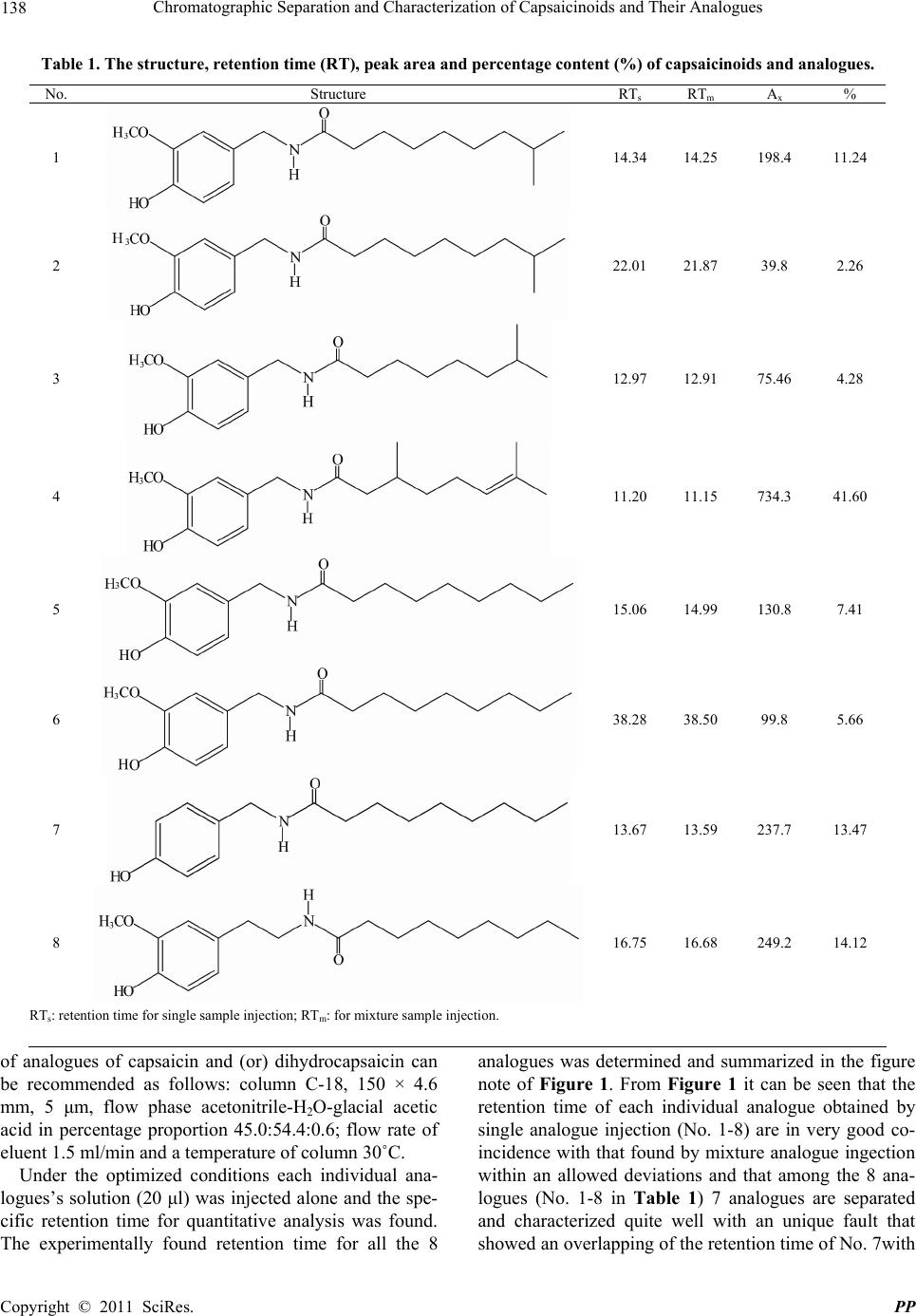 Chromatographic Separation and Characterization of Capsaicinoids and Their Analogues Copyright © 2011 SciRes. PP 138 Table 1. The structure, retention time (RT), peak area and percentage content (%) of capsaicinoids and analogues. No. Structure RTs RTm A x % 1 14.34 14.25 198.4 11.24 2 22.01 21.87 39.8 2.26 3 12.97 12.91 75.46 4.28 4 11.20 11.15 734.3 41.60 5 15.06 14.99 130.8 7.41 6 38.28 38.50 99.8 5.66 7 13.67 13.59 237.7 13.47 8 16.75 16.68 249.2 14.12 RTs: retention time for single sample injection; RTm: for mixture sample injection. of analogues of capsaicin and (or) dihydrocapsaicin can be recommended as follows: column C-18, 150 × 4.6 mm, 5 μm, flow phase acetonitrile-H2O-glacial acetic acid in percentage proportion 45.0:54.4:0.6; flow rate of eluent 1.5 ml/min and a temperature of column 30˚C. Under the optimized conditions each individual ana- logues’s solution (20 μl) was injected alone and the spe- cific retention time for quantitative analysis was found. The experimentally found retention time for all the 8 analogues was determined and summarized in the figure note of Figure 1. From Figure 1 it can be seen that the retention time of each individual analogue obtained by single analogue injection (No. 1-8) are in very good co- incidence with that found by mixture analogue ingection within an allowed deviations and that among the 8 ana- logues (No. 1-8 in Table 1) 7 analogues are separated and characterized quite well with an unique fault that howed an overlapping of the retention time of No. 7with s 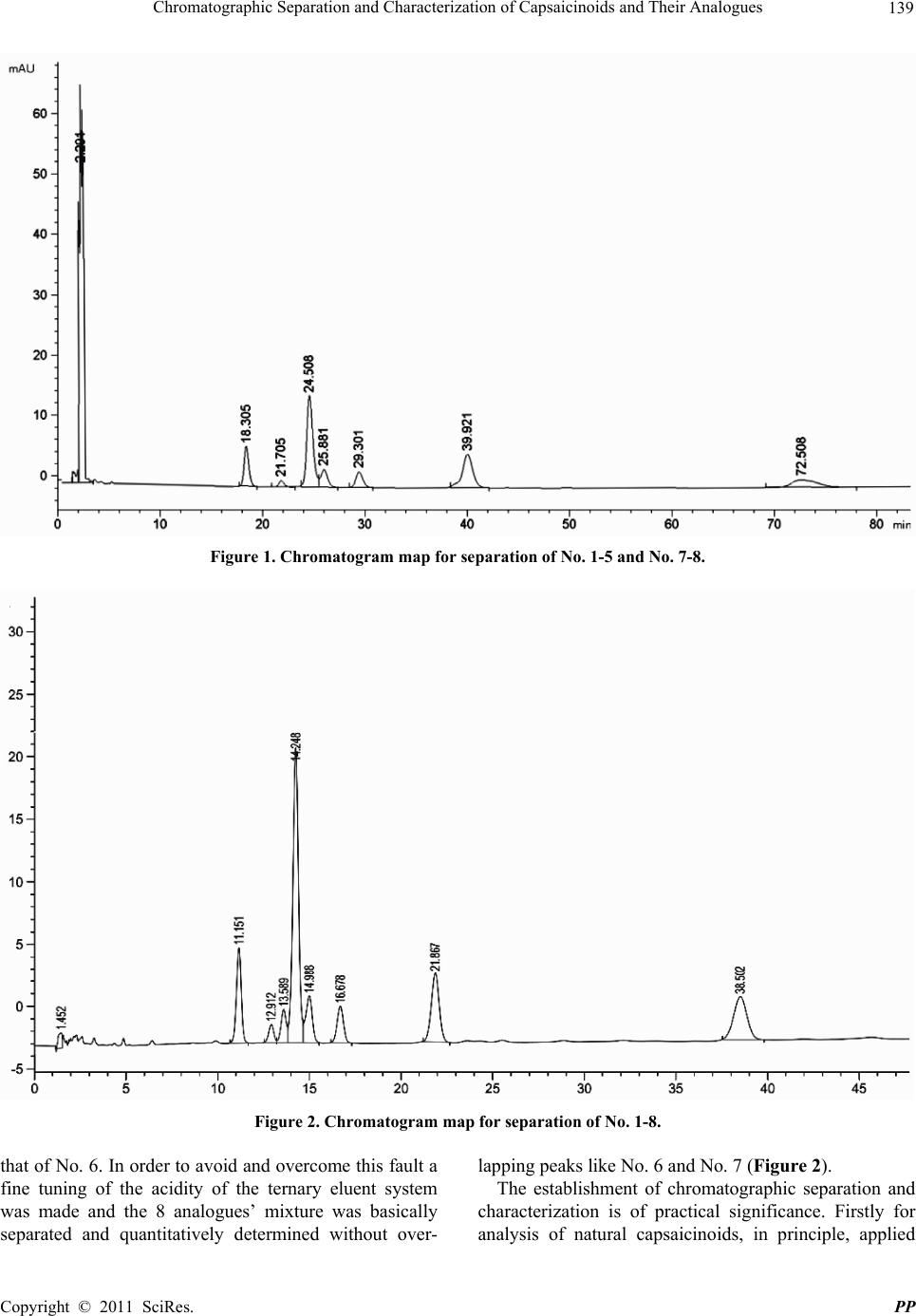 Chromatographic Separation and Characterization of Capsaicinoids and Their Analogues 139 Figure 1. Chromatogram map for separation of No. 1-5 and No. 7-8. Figure 2. Chromatogram map for separation of No. 1-8. that of No. 6. In order to avoid and overcome this fault a fine tuning of the acidity of the ternary eluent system was made and the 8 analogues’ mixture was basically separated and quantitatively determined without over- lapping peaks like No. 6 and No. 7 (Figure 2). The establishment of chromatographic separation and characterization is of practical significance. Firstly for analysis of natural capsaicinoids, in principle, applied Copyright © 2011 SciRes. PP  140 Chromatographic Separation and Characterization of Capsaicinoids and Their Analogues with minor modification, the analyzing scope of capsai- cinoids may be expanded to the minor members of cap- saicinoid, such as homohomocapsaicin and nornordi- hydrocapsaicin etc. whose content in native hot pepper amount totally less than 2% - 3%; Secondly for analysis of artificial analogues including those pungent com- pounds with similar or approximate structures to each other that are not existed in native hot pepper but are able to be synthesized in chemical laboratory. It is believed that the recommended chromatographic procedure may promote the preparative progress of high-qualified capsaicinoids and their analogues that hold promise of being candidate drugs for a potential anticarcinogenic use. 3.2. Summary 1) An optimized Chromatographically operational conditions for a apsaicinoids’ mixture separation can be summarized as follows: column C-18, 250 × 4.6 mm. 5u, flow phase acetonitrile -H2O- glacial acetic acid in per- centage (V/V) 45.0; 54.4:0.6, flow rate of eluent 1.5 ml/min and a column temperature at 30˚C. 2) 8 capsaicinoids/analogues are able to be separated and characterized with an allowed deviations and within a short period of 36 munites via 1 chromatographic ex- periment. 3) The suggested chromatographic analytical method holds promise to be used in principle for separating and characterizing native capsaicinoids as well as artificial analogues for medical usage. 4. References [1] J. L. Wang, Z. H. Peng, X. B. Zhang and B. X. Peng, “A Study of Pungency of Capsaicinoids as Affected by Their Molecular Structure Alteration,” Pharmacology and Pharmacy, in Press. [2] A. Mori, et al., “Capsaicin, a Component of Red Peppers, Inhibits the Growth of Androgen-Independent, p53 Mu- tant Prostate Cancer Cells,” Cancer Research, Vol. 66, No. 6, 2006, pp. 3222-3229. doi:10.1158/0008-5472.CAN-05-0087 [3] D. J. Morre, et al., “NADH Oxidase Activity from Sera Altered by Capsaicin Is Widely Distributed among Can- cer Patients,” Archives of Biochemistry and Biophysics, Vol. 342, No. 2, 1997, pp. 224-230. doi:10.1006/abbi.1997.0110 [4] A. M. Sanchez, et al., “Induction of the Endoplasmic Reticulum Stress Protein GADD153/CHOP by Capsaicin in Prostate PC-3 Cells: A Microarray Study,” Biochemi- cal and Biophysical Research Communications, Vol. 372, No. 4, 2008, pp. 785-791. doi:10.1016/j.bbrc.2008.05.138 [5] S. Malagarie-Cazenave, et al., “Capsaicin, a Component of Red Peppers, Induces Expression of Androgen Recep- tor via PI3K and MAPK Pathways in Prostate LNCaP cells,” FEBS Letters, Vol. 583, No. 1, 2009, pp. 141-147. doi:10.1016/j.febslet.2008.11.038 [6] A. M. Sanchez, et al., “Apoptosis Induced by Capsaicin in Prostate PC-3 Cells Involves Ceramide Accumulation, Neutral Sphingomyelinase, and JNK Activation,” Apop- tosis, Vol. 12, No. 11, 2007, pp. 2013-2024. doi:10.1007/s10495-007-0119-z [7] K. C. Brown, et al., “Capsaicin Displays Anti-Prolifera- tive Activity against Human Small Cell Lung Cancer in Cell Culture and Nude Mice Models via the E2F Path- way,” Plos One, Vol. 5, No. 4, 2010. [8] K. Ito, et al., “Induction of Apoptosis in Leukemic Cells by Homovanillic Acid Derivative, Capsaicin, through Oxidative Stress: Implication of Phosphorylation of p53 at Ser-15 Residue by Reactive Oxygen Species,” Cancer Research, Vol. 64, No. 3, 2004, pp. 1071-1078. doi:10.1158/0008-5472.CAN-03-1670 [9] G. Galati and P. J. O'Brien, “Cytoprotective and Anti- cancer Properties of Coenzyme Q versus Capsaicin,” Biofactors, Vol. 18, No. 1-4, 2003, pp. 195-205. doi:10.1002/biof.5520180222 [10] I. Diaz-Laviada, “Effect of Capsaicin on Prostate Cancer Cells,” Future Oncology, Vol. 6, No. 10, 2010, pp. 1545- 1550. doi:10.2217/fon.10.117 [11] K. Kobata, et al., “Enzymatic Synthesis of Capsaicin Analogs with Liver Acetone Powder,” Tetrahedron Let- ters, Vol. 37, No. 16, 1996, pp. 2789-2790. doi:10.1016/0040-4039(96)00429-7 C opyright © 2011 SciRes. PP |