

Paper Menu >>
Journal Menu >>
 Pharmacology & Pharmacy, 2011, 2, 122-126 doi:10.4236/pp.2011.23016 Published Online July 2011 (http://www.scirp.org/journal/pp) Copyright © 2011 SciRes. PP Unsaturated Keto and Exomethylene Pyranonucleoside Analogues of Thymine and Uracil Exhibit Potent Antioxidant Properties Chrysoula Spanou1, Niki Tzioumaki2, Stella Manta2, Panagiotis Margaris1,2, Dimitrios Kouretas1, Dimitri Komiotis2, Kalliopi Liadaki1* 1Department of Biochemistry and Biotechnology, Laboratory of Animal Physiology, University of Thessaly, Larissa, Greece; 2Department of Biochemistry and Biotechnology, Laboratory of Organic Chemistry, University of Thessaly, Larissa, Greece. Email: [email protected] Received March 29th, 2011; revised April 30th, 2011; accepted June 22nd, 2011. ABSTRACT Nucleoside analogues play an important role in the development of antitumor and antiviral agents. Specific sugar modified pyranonucleosides, like the keto and exocyclic methylene nucleosides, have been studied for their biological properties, but there is little information regarding their antioxidant activity. The present study reports the antioxidant activity of a series of α,β-unsaturated 2’- or 4’- keto and exomethylene 5’-hydroxymethyl-lacking pyranonucleosides. The antioxidant activity was evaluated using an in vitro assay which is based on the capacity to protect DNA strand scission induced by peroxyl radicals (ROO•). The majority of the tested nucleoside analogues exhibit potent antioxidant properties against ROO• radicals. We conclude that the presence of a carbon-carbon double bond at α,β-disposition to exomethylene group at position 2 of the sugar moiety and the substitution of thymine with uracil improves the antioxi- dant capacity of these analogues. Keywords: D-Lyxopyranonucleoside Derivatives, D-Arabinonucleoside Derivatives, DNA Damage, Peroxyl Radicals. 1. Introduction Nucleosides are structural modules of nucleic acids with fundamental importance in all living systems [1]. They constitute the basis for development of antitumor and antiviral agents because they act as selective inhibitors of key enzymes involved in cancer or viral replication [2], or as nucleic acid chain terminators which interrupt cel- lular replication [3-6]. Sugar modified pyranonucleosides are recognized as an important class of biologically ac- tive molecules [7-12]. Among them, unsaturated keto [13-15], as well as exomethylene pyranonucleoside ana- logues [16-19], exhibit interesting antitumor and antiviral properties, while early studies demonstrated that the presence of a primary hydroxyl and hydroxymethyl group in the sugar moiety does not seem to be critical for bio- logical activity [18,20-21]. In order to investigate the antioxidant properties of nucleoside analogues we have previously synthesized a new class of unsaturated 3’-fluoro-4’-ketonucleosides, that of N4-benzoyl cytosine and N6-benzoyl adenine, re- spectively [19]. Most of the aforementioned com- pounds showed significant ability to protect DNA from the strand breaking activity of ROO• radicals. Further- more, those nucleoside analogues containing an α,β-un- saturated keto system were the most potent against the activity of ROO• radicals. In extending these studies the antioxidant activity of a series of α,β-unsaturated 2’- or 4’- keto and exomethyl- ene 5’-hydroxymethyl-lacking pyranonucleoside analo- gues was investigated. Specifically, the present study is the first attempt to correlate structural modifications of the aforementioned nucleoside analogues with the ability to inhibit ROO• radicals-induced DNA damage. 2. Results Five out of the eight tested nucleoside analogues inhib- ited the DNA damage induced by ROO• radicals (Table 1). Compound 4 was the most potent as it exhibited 22% inhibition of radical-induced DNA damage at the con- centration of 20 μΜ. It should be noted that all com- pounds had no effect on plasmid conformation when they were tested alone at the highest concentration. 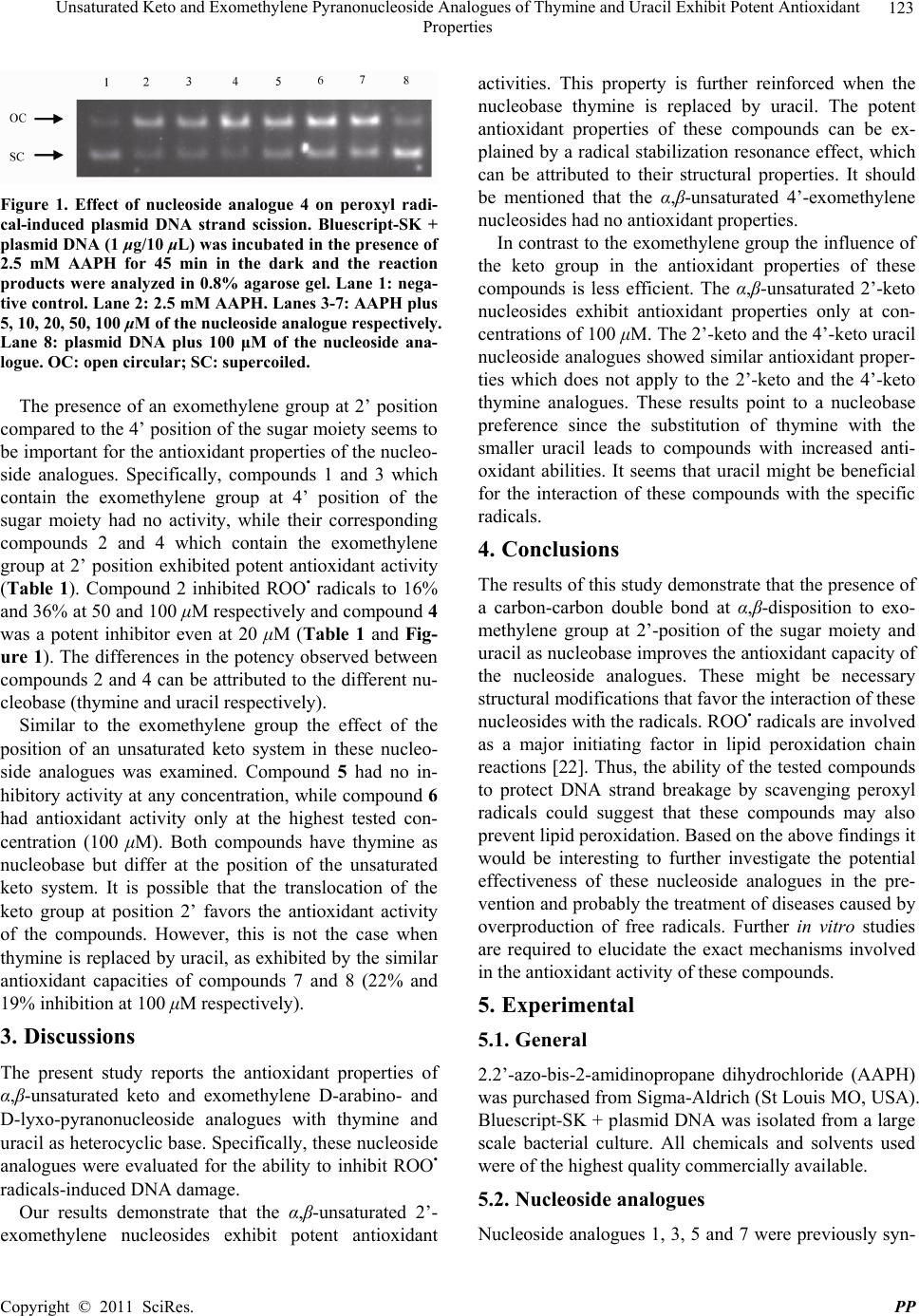 Unsaturated Keto and Exomethylene Pyranonucleoside Analogues of Thymine and Uracil Exhibit Potent Antioxidant Properties 123 Figure 1. Effect of nucleoside analogue 4 on peroxyl radi- cal-induced plasmid DNA strand scission. Bluescript-SK + plasmid DNA (1 μg/10 μL) was incubated in the presence of 2.5 mM AAPH for 45 min in the dark and the reaction products were analyzed in 0.8% agarose gel. Lane 1: nega- tive control. Lane 2: 2.5 mM AAPH. Lanes 3-7: AAPH plus 5, 10, 20, 50, 100 μM of the nucleoside analogue respectively. Lane 8: plasmid DNA plus 100 μM of the nucleoside ana- logue. OC: open circular; SC: supercoiled. The presence of an exomethylene group at 2’ position compared to the 4’ position of the sugar moiety seems to be important for the antioxidant properties of the nucleo- side analogues. Specifically, compounds 1 and 3 which contain the exomethylene group at 4’ position of the sugar moiety had no activity, while their corresponding compounds 2 and 4 which contain the exomethylene group at 2’ position exhibited potent antioxidant activity (Table 1). Compound 2 inhibited ROO• radicals to 16% and 36% at 50 and 100 μM respectively and compound 4 was a potent inhibitor even at 20 μΜ (Table 1 and Fig- ure 1). The differences in the potency observed between compounds 2 and 4 can be attributed to the different nu- cleobase (thymine and uracil respectively). Similar to the exomethylene group the effect of the position of an unsaturated keto system in these nucleo- side analogues was examined. Compound 5 had no in- hibitory activity at any concentration, while compound 6 had antioxidant activity only at the highest tested con- centration (100 μΜ). Both compounds have thymine as nucleobase but differ at the position of the unsaturated keto system. It is possible that the translocation of the keto group at position 2’ favors the antioxidant activity of the compounds. However, this is not the case when thymine is replaced by uracil, as exhibited by the similar antioxidant capacities of compounds 7 and 8 (22% and 19% inhibition at 100 μΜ respectively). 3. Discussions The present study reports the antioxidant properties of α,β-unsaturated keto and exomethylene D-arabino- and D-lyxo-pyranonucleoside analogues with thymine and uracil as heterocyclic base. Specifically, these nucleoside analogues were evaluated for the ability to inhibit ROO• radicals-induced DNA damage. Our results demonstrate that the α,β-unsaturated 2’- exomethylene nucleosides exhibit potent antioxidant activities. This property is further reinforced when the nucleobase thymine is replaced by uracil. The potent antioxidant properties of these compounds can be ex- plained by a radical stabilization resonance effect, which can be attributed to their structural properties. It should be mentioned that the α,β-unsaturated 4’-exomethylene nucleosides had no antioxidant properties. In contrast to the exomethylene group the influence of the keto group in the antioxidant properties of these compounds is less efficient. The α,β-unsaturated 2’-keto nucleosides exhibit antioxidant properties only at con- centrations of 100 μM. The 2’-keto and the 4’-keto uracil nucleoside analogues showed similar antioxidant proper- ties which does not apply to the 2’-keto and the 4’-keto thymine analogues. These results point to a nucleobase preference since the substitution of thymine with the smaller uracil leads to compounds with increased anti- oxidant abilities. It seems that uracil might be beneficial for the interaction of these compounds with the specific radicals. 4. Conclusions The results of this study demonstrate that the presence of a carbon-carbon double bond at α,β-disposition to exo- methylene group at 2’-position of the sugar moiety and uracil as nucleobase improves the antioxidant capacity of the nucleoside analogues. These might be necessary structural modifications that favor the interaction of these nucleosides with the radicals. ROO• radicals are involved as a major initiating factor in lipid peroxidation chain reactions [22]. Thus, the ability of the tested compounds to protect DNA strand breakage by scavenging peroxyl radicals could suggest that these compounds may also prevent lipid peroxidation. Based on the above findings it would be interesting to further investigate the potential effectiveness of these nucleoside analogues in the pre- vention and probably the treatment of diseases caused by overproduction of free radicals. Further in vitro studies are required to elucidate the exact mechanisms involved in the antioxidant activity of these compounds. 5. Experimental 5.1. General 2.2’-azo-bis-2-amidinopropane dihydrochloride (AAPH) was purchased from Sigma-Aldrich (St Louis MO, USA). Bluescript-SK + plasmid DNA was isolated from a large scale bacterial culture. All chemicals and solvents used were of the highest quality commercially available. 5.2. Nucleoside analogues Nucleoside analogues 1, 3, 5 and 7 were previously syn- Copyright © 2011 SciRes. PP 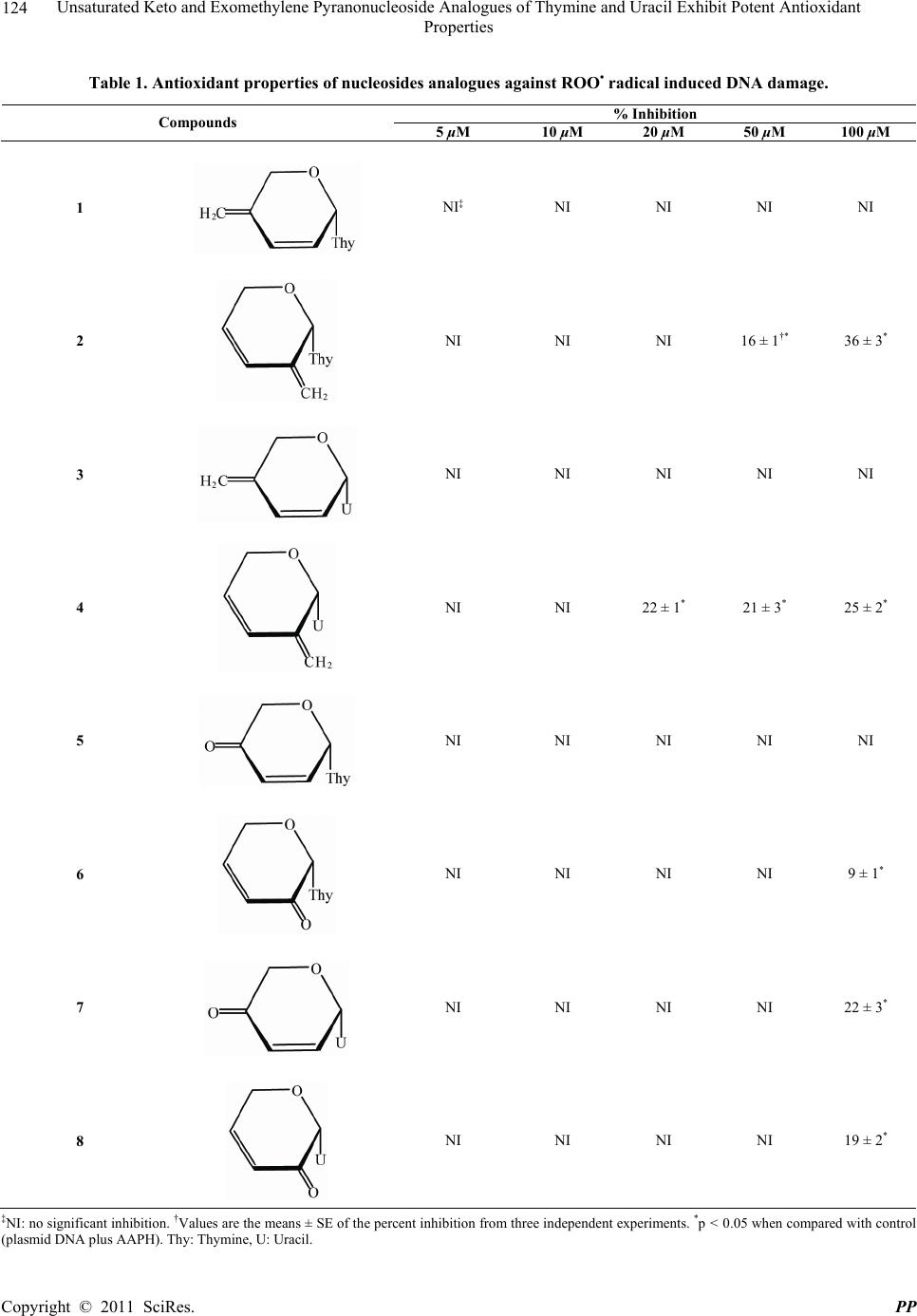 Unsaturated Keto and Exomethylene Pyranonucleoside Analogues of Thymine and Uracil Exhibit Potent Antioxidant Properties Copyright © 2011 SciRes. PP 124 Table 1. Antioxidant properties of nucleosides analogues against ROΟ• radical induced DNA damage. % Inhibition Compounds 5 μΜ 10 μΜ 20 μΜ 50 μΜ 100 μΜ 1 ΝΙ‡ ΝΙ ΝΙ ΝΙ ΝΙ 2 NI NI NI 16 ± 1†* 36 ± 3* 3 ΝΙ ΝΙ ΝΙ ΝΙ ΝΙ 4 NI NI 22 ± 1* 21 ± 3* 25 ± 2* 5 ΝΙ ΝΙ ΝΙ ΝΙ ΝΙ 6 NI NI NI NI 9 ± 1* 7 NI NI NI NI 22 ± 3* 8 NI NI NI NI 19 ± 2* ‡NI: no significant inhibition. †Values are the means ± SΕ of the percent inhibition from three independent experiments. *p < 0.05 when compared with control (plasmid DNA plus AAPH). Thy: Thymine, U: Uracil. 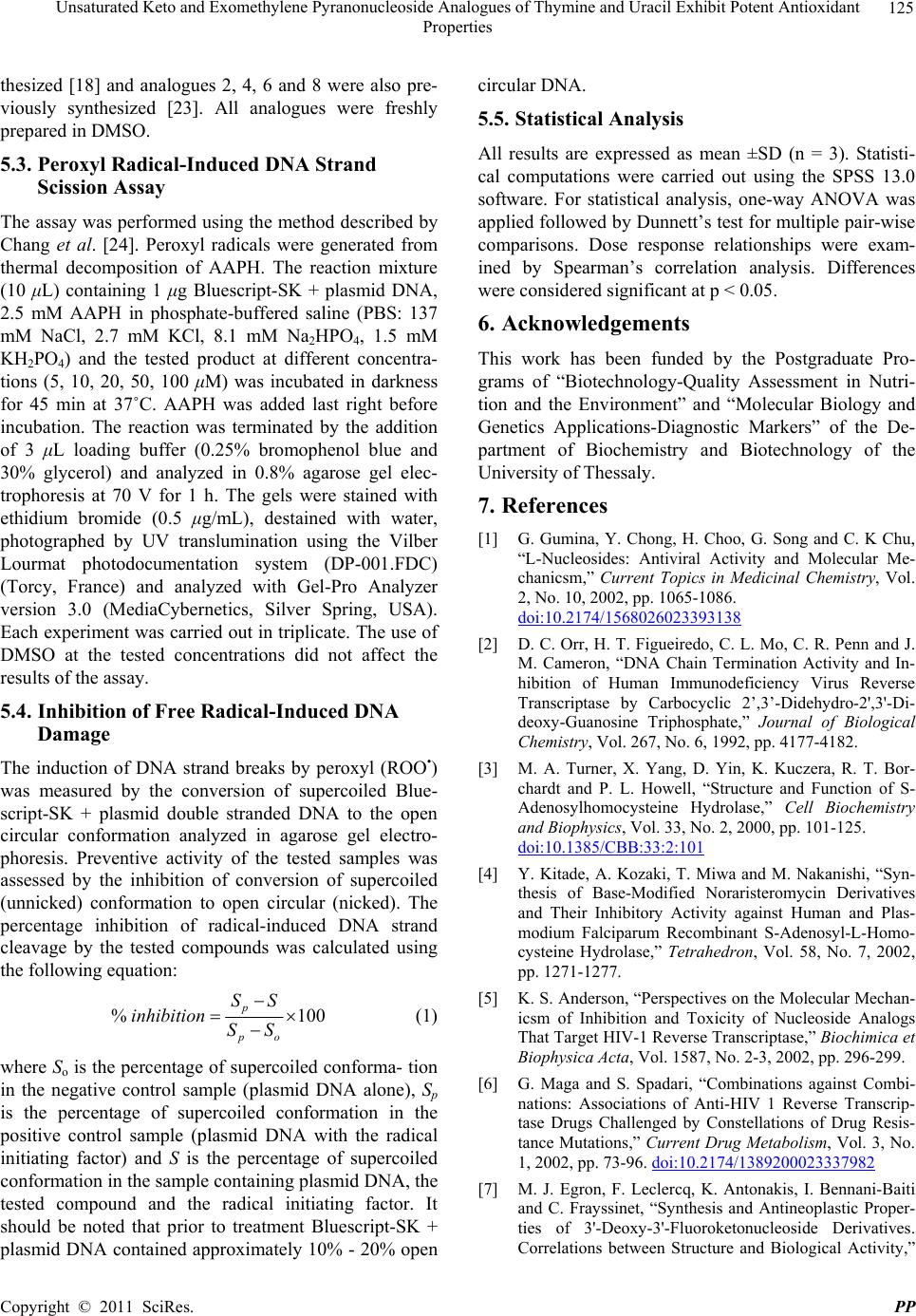 Unsaturated Keto and Exomethylene Pyranonucleoside Analogues of Thymine and Uracil Exhibit Potent Antioxidant Properties 125 thesized [18] and analogues 2, 4, 6 and 8 were also pre- viously synthesized [23]. All analogues were freshly prepared in DMSO. 5.3. Peroxyl Radical-Induced DNA Strand Scission Assay The assay was performed using the method described by Chang et al. [24]. Peroxyl radicals were generated from thermal decomposition of AAPH. The reaction mixture (10 μL) containing 1 μg Bluescript-SK + plasmid DNA, 2.5 mM AAPH in phosphate-buffered saline (PBS: 137 mM NaCl, 2.7 mM KCl, 8.1 mM Na2HPO4, 1.5 mM KH2PO4) and the tested product at different concentra- tions (5, 10, 20, 50, 100 μM) was incubated in darkness for 45 min at 37˚C. AAPH was added last right before incubation. The reaction was terminated by the addition of 3 μL loading buffer (0.25% bromophenol blue and 30% glycerol) and analyzed in 0.8% agarose gel elec- trophoresis at 70 V for 1 h. The gels were stained with ethidium bromide (0.5 μg/mL), destained with water, photographed by UV translumination using the Vilber Lourmat photodocumentation system (DP-001.FDC) (Torcy, France) and analyzed with Gel-Pro Analyzer version 3.0 (MediaCybernetics, Silver Spring, USA). Each experiment was carried out in triplicate. The use of DMSO at the tested concentrations did not affect the results of the assay. 5.4. Inhibition of Free Radical-Induced DNA Damage The induction of DNA strand breaks by peroxyl (ROO•) was measured by the conversion of supercoiled Blue- script-SK + plasmid double stranded DNA to the open circular conformation analyzed in agarose gel electro- phoresis. Preventive activity of the tested samples was assessed by the inhibition of conversion of supercoiled (unnicked) conformation to open circular (nicked). The percentage inhibition of radical-induced DNA strand cleavage by the tested compounds was calculated using the following equation: %1 p po SS inhibition SS 00 (1) where So is the percentage of supercoiled conforma- tion in the negative control sample (plasmid DNA alone), Sp is the percentage of supercoiled conformation in the positive control sample (plasmid DNA with the radical initiating factor) and S is the percentage of supercoiled conformation in the sample containing plasmid DNA, the tested compound and the radical initiating factor. It should be noted that prior to treatment Bluescript-SK + plasmid DNA contained approximately 10% - 20% open circular DNA. 5.5. Statistical Analysis All results are expressed as mean ±SD (n = 3). Statisti- cal computations were carried out using the SPSS 13.0 software. For statistical analysis, one-way ANOVA was applied followed by Dunnett’s test for multiple pair-wise comparisons. Dose response relationships were exam- ined by Spearman’s correlation analysis. Differences were considered significant at p < 0.05. 6. Acknowledgements This work has been funded by the Postgraduate Pro- grams of “Biotechnology-Quality Assessment in Nutri- tion and the Environment” and “Molecular Biology and Genetics Applications-Diagnostic Markers” of the De- partment of Biochemistry and Biotechnology of the University of Thessaly. 7. References [1] G. Gumina, Y. Chong, H. Choo, G. Song and C. K Chu, “L-Nucleosides: Antiviral Activity and Molecular Me- chanicsm,” Current Topics in Medicinal Chemistry, Vol. 2, No. 10, 2002, pp. 1065-1086. doi:10.2174/1568026023393138 [2] D. C. Orr, H. T. Figueiredo, C. L. Mo, C. R. Penn and J. M. Cameron, “DNA Chain Termination Activity and In- hibition of Human Immunodeficiency Virus Reverse Transcriptase by Carbocyclic 2’,3’-Didehydro-2',3'-Di- deoxy-Guanosine Triphosphate,” Journal of Biological Chemistry, Vol. 267, No. 6, 1992, pp. 4177-4182. [3] M. A. Turner, X. Yang, D. Yin, K. Kuczera, R. T. Bor- chardt and P. L. Howell, “Structure and Function of S- Adenosylhomocysteine Hydrolase,” Cell Biochemistry and Biophysics, Vol. 33, No. 2, 2000, pp. 101-125. doi:10.1385/CBB:33:2:101 [4] Y. Kitade, A. Kozaki, T. Miwa and M. Nakanishi, “Syn- thesis of Base-Modified Noraristeromycin Derivatives and Their Inhibitory Activity against Human and Plas- modium Falciparum Recombinant S-Adenosyl-L-Homo- cysteine Hydrolase,” Tetrahedron, Vol. 58, No. 7, 2002, pp. 1271-1277. [5] K. S. Anderson, “Perspectives on the Molecular Mechan- icsm of Inhibition and Toxicity of Nucleoside Analogs That Target HIV-1 Reverse Transcriptase,” Biochimica et Biophysica Acta, Vol. 1587, No. 2-3, 2002, pp. 296-299. [6] G. Maga and S. Spadari, “Combinations against Combi- nations: Associations of Anti-HIV 1 Reverse Transcrip- tase Drugs Challenged by Constellations of Drug Resis- tance Mutations,” Current Drug Metabolism, Vol. 3, No. 1, 2002, pp. 73-96. doi:10.2174/1389200023337982 [7] M. J. Egron, F. Leclercq, K. Antonakis, I. Bennani-Baiti and C. Frayssinet, “Synthesis and Antineoplastic Proper- ties of 3'-Deoxy-3'-Fluoroketonucleoside Derivatives. Correlations between Structure and Biological Activity,” Copyright © 2011 SciRes. PP  Unsaturated Keto and Exomethylene Pyranonucleoside Analogues of Thymine and Uracil Exhibit Potent Antioxidant Properties 126 Carbohydrate Research, Vol. 248, 1993, pp. 143-150. doi:10.1016/0008-6215(93)84122-M [8] M. Alaoui, M. J. Egron, M. Bessodes, K. Antonakis and I. Chouroulinkov, “Relationship between the Structure and Cytotoxic Activity of New Unsaturated Ketonucleosides Tested on Eight Cell Lines,” European Journal of Me- dicinal Chemistry, Vol. 22, No. 4, 1987, pp. 305-310. doi:10.1016/0223-5234(87)90267-4 [9] F. Leclercq and K. Antonakis, “Unsaturated Ketonucleo- tides: Synthesis of and Anomers of 1-(2,3-dide- oxy-6-O-diethoxyphosphoryl-D-glycero-hex-2-enopyra- nosyl-4-ulose) Thymine,” Carbohydrate Research, Vol. 263, No. 2, 1994, pp. 309-313. doi:10.1016/0008-6215(94)00168-5 [10] G. S. Bisacchi, S. T. Chao, C. Bachard, J. P. Daris, S. Innaimo, G. A. Jacobs, O. Kocy, P. Lapointe, A. Martel, Z. Merchant, W. A. Slusarchyk, J. E. Sundeen, M. G. Young, R. Colonno and R. Zahler, “BMS-200475, a Novel Carbocyclic 2′-Deoxyguanosine Analog with Po- tent and Selective Anti-Hepatitis B Virus Activity in Vi- tro,” Bioorganic & Medicinal Chemistry Letters, Vol. 7, No. 2, 1997, pp. 127-132. doi:10.1016/S0960-894X(96)00594-X [11] S. J. Yoo, H. O. Kim, Y. Lim, J. Kim and L. S. Jeong, “Synthesis of Novel (2R,4R)- and (2S,4S)-Iso-Dideoxy- nucleosides with Exocyclic Methylene as Potential Anti- viral Agents,” Bioorganic & Medicinal Chemistry, Vol. 10, No. 1, 2002, pp. 215-226. doi:10.1016/S0968-0896(01)00266-8 [12] P. Gunaga, M. Baba and L. S. Jeong, “Asymmetric Syn- thesis of Novel Thioisodideoxynucleosides with Exocyc- lic Methylene as Potential Antiviral Agents,” Journal of Organic Chemistry, Vol. 69, No. 9, 2004, pp. 3208-3211. [13] S. Manta, G. Agelis, T. Botić, A. Cencič and D. Komiotis, “Fluoro-Ketopyranosyl Nucleosides: Synthesis and Bio- logical Evaluation of 3-fluoro-2-keto-β-D-glucopyranosyl Derivatives of N4-benzoyl Cytosine,” Bioorganic & Me- dicinal Chemistry, Vol. 15, No. 2, 2007, pp. 980-987. doi:10.1016/j.bmc.2006.10.033 [14] S. Manta, G. Agelis, T. Botić, A. Cencič and D. Komiotis, “Unsaturated Fluoro-Ketopyranosyl Nucleosides: Syn- thesis and Biological Evaluation of 3-fluoro-4-keto-β-D- glucopyranosyl Derivatives of N4-benzoyl Cytosine and N6-benzoyl Adenine,” European Journal of Medicinal Chemistry, Vol. 43, No. 2, 2008, pp. 420-428. doi:10.1016/j.ejmech.2007.04.001 [15] S. Manta, E. Tsoukala, N. Tzioumaki, A. Goropevšek, R. T. Pamulapati, A. Cencič, J. Balzarini and D. Komiotis, “Dideoxy Fluoro-Ketopyranosyl Nucleosides as Potent Antiviral Agents: Synthesis and Biological Evaluation of 2,3- and 3,4-dideoxy-3-fluoro-4- and -2-keto-β-D-glu- copyranosyl Derivatives of N4-benzoyl Cytosine,” Euro- pean Journal of Medicinal Chemistry, Vol. 44, No. 6, 2009, pp. 2696-2704. doi:10.1016/j.ejmech.2009.01.020 [16] G. Agelis, N. Tzioumaki, T. Botić, A. Cencič and D. Synthesis and Biological Evaluation of 1-(2,3,4-trideoxy- 2-methylene-β-D-glycero-hex-3-enopyranosyl)thymine,” Bioorganic and Medicinal Chemistry, Vol. 15, No. 16, 2007, pp. 5448-5456. Komiotis, “Exomethylene Pyranonucleosides: Efficient doi:10.1016/j.bmc.2007.05.055 [17] G. Agelis, N. Tzioumaki, T. Tselios, T. Botić, A. Cencič and D. Komiotis, “Synthesis and Molecular Modelling of Unsaturated Exomethylene Pyranonucleoside Analogues with Antitumor and Antiviral Activities,” European Journal of Medicinal Chemistry, Vol. 43, No. 7, 2008, pp. 1366-1375. doi:10.1016/j.ejmech.2007.10.014 [18] N. Tzioumaki, E. Tsoukala, S. Manta, G. Agelis, J. Bal- zarini and D. Komiotis, “Synthesis, Antiviral and Cy- tostatic Evaluation of Unsaturated Exomethylene and keto D-lyxopyranonucleoside Analogues,” Archiv der Pharmazie, Vol. 342, No. 6, 2009, pp. 353-360. doi:10.1002/ardp.200900004 [19] C. Spanou, S. Manta, D. Komiotis, A. Dervishi and D. Kouretas, “Antioxidant Activity of a Series of Fluori- nated Pyrano-nucleoside Analogues of N4-benzoyl Cyto- sine and N6-benzoyl Adenine,” International Journal of Molecular Sciences, Vol. 8, No. 7, 2007, pp. 695-704. doi:10.3390/i8070695 [20] S. Manta, N. Tzioumaki, E. Tsoukala, A. Panagiotopou- lou, M. Pelecanou, J. Balzarini and D. Komiotis, “Un- saturated Dideoxy Fluoro-Ketopyranosyl Nucleosides as New Cytostatic Agents: A Convenient Synthesis of 2,6- dideoxy-3-fluoro-4-keto-β-D-glucopyranosyl Analogues of Uracil, 5-Fluorouracil, Thymine, N4-benzoyl Cytosine and N6-benzoyl Adenine,” European Journal of Medici- nal Chemistry, Vol. 44, No. 11, 2009, pp. 4764-4771. doi:10.1016/j.ejmech.2009.06.013 [21] S. Manta, E. Tsoukala, N. Tzioumaki, C. Kiritsis, J. Bal- zarini and D. Komiotis, “Synthesis of 4,6-dideoxy-3- fluoro-2-keto-β-D-glucopyranosyl Analogues of 5-Fluo- rouracil, N6-Benzoyl Adenine, Uracil, Thymine, N4-Ben- zoyl Cytosine and Evaluation of Their Antitumor Activi- ties,” Bioorganic Chemistry, Vol. 38, No. 2, 2010, pp. 48- 55. doi:10.1016/j.bioorg.2009.11.001 [22] C. Mylonas and D. Kouretas, “Lipid Peroxidation and Tissue Damage,” In Vivo, Vol. 13, No. 3, 1999, pp. 295- 310. doi:10.1016/j.ejmech.2011.01.005 [23] N. Tzioumaki, S. Manta, E. Tsoukala, J. V. Voorde, S. Liekens, D. Komiotis and J. Balzarini, “Synthesis and Biological Evaluation of Unsaturated Keto and Exome- thylene D-Arabinopyranonucleoside Analogues: Novel 5-Fluorouracil Analogues That Target Thymidylate Syn- thase,” European Journal of Medicinal Chemistry, Vol. 46, No. 4, 2011, pp. 993-1005. doi:10.1021/jf0100907 [24] S. T. Chang, J. H. Wu, S. Y. Wang, P. L. Kang, N. S. Yang and L. F. Shyur, “Antioxidant Activity of Extracts from Acacia Confusa Bark and Heartwood,” Journal of Agricultural and Food Chemistry, Vol. 49, No. 7, 2001, pp. 3420-3424. C opyright © 2011 SciRes. PP |