

Paper Menu >>
Journal Menu >>
 Psychology 2011. Vol.2, No.4, 388-392 Copyright © 2011 SciRes. DOI:10.4236/psych.2011.24061 Some Personal and Social Variables That Affect Extra Sensory Perception (Sixth Sense) Samah Khaled Abd El Kawy Zahran Child Education Department, Women’s College, Ain Shams University, Cairo, Egypt. Email: [email protected] Received April 23rd, 2011; revised May 27th, 2011; accepted July 2nd, 2011. If we accept the importance of the 6th sense in developing human community, we have to study the variables that may affect it, that may develop or control this frontier human ability. The current study tries to survey some personal and social variables that may affect this sense. These variables are: gender, age, country, educational level, monthly income, marital status, one hygiene, hobbies, personality type, one heredity of the sixth sense, one superior sense (the best sense) of the 5 ordinary senses, one case during 6th sense experience and day time during 6th sense experience. The author uses descriptive method on an intended sample, which experience 6th sense. By applying a criterion measure consists of these previous variables. Results showed that there are sig- nificant effects among the study variables, with empathies on early childhood importance in discovering and educating this frontier ability. Keywords: Sixth (6th) Sense, Social Variables, Personal Variables Introduction The Sixth Sense (Extra-Sensory Perception) Mankind’s advances in technology and science have so far outstripped his humanistic tendencies that we are in danger of obliterating ourselves. What humanity needs in order to catch up with its own technology is to allow the right, intuitive side of the brain to flower. We are suffering from the so-called (culture lag) wherein man has built weapons that can destroy himself without knowing how to control them. Perhaps through the balancing of intuition with logic our next generation can establish a balance between man’s humanity and inhumanity. (Tanous & Donnely, 2009). Intuition, extrasensory perception (ESP) and sixth sense are sometimes synonymous; they all refer to mind ability to communicate without using 5 common chan- nels of senses. ESP and psychic (PSI) can be synonymous, also. While esp. is a term popularized by J. B. Rhine and refers to information perceived by telepathy, clairvoyance or precogni- tion. Psi used as a term for all ESP type and psychokinetic phenomena. (Radin, 1997). So that 6th sense or (ESP) is the ability to sense something by means other than the main 5 senses of touch, taste, smell, sight and hearing. (Wikitionary, 2010). Intuition can be defined as a synthetic psychological function that apprehends the totality of a given situation (Vaughan, 1990 IN Khatri & Alivin, 1990s). It is a subcon- scious and an irrational process. It based on a deep understand- ing of the situation. It is a complex phenomenon that draws from the store of knowledge in our subconscious and is rooted in past experience. It is quick but not necessarily biased or emotion. (Khatri & Alivin, 1990s). Finally it can be defined as a direct acquisition of knowledge; some forms of intuitive in- formation come from the mind capacity to access information from distant location (Radin, 2007). Some forms of the sixth sense: The mainly forms of (ESP) or 6th senses are: 1) Telepathy: Sending of thoughts to another. It has been called thought transference, for example, it acts like this: person A is aware of person B’s thoughts at the moment person B is thinking them (Tanous & Donnelly, 2009). 2) Clairvoyance: Visual perception of events or things. This phenomenon consists of seeing the distant event simultaneously with its occurrence (Tanous & Donnelly, 2009). 3) Precognition: Knowledge of the future. It is a foretelling of an event that has not yet happened, the person experiencing the event must have had no way of knowing of it in advance. (Tanous & Donnelly, 2009). 4) Premonition: An experience akin to precognition and can best be defined as a vague, uneasy feeling that something is going to happen, but the something provides no specific infor- mation. (Tanous & Donnelly, 2009). 5) Psychometry: Picking up information by touching an ob- ject. It is a channel for picking up information about person or events, whether past present or future, from touching an inani- mate object or from seeing its presence through energies ema- nated. (Tanous & Donnelly, 2009). 6) Psychokinesis (PK): Moving objects without physical ex- ertion. It is the influence or energy a person exerts upon an object without the use of physical energy, the moving of an object through mental power alone. (Tanous & Donnelly, 2009). 7) Finally, there are psychic (PSI) dreams; most psi dreams appear to deal with telepathy, clairvoyance, precognition or premonition events. (Tanous & Donnelly, 2009). The 6th Sense and Its Relationship with Some Variables For many years scientists have examined the possible exis- tence of ESP, many researchers have argued that the results of these experiments provide strong support for the existence of  S. K. A. EL K. ZAHRAN 389 psychic ability (Wiseman, 2011). So that, there are number of works that study the 6th sense and its relationship with some variables, some from the physiological view, as the study cited by Radin: The significant correlations in brain waves between isolated identical twins, this study was reported in the journal Science in 1965 by Duane and Behrendt (Psychology Today, 2009). Also, a new study by Rollin 2004 provides evidence that the heart responds to future events and indicates women to be naturally more attuned to their intuition. Intuition has often thought of a mysterious 6th sense. Heart Math researchers found that we can actually be aware of an event five to seven seconds before it happens. (Powers, 2004). A new theory sug- gests that the anterior singulate cortex (ACC) may actually function as an early warning system that works at a subcon- scious level to help us recognize and avoid high risk situations. A new research from Washington University in St. Louis has defined a brain region that clearly acts as an early warning sys- tem and helps us adjust our behavior to avoid dangerous situa- tions. This brain study points to this region in relation to 6th sense (Science news blog, 2009). 6th Sense and the other five senses Backwards from this the discovery of the sixth sense was announced in a paper read at the world congress of medical men in Naples in 1909, a French academy Dr. Luis at Batavia School worked out a theory of sight through skin, as he men- tioned: the power in the blind child is due to an unusual devel- opment of external sensory nerves, in other words, the facial nerves of the blind have probably become so delicate in percep- tions as to afford these unfortunate children a sight by skin. (New York Times, 1915). 6th Sense and Personality type A study conducted by the Institute of Noetic Sciences in 2003, asked 465 people questions about their education, aller- gies, bodily sensitivities, mental practices, and unusual experi- ences. Found strong differences between men and women, con- sistent with the results of other surveys. Also they found that left-handed and ambidextrous people were significantly more likely to believe in exceptional experiences than right handed people and that younger people were significantly more likely to believe in exceptional experiences than older ones. Then by comparing 55 people who reported no experiences of telepathy against 60 who frequently reported such experiences, found a clear pattern emerging about bodily sensitivities. Finally, their findings made able to form a profile of a person very likely to report psychic experiences: a left-handed female who is thirty something or younger, physically highly sensitive, suffers from chronic anxiety, is somewhat introverted, make decisions based on feelings than logic, practices one or more creative arts, and engages in some forms of mental discipline like meditation, is open unconventional claims, and is interested more in possibili- ties than facts . (Radin, 2006). 6th sense and age There are some experiments indicated some aspects of the 6th sense among children aged from 8 to 12 old. In fact ESP plays an important role in the lives of many creative individu- als. As they are spontaneous, it is important not to push a child to produce them, instead we may: create an atmosphere of un- derstanding and caring, give older child books on ESP, keep a record on psychic happing, respond naturally to your child’s ESP experiences and give them ESP tests. (Khatri & Alivin, 2009). 6th sense and mental ability Gardener Murphy once states that, there is a relationship between creativeness and ESP. So that he claimed, we should take care about elementary school students as well as we do with adolescent students. He added that we should treat our children’s psychic abilities not as odd experiences that we should hide. Attitude is important and comprehension is im- portant too. Child should be able to transfer psychic abilities into everyday living; all psychic experiences will give the child a total picture of how to succeed. (Tanous, 2009). Sargent also concluded—from his experiment on 25 Zener cards at the Uni- versity of Cambridge that ESP is associated with a relaxed state of mind and a freer, more atavistic level of altered conscious- ness. (Wikipedia, 2010). 6th sense and the belief of psychic ability Personality’s measures have showed that people who belief in PSI tend to score above chance, while who not belief in it show null results. This is become known as “sheep-goat effect”. (Wikipedia, 2010). Wiseman with his mind machine experi- ment showed a relationship between participants’ ESP scores and their gender, belief in psychic ability and degree of pre- dicted success. (Wiseman, 2011). The methodology of studying 6th sense Parapsychologists have carried out a large number of studies examining the possible existence of ESP. One of the most prin- ciple types of experimental design uses the “forced choice” procedure, in which are asked to guess the identity of hidden targets. Many researchers have argued that the results of these studies support the existence of ESP. For example, Pratt et al. (1940/1966) reviewed findings from more than 3, 6 million guess made in over 140 forced choice, all were independently significant. (Wiseman, 2011). There were also, free-response measures used by Carington in the 1930s. This included relaxa- tion, meditation, REM-sleep and Ganzfeld (a mild sensory dep- rivation procedure). These studies have proved to be more suc- cessful than Rheine’s forced choice paradigm, with meta- analysis evidencing reliable effects and many confirmation replication studies (Wikipedia, 2010). From the related studies and the theoretical frame work- mentioned above, we may conclude that: 1) We do not need to examine the existence of 6th sense now, instead we need to draw a map about it. 2) Neither of these studies used method- ology except experimental one. 3) With this methodology, studies examined some variables that affect 6th sense, which are: Gender, age, education, heredity (as in twin studies), al- lergy or bodily sensitive, belief in exceptional experiences and mental ability. So the important and new manipulation in the current study is that, it is intended to draw a map of the 6th sense by trying to answer these mainly two questions: what is one condition through exceptional experience?—What are the circumstances surrounding one through this experiences? To answer the first question the author examined personal variables, while an- swering the second question the author examined social vari- ables. To capture and close up to the identity of this ESP we need to know: one’s age, gender, educational/economic and marital status, mood through hobbies, heredity, hygiene and best sense of one’s 5 senses. (Personal). Also, we need to know: one’s geographical region, circumstances and day time  S. K. A. EL K. ZAHRAN 390 during this experience. (Social). Some of these variables men- tioned above and the author intended to examine through de- scriptive way, while others not mentioned and consisted a new approach in this stud; but have their logic from the theoretical frame work; as region-place and time in the light of Quantum Theory, which describes that everything in particular time and environment interacting in quanta manner (Radin, 2006). Also, marital status may reflect telepathy comparing between single and married one and so on. Finally, the importance of the cur- rent study therefore, is to examine the effect of some personal and social variables that may develop or control this frontier ability; in order to draw a map of this sense—as Rheine once described it, as unconscious mental process, which may com- plete understanding of human personality (Wikipedia, 2010). And to develop it from early childhood as much as possible. Design and Procedures Design: The design represented (13) independent variables × (2) dependent variables. The independent variables are: 1) Per- sonal: age, gender, educational status, economic status, marital status, hygiene, hobbies—personal not social, personality ty pe, heredity and one best sense of 5 senses. 2) Social: geographical region, one’s circumstances (case) during the experience, one’s social hobbies and day time of the experience. The dependent ones are: forms of sixth sense and frequency of the sixth sense (rare, sometimes, usually). The forms of 6th sense that sample experienced, only, are: telepathy, premonition, PSI dreams and Psychokinesis (PK): in evil eye upon them (as they thought they have been envied). Procedure: The researcher explains definition of all 6th sense experiences; so that the sample members could define and express them; because these phenomena and their defini- tions are not known to the most of people here in our culture, in Egypt. Finally, it is an intended sample from people who have experienced these forms only of 6th sense. As mentioned be- fore, the new methodology of the current study indented to examine people as they experience 6th sense in natural situa- tions, not artificial one as experiments. By asking them: to de- scribe their experiences through a criterion measurement. Hypothesis 1) There are differences in 6th sense type according to: A—Gender. B—Age. C—One’s country. D—One’s educa- tional level. E—One’s monthly income. F—One’s marital status. H—One’s hygiene& Heredity. I-One’s best sense of his/her 5 ordinary senses. J—One’s personal hobbies. (Personal variables).K—Personality Type as one perceived. 2) There are differences in 6th sense type according to: A—One’s case/circumstances during experience. B—Time of the 24 hours through the experience. C—One’s social hob- bies (Social variables). Sample Description Table 1 (A) and (B) describes the sample with the study vari- ables: Sample consists of (50) participants, whom selected ac- cording to their exceptional experiences and their approval to respond to the author’s measurement: As shown in appendix 2. Results Scale Validity To obtain scale validity I have relayed on the questionnaire’s content about sixth sense with its affect on the mentioned social variables (content—descriptive validity, obtained by comparing it with the theoretical frame work). The author also, computed scale validity by comparing scale for adults with scale for chil- dren. T.Test was significant 0, 05. To obtain reliability internal consistency was assessed by computing Cronbach Alpha. Re- sults indicate Alpha of about 0.60 (0.58). The hypothesis examination: By computing Multivariate ANOVA (MAN OVA) was used: to examine differences among participants within the study variables. In order to examine the effect of 13 independent variables on 6th sense & 6th sense frequency, the author has divided them into 5 groups, as shown in Table 2. Table 2 appendix 2: Study’s results. From Table 2: Tests that are significant: 1) Bartlett’s Test shows the significant result (p .01).That means, the correlation among independent variables are high. 2) Multivariate Tests show that there are differences among dependent variables (telepathy, psi dreams, premonition and PK) according to the only significant independent variables (age, country, education, all personality types, one’s case during experience and day- time). 3) Levine’s Test refers that the error variance of the de- pendent variables are equal across majority of groups. 5) Post Hoc test refers to the source of variation among categories. There wasn’t variation among groups except case during ex- perience and day time variables. Discussion The current study shows from its significant results that the independent variables affect 6th sense & its frequency are: age, geographical place (country), education status, personality type, case during experience and daytime. According to sample: youth 19 - 45 are more than another age, which may consists with Noetic Institute study’s result, according to, the current study’s me a suremen t : The fi rst ti me t hat sa mple expe rien ce 6th sense was more frequent in adolescence, which may refers or suggests that 6th sense may flourish not begin in puberty . This is corresponding to the importance of education, which men- tioned in previous theoretical frame. The new approach in the current study is asking pre-school child of 5 years, which re- sults indicate here PSI dreams experience. Also, this suggests that the 6th sense may begins before adolescence and need more studies .The significant of geographical place and day- time, refers to specific place & time ESP needed to happen during it. This corresponds to the importance of physical envi- ronment surrounding experience, as Carl Jung’s idea of the collective unconscious, which means the existence of some form of nonlocal memory permeating time and space that can resonate with (Radin, 2006). The education status refers to the importance of social environment that adults have to develop this ability according to, which consists with previous result and related frame work. Personality type with the sample de-  S. K. A. EL K. ZAHRAN 391 scription (Table 1) consists with Noetic Institute result, which refers—as mentioned above that- one anxiety, introverted, sen- sitive and emotional than logic is more affected by PSI experi- ences than others. Another important result in this study have shown that: even early childhood may exhibit ESP experience that indicates the importance of discovering and educating it from early years. Finally, the frequency of ESP experience increase during disasters more than another times; as results were significant with all categories. This exhibits new result in the current study and shows the need for more studies to an- swer: Why do people experience more PSI—ESP or 6th sense, as mentioned before-experiences while they are frightened or during disasters? The independent variables which aren’t significant are: gen- der, although the previous studies showed that female experi- ences 6th sense more than male. Also the sample experienced more envied experiences (evil eye)—on them-from aged women than from men. This is a new record for the current study, also. Income and marital status shows insignificant re- sults, with their frequency. The importance of heredity is not required here by the sample response. But it is important that one have a family member with 6th sense, or believe in its ex- istence; because of education and attitude towards it. Also, results show that: it isn’t important that one have any superior sense from his/her 5 senses. 6th sense isn’t correlated with hobbies, according to current results, but needs hygiene for its frequency; thus all people ill and healthy experience it but its frequency refers to good health as result suggests. These recent results are new and suggest more studies to examine them. Finally, one important limitation of the current study is the small sample, that global study is required to draw a map all over the world for this important phenomena and frontier abil- ity. References Khatri, N., & Alivin, H. (2011). Role of intuition in strategic decision making (pp. 1-37). Singapore: Nanyang Technological University. www.nta.edu.sg/nbs/sabre/working_papers/01-97.pdf Powers, R. (2004). Sounding circle: The sixth sense: Dr. Rollin McCraty research at IHM. URL (last checked 6 December 2010) soundingcircle.com Radin, D. (1997). The conscious universe: the scientific truth of psychic phenomena (p. 15). New York: Harper Collins Publishers Inc. Radin, D. (2006). Entangled minds: Extrasensory experiences in a quantum reality (pp. 44-46, 249, 261). New York: Simon& Schuster, Inc. Radin, D. (2007). Consciousness and our entangled reality. Explore, 3, 610. doi:10.1016/j.explore.2007.09.005 Tanous, A., & Donnelly, K. F. (2009). Is your child psychic? A guide to developing your child’s innate abilities (pp. 1-50, 101). London: Penguin Group. Wiseman, R., & Greening, E. (2011). The mind machine. Hertfordshire : University of Hertfordshi re. URL (last checked 6 November 2010) www.richardwiseman.com/reseorses/mindmach.pdf Wikipedia (2011). Is there a sixth sense? Psychology Today. URL (6 December 2010). www.ps ycholog ytoday.com Wikipedia (2011). Science blog: Brain study points to sixth sense. URL (6 December 2010). science. c om/cms/node/7036 Wikipedia (2011) Tests to prove that human being’s have a sixth sense. New York Times, Published in May 9, 1915. URL (last checked 6 December 2010) www.nytimes.com/ Wikipedia (2010). Extrasensory perception. URL (last checked 6 May 2011) Wkipedia.org/Extrasensoty_perception 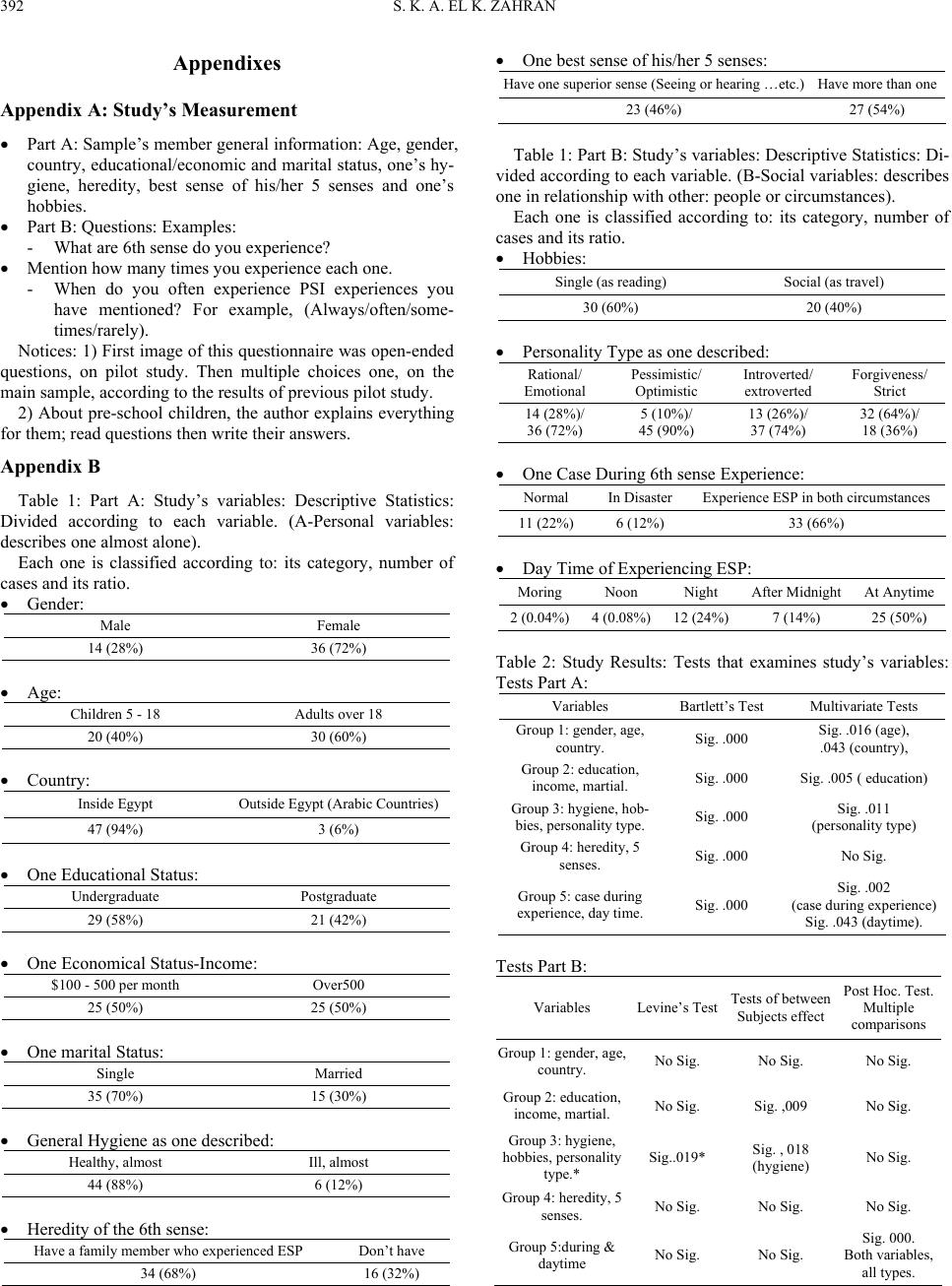 S. K. A. EL K. ZAHRAN 392 Appendixes Appendix A: Study’s Measurement Part A: Sample’s me mber general information: Age, gender, country, educational/economic and marital status, one’s hy- giene, heredity, best sense of his/her 5 senses and one’s hobbies. Part B: Questions: Examples: - What are 6th sense do you experience? Mention how many times you experience each one. - When do you often experience PSI experiences you have mentioned? For example, (Always/often/some- times/rarely). Notices: 1) First image of this questionnaire was open-ended questions, on pilot study. Then multiple choices one, on the main sample, according to the results of previous pilot study. 2) About pre-school children, the author explains everything for them; read questions then write their answers. Appendix B Table 1: Part A: Study’s variables: Descriptive Statistics: Divided according to each variable. (A-Personal variables: describes one almost alone). Each one is classified according to: its category, number of cases and its ratio. Gender: Male Female 14 (28%) 36 (72%) Age: Children 5 - 18 Adults over 18 20 (40%) 30 (60%) Country: Inside Egypt Outside Egypt (A rabic Countrie s) 47 (94%) 3 (6%) One Educational Status: Undergraduate Postgraduate 29 (58%) 21 (42%) One Economical Status-Income: $100 - 500 per month Over500 25 (50%) 25 (50%) One marital Status: Single Married 35 (70%) 15 (30%) General Hygiene as one described: Healthy, almost Ill, almost 44 (88%) 6 (12%) Heredity of the 6th sense: Have a family member who experienced ESP Don’t have 34 (68%) 16 (32%) One best sense of his/her 5 senses: Have one superior sense (Seeing or hearing …etc.) Have more than one 23 (46%) 27 (54%) Table 1: Part B: Study’s variables: Descriptive Statistics: Di- vided according to each variable. (B-Social variables: describes one in relationship with other: people or circumstances). Each one is classified according to: its category, number of cases and its ratio. Hobbies: Single (as reading) Social (as travel) 30 (60%) 20 (40%) Personality Type as one described: Rational/ Emotional Pessimistic/ Optimistic Introverted/ extroverted Forgiveness/ Strict 14 (28%)/ 36 (72%) 5 (10%)/ 45 (90%) 13 (26%)/ 37 (74%) 32 (64%)/ 18 (36%) One Case During 6th sense Experience: Normal In Disaster Experience ESP in both circumstances 11 (22%) 6 (12%) 33 (66%) Day Time of Experiencing ESP: Moring Noon Night After Midnigh t At Anytime 2 (0.04%)4 (0.08%)12 (24%) 7 (14%) 25 (50%) Table 2: Study Results: Tests that examines study’s variables: Tests Part A: Variables Bartlett’s Test Multivariate Tests Group 1: gender, age, country. Sig. .000 Sig. .016 (age), .043 (country), Group 2: educ ation, income, martial. Sig. .000 Sig. .005 ( education) Group 3: hyg i ene, hob- bies, personality type. Sig. .0 00 Sig. .011 (personality type) Group 4: heredity, 5 senses. Sig. .000 No Sig. Group 5: ca s e during experience, day time. Sig. .000 Sig. .0 02 (case during experience) Sig. .043 (daytime). Tests Part B: Variables Levine’s Test Tests of between Subjects effect Post Hoc. Test. Multiple comparisons Group 1: gender, age, country. No Sig. No Sig. No Sig. Group 2: educ ation, income, martial. No Sig. Sig. ,009 No Sig. Group 3: hygiene, hobbies, personality type.* Sig..019* Sig. , 018 (hygiene) No Sig. Group 4: heredity, 5 senses. No Sig. No Sig. No Sig. Group 5:during & daytime No Sig. No Sig. Sig. 000. Both variables, all types. |