

Paper Menu >>
Journal Menu >>
 Psychology 2011. Vol.2, No.4, 376-381 Copyright © 2011 SciRes. DOI:10.4236/psych.2011.24059 Assessment of Drawing Age of Children in Early Childhood and Its Correlates Saziye Senem Basgul1, Ozden Sukran Uneri2, Gulcan Basar Akkaya3, Nilay Etiler4, Aysen Coskun5 1Department of Child and Adolescent Psychiatry, Goztepe Education and Research Hospital, İstanbul, Turkey; 2Department of Child and Adolescent Psychiatry, Bakirkoy Mental Health, Education and Research Hospital, Ankara, Turkey; 3Atatürk Faculty of Education, Department of Education for Mentally Handicapped, Marmara University, İstanbul, Turkey; 4Faculty of Medicine, Department of Public Health, Kocaeli University, Kocaeli, Turkey; 5Faculty of Medicine, Department of Child and Adolescent Psychiatry, Kocaeli University, Kocaeli, Turkey. Email: [email protected] Received January 24th, 2011; revised March 28th, 2011; accepted May 7th, 2011. Aim: The drawing ability of children develops parallel to their mental and physical development. The present study aims to investigate the compatibility of children’s drawings with their mental and physical development and variables affecting this compatibility in early childhood. Methods: Children between the ages 3 and 5 were asked to draw a human/child figure on a given sheet of paper and their drawings were analyzed. Results: 175 children were evaluated. The mean age was found to be 3.94 ± 0.81 and the mean drawing age was 3.42 ± 1.75. The drawing age was found to be statistically lower than the calendar age. It was found that children who had low birth weights, who did not go to kindergarten and who masturbated had lower drawing age. Low drawing age was not found to be related with psychological disorders. Discussion: Drawing can be utilized by mental health professionals as an important assessment tool for young children. Further studies with larger sample sizes are required to generalize. Keywords: Early Childhood, Drawing Age, Psychiatry Introduction Children’s drawings have long been utilized to assess per- sonality traits and psychological disorders of children (Sayil, 2004; Brown & Pipe, 2007; Bonoti & Metallidou, 2010). Some studies on plastic arts and human psychology aim to detect direct links between these two domains (Kellog, 1970). A sig- nificant change occurs in a child’s artistic activities in parallel with his/her physical and mental development. There are five periods of development in children’s drawings (Samurcay, 1975): 1) Scribbling Period (Age 2 - 4) 2) Pre-symbolism Period (Age 4 - 7) 3) Symbolism Period (Age 7 - 9) 4) Realism Period (Age 9 - 12) 5) Apparent Naturalism Period (Age 12 - 14) Early childhood, which is also defined as pre-school or play period, is a period that includes development in physical, cog- nitive, language, motor and psychosocial domains. Children between the ages of 2 and 4 who are at the scribbling period draw random lines and figures on the paper. Human figures appear in the drawings of children after the age 4 (Senemoglu, 2004). Child drawings are known to be an easy-to-use and often employed economical method by professionals working with children (Malchiodi, 1998). A literature review indicates that there is a scarce number of studies in Turkey on children’s drawing age and the sociodemographic and psychological cor- relates. The primary aim of the present study was to detect the children’s physical and mental compatibility as well as drawing age through assessing drawings in early childhood. Our second aim was to find sociodemographic variables affecting drawing age, and to examine possibly related psychological disorders while the third aim was to assess the differences between chil- dren who accepted and did not accept to draw in terms of so- ciodemographic characteristics, children’s habits and psycho- logical disorders. Method Sample The study was conducted in the center settlement of Kocaeli, Turkey. It included clinical and population samples. The gen- eral population sample was selected among 3- to 5-year-old children (range, 3 years 0 months - 5 years 11 months) residing in the area served by the Central Kocaeli Health Authority. There were about 26,000 children in that age group according to the population data from primary healthcare units for 2004. The number of subjects to be enrolled was calculated by using the sample size formula to test a single proportion (Dawson, 1990). In the formula, the probability value (p) was taken as the incidence of psychiatric morbidity in 3- to 5-year-old children. The Mental Health Profile of Turkey, published following a 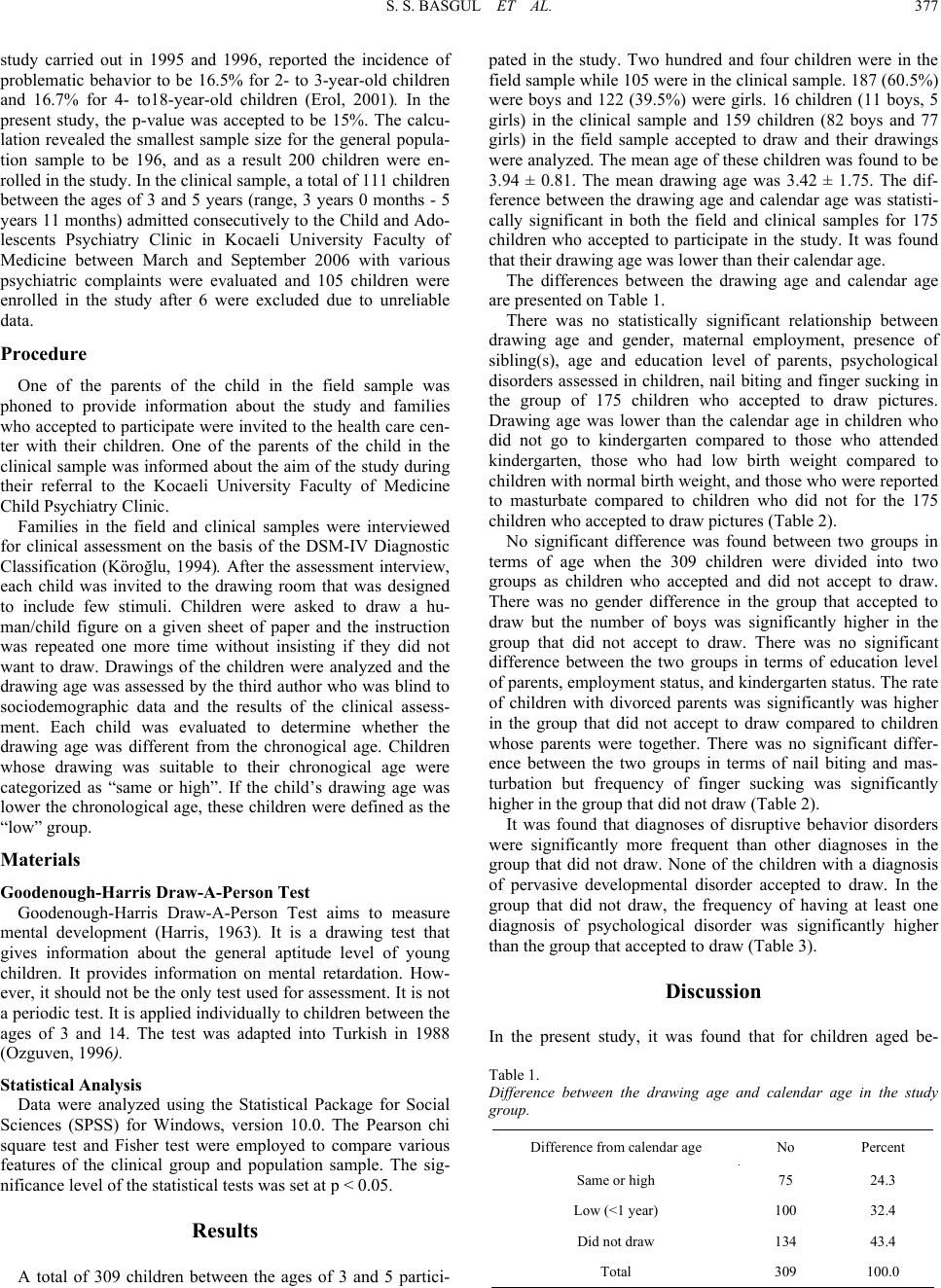 S. S. BASGUL ET AL. 377 study carried out in 1995 and 1996, reported the incidence of problematic behavior to be 16.5% for 2- to 3-year-old children and 16.7% for 4- to18-year-old children (Erol, 2001). In the present study, the p-value was accepted to be 15%. The calcu- lation revealed the smallest sample size for the general popula- tion sample to be 196, and as a result 200 children were en- rolled in the study. In the clinical sample, a total of 111 children between the ages of 3 and 5 years (range, 3 years 0 months - 5 years 11 months) admitted consecutively to the Child and Ado- lescents Psychiatry Clinic in Kocaeli University Faculty of Medicine between March and September 2006 with various psychiatric complaints were evaluated and 105 children were enrolled in the study after 6 were excluded due to unreliable data. Procedure One of the parents of the child in the field sample was phoned to provide information about the study and families who accepted to participate were invited to the health care cen- ter with their children. One of the parents of the child in the clinical sample was informed about the aim of the study during their referral to the Kocaeli University Faculty of Medicine Child Psychiatry Clinic. Families in the field and clinical samples were interviewed for clinical assessment on the basis of the DSM-IV Diagnostic Classification (Köroğlu, 1994). After the assessment interview, each child was invited to the drawing room that was designed to include few stimuli. Children were asked to draw a hu- man/child figure on a given sheet of paper and the instruction was repeated one more time without insisting if they did not want to draw. Drawings of the children were analyzed and the drawing age was assessed by the third author who was blind to sociodemographic data and the results of the clinical assess- ment. Each child was evaluated to determine whether the drawing age was different from the chronogical age. Children whose drawing was suitable to their chronogical age were categorized as “same or high”. If the child’s drawing age was lower the chronological age, these children were defined as the “low” group. Materials Goodenough-Harris Draw-A-Person Test Goodenough-Harris Draw-A-Person Test aims to measure mental development (Harris, 1963). It is a drawing test that gives information about the general aptitude level of young children. It provides information on mental retardation. How- ever, it should not be the only test used for assessment. It is not a periodic test. It is applied individually to children between the ages of 3 and 14. The test was adapted into Turkish in 1988 (Ozguven, 1996). Statistical Analysis Data were analyzed using the Statistical Package for Social Sciences (SPSS) for Windows, version 10.0. The Pearson chi square test and Fisher test were employed to compare various features of the clinical group and population sample. The sig- nificance level of the statistical tests was set at p < 0.05. Results A total of 309 children between the ages of 3 and 5 partici- pated in the study. Two hundred and four children were in the field sample while 105 were in the clinical sample. 187 (60.5%) were boys and 122 (39.5%) were girls. 16 children (11 boys, 5 girls) in the clinical sample and 159 children (82 boys and 77 girls) in the field sample accepted to draw and their drawings were analyzed. The mean age of these children was found to be 3.94 ± 0.81. The mean drawing age was 3.42 ± 1.75. The dif- ference between the drawing age and calendar age was statisti- cally significant in both the field and clinical samples for 175 children who accepted to participate in the study. It was found that their drawing age was lower than their calendar age. The differences between the drawing age and calendar age are presented on Table 1. There was no statistically significant relationship between drawing age and gender, maternal employment, presence of sibling(s), age and education level of parents, psychological disorders assessed in children, nail biting and finger sucking in the group of 175 children who accepted to draw pictures. Drawing age was lower than the calendar age in children who did not go to kindergarten compared to those who attended kindergarten, those who had low birth weight compared to children with normal birth weight, and those who were reported to masturbate compared to children who did not for the 175 children who accepted to draw pictures (Table 2). No significant difference was found between two groups in terms of age when the 309 children were divided into two groups as children who accepted and did not accept to draw. There was no gender difference in the group that accepted to draw but the number of boys was significantly higher in the group that did not accept to draw. There was no significant difference between the two groups in terms of education level of parents, employment status, and kindergarten status. The rate of children with divorced parents was significantly was higher in the group that did not accept to draw compared to children whose parents were together. There was no significant differ- ence between the two groups in terms of nail biting and mas- turbation but frequency of finger sucking was significantly higher in the group that did not draw (Table 2). It was found that diagnoses of disruptive behavior disorders were significantly more frequent than other diagnoses in the group that did not draw. None of the children with a diagnosis of pervasive developmental disorder accepted to draw. In the group that did not draw, the frequency of having at least one diagnosis of psychological disorder was significantly higher than the group that accepted to draw (Table 3). Discussion In the present study, it was found that for children aged be- Table 1. Difference between the drawing age and calendar age in the study group. Difference from calendar age No Percent Same or high 75 24.3 Low (<1 year) 100 32.4 Did not draw 134 43.4 Total 309 100.0 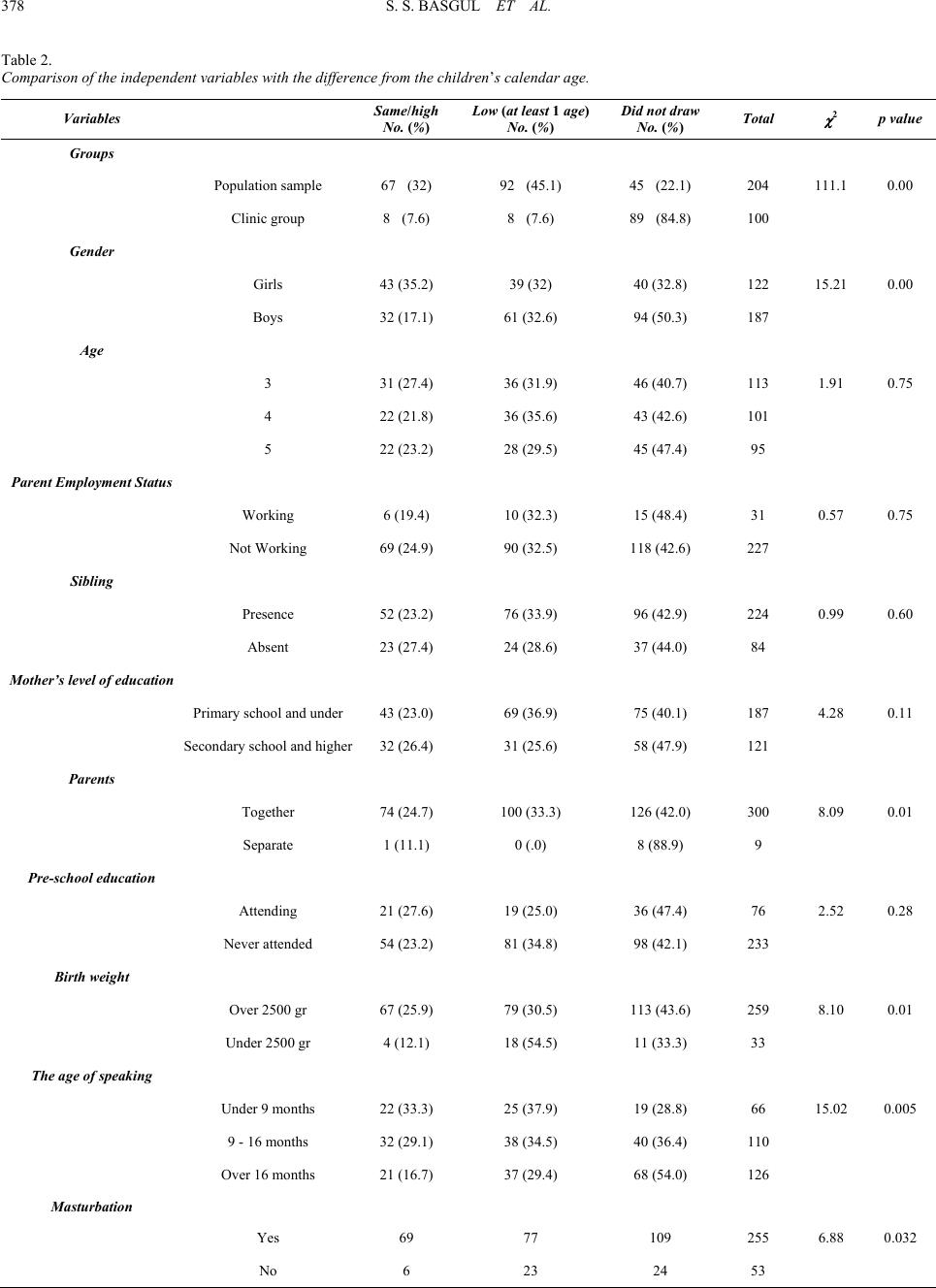 S. S. BASGUL ET AL. 378 Table 2. Comparison of the independent variables with the difference from the children’s calendar age. Variables Same/high No. (%) Low (at least 1 age) No. (%) D i d not draw No. (%) Total 2 p value Groups Population sample 67 (32) 92 (45.1) 45 (22.1) 204 111.1 0.00 Clinic group 8 (7.6) 8 (7.6) 89 (84.8) 100 Gender Girls 43 (35.2) 39 (32) 40 (32.8) 122 15.21 0.00 Boys 32 (17.1) 61 (32.6) 94 (50.3) 187 Age 3 31 (27.4) 36 (31.9) 46 (40.7) 113 1.91 0.75 4 22 (21.8) 36 (35.6) 43 (42.6) 101 5 22 (23.2) 28 (29.5) 45 (47.4) 95 Parent Employm ent Status Working 6 (19.4) 10 (32.3) 15 (48.4) 31 0.57 0.75 Not Working 69 (24.9) 90 (32.5) 118 (42.6) 227 Sibling Presence 52 (23.2) 76 (33.9) 96 (42.9) 224 0.99 0.60 Absent 23 (27.4) 24 (28.6) 37 (44.0) 84 Mother’s level of education Primary school and under 43 (23.0) 69 (36.9) 75 (40.1) 187 4.28 0.11 Secondary school and higher 32 (26.4) 31 (25.6) 58 (47.9) 121 Parents Together 74 (24.7) 100 (33.3) 126 (42.0) 300 8.09 0.01 Separate 1 (11.1) 0 (.0) 8 (88.9) 9 Pre-school education Attending 21 (27.6) 19 (25.0) 36 (47.4) 76 2.52 0.28 Never attended 54 (23.2) 81 (34.8) 98 (42.1) 233 Birth weight Over 2500 gr 67 (25.9) 79 (30.5) 113 (43.6) 259 8.10 0.01 Under 2500 gr 4 (12.1) 18 (54.5) 11 (33.3) 33 The age of speaking Under 9 months 22 (33.3) 25 (37.9) 19 (28.8) 66 15.02 0.005 9 - 16 months 32 (29.1) 38 (34.5) 40 (36.4) 110 Over 16 months 21 (16.7) 37 (29.4) 68 (54.0) 126 Masturbation Yes 69 77 109 255 6.88 0.032 No 6 23 24 53 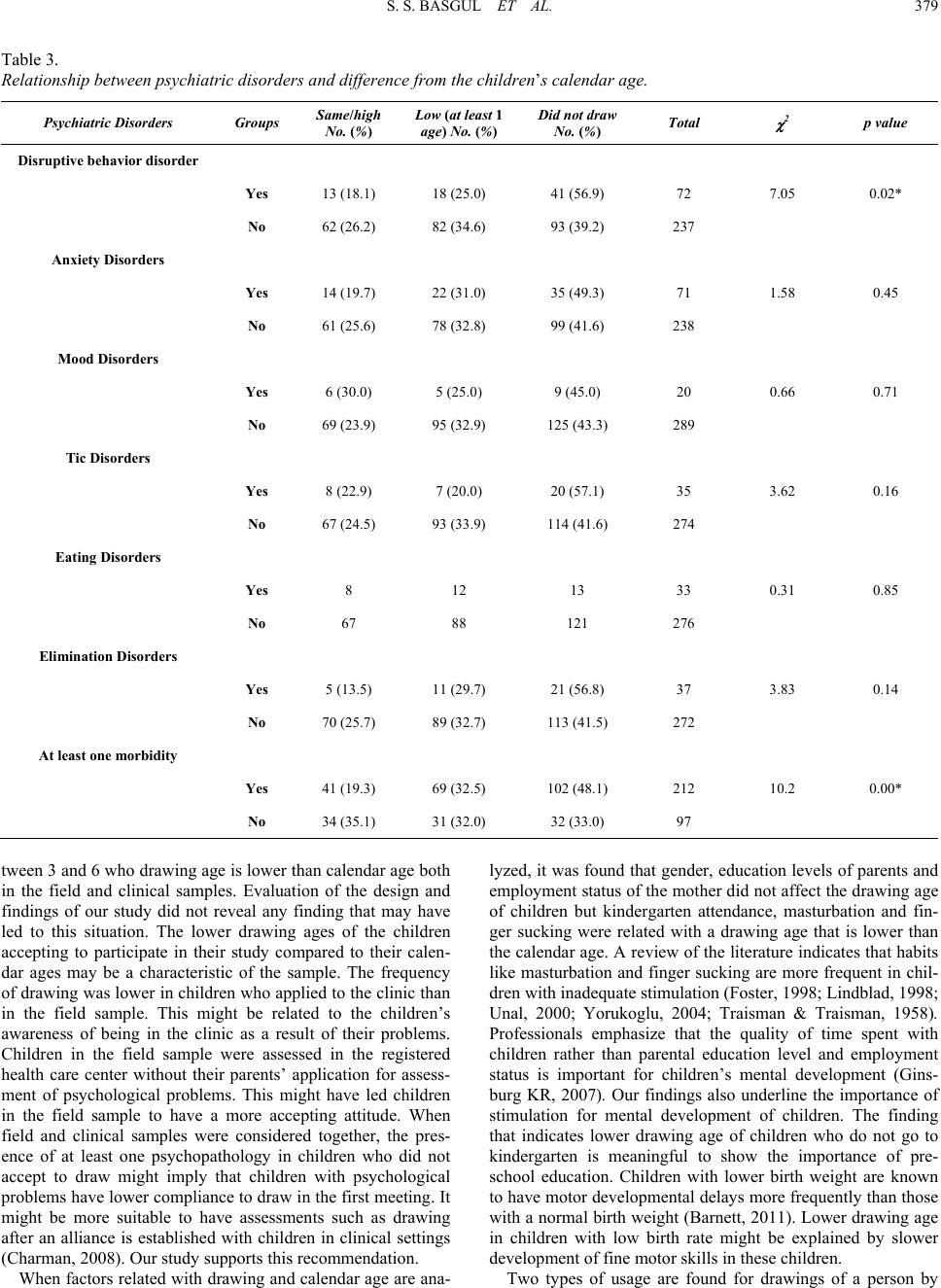 S. S. BASGUL ET AL. 379 Table 3. Relationship between psychiatric disorders and difference from the children’s calendar age. Psychiatric Disorders Groups Same/high No. (%) Low (at least 1 age) No. (%) Did not draw No. (%) Total 2 p value Disruptive behavior disorder Yes 13 (18.1) 18 (25.0) 41 (56.9) 72 7.05 0.02* No 62 (26.2) 82 (34.6) 93 (39.2) 237 Anxiety Disorders Yes 14 (19.7) 22 (31.0) 35 (49.3) 71 1.58 0.45 No 61 (25.6) 78 (32.8) 99 (41.6) 238 Mood Disorders Yes 6 (30.0) 5 (25.0) 9 (45.0) 20 0.66 0.71 No 69 (23.9) 95 (32.9) 125 (43.3) 289 Tic Disorders Yes 8 (22.9) 7 (20.0) 20 (57.1) 35 3.62 0.16 No 67 (24.5) 93 (33.9) 114 (41.6) 274 Eating Disorders Yes 8 12 13 33 0.31 0.85 No 67 88 121 276 Elimination Disorders Yes 5 (13.5) 11 (29.7) 21 (56.8) 37 3.83 0.14 No 70 (25.7) 89 (32.7) 113 (41.5) 272 At least one morbidity Yes 41 (19.3) 69 (32.5) 102 (48.1) 212 10.2 0.00* No 34 (35.1) 31 (32.0) 32 (33.0) 97 tween 3 and 6 who drawing age is lower than calendar age both in the field and clinical samples. Evaluation of the design and findings of our study did not reveal any finding that may have led to this situation. The lower drawing ages of the children accepting to participate in their study compared to their calen- dar ages may be a characteristic of the sample. The frequency of drawing was lower in children who applied to the clinic than in the field sample. This might be related to the children’s awareness of being in the clinic as a result of their problems. Children in the field sample were assessed in the registered health care center without their parents’ application for assess- ment of psychological problems. This might have led children in the field sample to have a more accepting attitude. When field and clinical samples were considered together, the pres- ence of at least one psychopathology in children who did not accept to draw might imply that children with psychological problems have lower compliance to draw in the first meeting. It might be more suitable to have assessments such as drawing after an alliance is established with children in clinical settings (Charman, 2008). Our study supports this recommendation. When factors related with drawing and calendar age are ana- lyzed, it was found that gender, education levels of parents and employment status of the mother did not affect the drawing age of children but kindergarten attendance, masturbation and fin- ger sucking were related with a drawing age that is lower than the calendar age. A review of the literature indicates that habits like masturbation and finger sucking are more frequent in chil- dren with inadequate stimulation (Foster, 1998; Lindblad, 1998; Unal, 2000; Yorukoglu, 2004; Traisman & Traisman, 1958). Professionals emphasize that the quality of time spent with children rather than parental education level and employment status is important for children’s mental development (Gins- burg KR, 2007). Our findings also underline the importance of stimulation for mental development of children. The finding that indicates lower drawing age of children who do not go to kindergarten is meaningful to show the importance of pre- school education. Children with lower birth weight are known to have motor developmental delays more frequently than those with a normal birth weight (Barnett, 2011). Lower drawing age in children with low birth rate might be explained by slower development of fine motor skills in these children. Two types of usage are found for drawings of a person by  S. S. BASGUL ET AL. 380 children. The first one is using them for a rough analysis of the child’s cognitive development as with other visual-motor tests (Brown, 1990; Cherney ve ark, 2006; Koppitz, 1968). The sec- ond use is to obtain information on the emotional structure and or current emotional status of the child (Catte & Cox, 1999; Matto, 2002, Tharinger & Stark, 1990). The presence of any psychopathology in the children was not found to affect draw- ing age. Conduct disorder and major depressive disorder were found to be significantly higher in children who did not draw. It might be useful, especially for the clinician, to consider this finding in clinical application. The findings of the present study that children with some psychological disorders did not accept to draw, and that children who have habits that might appear secondary to inadequate stimulation like masturbation and fin- ger sucking have lower drawing age support the notion that drawing is a useful assessment tool for children. There are other articles on the drawing in children with diffuse developmental disorder (Evans & Dubowski, 2001; Lee & Hobson, 2006; Ste- fanatou, 2008). We did not come across any information on when the drawing activity was held or whether any group re- fused to draw in these articles. Children with this diagnosis did not accept to draw in our study. This may indicate that trying to get children who find it difficult to form social relationships may not be appropriate. However, we do not know whether these children accepted to draw in future interviews due to the design of our study. New drawing studies with these children could use a study design that also included longitudinal fol- low-up of children who accepted and did not accept to draw to determine which visit may be best to use a test such as drawing evaluation. Inadequate distribution of sample between field and clinical samples and small sample size might be considered among the limitations of the present study. However, when sample size is evaluated, the fact that clinical interviews were conducted with all children and their families who participated in the study should be considered. Conclusion A literature review indicates that there is no other study on the drawing age of children, sociodemographic and psycho- pathological correlates, accepting to draw and its association with psychological disorders. Considering the importance of drawing as an assessment tool for health care professionals, further studies with larger sample size and more variables are warranted to generalize assessments of children in the field of drawing and to utilize findings in clinical studies. References American Psychiatric Association (APA) (1994). Diagnostic and statis- tical manual of mental disorders (4th ed.) (DSM-IV), Washington DC: American Psychiatric Association. Barry, A., & Kochanska, G. (2010). A longitudinal investigation of the affective environment in families with young children: From infancy to early school age. Emotion, 10, 237-249.doi:10.1037/a0018485 Barnett, A. L. (2011). Motor impairment in extremely preterm or low birthweight children. Developmental Medicine & Child Neurology, 53, 9-10. doi:10.1111/j.1469-8749.2010.03801.x Brown, D. A., Pipe, M. E., Lewis, C., Lamb, M. E., & Orbach, Y. (2007). Supportive or suggestive: Do human figure drawings help 5- to 7-year-old children to report touch? Journal of Consulting and Clinical Psychology, 7 5, 33-42. doi:10.1037/0022-006X.75.1.33 Bonoti, F., & Metallidou, P. (2010). Children’s judgments and feelings about their own drawings. Scientific Research, 1, 329-336. Catte, M. V., & Cox, M. (1999). Emotional indicators in children’s human figure drawings. European Child & Adolescent Psychiatry, 8, 86-89. doi:10.1007/s007870050089 Charman, T., Hood, J. & Howlin, P. (2008). Ch. 21: Psychological assesment in the clinical context. Rutter’s child and adolescent psy- chiatry. In M. Rutter, V. M. Bishop, D. S. Pine, S. Scott, J. Stevenson, E. Taylor and A. Thapar (Eds.), Rutter’s child and adolescent psy- chiatry (pp. 229-316). Malden, MA: Blackwell Publishing Limited. Cherney, I. D., Seiwert, C. S., Dickey, T. M., & Flichtbeil, J. D. (2006). Children’s drawings: A mirror to their minds. Journal of Educational Psychology, 26, 127-142. doi:10.1080/01443410500344167 Dawson, B., Dawson-Saunders, B., & Trapp, R. G. (1990). Basic and clinical biostatistics. London: Appleton & Lange. Erol, N., & Simsek, Z. (2001). The mental health profile of Turkey: Distribution of the areas of competency and problem behavior in children and adolescent. In N. Erol, C. Kilic, M. Ulusoy, M. Kececi, & Z. Simsek (Eds), Preliminary report on the mental health profile of Turkey. Ankara: Aydogdu Ofset. Evans, K., & Dubowski, J. (2001). Art therapy with children on the autistic spectrum: Beyond words. Philadelphia PA: Jessica Kingsley Publishers. Foster, L. G. (1998). Nervous habits and stereotyped behaviors in pre- school children. Journal of the American Academy of Child and Adolescent Psychiatry, 37, 711-717. doi:10.1097/00004583-199807000-00010 Ginsburg, K. R. (2007). The importance of play in promoting healthy child development and maintaining strong parent-child bonds. American Academy of Pediat rics , 119, 182-191. Harris, D. B. (1963). Children’s drawings as measures of intellectual maturity. A revision and extension of the Goodenough Draw-A-Man Test. New York: Harcourt, Brace, and World. Koppitz, E. M. (1968). Psychological evaluation of children’s human figure drawings. New York: Grune & Stratton. Kellog, R. (1970). Analyzing children’s art. Palo Alto, CA: Mayfield Publishing Company. Lee, A., & Hobson, R. P. (2006). Drawing self and others: How do children with autism differ from those with learning difficulties? British Journal of Developmental Psychology , 24, 547-565. doi:10.1348/026151005X49881 Lindblad, F., Gustafsson, P. A., Larsson, I., & Lundin, B. (1995). Pre- schoolers’ sexual behavior at daycare centers: An epidemiological study. Child Abuse & Neglect, 19, 569-577. doi:10.1016/0145-2134(95)00016-2 Malchiodi, C. A. (1998). Understanding children’s drawings. New York: The Guilford Pres. Matto, H. C. (2002). Investigating the validity of the Draw-A-Person screening procedure for emotional disturbance. Psychological As- sessment, 14, 221-225. doi:10.1037/1040-3590.14.2.221 Ozguven, I. E. (1996). Goodenough-Harris Draw-A-Man Test Turkish manual. Ankara: PDREM Press. Samurcay, N. (1975). Development of graphic activities in pre-school children. Ankara: Faculty of Humanities Publishing, Ankara Univer- sity. Sayıl, M. (2004). An evaluation on clinical use of children’s drawings. Türk Psikoloji Yazıları, 7, 1-13. Senemoglu, N. (2004). Development in early childhood. In E. Ceyhan, (Ed.), Child Development and Psychology. Eskisehir: Anadolu Uni- versity Publishing, Web-Ofset Facility. Stefanatou, A. (2008). Use of drawings in children with pervasive de- velopmental disorder during hospitalization: A developmental per- spective. Journal o f Child Health Care, 12, 268-283. doi:10.1177/1367493508096203 Tharinger, D. I., & Stark, K. ( 1990). A qualitative versus quantitative approach to evaluatingthe Draw-A-Person and kinetic family draw- ing: a study of mood- and anxiety-disorder children. Psychological  S. S. BASGUL ET AL. 381 assessment. Journal of Consulting and Clinical Psychology, 2, 365-375. Traisman, A. S., & Traisman, H. S, (1958). Thumb- and finger-sucking: A study of 2650 infants and children. The Journal of Pediatrics, 52, 566-572. doi:10.1177/1367493508096203 Unal, F. (2000). The clinical outcome of childhood masturbation. The Turkish Journal of Pediatrics, 42, 304-307. Yorukoglu, A. (2004). Child mental health. Ankara: Ozgur Publishing. |