

Paper Menu >>
Journal Menu >>
 Psychology 2011. Vol.2, No.4, 307-311 Copyright © 2011 SciRes. DOI:10.4236/psych.2011.24048 Comparison of the Effectiveness of the Transactional Analysis, Existential, Cognitive, and Integrated Group Therapies on Improving Problem-Solving Skills Bahramali A. Ghanbari-e-Hashem-Abadi1, Mustafa Bolghan-Abadi2, Zahra Vafaei-e-Jahan3, Raheleh Maddah-Shoorcheh3, Elaheh Maddah-Shoorcheh4 1Ferdowsi University of Mashhad, Mashhad, Iran; 2Family Counseling, Ferdowsi University of Mashhad, Mashhad, Iran; 3General Psychology, Ferdowsi University of Mashhad, Mashhad, Iran; 4Tabaran Institute Higher Education, Tabaran, Iran. Email: [email protected] Received January 15th, 2011; revised March 18th, 2011; accepted April 25th, 2011. Problem-solving is one of the necessities of life in twenty first century. Therefore, Psychologists consider it as a skill that everyone must learn it. The purpose of the present study is to compare the effectiveness of the transac- tional analysis, existential, cognitive, and integrated group therapies on improving problem-solving skills. For this purpose, 65 subjects of the clients who were referring to the Ferdowsi University of Mashhad’s Mental Health Centre were selected randomly and subjects placed in 5 groups in random assignment method (13 par- ticipants in each group). The research method is Pre-test/Post-test control group design. To gather the data, Long & Cassidy’s problem solving styles questionnaire (1996) was used. In the descriptive level, the data were ana- lyzed using mean and standard deviation, and in the inferential level Analysis of Covariance test (ANCOVA) was used. The results of data analysis were indicative of the fact that after modifying pretest scores, there was a significant difference between group’s subjects. The results showed that group therapies were effective on im- proving problem-solving skills and that cognitive and integrated group therapies were more effective on im- proving problem-solving skills comparing to other groups. Regarding the results of the present study, it can be concluded that transactional analysis, existential, cognitive and integrated group therapies were effective on im- proving problem-solving skills of the clients who were referring to the Ferdowsi University of Mashhad's Men- tal Health Centre. Keywords: Transactional Analysis Group Therapy, Existential Group Therapy, Cognitive Group Therapy, Integrated Group Therapy Introduction Problem-solving is a cognitive process by which the indi- vidual tries to find a suitable solution for the problem (Perla & O’ Donnel, 2004). In problem-solving, finding a specific solu- tion for a specific problem is not that much important, the thing that matters is to find an abstract rule or principle that can be generalized for other situations (Khoshkam, Malekpoor, & Molavi, 2008). Problem-solving is a vital skill for life. Today in all activities, the authorities are called for thinking in a high level and problem-solving skills, whether in normal or compli- cated activities. And most of them emphasize that prob- lem-solving skills must be improved (Poshtiban, 2007). When facing a Program, every individual uses a different method of problem-solving. Methods of problem-solving are: helplessness in solving a problem, problem-solving control, avoidance style, creative style, problem-solving confidence and approach style. The first there styles are called ineffective problem-solving methods and the last three styles are called effective prob- lem-solving methods (Cassidy & Long, 1996). Problem-solving is a coping skill which increases self-confidence and has a connection with good personal compatibility (Eizadi & Scpasi-Ashtiani, 2010). In problem-solving approach, therapy begins with focusing present goals. Focusing on present goals probably persuades the clients to concentrate on the problem and after that he/she will concentrate on the solutions. Solutions are the results of conversations and each solution is unique (Prochaska & Norcross, 2010). In the late 1960s and the early 1970s, problem-solving started as a port of cogni- tive-behavioral movement to modify behavior. D’Zurilla & Aoldfried who are the founders of this method in on article at American Psychological Association conference in 1968—em- phasized on the necessity of teaching problem-solving skill in the program of teaching social skills. Since then, this method is used in a vast range of clinical counseling and psychotherapy situations and positive results are reported (Nezu & D’zurrila, 2001). Problem-solving is an intellectual process and is part of lar- ger problem process that includes problem finding and problem shaping. Considered the most complex of all intellectual func- tions, problem-solving has been defined as higher-order cogni- tive process that requires the modulation and control of more routine or basic skills (Goldstein & Levin, 1987). Problem- solving requires a variety of skills including clarifying informa-  B. A. GHANBARI-E-HASHEM-ABADI ET AL. 308 tion, programming and working methodically, checking out- comes and trying alternative strategies (Muir, Beswick, & Wil- liamson, 2008). The issue of Problem-solving has attracted the attention of many researchers. The findings show that it is not so much important that people face problems and difficulties in their lives, but the thing which is important is to behave correctly when facing problems. Some people are not even able to solve their routine Problems and when facing a trivial problem they become embarrassed, upset and tense (Shokohi-Yekta & Parands, 2008). According to the aforementioned materials, the necessity of teaching problem-solving skill becomes evident. The purpose of the present study is to find answers to this ques- tion: Is there any difference on improving problem-solving skill between the four therapy groups? To achieve this goal, transactional analysis, existential, cog- nitive and integrated group therapies were formed which were based on teaching problem-solving skill. The hypothesis of the study suggests that after group therapies, there is difference between control group and experimental groups in the extent of problem-solving skill. Similar studies in problem-solving skill show that teaching problem-solving skill has been effective in decreasing Parent-child conflicts (Moradi & Sanayi-e-zaker, 2006). Shafea-Abad & shams (2000) found that problem-solving skills instruction can significantly decrease the tendency to suicide, frustration and negative feelings of the youths who have attempted suicide. Heydori & Rasolzadeh (2007) used teaching problem-solving skill decrease girl’s escape from home and it was effective. Said et al., (2010) found that teach- ing problem-solving skill to families with children who have chronic asthma is effective on improving their life quality that is related to the children’s health. A meta-analysis of the re- searches done in the field of problem-solving therapies was indicative of the fact that most of the problem-solving therapies had positive results on treating depression (Cuijpers, Straten, & Warmerdam, 2007). In another meta-analysis on the effective- ness of problem-solving therapies in decreasing problems re- lating to physical and mental health showed that all the studies done in this area had a significant effect on decreasing psychi- cal and mental health problems (Malouff, Thorsteinsson, & Schutte, 2007). The results of a study showed that cognitive group therapy which was based on problem-solving has positive effects on losing weight & changing lifestyle of middle-aged American women (Murawsk et al., 2009). Cognitive functions and prob- lem-solving skills have a significant difference between schizo- phrenia and healthy people (Zanello, Perring, & Huguclet, 2006). The purpose of the present study is to compare the effective- ness of the transactional analysis, existential, cognitive, and integrated group therapies on improving problem-solving skills. The hypotheses of the study are: 1) At the end of group therapies, there is a significant differ- ence is posttest scores of control group and experimental groups. 2) At the end of group therapies, there is a significant differ- ence in posttest scores of transactional analysis, existential, cognitive, and integrated experimental groups. Method The present study is a Pre-test/Post-test control group design. The population of the study was all clients who were referring to the Ferdowsi University of Mashhad's Mental Health Centre. From this population 65 subjects were selected randomly and were placed in 5 groups in random assignment method (13 participants in each group). Participants The participants’ age of this study was between 18 to 30 years old. 33 subjects of them were master students (50.77%) and 32 subjects of them (49.23%) were bachelor students. 34 subjects of the participants were females (52.31%) and 31 sub- jects were males (47.69%). In cognitive group 8 females (61.5%) and 5 males (38.46%), in integrated group 3 females (23.08%) and 10 males (76.92%), in existential group 9 females (69.23%) and 4 males (30.77%), in transactional analysis group 7 females (53.85%) and 6 males (64.15%), and in control group 7 females (53.85%) and 6 males (46.15%) participated. Procedure Methods of interventions were transactional analysis, exis- tential, cognitive and integrated group therapies with teaching problem-solving skills. Participants were randomly selected among students who had referred to the Ferdowsi University of Mashhad's Mental Health Centre. They were then randomly divided into five groups of 13. Pretest measures were adminis- tered prior to the intervention. The experimental groups re- ceived eight 2-hourly intervention sessions which were weekly apart and last in 8 weeks. The same measures were adminis- tered at the posttest, which followed the last intervention ses- sion. Measure Problem-solving styles questionnaire: this questionnaire which was designed by Cassidy & long (1996) containers 24 Items that have two choices which totally evaluates 6 factors or problem-solving styles. These factors are: 1) Helplessness style which shows that the individual is totally helplessness in prob- lematic situation. 2) Control style that reflects inner-outer con- trol in problematic situations. 3) Creative style which shows planning and considering various solutions. 4) Confidence style that believes the individual can solve the problem. 5) Avoid- ance style that reflects ignoring and rejecting the problem rather than facing it. 6) Approach style that shows positive attitude towards problems and tendency to face them. Studies that result in designing and finding a norm are in- dicative of the fact that this measure is a useful, valid and reli- able instrument to evaluate problem-solving methods (Moham- madi, 1997). Mohammadi and Sahebi (2001) reported the reli- ability of this instrument using Cronbach’s alpha coefficient that equaled 0.66. In a study conducted by Babapoor Kheyrodin and Ezhey (2002) alpha coefficient was equal to 0.77. On the other hand, with considering the reliability index as validity coefficient (validity coefficient equals the second root of reli- ability coefficient) then validity coefficient is 87% (Babapoor kheyrodin & Ezhey, 2002). 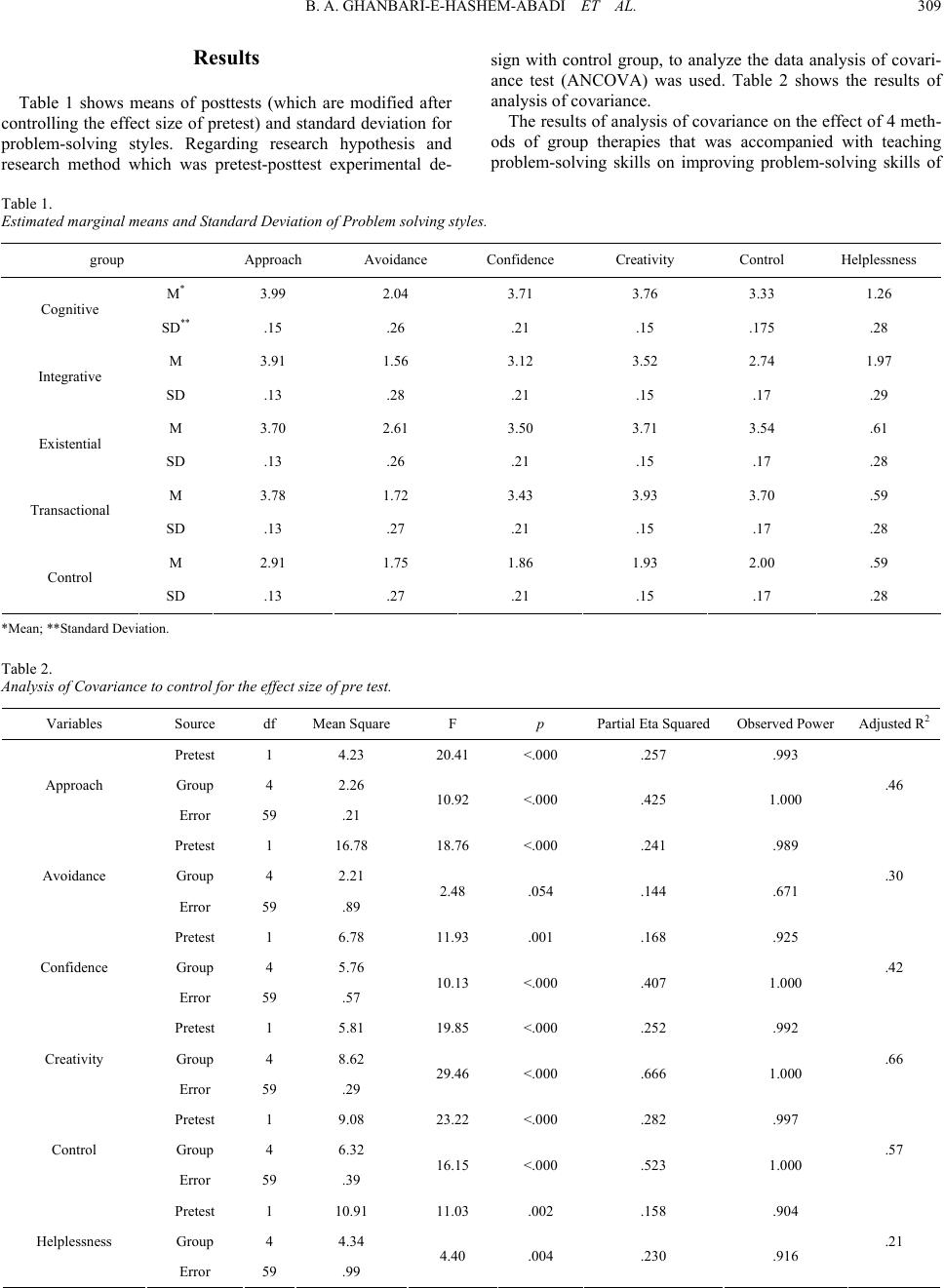 B. A. GHANBARI-E-HASHEM-ABADI ET AL. 309 Results Table 1 shows means of posttests (which are modified after controlling the effect size of pretest) and standard deviation for problem-solving styles. Regarding research hypothesis and research method which was pretest-posttest experimental de- sign with control group, to analyze the data analysis of covari- ance test (ANCOVA) was used. Table 2 shows the results of analysis of covariance. The results of analysis of covariance on the effect of 4 meth- ods of group therapies that was accompanied with teaching problem-solving skills on improving problem-solving skills of Table 1. Estimated marginal means and Standard Deviation of Pro b lem solving styles. group Approach Avoidance Confidence Creativity Control Helplessness M* 3.99 2.04 3.71 3.76 3.33 1.26 Cognitive SD** .15 .26 .21 .15 .175 .28 M 3.91 1.56 3.12 3.52 2.74 1.97 Integrative SD .13 .28 .21 .15 .17 .29 M 3.70 2.61 3.50 3.71 3.54 .61 Existential SD .13 .26 .21 .15 .17 .28 M 3.78 1.72 3.43 3.93 3.70 .59 Transactional SD .13 .27 .21 .15 .17 .28 M 2.91 1.75 1.86 1.93 2.00 .59 Control SD .13 .27 .21 .15 .17 .28 *Mean; **Standard Deviation. Table 2. Analysis of Covariance to contr o l for the effect size of pre test. Adjusted R2 Observed Power Partial Eta Squaredp F Mean Square df Source Variables .993 .257 <.000 20.41 4.23 1 Pretest 2.26 4 Group .46 1.000 .425 <.000 10.92 .21 59 Error Approach .989 .241 <.000 18.76 16.78 1 Pretest 2.21 4 Group .30 .671 .144 .054 2.48 .89 59 Error Avoidance .925 .168 .001 11.93 6.78 1 Pretest 5.76 4 Group .42 1.000 .407 <.000 10.13 .57 59 Error Confidence .992 .252 <.000 19.85 5.81 1 Pretest 8.62 4 Group .66 1.000 .666 <.000 29.46 .29 59 Error Creativity .997 .282 <.000 23.22 9.08 1 Pretest 6.32 4 Group .57 1.000 .523 <.000 16.15 .39 59 Error Control .904 .158 .002 11.03 10.91 1 Pretest 4.34 4 Group .21 .916 .230 .004 4.40 .99 59 Error Helplessness 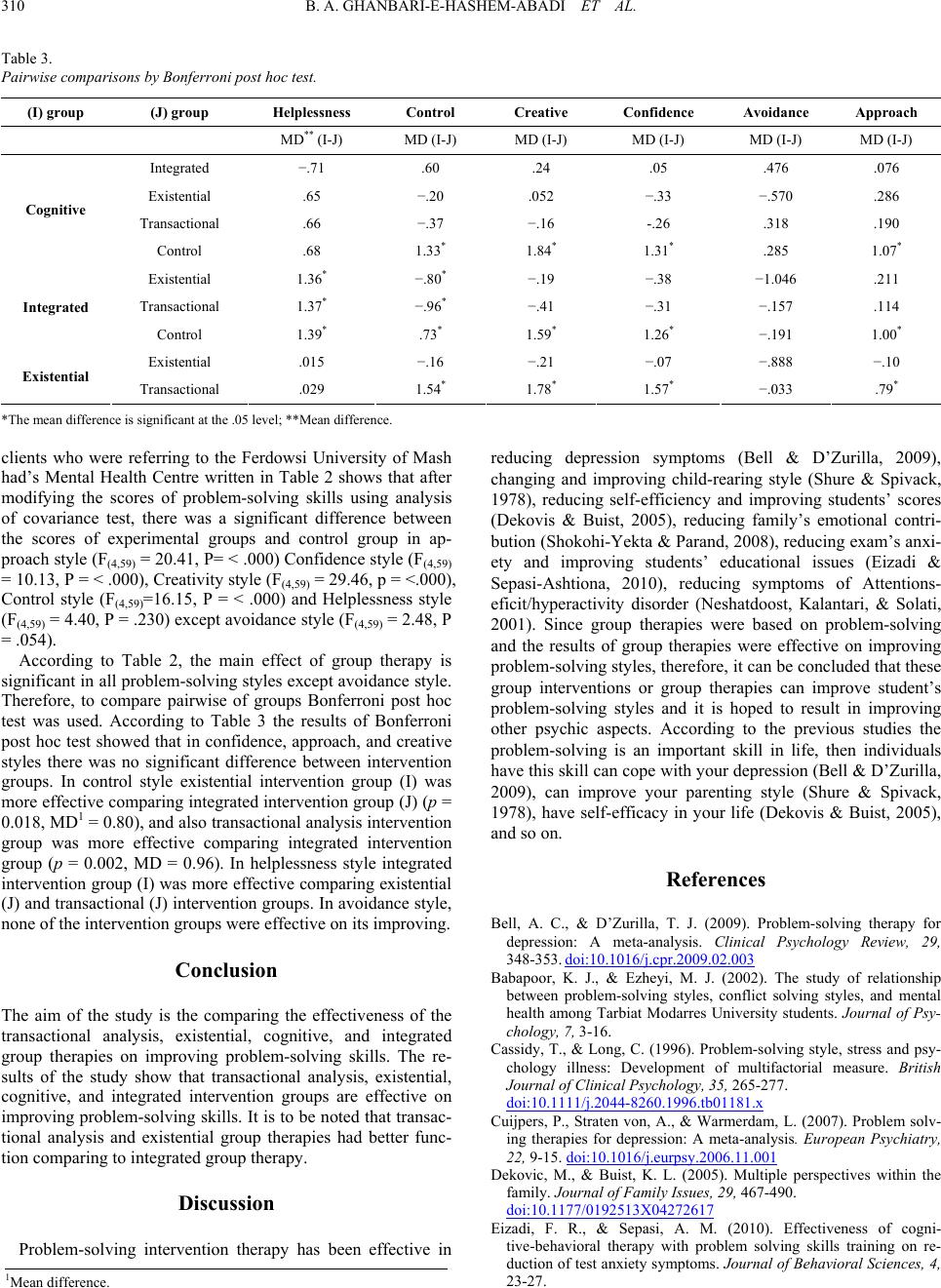 B. A. GHANBARI-E-HASHEM-ABADI ET AL. 310 Table 3. Pairwise comparisons by Bonfe r r o n i post hoc test. (I) group (J) group Helplessness Control Creative Confidence Avoidance Approach MD** (I-J) MD (I-J) MD (I-J) MD (I-J) MD (I-J) MD (I-J) Integrated −.71 .60 .24 .05 .476 .076 Existential .65 −.20 .052 −.33 −.570 .286 Transactional .66 −.37 −.16 -.26 .318 .190 Cognitive Control .68 1.33* 1.84* 1.31* .285 1.07* Existential 1.36* −.80* −.19 −.38 −1.046 .211 Transactional 1.37* −.96* −.41 −.31 −.157 .114 Integrated Control 1.39* .73* 1.59* 1.26* −.191 1.00* Existential .015 −.16 −.21 −.07 −.888 −.10 Existential Transactional .029 1.54* 1.78* 1.57* −.033 .79* *The mean difference is significant at the .05 level; **Mean difference. clients who were referring to the Ferdowsi University of Mash had’s Mental Health Centre written in Table 2 shows that after modifying the scores of problem-solving skills using analysis of covariance test, there was a significant difference between the scores of experimental groups and control group in ap- proach style (F(4,59) = 20.41, P= < .000) Confidence style (F(4,59) = 10.13, P = < .000), Creativity style (F(4,59) = 29.46, p = <.000), Control style (F(4,59)=16.15, P = < .000) and Helplessness style (F(4,59) = 4.40, P = .230) except avoidance style (F(4,59) = 2.48, P = .054). According to Table 2, the main effect of group therapy is significant in all problem-solving styles except avoidance style. Therefore, to compare pairwise of groups Bonferroni post hoc test was used. According to Table 3 the results of Bonferroni post hoc test showed that in confidence, approach, and creative styles there was no significant difference between intervention groups. In control style existential intervention group (I) was more effective comparing integrated intervention group (J) (p = 0.018, MD1 = 0.80), and also transactional analysis intervention group was more effective comparing integrated intervention group (p = 0.002, MD = 0.96). In helplessness style integrated intervention group (I) was more effective comparing existential (J) and transactional (J) intervention groups. In avoidance style, none of the intervention groups were effective on its improving. Conclusion The aim of the study is the comparing the effectiveness of the transactional analysis, existential, cognitive, and integrated group therapies on improving problem-solving skills. The re- sults of the study show that transactional analysis, existential, cognitive, and integrated intervention groups are effective on improving problem-solving skills. It is to be noted that transac- tional analysis and existential group therapies had better func- tion comparing to integrated group therapy. Discussion Problem-solving intervention therapy has been effective in reducing depression symptoms (Bell & D’Zurilla, 2009), changing and improving child-rearing style (Shure & Spivack, 1978), reducing self-efficiency and improving students’ scores (Dekovis & Buist, 2005), reducing family’s emotional contri- bution (Shokohi-Yekta & Parand, 2008), reducing exam’s anxi- ety and improving students’ educational issues (Eizadi & Sepasi-Ashtiona, 2010), reducing symptoms of Attentions- eficit/hyperactivity disorder (Neshatdoost, Kalantari, & Solati, 2001). Since group therapies were based on problem-solving and the results of group therapies were effective on improving problem-solving styles, therefore, it can be concluded that these group interventions or group therapies can improve student’s problem-solving styles and it is hoped to result in improving other psychic aspects. According to the previous studies the problem-solving is an important skill in life, then individuals have this skill can cope with your depression (Bell & D’Zurilla, 2009), can improve your parenting style (Shure & Spivack, 1978), have self-efficacy in your life (Dekovis & Buist, 2005), and so on. References Bell, A. C., & D’Zurilla, T. J. (2009). Problem-solving therapy for depression: A meta-analysis. Clinical Psychology Review, 29, 348-353. doi:10.1016/j.cpr.2009.02.003 Babapoor, K. J., & Ezheyi, M. J. (2002). The study of relationship between problem-solving styles, conflict solving styles, and mental health among Tarbiat Modarres University students. Journal of Psy- chology, 7, 3-16. Cassidy, T., & Long, C. (1996). Problem-solving style, stress and psy- chology illness: Development of multifactorial measure. British Journal of Clinical Psychology, 35, 265-277. doi:10.1111/j.2044-8260.1996.tb01181.x Cuijpers, P., Straten von, A., & Warmerdam, L. (2007). Problem solv- ing therapies for depression: A meta-analysis. European Psychiatry, 22, 9-15. doi:10.1016/j.eurpsy.2006.11.001 Dekovic, M., & Buist, K. L. (2005). Multiple perspectives within the family. Journal of Family Issues, 29, 467-490. doi:10.1177/0192513X04272617 Eizadi, F. R., & Sepasi, A. M. (2010). Effectiveness of cogni- tive-behavioral therapy with problem solving skills training on re- duction of test anxiety symptoms. Journal of Behavioral Sciences, 4, 23-27. 1Mean difference.  B. A. GHANBARI-E-HASHEM-ABADI ET AL. 311 Goldstein, F. C., & Levin, H. S. (1987). Disorders of reasoning and problem-solving ability. In M. Meier, A. Benton and L. Diller (Eds.), Neuropsychological rehabilitation. London: Taylor & Francis Group. Heydari, Sh., & Rasolzadeh, T. K. (2007). Study of effectiveness of problem solving instruction on reducing of tendency of escape in adolescent girls. The Quarterly of Family Research, 3, 573-585. Khoshkam, Z., Malekpoor, M., & Molavi, H. (2008). The effectiveness of instruction of group problem solving on students’ social skills with visual injury. Research on Exceptional Children, 8, 141-156. Malouff, J. M., Thorsteinsson, E. B., & Schutte, N. S. (2007). The efficacy of problem solving therapy in reducing mental and physical health problems: A meta-analysis. Clinical Psychology Review, 27, 46-57. doi:10.1016/j.cpr.2005.12.005 Mohammadi, F. (1997). Comparison of problem solving styles among depressed and normal individuals. Postgraduate Dissertation, Mash- had: Ferdowsi University of Mashhad, unpublished. Mohammadi, F., & Sahebi, A. (2001). The study of comparison of problem-solving among depression and normal human. Journal of psychological Sciences, 1, 24-42. Moradi, O., & Sanayi-e-Zaker, B. (2006). Study of effectiveness of problem solving skills on parent-child conflicts in high school stu- dents in Tehran. New Things and Researches of Counseling, 5, 23-38. Muir, T., Beswick, K., & Williamson, J. (2008). “I’m not very good at solving problems”: An exploration of students’ problem solving be- haviours. The Journal of Mathema ti ca l Behavior, 27, 228-241. doi:10.1016/j.jmathb.2008.04.003 Murawski, M. E., Milsom, V. A., Ross, M. K., Rickel, K. A., DeBra- ganza, N., Gibbons, L. M., & Perri, M. G. (2009). Problem solving, treatment adherence, and weight-loss outcome among women par- ticipating in lifestyle treatment for obesity. Eating Behaviors, 10, 146-151. doi:10.1016/j.eatbeh.2009.03.005 Neshatdoost, H., Kalantari, M., & Soltani, A. (2001). The study of effectiveness of problem solving instruction on reducing of attention deficit hyperactivity disorders symptoms. The Journal of New Things of Cognitive Sciences, 3, 46-52. Nezu, A., & D’Zurrilla, T. J. (2001). Problem solving training, hand- book of cognitive behavior therapies. New York: Guilford. Perla, E., and O’ Donnel, B. (2004). Encouraging problem solving in orientation and mobility. Journal of Visual Impairment & Blindness, 98, 47-52. Poshtiban, A. (2007). The relationship between problem solving styles with academic achievement, self esteem, and thought manner in sen- iors of Tabriz. Postgraduate Dissertation, Tabriz: Tabriz University, unpublished. Prochaska, J. O., & Norcross, J. C. (2010). Systems of psychotherapy: A transtheoretical analysis (7th Ed.). Pacific Grove, CA: Brooks/ Cole. Seid, M., Varni, J. W., Gidwani, P., Gelhard, L. R., & Slymen, D. J. (2010). Problem-solving skills training for vulnerable families of children with persistent asthma: Report of a randomized trial on health-related quality of life outcomes. Journal of Pediatric Psy- chology, 35, 33-43. doi:10.1093/jpepsy/jsp133 Shafea, A. A., & Shams, S. (2000). The study of effectiveness of prob- lem solving skills instruction on cognitive features in adolescents who have attempted suicide. Research and New Issues in Counseling, 2, 21-40. Shokohi, Y. M., & Parand, A. (2008). The effectiveness of instruction based on cognitive approach on family relationship.. Journal of Fam- ily Research, 4, 5-16. Shure, M. B., & Spivack, G. (1978). Problem solving techniques in childrearing. San Francisco, CA: Jossey-Bass. Zanello, A., Perrig, L., & Huguelet, P. (2006). Cognitive functions related to interpersonal problem-solving skills in schizophrenic pa- tients compared with healthy subjects. Psychiatry Research, 142, 67-78. doi:10.1016/j.psychres.2003.07.009 |