

Paper Menu >>
Journal Menu >>
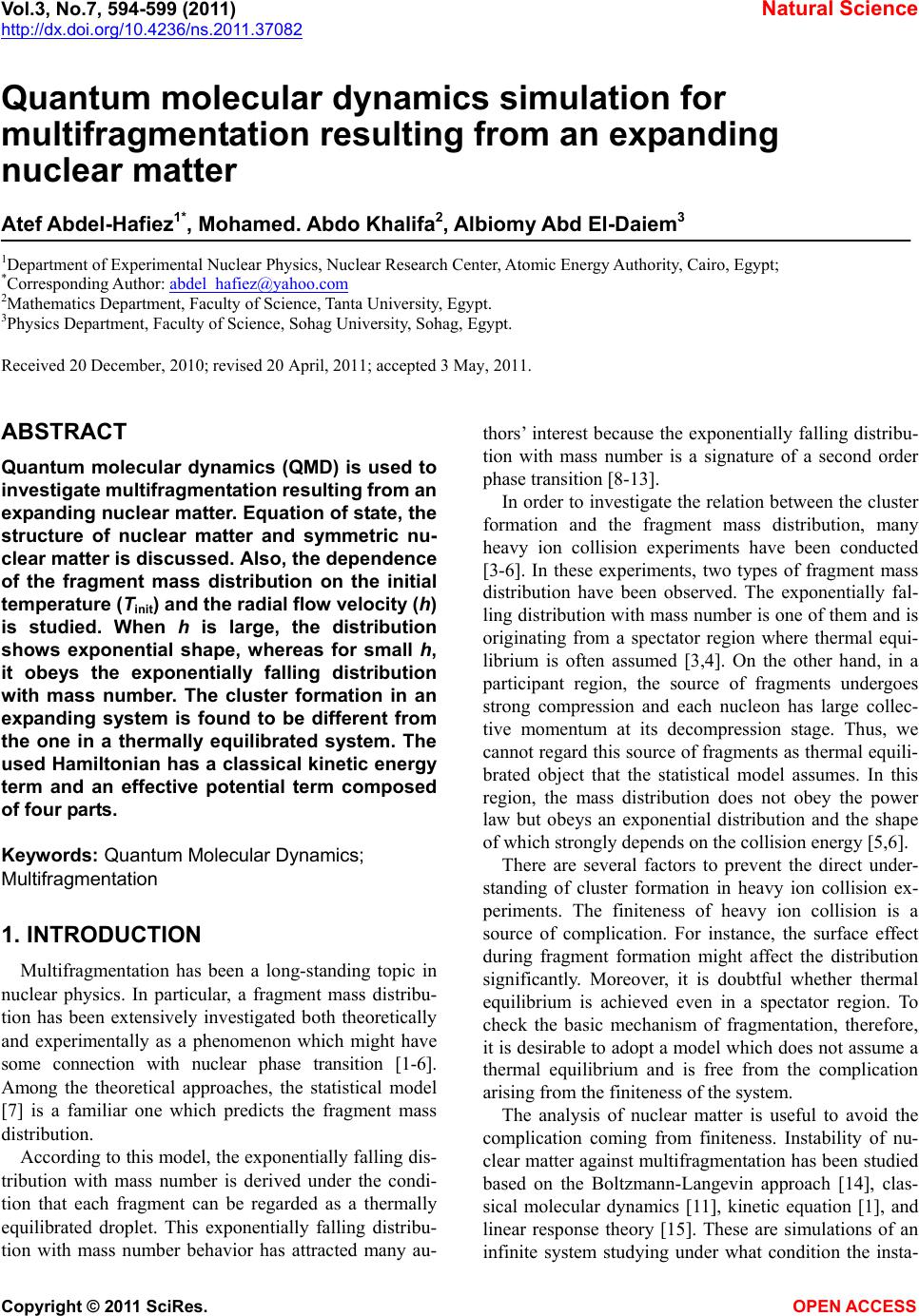 Vol.3, No.7, 594-599 (2011) Natural Science http://dx.doi.org/10.4236/ns.2011.37082 Copyright © 2011 SciRes. OPEN ACCESS Quantum molecular dynamics simulation for multifragmentation resulting from an expanding nuclear matter Atef Abdel-Hafiez1*, Mohamed. Abdo Khalifa2, Albiomy Abd El-Daiem3 1Department of Experimental Nuclear Physics, Nuclear Research Center, Atomic Energy Authority, Cairo, Egypt; *Corresponding Author: [email protected] 2Mathematics Department, Faculty of Science, Tanta University, Egypt. 3Physics Department, Faculty of Science, Sohag University, Sohag, Egypt. Received 20 December, 2010; revised 20 April, 2011; accepted 3 May, 2011. ABSTRACT Quantum molecular dynamics (QMD) is used to investigate multifragmentation resulting from an expanding nuclear matter. Equation of state, the structure of nuclear matter and symmetric nu- clear matter is discussed. Also, the dependence of the fragment mass distribution on the initial temperature (Tinit) and the radial flow velocity (h) is studied. When h is large, the distribution shows exponential shape, whereas for small h, it obeys the exponentially falling distribution with mass number. The cluster formation in an expanding system is found to be different from the one in a thermally equilibrated system. The used Hamiltonian has a classical kinetic energy term and an effective potential term composed of four parts. Keywords: Quantum Molecular Dynamics; Multifragmentation 1. INTRODUCTION Multifragmentation has been a long-standing topic in nuclear physics. In particular, a fragment mass distribu- tion has been extensively investigated both theoretically and experimentally as a phenomenon which might have some connection with nuclear phase transition [1-6]. Among the theoretical approaches, the statistical model [7] is a familiar one which predicts the fragment mass distribution. According to this model, the exponentially falling dis- tribution with mass number is derived under the condi- tion that each fragment can be regarded as a thermally equilibrated droplet. This exponentially falling distribu- tion with mass number behavior has attracted many au- thors’ interest because the exponentially falling distribu- tion with mass number is a signature of a second order phase transition [8-13]. In order to investigate the relation between the cluster formation and the fragment mass distribution, many heavy ion collision experiments have been conducted [3-6]. In these experiments, two types of fragment mass distribution have been observed. The exponentially fal- ling distribution with mass number is one of them and is originating from a spectator region where thermal equi- librium is often assumed [3,4]. On the other hand, in a participant region, the source of fragments undergoes strong compression and each nucleon has large collec- tive momentum at its decompression stage. Thus, we cannot regard this source of fragments as thermal equili- brated object that the statistical model assumes. In this region, the mass distribution does not obey the power law but obeys an exponential distribution and the shape of which strongly depends on the collision energy [5,6]. There are several factors to prevent the direct under- standing of cluster formation in heavy ion collision ex- periments. The finiteness of heavy ion collision is a source of complication. For instance, the surface effect during fragment formation might affect the distribution significantly. Moreover, it is doubtful whether thermal equilibrium is achieved even in a spectator region. To check the basic mechanism of fragmentation, therefore, it is desirable to adopt a model which does not assume a thermal equilibrium and is free from the complication arising from the finiteness of the system. The analysis of nuclear matter is useful to avoid the complication coming from finiteness. Instability of nu- clear matter against multifragmentation has been studied based on the Boltzmann-Langevin approach [14], clas- sical molecular dynamics [11], kinetic equation [1], and linear response theory [15]. These are simulations of an infinite system studying under what condition the insta- 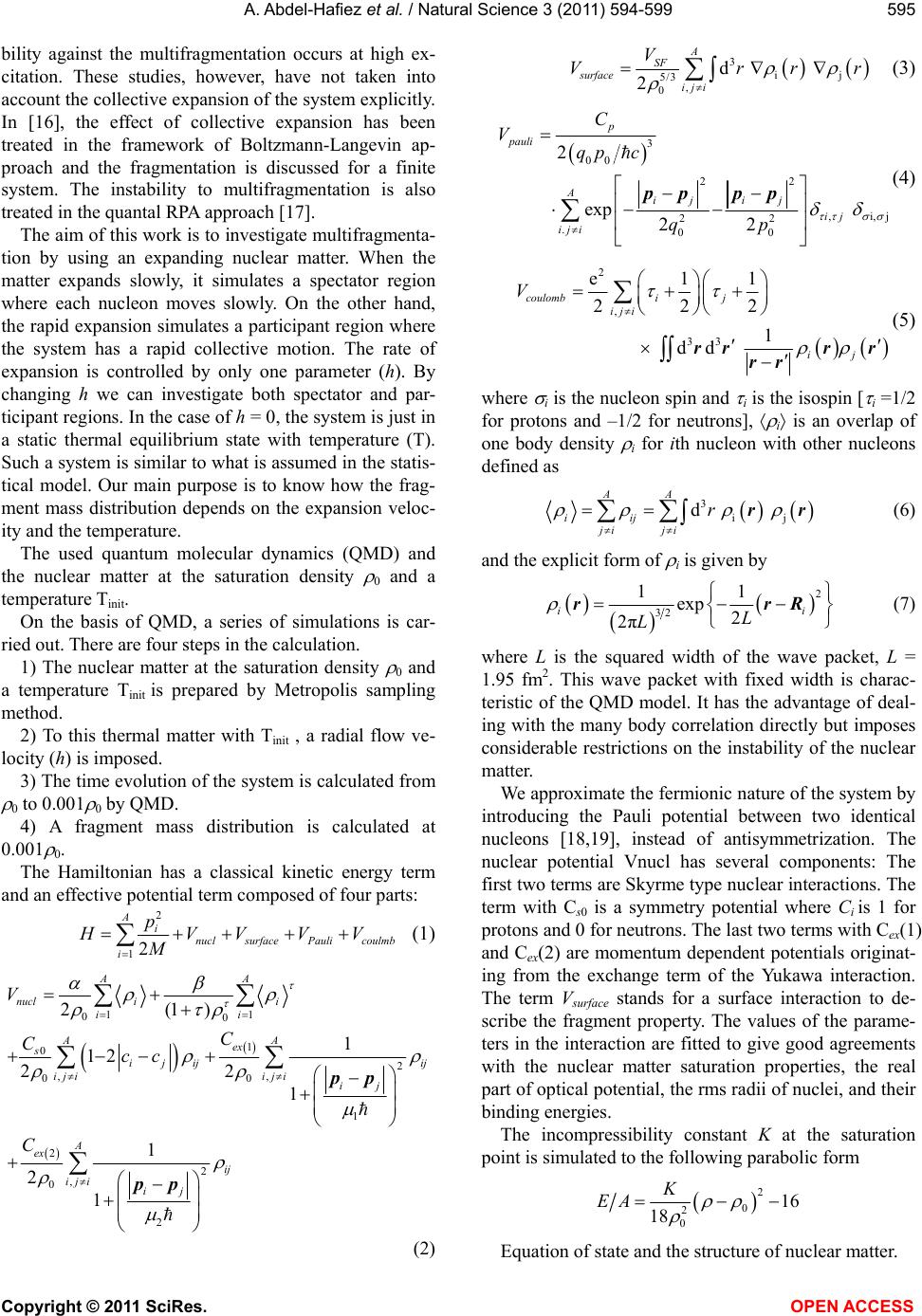 A. Abdel-Hafiez et al. / Natural Science 3 (2011) 594-599 Copyright © 2011 SciRes. OPEN ACCESS 595 bility against the multifragmentation occurs at high ex- citation. These studies, however, have not taken into account the collective expansion of the system explicitly. In [16], the effect of collective expansion has been treated in the framework of Boltzmann-Langevin ap- proach and the fragmentation is discussed for a finite system. The instability to multifragmentation is also treated in the quantal RPA approach [17]. The aim of this work is to investigate multifragmenta- tion by using an expanding nuclear matter. When the matter expands slowly, it simulates a spectator region where each nucleon moves slowly. On the other hand, the rapid expansion simulates a participant region where the system has a rapid collective motion. The rate of expansion is controlled by only one parameter (h). By changing h we can investigate both spectator and par- ticipant regions. In the case of h = 0, the system is just in a static thermal equilibrium state with temperature (T). Such a system is similar to what is assumed in the statis- tical model. Our main purpose is to know how the frag- ment mass distribution depends on the expansion veloc- ity and the temperature. The used quantum molecular dynamics (QMD) and the nuclear matter at the saturation density 0 and a temperature Tinit. On the basis of QMD, a series of simulations is car- ried out. There are four steps in the calculation. 1) The nuclear matter at the saturation density 0 and a temperature Tinit is prepared by Metropolis sampling method. 2) To this thermal matter with Tinit , a radial flow ve- locity (h) is imposed. 3) The time evolution of the system is calculated from 0 to 0.001 0 by QMD. 4) A fragment mass distribution is calculated at 0.001 0. The Hamiltonian has a classical kinetic energy term and an effective potential term composed of four parts: 2 12 A i nuclsurface Pauli coulmb i p HVVVV M (1) 11 00 1 0 2 ,, 00 1 2 2 , 0 2 2(1 ) 1 12 22 1 1 2 1 AA nucl ii ii AA ex s ij ijij ij iij iij A ex ij ij iij V C Ccc C pp pp (2) 3 ij 5/3 , 0 d 2 A SF surface ij i V Vrrr (3) 3 00 22 ,i,j 22 .00 2 exp 22 p pauli Aij ij ij ij i C V qp c qp pp pp(4) 2 , 33 e11 222 1 dd coulombi j ij i ij V rrr r rr (5) where i is the nucleon spin and i is the isospin [ i =1/2 for protons and –1/2 for neutrons], i is an overlap of one body density i for ith nucleon with other nucleons defined as 3 ij d AA iij ji ji r rr (6) and the explicit form of i is given by 2 32 11 exp 2 2π ii L L rrR (7) where L is the squared width of the wave packet, L = 1.95 fm2. This wave packet with fixed width is charac- teristic of the QMD model. It has the advantage of deal- ing with the many body correlation directly but imposes considerable restrictions on the instability of the nuclear matter. We approximate the fermionic nature of the system by introducing the Pauli potential between two identical nucleons [18,19], instead of antisymmetrization. The nuclear potential Vnucl has several components: The first two terms are Skyrme type nuclear interactions. The term with Cs0 is a symmetry potential where Ci is 1 for protons and 0 for neutrons. The last two terms with Cex(1) and Cex(2) are momentum dependent potentials originat- ing from the exchange term of the Yukawa interaction. The term Vsurface stands for a surface interaction to de- scribe the fragment property. The values of the parame- ters in the interaction are fitted to give good agreements with the nuclear matter saturation properties, the real part of optical potential, the rms radii of nuclei, and their binding energies. The incompressibility constant K at the saturation point is simulated to the following parabolic form 2 0 2 0 16 18 K EA Equation of state and the structure of nuclear matter. 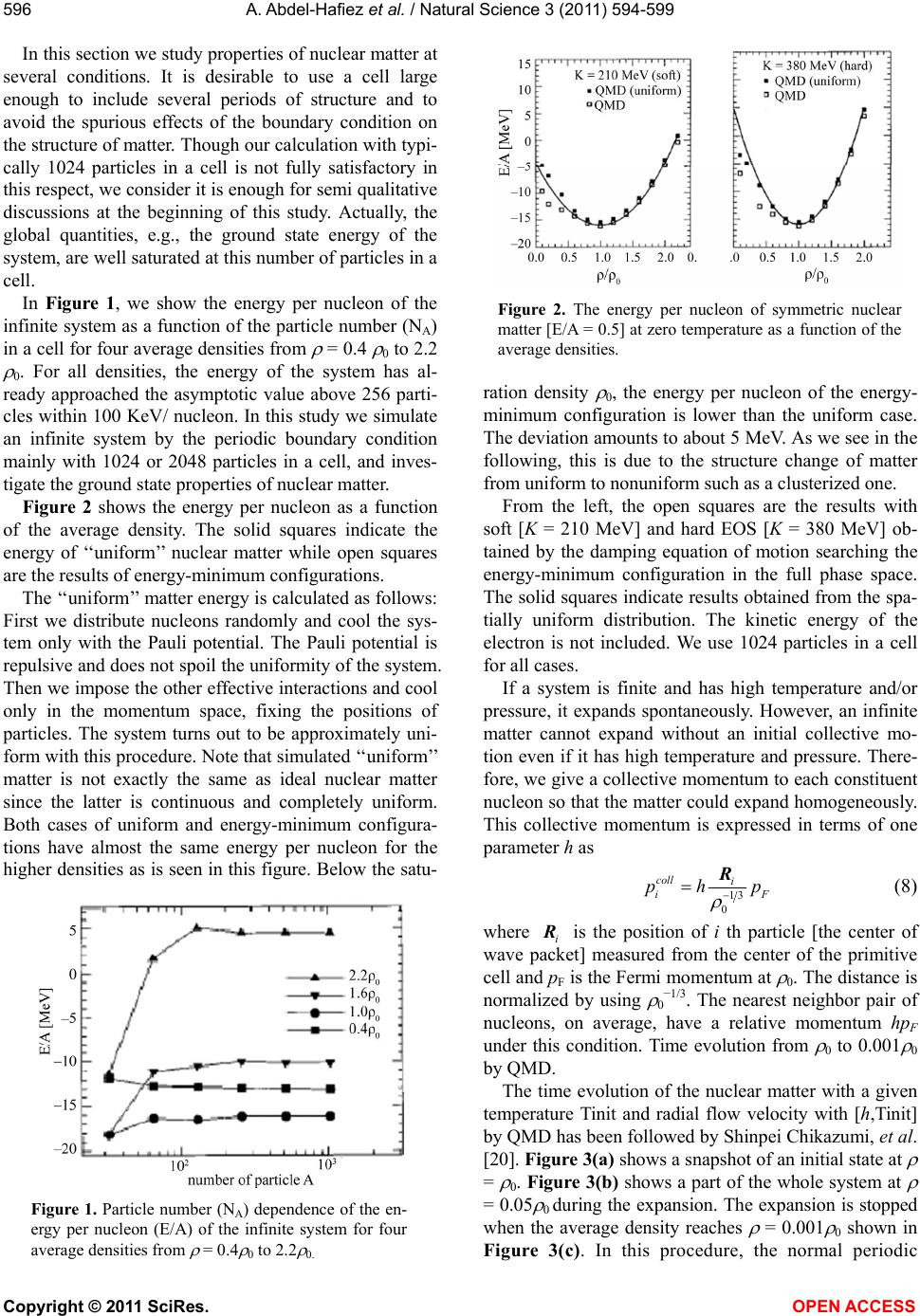 A. Abdel-Hafiez et al. / Natural Science 3 (2011) 594-599 Copyright © 2011 SciRes. OPEN ACCESS 596 In this section we study properties of nuclear matter at several conditions. It is desirable to use a cell large enough to include several periods of structure and to avoid the spurious effects of the boundary condition on the structure of matter. Though our calculation with typi- cally 1024 particles in a cell is not fully satisfactory in this respect, we consider it is enough for semi qualitative discussions at the beginning of this study. Actually, the global quantities, e.g., the ground state energy of the system, are well saturated at this number of particles in a cell. In Figure 1, we show the energy per nucleon of the infinite system as a function of the particle number (NA) in a cell for four average densities from = 0.4 0 to 2.2 0. For all densities, the energy of the system has al- ready approached the asymptotic value above 256 parti- cles within 100 KeV/ nucleon. In this study we simulate an infinite system by the periodic boundary condition mainly with 1024 or 2048 particles in a cell, and inves- tigate the ground state properties of nuclear matter. Figure 2 shows the energy per nucleon as a function of the average density. The solid squares indicate the energy of ‘‘uniform’’ nuclear matter while open squares are the results of energy-minimum configurations. The ‘‘uniform’’ matter energy is calculated as follows: First we distribute nucleons randomly and cool the sys- tem only with the Pauli potential. The Pauli potential is repulsive and does not spoil the uniformity of the system. Then we impose the other effective interactions and cool only in the momentum space, fixing the positions of particles. The system turns out to be approximately uni- form with this procedure. Note that simulated ‘‘uniform’’ matter is not exactly the same as ideal nuclear matter since the latter is continuous and completely uniform. Both cases of uniform and energy-minimum configura- tions have almost the same energy per nucleon for the higher densities as is seen in this figure. Below the satu- Figure 1. Particle number (NA) dependence of the en- ergy per nucleon (E/A) of the infinite system for four average densities from = 0.4 0 to 2.2 0. Figure 2. The energy per nucleon of symmetric nuclear matter [E/A = 0.5] at zero temperature as a function of the average densities. ration density 0, the energy per nucleon of the energy- minimum configuration is lower than the uniform case. The deviation amounts to about 5 MeV. As we see in the following, this is due to the structure change of matter from uniform to nonuniform such as a clusterized one. From the left, the open squares are the results with soft [K = 210 MeV] and hard EOS [K = 380 MeV] ob- tained by the damping equation of motion searching the energy-minimum configuration in the full phase space. The solid squares indicate results obtained from the spa- tially uniform distribution. The kinetic energy of the electron is not included. We use 1024 particles in a cell for all cases. If a system is finite and has high temperature and/or pressure, it expands spontaneously. However, an infinite matter cannot expand without an initial collective mo- tion even if it has high temperature and pressure. There- fore, we give a collective momentum to each constituent nucleon so that the matter could expand homogeneously. This collective momentum is expressed in terms of one parameter h as 13 0 coll i iF ph p R (8) where i R is the position of i th particle [the center of wave packet] measured from the center of the primitive cell and pF is the Fermi momentum at 0. The distance is normalized by using 0 –1/3. The nearest neighbor pair of nucleons, on average, have a relative momentum hpF under this condition. Time evolution from 0 to 0.001 0 by QMD. The time evolution of the nuclear matter with a given temperature Tinit and radial flow velocity with [h,Tinit] by QMD has been followed by Shinpei Chikazumi, et al. [20]. Figure 3(a) shows a snapshot of an initial state at = 0. Figure 3(b) shows a part of the whole system at = 0.05 0 during the expansion. The expansion is stopped when the average density reaches = 0.001 0 shown in Figure 3(c). In this procedure, the normal periodic 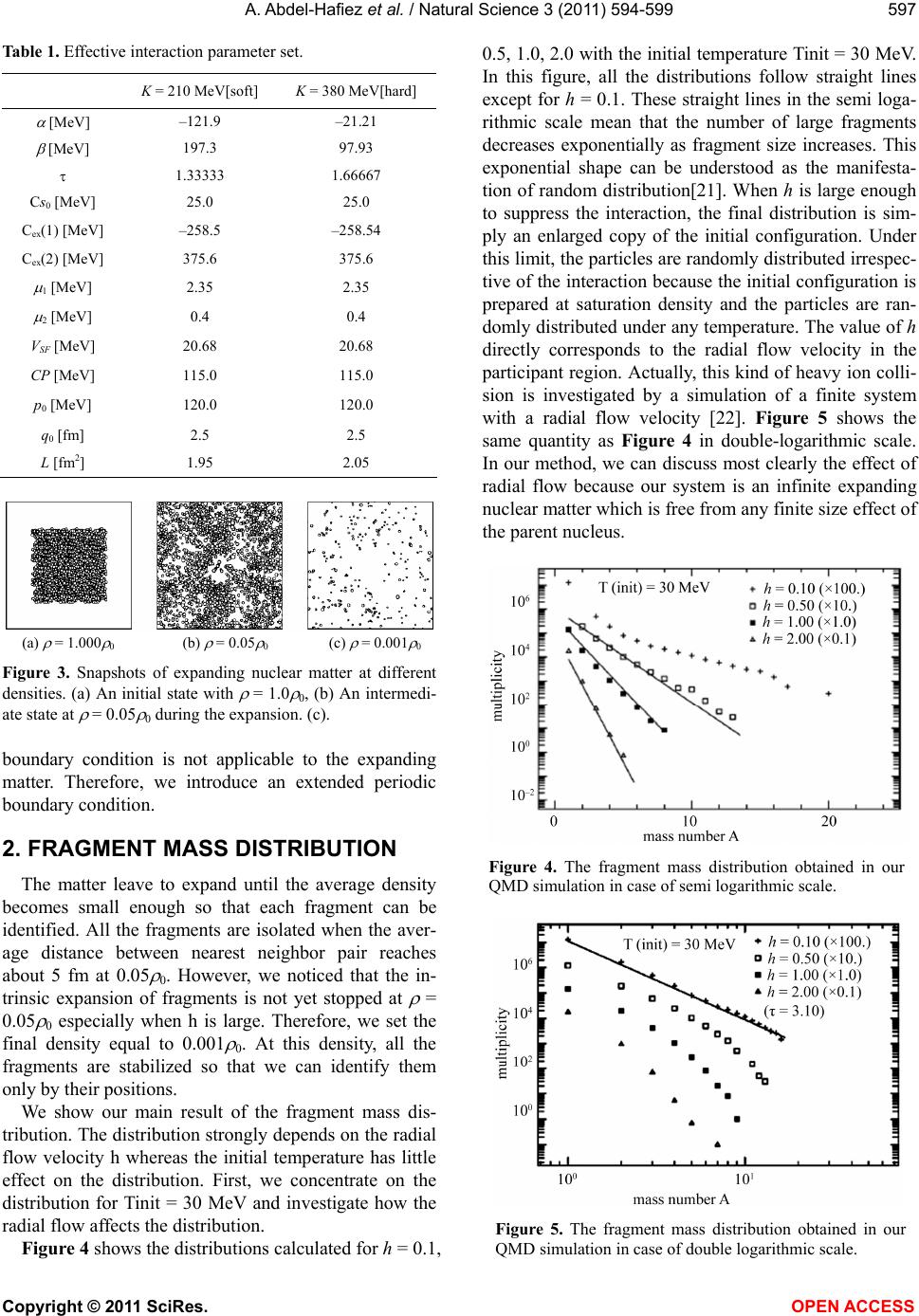 A. Abdel-Hafiez et al. / Natural Science 3 (2011) 594-599 Copyright © 2011 SciRes. OPEN ACCESS 597 Table 1. Effective interaction parameter set. K = 210 MeV[soft] K = 380 MeV[hard] [MeV] –121.9 –21.21 [MeV] 197.3 97.93 1.33333 1.66667 Cs0 [MeV] 25.0 25.0 Cex(1) [MeV] –258.5 –258.54 Cex(2) [MeV] 375.6 375.6 1 [MeV] 2.35 2.35 2 [MeV] 0.4 0.4 VSF [MeV] 20.68 20.68 CP [MeV] 115.0 115.0 p0 [MeV] 120.0 120.0 q0 [fm] 2.5 2.5 L [fm2] 1.95 2.05 (a) = 1.000 0 (b) = 0.05 0 (c) = 0.001 0 Figure 3. Snapshots of expanding nuclear matter at different densities. (a) An initial state with = 1.0 0, (b) An intermedi- ate state at = 0.05 0 during the expansion. (c). boundary condition is not applicable to the expanding matter. Therefore, we introduce an extended periodic boundary condition. 2. FRAGMENT MASS DISTRIBUTION The matter leave to expand until the average density becomes small enough so that each fragment can be identified. All the fragments are isolated when the aver- age distance between nearest neighbor pair reaches about 5 fm at 0.05 0. However, we noticed that the in- trinsic expansion of fragments is not yet stopped at = 0.05 0 especially when h is large. Therefore, we set the final density equal to 0.001 0. At this density, all the fragments are stabilized so that we can identify them only by their positions. We show our main result of the fragment mass dis- tribution. The distribution strongly depends on the radial flow velocity h whereas the initial temperature has little effect on the distribution. First, we concentrate on the distribution for Tinit = 30 MeV and investigate how the radial flow affects the distribution. Figure 4 shows the distributions calculated for h = 0.1, 0.5, 1.0, 2.0 with the initial temperature Tinit = 30 MeV. In this figure, all the distributions follow straight lines except for h = 0.1. These straight lines in the semi loga- rithmic scale mean that the number of large fragments decreases exponentially as fragment size increases. This exponential shape can be understood as the manifesta- tion of random distribution[21]. When h is large enough to suppress the interaction, the final distribution is sim- ply an enlarged copy of the initial configuration. Under this limit, the particles are randomly distributed irrespec- tive of the interaction because the initial configuration is prepared at saturation density and the particles are ran- domly distributed under any temperature. The value of h directly corresponds to the radial flow velocity in the participant region. Actually, this kind of heavy ion colli- sion is investigated by a simulation of a finite system with a radial flow velocity [22]. Figure 5 shows the same quantity as Figure 4 in double-logarithmic scale. In our method, we can discuss most clearly the effect of radial flow because our system is an infinite expanding nuclear matter which is free from any finite size effect of the parent nucleus. Figure 4. The fragment mass distribution obtained in our QMD simulation in case of semi logarithmic scale. Figure 5. The fragment mass distribution obtained in our QMD simulation in case of double logarithmic scale. 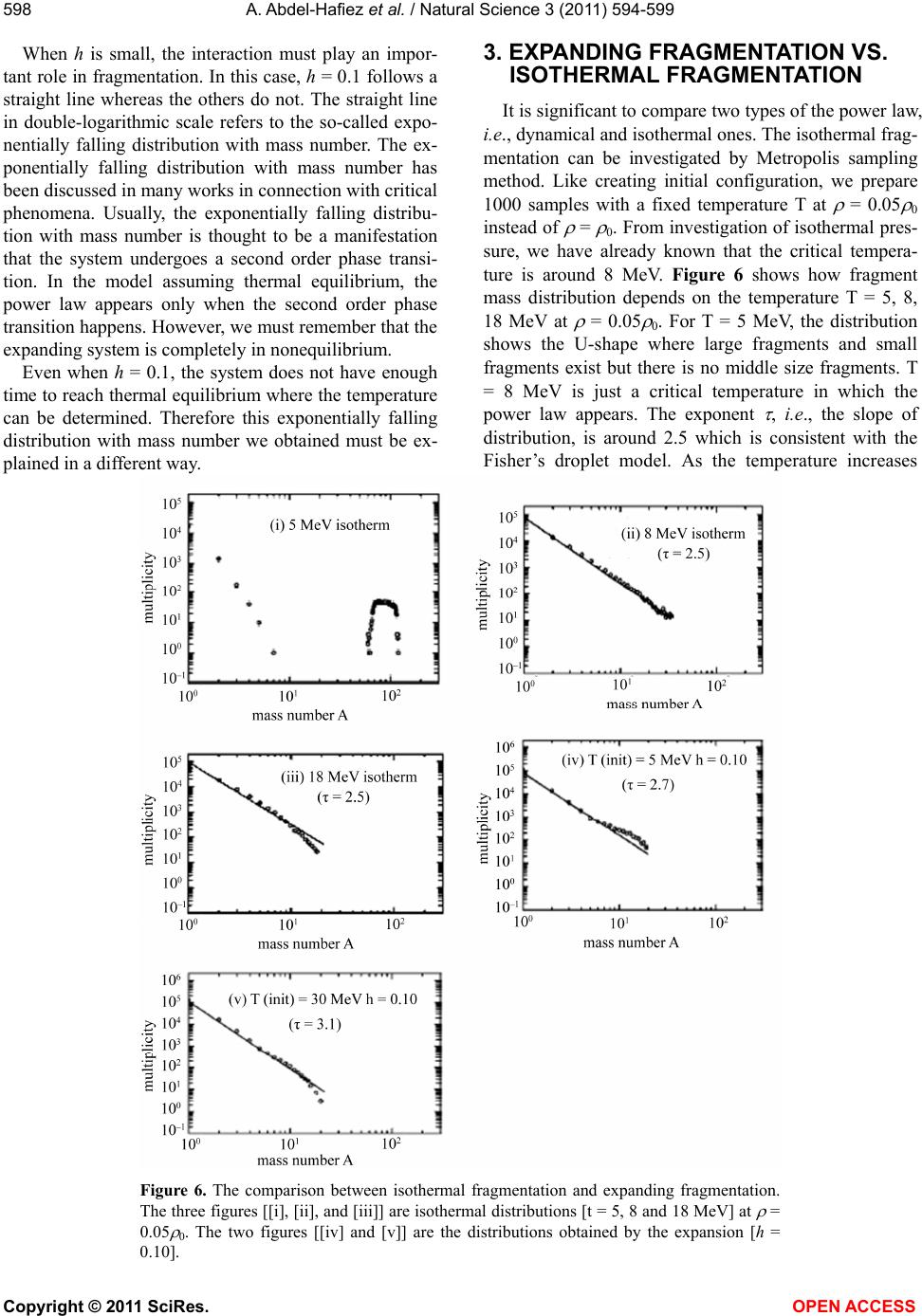 A. Abdel-Hafiez et al. / Natural Science 3 (2011) 594-599 Copyright © 2011 SciRes. OPEN ACCESS 598 When h is small, the interaction must play an impor- tant role in fragmentation. In this case, h = 0.1 follows a straight line whereas the others do not. The straight line in double-logarithmic scale refers to the so-called expo- nentially falling distribution with mass number. The ex- ponentially falling distribution with mass number has been discussed in many works in connection with critical phenomena. Usually, the exponentially falling distribu- tion with mass number is thought to be a manifestation that the system undergoes a second order phase transi- tion. In the model assuming thermal equilibrium, the power law appears only when the second order phase transition happens. However, we must remember that the expanding system is completely in nonequilibrium. Even when h = 0.1, the system does not have enough time to reach thermal equilibrium where the temperature can be determined. Therefore this exponentially falling distribution with mass number we obtained must be ex- plained in a different way. 3. EXPANDING FRAGMENTATION VS. ISOTHERMAL FRAGMENTATION It is significant to compare two types of the power law, i.e., dynamical and isothermal ones. The isothermal frag- mentation can be investigated by Metropolis sampling method. Like creating initial configuration, we prepare 1000 samples with a fixed temperature T at = 0.05 0 instead of = 0. From investigation of isothermal pres- sure, we have already known that the critical tempera- ture is around 8 MeV. Figure 6 shows how fragment mass distribution depends on the temperature T = 5, 8, 18 MeV at = 0.05 0. For T = 5 MeV, the distribution shows the U-shape where large fragments and small fragments exist but there is no middle size fragments. T = 8 MeV is just a critical temperature in which the power law appears. The exponent , i.e., the slope of distribution, is around 2.5 which is consistent with the Fisher’s droplet model. As the temperature increases Figure 6. The comparison between isothermal fragmentation and expanding fragmentation. The three figures [[i], [ii], and [iii]] are isothermal distributions [t = 5, 8 and 18 MeV] at = 0.05 0. The two figures [[iv] and [v]] are the distributions obtained by the expansion [h = 0.10].  A. Abdel-Hafiez et al. / Natural Science 3 (2011) 594-599 Copyright © 2011 SciRes. OPEN ACCESS 599 beyond the critical temperature Tc = 8 MeV, the distribu- tion deviates from the exponentially falling distribution with mass number and becomes an exponential shape. In the bottom figure [T = 18 MeV], thermal motion com- pletely overcomes attractive interaction. Therefore, a random distribution appears like the rapid expansion case. 4. CONCLUTIONS In this paper we have presented the QMD approach for studying multifragmentation resulting from an ex- panding nuclear matter. We can reproduce well the finite nuclear properties for various mass ranges by inclusion of the Pauli and surface potential. We have investigated the EOS of nuclear matter by simulating an infinite sys- tem with the used QMD. The fragmentation during ex- pansion can be classified according to the speed of ex- pansion h. Also, the symmetric nuclear matter is dis- cussed. Our QMD model contains a further possibility for the simulation of the dynamical evolution of infinite nuclear matter such as supernova explosions, the glitch of the neutron star, and the initial stage of the universe. An intensive and systematic study of nuclear matter with the present model will be important since it contains fewer assumptions than the foregoing models as to the struc- ture of matter. REFERENCES [1] Schmelzer, J., Ro¨pke, G. and Ludwig, F.-P. (1997) Nu- clear multifragmentation processes and nucleation theory. Physical Review C, 55, 1917-1927. doi:10.1103/PhysRevC.55.1917 [2] Strachan, A. and Dorso, C.O. (1999) Temperature and energy partition in fragmentation. Physical Review C, 59, 285-294. doi:10.1103/PhysRevC.59.285 [3] Gilkes, M.L. et al., (1994) Determination of critical exponents from the multifragmentation of gold nuclei. Physical Review Letters, 73, 1590-1593. doi:10.1103/PhysRevLett.73.1590 [4] Mastinu, P.F. et al., (1996) Circumstantial evidence for critical behavior in peripheral Au+Au collisions at 35 MeV/nucleon. Physical Review Letters, 76, 2646-2649. doi:/10.1103/PhysRevLett.76.2646 [5] Petrovici, M. et al., (1995) Cluster formation during expansion of hot and compressed nuclear matter pro- duced in central collisions of Au on Au at 250 A MeV. Physical Review Letter ,74, 5001-5004. http://dx.doi.org/10.1103/PhysRevLett.76.2646 [6] Reisdorf, W. et al., (1997) Central collisions of Au on Au at 150-A/Mev, 250-A/Mev and 400-A/Mev, Nuclear Physics A, 612, 493-556. doi:10.1016/S0375-9474(96)00388-0 [7] Das Gupta, S., Mekjian, A.Z. and Tsang, B. (2001) Symmetry and surface symmetry energies in finite nuclei. Advances in Nuclear Physics, 26, 89. [8] Mishustin, I.N. (1998) Fluctuations near the deconfine- ment phase transition boundary. Nuclear Physics A, 630, 111-125. doi:10.1016/S0375-9474(97)00748-3 [9] Belkacem, M., Latora, V. and Bonasera, A. (1995) Criti- cal evolution of a finite system. Physical Review C, 52, 271-285. doi:10.1103/PhysRevC.52.271 [10] Colonna, M. and Chomaz, Ph. (1998) Quantal effects on growth of instabilities in nuclear matter. Physical Review B, 436, 1-9. doi:10.1016/S0370-2693(98)00882-X [11] Finocchiaro, P., Belkacem, M., Kubo, T., Latora, V. and Bonasera, A. (1996) The nuclear liquid-gas phase transi- tion within fermionic molecular dynamics. Nuclear Physics A, 600, 236-250. doi:10.1016/0375-9474(96)00040-1 [12] Ohnishi, A. and Randrup, J. (1997) Quantum fluctuation effects on nuclear fragment formation. Physical Review B, 394, 260-268. doi:10.1016/S0370-2693(97)00032-4 [13] Sugawa, Y. and Horiuchi, H. (1999) Nucleon-induced fragment formation with antisymmetrized molecular dy- namics. Physical Review C, 60, 064613-054621. doi:10.1103/PhysRevC.60.064613 [14] Colonna, M. andChomaz, Ph. (1994) Unstable infinite nuclear matter in stochastic mean field approach. Physi- cal Review C, 49, 1908. [15] Baran, V., Colonna, M., Di Toro, M. and Larionov, A.B. (1998) Fragment isotope distributions and the isospin dependent equation. Nuclear Physics A, 632, 287-303. doi:10.1016/S0375-9474(98)00006-2 [16] Guarnera, A., Colonna, M. and Chomaz, Ph. (1996) Iso- spin effects in nuclear fragmentation. Physics Letters B, 373, 267-274. doi:10.1016/0370-2693(96)00152-9 [17] Ayik, S. and Colonna, M. (1995) Quantal effects on growth of instabilities in nuclear matter. Physical Review B, 353, 417-421. doi:10.1016/0370-2693(95)00596-D [18] Dorso, C.O., Duarte, S. and Randrup, J. (1987) Classical simulation of the fermi gas. Physics Letters B, 188, 287-294. doi:10.1016/0370-2693(87)91382-7 [19] Maruyama, T. Niita, K., Oyamatsu, K. Maruyama, T., Chiba, S. and Iwamoto, A. (1998) Quantum molecular dynamics approach to the nuclear matter below the satu- ration density. Physical Review C, 57, 655-665. doi:10.1103/PhysRevC.57.655 [20] Chikazumi, S., Maruyama, T., Chiba, S., Niita, K. and Iwamoto, A. (2001) Quantum molecular dynamics simu- lation of expanding nuclear matter and nuclear multi- fragmentation. Physical Review C, 63, 024602. doi:10.1103/PhysRevC.63.024602 [21] Holian B.L. and Grady, D.E. (1988) Fragmentation by molecular dynamics: The microscopic ‘‘big bang”. Phy- sical Review Letters, 60, 1355-1358. doi:10.1103/PhysRevLett.60.1355 [22] Reisdorf, W.et al., (1997) Central collisions of Au on Au at 150-A/Mev, 250-A/Mev and 400-A/Mev. Nuclear Physics A, 612, 493-556. doi:10.1016/S0375-9474(96)00388-0 |