

Paper Menu >>
Journal Menu >>
 Vol.3, No.7, 542-550 (2011) Natural Science http://dx.doi.org/10.4236/ns.2011.37076 Copyright © 2011 SciRes. OPEN ACCESS Synthesis, spectral characterization, catalytic and biological studies of new Ru(II) carbonyl Schiff base complexes of active amines Vellalapalayam Vangaiannan Raju1, Kugalur Palanisamy Balasubramanian1, Chinnasamy Jayabalakrishnan2, Vaiapuri Chinnusamy2* 1Department of Chemistry, Gobi Arts & Science College, Gobichettipalayam, India; 2PG Department of Chemistry, Sri Ramakrishna Mission Vidyalaya College of Arts & Science, Coimbatore, India; *Corresponding Author: [email protected] Received 23 December, 2010; revised 22 March, 2011; accepted 10 April, 2011. ABSTRACT The synthesis and characterization of several hexa–coordinated Ru(II) complexes of the type [Ru(CO)(B)(L)] (B = PPh3/AsPh3/py/pip; L = di- basic tetradentate ligand derived from the con- densation of isatin with diamines) were reported. IR, electronic, 1H-NMR, 31P-NMR of the com- plexes are discussed. An octahedral geometry has been tentatively proposed for all these complexes. The new complexes have been tested for the catalytic activity in the reaction of oxidation of alcohols in the presence of N-me- thylmorpholine-N-oxide as co-oxidant. The new complexes were also exhibited antimicrobial investigations. Keyw ords: Ruthenium(II) Complexes; Tetradentate N2O2 Schiff Base; Characterization; Catalytic Oxidation; Antimicrobial Activity 1. INTRODUCTION Transition metal complexes with tetradentate Schiff base ligands have been studied as catalyst for a number of organic oxidation and reduction reactions and electro chemical reduction processes [1,2]. The accessibility of ruthenium higher oxidation states [3,4] converts them into excellent catalyst for redox reactions. Particularly, metal complexes of ruthenium have demonstrated to be useful laboratory and industrial homogeneous catalysts in the epoxidation of alkenes and oxidation of alcohols using iodosylbenzene, sodium hypochlorite hydrogen peroxide and N-methylmorpholine-N-oxide as oxygen sources [5-8]. Further the oxidation of organic substrates mediated by high valent ruthenium-oxo species evokes much interest in modeling of cytochrome p.450 [9]. Sharpless et al. [10] carried out a yield oriented study of oxidation of cholesterol, geranial etc. catalyzed by ru- thenium complexes in the presence of N-methylmor- pholine-N-oxide and N, N-dimeth ylaniline-N-oxide. Fur- thermore, the catalytic activities of ruthenium complexes containing tertiaryphosphine or arsine ligands are well established [11,12]. Tetradentate Schiff base complexes have been employed as catalysts for many reactions and as biological models in understanding the structure of bio molecules and biological process [13,14]. In addition, the chemistry of chelating tetradentate Schiff base ligands with ruthenium has also been exten- sively studied [15]. This is due to the fact that Schiff bases offer opportunities for inducing substrate chirality, tuning metal centered electronic factors, enhancing solu- bility and stability and their use as either homogeneous or heterogeneous catalysis [16-18]. The oxidation of primary and secondary alcohols into their corresponding aldehydes and ketones respectively, plays a central role in organic synthesis [19,20]. In continuation of our re- search interest [21] to understand the role of these sim- ple and inexpensive N2O2 donor Schiff base ligands to- wards ruthenium, the reaction of Schiff bases derived from isatin and diamines with ruthenium(II) precursors containing PPh3/AsPh3/py/pip has been carried out. Thus, the present work describes the results of synthesis, char- acterization and properties of hexa coordinated Ru(II) complexes exhibiting a N2O2 ligating core with their catalytic activity towards oxidation of alcohols in the presence of NMO. Further, the antibacterial activity of the Schiff bases and their ruthenium complexes were examined. The following Schiff bases, derived from the condensation of isatin with ethylenediamine/o-phenyle- nediamine/propylene diamine (Scheme 1), were used to prepare the new ruthenium (II) complexes. 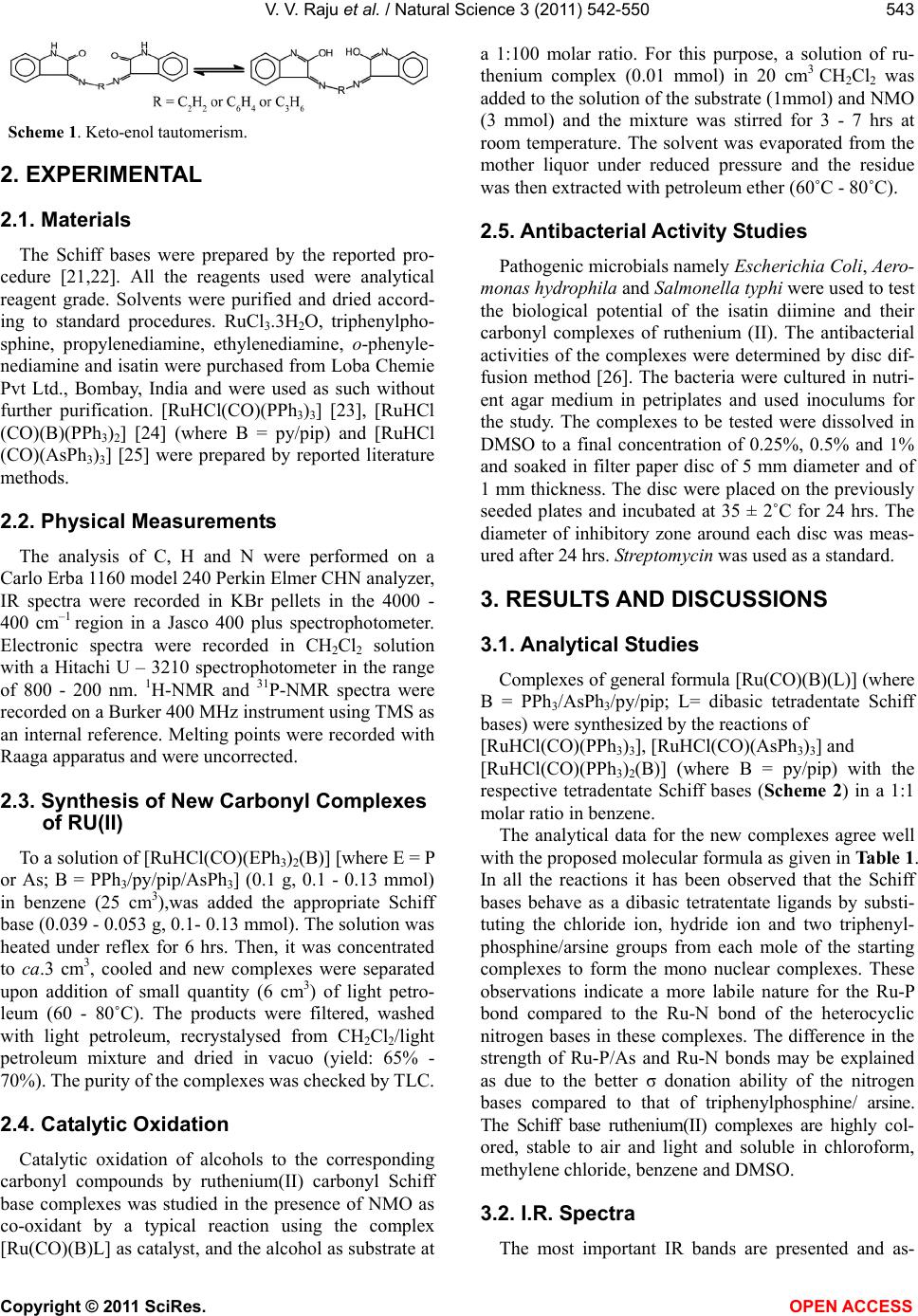 V. V. Raju et al. / Natural Science 3 (2011) 542-550 Copyright © 2011 SciRes. OPEN ACCESS 543 Scheme 1. Keto-enol tautomerism. 2. EXPERIMENTAL 2.1. Materials The Schiff bases were prepared by the reported pro- cedure [21,22]. All the reagents used were analytical reagent grade. Solvents were purified and dried accord- ing to standard procedures. RuCl3.3H2O, triphenylpho- sphine, propylenediamine, ethylenediamine, o-phenyle- nediamine and isatin were purchased from Loba Chemie Pvt Ltd., Bombay, India and were used as such without further purification. [RuHCl(CO)(PPh3)3] [23], [RuHCl (CO)(B)(PPh3)2] [24] (where B = py/pip) and [RuHCl (CO)(AsPh 3)3] [25] were prepared by reported literature methods. 2.2. Physical Measurements The analysis of C, H and N were performed on a Carlo Erba 1160 model 240 Perkin Elmer CHN analyzer, IR spectra were recorded in KBr pellets in the 4000 - 400 cm–1 region in a Jasco 400 plus spectrophotometer. Electronic spectra were recorded in CH2Cl2 solution with a Hitachi U – 3210 spectrophotometer in the range of 800 - 200 nm. 1H-NMR and 31P-NMR spectra were recorded on a Burker 400 MHz instrument using TMS as an internal reference. Melting points were recorded with Raaga apparatus and were uncorrected. 2.3. Synthesis of New Carbonyl Complexes of RU(II) To a solution of [RuHCl(CO)(EPh3)2(B)] [where E = P or As; B = PPh3/py/pip/AsPh3] (0.1 g, 0.1 - 0.13 mmol) in benzene (25 cm3),was added the appropriate Schiff base (0.039 - 0.053 g, 0.1- 0.13 mmol). The solution was heated under reflex for 6 hrs. Then, it was concentrated to ca.3 cm3, cooled and new complexes were separated upon addition of small quantity (6 cm3) of light petro- leum (60 - 80˚C). The products were filtered, washed with light petroleum, recrystalysed from CH2Cl2/light petroleum mixture and dried in vacuo (yield: 65% - 70%). The purity of the complexes was checked by TLC. 2.4. Catalytic Oxidation Catalytic oxidation of alcohols to the corresponding carbonyl compounds by ruthenium(II) carbonyl Schiff base complexes was studied in the presence of NMO as co-oxidant by a typical reaction using the complex [Ru(CO)(B)L] as catalyst, and the alcohol as substrate at a 1:100 molar ratio. For this purpose, a solution of ru- thenium complex (0.01 mmol) in 20 cm3 CH2Cl2 was added to the solution of the substrate (1mmol) and NMO (3 mmol) and the mixture was stirred for 3 - 7 hrs at room temperature. The solvent was evaporated from the mother liquor under reduced pressure and the residue was then extracted with petroleum ether (60˚C - 80˚C). 2.5. Antibacterial Activity Studies Pathogenic microbials namely Escherichia Coli, Aero- monas hydrophila and Salmonella typhi were used to test the biological potential of the isatin diimine and their carbonyl complexes of ruthenium (II). The antibacterial activities of the complexes were determined by disc dif- fusion method [26]. The bacteria were cultured in nutri- ent agar medium in petriplates and used inoculums for the study. The complexes to be tested were dissolved in DMSO to a final concentration of 0.25%, 0.5% and 1% and soaked in filter paper disc of 5 mm diameter and of 1 mm thickness. The disc were placed on the previously seeded plates and incubated at 35 ± 2˚C for 24 hrs. The diameter of inhibitory zone around each disc was meas- ured after 24 hrs. Streptomycin was used as a standard. 3. RESULTS AND DISCUSSIONS 3.1. Analytical Studies Complexes of general formula [Ru(CO)(B)(L)] (where B = PPh3/AsPh3/py/pip; L= dibasic tetradentate Schiff bases) were synthesized by the reactions of [RuHCl(CO)(PPh3)3], [RuHCl(CO)(AsPh3)3] and [RuHCl(CO)(PPh3)2(B)] (where B = py/pip) with the respective tetradentate Schiff bases (Scheme 2) in a 1:1 molar ratio in benzene. The analytical data for the new complexes agree well with the proposed molecular formula as given in Table 1. In all the reactions it has been observed that the Schiff bases behave as a dibasic tetratentate ligands by substi- tuting the chloride ion, hydride ion and two triphenyl- phosphine/arsine groups from each mole of the starting complexes to form the mono nuclear complexes. These observations indicate a more labile nature for the Ru-P bond compared to the Ru-N bond of the heterocyclic nitrogen bases in these complexes. The difference in the strength of Ru-P/As and Ru-N bonds may be explained as due to the better σ donation ability of the nitrogen bases compared to that of triphenylphosphine/ arsine. The Schiff base ruthenium(II) complexes are highly col- ored, stable to air and light and soluble in chloroform, methylene chloride, benzene and DMSO. 3.2. I.R. Spectra The most important IR bands are presented and as- 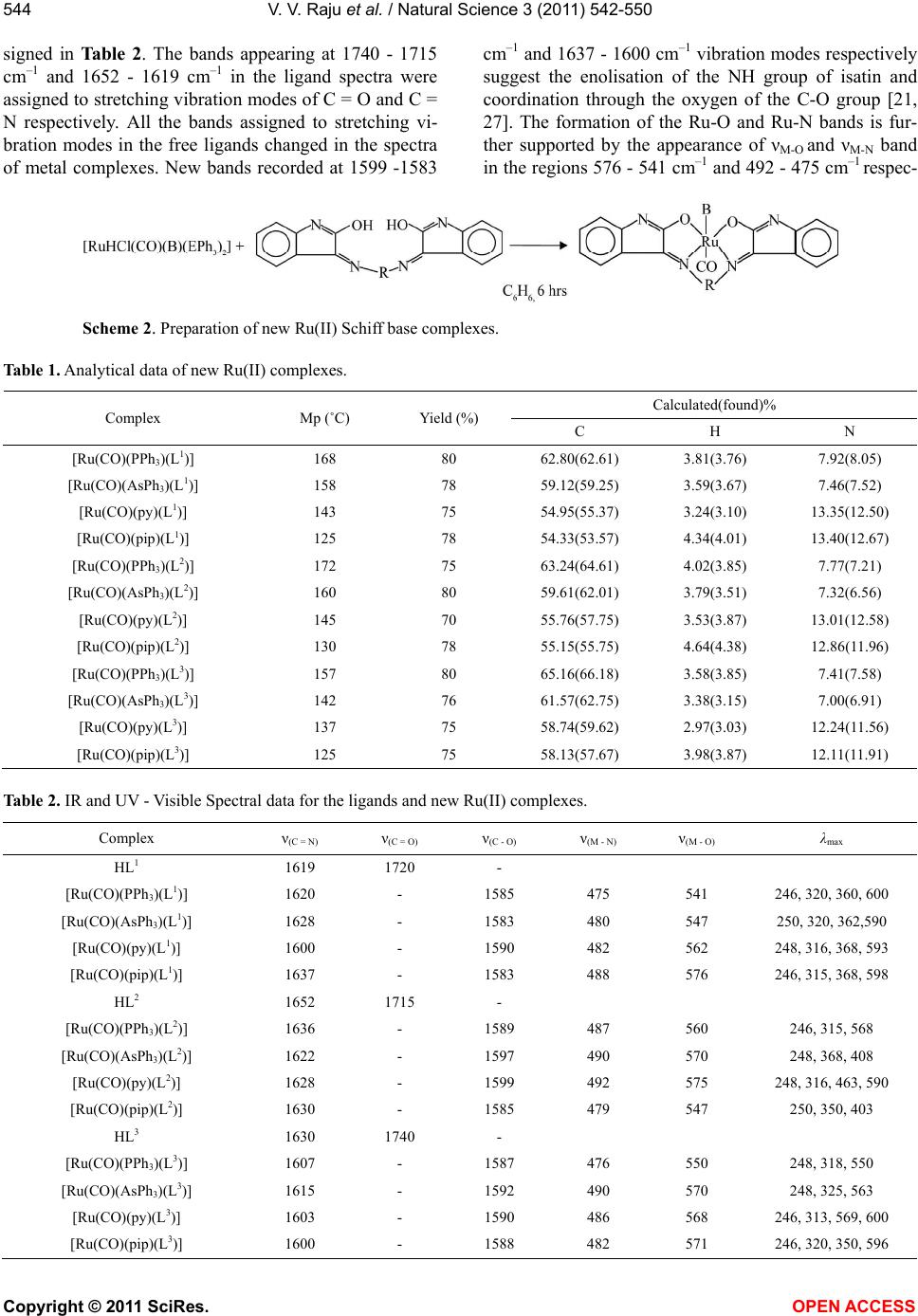 V. V. Raju et al. / Natural Science 3 (2011) 542-550 Copyright © 2011 SciRes. OPEN ACCESS 544 signed in Table 2. The bands appearing at 1740 - 1715 cm–1 and 1652 - 1619 cm–1 in the ligand spectra were assigned to stretching vibration modes of C = O and C = N respectively. All the bands assigned to stretching vi- bration modes in the free ligands changed in the spectra of metal complexes. New bands recorded at 1599 -1583 cm–1 and 1637 - 1600 cm–1 vibration modes respectively suggest the enolisation of the NH group of isatin and coordination through the oxygen of the C-O group [21, 27]. The formation of the Ru-O and Ru-N bands is fur- ther supported by the appearance of νM-O and νM-N band in the regions 576 - 541 cm–1 and 492 - 475 cm–1 respec- Scheme 2. Preparation of new Ru(II) Schiff base complexes. Table 1. Analytical data of new Ru(II) complexes. Calculated(found)% Complex Mp (˚C) Yield (%) C H N [Ru(CO)(PPh3)(L1)] 168 80 62.80(62.61) 3.81(3.76) 7.92(8.05) [Ru(CO)(AsPh3)(L1)] 158 78 59.12(59.25) 3.59(3.67) 7.46(7.52) [Ru(CO)(py)(L 1)] 143 75 54.95(55.37) 3.24(3.10) 13.35(12.50) [Ru(CO)(pip)(L1)] 125 78 54.33(53.57) 4.34(4.01) 13.40(12.67) [Ru(CO)(PPh3)(L2)] 172 75 63.24(64.61) 4.02(3.85) 7.77(7.21) [Ru(CO)(AsPh3)(L2)] 160 80 59.61(62.01) 3.79(3.51) 7.32(6.56) [Ru(CO)(py)(L 2)] 145 70 55.76(57.75) 3.53(3.87) 13.01(12.58) [Ru(CO)(pip)(L2)] 130 78 55.15(55.75) 4.64(4.38) 12.86(11.96) [Ru(CO)(PPh3)(L3)] 157 80 65.16(66.18) 3.58(3.85) 7.41(7.58) [Ru(CO)(AsPh3)(L3)] 142 76 61.57(62.75) 3.38(3.15) 7.00(6.91) [Ru(CO)(py)(L 3)] 137 75 58.74(59.62) 2.97(3.03) 12.24(11.56) [Ru(CO)(pip)(L3)] 125 75 58.13(57.67) 3.98(3.87) 12.11(11.91) Table 2. IR and UV - Visible Spectral data for the ligands and new Ru(II) complexes. Complex ν(C = N) ν(C = O) ν(C - O) ν(M - N) ν(M - O) λmax HL1 1619 1720 - [Ru(CO)(PPh3)(L1)] 1620 - 1585 475 541 246, 320, 360, 600 [Ru(CO)(AsPh3)(L1)] 1628 - 1583 480 547 250, 320, 362,590 [Ru(CO)(py)(L 1)] 1600 - 1590 482 562 248, 316, 368, 593 [Ru(CO)(pip)(L1)] 1637 - 1583 488 576 246, 315, 368, 598 HL2 1652 1715 - [Ru(CO)(PPh3)(L2)] 1636 - 1589 487 560 246, 315, 568 [Ru(CO)(AsPh3)(L2)] 1622 - 1597 490 570 248, 368, 408 [Ru(CO)(py)(L 2)] 1628 - 1599 492 575 248, 316, 463, 590 [Ru(CO)(pip)(L2)] 1630 - 1585 479 547 250, 350, 403 HL3 1630 1740 - [Ru(CO)(PPh3)(L3)] 1607 - 1587 476 550 248, 318, 550 [Ru(CO)(AsPh3)(L3)] 1615 - 1592 490 570 248, 325, 563 [Ru(CO)(py)(L 3)] 1603 - 1590 486 568 246, 313, 569, 600 [Ru(CO)(pip)(L3)] 1600 - 1588 482 571 246, 320, 350, 596 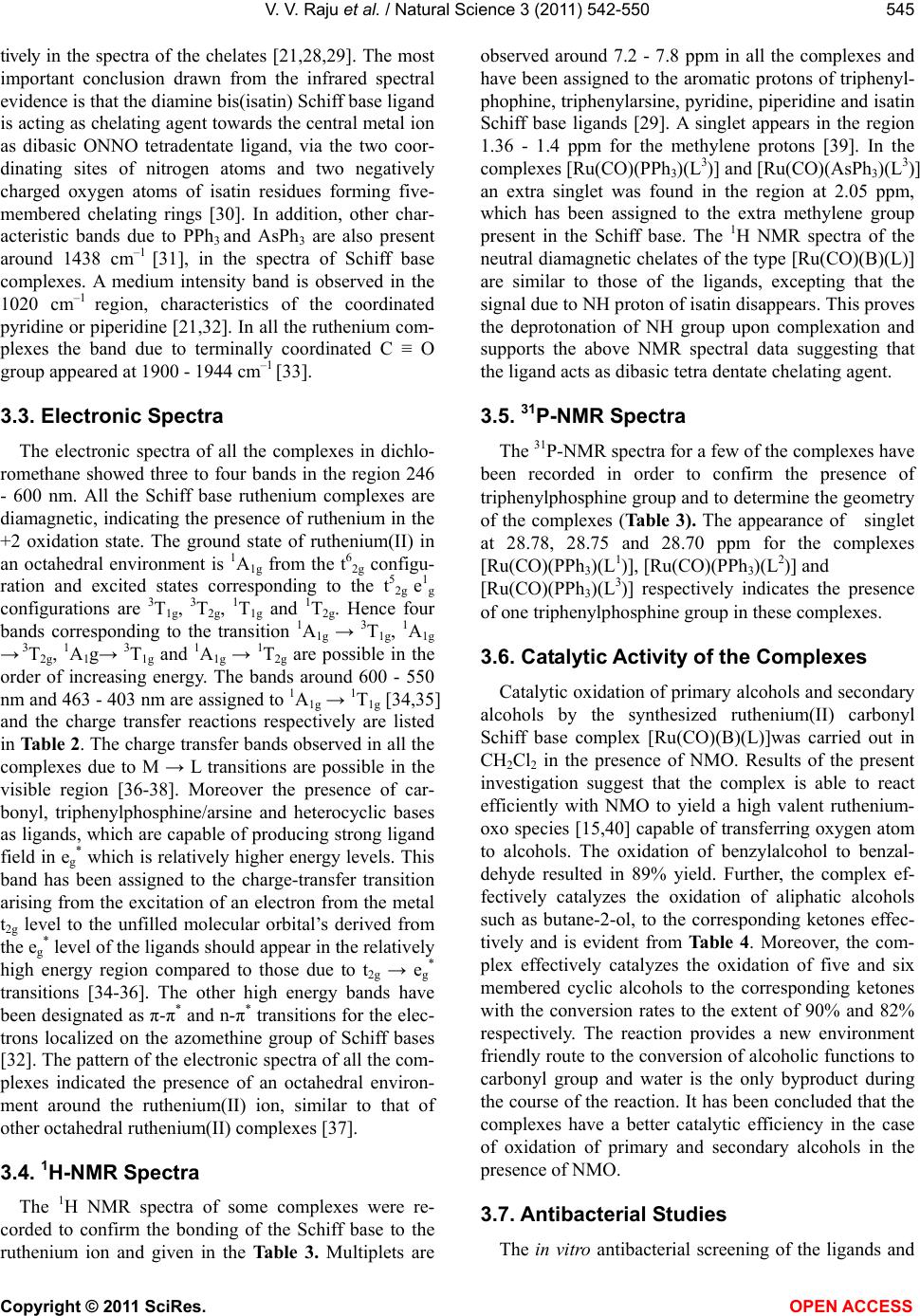 V. V. Raju et al. / Natural Science 3 (2011) 542-550 Copyright © 2011 SciRes. OPEN ACCESS 545 tively in the spectra of the chelates [21,28,29]. The most important conclusion drawn from the infrared spectral evidence is that the diamine bis(isatin) Schiff base ligand is acting as chelating agent towards the central metal ion as dibasic ONNO tetradentate ligand, via the two coor- dinating sites of nitrogen atoms and two negatively charged oxygen atoms of isatin residues forming five- membered chelating rings [30]. In addition, other char- acteristic bands due to PPh3 and AsPh3 are also present around 1438 cm–1 [31], in the spectra of Schiff base complexes. A medium intensity band is observed in the 1020 cm–1 region, characteristics of the coordinated pyridine or piperidine [21,32]. In all the ruthenium com- plexes the band due to terminally coordinated C ≡ O group appeared at 1900 - 1944 cm–1 [33]. 3.3. Electronic Spectra The electronic spectra of all the complexes in dichlo- romethane showed three to four bands in the region 246 - 600 nm. All the Schiff base ruthenium complexes are diamagnetic, indicating the presence of ruthenium in the +2 oxidation state. The ground state of ruthenium(II) in an octahedral environment is 1A1g from the t6 2g configu- ration and excited states corresponding to the t5 2g e1 g configurations are 3T1g, 3T2g, 1T1g and 1T2g. Hence four bands corresponding to the transition 1A1g → 3T1g, 1A1g → 3T2g, 1A1g→ 3T1g and 1A1g → 1T2g are possible in the order of increasing energy. The bands around 600 - 550 nm and 463 - 403 nm are assigned to 1A1g → 1T1g [34,35] and the charge transfer reactions respectively are listed in Table 2. The charge transfer bands observed in all the complexes due to M → L transitions are possible in the visible region [36-38]. Moreover the presence of car- bonyl, triphenylphosphine/arsine and heterocyclic bases as ligands, which are capable of producing strong ligand field in eg * which is relatively higher energy levels. This band has been assigned to the charge-transfer transition arising from the excitation of an electron from the metal t2g level to the unfilled molecular orbital’s derived from the eg * level of the ligands should appear in the relatively high energy region compared to those due to t2g → e g * transitions [34-36]. The other high energy bands have been designated as π-π* and n-π* transitions for the elec- trons localized on the azomethine group of Schiff bases [32]. The pattern of the electronic spectra of all the com- plexes indicated the presence of an octahedral environ- ment around the ruthenium(II) ion, similar to that of other octahedral ruthenium(II) complexes [37]. 3.4. 1H-NMR Spectra The 1H NMR spectra of some complexes were re- corded to confirm the bonding of the Schiff base to the ruthenium ion and given in the Table 3. Multiplets are observed around 7.2 - 7.8 ppm in all the complexes and have been assigned to the aromatic protons of triphenyl- phophine, triphenylarsine, pyridine, piperidine and isatin Schiff base ligands [29]. A singlet appears in the region 1.36 - 1.4 ppm for the methylene protons [39]. In the complexes [Ru(CO)(PPh3)(L3)] and [Ru(CO)(AsPh3)(L3)] an extra singlet was found in the region at 2.05 ppm, which has been assigned to the extra methylene group present in the Schiff base. The 1H NMR spectra of the neutral diamagnetic chelates of the type [Ru(CO)(B)(L)] are similar to those of the ligands, excepting that the signal due to NH proton of isatin disappears. This proves the deprotonation of NH group upon complexation and supports the above NMR spectral data suggesting that the ligand acts as dibasic tetra dentate chelating agent. 3.5. 31P-NMR Spectra The 31P-NMR spectra for a few of the complexes have been recorded in order to confirm the presence of triphenylphosphine group and to determine the geometry of the complexes (Table 3). The appearance of singlet at 28.78, 28.75 and 28.70 ppm for the complexes [Ru(CO)(PPh3)(L1)], [Ru(CO)(PPh3)(L2)] and [Ru(CO)(PPh3)(L3)] respectively indicates the presence of one triphenylphosphine group in these complexes. 3.6. Catalytic Activity of the Complexes Catalytic oxidation of primary alcohols and secondary alcohols by the synthesized ruthenium(II) carbonyl Schiff base complex [Ru(CO)(B)(L)]was carried out in CH2Cl2 in the presence of NMO. Results of the present investigation suggest that the complex is able to react efficiently with NMO to yield a high valent ruthenium- oxo species [15,40] capable of transferring oxygen atom to alcohols. The oxidation of benzylalcohol to benzal- dehyde resulted in 89% yield. Further, the complex ef- fectively catalyzes the oxidation of aliphatic alcohols such as butane-2-ol, to the corresponding ketones effec- tively and is evident from Table 4. Moreover, the com- plex effectively catalyzes the oxidation of five and six membered cyclic alcohols to the corresponding ketones with the conversion rates to the extent of 90% and 82% respectively. The reaction provides a new environment friendly route to the conversion of alcoholic functions to carbonyl group and water is the only byproduct during the course of the reaction. It has been concluded that the complexes have a better catalytic efficiency in the case of oxidation of primary and secondary alcohols in the presence of NMO. 3.7. Antibacterial Studies The in vitro antibacterial screening of the ligands and  V. V. Raju et al. / Natural Science 3 (2011) 542-550 Copyright © 2011 SciRes. OPEN ACCESS 546 Table 3. NMR Spectral data of new Ru(II) complexes. S. No. Complex 1H-NMR data (ppm) 31P-NMR data (ppm) 1. [Ru(CO)(PPh3)(L1)] 7.2 - 7.6 (Ph, m),1.36 (N-(CH2)2, s) 28.78 2. [Ru(CO)(AsPh3)(L1)] 7.3 - 7.6 (Ph, m),1.36 (N-(CH2)2, s) - 3. [Ru(CO)(py)(L1)] 7.2 - 7.6 (Ph, m),1.4 (N-(CH2)2, s) - 4. [Ru(CO)(PPh3)(L2)] 7.3 - 7.8 (Ph, m) 28.75 5. [Ru(CO)(AsPh3)(L2)] 7.2 - 7.7 (Ph, m) - 6. [Ru(CO)(pip)(L2)] 7.2 - 7.6 (Ph, m) - 7. [Ru(CO)(PPh3)(L3)] 7.3 - 7.6 (Ph, m),1.36 (N-(CH2)2, s), 2.05 (CH2,s)28.70 8. [Ru(CO)(AsPh3)(L3)] 7.2 - 7.6 (Ph, m),1.36 (N-(CH2)2, s), 2.05 (CH2,s)- Table 4. Catalytic oxidation of alcohols by Ru(II) complexes. Complex Substrate Product Yielda Turnoverb Benzylalcohol Benzaldehyde 76 75 [Ru(CO)(PPh3)(L1)] Cyclohexanol Cyclohexanone 82 80 Butane-2-ol Butanone 84 88 Cyclopentanol Cyclopentanone 90 92 Benzylalcohol Benzaldehyde 80 81 [Ru(CO)(AsPh3)(L1)] Cyclohexanol Cyclohexanone 82 80 Butane-2-ol Butanone 73 78 Cyclopentanol Cyclopentanone 89 88 Benzylalcohol Benzaldehyde 76 78 [Ru(CO)(py)(L 1)] Cyclohexanol Cyclohexanone 83 86 Butane-2-ol Butanone 74 79 Cyclopentanol Cyclopentanone 90 92 Benzylalcohol Benzaldehyde 77 79 [Ru(CO)(pip)(L1)] Cyclohexanol Cyclohexanone 85 87 Butane-2-ol Butanone 80 84 Cyclopentanol Cyclopentanone 91 95 Benzylalcohol Benzaldehyde 81 85 [Ru(CO)(PPh3)(L2)] Cyclohexanol Cyclohexanone 80 83 Butane-2-ol Butanone 78 87 Cyclopentanol Cyclopentanone 90 91 Benzylalcohol Benzaldehyde 82 81 [Ru(CO)(AsPh3)(L2)] Cyclohexanol Cyclohexanone 81 85 Butane-2-ol Butanone 72 76 Cyclopentanol Cyclopentanone 89 86  V. V. Raju et al. / Natural Science 3 (2011) 542-550 Copyright © 2011 SciRes. OPEN ACCESS 547 Benzylalcohol Benzaldehyde 82 84 [Ru(CO)(py)(L 2)] Cyclohexanol Cyclohexanone 80 84 Butane-2-ol Butanone 71 74 Cyclopentanol Cyclopentanone 90 87 Benzylalcohol Benzaldehyde 76 79 [Ru(CO)(pip)(L2)] Cyclohexanol Cyclohexanone 83 78 Butane-2-ol Butanone 72 75 Cyclopentanol Cyclopentanone 90 93 Benzylalcohol Benzaldehyde 75 78 [Ru(CO)(PPh3)(L3)] Cyclohexanol Cyclohexanone 86 82 Butane-2-ol Butanone 76 80 Cyclopentanol Cyclopentanone 93 90 [Ru(CO)(AsPh3)(L3)] Benzylalcohol Benzaldehyde 73 77 Cyclohexanol Cyclohexanone 79 80 Butane-2-ol Butanone 70 73 Cyclopentanol Cyclopentanone 91 86 [Ru(CO)(py)(L 3)] Benzylalcohol Benzaldehyde 75 78 Cyclohexanol Cyclohexanone 75 79 Butane-2-ol Butanone 72 75 Cyclopentanol Cyclopentanone 93 80 [Ru(CO)(pip)(L3)] Benzylalcohol Benzaldehyde 67 70 Cyclohexanol Cyclohexanone 81 80 Butane-2-ol Butanone 78 81 Cyclopentanol Cyclopentanone 91 86 their ruthenium complexes have been carried out against Escherichia Coli, Aeromonas hydrophila and Salmonella typhi using a nutrient agar medium by disc diffusion method. The results (Table 5) showed the complexes exhibit moderate activity against Escherichia Coli, Aero- monas hydrophila and Salmonella typhi. The toxicity of ruthenium chelates increases on increasing the concen- tration [41]. The increase in the antibacterial activity of metal chelates may be due to the effect of the metal ion on the normal cell process. A possible mode of the toxic- ity increase may be considered in light of Tweeds chela- tion theory [42]. Chelation considerably reduces the po- larity of the metal ion because of partial sharing of its positive charge with the donor groups and possible π- electron delocalization over the whole chelate ring. Such chelation could enhance the lipophilic character of the central metal atom, which subsequently favors its per- meation through the lipid layers of cell membrane. Fur- thermore, the mode of action of the compounds may involve in the formation of a hydrogen bond through the azomethine (>C = N) group with the active centers of cell constituents, resulting in interference with the nor- mal cell processes [42]. Though the complexes possess activity, it could not reach the effectiveness of the stan- dard drug streptomycin. The variation in the effective- ness of the different compounds against different organ- isms depend either on the impermeability of the cells of the microbes or differences in ribosomes of microbial cells [40,41]. Based on the analytical, spectral (IR, electronic, 1H NMR and 31P-NMR) data, Scheme 3 octahedral stru- cture has been tentatively proposed for all the new car- bonyl Schiff base complexes of ruthenium (II).  V. V. Raju et al. / Natural Science 3 (2011) 542-550 Copyright © 2011 SciRes. OPEN ACCESS 548 Table 5. Antibacterial activity of ligands and Ru(II) complexes (diameter of inhibition zones-mm). Escherichia coli Aeromonas hydrophila Salmonella typhi Ligand/Complex 0.25% 0.5% 1.0%0.25% 0.5%1.0% 0.25% 0.5%1.0% L1 10 11 13 11 12 13 9 12 13 [Ru(CO)(PPh3)(L1)] 12 14 16 14 17 18 13 16 20 [Ru(CO)(AsPh3)(L1)] 11 15 17 12 16 20 14 17 21 [Ru(CO)(py)(L 1)] 14 16 20 13 17 19 15 17 20 [Ru(CO)(pip)(L1)] 16 18 20 13 17 19 15 18 20 L2 10 12 14 9 12 15 10 11 14 [Ru(CO)(PPh3)(L2)] 12 15 19 11 16 18 12 18 20 [Ru(CO)(AsPh3)(L2)] 15 18 21 12 18 21 14 15 18 [Ru(CO)(py)(L 2)] 14 16 19 14 19 20 18 20 21 [Ru(CO)(pip)(L2)] 15 20 21 16 18 21 19 20 21 L3 10 11 13 12 14 15 10 11 14 [Ru(CO)(PPh3)(L3)] 12 14 17 14 16 18 15 18 20 [Ru(CO)(AsPh3)(L3)] 14 18 20 15 18 20 17 18 21 [Ru(CO)(py)(L 3)] 16 17 21 14 17 19 19 22 23 [Ru(CO)(pip)(L3)] 17 18 22 16 18 22 17 19 22 Streptomycin 22 23 28 21 37 29 29 21 25 Scheme 3. Structure of New Ru(II) complexes. 4. CONCLUSIONS A new family of carbonyl complexes of ruthenium(II) containing N2O2 donor Schiff bases incorporating tri- phenylphosphine/triphenylarsine/pyridine/piperidine li- gands were synthesized and characterized. The new com- plexes were tested as a new and efficient catalyst for the oxidation of primary and secondary alcohols to their corresponding aldehydes and ketones with excellent yields in the presence of N-methylmorpholine-N-oxide. Further the possible explanations for the mode of action of these complexes against three different microbes are described. REFERENCES [1] Canali, L. and Sherrington, D.C. (1999) Utilization of homogeneous and supported chiral metal (salen) com- plexes in asymmetric catalysis. Chemical Society Re- views, 28, 85-93. doi:10.1039/a806483k [2] Isse, A.A., Gennara A. and Viane, E. (1998) Mechanism of the electrochemical reduction of benzylchlorides cata- lyzed by Co(salen). Journal of Electroanalytical Chem- istry, 444, 241-245. doi:10.1016/S0022-0728(97)00572-X [3] Liobet, A., Hodgson D.J. and Meyer, T.J. (1990) Synthe- sis, structure and redox properties of triaqua (tris (1- pyra- zolyl) methan) ruthenium(II) cation. Inorganic Chemistry, 29, 3760-3766. doi:10.1021/ic00344a023 [4] Liobet, A. (1994) Synthesis, spectral and redox proper- ties of a new series of aqua complexes of Ruthenium (II). Inorganica Chimica Acta, 221, 125-131. doi:10.1016/0020-1693(94)03963-1 [5] Thron, J.R. and Wilkinson, G. (1978) Schiff base com- plexes of ruthenium(II). Journal of the Chemical Society, Dalton Transactions, 2, 110-115. doi:10.1039/DT9780000110 [6] Katsuki, T. (1995) Catalytic asymmetry oxidation using optically active (salen) Manganese (III) complexes as catalysts. Coordination Chemistry Reviews, 140, 189-214. doi:10.1016/0010-8545(94)01124-T [7] Claustro, I., G. Abate, Sanchez, E. and Acquaye, J.H. (2003) Synthesis spectroscopic and electrochemical properties of ruthenium-2-(2’-hydroxyphenyl)-benzo- xazole complexes. Crystal structure of [Ru(ter-py)HPBCl]. Inorganica Chimica Acta, 342, 29-36. doi:10.1016/S0020-1693(02)01068-X [8] Silva, A.R., Freire, C. and Castro, B. (2004) Modulation of the catalytic activity of manganese(III) solen com- plexes in the epoxidation of styrene: Influence of the oxygen source. New Journal of Chemistry, 28, 253-260. doi:10.1039/b309125b  V. V. Raju et al. / Natural Science 3 (2011) 542-550 Copyright © 2011 SciRes. OPEN ACCESS 549 [9] Meunier, B. (1992) Metallophorphyrins as versatile cata- lysts for oxidation reactions and oxidative DNA cleavage. Chemical Review, 92, 1411-1456. doi:10.1021/cr00014a008 [10] Sharpless, K.B., Akashi, K. and Osima, K. (1976) Ruthe- nium catalyzed oxidation of alcohols to aldehydes and ke- tones by amine-n-oxide. Tetrahedron Letters, 17, 2503- 2506. doi:10.1016/S0040-4039(00)78130-5 [11] Leung, W.H. and Che, C.M. (1989) Oxidation chemistry of Ruthenium–Salon Complexes. Inorganic Chemistry, 28, pp. 4619-4622. doi:10.1021/ic00325a016 [12] Wong, W.K., Chen, X.P., Gao, J.P., Chi, Y.G., Pan, W.X. and Wang, W.Y. (2002) Studies on electronic structures and related properties of complexes M(tap)3 2+ (M=Fe, Ru, Os) by the DFT method. Journal of the Chemical Society, Dalton Transactions, 1,113-119. doi:10.1039/b105266g [13] Bhowon, M.G., Wah, L.K. and Narain, R. (1998) Schiff base complexes of Ru (II) and their uses as catalytic oxi- dants. Polyhydron, 18, 3341-3345. [14] R. Atkins, G. Brewer, E. Kokot. (1985) Copper (II) and Ni(II) complexes of unsymmetrical tetra dentate Schiff base ligands. Inorganic Chemistry, 24, 128-134. doi:10.1021/ic00196a003 [15] Khan, M.M.T., Sreelatha, C.H., Mizra, S.A., Ramachan- draiah, G. and Abdi, S.H.R. (1998) Synthesis and charac- terization of Ru(V)oxo compounds of Schiff base: bis(salicylaldehye) –o–phenylenediamine, with appended Cl-, imidazole and 2-methylimidazole: the first com- plexes of stable oxo-complexes via direct oxygenation. Inorganica Chimica Acta, 154, 103-108. doi:10.1016/S0020-1693(00)85173-7 [16] Clercq, B.D. and Verpoort, F. (2002) Atom transfer radi- cal polymerization of vinyl monomers mediated by Schiff base–Ruthenium–alkylide catalysts and the adven- titious effects of water in polymerization with analogous cationic complexes. Mac romolecules, 35, 8943-8947. doi:10.1021/ma020307d [17] Opstal, T. and Verpoort, F. (2002) Ruthenium indeny- lidene and vinylidene complexes bearing Schiff bases: Potential catalysts in Enol–Ester Synthesis. Synlett, 6, 935-941. doi:10.1055/s-2002-31892 [18] Opstal, T. and Verpoort, F. (2003) Synthesis of highly active Ruthenium indenylidene complexes for atom transfer radical polymerization and ring opening me- tathesis polymerization. Angewandte Chemie Interna- tional Edition, 42, 2876-2879. doi:10.1002/anie.200250840 [19] Sherrington, D.C., Dijksman, A., Arends, I.W.C.E. and Sheldon, R.A. (2001) Polymer immobilized Tempo (PIPO): An efficient catalytic system for environmentally benign oxidation of alcohols. Supported Catalyst and Their Applications, 118-124. doi:10.1039/9781847551962-00118 [20] Venkatachalam, G. and Ramesh, R. (2005) Catalytic transfer hydrogenation of ketones catalysed by ortho metalated ruthenium(III) 2-(aryl azo) phenolate com- plexes containing triphenylarsine. Tetrahedron Letters, 46, 5215-5218. doi:10.1016/j.tetlet.2005.05.116 [21] Balasubramanian, K.P., Raju, V.V. and Chinnusamy, V. (2009) Synthesis, characteristic, catalytic and antimic- ribial activities of imidazolo substituted benzilidene im- ines with ruthenium(II) complexes. Journal of Indian chemistry Society, 86, 570-576. [22] Manivannan, S., Prabhakaran, R., Balasubramanian, K.P., Danabal, V., Karvembu, R., Chinnusamy, V. and Natara- jan, K. (2007) Synthesis, spectral, electrochemical and catalytic studies of new Ru(III) tetra dentate Schiff base complexes. Organic Chemistry, 21, 952-957. doi:10.1002/aoc.1318 [23] Parnav, C., Kriza, A., Pop, V. and Udrea, S. (2005) Com- plexes of tin(IV) and Zirconium(IV) with Schiff bases derived from isatin and diamines. Journal of Indian chemistry Society, 82, 7173. [24] Kanchanadevi, S., Balasubramanian, K.P. and Chin- nusamy, V. (2005) Synthesis, characterisation and cata- lytic studies of ruthenium(II) Schiff base complexes. Transition Metal Chemistry, 30, 330-333. doi:10.1007/s11243-004-5853-2 [25] Raberto, A., Delgade, S., Lee, W.Y., Choi, S.R. and Jun, M.-J. (1991) The chemistry and catalytic properties of ruthenium and osmium complexes. Part 5. Synthesis of new compounds containing arsine ligands and catalytic activity in the homogeneous hydrogenation of aldehydes. Transition Metal Chemistry, 16, 241-244. doi:10.1007/BF01032844 [26] Raman, N., Kulandaisamy, A. and Jeyasubramanian, K. (2002) Synthesis, spectral, redox and biological studies of some Schiff base copper(II), Nickel(II), cobalt(II), Manganese(II), Zinc(II) and oxovanadium complexes derived from 1-phenyl-2,3dimethyl-4(4 iminopentan-2- one)pyrazole-5-one and 2-amino phenol/ 2-amino-thio- phenol. Indian Journal of Chemistry, 41, 942-949. [27] Karvembu, R., Hemalatha, S., Prabhakaran, R. and Na- tarajan, K. (2003) Synthesis, characterization and cata- lytic activities of ruthenium complexes containing triphenylphosphine/triphenylarsine and tetra dentate Schiff bases. Inorganic Chemistry Communications, 6, 486-490. doi:10.1016/S1387-7003(03)00021-2 [28] Nakamoto, K. (1971) Infrared and Raman Spectra of Inorganic and coordination compounds. Wiley Inter- science, New York. [29] Dyer, J.R. (1978) Application of absorption spectroscopy of organic compounds. Prentic-Hall, Upper Saddle River. [30] Hassaan, A.M.A. and Shehat, A.K. (1993) Metal chelates of o-phenylenediaminesbis-isatin Schiff base with La(III), Ce(III), Th(IV), UO2(II), Ag(I) and Hg(II). Synthesis and Reactivity in Inorganic and Metal-Organic Chemistry, 23, 815-823. doi:10.1080/15533179308016863 [31] Danialthangadurai, T., Gowri, M. and Natarajan, K. (2002) Synthesis and characterization of Ru(III) com- plexes containing monobasic bidentate Schiff bases and their biological activities. Synthesis and Reactivity in In- organic and Metal-Organic Chemistry, 32, 329-343. doi:10.1081/SIM-120003211 [32] El-Shahawi, M.S. and Shoair, A.F. (2004) Synthesis, spectroscopic characterization, redox properties and catalytic activities of some ruthenium(II) complexes con- taining aromatic aldehyde and triphenylphosphine or triphenylarsine. Spectrochimica acta Part A Molecular and biomolecular spectroscopy, 60 , 121-127. [33] Balasubramanian, K.P., Karvembu, R., Prabhakaran, R., Chinnusamy, V. and Natarajan, K. (2007) Synthesis, spectral, catalytic and antimicrobial studies of PPh3/  V. V. Raju et al. / Natural Science 3 (2011) 542-550 Copyright © 2011 SciRes. OPEN ACCESS 550 AsPh3 complexes of Ru(III) with dibasic tridentate O,N,S donor ligands. Spectrochimica Acta Part A: Molecular and Biomolecular Spectroscopy, 68, 50-54. doi:10.1016/j.saa.2006.10.049 [34] Remesh, R. and Sivagamasundari, M. (2003) Synthesis, spectral and anti-fungal activity of Ru(II) mixed ligand complexes. Synthesis and Reactivity in Inorganic and Metal-Organic Chemistry, 33, 899-910. doi:10.1081/SIM-120021656 [35] Natarajan, K., Poddar, R.K. and Agarwala, C.U. (1977) Mixed complexes of Ruthenium (III) and Ruthenium(II) with triphenylphosphine or triphenylarsine and other ligands. Journal of Inorganic and Nuclear Chemistry, 39, 431-435. doi:10.1016/0022-1902(77)80056-0 [36] Lever, A.B.P. (1984) Inorganic Electronic Spectroscopy. 2nd Edition, Elsevier, New York. [37] Chichak, K., Jacquenard, U. and Branda, N.R. (2002) The construction of (Salophen) Ruthenium(II) assemblies using axial coordination. European Journal of Inorganic Chemistry, 2002, 357-368. doi:10.1002/1099-0682(20022)2002:2<357::AID-EJIC35 7>3.0.CO;2-T [38] Nareshkumar, K. and Ramesh, R. (2004) Synthesis, char- acterization, redox property and biological activity of ru- thenium(II) carbonyl complexes containing O, N – donor ligands and heterocyclic bases. Spectrochim Acta A Mol Biomol Spectrosc, 60, 2913-2918. [39] Jayabalakrisnnan, C. and Natarajan, K. (2002) Ruthe- nium(II)carbonyl complexes with tridentate Schiff bases and their catalytic activity. Transition Metal Chemistry, 27, 75-79. doi:10.1023/A:1013437203247 [40] Prabhakaran, R., Geetha, A., Thilagavathi, M., Karve- mbu, R., Krishnan, V., Bertagnolli, H. and Natarajan, K. (2004) Synthesis, characterization, EXAFS investigation and antibacterial activities of new ruthenium (III) com- plexes containing tetra dentate Schiff base. Journal of Inorganic Biochemistry, 98, 2131-2140. doi:10.1016/j.jinorgbio.2004.09.020 [41] Padmapriya, N., Arunachalam, S.V., Sathya, N., Chin- nusamy V. and Jayabalakrishnan, C. (2009) Catalytic and antimicrobial studies of binuclear ruthenium (III) com- plexes containing bis-β diketones. Transition Metal Chemistry, 34, 437-445. doi:10.1007/s11243-009-9214-z [42] Periasamy, M., Balasubramanian, K.P. and Chinnusamy, V. (2004) Synthesis, characterization and biological ac- tivities of Ruthenium(II) Schiff base complexes. Indian Journal of Chemistry, 43, 2132-2136. |