

Paper Menu >>
Journal Menu >>
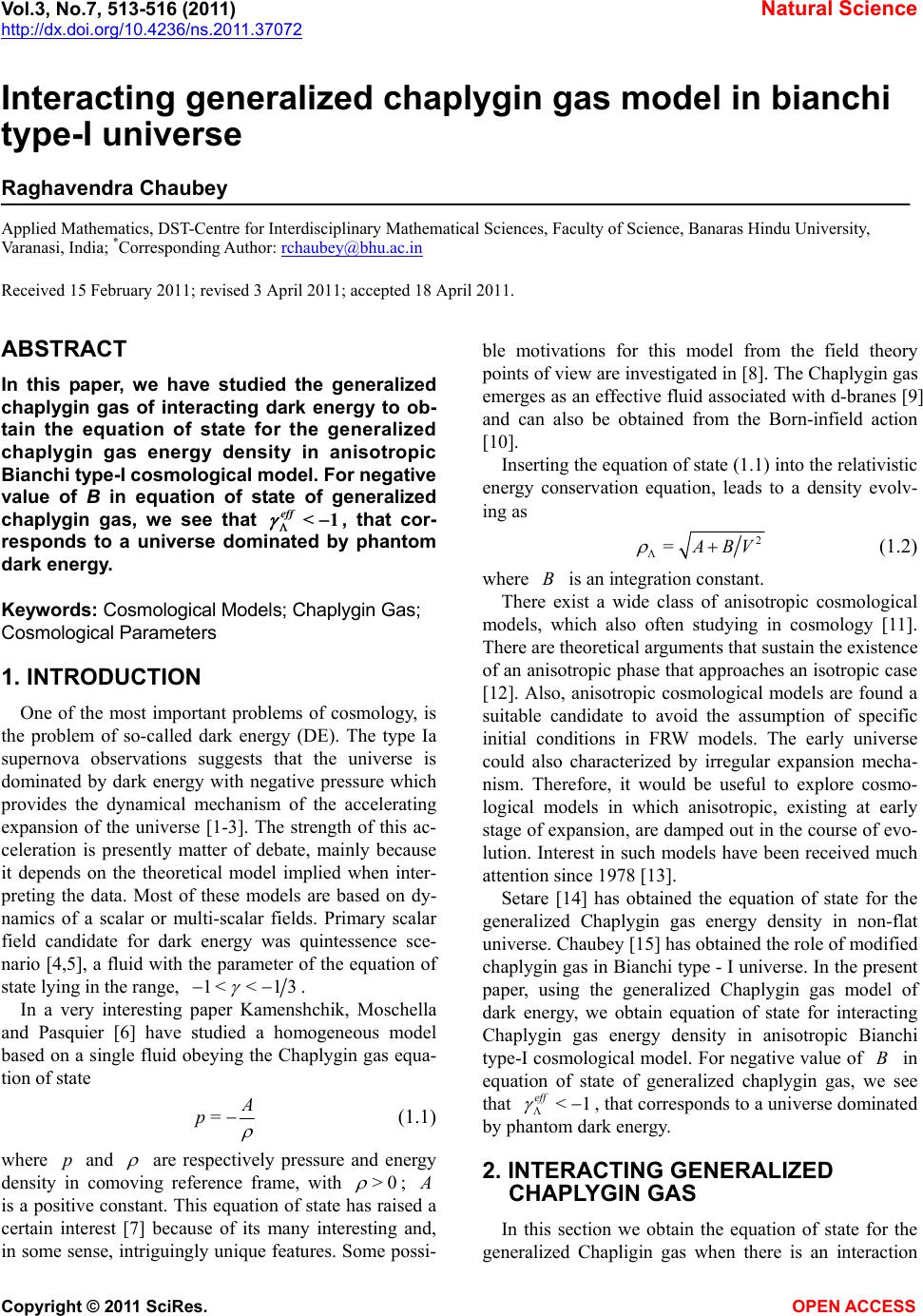 Vol.3, No.7, 513-516 (2011) Natural Science http://dx.doi.org/10.4236/ns.2011.37072 Copyright © 2011 SciRes. OPEN ACCESS Interacting generalized chaplygin gas model in bianchi type-I universe Raghavendra Chaubey Applied Mathematics, DST-Centre for Interdisciplinary Mathematical Sciences, Faculty of Science, Banaras Hindu University, Varanasi, India; *Corresponding Author: [email protected] Received 15 February 2011; revised 3 April 2011; accepted 18 April 2011. ABSTRACT In this paper, we have studied the generalized chaplygin gas of interacting dark energy to ob- tain the equation of state for the generalized chaplygin gas energy density in anisotropic Bianchi type-I cosmological model. For negative value of B in equation of state of generalized chaplygin gas, we see that <1 eff , that cor- responds to a universe dominated by phantom dark energy. Keyw ords: Cosmological Models; Chaplygin Gas; Cosmological Parameters 1. INTRODUCTION One of the most important problems of cosmology, is the problem of so-called dark energy (DE). The type Ia supernova observations suggests that the universe is dominated by dark energy with negative pressure which provides the dynamical mechanism of the accelerating expansion of the universe [1-3]. The strength of this ac- celeration is presently matter of debate, mainly because it depends on the theoretical model implied when inter- preting the data. Most of these models are based on dy- namics of a scalar or multi-scalar fields. Primary scalar field candidate for dark energy was quintessence sce- nario [4,5], a fluid with the parameter of the equation of state lying in the range, 1<<1 3 . In a very interesting paper Kamenshchik, Moschella and Pasquier [6] have studied a homogeneous model based on a single fluid obeying the Chaplygin gas equa- tion of state = A p (1.1) where p and are respectively pressure and energy density in comoving reference frame, with >0 ; A is a positive constant. This equation of state has raised a certain interest [7] because of its many interesting and, in some sense, intriguingly unique features. Some possi- ble motivations for this model from the field theory points of view are investigated in [8]. The Chaplygin gas emerges as an effective fluid associated with d-branes [9] and can also be obtained from the Born-infield action [10]. Inserting the equation of state (1.1) into the relativistic energy conservation equation, leads to a density evolv- ing as 2 = A BV (1.2) where B is an integration constant. There exist a wide class of anisotropic cosmological models, which also often studying in cosmology [11]. There are theoretical arguments that sustain the existence of an anisotropic phase that approaches an isotropic case [12]. Also, anisotropic cosmological models are found a suitable candidate to avoid the assumption of specific initial conditions in FRW models. The early universe could also characterized by irregular expansion mecha- nism. Therefore, it would be useful to explore cosmo- logical models in which anisotropic, existing at early stage of expansion, are damped out in the course of evo- lution. Interest in such models have been received much attention since 1978 [13]. Setare [14] has obtained the equation of state for the generalized Chaplygin gas energy density in non-flat universe. Chaubey [15] has obtained the role of modified chaplygin gas in Bianchi type - I universe. In the present paper, using the generalized Chaplygin gas model of dark energy, we obtain equation of state for interacting Chaplygin gas energy density in anisotropic Bianchi type-I cosmological model. For negative value of B in equation of state of generalized chaplygin gas, we see that <1 eff , that corresponds to a universe dominated by phantom dark energy. 2. INTERACTING GENERALIZED CHAPLYGIN GAS In this section we obtain the equation of state for the generalized Chapligin gas when there is an interaction 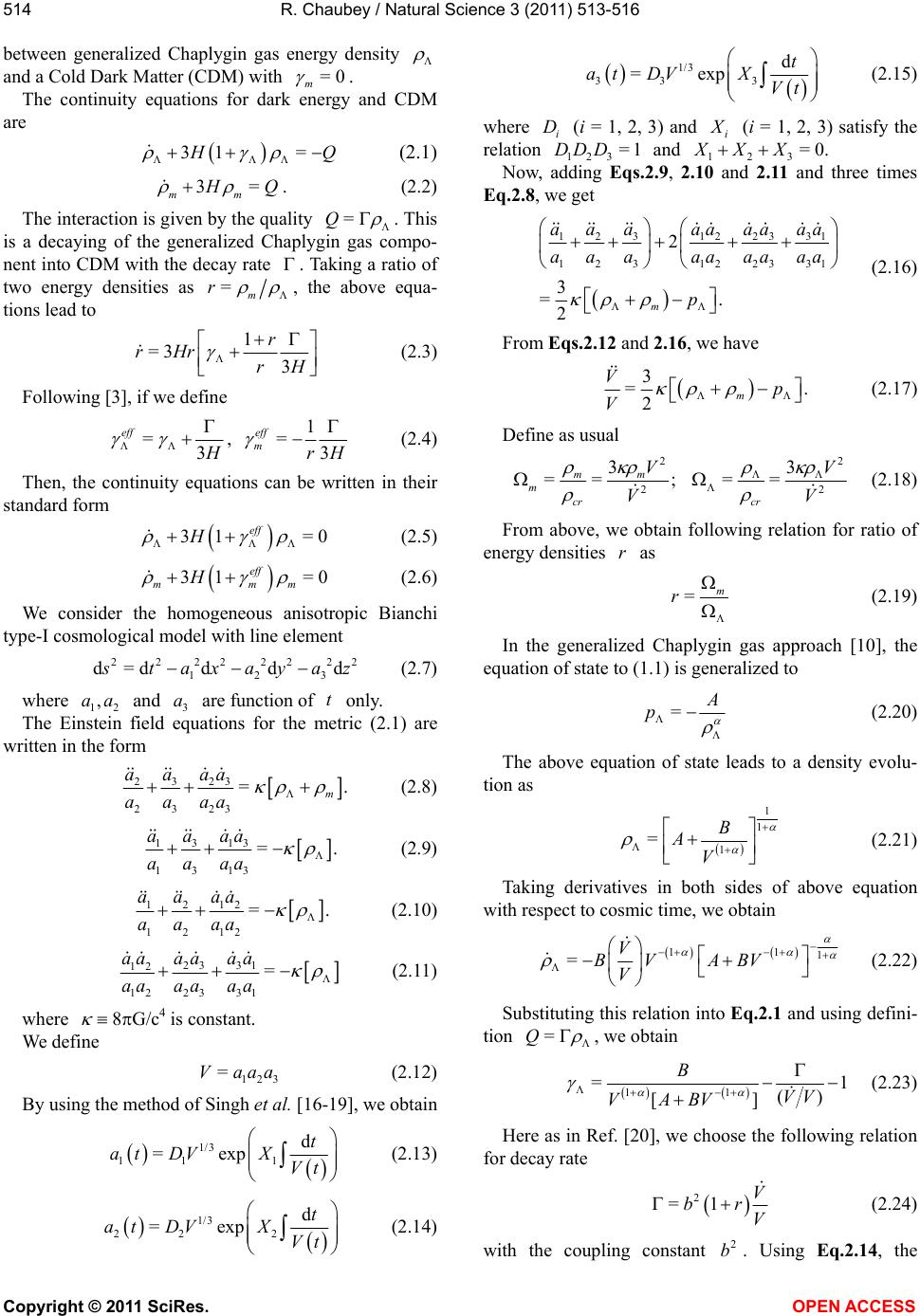 R. Chaubey / Natural Science 3 (2011) 513-516 Copyright © 2011 SciRes. OPEN ACCESS 514 between generalized Chaplygin gas energy density and a Cold Dark Matter (CDM) with =0 m . The continuity equations for dark energy and CDM are 31 = H Q (2.1) 3= mm H Q . (2.2) The interaction is given by the quality =Q . This is a decaying of the generalized Chaplygin gas compo- nent into CDM with the decay rate . Taking a ratio of two energy densities as =m r , the above equa- tions lead to 1 =3 3 r rHrrH (2.3) Following [3], if we define =3 eff H , 1 =3 eff mrH (2.4) Then, the continuity equations can be written in their standard form 31 =0 eff H (2.5) 31 =0 eff mmm H (2.6) We consider the homogeneous anisotropic Bianchi type-I cosmological model with line element 22222222 123 d=d ddd s taxayaz (2.7) where 12 ,aa and 3 a are function of t only. The Einstein field equations for the metric (2.1) are written in the form 323 2 2323 =. m aaa a aaaa (2.8) 313 1 1313 =. aaa a aaaa (2.9) 1212 1212 =. aa aa aa aa (2.10) 23 31 12 1223 31 = aa aa aa aaa aaa (2.11) where 8G/c4 is constant. We define 123 =Vaaa (2.12) By using the method of Singh et al. [16-19], we obtain 1/3 11 1 d =exp t atDVX Vt (2.13) 1/3 22 2 d =exp t atDVX Vt (2.14) 1/3 333 d =exp t atDVX Vt (2.15) where i D (i = 1, 2, 3) and i X (i = 1, 2, 3) satisfy the relation 123 =1DDD and 123 =0.XX X Now, adding Eqs.2.9, 2.10 and 2.11 and three times Eq.2.8, we get 32331 12 12 123 122331 2 3 =. 2m aaaaa aa aa aa aaa aaaa p (2.16) From Eqs.2.12 and 2.16, we have 3 =. 2m Vp V (2.17) Define as usual 2 2 3 == ; mm m cr V V 2 2 3 == cr V V (2.18) From above, we obtain following relation for ratio of energy densities r as =m r (2.19) In the generalized Chaplygin gas approach [10], the equation of state to (1.1) is generalized to = A p (2.20) The above equation of state leads to a density evolu- tion as 1 1 1 =B AV (2.21) Taking derivatives in both sides of above equation with respect to cosmic time, we obtain 11 1 =V BV ABV V (2.22) Substituting this relation into Eq.2.1 and using defini- tion =Q , we obtain 11 =1 () [] B VV VABV (2.23) Here as in Ref. [20], we choose the following relation for decay rate 2 =1 V br V (2.24) with the coupling constant 2 b. Using Eq.2.14, the 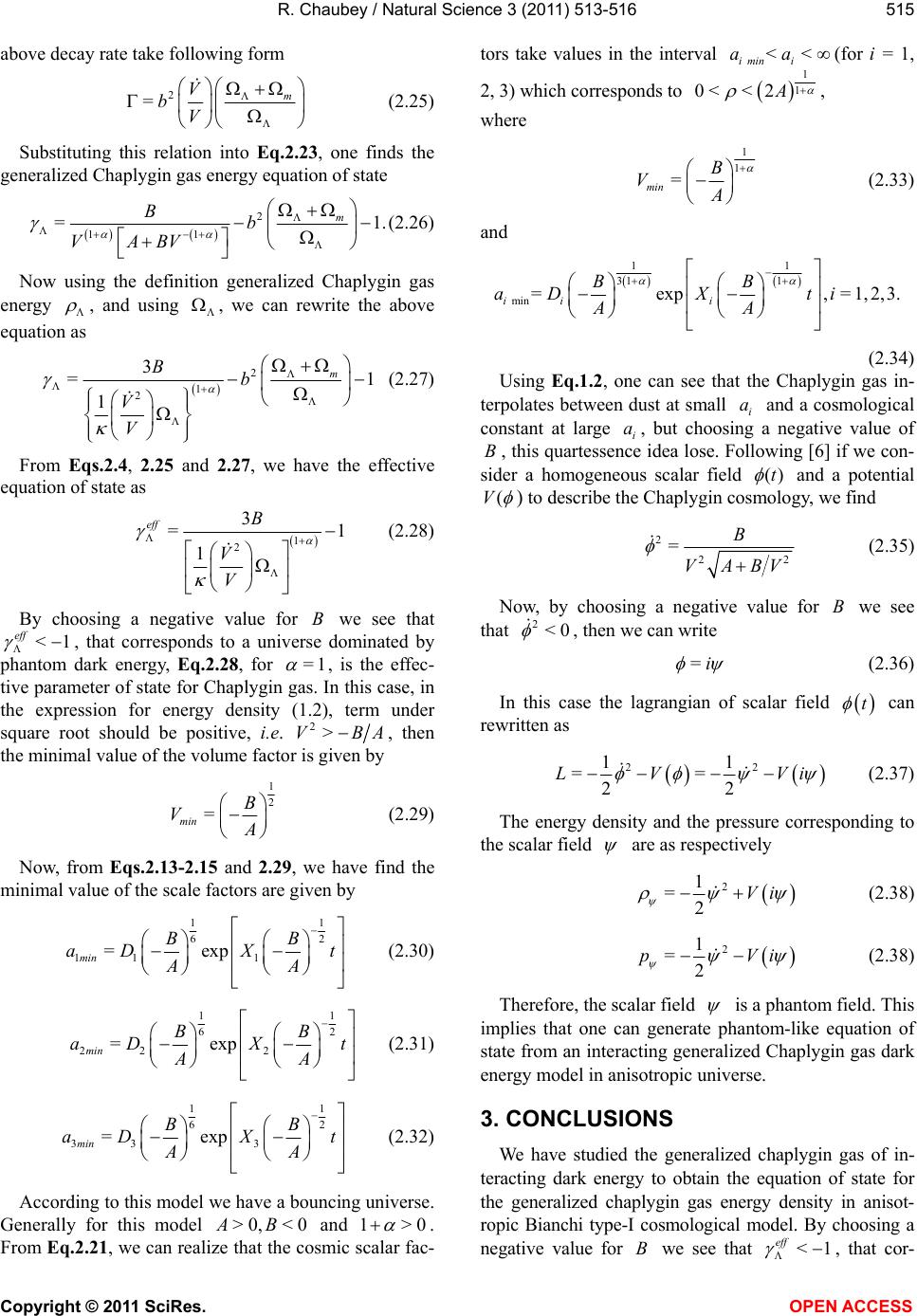 R. Chaubey / Natural Science 3 (2011) 513-516 Copyright © 2011 SciRes. OPEN ACCESS 515 above decay rate take following form 2 =m V bV (2.25) Substituting this relation into Eq.2.23, one finds the generalized Chaplygin gas energy equation of state 2 11 =1. m Bb VABV (2.26) Now using the definition generalized Chaplygin gas energy , and using , we can rewrite the above equation as 2 1 2 3 =1 1 m Bb V V (2.27) From Eqs.2.4, 2.25 and 2.27, we have the effective equation of state as 1 2 3 =1 1 eff B V V (2.28) By choosing a negative value for B we see that <1 eff , that corresponds to a universe dominated by phantom dark energy, Eq.2.28, for =1 , is the effec- tive parameter of state for Chaplygin gas. In this case, in the expression for energy density (1.2), term under square root should be positive, i.e. 2>VBA, then the minimal value of the volume factor is given by 1 2 = min B V A (2.29) Now, from Eqs.2.13-2.15 and 2.29, we have find the minimal value of the scale factors are given by 11 62 11 1 =exp min BB aDX t AA (2.30) 11 62 22 2 =exp min BB aDX t AA (2.31) 11 62 333 =exp min BB aDX t AA (2.32) According to this model we have a bouncing universe. Generally for this model >0, <0AB and 1>0 . From Eq.2.21, we can realize that the cosmic scalar fac- tors take values in the interval << imin i aa(for i = 1, 2, 3) which corresponds to 1 1 0<<2A , where 1 1 = min B VA (2.33) and 11 31 1 min =exp,=1, 2, 3. ii i BB aDX ti AA (2.34) Using Eq.1.2, one can see that the Chaplygin gas in- terpolates between dust at small i a and a cosmological constant at large i a, but choosing a negative value of B, this quartessence idea lose. Following [6] if we con- sider a homogeneous scalar field ()t and a potential (V ) to describe the Chaplygin cosmology, we find 2 22 =B VABV (2.35) Now, by choosing a negative value for B we see that 2<0 , then we can write =i (2.36) In this case the lagrangian of scalar field t can rewritten as 22 11 == 22 LV Vi (2.37) The energy density and the pressure corresponding to the scalar field are as respectively 2 1 =2Vi (2.38) 2 1 =2 pVi (2.38) Therefore, the scalar field is a phantom field. This implies that one can generate phantom-like equation of state from an interacting generalized Chaplygin gas dark energy model in anisotropic universe. 3. CONCLUSIONS We have studied the generalized chaplygin gas of in- teracting dark energy to obtain the equation of state for the generalized chaplygin gas energy density in anisot- ropic Bianchi type-I cosmological model. By choosing a negative value for B we see that <1 eff , that cor-  R. Chaubey / Natural Science 3 (2011) 513-516 Copyright © 2011 SciRes. OPEN ACCESS 516 responds to a universe dominated by phantom dark en- ergy. REFERENCES [1] Perlmutter, S., et al. (1999) Measurements of Ω and from 42 high-redshift supernovae. The Astrophysical Jo- urnal, 517, 565-586. doi:10.1086/307221 [2] Garnavich, P.M., et al. (1998) Constraints on cosmologi- cal models from Hubble Space Telescope observations of high-z supernovae. The Astrophysical Journal, 493 , L53. doi:10.1086/311140 [3] Riess, A.G., et al. (1998) Observational evidence from supernovae for an accelerating universe and cosmologi- cal constant. The Astrophysical Journal, 116, 1009-1038. doi:10.1086/300499 [4] Ratra, B. and Peebles, P.J.E. (1988) Cosmological con- sequences of a rolling homogeneous scalar field. Physi- cal Review D, 37, 3406-3427. [5] Zlatev, I., Wang, L. and Steinhardt, P.J. (1999) Quintes- sence, cosmic coincidence, and the cosmological con- stant. Physics Review Letters, 82, 896-899. doi:10.1103/PhysRevD.59.123504 [6] Kamenshchik, A.Y., Moschella, U. and Pasquier, V. (2001) An alternative to quintessence. Physics Letters B, 511, 265-268. doi:10.1016/S0370-2693(01)00571-8 [7] Bazeia, D. and Jackiw, R. (1998) Nonlinear realization of a dynamical poincare symmetry by a field-dependent diffeomorphism. Annals of Physics, 270, 246-259. doi:10.1103/PhysRevD.69.023506 [8] Billic, N., Tupper, G.B. and Viollier, R.D. (2002) Unifi- cation of dark matter and dark energy: the inhomogene- ous Chaplygin gas. Physics Letters B, 535, 17-21. [9] Bordemann, M. and Hoppe, J. (1993) The dynamics of relativistic membranes. Reduction to 2-dimensional fluid dynamics. Physics Letters B, 317, 315-320. doi:10.1023/A:1015266421750 [10] Bento, M.C., Bertolami, O. and Sen, A.A. (2003) WMAP constraints on the generalized chaplygin gas model. Physics Letters B, 575, 172-180. doi:10.1103/PhysRevD.72.063511 [11] Misner, C.W., Thorne, K.S. and Wheeler, J.A. (1973) Gravitation. W.H. freeman, New York. [12] Misner, C.W. (1968) The isotropy of the universe. As- trophysics Journal, 151, 431-457. [13] Hu, B.L. and Parker, L. (1978) Anisotropy damping through quantum effects in the early universe. Physics Review D, 17, 933-945. doi:10.1103/PhysRevD.17.933 [14] Setare, M.R. (2007) Interacting generalized Chaplygin gas model in non-flat universe. European Physical Jour- nal, C52, 689-692. doi:10.1140/epjc/s10052-007-0405-5 [15] Chaubey, R. (2009) Role of modified Chaplygin gas in Bianchi type—I universe. International Journal of Theo- retical Physics, 48, 952-960. [16] Singh, T. and Chaubey, R. (2009) Bianchi type-I, III, V, VIo and Kantowski-Sachs models in scalar-tensor theo- ries with dynamic cosmological constant. Astrophysics and Space Science, 318, 231-236. doi:10.1007/s10509-008-9917-1 [17] Singh, T. and Chaubey, R. (2008) Bianchi type-I universe with wet dark fluid. Pramana—Journal of Physics, 71, 447-458. [18] Singh, T. and Chaubey, R. (2009) Bianchi type-I, III, V, VIo and Kantowski-Sachs universes in creation-field cosmology. Astrophysics and Space Science, 321, 5-18. doi:10.1007/s10509-009-9989-6 [19] Singh, T. and Chaubey, R. (2009) Bianchi type-III, V, VIo and Kantowski-Sachs universes with varying , G and 2 simultaneously. Proceedings of the National Academy of Sciences, India Section A, 79, 337-354. [20] Wang, B., Gong, Y. and Abdalla, E. (2005) Transition of the dark energy equation of state in an interacting holo- graphic dark energy model. Physics Letters, B624, 141- 146. doi:10.1016/j.physletb.2005.08.008 |