

Paper Menu >>
Journal Menu >>
 International Journal of Clinical Medicine, 2011, 2, 260-263 doi:10.4236/ijcm.2011.23041 Published Online July 2011 (http://www.SciRP.org/journal/ijcm) Copyright © 2011 SciRes. IJCM Clinical Feature of Japanese Patients with Fulminant Myocarditis —Myocarditis in Japanese Patients Hiroaki Kawano1*, Yasuhiro Nagayoshi2, Sunao Kojima2, Nahoko Kakihara3, Satoshi Sakuma1, Masumi Uchino1, Aiko Komatsu1, Machiko Asaka1, Mitsuhiro Shimomura1, Hiroshige Yamabe2, Hisao Ogawa2, Koichi Node1 1Department of Cardiovascular Medicine, Saga University, Saga, Japan; 2Department of Cardiovascular Medicine, Graduate School of Medical Sciences, Kumamoto University, Kumamoto, Japan; 3Department of Basic Science of Nursing, Division of Function and Morphology for Nursing, Saga University, Saga, Japan. Email: *[email protected] Received April 20th, 2011; revised May 27th, 2011; accepted June 7th, 2011. ABSTRACT Fulminant myocarditis is commonly recognized as an acute myocarditis with cardiogenic shock requiring mechanical support systems. Before the development of mechanical assist devices, previous study described that most of patients with fulminant myocarditis die at acute phase because of rapidly progressive cardiac decompensation. To investigate the feature of myocarditis, we checked consecutive 18 patients (10 men, 8 women, (12 yr - 80 yr)) from April in 2001 to September 2008 in University. Of these patients 3 needed intra-aortic balloon pumping (IABP) (2 men, 1 woman), 6 did both IABP and percutaneous card iopulmonary support (PCPS) (2 men, 4 women). Three patients who need both IABP and PCPS died (2 men, 49 yr and 65 yr, 1 woman, 54 yr) because of uncontrolled bacterial infection . No patients whose age was under 40 yr (5 men, 4 women) died although a man needed IABP and 3 women did both IABP and PCPS. Six- teen patients were able to resume a normal life although 1 male patient needed permanent pacemaker, 1 female did cardiac resynch ronizatio n therapy, and a male and a fema le had left ventricular systo lic dysfunction. In conclu sion, the young patients had better prognosis than older even if mechanical assist is needed. Although half of patients needed mechanical assist, the prevention of multi-organ complications including bacterial infection is one of the most impor- tant keys in the treatment of fulminant myocarditis. Keywords: Myocarditis, Mechanical Support, Immunosuppressive Therapy, Immunomodulation Therapy 1. Introduction Myocarditis is one of the most challenging diagnoses for cardiologists. The entity is rarely recognized, the patho- physiology is poorly understood, there is no commonly accepted diagnostic gold standard and all current treat- ment is controversial. The prevalence of myocarditis has been found to be up to 42% in case of unexplained death in people aged 35 or younger [1,2]. Acute myocarditis, especially fulminant myocarditis, still causes substantial morbidity and mortality, espe- cially in children and young adults. Fulminant myocardi- tis is commonly recognized as an acute myocarditis with cardiogenic shock requiring artificial mechanical support systems [3,4]. Recently, because of the use of steroids and immunoglobulin as well as mechanical circulatory assist devices, such as intra-aortic balloon pumping (IABP), percutaneous cardiopulmonary support (PCPS), and left ventricular assist devices, the acute stage sur- vival of fulminant myocarditis have been improved [5-8]. Mechanical circulatory support has become the standard therapy to bridge patients with intractable heart failure to either transplantation or myocardial recovery. In the present study, we report the feature of Japanese patients with fulminant myocarditis who hospitalized be- tween 2001 and 2008 in our institute. 2. Methods Before the development of mechanical assist devices, previous study described that a lot of patients with ful- minant myocarditis die at acute phase because of rapidly progressive cardiac decompensation [10]. From April in 2001 to September 2008, we had 18 patients with fulmi- 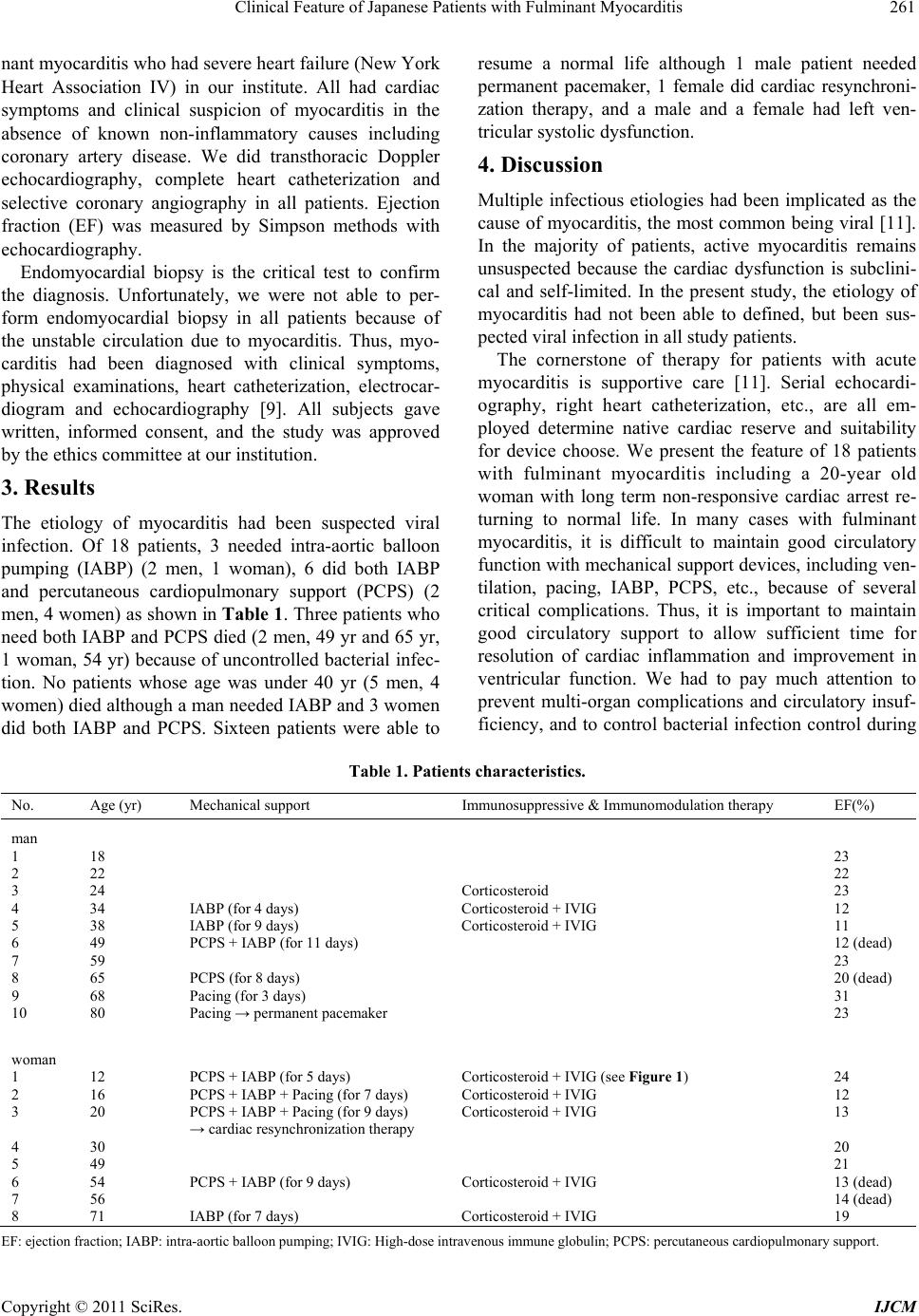 Clinical Feature of Japanese Patients with Fulminant Myocarditis261 nant myocarditis who had severe heart failure (New York Heart Association IV) in our institute. All had cardiac symptoms and clinical suspicion of myocarditis in the absence of known non-inflammatory causes including coronary artery disease. We did transthoracic Doppler echocardiography, complete heart catheterization and selective coronary angiography in all patients. Ejection fraction (EF) was measured by Simpson methods with echocardiography. Endomyocardial biopsy is the critical test to confirm the diagnosis. Unfortunately, we were not able to per- form endomyocardial biopsy in all patients because of the unstable circulation due to myocarditis. Thus, myo- carditis had been diagnosed with clinical symptoms, physical examinations, heart catheterization, electrocar- diogram and echocardiography [9]. All subjects gave written, informed consent, and the study was approved by the ethics committee at our institution. 3. Results The etiology of myocarditis had been suspected viral infection. Of 18 patients, 3 needed intra-aortic balloon pumping (IABP) (2 men, 1 woman), 6 did both IABP and percutaneous cardiopulmonary support (PCPS) (2 men, 4 women) as shown in Table 1. Three patients who need both IABP and PCPS died (2 men, 49 yr and 65 yr, 1 woman, 54 yr) because of uncontrolled bacterial infec- tion. No patients whose age was under 40 yr (5 men, 4 women) died although a man needed IABP and 3 women did both IABP and PCPS. Sixteen patients were able to resume a normal life although 1 male patient needed permanent pacemaker, 1 female did cardiac resynchroni- zation therapy, and a male and a female had left ven- tricular systolic dysfunction. 4. Discussion Multiple infectious etiologies had been implicated as the cause of myocarditis, the most common being viral [11]. In the majority of patients, active myocarditis remains unsuspected because the cardiac dysfunction is subclini- cal and self-limited. In the present study, the etiology of myocarditis had not been able to defined, but been sus- pected viral infection in all study patients. The cornerstone of therapy for patients with acute myocarditis is supportive care [11]. Serial echocardi- ography, right heart catheterization, etc., are all em- ployed determine native cardiac reserve and suitability for device choose. We present the feature of 18 patients with fulminant myocarditis including a 20-year old woman with long term non-responsive cardiac arrest re- turning to normal life. In many cases with fulminant myocarditis, it is difficult to maintain good circulatory function with mechanical support devices, including ven- tilation, pacing, IABP, PCPS, etc., because of several critical complications. Thus, it is important to maintain good circulatory support to allow sufficient time for resolution of cardiac inflammation and improvement in ventricular function. We had to pay much attention to prevent multi-organ complications and circulatory insuf- ficiency, and to control bacterial infection control during Table 1. Patients characteristics. No. Age (yr) Mechanical support Immunosuppressive & Immunomodulation therapy EF(%) man 1 18 23 2 22 22 3 24 Corticosteroid 23 4 34 IABP (for 4 days) Corticosteroid + IVIG 12 5 38 IABP (for 9 days) Corticosteroid + IVIG 11 6 49 PCPS + IABP (for 11 days) 12 (dead) 7 59 23 8 65 PCPS (for 8 days) 20 (dead) 9 68 Pacing (for 3 days) 31 10 80 Pacing → permanent pacemaker 23 woman 1 12 PCPS + IABP (for 5 days) Corticosteroid + IVIG (see Figure 1) 24 2 16 PCPS + IABP + Pacing (for 7 days) Corticosteroid + IVIG 12 3 20 PCPS + IABP + Pacing (for 9 days) → cardiac resynchronization therapy Corticosteroid + IVIG 13 4 30 20 5 49 21 6 54 PCPS + IABP (for 9 days) Corticosteroid + IVIG 13 (dead) 7 56 14 (dead) 8 71 IABP (for 7 days) Corticosteroid + IVIG 19 EFejection fraction; IABP: intra-aortic balloon pumping; IVIG: High-dose intravenous immune globulin; PCPS: percutaneous cardiopulmonary support. : Copyright © 2011 SciRes. IJCM 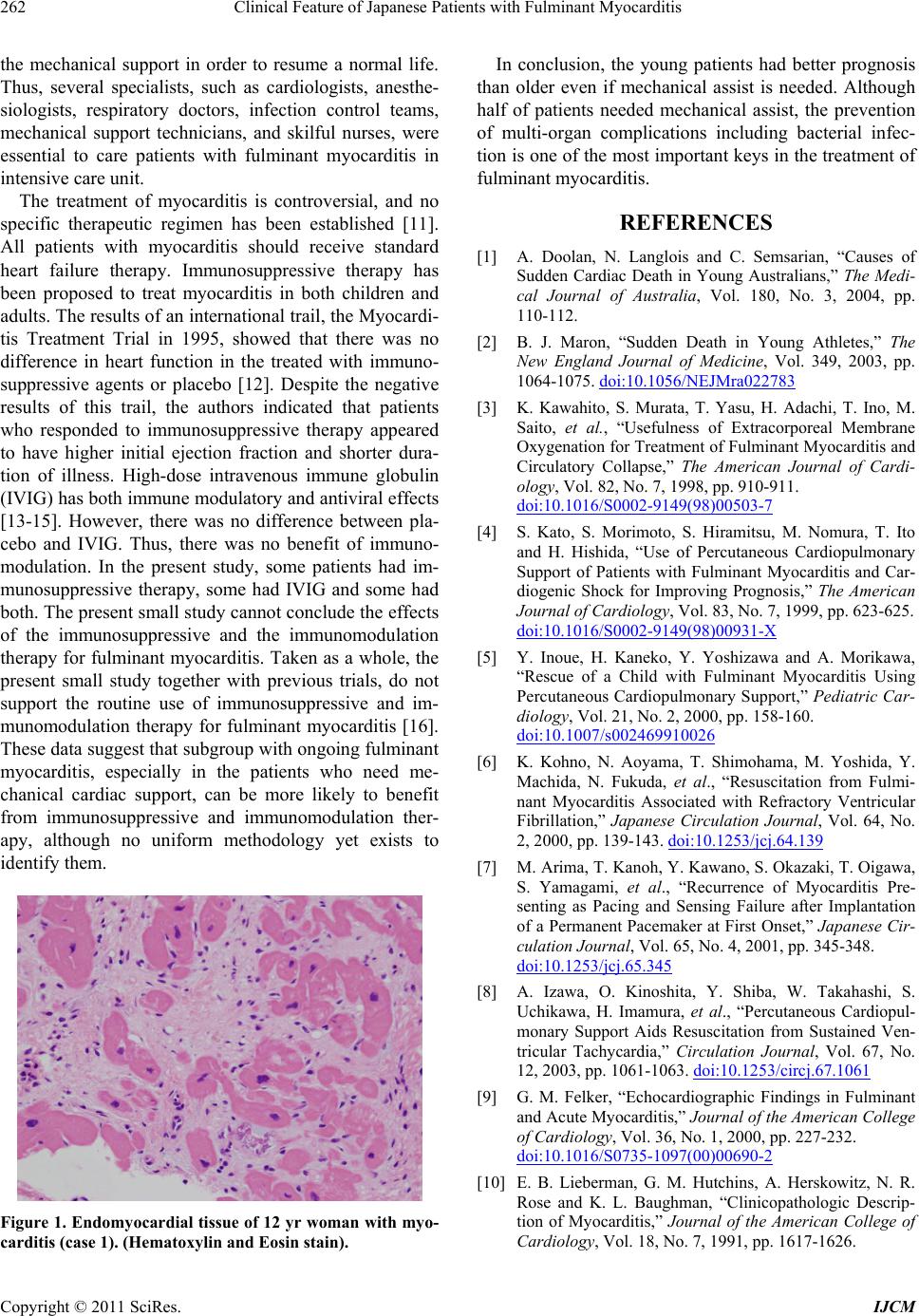 Clinical Feature of Japanese Patients with Fulminant Myocarditis 262 the mechanical support in order to resume a normal life. Thus, several specialists, such as cardiologists, anesthe- siologists, respiratory doctors, infection control teams, mechanical support technicians, and skilful nurses, were essential to care patients with fulminant myocarditis in intensive care unit. The treatment of myocarditis is controversial, and no specific therapeutic regimen has been established [11]. All patients with myocarditis should receive standard heart failure therapy. Immunosuppressive therapy has been proposed to treat myocarditis in both children and adults. The results of an international trail, the Myocardi- tis Treatment Trial in 1995, showed that there was no difference in heart function in the treated with immuno- suppressive agents or placebo [12]. Despite the negative results of this trail, the authors indicated that patients who responded to immunosuppressive therapy appeared to have higher initial ejection fraction and shorter dura- tion of illness. High-dose intravenous immune globulin (IVIG) has both immune modulatory and antiviral effects [13-15]. However, there was no difference between pla- cebo and IVIG. Thus, there was no benefit of immuno- modulation. In the present study, some patients had im- munosuppressive therapy, some had IVIG and some had both. The present small study cannot conclude the effects of the immunosuppressive and the immunomodulation therapy for fulminant myocarditis. Taken as a whole, the present small study together with previous trials, do not support the routine use of immunosuppressive and im- munomodulation therapy for fulminant myocarditis [16]. These data suggest that subgroup with ongoing fulminant myocarditis, especially in the patients who need me- chanical cardiac support, can be more likely to benefit from immunosuppressive and immunomodulation ther- apy, although no uniform methodology yet exists to identify them. Figure 1. Endomyocardial tissue of 12 yr woman with myo- carditis (case 1). (Hematoxylin and Eosin stain). In conclusion, the young patients had better prognosis than older even if mechanical assist is needed. Although half of patients needed mechanical assist, the prevention of multi-organ complications including bacterial infec- tion is one of the most important keys in the treatment of fulminant myocarditis. REFERENCES [1] A. Doolan, N. Langlois and C. Semsarian, “Causes of Sudden Cardiac Death in Young Australians,” The Medi- cal Journal of Australia, Vol. 180, No. 3, 2004, pp. 110-112. [2] B. J. Maron, “Sudden Death in Young Athletes,” The New England Journal of Medicine, Vol. 349, 2003, pp. 1064-1075. doi:10.1056/NEJMra022783 [3] K. Kawahito, S. Murata, T. Yasu, H. Adachi, T. Ino, M. Saito, et al., “Usefulness of Extracorporeal Membrane Oxygenation for Treatment of Fulminant Myocarditis and Circulatory Collapse,” The American Journal of Cardi- ology, Vol. 82, No. 7, 1998, pp. 910-911. doi:10.1016/S0002-9149(98)00503-7 [4] S. Kato, S. Morimoto, S. Hiramitsu, M. Nomura, T. Ito and H. Hishida, “Use of Percutaneous Cardiopulmonary Support of Patients with Fulminant Myocarditis and Car- diogenic Shock for Improving Prognosis,” The American Journal of Cardiology, Vol. 83, No. 7, 1999, pp. 623-625. doi:10.1016/S0002-9149(98)00931-X [5] Y. Inoue, H. Kaneko, Y. Yoshizawa and A. Morikawa, “Rescue of a Child with Fulminant Myocarditis Using Percutaneous Cardiopulmonary Support,” Pediatric Car- diology, Vol. 21, No. 2, 2000, pp. 158-160. doi:10.1007/s002469910026 [6] K. Kohno, N. Aoyama, T. Shimohama, M. Yoshida, Y. Machida, N. Fukuda, et al., “Resuscitation from Fulmi- nant Myocarditis Associated with Refractory Ventricular Fibrillation,” Japanese Circulation Journal, Vol. 64, No. 2, 2000, pp. 139-143. doi:10.1253/jcj.64.139 [7] M. Arima, T. Kanoh, Y. Kawano, S. Okazaki, T. Oigawa, S. Yamagami, et al., “Recurrence of Myocarditis Pre- senting as Pacing and Sensing Failure after Implantation of a Permanent Pacemaker at First Onset,” Japanese Cir- culation Journal, Vol. 65, No. 4, 2001, pp. 345-348. doi:10.1253/jcj.65.345 [8] A. Izawa, O. Kinoshita, Y. Shiba, W. Takahashi, S. Uchikawa, H. Imamura, et al., “Percutaneous Cardiopul- monary Support Aids Resuscitation from Sustained Ven- tricular Tachycardia,” Circulation Journal, Vol. 67, No. 12, 2003, pp. 1061-1063. doi:10.1253/circj.67.1061 [9] G. M. Felker, “Echocardiographic Findings in Fulminant and Acute Myocarditis,” Journal of the American College of Cardiology, Vol. 36, No. 1, 2000, pp. 227-232. doi:10.1016/S0735-1097(00)00690-2 [10] E. B. Lieberman, G. M. Hutchins, A. Herskowitz, N. R. Rose and K. L. Baughman, “Clinicopathologic Descrip- tion of Myocarditis,” Journal of the American College of Cardiology, Vol. 18, No. 7, 1991, pp. 1617-1626. Copyright © 2011 SciRes. IJCM  Clinical Feature of Japanese Patients with Fulminant Myocarditis263 doi:10.1016/0735-1097(91)90493-S [11] J. W. Magnani and G. W. Dec, “Myocarditis: Current Trends in Diagnosis and Treatment,” Circulation, Vol. 113, 2006, pp. 876-890. doi:10.1161/CIRCULATIONAHA.105.584532 [12] J. W. Mason, J. B. O'Connell, A. Herskowitz, N. R. Rose, B. M. McManus, M. E. Billingham and T. E. Moon, “The Myocarditis Treatment Trial Investigators, A Clinical Trial of Immunosuppressive Therapy for Myocarditis,” The New England Journal of Medicine, Vol. 333, 1995, pp. 269-275. doi:10.1056/NEJM199508033330501 [13] D. M. McNamara, W. D. Rosenblum, K. M. Janosko, M. K. Trost, F. S. Villaneuva, A. J. Demetris, S. Murali and A. M. Feldman, “Intravenous Immune Globulin in the Therapy of Myocarditis and Acute Cardiomyopathy,” Circulation, Vol. 95, No. 11, 1997, pp. 2476-2478. [14] D. M. McNamara, R. Holubkov, R. C. Starling, G. W. Dec, E. Loh, G. GuillTorre-Amione, A. Gass, K. Janosko, T. Tokarczyk, P. Kessler, D. L. Mann and A. M. Feldman, “Controlled Trial of Intravenous Immune Globulin in Recent-Onset Dilated Cardiomyopathy,” Circulation, Vol. 103, No. 18, 2001, pp. 2254-2259. [15] K. Shioji, Y. Matsuura, T. Iwase, S. Kitaguchi, H. Naka- mura, J. Yodoi, et al., “Successful Immunoglobulin Treatment for Fulminant Myocarditis and Serial Analysis of Serum Thioredoxin: A Case Report,” Circulation Journal, Vol. 66, No. 10, 2002, pp. 977-980. doi:10.1253/circj.66.977 [16] L. T. Cooper Jr., “Myocarditis,” The New England Journal of Medicine, Vol. 360, 2009, pp. 1526-1538. doi:10.1056/NEJMra0800028 Copyright © 2011 SciRes. IJCM |