

Paper Menu >>
Journal Menu >>
 Open Journal of Marine Science, 2011, 1, 43-49 doi:10.4236/ojms.2011.12005 Published Online July 2011 (http://www.SciRP.org/journal/ojms) Copyright © 2011 SciRes. OJMS The Effect of Photoacclimation on Photosynthetic Energy Storage Efficiency, Determined by Photoacoustics Yulia Pinchasov-Grinblat*, Razy Hoffman, Zvy Dubinsky Faculty of Life Sciences, Bar-Ilan University, Ramat-Gan, Israel E-mail: [email protected] Received May 11, 2011; revised May 23, 2011; accepted June 8, 2011 Abstract Photosynthesis rates in phytoplankton depend on light intensity and its spectral composition, however their relation changes with photoacclimation. During the photoacclimation process algal cells optimize their har- vesting and utilization of available light through series of related physical, biophysical, biochemical and physiological changes. These changes result in the ability of phytoplankton to survive under dim light when transported to the depth of the water column and avoid photodynamic damage when exposed to the intense radiation at the surface. Any reduction in the efficiency of light utilization results in decreased rates of pho- tosynthesis rate and slow growth. We present here the study of changes in photosynthetic energy storage ef- ficiency of three phytoplankton species upon photoacclimation to low and high light, as measured by photo- acoustics. Our results illustrate the power of photoacoustics as a tool in aquatic ecology and in the physio- logical research of phytoplankton. Keywords: Phytoplankton, Photoacclimation, Photosynthesis, Photoacoustics 1. Introduction Phytoplankton, like all photosynthetic organisms, depend on the capture of light and the transformation of its en- ergy into stored photosynthate, which subsequently fuels all ecosystem activities. For the first step of the photo- synthetic process, light has to be intercepted by a variety of light absorbing substances, the photosynthetic pig- ments. These pigments are associated with proteins, forming light harvesting arrays, or “antennae”, which collect excitation energy and transfer it to the reaction centers of the two photosystems, PSI and PSII that to- gether constitute the photosynthetic unit. These photo- synthetic units have a given probability or cross-section for absorbing impinging light photons. Because of the importance of photoacclimation for phytoplankton which is frequently transported over two orders of magnitude changes in light intensity within hours, this process received considerable attention in the study of aquatic primary production [1-3]. In all the nu- merous studies of the mechanisms of the photoacclima- tion process in phytoplankton, a common trend of in- crease in chlorophyll a and in other light harvesting pig- ments as growth irradiance decreases was observed. Photoacclimation also affects pigment ratios of phyto- plankton, as light harvesting pigments such as the chlorophylls, phycobilins, fucoxanthin and peridinin in- crease under low light, whereas photoprotective carote- noids like β carothene, astaxanthin and xanthophyll cycle pigments show the opposite relation with ambient light, increasing whenever exposed to potentially harmfully high intense light [4-7]. Most photosynthetic pigments other than chloropyll a are an integral part of the light harvesting antennae. These photosynthetic pigments re- spond to changes in light intensity in a similar way to that of chlorophyll a [8]. Concomitantly, as cellular pig- mentation increases in the course of photoacclimation to low light, the cross section of phytoplankton invariably decreases [8,9]. This change in cross section resulting from the increase in mutual shading between cellular light harvesting entities, as their density increases. It happens on all scales, among individual pigment mole- cules, thylakoids, chloroplasts within cells, and among cells in culture [10]. Upon exposure to high light inten- sity, the above described trends are reversed [11]. The photoacoustic method, allows the direct determi- nation of the energy storage efficiency of photosynthesis by relating the energy stored by photosynthesis to the total light energy absorbed by the plant material [12-14]. Depending on the efficiency of the photosynthetic sys-  44 Y. PINCHASOV-GRINBLAT ET AL. tem, a variable fraction of the absorbed light energy is stored, thereby affecting the heat evolved and the result- ing photoacoustic signal. By exposing the cells to a saturating continuous back- ground light, no storage of any of the pulse energy can take place, whereas in the absence of such light, a maxi- mal fraction of the pulse energy is stored by photosyn- thesis. Thus the maximal efficiency max , is determined as the complement of the ratios of the photoacoustic sig- nal, generated by a weak pulse of light in the dark (PAdark), to that obtained under strong continuous light (PAlight). max 1 PAdarkPAlight (1) The aim of this work was to examine the photoacous- tic method developed by us [15-17] in physiological phytoplankton research. We demonstrate this novel ap- plication, by investigating changes in photosynthetic energy storage efficiency occurring in a few phyto- plankton species of different taxa, resulting from photo- acclimation. 2. Methods and Materials 2.1. Algal Culture The three species of marine phytoplankton studied were a diatom, Phaeodactylum tricornutum, green alga Nan- nochloropsis sp. and golden-brown flagellate Isochrysis galbana. All cultures were grown in 250 mL Erlenmey- ers flasks containing 200mL enriched artificial seawater medium (Guillard’s F/2) [18] at 24˚ ± 0.5 C, under white fluorescent lights at ~10 μmol q m-2 s-1 (low light (LL)) and ~500 μmol q m-2 s-1 (high light (HL)). Cell concentration was measured with a hemacytome- ter. Chlorophyll content was measured spectrophotomet- rically in 90% acetone extracts using the equations of Jeffrey and Humphrey [19]. 2.2. Photoacoustics The experimental system is shown schematically in Fig- ure 1. The sample was placed in a 16 mm square glass cell (PAC). The laser (L) pulse, after passing through a pair of 1mm wide slits (S) is incident upon the suspen- sion of algae whose pigments absorb part of the laser light. Depending on the experimental conditions, a frac- tion of the absorbed light pulse is stored in the products of photosynthesis. The remainder of the absorbed light is converted to heat producing an acoustic wave. This is intercepted by a submersible detector (D), containing the ceramic disc. A small portion of the laser pulse is de- flected by a beam splitter (BS) and used to trigger the Tektronix TDS 430A oscilloscope, where the amplified (Amptek A-250 Preamp and Stanford Research A 560 Amp) photoacoustic signal is recorded. The signal con- tains a noisy background and later reflections from the walls of the vessel as well as from impedance mismatch within the detector (for details see [17]). By increasing the continuous background light inten- sity from zero to saturation of photosynthesis, an in- creasing fraction of the reaction centers is closed at any time, and a decreasing fraction of the probe laser pulse energy is stored. A corresponding increase in the fraction of the pulse energy is converted to heat, which is sensed by the photoacoustic detector. From these detector re- sponses the photosynthetic energy-storage versus back- ground light-intensity relationship was obtained [15-17]. 3. Results and Discussion In these experiments the photoacclimation of three algal species Phaeodactylum tricornutum, Nannochloropsis sp and Isochrysis galbana to low and high photon irradian- ces was examined. In general, photoacclimation to low light results in increased cellular absorption due to high concentration of light-harvesting pigments. In the nu- merous studies on the mechanism of photoacclimation in phytoplankton, a common trend was reported of increase in chlorophyll as growth irradiance decreases (Falkowski, 1980; 1984; Dubinsky et al. 1986; 1995, Ritz, et al. 2000). As seen in Figure 2 and Figure 3 all three species showed a difference in cellular chlorophyll content by ~56% in Isochrysis galbana, 38% and 35% in Phaeodactilum tri- cornutum and Nannochloropsis sp, respectively. The ratios of cellular chlorophyll under the low and high light were 1.415 for Phaeodactilum tricornutum, 1.398 for Nannochloropsis sp. and 1.984 for Isochrysis Figure 1. Schematic of the photoacoustic setup: L: laser (Minilite Q Switched Nd :YAG, 532 nm); S: beam shaping slits, BS: beam splitter; PAC: photoacoustic cell with sus- pension of algae; D: stainless-steel photoacoustic detector, contained a 10-mm diameter resonating ceramic disc (BM 500, Sensor, Ontario, Canada); P: low-noise preamplifier (Amptek A-250); A: low noise amplifier (SRS 560); PD: photodiode; TR: trigger signal, B: background light source, quartz-halogen illuminator (Cole Parmer 4971); O: oscillo- scope (Tektronix TDS 430A); C: computer. Copyright © 2011 SciRes. OJMS  Y. PINCHASOV-GRINBLAT ET AL. Copyright © 2011 SciRes. OJMS 45 galbana. In addition to the changes in cellular chloro- phyll most other plant pigments also respond to ambient irradiance [4,23]. All light-harvesting pigments increase under low light. These include the carotenoids fucoxan- tin and peridinin, in addition to all chlorolhylls, phyco- erythrin and phycocyanin [4]. The decrease of chlorophyll concentration in HL growth conditions resulted in a parallel reduce in photo- synthetic energy storage efficiency Figure 4. We determined the photosynthetic energy storage un- der different ambient irradiance levels, resulting in an energy storage curve (Figure 5). This relationship is similar to the photosynthesis versus irradiance, (P vs I) curve obtained by the tedious standard measurements of 14C fixation and oxygen evolution [24-26] or the indirect results from measurement of variable fluorescence [27]. These results are similar to the data cited in the litera- ture, where cellular chlorophyll content increased under low light (LL) conditions and reduced under high light (HL) (Table 1) Figure 2. The effect of photoacclimation to high light (500 mol·q·m–2·s–1) and low light (10 mol·q·m–2·s–1) on cellular chlo- rophyll content for three algae.  46 Y. PINCHASOV-GRINBLAT ET AL. Figure 3. The effect of photoacclimation to high light and low light on chlorophyll concentration measured by photoacoustics. Table 1. The LL/HL chlorophyll ratios for different phytoplankton species cited in literature. Algae Reference Phaeodactilum tricornutum 1.415 Present study Nannochloropsis sp. 1.398 Present study Isochrysis galbana 1.984 Present study Phaeodactilum tricornutum 1.592 Present study by photoacoustics Nannochloropsis sp. 1.020 Present study by photoacoustics Isochrysis galbana 2.501 Present study by photoacoustics Thalassiosira weisflogii 2.486 Dubinsky et al. 1986 Isochrysis galbana 2.130 Dubinsky et al. 1986 Prorocentrum micans 2.351 Dubinsky et al. 1986 Symbiodinium microadriaticum 1.921 Iglesias Prieto and Trench, 1994 Isochrysis galbana 2.076 Herzig and Dubinsky, 1992 Copyright © 2011 SciRes. OJMS 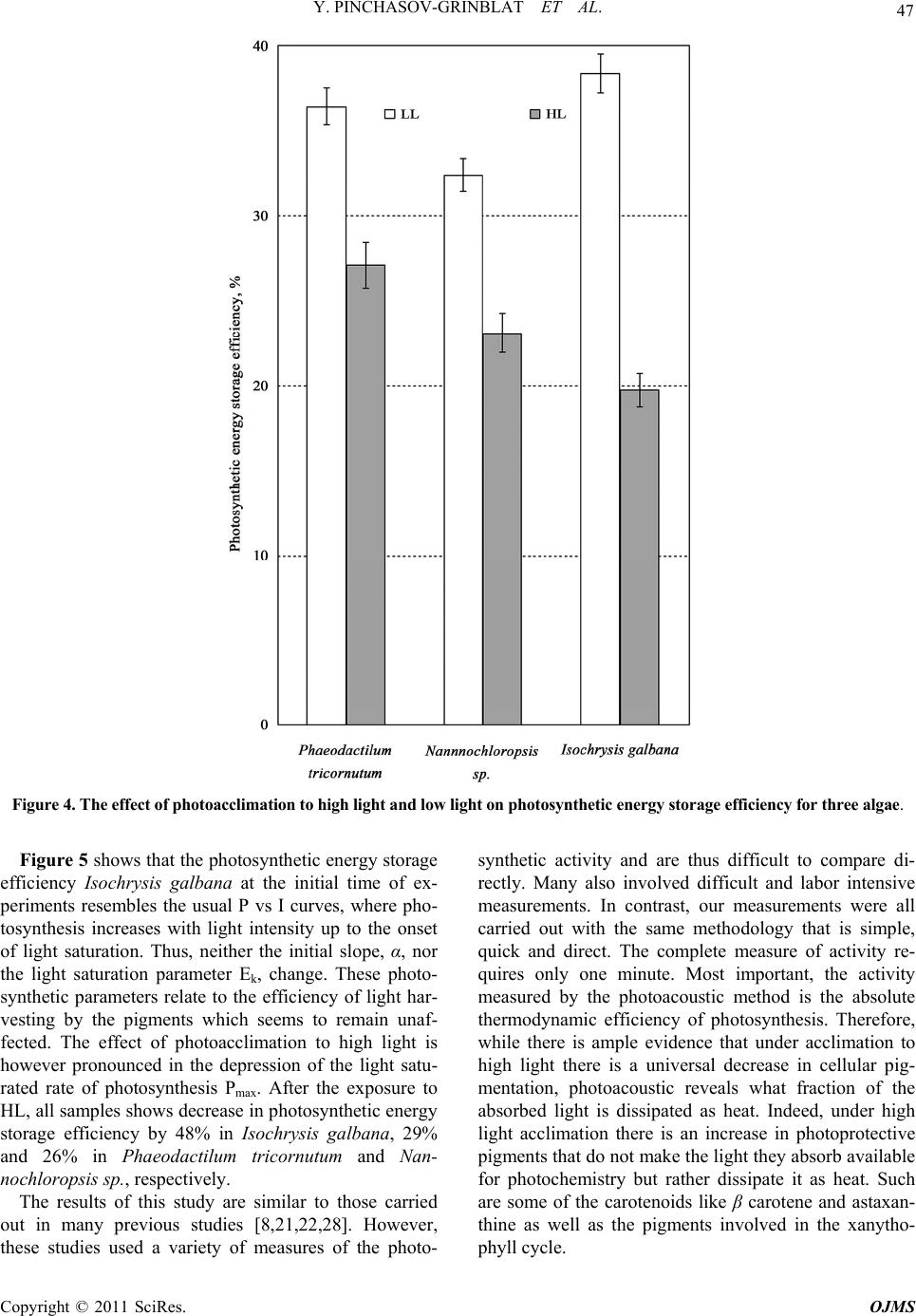 Y. PINCHASOV-GRINBLAT ET AL. Copyright © 2011 SciRes. OJMS 47 Figure 4. The effect of photoacclimation to h igh light and low light on p hotos ynthetic en ergy storage efficiency for th ree alga e. Figure 5 shows that the photosynthetic energy storage efficiency Isochrysis galbana at the initial time of ex- periments resembles the usual P vs I curves, where pho- tosynthesis increases with light intensity up to the onset of light saturation. Thus, neither the initial slope, α, nor the light saturation parameter Ek, change. These photo- synthetic parameters relate to the efficiency of light har- vesting by the pigments which seems to remain unaf- fected. The effect of photoacclimation to high light is however pronounced in the depression of the light satu- rated rate of photosynthesis Pmax. After the exposure to HL, all samples shows decrease in photosynthetic energy storage efficiency by 48% in Isochrysis galbana, 29% and 26% in Phaeodactilum tricornutum and Nan- nochloropsis sp., respectively. The results of this study are similar to those carried out in many previous studies [8,21,22,28]. However, these studies used a variety of measures of the photo- synthetic activity and are thus difficult to compare di- rectly. Many also involved difficult and labor intensive measurements. In contrast, our measurements were all carried out with the same methodology that is simple, quick and direct. The complete measure of activity re- quires only one minute. Most important, the activity measured by the photoacoustic method is the absolute thermodynamic efficiency of photosynthesis. Therefore, while there is ample evidence that under acclimation to high light there is a universal decrease in cellular pig- mentation, photoacoustic reveals what fraction of the absorbed light is dissipated as heat. Indeed, under high light acclimation there is an increase in photoprotective pigments that do not make the light they absorb available for photochemistry but rather dissipate it as heat. Such are some of the carotenoids like β carotene and astaxan- thine as well as the pigments involved in the xanytho- phyll cycle. 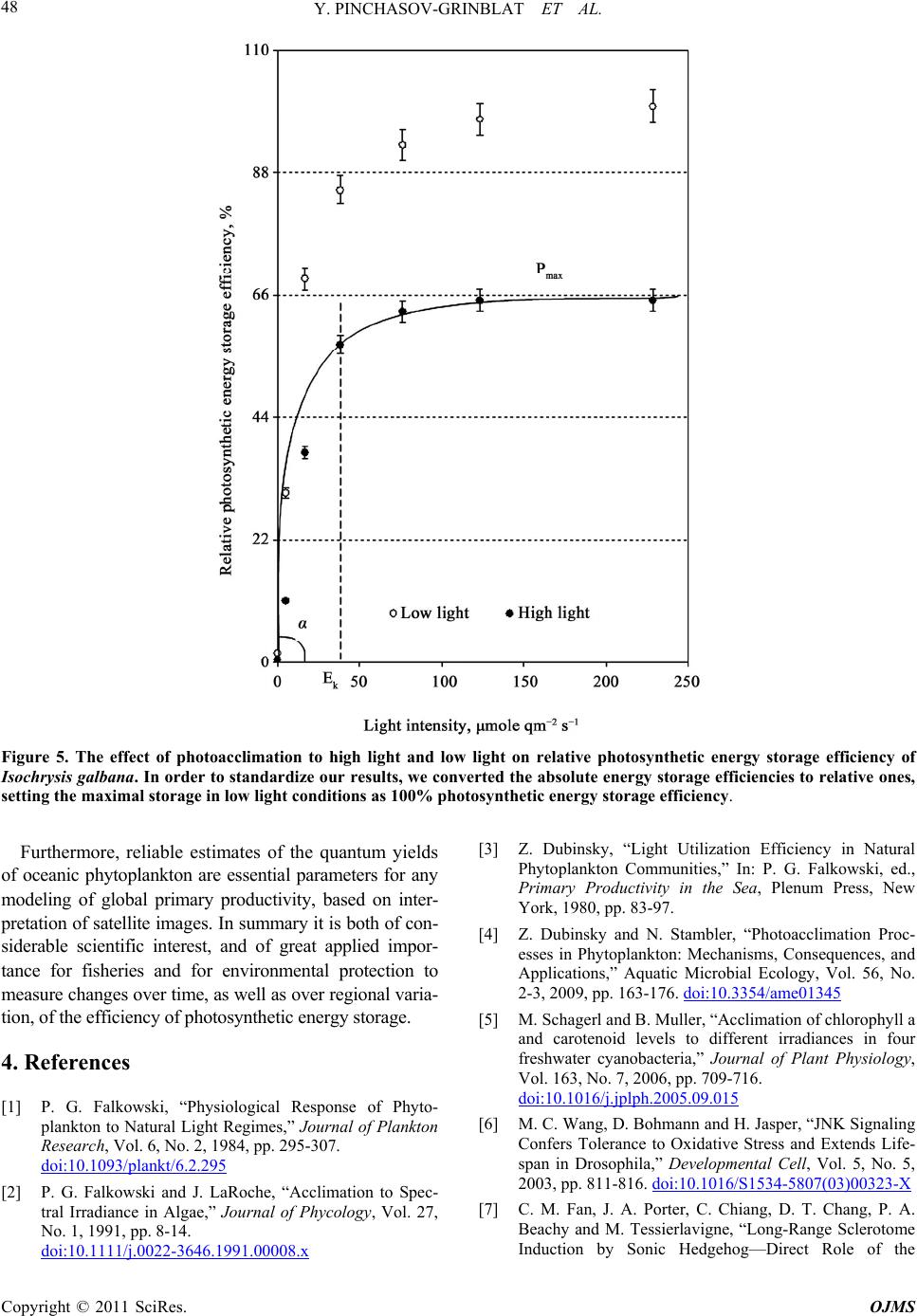 Y. PINCHASOV-GRINBLAT ET AL. 48 Figure 5. The effect of photoacclimation to high light and low light on relative photosynthetic energy storage efficiency of Isochrysis galbana. In order to standardize our results, we converted the absolute energy storage efficiencies to relative ones, setting the maximal storage in low light conditions as 100% photosynthetic energy storage efficiency. Furthermore, reliable estimates of the quantum yields of oceanic phytoplankton are essential parameters for any modeling of global primary productivity, based on inter- pretation of satellite images. In summary it is both of con- siderable scientific interest, and of great applied impor- tance for fisheries and for environmental protection to measure changes over time, as well as over regional varia- tion, of the efficiency of photosynthetic energy storage. 4. References [1] P. G. Falkowski, “Physiological Response of Phyto- plankton to Natural Light Regimes,” Journal of Plankton Research, Vol. 6, No. 2, 1984, pp. 295-307. doi:10.1093/plankt/6.2.295 [2] P. G. Falkowski and J. LaRoche, “Acclimation to Spec- tral Irradiance in Algae,” Journal of Phycology, Vol. 27, No. 1, 1991, pp. 8-14. doi:10.1111/j.0022-3646.1991.00008.x [3] Z. Dubinsky, “Light Utilization Efficiency in Natural Phytoplankton Communities,” In: P. G. Falkowski, ed., Primary Productivity in the Sea, Plenum Press, New York, 1980, pp. 83-97. [4] Z. Dubinsky and N. Stambler, “Photoacclimation Proc- esses in Phytoplankton: Mechanisms, Consequences, and Applications,” Aquatic Microbial Ecology, Vol. 56, No. 2-3, 2009, pp. 163-176. doi:10.3354/ame01345 [5] M. Schagerl and B. Muller, “Acclimation of chlorophyll a and carotenoid levels to different irradiances in four freshwater cyanobacteria,” Journal of Plant Physiology, Vol. 163, No. 7, 2006, pp. 709-716. doi:10.1016/j.jplph.2005.09.015 [6] M. C. Wang, D. Bohmann and H. Jasper, “JNK Signaling Confers Tolerance to Oxidative Stress and Extends Life- span in Drosophila,” Developmental Cell, Vol. 5, No. 5, 2003, pp. 811-816. doi:10.1016/S1534-5807(03)00323-X [7] C. M. Fan, J. A. Porter, C. Chiang, D. T. Chang, P. A. Beachy and M. Tessierlavigne, “Long-Range Sclerotome Induction by Sonic Hedgehog—Direct Role of the C opyright © 2011 SciRes. OJMS 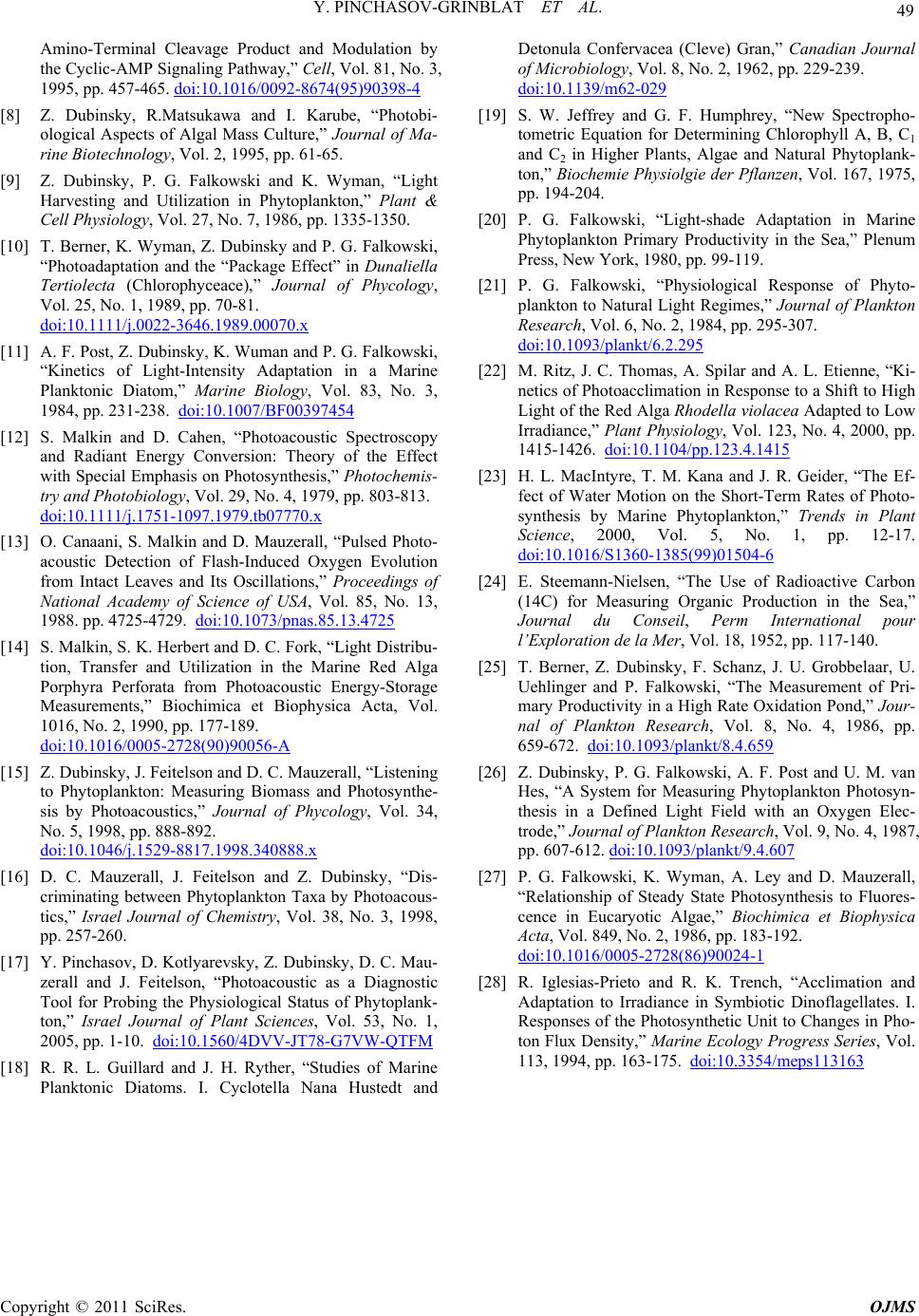 Y. PINCHASOV-GRINBLAT ET AL. 49 Amino-Terminal Cleavage Product and Modulation by the Cyclic-AMP Signaling Pathway,” Cell, Vol. 81, No. 3, 1995, pp. 457-465. doi:10.1016/0092-8674(95)90398-4 [8] Z. Dubinsky, R.Matsukawa and I. Karube, “Photobi- ological Aspects of Algal Mass Culture,” Journal of Ma- rine Biotechnology, Vol. 2, 1995, pp. 61-65. [9] Z. Dubinsky, P. G. Falkowski and K. Wyman, “Light Harvesting and Utilization in Phytoplankton,” Plant & Cell Physiology, Vol. 27, No. 7, 1986, pp. 1335-1350. [10] T. Berner, K. Wyman, Z. Dubinsky and P. G. Falkowski, “Photoadaptation and the “Package Effect” in Dunaliella Tertiolecta (Chlorophyceace),” Journal of Phycology, Vol. 25, No. 1, 1989, pp. 70-81. doi:10.1111/j.0022-3646.1989.00070.x [11] A. F. Post, Z. Dubinsky, K. Wuman and P. G. Falkowski, “Kinetics of Light-Intensity Adaptation in a Marine Planktonic Diatom,” Marine Biology, Vol. 83, No. 3, 1984, pp. 231-238. doi:10.1007/BF00397454 [12] S. Malkin and D. Cahen, “Photoacoustic Spectroscopy and Radiant Energy Conversion: Theory of the Effect with Special Emphasis on Photosynthesis,” Photochemis- try and Photobiology, Vol. 29, No. 4, 1979, pp. 803-813. doi:10.1111/j.1751-1097.1979.tb07770.x [13] O. Canaani, S. Malkin and D. Mauzerall, “Pulsed Photo- acoustic Detection of Flash-Induced Oxygen Evolution from Intact Leaves and Its Oscillations,” Proceedings of National Academy of Science of USA, Vol. 85, No. 13, 1988. pp. 4725-4729. doi:10.1073/pnas.85.13.4725 [14] S. Malkin, S. K. Herbert and D. C. Fork, “Light Distribu- tion, Transfer and Utilization in the Marine Red Alga Porphyra Perforata from Photoacoustic Energy-Storage Measurements,” Biochimica et Biophysica Acta, Vol. 1016, No. 2, 1990, pp. 177-189. doi:10.1016/0005-2728(90)90056-A [15] Z. Dubinsky, J. Feitelson and D. C. Mauzerall, “Listening to Phytoplankton: Measuring Biomass and Photosynthe- sis by Photoacoustics,” Journal of Phycology, Vol. 34, No. 5, 1998, pp. 888-892. doi:10.1046/j.1529-8817.1998.340888.x [16] D. C. Mauzerall, J. Feitelson and Z. Dubinsky, “Dis- criminating between Phytoplankton Taxa by Photoacous- tics,” Israel Journal of Chemistry, Vol. 38, No. 3, 1998, pp. 257-260. [17] Y. Pinchasov, D. Kotlyarevsky, Z. Dubinsky, D. C. Mau- zerall and J. Feitelson, “Photoacoustic as a Diagnostic Tool for Probing the Physiological Status of Phytoplank- ton,” Israel Journal of Plant Sciences, Vol. 53, No. 1, 2005, pp. 1-10. doi:10.1560/4DVV-JT78-G7VW-QTFM [18] R. R. L. Guillard and J. H. Ryther, “Studies of Marine Planktonic Diatoms. I. Cyclotella Nana Hustedt and Detonula Confervacea (Cleve) Gran,” Canadian Journal of Microbiology, Vol. 8, No. 2, 1962, pp. 229-239. doi:10.1139/m62-029 [19] S. W. Jeffrey and G. F. Humphrey, “New Spectropho- tometric Equation for Determining Chlorophyll A, B, C1 and C2 in Higher Plants, Algae and Natural Phytoplank- ton,” Biochemie Physiolgie der Pflanzen, Vol. 167, 1975, pp. 194-204. [20] P. G. Falkowski, “Light-shade Adaptation in Marine Phytoplankton Primary Productivity in the Sea,” Plenum Press, New York, 1980, pp. 99-119. [21] P. G. Falkowski, “Physiological Response of Phyto- plankton to Natural Light Regimes,” Journal of Plankton Research, Vol. 6, No. 2, 1984, pp. 295-307. doi:10.1093/plankt/6.2.295 [22] M. Ritz, J. C. Thomas, A. Spilar and A. L. Etienne, “Ki- netics of Photoacclimation in Response to a Shift to High Light of the Red Alga Rhodella violacea Adapted to Low Irradiance,” Plant Physiology, Vol. 123, No. 4, 2000, pp. 1415-1426. doi:10.1104/pp.123.4.1415 [23] H. L. MacIntyre, T. M. Kana and J. R. Geider, “The Ef- fect of Water Motion on the Short-Term Rates of Photo- synthesis by Marine Phytoplankton,” Trends in Plant Science, 2000, Vol. 5, No. 1, pp. 12-17. doi:10.1016/S1360-1385(99)01504-6 [24] E. Steemann-Nielsen, “The Use of Radioactive Carbon (14C) for Measuring Organic Production in the Sea,” Journal du Conseil, Perm International pour l’Exploration de la Mer, Vol. 18, 1952, pp. 117-140. [25] T. Berner, Z. Dubinsky, F. Schanz, J. U. Grobbelaar, U. Uehlinger and P. Falkowski, “The Measurement of Pri- mary Productivity in a High Rate Oxidation Pond,” Jour- nal of Plankton Research, Vol. 8, No. 4, 1986, pp. 659-672. doi:10.1093/plankt/8.4.659 [26] Z. Dubinsky, P. G. Falkowski, A. F. Post and U. M. van Hes, “A System for Measuring Phytoplankton Photosyn- thesis in a Defined Light Field with an Oxygen Elec- trode,” Journal of Plankton Research, Vol. 9, No. 4, 1987, pp. 607-612. doi:10.1093/plankt/9.4.607 [27] P. G. Falkowski, K. Wyman, A. Ley and D. Mauzerall, “Relationship of Steady State Photosynthesis to Fluores- cence in Eucaryotic Algae,” Biochimica et Biophysica Acta, Vol. 849, No. 2, 1986, pp. 183-192. doi:10.1016/0005-2728(86)90024-1 [28] R. Iglesias-Prieto and R. K. Trench, “Acclimation and Adaptation to Irradiance in Symbiotic Dinoflagellates. I. Responses of the Photosynthetic Unit to Changes in Pho- ton Flux Density,” Marine Ecology Progress Series, Vol. 113, 1994, pp. 163-175. doi:10.3354/meps113163 Copyright © 2011 SciRes. OJMS |