

Paper Menu >>
Journal Menu >>
 International Journal of Clinical Medicine, 2011, 2, 310-312 doi:10.4236/ijcm.2011.23053 Published Online July 2011 (http://www.SciRP.org/journal/ijcm) Copyright © 2011 SciRes. IJCM Abnormal Placental Findings Associated with Non-reassuring Fetal Monitoring and Excellent Neonatal Outcomes Gary Ventolini1, Shanthi Ramesh1, Sheela Barhan1, Ran Neiger2 1Wright State Physicians Boonshoft School of Medicine Department of Obstetrics and Gynecology, Dayton Ohio, USA; 2Perinatal Partners, Miami Valley Hospital Berry Building, Maternal Fetal Medicine, Dayton Ohio, USA. Email: [email protected] Received February 29th, 2011; revised April 27th, 2011; accepted May 12th, 2011. ABSTRACT Objective: Obstetricians, Neonatologists, and Pathologists have studied gross histological analysis of human placentas in search of specific alterations in placental functions that can be correlated with neonatal outcomes. Our study as- sessed the prevalence of abnormal placental findings associated with non-reassuring fetal monitoring in labor requir- ing emergent instrumental or cesarean delivery, followed by an excellent neonatal outcome. Study Design: One hun- dred consecutive emergency deliveries, instrumental or cesarean, performed due to non-reassuring fetal monitoring while in labor were retrospectively evaluated. All patien ts were low-risk for obstetric complications, and had a single- ton, term pregnancy. They had a normal antenatal routine testing and a normal anatomy ultrasound scan at 20 to 22 weeks gestation. Results: There were 35 placentas (35%) with gross placental anomalies at the delivery triage. Addi- tionally 7 placentas (7%) were reported to be abnormal at the patholog y examination. Conclusions: The prevalence of abnormal placental findings in our studied popula tion was 42%. Keywords: Abnormal Placental Findings, Excellent Neonatal Outcomes, Non-Reassuring Fetal Monitoring 1. Introduction Obstetricians, Neonatologists, and Pathologists have studied gross and histological analysis of human pla- centas in search of specific alterations in placental func- tion that can be correlated with neonatal outcomes. The placenta provides a third party perspective regarding the pregnancy and many maternal and fetal conditions are evidenced by placental abnormalities [1]. Specific pla- cental pathology is found in pregnancy loss associated with thrombophilia, in many stillbirths and neonatal deaths, and in cases of non-immune hydrops fetalis [2]. Many grossly and histopathological abnormal placentas are, however, not associated with adverse neonatal out- comes. Further attention to placental analysis including more rigorous guidelines for pathologic diagnosis is needed to delineate which abnormal findings are associ- ated with adverse neonatal outcomes. Per The College of American Pathologists (CAP) guidelines, all human placentas should be inspected and triaged at the delivery room and the abnormal ones should be sent to pathology for a complete examination using specific examination criteria as established by the CAP. As previously determined by Ventolini et al., in a cohort of 88 uneventful deliveries, 42% of placentas had abnormal findings during pathological evaluation. Thir- teen of the abnormal placentas (35.1%) showed pathol- ogy unassociated with fetal compromise. Twenty-four of the placentas (27.3% of the total cohort and 64.9% of the abnormal placentas) showed findings associated with fetal compromoise, all with APGAR scores at birth of greater than or equal to 7 at 1 and 5 minutes. The most common pathologies were marginal cord insertion, cho- rioamnionitis, and abruption [3]. The purpose of our study was to assess the prevalence of abnormal placental findings associated with non-re- assuring fetal monitoring in labor requiring emergent instrumental or cesarean delivery, followed by an excel- lent neonatal outcome. 2. Materials and Methods One hundred consecutive emergency deliveries, instru- mental or cesarean, performed due to non-reassuring fetal monitoring while in labor were retrospectively 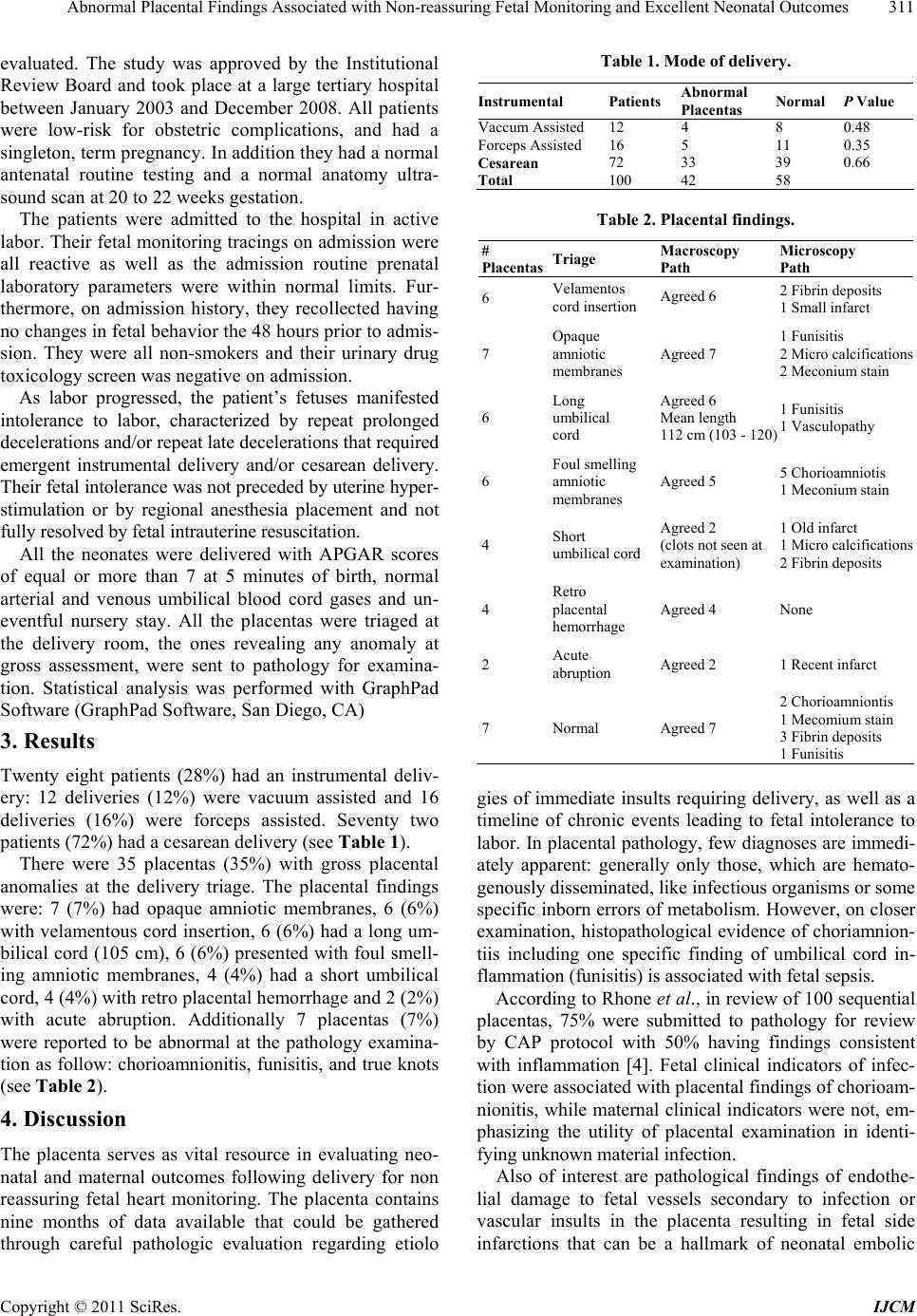 Abnormal Placental Findings Associated with Non-reassuring Fetal Monitoring and Excellent Neonatal Outcomes 311 evaluated. The study was approved by the Institutional Review Board and took place at a large tertiary hospital between January 2003 and December 2008. All patients were low-risk for obstetric complications, and had a singleton, term pregnancy. In addition they had a normal antenatal routine testing and a normal anatomy ultra- sound scan at 20 to 22 weeks gestation. The patients were admitted to the hospital in active labor. Their fetal monitoring tracings on admission were all reactive as well as the admission routine prenatal laboratory parameters were within normal limits. Fur- thermore, on admission history, they recollected having no changes in fetal behavior the 48 hours prior to admis- sion. They were all non-smokers and their urinary drug toxicology screen was negative on admission. As labor progressed, the patient’s fetuses manifested intolerance to labor, characterized by repeat prolonged decelerations and/or repeat late decelerations that required emergent instrumental delivery and/or cesarean delivery. Their fetal intolerance was not preceded by uterine hyper- stimulation or by regional anesthesia placement and not fully resolved by fetal intrauterine resuscitation. All the neonates were delivered with APGAR scores of equal or more than 7 at 5 minutes of birth, normal arterial and venous umbilical blood cord gases and un- eventful nursery stay. All the placentas were triaged at the delivery room, the ones revealing any anomaly at gross assessment, were sent to pathology for examina- tion. Statistical analysis was performed with GraphPad Software (GraphPad Software, San Diego, CA) 3. Results Twenty eight patients (28%) had an instrumental deliv- ery: 12 deliveries (12%) were vacuum assisted and 16 deliveries (16%) were forceps assisted. Seventy two patients (72%) had a cesarean delivery (see Table 1). There were 35 placentas (35%) with gross placental anomalies at the delivery triage. The placental findings were: 7 (7%) had opaque amniotic membranes, 6 (6%) with velamentous cord insertion, 6 (6%) had a long um- bilical cord (105 cm), 6 (6%) presented with foul smell- ing amniotic membranes, 4 (4%) had a short umbilical cord, 4 (4%) with retro placental hemorrhage and 2 (2%) with acute abruption. Additionally 7 placentas (7%) were reported to be abnormal at the pathology examina- tion as follow: chorioamnionitis, funisitis, and true knots (see Table 2). 4. Discussion The placenta serves as vital resource in evaluating neo- natal and maternal outcomes following delivery for non reassuring fetal heart monitoring. The placenta contains nine months of data available that could be gathered through careful pathologic evaluation regarding etiolo Table 1. Mode of delivery. Instrumental Patients Abnormal Placentas Normal P Value Vaccum Assisted 12 4 8 0.48 Forceps Assisted 16 5 11 0.35 Cesarean 72 33 39 0.66 Total 100 42 58 Table 2. Placental findings. # Placentas Triage Macroscopy Path Microscopy Path 6 Velamentos cord insertion Agreed 6 2 Fibrin deposits 1 Small infarct 7 Opaque amniotic membranes Agreed 7 1 Funisitis 2 Micro calcifications 2 Meconium stain 6 Long umbilical cord Agreed 6 Mean length 112 cm (103 - 120) 1 Funisitis 1 Vasculopathy 6 Foul smelling amniotic membranes Agreed 5 5 Chorioamniotis 1 Meconium stain 4 Short umbilical cord Agreed 2 (clots not seen at examination) 1 Old infarct 1 Micro calcifications 2 Fibrin deposits 4 Retro placental hemorrhage Agreed 4 None 2 Acute abruption Agreed 2 1 Recent infarct 7 Normal Agreed 7 2 Chorioamniontis 1 Mecomium stain 3 Fibrin deposits 1 Funisitis gies of immediate insults requiring delivery, as well as a timeline of chronic events leading to fetal intolerance to labor. In placental pathology, few diagnoses are immedi- ately apparent: generally only those, which are hemato- genously disseminated, like infectious organisms or some specific inborn errors of metabolism. However, on closer examination, histopathological evidence of choriamnion- tiis including one specific finding of umbilical cord in- flammation (funisitis) is associated with fetal sepsis. According to Rhone et al., in review of 100 sequential placentas, 75% were submitted to pathology for review by CAP protocol with 50% having findings consistent with inflammation [4]. Fetal clinical indicators of infec- tion were associated with placental findings of chorioam- nionitis, while maternal clinical indicators were not, em- phasizing the utility of placental examination in identi- fying unknown material infection. Also of interest are pathological findings of endothe- lial damage to fetal vessels secondary to infection or vascular insults in the placenta resulting in fetal side infarctions that can be a hallmark of neonatal embolic Copyright © 2011 SciRes. IJCM  Abnormal Placental Findings Associated with Non-reassuring Fetal Monitoring and Excellent Neonatal Outcomes Copyright © 2011 SciRes. IJCM 312 disease. Roberts et al. [5] reported that “fetal thrombotic vasculopathy,” referring to inflammatory damages to vessels secondary to infection or vascular insult and related placental findings is often cited in a legal context [6-8], however, further research is need to determine prognostically how these findings affect long-term neo- natal outcome. Our study found 35% of placentas with gross abnor- malities associated with potential for adverse fetal con- sequences including opaque or foul smelling amniotic membranes; velamentous cord insertion, long umbilical cord, and short umbilical cord, acute abruption, and retro placental hemorrhage. Additionally 7 placentas (7%) were reported to be abnormal at the pathology examina- tion as follow: chorioamnionitis, funisitis, and true knots. Such abnormalities were associated with reassuring neonatal outcomes as measured by APGAR scores of more than 7 at 5 minutes of birth, normal arterial and venous umbilical blood cord gases and uneventful nurs- ery stay. What is unknown is the degree to which these placental anomalies, while not associated with abnormal fetal development, effect placental perfusion, leading to fetal intolerance of labor. A recent classification system of cerebral palsy calls for an assessment of the timing and etiology of brain injury [9]. The placental examination is an underused resource for addressing these important questions. An expert assessment of the placental pathology can provide temporally and mechanistically specific data not avail- able from any other source. An analysis of 125 placentas from term infants with cerebral palsy, neonatal encepha- lopathy, and other neurodisabilities compared with 200 term placentas from healthy infants, found four lesions: fetal thrombotic vasculopathy, chronic villitis with oblit- erative vasculopathy, chorioamnionitis with intense cho- rionic vasculitis, and meconium associated vascular ne- crosis to be statistically significantly increased in af- fected infants when controlled for confounding factors. Further analysis demonstrated that the lesions were equally common in affected infants with normal or ab- normal umbilical blood gases and 5 min APGAR scores [10]. While this data is limited, it does demonstrate a placental abnormality as seen on histological examina- tion as correlated with neonatal outcome. 5. Comments The prevalence of abnormal placental findings in our studied population was 42%. Placental anomalies could contribute to non-reassuring tracings that require emer- gent delivery. Further delineation of specific placental abnormalities in relationship to adverse neonatal out- comes requires increased collaboration between Obste- tricians, Pathologists, and Neonatologists with diligent analysis of placentas both grossly and histologically. 6. Key Points All human placentas should be inspected and triaged at the delivery room and the abnormal ones should be sent to pathology for a complete examination The placenta provides a third party perspective re- garding the pregnancy and many maternal and fetal conditions are evidenced by placental abnormalities. Placental anomalies could contribute to non-reas- suring tracings that require emergent delivery. The prevalence of abnormal placental findings in our studied population was 42% The most common pathologies were marginal core insertion, chorioamnionitis and abruption REFERENCES [1] S. Aladjem, E. Perrin and A. Fanaroff, “Placental Score and Neonatal Outcome: A Clinical and Pathologic Stu- dy,” Obstetrics and Gynecology, Vol. 39, No. 4, 1972, pp. 591-602. [2] A. L. Kent and J. E. Dahlstrom, “Placental Assessment: Simple Techniques to Enhance Best Practice,” Australian and New Zealand Journal of Obstetrics and Gynaecology, Vol. 46, No. 1, 2006, pp. 32-37. doi:10.1111/j.1479-828X.2006.00511.x [3] G. Ventolini, R. Samlowski and D. L. Hood, “Placental Findings in Low-Risk, Singleton, Term Pregnancies after Uncomplicated Deliveries,” American Journal of Perina- tology, Vol. 21, No. 6, 2004, pp. 325-328. doi:10.1055/s-2004-831882 [4] S. A. Rhone, F. Magee, V. Remple and D. Money, “The Association of Placental Abnormalities with Maternal and Neonatal Clinical Findings: A Retrospective Cohort Stu- dy,” Journal of Obstetrics and Gynaecology Canada, Vol. 25, No. 2, 2003, pp. 123-128. [5] D. Roberts and E. Oliva, “Clinical Significance of Pla- cental Examination in Perinatal Medicine,” The Journal of Maternal-Fetal and Neonatal Medicine, Vol. 19, No. 5, 2006, pp. 255-264. doi:10.1080/14767050600676349 [6] K. Benirschke, “The Placenta in the Litigation Process,” American Journal of Obstetrics and Gynecology, Vol. 162, No. 6, pp. 1445-1450. [7] F. T. Kraus, “Perinatal Pathology, the Placenta, and Liti- gation,” Humam Pathology, Vol. 34, No. 6, 2003, pp. 517-521. doi:10.1016/S0046-8177(03)00227-2 [8] J. P. Lavery, “The Role of Placental Examination and Its Pathology in Obstetric Risk Management,” Journal Healthcare Risk Management, Vol. 17, No. 3, 1997, pp. 15-20. doi:10.1002/jhrm.5600170304 [9] R. W. Redline, “Placental Pathology and Cerebral Palsy,” Clinics in Perinatology, Vol. 33, No. 2, 2006, pp. 503- 516. doi:10.1016/j.clp.2006.03.007 [10] R. W. Redline, D. Heller, S. Keating and J. Kingdom, “Placental Diagnostic Criteria and Clinical Correlation― A Workshop Report,” Placenta, Vol. SA, 2005, pp. S114- S117. |