

Paper Menu >>
Journal Menu >>
 Journal of Surface Engineered Materials and Advanced Technology, 2011, 1, 30-34 doi:10.4236/jsemat.2011.12005 Published Online July 2011 (http://www.SciRP.org/journal/jsemat) Copyright © 2011 SciRes. JSEMAT Modeling of Adsorptio n of Bi(III) from Nitrate Medium by Impregnated Resin D2EHPA/XAD-1180 Nasr-Eddine Belkhouche*, Nacera Benyahia Laboratory of Separation and Purification Technologies, Department of Chemistry-Facult y of Sciences, Tlemcen University, Algeria. Email: [email protected] Received April 6th, 2011; revised May 17th, 2011; accepted May 25th, 2011. ABSTRACT Di(2-ethylhexyl)phosphoric acid (D2EHPA) in acetone was supported on the Amberlite XAD-1180 polystyrene divinyl- benzene copolymer resin. The use of XAD-1180 impregnated with D2EHPA for the extraction of bismuth(III) from ni- trate medium was carried out using batch technique. Various parameters affecting the uptake of this metal ion were described in the previous paper Reference [1] and the capacity of the impregnated resin for bismuth(III) was found to be 490.7 mg/g of resin. Effect of temperature on the values of distribution equilibrium was studied to evaluate the changes in standard thermodynamic quantities. A comparison of Langmuir forms I, II and Freundlich sorption iso- therms was realized and the kinetic models applied to the adsorption rate data were evaluated for Lagergren first or- der, the pseudo second order and Morris–Weber models. From the results, the adsorption of Bi(III) onto D2EHPA/XAD-1180 resin shown the exothermic character and followed the Langmuir form II isotherm. Thus, the ca- pacity of monolayer adsorption of Bi(III) was equal to 769.23 mg/g of resin. Both the Lagergren pseudo first order and film-diffusion models were found to best describe the experimental rate data. Keywords: Bismuth , XAD-1180 Resin, D2EHPA, Sorption Isotherms, Kinetic Models 1. Introduction The previous paper [1] was devoted to study the kinetics of bismuth(III) extraction from nitrate medium by sol- vent impregnated resin technique (SIR) using the Am- berlite XAD-1180 resin as support for di(2-ethylhexyl) phosphoric acid (D2EHPA) as organophosphorus ex- tractant, in order to know the best operating conditions of later selective extraction from other metals such as lead, copper and tin. The bismuth(III) was fixed at 490.7 mg/g of XAD-1180 resin, at 295 K. The extractant impreg- nated resin (EIR) of bismuth(III) was studied in function of the experimental parameters such as: Amberlite XAD- 1180 impregnation, D2EHPA/XAD-1180 ratio, Contact time and stirring speed, pH of Bi(III) solution, Concen- tration of Bi(III), Aqueous phase volume, NaCl electro- lyte and elution of Bi(III) from loaded EIR. The results were used to determine the constants of polynomial model which described the experimental data of bismuth (III) extraction process. In this present paper we are interested to study the thermodynamic parameters of the distribution equili- brium of Bi(III) sorption process for evaluated the chan ges in sta ndard ther modyna mic quantities. The sor p- tion isotherms such as: Langmuir forms I, II and Freun- dlich were tested for exp eri mental data o f Bi(III ) sorptio n onto D2EHPA/XAD-1180 resin. Also, the kinetics mod- els as the Lagergren first order, the pseudo second order and Morris–Weber were applied for modeling the ad- sorptio n ra te data. 2. Results and Discussion 2.1. Effect of the Temperat ure The study of the temperature effect on the bismuth(III) sorptio n from nitrate mediu m onto 15 mmol of D2HPA/g of X AD-1180 resin was carried out by using 250 ppm of the concentration of metal ion at pH 3.6 with v/m ratio equal to 50 ml/g. The distribution coefficient (Kd) of metal ion between the aqueous bulk phase and the resin phase was calcu- lated from the Equation (1): 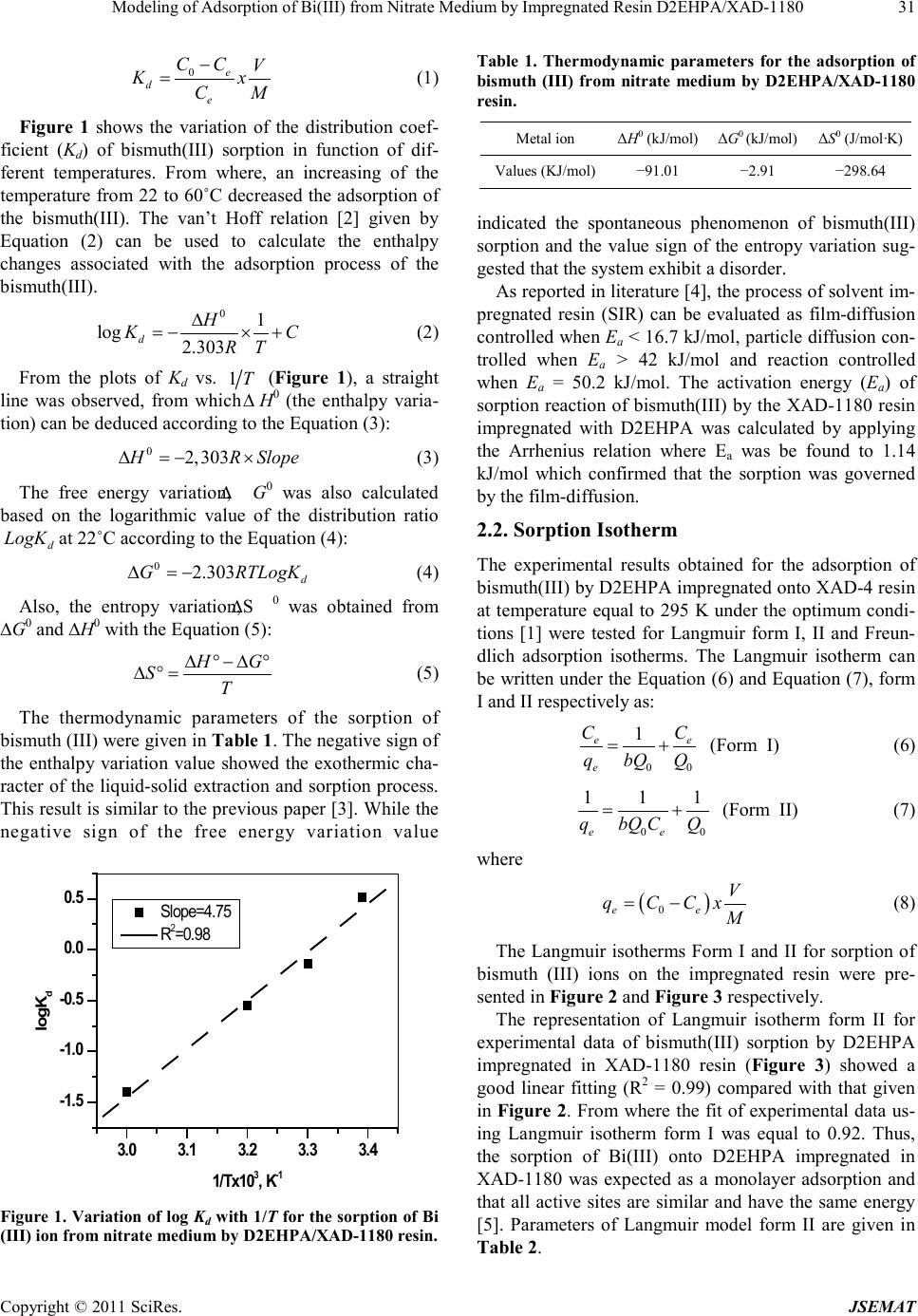 Modeling of Adsorption of Bi(III) from Nitrate Medium by Impregnated Resin D2EHPA/XAD-1180 Copyright © 2011 SciRes. JSEMAT 31 0e de CCV Kx CM − = (1) Figure 1 shows the variation of the distribution coef- ficient (Kd) of bismuth(III) sorption in function of dif- ferent temperatures. From where, an increasing of the temper ature from 22 to 60˚C decreased the adsorption of the bismuth(III). The van’t Hoff relation [2] given by Equation (2) can be used to calculate the enthalpy changes associated with the adsorption process of the bismuth(III). 0 1 log 2.303 d H KC RT ∆ =− ×+ (2) From the plots of Kd vs. 1T (Figure 1), a straight line was observed, from which ∆H0 (the enthalpy varia- tion) can be deduced according to the Equation (3): 02,303HR Slope∆=−× (3) The free energy variation, ∆G0 was also calculated based on the logarithmic value of the distribution ratio d LogK at 22˚C according to the Equation (4): 0 2.303 d G RTLogK∆=− (4) Also, the entropy variation, ∆S 0 was obtained from ∆G0 and ∆H0 with the Equation (5 ): HG ST ∆°−∆ ° ∆ °= (5) The thermodynamic parameters of the sorption of bismuth (III) were given in Table 1 . The nega t ive sig n o f the enthalpy variation value showed the exothermic cha- racter of the liquid-solid extraction and sorption process. This result is similar to the p revious pa per [3]. W hile the negative sign of the free energy variation value 3.0 3.1 3.2 3.3 3.4 -1.5 -1.0 -0.5 0.0 0.5 logK d 1/Tx10 3 , K -1 Slope=4.75 R 2 =0.98 Figure 1. Variat ion of log Kd with 1/T for the sorption of B i (III) ion from nitrate medium by D2EHPA/XAD-1180 resin. Table 1. Thermodynamic parameters for the adsorption of bismuth (III) from nitrate medium by D2EHPA/XAD-1180 resin. Metal ion ΔH0 (kJ/mol) ΔG0 ( k J/ m ol ) ΔS0 ( J/ m ol ·K) Values (KJ/mol) −91.01 −2.91 −298.64 indicated the spontaneous phenomenon of bismuth(III) sorption and the value sign of the entropy variation sug- gested that the system exhibit a disorde r . As reported in literature [4], the p roc ess o f so lve nt i m- pregnated resin (SIR) can be evaluated as film-diffusion contr olled when Ea < 16.7 kJ/mol, particle d iffusion con- trolled when Ea > 42 kJ/mol and reaction controlled when Ea = 50.2 kJ/mol. The activation energy (Ea) of sorption reaction of bismuth(III) by the XAD-1180 resin i mpre gnated with D2EHPA was calculated by applying the Arrhenius relation where Ea was be found to 1.14 kJ/mol which confirmed that the sorption was governed by the film-diffusion. 2.2. Sorption Isotherm The experimental results obtained for the adsorption of bismuth(III) by D2EHPA impregnated onto XAD-4 resin at temperature equal to 295 K under the optimum condi- tions [1] were tested for Langmuir form I, II and Freun- dlich adsorption isotherms. The Langmuir isotherm can be written under the Eq uation (6) and Equation (7), form I and II respectively as: 00 1 ee e CC qbQ Q = + (Form I) (6) 00 111 ee qbQ CQ = + (Form II) (7) where ( ) 0ee V qC Cx M = − (8) The Langmuir isotherms Form I and II for sorption of bismuth (III) ions on the impregnated resin were pre- sented in Figure 2 and Figure 3 respectively. The representation of Langmuir isotherm form II for experimental data of bismuth(III) sorption by D2EHPA impregnated in XAD-1180 resin (Figure 3) showed a good linear fitting (R2 = 0.99) compared with that given in Figure 2. From where the fit of experimental data us- ing Langmuir isotherm form I was equal to 0.92. Thus, the sorption of Bi(III) onto D2EHPA impregnated in XAD-1180 was expected as a monolayer adsorption and that all active sites are similar and have the same energy [5]. Parameters of Langmuir model form II are given in Table 2. 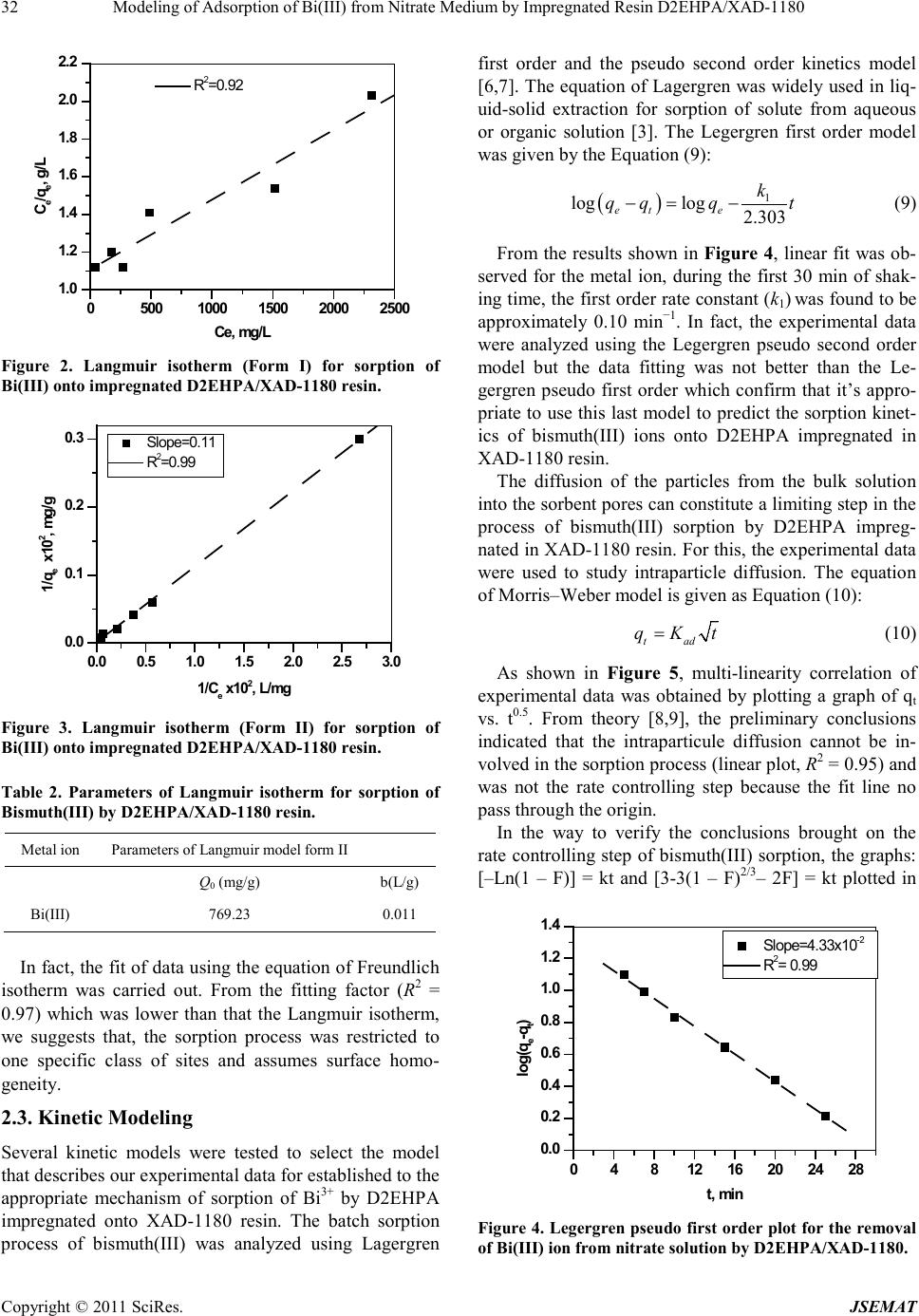 Modeling of Adsorption of Bi(III) from Nitrate Medium by Impregnated Resin D2EHPA/XAD-1180 Copyright © 2011 SciRes. JSEMAT 32 05001000 1500 2000 2500 1.0 1.2 1.4 1.6 1.8 2.0 2.2 R 2 =0.92 C e /q e , g /L C e , mg /L Figure 2. Langmuir isotherm (Form I) for sorption of Bi(III) onto impregnated D2EHPA/XAD-1180 resin. 0.0 0.5 1.0 1.5 2.0 2.5 3.0 0. 0 0. 1 0. 2 0. 3 1/ q e x10 2 , mg/g 1/ C e x10 2 , L /mg Slope=0.11 R 2 =0.99 Figure 3. Langmuir isotherm (Form II) for sorption of Bi(III) onto impregnated D2EHPA/XAD-1180 resin. Table 2. Parameters of Langmuir isotherm for sorption of Bismuth(III) by D2EHPA/XAD-1180 resin. Metal ion Parameters of Langmu ir model form II Q0 (mg/g) b( L/g) Bi(III) 769.23 0.011 In fact, the f it of data usi ng the equation o f Freundlic h isotherm was carried out. From the fitting factor (R2 = 0.97) which was lower than that the Langmuir isotherm, we suggests that, the sorption process was restricted to one specific class of sites and assumes surface homo- geneity. 2.3. Kinetic Modeling Several kinetic models were tested to select the model that describes our exp e rimental da ta for establis hed to the appropriate mechanism of sorption of Bi3+ by D2EHPA impregnated onto XAD-1180 resin. The batch sorption process of bismuth(III) was analyzed using Lagergren first order and the pseudo second order kinetics model [6,7]. T he equat ion of La gergre n was wide ly used in liq- uid-solid extraction for sorption of solute from aqueous or organic solution [3]. The Legergren first order model was given by the Equation (9): ( ) 1 loglog 2.303 et e k qq qt−= − (9) Fro m the results shown in Figure 4, linear fit was ob- served for the metal ion, during t he first 30 min of sha k- ing time, the first o rder rate constant ( k1) was fou nd to be approximately 0.10 min−1. In fact, the experimental data were analyzed using the Legergren pseudo second order model but the data fitting was not better than the Le- gergren pseudo first order which confirm that it’s appro- priate to use this last mod el to predic t the sorption kinet- ics of bismuth(III) ions onto D2EHPA impregnated in XAD-1180 resin. The diffusion of the particles from the bulk solution into the sorbent po res can constitute a li miting step in the process of bismuth(III) sorption by D2EHPA impreg- nated in XAD -1180 resin. For this, the e xperimental data were used to study intraparticle diffusion. The equation of Morris–Weber model is given as Equation (10): t ad qKt= (10) As shown in Fig ure 5, multi-linearity correlation of experimental data was obtained by plotting a graph of qt vs. t0.5. From theory [8,9], the preliminary conclusions indicated that the intraparticule diffusion cannot be in- volved in the sorption process (linear plot, R2 = 0.95) and was not the rate controlling step because the fit line no pass through the origin. In the way to verify the conclusions brought on the rate controlling step of bismuth(III) sorption, the graphs: [–Ln(1 – F)] = kt and [3-3(1 – F)2/3– 2F] = kt plotted in 04812 1620 2428 0.0 0.2 0.4 0.6 0.8 1.0 1.2 1.4 log(q e -q t ) t, min Slope=4.33x10 -2 R 2 = 0.99 Figure 4. Legerg ren pseudo first order plot for the removal of Bi(III) ion from nitrate solution by D2EHPA/XAD-1180. 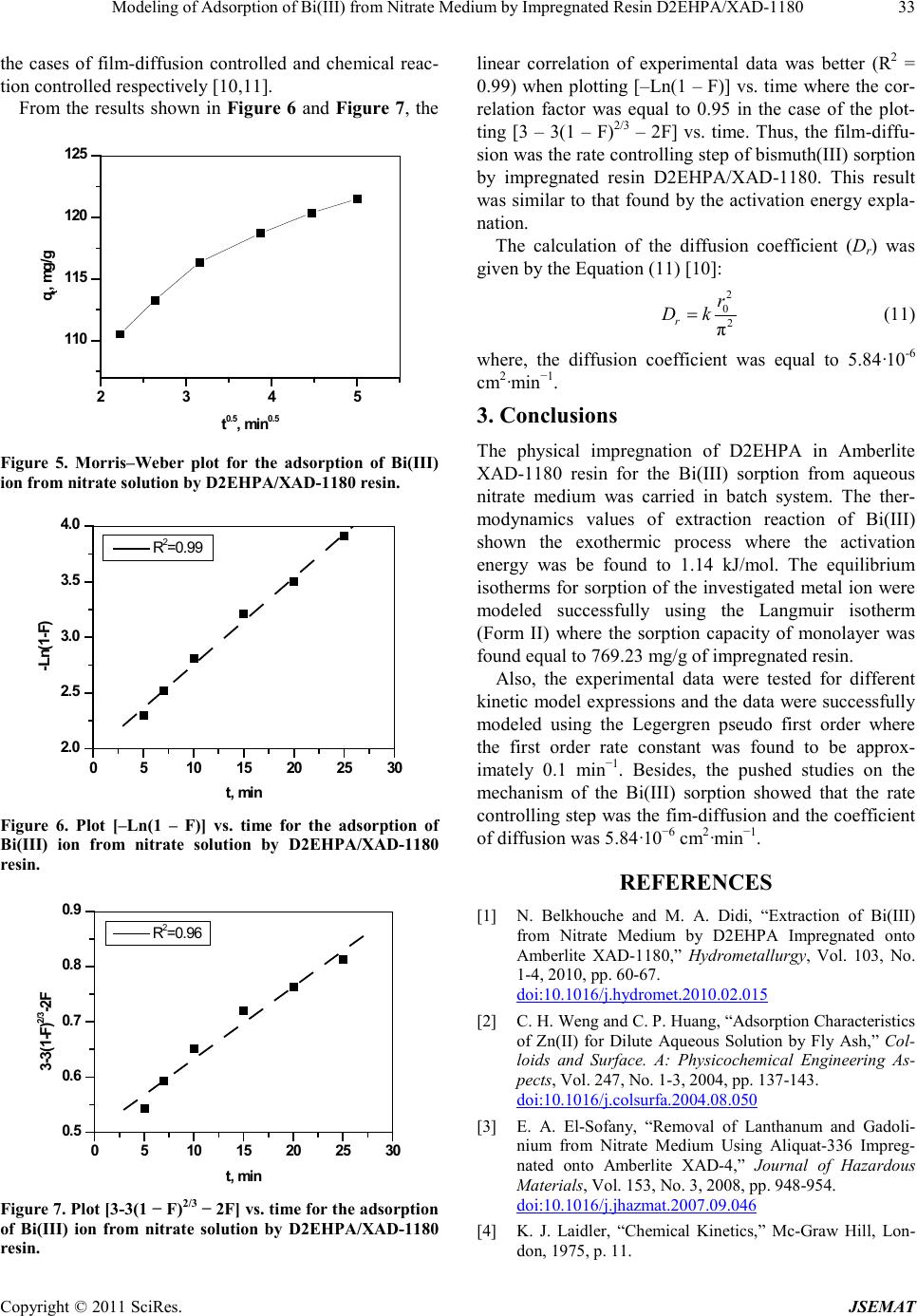 Modeling of Adsorption of Bi(III) from Nitrate Medium by Impregnated Resin D2EHPA/XAD-1180 Copyright © 2011 SciRes. JSEMAT 33 the cases of film-diffusion controlled and chemical reac- tion controlled respectively [10,11]. Fro m the results shown in Figure 6 and Figure 7, the 2 3 4 5 110 115 120 125 qt, mg /g t0.5, min0. 5 Figure 5. Morris–Weber plot for the adsorption of Bi(III) ion from nitrate solution by D2EHPA/XA D-1180 resin. 05 10 15 20 25 30 2. 0 2. 5 3. 0 3. 5 4. 0 R 2 =0.99 -Ln(1-F) t, min Figure 6. Plot [–Ln(1 – F)] vs. time for the adsorption of Bi(III) ion from nitrate solution by D2EHPA/XAD-1180 resin. 0510 152025 30 0. 5 0. 6 0. 7 0. 8 0. 9 R 2 =0.96 3-3(1-F) 2/3 -2F t, min Figure 7. Plot [3-3(1 − F)2/3 − 2F] vs. t i me f or t he a dso rption of Bi(III) ion from nitrate solution by D2EHPA/XAD-1180 resin. linear correlation of experimental data was better (R2 = 0.99) when plotting [–Ln(1 – F)] vs. time where the cor- relation factor was equal to 0.95 in the case of the plot- ting [3 – 3(1 – F)2/3 – 2F] vs. time. Thus, the film-diffu- sion was the rate contro lling step o f bismuth(III) sorption by impregnated resin D2EHPA/XAD-1180. This result was similar to that found by the activation energy expla- nation. The calculation of the diffusion coefficient (Dr) was given by the Equation (11) [10]: 2 02 π r r Dk= (11) where, the diffusion coefficient was equal to 5.84·10-6 cm2·min−1. 3. Conclusions The physical impregnation of D2EHPA in Amberlite XAD-1180 resin for the Bi(III) sorption from aqueous nitrate medium was carried in batch system. The ther- modynamics values of extraction reaction of Bi(III) shown the exothermic process where the activation energy was be found to 1.14 kJ/mol. The equilibrium isotherms for sorption of the investigated metal ion were modeled successfully using the Langmuir isotherm (Form II) where the sorption capacity of monolayer was found equal to 769.23 mg/g of impregnated resin. Also, the experimental data were tested for different kinetic model expressions and the data were successfully modeled using the Legergren pseudo first order where the first order rate constant was found to be approx- imately 0.1 min−1. Besides, the pushed studies on the mechanism of the Bi(III) sorption showed that the rate controlling step was the fim-diffusion and the coefficient of diffusion was 5.84·10−6 cm2·min−1. REFERENCES [1] N. Belkhouche and M. A. Didi, “Extraction of Bi(III) from Nitrate Medium by D2EHPA Impregnated onto Amberlite XAD-1180,” Hydrometallurgy, Vol. 103, No. 1-4, 2010, pp. 60-67. doi:10.1016/j.hydromet.2010.02.015 [2] C. H . We n g an d C . P . Huang, “Adsorption Characteristics of Zn(II) for Dilute Aqueous Solution by Fly Ash,” Col- loids and Surface. A: Physicochemical Engineering As- pects, Vol. 247, No. 1-3, 2004, pp. 137-143. doi:10.1016/j.colsurfa.2004.08.050 [3] E. A. El-Sofany, “Removal of Lanthanum and Gadoli- nium from Nitrate Medium Using Aliquat-336 Impreg- nated onto Amberlite XAD-4,” Journal of Hazardous Materials, Vol. 153, No. 3, 2008, pp. 94 8-954. doi:10.1016/j.jhazmat.2007.09.046 [4] K. J. Laidler, “Chemical Kinetics,” Mc-Graw Hill, Lon- don, 197 5, p. 11 .  Modeling of Adsorption of Bi(III) from Nitrate Medium by Impregnated Resin D2EHPA/XAD-1180 Copyright © 2011 SciRes. JSEMAT 34 [5] A. M. El-Kamash, N. S. Awad and A. A. El-Sayed, “Sorption of Uranium and Thorium Ions from Nitric Acid Solution Using HDEHP-Impregnated Activated Carbon,” Arab Journal of Nuclear Sciences and Applications, Vol. 38, No. 1, 20 05, pp. 44-49 [6] Y. S. Ho and G. McKay, “Pseudo-Second Order Model for Sorption Processes,” Process Biochemical, Vol. 34, No. 5, 1999, pp. 451 -465. doi:10.1016/S0032-9592(98)00112-5 [7] W. J. Weber and J. M . M or ris, “Kin eti cs of Adsorption of Carbon from Solutions,” Journal of Sanitary Engineering Division American Society Engineers, Vol. 89, 1963, pp. 31-60 [8] N. K. Lazaridis, T. D. Karapantsios and D. Georgantas, “Kinetic Analysis for the Removal of a Reactive Dye from Aqueous Solution onto Hydrotalcite by Adsorption,” Water Research, Vol. 37, No. 12, 2003, pp. 3023-3033. doi:10.1016/S0043-1354(03)00121-0 [9] M. Alkan, O. Demirbas, S. Alikcapa and M. Dogan, “Sorption of Red 57 from Aqueous Solution onto Sepi- olite,” Journal Hazardous Materials, Vol. 116, No. 1-2, 2004, pp . 135-145. doi:10.1016/j.jhazmat.2004.08.003 [10] F. J. Alguacil, “A Kinetic Study of Cadmiu m(II) Adsorp- tion on Lewatit TP260 Resin,” Journal of Chemical Re- search, Vol. 2003, No. 3, 2003, 144-146. doi:10.3184/030823403103173282 [11] R. Chiar izia, E. P. Horwitz an d S. D. Alexandratos, “Up- take of Metal I ons by a New Chel ating I on Exchan ge Re- sin. Part 4: Kinetics,” Solvent Extraction and Ion Ex- change, Vol. 12, No. 1, 1994, pp. 211-237. doi:10.1080/07366299408918209 Symbols b: Constant related to the free energy of adsorption, b ∞ exp(−∆G/RT) C: Co ns t ant C0: Initial concentration of metal ion in solution, mg/L Ce: Equilibrium concentration of metal ion in solution, mg/L F = qt/qe k: Rate constant, min−1 k1: Pseudo first or der rate constant, min−1 Kad: Rate consta nt o f intraparti c le transport, mg/g min0.5 M: Weight of the adsorbent, g Q0: Monolayer adsorption capacity, mg/g qe: Amount of solute sorbed per unit weight of adsorbent at equilibriu m, mg/g qt: Conc entrat ion of ion in the adsorbent at time t, mg/g R: Uni versal gas constant (8.314 J·mol−1·K−1) r0: radius of particles of resin (0.024 cm) T: Absolute tempe rature, Kel vin V: Volume of bulk solution, L |