

Paper Menu >>
Journal Menu >>
 Journal of Surface Engineered Materials and Advanced Technology, 2011, 1, 23-29 doi:10.4236/jsemat.2011.12004 Published Online July 2011 (http://www.SciRP.org/journal/jsemat) Copyright © 2011 SciRes. JSEMAT 23 H2 and CH4 Sorption on Cu-BTC Metal Organic Framewo rk s at Pressures up to 15 MPa and Temperat ures between 273 and 318 K Yves Gensterblum Institute of Geology and Geochemistry of Petroleum and Coal, RWTH Aachen University, Lochn er s tr Aachen, Germany. Emai l: [email protected] Received March 17th, 2011; revised May 31st, 2011; accepted Jun e 9th, 2011. ABSTRACT Sorption isotherms of methane and hydrogen on Cu3(BTC)2 have been measured in the temperature range from 273 to 318 K and a t pr essu res up to 15 MPa. H2 excess sorption capacities of the Cu3(BTC)2 amounted to 3.9 mg/g at 14 MPa. Promising maximum CH4 excess so rption capacities on the same sample were reached at approximately 5 MPa. They amounted to 101, 100, 92 and 80 mg/g at 273, 278, 293 and 318 K, respectively. The sorbed phase density was essen- tially the same for all temperatures and amounted to ~600 kg/m3. Structural changes of the Cu3(BTC)2 samples after thermal activation and treatment with high pressure H2 and CH4 were tested. It was found that the initial micropore structure has virtually disappeared as evidenced by a decrease of the Langmuir specific surface area by a factor ~3 and CO2 micropore volume by a factor of ~4 for H2 and ~3 for CH4. This is in line with a n inc rease in the average pore di- ameter from in itially 9.2 to 15.7 for H2 and 12.8 for CH4. Keywords: Metal Organic Framework (MOF), Sorption, Methane, Hydrogen, Pore Structure 1. Introduction The concept of reticular design in the synthesis of metal organic frameworks (MOF) permits custom-tailoring of regular pore structures on the nanometer scale [1]. This approach opens new perspectives for the development of gas and energy storage systems [2]. So far, the ga s sorp- tion capacity of metal-organic frameworks (MOF) of various chemical and structural compositions has mainly been determined at low pressures (< 0.1 MPa) and tem- peratures (77 to 87 K). Only a few studies [3,4] reported H2 and CO 2 measurements at ambient temperatures (ideal operating temperature). Several authors reported the internal structure of dif- ferent MOFs [5,6]; however, significant amounts of side products were detected using the synthesis described by Chui et al. (1999)[5]. One major problem concerning the storage of gases on these materials at high pr essur es (> 1 MPa) and temperatures (especially at the activation tem- perature of 458 K) is their structural instability and hence, a decrease in specific surface area associated with struc- tural rearrangements for Cu-(BTC) [6]. In this study the sorption capacities of CH4 and H2 on Cu3(BTC)2 (Copper benzene-1,3,5-tricarbox ylate,C18H6 Cu3O12) have been investigated at temperatures between 273 and 318 K and pressures up to 15 MPa. Specific surface areas (SSA) and pore size distributions (PSD) have been determined on untreated samples before and after high-pressure sorption experiments in order to de- tect any structural changes of the sample due to the in- teraction with the gases. A similar approach has been used by [7], who reported changes in SSA and PSD on MOF-5 during hydrogen sorption. Two slightly different MOFs both consist of the same organic ligands but with different basic metals (Al3+ and Cr3+) [8]. At 77K the Al3+–MOF shows higher sorption capacities than the corresponding Cr3+ sa mp le. However, both samples nearly show the same specific surface area of ~1000 m2/g (Figure 1). This finding confirms the im- portance of micropore volume and the electrostatical potential of t he different metal s. Data provided in Figure 1 reflects the general correla- tion between SSA (determined by low pressure N2-iso- therms at 77 K) and H2 sorption capacity at 77 K. It is known that this trend is ambiguous for isotherms re- corded at higher temperatures [9]. One suggestion is that 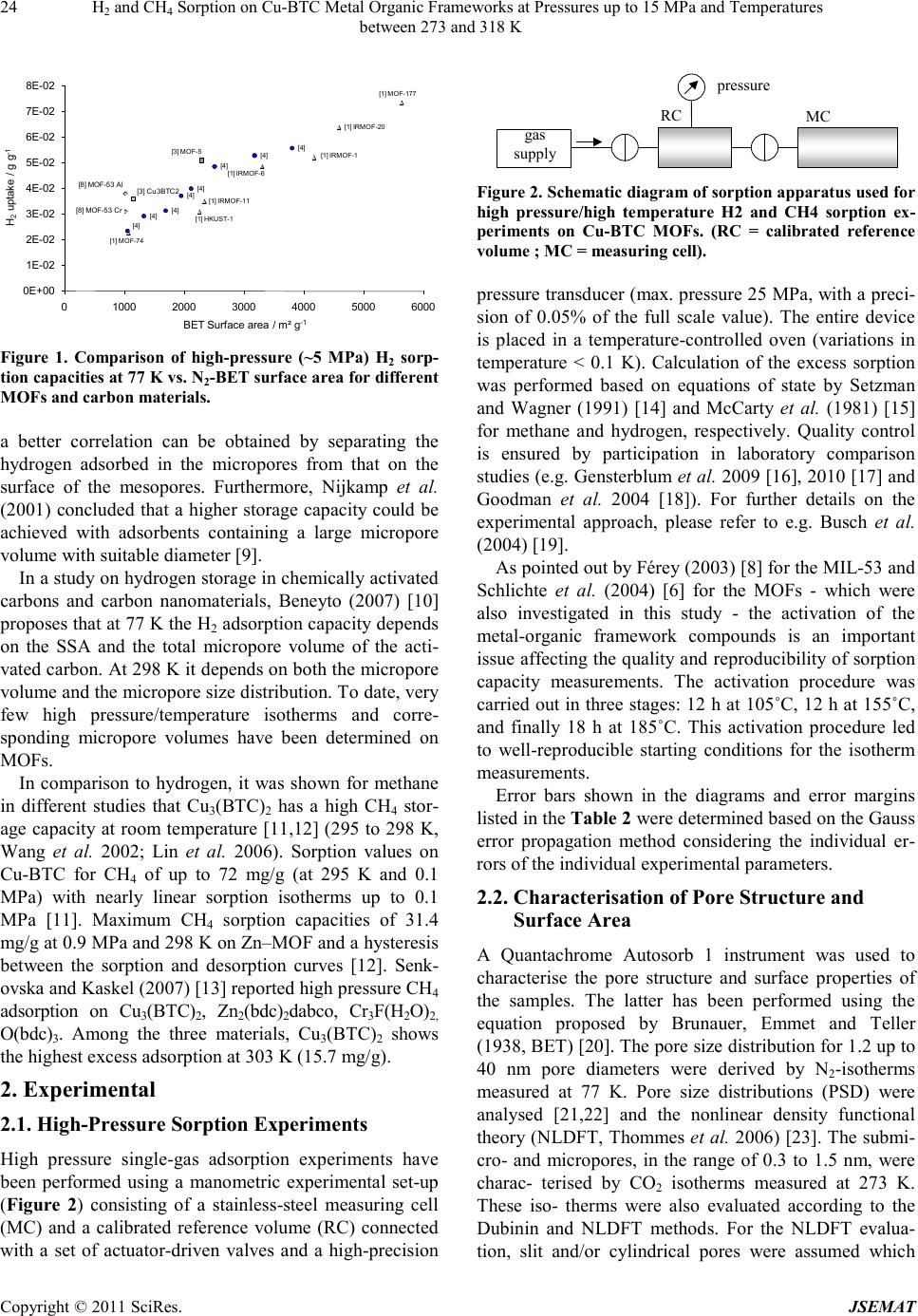 H2 and CH4 Sorption on Cu-BTC Metal Organic Frameworks at Pressures up to 15 MPa and Temperatures between 273 and 318 K Copyright © 2011 SciRes. JSEMAT 24 [1] IRMOF-11 [1] IRMOF-6 [1] MOF-177 [1] IRMOF-1 [1] HKUST-1 [1] IRMOF-20 [3] Cu3BTC2 [3] MOF-5 [1] MOF-74 [8] MOF-53 Cr [8] MOF-53 Al [4] [4] [4] [4] [4] [4] [4] [4] 0E+00 1E-02 2E-02 3E-02 4E-02 5E-02 6E-02 7E-02 8E-02 01000 2000 3000 4000 5000 6000 H 2 uptake / g g -1 BET Surface area / m² g -1 Figure 1. Comparison of high-pressure (~5 MPa) H2 sorp- tion capacities at 77 K vs. N2-BET surface area for different MOFs and carbon materials . a better correlation can be obtained by separating the hydrogen adsorbed in the micropores from that on the surface of the mesopores. Furthermore, Nijkamp et al. (2001) concluded that a higher storage capacity could be achieved with adsorbents containing a large micropore volume with suitable diameter [9]. In a st ud y on h ydr ogen stor ag e in c hemi call y ac tiva ted carbons and carbon nanomaterials, Beneyto (2007) [10] proposes that at 77 K the H2 adsorption capacity depends on the SSA and the total micropore volume of the acti- vated carbon. At 298 K it depends on both the micropore volume and the micropore size distribution. To date, very few high pressure/temperature isotherms and corre- sponding micropore volumes have been determined on MOFs. In comparison to hydrogen, it was shown for methane in different studies that Cu3(BTC)2 has a high CH4 stor- age capacity at room temperature [11,12] (295 to 298 K, Wang et al. 2002; Lin et al. 2006). Sorption values on Cu-BTC for CH4 of up to 72 mg/g (at 295 K and 0.1 MPa) with nearly linear sorption isotherms up to 0.1 MPa [11]. Maximum CH4 sorption capacities of 31.4 mg/g at 0.9 MPa and 298 K on Zn–MOF and a hysteresis between the sorption and desorption curves [12]. Senk- ovska and Kaskel (2007) [13] reported high pressure CH4 adsorption on Cu3(BTC)2, Zn2(bdc)2dabco, Cr3F(H2O)2, O(bdc)3. Among the three materials, Cu3(BTC)2 shows the highest excess adsorption at 303 K (15.7 mg/g). 2. Experimental 2.1. High-Pressure Sorption Experiments High pressure single-gas adsorption experiments have been performed using a manometric experimental set-up (Figure 2) consisting of a stainless-steel measuring cell (MC) and a calibrated reference volume (RC) connected with a set of actuator-driven valves and a high-precision gas supply pressure RC MC Figure 2 . S che mat i c diag r a m of s or pti o n a p par at us us e d fo r high pressure/high temperature H2 and CH4 sorption ex- periments on Cu-BTC MOFs. (RC = calibrated reference volume ; MC = measuring cell). pressure transducer (max. pressure 25 MPa, with a preci- sion of 0.05% of the full scale value). The entire device is placed in a temperature-controlled oven (variations in temperature < 0.1 K). Calculation of the excess sorption was performed based on equations of state by Setzman and Wagner (1991) [14] and McCarty et al. (1981) [15] for methane and hydrogen, respectively. Quality control is ensured by participation in laboratory comparison studie s (e. g. Gensterblum et a l. 2009 [16], 2010 [17] and Goodman et al. 2004 [18]). For further details on the experimental approach, please refer to e.g. Busch et al. (2004) [19]. As pointed out by Férey (2003) [8] for the MIL-53 and Schlichte et al. (2004) [6] for the MOFs - which were also investigated in this study - the activation of the metal-organic framework compounds is an important issue affecting the qualit y and rep roducibilit y of sorption capacity measurements. The activation procedure was carried out in three stages: 12 h at 105˚C, 12 h at 155˚C, and finally 18 h at 185˚C. This activation procedure led to well-reproducible starting conditions for the isotherm measurements. Error bars shown in the diagrams and error margins listed in the Table 2 were determined based on the Gauss error propagation method considering the individual er- rors of the individual experimental parameters. 2.2. Characterisation of Pore Structure and Surface Area A Quantachrome Autosorb 1 instrument was used to characterise the pore structure and surface properties of the samples. The latter has been performed using the equation proposed by Brunauer, Emmet and Teller (1938, BET) [20]. The pore size distribution for 1.2 up to 40 nm pore diameters were derived by N2-isotherms measured at 77 K. Pore size distributions (PSD) were analysed [21,22] and the nonlinear density functional theory (NLDFT, Thommes et al. 2006) [ 23]. The submi- cro- and micropores, in the range of 0.3 to 1.5 nm, were charac- terised by CO2 isotherms measured at 273 K. These iso- therms were also evaluated according to the Dubinin and NLDFT methods. For the NLDFT evalua- tion, slit and/or cylindrical pores were assumed which 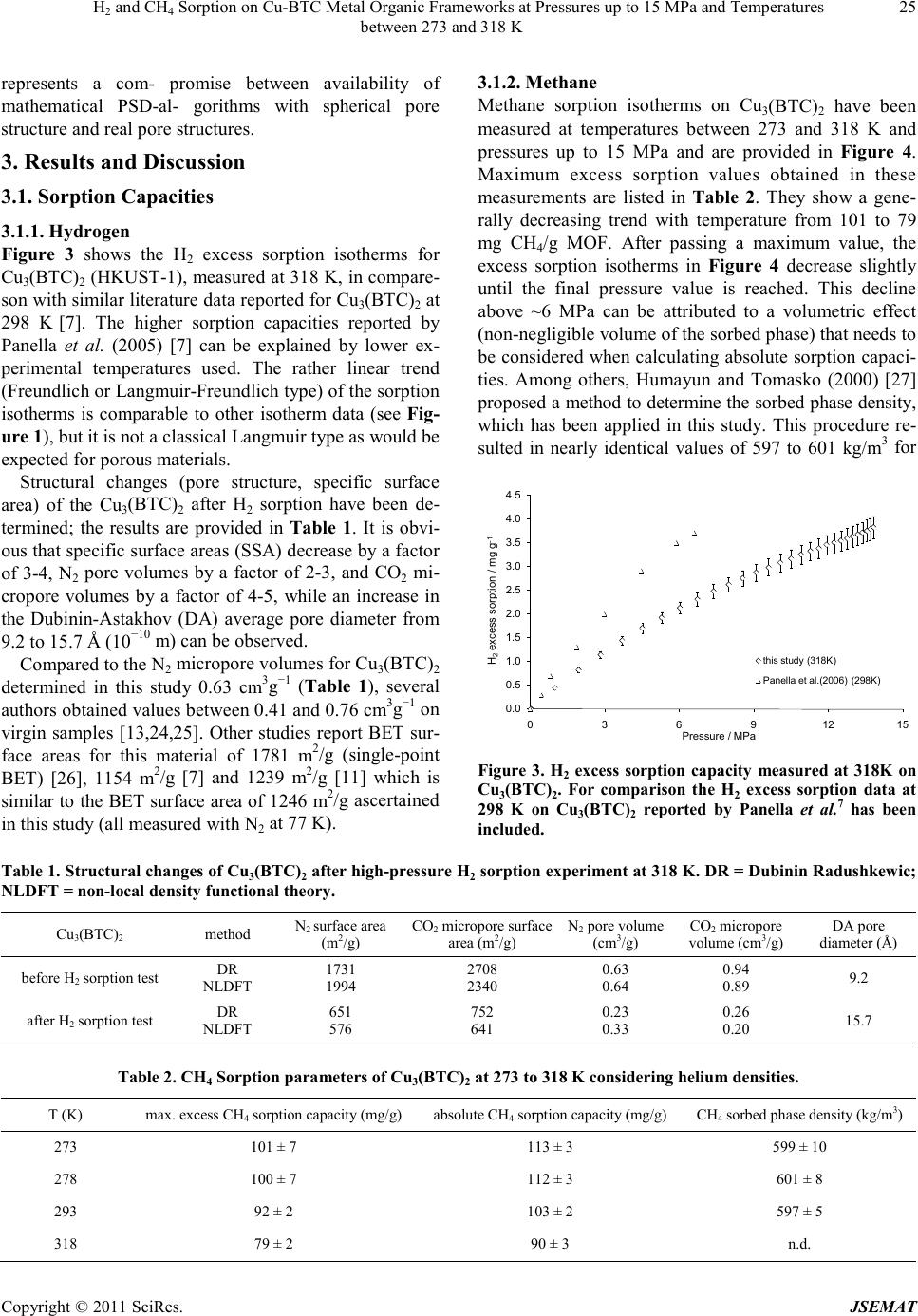 H2 and CH4 Sorption on Cu-BTC Metal Organic Frameworks at Pressures up to 15 MPa and Temperatures between 273 and 318 K Copyright © 2011 SciRes. JSEMAT 25 represents a com- promise between availability of mathematical PSD-al- gorithms with spherical pore structure and real pore structures. 3. Results and Discussion 3.1. Sorption Capacities 3.1.1. Hydrogen Figure 3 shows the H2 excess sorption isotherms for Cu3(BTC)2 (HKUST-1), measured at 318 K, in compare- son with similar literature data reported for Cu3(BTC)2 at 298 K [7]. The higher sorption capacities reported by Panella et al. (2005) [7] can be explained by lower ex- perimental temperatures used. The rather linear trend (Freundlich or Langmuir-Freundlich type) of the sorption isotherms is comparable to other isotherm data (see Fig- ure 1), but it is not a cla ssical Langmuir type as would be expected for porous materials. Structural changes (pore structure, specific surface area) of the Cu3(BTC)2 after H2 sorption have been de- termined; the results are provided in Table 1. It is obvi- ous that specific surface areas (SSA) decrease by a factor of 3-4, N2 pore volumes by a factor of 2-3, and CO2 mi- cropore volumes by a factor of 4-5, while an increase in the Dubinin-Astakhov (DA) average pore diameter from 9.2 to 15.7 Å (10−10 m) can be observed. Compared to the N2 micropore volumes for Cu3(BTC)2 determined in this study 0.63 cm3g−1 (Table 1), several authors obtained values between 0.41 and 0.76 cm3g−1 on virgin samples [13,24,25]. Other studies report BET sur- face areas for this material of 1781 m2/g (single-point BET) [26], 1154 m2/g [7] and 1239 m2/g [11] which is similar to the BET surface area of 1246 m2/g ascertained in this study (all measured wit h N2 at 77 K). 3.1.2. Met hane Methane sorption isotherms on Cu3(BTC)2 have been measured at temperatures between 273 and 318 K and pressures up to 15 MPa and are provided in Figure 4. Maximum excess sorption values obtained in these measurements are listed in Table 2. They show a gene- rally decreasing trend with temperature from 101 to 79 mg CH4/g MOF. After passing a maximum value, the excess sorption isotherms in Figure 4 decrease slightly until the final pressure value is reached. This decline above ~6 MPa can be attributed to a volumetric effect (non-negligibl e volume of the sorbed phase) that needs to be considered when calculating absolute sorption capaci- ties. Among others, Humayun and Tomasko (2000) [27] proposed a method to determine the sorbed phase density, which has been applied in this study. This procedure re- sulted in nearly identical values of 597 to 601 kg/m3 for 0.0 0.5 1.0 1.5 2.0 2.5 3.0 3.5 4.0 4.5 036912 15 H 2 excess s or ption / mg g -1 Pressure / MPa this study (318K) Panella et al.(2006) (298K) Figure 3. H2 excess sorption capacity measured at 318K on Cu3(BTC)2. For comparison the H2 excess sorption data at 298 K on Cu3(BTC)2 reported by Panella et al.7 has been included. Table 1. Structural cha nges of Cu3(BTC)2 after high-pressure H2 s orpt ion e x peri ment at 318 K. DR = Dubinin R ad ushkewic; NLDFT = non-local density functional theory. Cu3(BTC)2 method N2 surface area (m2/g) CO2 micropore surface area (m2/g) N2 pore volume (cm3/g) CO2 micropore volume (cm3/g) DA pore diam et er (Å) befor e H2 sor ptio n test DR NLDFT 1731 1994 2708 2340 0.63 0.64 0.94 0.89 9.2 after H2 sorption test DR NLDFT 651 576 752 641 0.23 0.33 0.26 0.20 15.7 Table 2. CH4 Sorptio n p arameters of Cu3(BTC)2 at 273 to 318 K considering helium densities. T (K) max. excess CH4 sorption capacity (mg/g) absolute CH4 sorption capa city (mg/g) CH4 sor be d phase de ns i ty (kg / m 3) 273 101 ± 7 11 3 ± 3 599 ± 10 278 100 ± 7 11 2 ± 3 601 ± 8 293 92 ± 2 103 ± 2 59 7 ± 5 318 79 ± 2 90 ± 3 n.d. 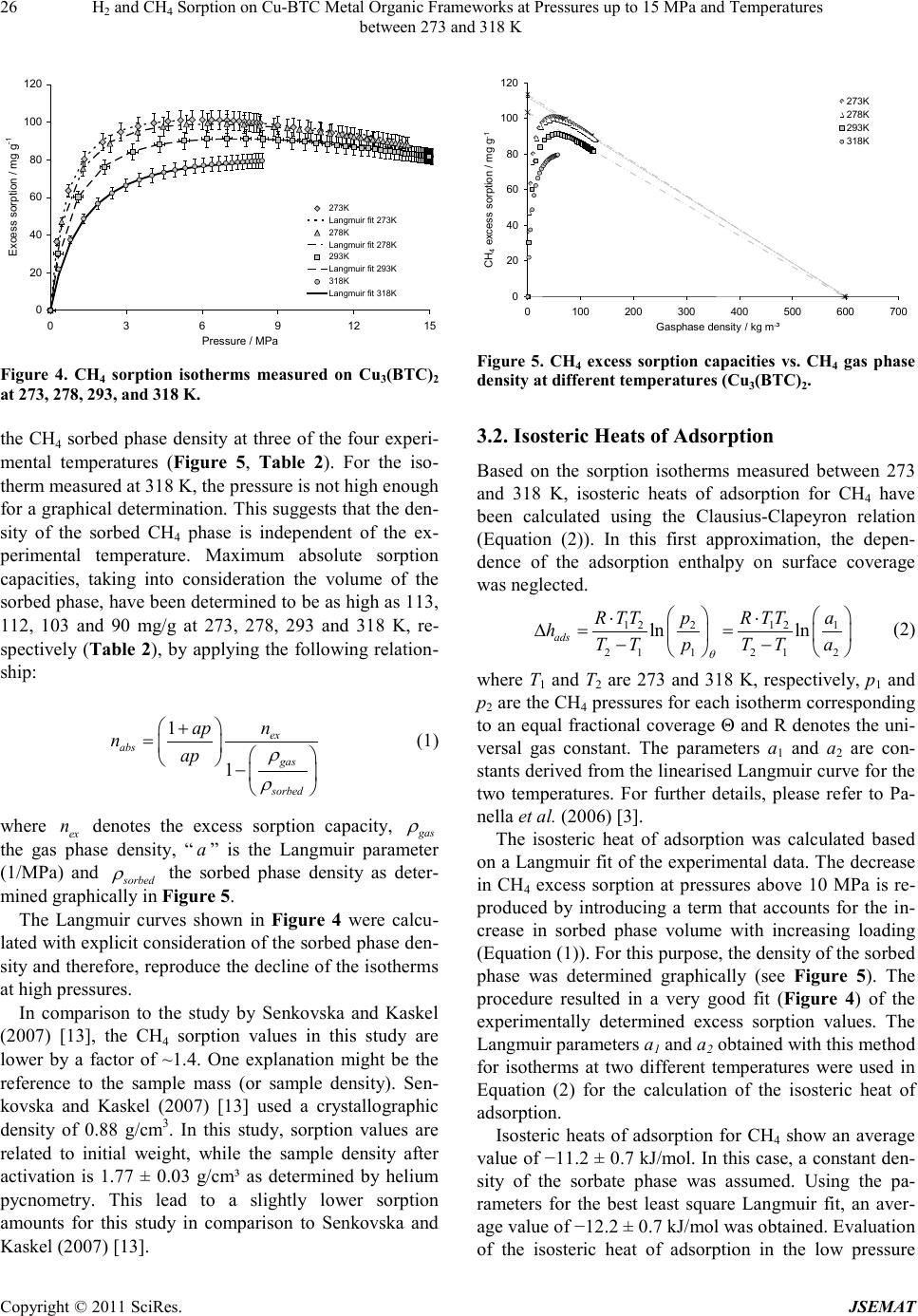 H2 and CH4 Sorption on Cu-BTC Metal Organic Frameworks at Pressures up to 15 MPa and Temperatures between 273 and 318 K Copyright © 2011 SciRes. JSEMAT 26 0 20 40 60 80 100 120 036912 15 Pressure / MPa Excess sorption / mg g -1 273K Langmuir fit 273K 278K Langmuir fit 278K 293K Langmuir fit 293K 318K Langmuir fit 318K Figure 4. CH4 sorption isotherms measured on Cu3(BTC)2 at 273, 278, 293, and 318 K. the CH4 sorbed phase density at three of the four experi- mental temperatures (Figure 5, Table 2). For the iso- therm measured at 318 K, the pr essure i s not high enough for a graphical d etermination. This suggests that t he den- sity of the sorbed CH4 phase is independent of the ex- perimental temperature. Maximum absolute sorption capacities, taking into consideration the volume of the sorbed phase, have been determined to be as high as 113, 112, 103 and 90 mg/g at 273, 278, 293 and 318 K, re- spectively (Table 2), by applying the following relatio n- ship: 1 1 ex abs gas sorbed n ap nap ρ ρ + = − (1) where ex n denotes the excess sorption capacity, gas ρ the gas phase density, “ a ” is the Langmuir parameter (1/MPa) and sorbed ρ the sorbed phase density as deter- mined graphically in Figure 5. The Langmuir curves shown in Figure 4 were calcu- lated with explicit consideration of the sorbed phase den- sity and therefore, reproduce the decline of the isotherms at high pressures. In comparison to the study by Senkovska and Kaskel (2007) [13], the CH4 sorption values in this study are lower by a factor of ~1.4. One explanation might be the reference to the sample mass (or sample density). Sen- kovska and Kaskel (2007) [13] used a crystallographic density of 0.88 g/cm3. In this study, sorption values are related to initial weight, while the sample density after activation is 1.77 ± 0.03 g/cm³ as determined by helium pycnometry. This lead to a slightly lower sorption amounts for this study in comparison to Senkovska and Kaskel (2007) [13]. 0 20 40 60 80 100 120 0100 200300 400500 600700 CH 4 excess sorpt ion / mg g -1 Gasphas e dens ity / kg m - ³ 273K 278K 293K 318K Figure 5. CH4 excess sorption capacities vs. CH4 gas phase density at different temperatures (Cu3(BTC)2. 3.2. Isosteric Heats of Adsorption Based on the sorption isotherms measured between 273 and 318 K, isosteric heats of adsorption for CH4 have been calculated using the Clausius-Clapeyron relation (Equation (2)). In this first approximation, the depen- dence of the adsorption enthalpy on surface coverage was neglected. 12212 1 21121 2 ln ln ads R TTpR TTa hTTpTT a θ ⋅⋅ ∆= = −− (2) where T1 and T2 are 273 and 318 K, respectively, p1 and p2 are the CH4 pressures for each isotherm corresponding to an equal fractional coverage Θ and R denotes the uni- versal gas constant. The parameters a1 and a2 are con- stant s de rived fr om t he li near ise d La ngmu ir c urve for the two temperatures. For further details, please refer to Pa- nella et al. (2006) [3]. The isosteric heat of adsorption was calculated based on a Langmuir fit of the experimental data. The decrease in CH4 excess sorption at pressures above 10 MPa is re- produced by introducing a term that accounts for the in- crease in sorbed phase volume with increasing loading (Equation (1)). For this purpose, the density of the sorbed phase was determined graphically (see Figure 5). The procedure resulted in a very good fit (Figure 4) of the experimentally determined excess sorption values. The Langmuir parameters a1 and a2 obtained with this met ho d for isotherms at two different temperatures were used in Equation (2) for the calculation of the isosteric heat of adsorption. Isosteric heats of adsorption for CH4 show an average value of −11.2 ± 0.7 kJ/mol. In this case, a constant den- sity of the sorbate phase was assumed. Using the pa- rameters for the best least square Langmuir fit, an aver- age value of −12.2 ± 0.7 kJ/mol was obtained. Evaluation of the isosteric heat of adsorption in the low pressure  H2 and CH4 Sorption on Cu-BTC Metal Organic Frameworks at Pressures up to 15 MPa and Temperatures between 273 and 318 K Copyright © 2011 SciRes. JSEMAT 27 range (0 - 4 MPa) w wi it th h the linearised Langmuir fit (pro- viding the same values of absolute adsorption as the graphical evaluation) results in a significantly higher value for the heat of adsorption (−17.9 ± 1.3 kJ/mol). 3.3. Impact of CH4 Sorption on Pore-Size Distribution The pore-size distributions of the initial Cu3(BTC)2 and the samples after successive CH4 and H2 sorption mea- surements were determined by N2 adsorption at 77 K. In order to describe adsorption on a wider range of mic- roporous materials the Dubinin-Astakhov (DA) equation was used (Dubinin and Astakhov, 1971) [21]. It is a ge- neralized form of the Dubinin-Radushkevich (DR; Du- binin, 1975 [22]) equation and was found to reasonably fit adsorption data for heterogeneous micropores. The resul ts of the evaluatio ns according to the DA method are displayed in Figure 6; the pertaining fitting parameters are listed in Table 3. The heterogeneity value (n) is higher for homogeneous distributions and is typically between 1 and 3. For instance, zeolite has an n-value higher t han 3, d e monstrating that these materials are very homogeneous. In this study, a value of n = 1 was dete r- mined for Cu3(BTC)2. The characteristic energy E after Dubinin (1975) was determined to be 20.97 kJ/mol for the initial (unspoiled) sample and ranged between 8 and 18 kJ/mol after high-pressure CH4 and H2 sorption tests. The interaction constant is given as k = 2.96 kJ·nm3/mol for nitrogen. From Figure 6 it is evident that CH4 affects the stabi- lity of the MOF to a lesser extent than H2. Although a significant decrease in total pore volume is shown after two successive CH4 sorption experiments, accompanied by a shift to larger mean pore radii (4.7 Å for the original sample; 6 . 4 Å afte r si x CH4 so rptio n isother ms; Table 3), a reduction comparable to the H2 treatment is only ob- served after 6 CH4 sorption isotherms. As observed for the H2 treatment, the pore volume in the 5 to 15 Å range is most heavily affected. In this study it is likely that we had chosen a slightly too high activation temperature. However the reason for the different influence of CH4 and H 2 on the sample structure is not clear will be invest- tigated in further detail in a fol low-up st udy. Results of the evaluation of the micropore structure of the Cu3(BTC)2 before and after high-pressure CH4 sorp- tion i so therms b ase d o n the D R met hod a nd the no nl i near density functional theory (NLDFT) are summarised in Table 4 . The se results a lso supp ort a signi fica nt decrease in micropore volume and subsequent reduction in spe- cific surface area of the sample after high-pressure CH4 sorptio n tests. Figure 7 compares the high-pressure CH4 exce ss sorp- 0.00 0.02 0.04 0.06 0.08 0.10 0.12 0.14 0.16 010 20 30 40 50 60 Differential pore volume / cm³ g -1 A -1 Pore diameter / A initial sa mp le after 2 CH4 s orption cycles after 6 CH4 s orption cycles after 2 H2 s orption cycles Figure 6. Dubinin Astakov differential pore volume distri- butions of Cu3(B TC)2 before and after high-pressure CH4 and H2 sorption isotherms. Evaluation based on low-pres- sure N2-sorption at 77 K. 0 20 40 60 80 100 120 0246810 12 14 16 CH 4 excess sorpt ion / mg g -1 Pressure / MPa initial sa mp le after treatment ∆m = 39.7 mg g -1 Figure 7. Comparison between initial and CH4 treated Cu3(BTC)2 at 293 K. tion isotherms measured on the initial Cu-BTC MOF with a decomposed sample of the same material at 293 K. The treated sample shows significantly lower sor ption values (decrease of up to 40 mg/g) compared to the ini- tial samples, while the shape of the isotherms is similar between the two isotherms. 4. Conclusions At pressures up to 7 MPa, Cu-BTC MOF is one of the most promising MOF materials for metha ne storage with a large uptake capacity and an excess sorption of 9.2 wt% at 293 K. The repeated thermal activation and high- pressure sorption tests with CH4 on HKUST-1 at tem- peratures between 273 and 318 K resulted in a reduction of specific micropore volumes and surface area. The processes behind the reduction of the specific micropore volumes and surface area during each CH4 sorption test (Table 4) are ambiguous and further research on this topic is needed. Recent studies indicate ther mal deter ioratio n effect s and  H2 and CH4 Sorption on Cu-BTC Metal Organic Frameworks at Pressures up to 15 MPa and Temperatures between 273 and 318 K Copyright © 2011 SciRes. JSEMAT 28 Table 3. Fitting parameters of the DA equation for micropore characterisation of Cu3(BTC)2 before and after CH4 and H2 high-pressure sorpt ion i sotherms. Cu3(BTC)2 N2 char acteristi c energ y E [kJ/mol] DA h etero geneous va l ue n average pore radius [Å] initial sample 20.97 1 4.7 after 2 Ch4 isotherms 18.66 1 4.9 after H2 isotherms 11.17 1 5.8 after 6 CH4 isotherms 8.66 1 6.4 Table 4. Results of pore structure analysis of Cu3(BTC)2 before and after high-pressure so rption isotherms with CH4. method N2 surface ar ea (m2/g) N2 pore volume (cm3/g) CO2 surface area (m2/g) CO2 micropore volume (cm3/g) N2 DA por e dia meter (Å) initial sample DR NLDFT 1731 1994 0.62 0.64 2708 2340 0.94 0.89 9.2 after 2 CH4 isotherms DR NLDFT 1174 1186 0.42 0.55 1226 1069 0.43 0.35 12.4 after 6 CH4 isotherms DR NLDFT 737 591 0.26 0.48 997 887 0.35 0.28 12.8 by interaction with atmospheric air could cause the ob- served degradation of the sample. Table 4 shows a stepwise deterioration of the sample after successive CH4 sorption isotherms and the thermal activation process on the identical sample. Further changes caused by exposure to the atmosphere (e.g. oxi- dation of the sample) can be neglected, since samples did not come in contact with atmospheric air from the begin- ning of the thermal activation process (only H2, CH4 and He). However, it is unclear as of yet why micropores volumes decrease drastically and larger pores remain preserved. Finally, this study has shown that the CH4 sorbed phase density is, within reasonable errors, independent of temperature. 5. Acknowledgments I am greatly indebted to Stefan Kaskel for providing 2007 the samples and Joachim Borchardt for technical support. The fruitful discussion and remarks of Bernd Krooß, Andreas Busch, Susan Giffin and Dirk Prinz are greatly appreciated. REFERENCES [1] M. Eddaoudi, J. K im, N. Rosi, D. Vodak, J. Wachter, M. O’Keeffe and O. M. Yaghi, “Systematic Design of Pore Size and Functionality in Isoreticular MOFs and Their Application in Methane Storage,” Science Magazine, Vol. 295, No. 5554, 2002, pp. 469-472. doi:10.1126/science.1067208 [2] N. Amaroli and V. Balzani, “The Future of Energy Sup- ply: Challenges and Opportunities,” General and Introdu ctory Chemistry, Vol. 46, No. 1-2, 200 7, pp. 52-66. doi:10.1002/anie.200602373 [3] B. Panella, M. Hirscher, H. Pütter and U. Müller, “Hydrogen Adsorption in Metal-Organic Frameworks: Cu-MOFs and Zn-MOFs Compared,” Advanced Func- tional Material s, Vol. 16, No. 4, 2006, pp. 520-524. doi:10.1002/adfm.200500561 [4] H. Li, M. Eddaoudi, M. O’Keeffe and O. M. Yaghi, “Design and Synthesis of an Exceptionally Stable and Highly Porous Metal-Organic Framework,” Nature, Vol. 402, pp. 276-279. doi:10.1038/46248 [5] S. Y. Chui, et al., “A Chemically Functionalizable Nanoporous Material [Cu3(TMA) 2(H2O)3]n,” Science Magazine, Vol. 283, No. 54 05 , 1999,pp. 1148-1150. doi: 10.1126/science.283.5405.1148 [6] K. Schlichte, T. Kratzke and S. Kaskel, “Improved synthesis, Thermal Stability and Catalytic Properties of The Metal -Organi c Framework Compound Cu3(BTC)2,” Micro porous and Mesoporous Materials, Vol. 73, No. 1-2, 2004, pp. 81-88. doi:10.1016/j.micromeso.2003.12.027 [7] B. Panella and M. Hirscher. “Hydrogen Physisorption in Metal-Organi c Porous Systems,” Adva nced Material, Vol. 17, No. 5, 2005, pp. 538-541. doi:10.1002/adma.200400946 [8] G. Férey, M. Latroche, C. Serre, F. Millange, T. Loiseau and A. Percheron-Guégan, “Hydrogen Adsorption in the Nanoporous Metal-Benzenedi carboxylate M(OH)(O2C– C6H4–CO2)(M = Al3+, Cr3+), MIL-53,” Chemical Com- munications, No. 24, 2003, pp. 2976-2977. doi: 10.1039/B308903G [9] M. G. Nijkamp, J. E. M. J. Raaymakers, A. J. van Dillen and K. P. de Jong “Hydrogen Storage Using Physisorption – Materials Demands,” Applied Physics A Materia ls Sci ence & Processing , Vol. 72, No. 5 , 2001, pp.  H2 and CH4 Sorption on Cu-BTC Metal Organic Frameworks at Pressures up to 15 MPa and Temperatures between 273 and 318 K Copyright © 2011 SciRes. JSEMAT 29 619-623. [10] J. Beneyto, F. Suárez-García, D. Lozano-Castelló, D. Cazorla-Amorós and A. Linares-Solano, “Hydrogen Storage on Chemically Activated Carbons and Carbon Nanomaterials at High Press ures,” Carbon, Vol. 45, No. 2, 2007, pp. 293-303. doi:10.1016/j.carbon.2006.09.022 [11] Q. M. Wang, D. Shen, M. Bulow, M. L. Lau, S. Deng, F. R. Fitch and N. O. Lemcoff, J. Semanscin, “Metallo-Organic Molecular Sieve for Gas Separation and Purification,” Microporous and Mesoporous Mate- rials, Vol. 55, No. 2, 2002, pp. 217-230. doi:10.1016/S1387-1811(02)00405-5 [12] X. Lin, A. J. Blake, C. Wilson, X. Z. Sun, N. R. Champness, M. W. George, P. Hubberstey, R. Mokaya and M. Schroder, “A Porous Framework Polymer Based on a Zinc(II) 4,4’-Bipyridine-2,6,2‘, 6‘-Tetracarboxylate: Synthesis, Structure, and ‘Zeolite-Like’ Behavio r s ,” Journal of American Chemical Society, Vol. 128, No. 33, 2006, pp. 10745-10753. doi:10.1021/ja060946u [13] J. Senkovska and S. Kaskel, “High Pressure Methane Adsorption in the M etal-Organic Frame works Cu3(BTC)2, Zn2(bdc)2dabco, and Cr3F(H2O)2O(bdc)3,” Microporous and Mesoporous Materials, Vol. 112, No. 1-3, 2008, pp. 108-115. doi:10.1016/j.micromeso.2007.09.016 [14] U. Setzmann and W. Wagner, “A New Equation of State and Tables of Thermodynamic Properties for Methane Covering the Range From the Melting Line to 625 K at pressures up to 1000 MPa,” Journal of Physical and Chemical Reference Data , Vol. 20, No. 6, 1991, pp. 1061-1155. doi:10.1063/1.555898 [15] R. D. McCarty and V. D Arp , “A New Wide Ran ge Equ- ation of State for Helium,” Advances in Cryogenic Engi- neerin g, Vol. 35, 1990, pp. 1465-1475. [16] Y. Gensterblum, P. van Hemert, P. Billemont, A. Busch, D. Charriere, D. Li, B. M. Krooss, G. de Weireld, D. Prinz and K.-H. A. A. Wolf, “European Inter-Laboratory Comparison of High Pressure CO2 Sorption Isotherms. I: Activated Carbon ,” Carbon, Vol. 47, No. 13, 2009, pp. 2958-2969. doi:10.1016/j.carbon.2009.06.046 [17] A. L. Goodman, A. Busch, G. Duffy, J. E. Fitzgerald, et al., “An Inter-laboratory Comparison of CO2 Isotherms Measured on Argonne Premium Coal Samples,” Energy and Fuels, Vol. 18, No. 4, 2004, pp. 1175-1182. doi:10.1021/ef034104h [18] Y. Gensterblum, P. Van Hemert, P. Billemont, et al., “European inter-laboratory comparison of high pressure CO2 sorption isotherms II: Natural coals,” International Journal of Coal Geology, Vol. 84, No. 2, 2010, pp. 115-124. doi:10.1016/j.carbon.2009.06.046 [19] A. Busch, Y. Gensterblum, B. M. Krooss and R. Littke, “Methane and Carbon Dioxide Adsorption-Diffusion Ex- periments on Coal: An upscaling and Modelling,” Inter- national Journal of Coal Geology, Vol. 60, No . 2-4, 2004, pp. 151-168. doi:10.1016/j.coal.2004.05.002 [20] S. Brunauer, P. H. Emmett and E. Teller, “Adsorption of Gases in Multimolecular Layers,” Journal of American Chemical Society, Vol. 60, No. 2, 1938, pp. 309-319. doi:10.1021/ja01269a023 [21] M. M. Dubinin, “Physical Adsorption of Gases and Va- pors in Micropo res,” Acade mic Press, New York, 1975, p. 1-70. [22] M. M. Dubinin and V. A. Astakhov, “Description of Ad- sorption Equilibria of Vapors on Zeolites over Wide Ranges of Temperature And Pressure,” Advances in Chemistry, Vol. 102, No. 69, 1971, pp. 65-69. doi:10.1021/ba-1971-0102.ch044 [23] M. Thommes, B. Smarsly, M. Groenevolt, P. I. Ravi- kovitch and A.V. Neimark, “Adsorption Hysteresis of Nitrogen and Argon in Pore Networks and Cha- racterization of Novel Micro- and Mesoporous Silicas,” Langmuir, Vol. 22, Vol. 2, 2006, pp. 756-764. doi:10.1021/la051686h [24] M. Kramer, U. Schwarzer, S. Kaskel, “Synthesis and properties of the metal-organic framework Mo3(BTC)2 (TUDMOF-1)” Journal of Material Chemistry, Vol. 16, 2006, pp. 2245-2248. doi:10.1039/b601811d [25] P. Krawiec, M. Kramer, M. Sabo, R. Kunschke, H. Fröde and S. Kaskel, “Improved Hydrogen Storage in the Metal-Organic Framework Cu3(BTC)2” Advanced Engi- neering Material, Vol. 8, No. 4, 2006, pp. 293-296. doi:10.1002/adem.200500223 [26] A. R. Millward and O. M. Yaghi, “Metal-Organic Frameworks with Exceptionally High Capacity for Storage of Carbon Dioxide at Room Temperature,” Journal of American Chemical Society, Vol. 127, No. 51, 2005, pp 17 998-17999. doi:10.1021/ja0570032 [27] R. Humayun, D. L. Tomasko, “High-Resolution Adsorp- Tion Isotherms of Supercritical Carbon Dioxide on Acti- vated Carb on,” A ICHE Journal, Vol. 46, No. 10, 2000,pp. 2065-2075. doi:10.1002/aic.690461017 |