

Paper Menu >>
Journal Menu >>
 Journal of Surface Engineered Materials and Advanced Technology, 2011, 1, 42-50 doi:10.4236/jsemat.2011.12007 Published Online July 2011 (http://www.SciRP.org/journal/jsemat) Copyright © 2011 SciRes. JSEMAT Effect of Self-Assembled Monola yers on the Perfor mance of Organic Photovoltaic Cells Hanène Bedis 1UMAO, Faculté des Sciences de Tunis, Campus U niversitai r e, Tunis, Tu nisia; 2ITODYS, 15 Rue Jean-Antoine de Baï f , Paris, France. Email: [email protected]u.tn Received April 1st, 2011; revised May 5th, 2011; accepted May 14th, 2011. ABSTRACT The improvement of the performance of organic photovoltaic cells (OPVCs) and the photogeneration process in these devices may occur via multiple mechanisms depending on their structure and/or architecture. For this purpose we in- vestigate how self-assembled monolayers of thiol molecules (C12H25SH and 3T(CH2)6SH) and benzoic acid molecules (ABA and NBA) affect the efficiency and the photogeneration of free carriers in a sexithiophene based photovoltaic cells. Firstly, we provide the results of absorption spectra for samples with SAM of thiol that show there effect on ori- entation of 6T molecules on these structures and the organization degree of the thiol molecules on ITO substrate. Af- terward, we describe from current vs. applied voltage after illumination, the enhancement of the performance of these cells. In the second, we study the effect of SAM of benzoic acids molecules on the photovoltaic behavior. A theoretical model is used for quantitative description of the open circuit voltage as a function of carrier’s generation rates at the electrodes. The results of I-V characterization under illumination show that open circuit voltage as well as short circuit current is dramatically affected by the dipolar layer. The orientation and the magnitude of dipole moment of benzoic acid molecules are the crucial factors that affect the organic photovoltaic parameters. Keywords: SAMs, Oligothiophene, Photovoltaïc Cell, Photogeneration, Efficiency , Performance 1. Introduction Organic semiconductors materials are potential candi- dates in electronics industry, more diversified and less expensive. Indeed, the fact that is a synthetic materials contrary to the mineral semiconductors, allows to mode- ling the constitutive molecules to adjust a very precise property. It is by proceeding that we were able to con- ceive a multitude of electronic structures such as organic light-emitting diodes (OLEDs) which cover the totality of the vi sib le spectral field and organic photo voltaic cells (OPVCs). Organic photovoltaic cells are gaining considerable interest motivated by a steady enhance of their conver- sion efficiency during the last decade [1- 3]. Nevertheless, their opera ting mechanisms are still s ubject of controver- sial theories. In fact, the observed photocurrent in OPVCs is an experimental evidence of free photocarrier production. Nonetheless, the origin of photogenerated carriers that are responsible of the observed photocurrent may be attributed to mainly three mechanisms. The first is the ionization of tight bound excitons or the Frenkel- type excitons in the bulk which is described by Onsager theory [4,5]. In this mechanism Frenkel excitons lead to the formation of charge transfer excitons resulting in geminate pairs of photogenerated carriers lying on adja- cent molecules. The geminate pairs escape the strong columbic attraction under the effect of built-in electric field E at a given temperature T with the probability P(E,T). The second mechanism occurs at the interface with the electrodes. In this mechanism one of the gemi- nate pair carriers passes through the electrode and the other is left “free” to contribu te to photocurrent. T he last mechanism is attributed to detrapping of trapped carriers. In this mechanism photogenerated tight bound excitons transfer enough energy to trapped charges by colliding them. Actually, all of the three described mechanisms may occur simultaneously but in some cases one among them may be preponderant on the two others as for ex- ample the case of materials with low mobility, in which bulk photogeneration may be ignored because their short lifetime and photogenerated carriers in the bulk that are 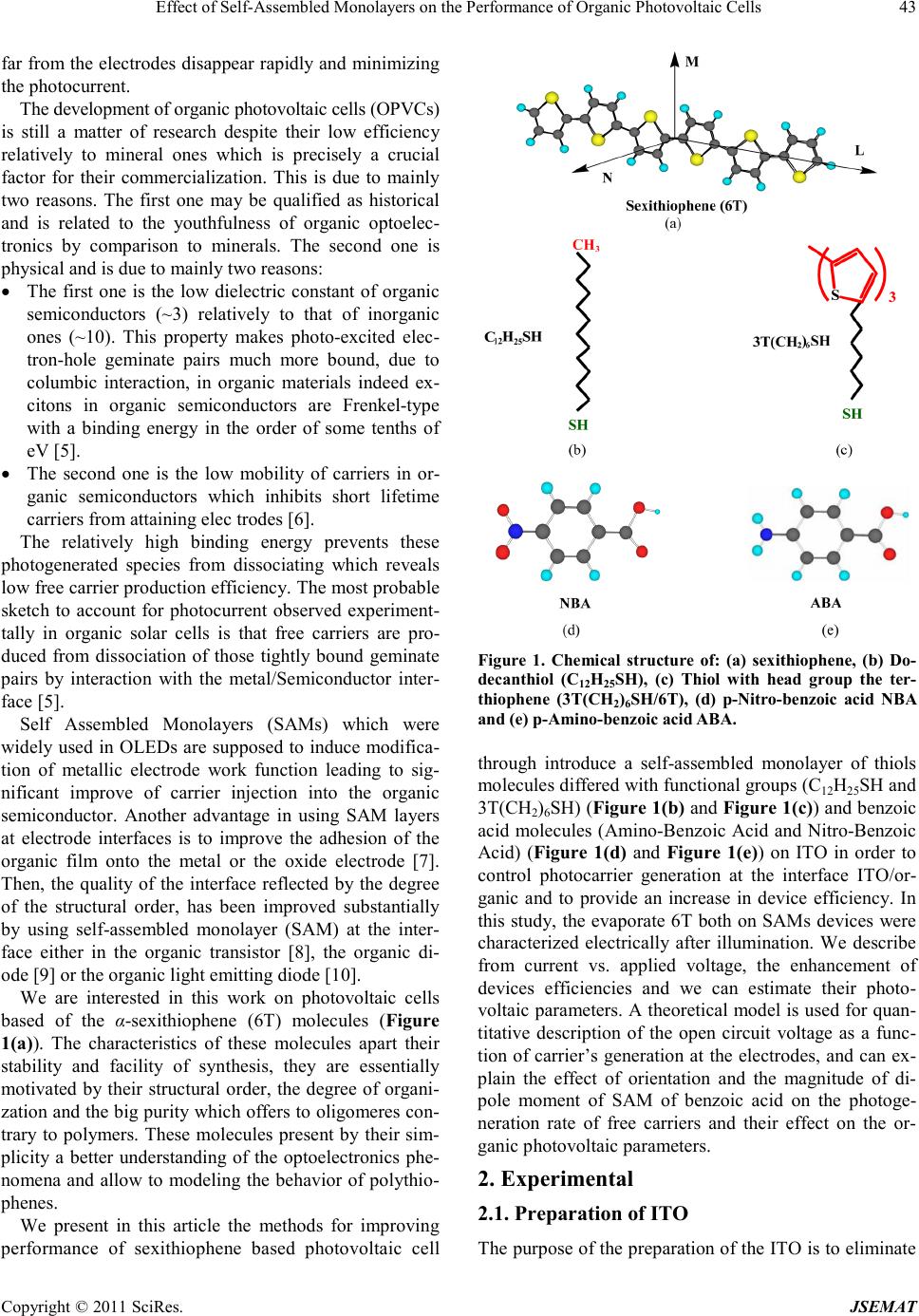 Effect of Self-Assembled Monolayers on the Performance of Organic Photovoltaic Cells Copyright © 2011 SciRes. JSEMAT 43 far from the electrodes disappear rapidly and minimizing the photocurre nt. The development of organic photovoltaic cells (OPVCs) is still a matter of research despite their low efficiency relatively to mineral ones which is precisely a crucial factor for their commercialization. This is due to mainly two reasons. The first one may be qualified as historical and is related to the youthfulness of organic optoelec- tronics by comparison to minerals. The second one is physical and is due to mainly two reasons: • The first one is the low dielectric constant of organic semiconductors (~3) relatively to that of inorganic ones (~10). This property makes photo-excited elec- tron-hole geminate pairs much more bound, due to columbic interaction, in organic materials indeed ex- citons in organic semiconductors are Frenkel-type with a binding energy in the order of some tenths of eV [5]. • The second one is the low mobility of carriers in or- ganic semiconductors which inhibits short lifetime carriers from attaining elec trodes [6]. The relatively high binding energy prevents these photogenerated species from dissociating which reveals low free carrier production efficiency. The most probable sketch to account for photocurrent observed experime n t- tally in organic solar cells is that free carriers are pro- duced from dissociation of those tightly bound geminate pairs by interaction with the metal/Semiconductor inter- face [5]. Self Assembled Monolayers (SAMs) which were widely used in OLEDs are supposed to induce modifica - tion of metallic electrode work function leading to sig- nificant improve of carrier injection into the organic semiconductor. Another advantage in using SAM layers at electrode interfaces is to improve the adhesion of the organic film onto the metal or the oxide electrode [7]. Then, the quality of the interface reflected by the degree of the structural order, has been improved substantially by using self-assembled monolayer (SAM) at the inter- face either in the organic transistor [8], the organic di- ode [9] or the organic light e mitting d iode [10]. We are interested in this work on photovoltaic cells based of the α-sexithiophene (6T) molecules (Figure 1(a)). The characteristics of these molecules apart their stability and facility of synthesis, they are essentially motivated by their structural order, the degree of organi- zati on and the big pur ity whi ch offers to oligomeres con- trary to polymers. These molecules present by their sim- plicity a better understanding of the optoelectronics phe- nomena and allow to modeling the behavior of polythio- phenes. We present in this article the methods for improving performance of sexithiophene based photovoltaic cell Figure 1. Chemical structure of: (a) sexithiophene, (b) Do- decanthiol (C12H25SH), (c) Thiol with head group the ter- thiophene (3T(CH2)6SH/6T), (d) p-Nit ro -benzoic acid NBA and (e ) p-Amino -benzoic acid ABA. through introduce a self-assembled monolayer of thiols molecules differed wit h func ti o na l gr o up s (C12H25SH a nd 3T(CH2)6SH) (Figure 1(b) and Figure 1 ( c) ) a nd benz oic acid molecules (Amino-Benzoic Acid and Nitro-Benzoic Acid) (Figure 1(d) and Figure 1(e)) on ITO in order to control photocarrier generation at the interface ITO/or- ganic and to provide an increase in device efficiency. In this study, the evaporate 6T both on SAMs devices were characterized electrically after illumination. We describe from current vs. applied voltage, the enhancement of devices efficiencies and we can estimate their photo- voltaic parameters. A theoretical model is used for quan- titative description of the open circuit voltage as a func- tion of carrier’s generation at the electrodes, and can ex- plain the effect of orientation and the magnitude of di- pole moment of SAM of benzoic acid on the photoge- neration rate of free carriers and their effect on the or- ganic photovoltaic parameters. 2. Experimental 2.1. Preparation of ITO The purpose of the preparation of the ITO is to eliminate 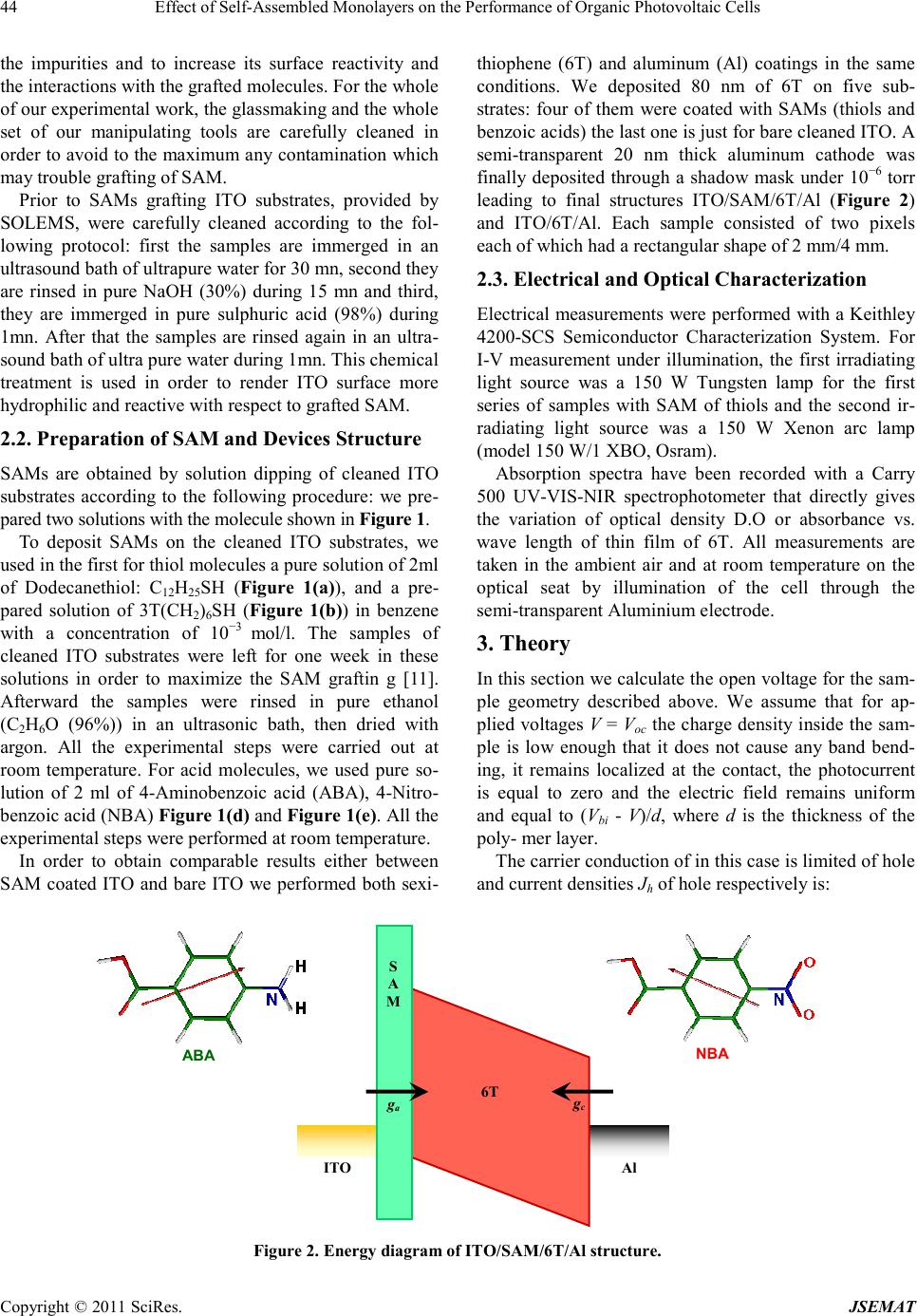 Effect of Self-Assembled Monolayers on the Performance of Organic Photovoltaic Cells Copyright © 2011 SciRes. JSEMAT 44 the impurities and to increase its surface reactivity and the interactio ns with the grafted molecules. For the whole of our exp e rimenta l wor k, the glas s ma ki n g and the whol e set of our manipulating tools are carefully cleaned in order to avoid to the maximum any contamination which may trouble grafting of SAM. Prior to SAMs grafting ITO substrates, provided by SOLEMS, were carefully cleaned according to the fol- lowing protocol: first the samples are immerged in an ultrasound bath of ultrapure water for 30 mn, seco nd they are rinsed in pure NaOH (30%) during 15 mn and third, they are immerged in pure sulphuric acid (98%) during 1mn. After that the samples are rinsed again in an ultra- sound bath of ultra pure water during 1mn. This chemical treatment is used in order to render ITO surface more hydrophilic and reactive with respect to grafted SAM. 2.2. Preparation of SAM and Devices Structure SAMs are obtained by solution dipping of cleaned ITO substrates according to the following procedure: we pre- pared two solutions with the molecule shown i n Figure 1. To deposit SAMs on the cleaned ITO substrates, we used in the firs t for thiol mole c ules a pure solution of 2ml of Dodecanethiol: C12H25SH (Figure 1(a)), and a pre- pared solution of 3T(CH2)6SH (Figure 1(b)) in benzene with a concentration of 10−3 mol/l. The samples of cleaned ITO substrates were left for one week in these solutions in order to maximize the SAM graftin g [11]. Afterward the samples were rinsed in pure ethanol (C2H6O (96%)) in an ultrasonic bath, then dried with argon. All the experimental steps were carried out at room temperature. For acid molecules, we used pure so- lution of 2 ml of 4- Aminobenzoic acid (ABA), 4-Nitro- benzoic acid (NBA) Figure 1(d) and F ig ure 1(e). All the experimental steps were performed at room temperature. In order to obtain comparable results either between SAM coated ITO and bare ITO we performed both sexi- thiophene (6T) and aluminum (Al) coatings in the same conditions. We deposited 80 nm of 6T on five sub- strates: four of them were coated with SAMs (thiols and benzoic acids) the last one is just for bare cleaned ITO. A semi-transparent 20 nm thick aluminum cathode was finally deposited through a shadow mask under 10−6 torr leading to final structures ITO/SAM/6T/Al (Figure 2) and ITO/6T/Al. Each sample consisted of two pixels each of which had a rectangular shape of 2 mm/4 mm. 2.3. Ele ctr ical and Op t ical Characterization Electrical measurements were performed with a Keithley 4200-SCS Semiconductor Characterization System. For I-V measurement under illumination, the first irradiating light source was a 150 W Tungsten lamp for the first series of samples with SAM of thiols and the second ir- radiating light source was a 150 W Xenon arc lamp (model 150 W/1 XBO, Osram). Absorption spectra have been recorded with a Carry 500 UV-VIS-NIR spectrophotometer that directly gives the variation of optical density D.O or absorbance vs. wave length of thin film of 6T. All measurements are taken in the ambient air and at room temperature on the optical seat by illumination of the cell through the semi-tra nspa rent Aluminium electrod e . 3. Theory In this section we calculate the open voltage for the sam- ple geometry described above. We assume that for ap- plied voltage s V = Voc the c harge densit y inside the sa m- ple is low enough that it does not cause any band bend- ing, it remains localized at the contact, the photocurrent is equal to zero and the electric field remains uniform and equal to (Vbi - V)/d, where d is the thickness of the poly- mer layer. The carrier conduction of in this case is limited of hole and current den sities Jh of hole respectively is: g a g c ITO Al 6T S A M ABA NBA Figure 2. E nergy diagram of ITO/SAM/6T/Al structure. 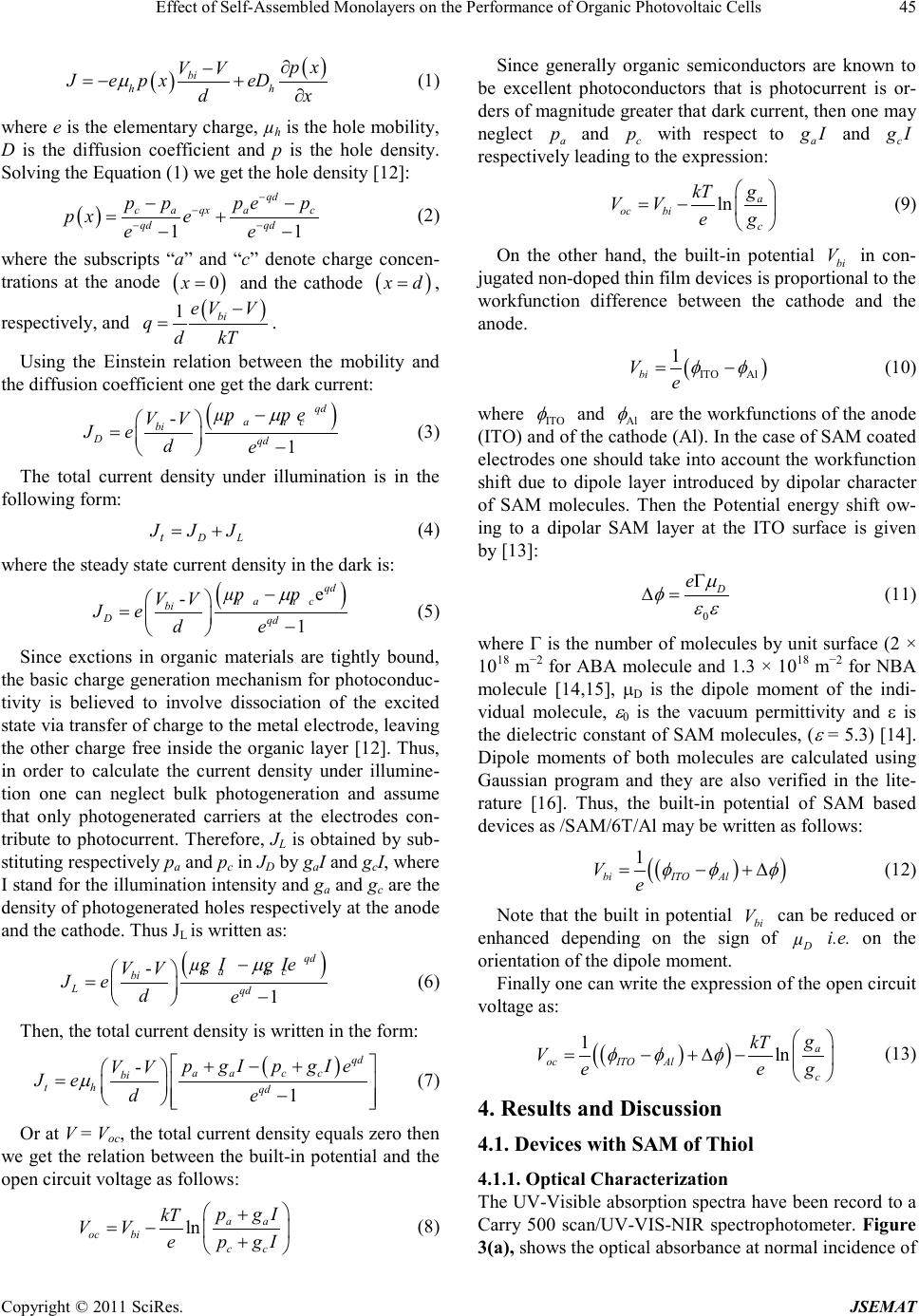 Effect of Self-Assembled Monolayers on the Performance of Organic Photovoltaic Cells Copyright © 2011 SciRes. JSEMAT 45 ( )( ) bi hh px VV Jep xeD dx µ ∂ − =−+ ∂ (1) where e is the elementary charge, µh is the hole mobility, D is the diffusion coefficient and p is the hole density. Solving the Equation (1) we get the hole den sity [12]: ( ) 11 qd qx caa c qd qd p ppep px e ee − − −− −− = + −− (2) where the subscripts “a” and “c” denote charge concen- trations at the anode ( ) 0x= and the cathode ( ) xd= , respectively, and ( ) 1 bi eV V qd kT − = . Using the Einstein relation between the mobility and the diffusion coefficient one get the dark current: ( ) - 1 qd ha hc bi Dqd µp pe VV Jede µ − = − (3) The total current density under illumination is in the following for m: DL t JJJ= + (4) where the steady state current density in the dark is: ( ) e - 1 qd ha hc bi Dqd µpp VV Jede µ − = − (5) Since exctions in organic materials are tightly bound, the basic charge generation mechanism for photoconduc- tivity is believed to involve dissociation of the excited state via transfer of charge to the metal electrode, leaving the other charge free inside the organic layer [12]. Thus, in order to calculate the current density under illumine - tion one can neglect bulk photogeneration and assume that only photogenerated carriers at the electrodes con- tribute to photocurrent. Therefore, JL is obtained by sub- stit uti ng r es pe ctively pa and pc in JD by gaI and gcI, wher e I stand for the illuminatio n intensity and ga and gc are the density of photogenerated holes respectively at the anode and the cathod e. Thus JL is written as: ( ) - 1 qd ha hc bi Lqd µgIg Ie VV Jede µ − = − (6) Then, the total curre nt density is written in t he form: ( ) - 1 qd aa cc bi th qd pgIpgI e VV Je de µ +−+ = − (7) Or at V = Voc, the total cur rent densi ty equals zero then we ge t the relation between the built-in potential and the open circuit voltage as follows: ln aa oc bicc p gI kT VV ep gI + = − + (8) Since generally organic semiconductors are known to be excellent photoconductors that is photocurrent is or- der s o f mag nit ud e gre at er that d ar k cur r ent, then one ma y neglect a p and c p with respect to a gI and c gI respectively leading to the expression: ln a oc bic g kT VV eg = − (9) On the other hand, the built-in potential bi V in con- jugated non-doped thin film devices is p roportional to the workfunction difference between the cathode and the anode. ( ) ITO Al 1 bi Ve φφ = − (10) where ITO φ and Al φ are the workfunctions of the anode (ITO) and o f the c athode (Al ). In the case of SAM coated electrodes one should take into account the workfunction shift due to dipole layer introduced by dipolar character of SAM molecules. Then the Potential energy shift ow- ing to a dipolar SAM layer at the ITO surface is given by [13]: 0 D e µ φεε Γ ∆= (11) where Γ is the number of molecules by unit surface (2 × 10¹⁸ m−2 for ABA molecule and 1.3 × 10¹⁸ m−2 for NBA molecule [14,15], µD is the dipole moment of the indi- vidual molecule, ε 0 is the vacuum permittivity and ε is the dielectric co nstant of S AM molecules, ( ε = 5.3) [14]. Dipole moments of both molecules are calculated using Gaussian program and they are also verified in the lite- rature [16]. Thus, the built-in potential of SAM based devices as /SAM/6T/Al may be written as follows: ( ) ( ) 1 biITO Al Ve φφ φ =− +∆ (12) Note that the built in potential bi V can be reduced or enhanced depending on the sign of D µ i.e. on the orientation of the dipole moment. Finall y o ne can write the expression of the open circuit voltage a s : ( ) ( ) 1ln a ocITO Alc g kT Ve eg φφ φ =−+∆ − (13) 4. Results and Discussion 4.1. Devices with SA M of Thiol 4.1.1. Optical Characterization The UV-Visible absorption spectra have been record to a Carry 500 scan/UV-VIS-NIR spectrophotometer. Figure 3(a), shows the optical absorbance at normal incidence of 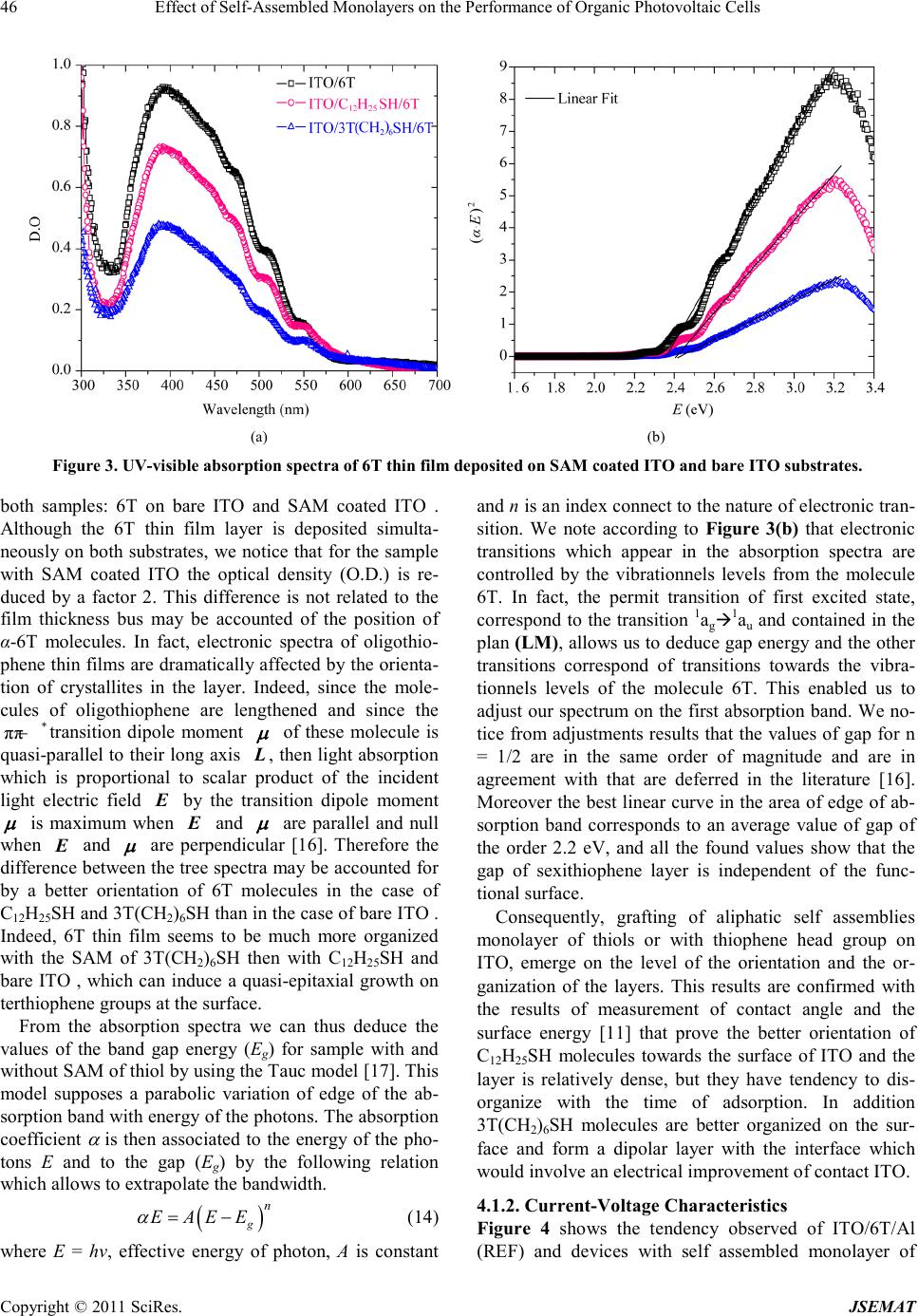 Effect of Self-Assembled Monolayers on the Performance of Organic Photovoltaic Cells Copyright © 2011 SciRes. JSEMAT 46 (a) (b) Figure 3 . UV-visible absorption spect ra of 6T thin film deposited on SAM coated I TO and bare ITO substrates. both samples: 6T on bare ITO and SAM coated ITO . Although the 6T thin film layer is deposited simulta- neously on both substrates, we notice that for the sample with SAM coated ITO the optical density (O.D.) is re- duced by a factor 2. This difference is not related to the film thickness bus may be accounted of the position of α-6T molecules. In fact, electronic spectra of oligothio- phene thin films are dramatically affected by the orienta- tion of crystallites in the layer. Indeed, since the mole- cules of oligothiophene are lengthened and since the * ππ− transition dipole moment µ of these molecule is quasi-parallel to their long axis L , t hen lig ht absor ption which is proportional to scalar product of the incident light electric field E by the transition dipole moment µ is maximum when E and µ are parallel and null when E and µ are perpendicular [16]. Therefore the difference between the tree spectra may be accounted for by a better orientation of 6T molecules in the case of C12H25SH and 3T(CH2)6SH than in the case of bare ITO . Indeed, 6T thin film seems to be much more organized with the SAM of 3T(CH2)6SH then with C12H25SH and bare ITO , which can induce a quasi-epitaxial growth on terthiophene groups at the surface. From the absorption spectra we can thus deduce the values of the band gap energy (Eg) for sample with and without S AM o f t hio l by usi n g the T a uc mod el [17]. Th is model supposes a parabolic variation of edge of the ab- sorption band with energy of the photons. The absorption coefficient α is then associated to the energy of the pho- tons E and to the gap (Eg) by the following relation which allows to extrapolate the bandwidth. ( ) g n EAE E α = − (14) where E = hν, effective energy of photon, A is constant and n is a n index connec t to the na ture of electr onic tra n- sition. We note according to Figur e 3 ( b) that electronic transitions which appear in the absorption spectra are controlled by the vibrationnels levels from the molecule 6T. In fact, the permit transition of first excited state, correspond to the transition 1ag1au and contained in the plan (LM), allows us to deduce gap energy and the other transitions correspond of transitions towards the vibra- tionnels levels of the molecule 6T. This enabled us to adjust our spectrum on the first absorption band. We no- tice from adjustments results that the values o f gap for n = 1/2 are in the same order of magnitude and are in agreement with that are deferred in the literature [16]. Moreover the best linear curve in the area of edge of ab- sorption band corresponds to an average value of gap of the order 2.2 eV, and all the found values show that the gap of sexithiophene layer is independent of the func- tional surface. Consequently, grafting of aliphatic self assemblies monolayer of thiols or with thiophene head group on ITO, emerge on the level of the orientation and the or- ganization of the layers. This results are confirmed with the results of measurement of contact angle and the surface energy [11] that prove the better orientation of C12H25SH molecules towards the surface of ITO and the layer is relatively dense, but they have tendency to dis- organize with the time of adsorption. In addition 3T(CH2)6SH molecules are better organized on the sur- face and form a dipolar layer with the interface which would involve an electrical improvement of contact ITO . 4.1.2. Current-Voltage Characteristics Figure 4 shows the tendency observed of ITO/6 T/Al (REF) and devices with self assembled monolayer of 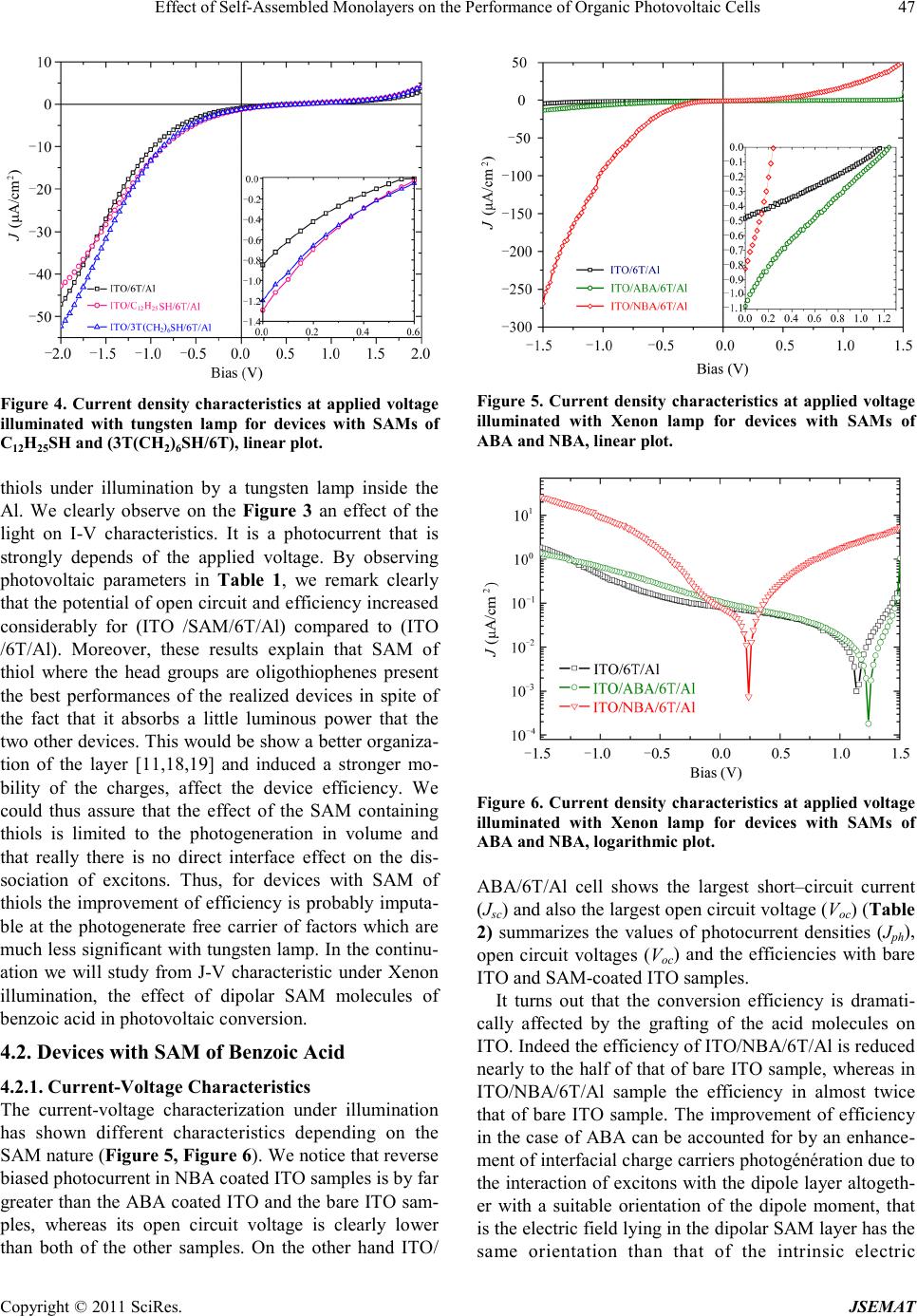 Effect of Self-Assembled Monolayers on the Performance of Organic Photovoltaic Cells Copyright © 2011 SciRes. JSEMAT 47 Figure 4. Curr ent density c haracteristics at applied voltage illuminated with tungsten lamp for devices with SAMs of C12H25SH and (3T(CH2)6SH/6T), li near plot. thiols under illumination by a tungsten lamp inside the Al. We clearly observe on the Figure 3 an effect of the light on I-V characteristics. It is a photocurrent that is strongly depends of the applied voltage. By observing photovoltaic parameters in Table 1, we remark clearly that the poten tial of open cir cuit and e fficiency increased considerably for (ITO /SAM/6T/Al) compared to (ITO /6T/Al). Moreover, these results explain that SAM of thiol where the head groups are oligothiophenes present the best performances of the realized devices in spite of the fact that it absorbs a little luminous power that the two other devices. This would be show a better organiza- tion of the layer [11,18,19] and induced a stronger mo- bility of the charges, affect the device efficiency. We could thus assure that the effect of the SAM containing thiols is limited to the photogeneration in volume and that really there is no direct interface effect on the dis- sociation of excitons. Thus, for devices with SAM of thiols the improvement of efficiency is probably imputa- ble at the photogenerate free carrier of factors which are much l ess signi ficant with tungst en lamp. In the conti nu- ation we will study from J-V characteristic under Xenon illumination, the effect of dipolar SAM molecules of benzoic acid in photo vo lta ic conversion. 4.2. Devices with SAM of Benzoic Acid 4.2.1. Current-Voltage Characteristics The current-voltage characterization under illumination has shown different characteristics depending on the SAM nature (Figure 5, Figure 6). We notice that reverse biased photocurrent in NBA coated ITO samples is by fa r greater than the ABA coated ITO and the bare ITO sam- ples, whereas its open circuit voltage is clearly lower than both of the other samples. On the other hand ITO/ Figure 5. Current density characteristics at applied voltage illuminated with Xenon lamp for devices with SAMs of AB A and NB A, linear plot. Figure 6. Current density characteristics at applied voltage illuminated with Xenon lamp for devices with SAMs of ABA and NBA, logarithmic plot. ABA/6T/Al cell shows the largest short–circuit current (Jsc) and also the largest o pen circ uit voltage ( Voc) (Table 2) summarizes the values of photocurrent densities (Jph), open circuit voltages (Voc) and the efficiencies with bare ITO and SAM-coated ITO samples. It turns out that the conversion efficiency is dramati- cally affected by the grafting of the acid molecules on ITO. Indeed the ef ficienc y of I T O/NB A/6T /Al is reduced nearly to the half of that of bare ITO sample, whereas in ITO/NBA/6T/Al sample the efficiency in almost twice that of bare ITO sample. The improvement of efficiency in the case of ABA can be accounted for b y an enhance- ment of interfacial charge carriers photogénération due to the interactio n of excitons with the dipole layer altogeth- er with a suitable orientation of the dipole moment, that is the electric field lying in the d ipo lar SAM layer has the same orientation than that of the intrinsic electric 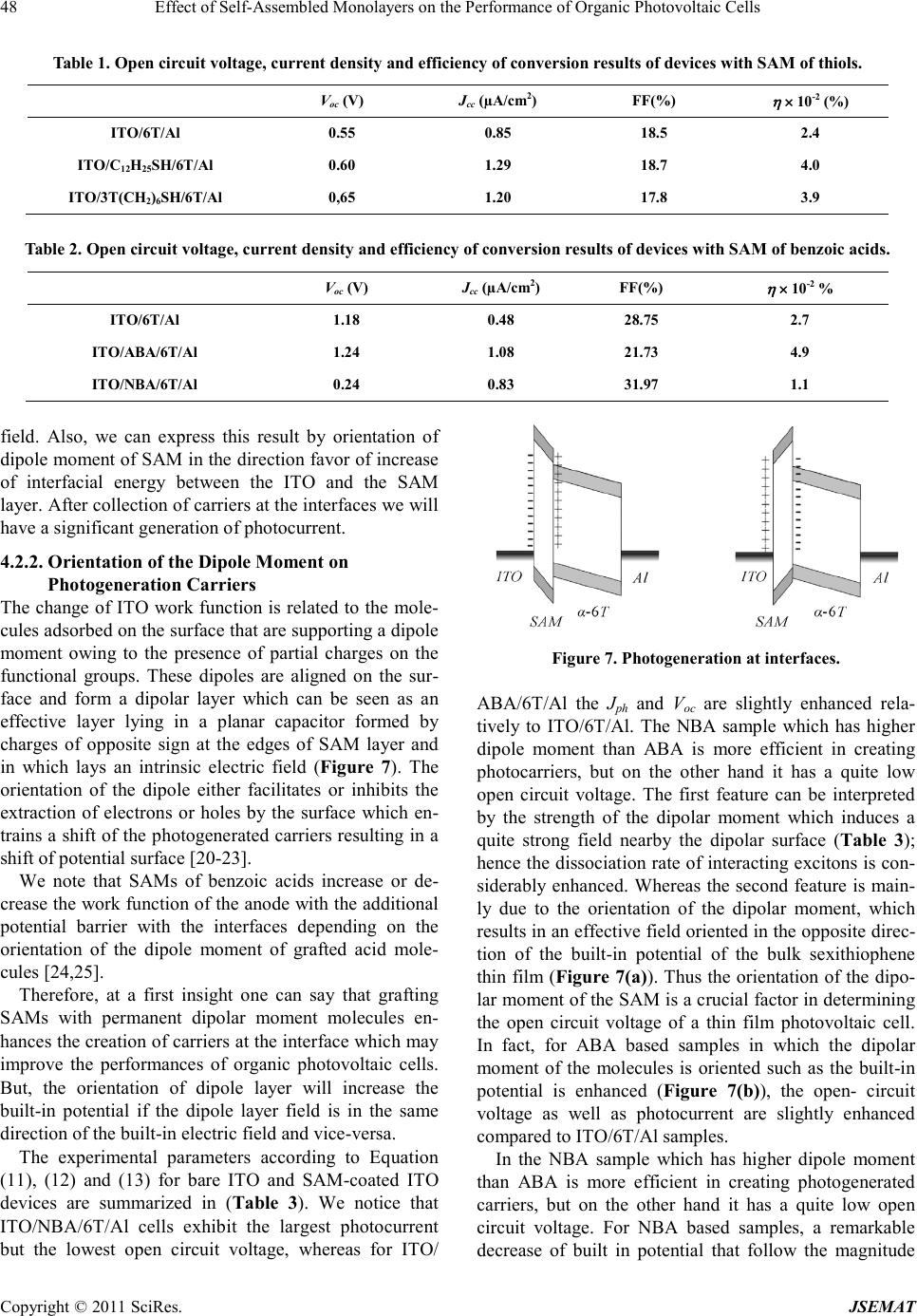 Effect of Self-Assembled Monolayers on the Performance of Organic Photovoltaic Cells Copyright © 2011 SciRes. JSEMAT 48 Table 1. Open circuit volt age, current den sity and efficiency of co nversion results of d evi ces with SAM of thiol s . Voc (V) Jcc (µA/cm2) FF(%) η × 10-2 (%) ITO /6T/Al 0.55 0.85 18.5 2.4 ITO/C12H25SH/6T/Al 0.60 1.29 18.7 4.0 ITO/3T(CH2)6SH/6T/Al 0,65 1.20 17.8 3 .9 Table 2. Open circuit voltage, current density and efficiency of conversi on results of devices w ith SAM of benzoic acids. Voc (V) Jcc (µA/ cm2) FF(%) η × 10-2 % ITO /6T/Al 1.18 0.48 28.75 2.7 ITO/ ABA/6T/Al 1.24 1.08 21.73 4.9 ITO/ NBA/6T/Al 0.24 0.83 31.97 1.1 field. Also, we can express this result by orientation of dipole moment of S AM in the direction favor o f increase of interfacial energy between the ITO and the SAM layer. After collection of carriers at the interfaces we will have a significant generation of photoc urrent. 4.2.2. Orientation of the Dipole Moment on Photogeneration Carriers The change o f ITO work function is related to the mole- cules adsorbed on the surface that are supporting a dipole moment owing to the presence of partial charges on the functional groups. These dipoles are aligned on the sur- face and form a dipolar layer which can be seen as an effective layer lying in a planar capacitor formed by charges of opposite sign at the edges of SAM layer and in which lays an intrinsic electric field (Figure 7). The orientation of the dipole either facilitates or inhibits the extraction of electrons or holes by the surface which en- trai ns a shif t of the p hotoge nerate d carr iers resul ting in a shift of potential surface [20- 23]. We note that SAMs of benzoic acids increase or de- crease the work function of the anode with the additional potential barrier with the interfaces depending on the orientation of the dipole moment of grafted acid mole- cules [24,25]. Therefore, at a first insight one can say that grafting SAMs with permanent dipolar moment molecules en- hances the creation of carriers at the interface which may improve the performances of organic photovoltaic cells. But, the orientation of dipole layer will increase the built-in potential if the dipole layer field is in the same direction o f the built-in electric field and vice-versa. The experimental parameters according to Equation (11), (12) and (13) for bare ITO and SAM-coated ITO devices are summarized in (Table 3). We notice that ITO/NBA/6T/Al cells exhibit the largest photocurrent but the lowest open circuit voltage, whereas for ITO/ Figure 7. Photogeneration at interfaces. ABA/6T/Al the Jph and Voc are slightly enhanced rela- tively to ITO/6T/Al. The NBA sample which has higher dipole moment than ABA is more efficient in creating photocarriers, but on the other hand it has a quite low open circuit voltage. The first feature can be interpreted by the strength of the dipolar moment which induces a quite strong field nearby the dipolar surface (Table 3); hence the dissociation rate of interacting excitons is con- siderably enhanced. Whereas the second feature is main- ly due to the orientation of the dipolar moment, which results in an effective field oriented in the opposite d irec- tion of the built-in potential of the bulk sexithiophene thin fil m (Figure 7(a)). Thus the orientation of the dipo- lar moment o f the SAM is a c rucial factor in determining the open circuit voltage of a thin film photovoltaic cell. In fact, for ABA based samples in which the dipolar moment of the molecules is oriented such as the built-in potential is enhanced (Figure 7(b)), the open- circuit voltage as well as photocurrent are slightly enhanced compared to ITO/6T/Al samples. In the NBA sample which has higher dipole moment than ABA is more efficient in creating photogenerated carriers, but on the other hand it has a quite low open circuit voltage. For NBA based samples, a remarkable decrease of built in potential that follow the magnitude 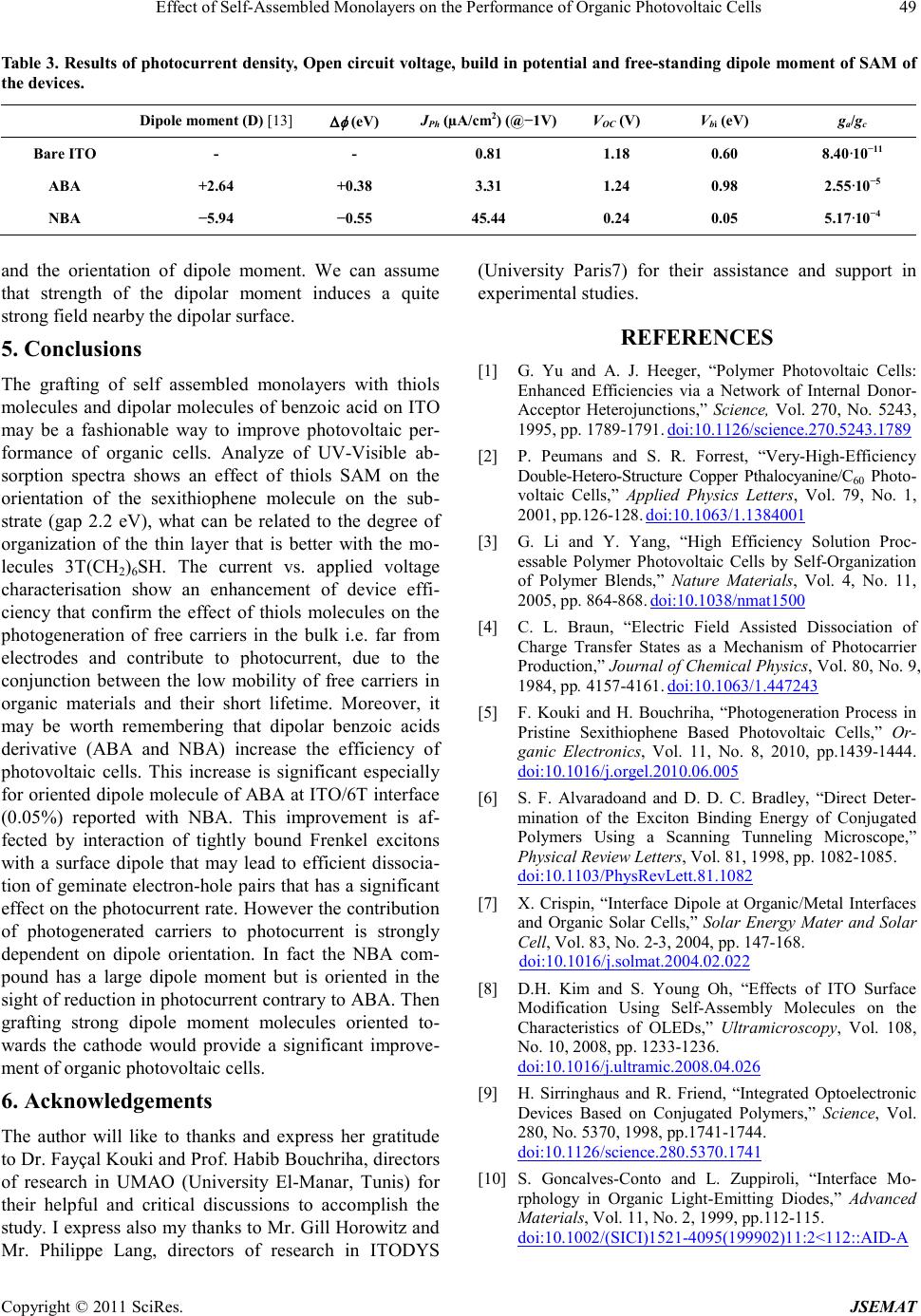 Effect of Self-Assembled Monolayers on the Performance of Organic Photovoltaic Cells Copyright © 2011 SciRes. JSEMAT 49 Table 3. Resul ts of ph otocur rent dens ity, Open ci rcuit vol tage, buil d in potent ial an d fre e-sta nding dipole mo ment of SAM of the devices. Dipole moment (D) [13] ∆ φ (eV) JPh (µA/cm2) (@−1V) VOC (V) Vbi (eV) ga/gc Bare ITO - - 0.81 1.18 0.60 8.40·10−11 ABA +2.64 +0.38 3.31 1.24 0.98 2.55·10−5 NBA −5.94 −0.55 45.44 0.24 0.05 5.17·10−4 and the orientation of dipole moment. We can assume that strength of the dipolar moment induces a quite strong field nearby the dipolar surface. 5. Conclusions The grafting of self assembled monolayers with thiols molecules and dipolar molecules of benzoic acid on ITO may be a fashionable way to improve photovoltaic per- formance of organic cells. Analyze of UV-Visible ab- sorption spectra shows an effect of thiols SAM on the orientation of the sexithiophene molecule on the sub- strate (gap 2.2 eV), what can be related to the degree of organization of the thin layer that is better with the mo- lecules 3T(CH2)6SH. The current vs. applied voltage characterisation show an enhancement of device effi- ciency that confirm the effect of thiols molecules on the photogeneration of free carriers in the bulk i.e. far from electrodes and contribute to photocurrent, due to the conjunction between the low mobility of free carriers in organic materials and their short lifetime. Moreover, it may be worth remembering that dipolar benzoic acids derivative (ABA and NBA) increase the efficiency of photovoltaic cells. This increase is significant especially for oriented d ipole molecule of ABA at IT O/6T interface (0.05%) reported with NBA. This improvement is af- fected by interaction of tightly bound Frenkel excitons with a surface dipole that may lead to efficient dissocia- tion of gemi nate electron-ho le p airs tha t ha s a sig nifica nt effect on the photoc urrent rate. However the contributio n of photogenerated carriers to photocurrent is strongly dependent on dipole orientation. In fact the NBA com- pound has a large dipole moment but is oriented in the sight of re d uct ion i n pho t oc ur r e nt co nt ra r y t o ABA. T he n grafting strong dipole moment molecules oriented to- wards the cathode would provide a significant improve- ment of organic photovoltaic cells. 6. Acknowledgements The author will like to thanks and express her gratitude to Dr. Fayçal Kouki and Prof. Habib Bouchriha, directors of research in UMAO (University El-Manar, Tunis) for their helpful and critical discussions to accomplish the st udy. I express al so my than ks to Mr. Gill Ho rowitz and Mr. Philippe Lang, directors of research in ITODYS (University Paris7) for their assistance and support in experimental studies. REFERENCES [1] G. Yu and A. J. Heeger, “Polymer Photovoltaic Cells: Enhanced Efficiencies via a Network of Internal Donor- Acceptor Heterojunctions,” Science, Vol. 270, No. 5243, 1995, pp. 1789-1791. doi:10.1126/science.270.5243.1789 [2] P. Peumans and S. R. Forrest, “Very-High-Efficiency Double -Hetero-Structure Copper Pthalocyanine/C60 Photo- voltaic Cells,” Applied Physics Letters, Vol. 79, No. 1, 2001, pp.126-128. doi:10.1063/1.1384001 [3] G. Li and Y. Yang, “High Efficiency Solution Proc- essable Polymer Photovoltaic Cells by Self-Organization of Polymer Blends,” Nature Materials, Vol. 4, No. 11, 2005, pp . 864-868. doi:10.1038/nmat1500 [4] C. L. Braun, “Electric Field Assisted Dissociation of Charge Transfer States as a Mechanism of Photocarrier Production,” Journal of Ch emical Ph ysics, Vol. 80, No. 9, 1984, pp . 4157-4161. doi:10.1063/1.447243 [5] F. Kouki and H. Bouchriha, “Photogeneration Process in Pristine Sexithiophene Based Photovoltaic Cells,” Or- ganic Electronics, Vol. 11, No. 8, 2010, pp.1439-1444. doi:10.1016/j.orgel.2010.06.005 [6] S. F. Alvaradoand and D. D. C. Bradley, “Direct Deter- mination of the Exciton Binding Energy of Conjugated Polymers Using a Scanning Tunneling Microscope,” Physical Review Letters, Vol. 81, 199 8, pp . 108 2-1085. doi:10.1103/PhysRevLett.81.1082 [7] X. Crispin, “Interface Dipole at Organic/Metal Interfaces and Organic Solar Cells,” Solar Energy Mater and Solar Cell, Vol. 83, No. 2-3, 2004, pp. 147 -168. doi:10.1016/j.solmat.2004.02.022 [8] D.H. Kim and S. Young Oh, “Effects of ITO Surface Modification Using Self-Assembly Molecules on the Character istics of OLEDs,” Ultramicroscop y, Vol. 108, No. 10, 2008, pp. 1233-1236. doi:10.1016/j.ultramic.2008.04.026 [9] H. Sirringhaus and R. Friend, “Integrated Optoelectronic Devices Based on Conjugated Polymers,” Science, Vol. 280, No. 5370, 1998, pp.1741-1744. doi:10.1126/science.280.5370.1741 [10] S. Goncalves-Conto and L. Zuppiroli, “Interface Mo- rphology in Organic Light-Emitting Diodes,” Advanced Materials, Vol. 11, No. 2, 1999, pp.112-115. doi:10.1002/(SICI)1521-4095(199902)11:2<112::AID-A  Effect of Self-Assembled Monolayers on the Performance of Organic Photovoltaic Cells Copyright © 2011 SciRes. JSEMAT 50 DMA112>3.0.CO;2-Z [11] H. Bedis Ouerghemmi and F. Kouki, “Self-Assembled Monolayer Effect on the Characteristics of Organic Dio- des,” Synthetic Metals, Vol. 159, No. 7-8, 2009, pp. 551-555. doi:10.1016/j.synthmet.2008.11.031 [12] G. G. Malliaras and J. C. Scott, “Photovoltaic Measu r e- ment of The Built-in Potential in Organic Light Emitting Diodes and Photodiodes,” Journal of Applied Physics, Vol. 84, No. 3, 1998, pp. 1583-1587. doi:10.1063/1.368227 [13] S. G. Ray and H. Waldeck, “Organizatio n-Induced Charge Redistribution in Self-Assembled Organic Monolayers on Gold,” Journal of Physical Chemistry B, Vol. 109, No. 29, July 2005, pp. 14064-14073. doi:10.1021/jp050398r [14] H. Bässler and G. Vaubel, “Exciton-Induced Photocur- rents in Molecular Crystals,” Discussions of the Faraday Soci ety, Vol. 51, 1971, pp. 48-53. doi: 10.1039/DF9715100048 [15] L. Zuppiroli1 and M. Grätzel, “Self-assembled Monolay- ers as Interfaces for Organic Opto-Electronic Devices,” European Physical Journal B, Vol. 11, No. 3, 1999, pp. 505-512. doi:10.1007/s100510050962 [16] F. Kouki an d F. Garn ier, “E xperimental Determination of Excitonic Levels in Alpha-Oligothiophenes,” Journal of Chemical Physi cs , Vol. 113, No. 1, 2000, pp. 385-391. doi:10.1063/1.481804 [17] J. Tauc and A. Van cu, “Opti cal Properties and Electronic Structure of Amorphous Germanium,” Physica Status Solidi, Vol. 15, No. 2, 1966, pp. 627-637. doi:10.1002/pssb.19660150224 [18] N. Camaioni and Giovanna Barbarella, “Branched Thio- Phene-Based Oligomers as Electron Acceptors for Or- ganic Photovoltaics,” Journal of Materials Chemistry, Vol. 15, No. 22, 2005, pp. 2220-2225. doi: 10.1039/B503062E [19] H. Hoppe and N. Serdar Sarici ftci, “P olymer So lar Cell s,” Advances in Polymer Science, Vol. 214, 2007, pp.1-86. doi: 10.1007/12_2007_121 [20] J. W. King and S . P. Mo ln ar, “ Molecul ar Structural Index Control in P roperty-Directed Clustering and Correlation,” International Journal of Quan tum Chemistry, Vol. 80, No. 6, 2000, p p. 1164 -1171. doi:10.1002/1097-461X(2000)80:6<1164::AID-QUA3>3. 0.CO;2 -C [21] I. H. Campbell and D. L. Smith, “Electrical Impedance Measurements of Polymer Light Emitting Diodes”, Ap- plied Physics Letters, Vol. 66, No. 22, 1995, p. 3030. doi:10.1063/1.114267 [22] P. S. Davids and D. L. Smith, “Nondegenerate Contin- uum Model for Polymer Light - Emitting Diodes,” Journal of Applied Physics, Vol. 78, No. 6, 1995, pp. 4244-4252. doi:10.1063/1.359886 [23] A. J. Cambell and D. G. Lidzey, “Space-Charge Limited Conduction with Traps in Poly (Phenylene Vinylene) Light Emitting Diodes,” Journal of Applied Physics, Vol. 82, No. 12, 1997, pp. 6326-6342. doi:10.1063/1.366523 [24] M. Carrara and L. Zuppiroli, “Carboxylic Acid Anchoring Groups for the Construction of Self-Assembled Monolayers on Organic Device Electrodes,” S ynthetic Metals, Vol. 121, 20 01 , pp. 1633-1634. doi:10.1016/S0379-6779(00)00728-1 [25] H. Bedis, F. Kouki and H. Bouchriha, “Effect of Self Assembled Monolayers on Carrier Photogeneration in Organic Photovoltaic Cells,” International conference ELECMOL’08 Grenoble-HMMNT-Mina tec, 2008. |