

Paper Menu >>
Journal Menu >>
 International Journal of Clinical Medicine, 2011, 2, 289-291 doi:10.4236/ijcm.2011.23048 Published Online July 2011 (http://www.SciRP.org/journal/ijcm) Copyright © 2011 SciRes. IJCM 289 Parastomal Hernia as a Risk Factor for Ileal Conduit Fistulae Thomas Andrew Alexander Skinnner, Richard Watson Norman Department of Urology, Dalhousie University, Halifax, Canada. Email: [email protected] Received January 29th, 2011; revised April 16th, 2011; accepted May 11th, 2011. ABSTRACT Purpose: to review potential risk factors for the development of ileal conduit fistulae. Methods: two patients were iden- tified who had a remote history of an ileal conduit and who formed a fistula from the conduit—one to the small bowel and one to the skin. Their presentation, management and outcomes are described. Results: Both patients had paras- tomal hernias as th e likely cause of their fistula forma tion. Discussion: parastomal h erniation may con tribute to fistula formation due to a strangulated ischemic pressure necrosis of the ad jacent ileal conduit and/or bowel. Keywords: Fistula, Ileal Conduit, Parastomal Hernia, Urinary Diversion 1. Introduction Advancements in surgical procedures can lead to new and complex problems. Over the past 40 years, radical cystectomy has become the treatment of choice for inva- sive or aggressive bladder cancers, as well as for other bladder disorders. The development of this procedure has lead to a variety of urine management systems designed to replace the bladder’s storage and voiding functions. Bladder substitution with an ileal conduit was pioneered by Eugene M. Bricker over half a century ago and re- mains a popular technique today [1,2]. This method of urinary diversion requires a relatively simple surgical procedure, has low complications rates and is associated with good patient quality of life [2,3]. It does, however, open the door to a number of potential problems. Complications following the creation of a Bricker conduit may be separated into early and late events. Early complications are most commonly visceral, in- cluding gastrointestinal or urinary fistulae and intestinal ileus. Delayed complications tend to consist of urological or parietal issues including acute pyelonephritis, uret- eroileal stricturing, urolithiasis, incisional hernias, paras- tomal hernias and stricturing of the stoma [4]. Stomal complications are generally regarded as the commonest problem associated with ileal conduits with parastomal hernia occurring most frequently [4-6]. Identified risk factors for the development of parastomal hernia include advanced age, obesity, steroid use, chronic cough and malnutrition [4]. Less common is the occurrence of ileal conduit fistulae, which can cause serious morbidity often requiring surgical intervention [7]. Risk factors for de- velopment of fist ul ae are not wel l unde rst o o d. We report two patients with a remote history of an ileal conduit who developed parastomal hernias and went on to form a fistula from the conduit—one to the small bowel and one to the skin. We suggest that both devel- oped as secondary complications of parastomal hernia formation, which may explain their late presen tation. 2. Case # 1 Forty-five years earlier, this 77 year old woman had marked ureteric dilatation and renal scarring and under- went partial cystectomy and bilateral ureteric re-im- plantation. Three years later she was converted to an ileal conduit urinary diversion due to voiding dysfunction, intolerance of a urethral catheter and upper tract deterio- ration. Five years after she developed stomal stenosis treated by dilatation and then revision. In the same year, she had small bowel resection for obstruction secondary to adhesions with gangrenous bowel. Four years subse- quently she had an elective cholecystectomy and further revision of her stoma because of re-stenosis and recurrent symptomatic urinary tract infections. She continued to have intermittent problems with stomal stenosis managed by daily finger/catheter dilatation and eventually the stoma was revised again 38 and 39 years after her origi- nal diversion. She was first noted to have parastomal hernia 1 year later. A year after that she developed a 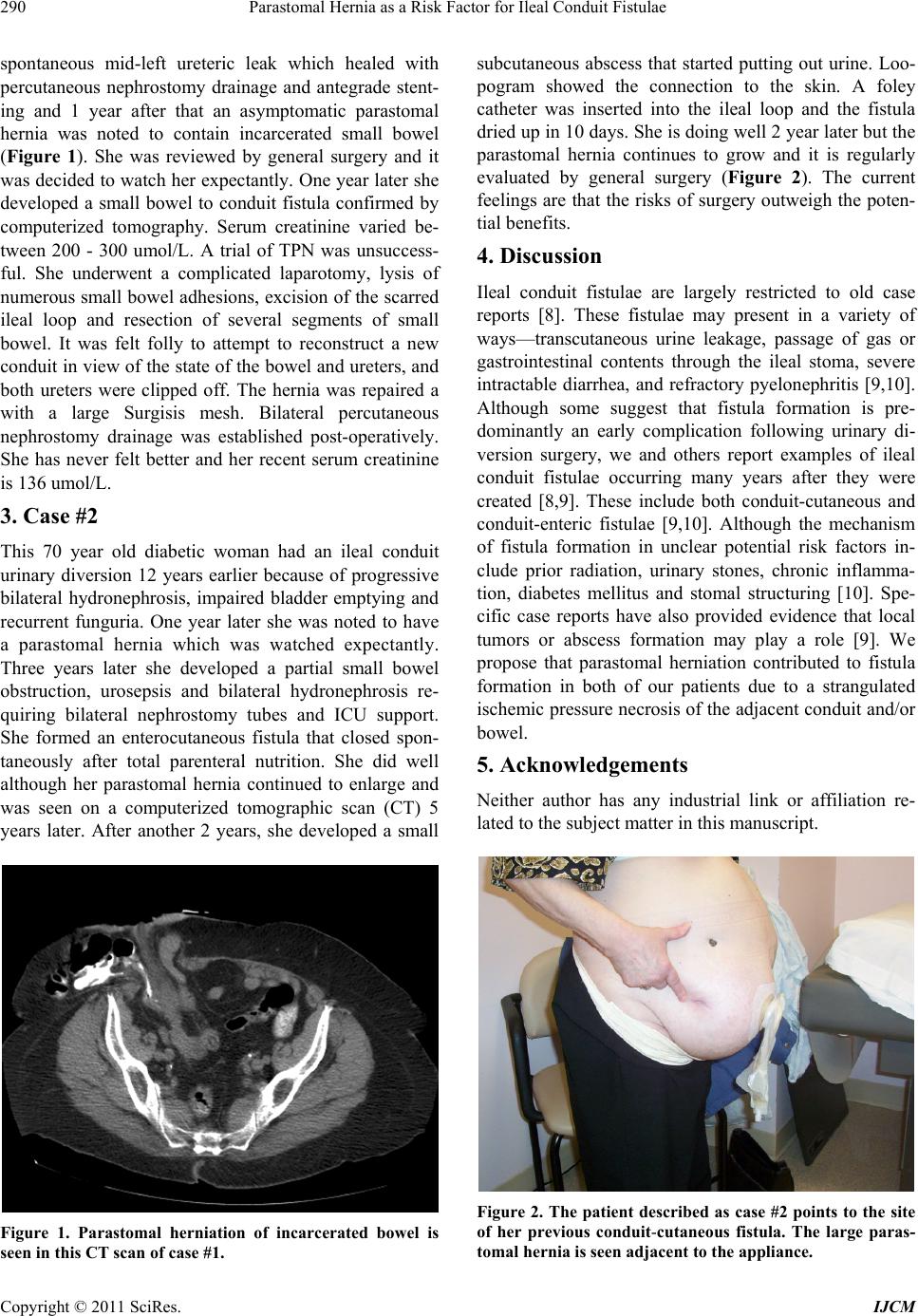 Parastomal Hernia as a Risk Factor for Ileal Conduit Fistulae 290 spontaneous mid-left ureteric leak which healed with percutaneous nephrostomy drainage and antegrade stent- ing and 1 year after that an asymptomatic parastomal hernia was noted to contain incarcerated small bowel (Figure 1). She was reviewed by general surgery and it was decided to watch her expectantly. One year later she developed a small bowel to conduit fistula confirmed by computerized tomography. Serum creatinine varied be- tween 200 - 300 umol/L. A trial of TPN was unsuccess- ful. She underwent a complicated laparotomy, lysis of numerous small bowel adhesions, excision of the scarred ileal loop and resection of several segments of small bowel. It was felt folly to attempt to reconstruct a new conduit in view of the state of the bow el and ureters, and both ureters were clipped off. The hernia was repaired a with a large Surgisis mesh. Bilateral percutaneous nephrostomy drainage was established post-operatively. She has never felt better and her recent serum creatinine is 136 umol/L. 3. Case #2 This 70 year old diabetic woman had an ileal conduit urinary diversion 12 years earlier because of progressive bilateral hydronephrosis, impaired bladder emptying and recurrent funguria. One year later she was noted to have a parastomal hernia which was watched expectantly. Three years later she developed a partial small bowel obstruction, urosepsis and bilateral hydronephrosis re- quiring bilateral nephrostomy tubes and ICU support. She formed an enterocutaneous fistula that closed spon- taneously after total parenteral nutrition. She did well although her parastomal hernia continued to enlarge and was seen on a computerized tomographic scan (CT) 5 years later. After another 2 years, she developed a small Figure 1. Parastomal herniation of incarcerated bowel is seen in this CT scan of case #1. subcutaneous abscess that started putting out urine. Loo- pogram showed the connection to the skin. A foley catheter was inserted into the ileal loop and the fistula dried up in 10 days. She is doing well 2 year later but the parastomal hernia continues to grow and it is regularly evaluated by general surgery (Figure 2). The current feelings are that the risks of surgery outweigh the poten- tial benefits. 4. Discussion Ileal conduit fistulae are largely restricted to old case reports [8]. These fistulae may present in a variety of ways—transcutaneous urine leakage, passage of gas or gastrointestinal contents through the ileal stoma, severe intractable diarrhea, and refractory pyelonephritis [9,10]. Although some suggest that fistula formation is pre- dominantly an early complication following urinary di- version surgery, we and others report examples of ileal conduit fistulae occurring many years after they were created [8,9]. These include both conduit-cutaneous and conduit-enteric fistulae [9,10]. Although the mechanism of fistula formation in unclear potential risk factors in- clude prior radiation, urinary stones, chronic inflamma- tion, diabetes mellitus and stomal structuring [10]. Spe- cific case reports have also provided evidence that local tumors or abscess formation may play a role [9]. We propose that parastomal herniation contributed to fistula formation in both of our patients due to a strangulated ischemic pressure necrosis of the adjacent conduit and/or bowel. 5. Acknowledgements Neither author has any industrial link or affiliation re- lated to the subject matter in this manuscript. Figure 2. The patient described as case #2 points to the site of her previous conduit-cutaneous fistula. The large paras- tomal hernia is seen adjacent to the appliance. Copyright © 2011 SciRes. IJCM  Parastomal Hernia as a Risk Factor for Ileal Conduit Fistulae Copyright © 2011 SciRes. IJCM 291 REFERENCES [1] E. M. Bricker, “Bladder Substitution after Pelvic Evis- ceration,” Surgical Clinics of North America, Vol. 30, No. 5, 1950, pp. 1511-1521. [2] W. J. Yang, K. S. Cho, K. H. Rha, et al., “Long-Term Effects of Ileal Conduit Urinary Diversion on Upper Uri- nary Tract in Bladder Cancer,” Urology, Vol. 68, No. 2, 2006, pp. 324-327. doi:10.1016/j.urology.2006.02.015 [3] P. S. Frich, C. A. Kvestad and A. Angelsen, “Outcome and Quality of Life in Patients Operated on with Radical Cystectomy and Three Different Urinary Diversion Tech- niques,” Scandinavian Journal of Urology and Nephrol- ogy, Vol. 43, No. 1, 2009, pp. 37-41. doi:10.1080/00365590802473198 [4] S. B. Farnham and M. S. Cookson, “Surgical Complica- tions of Urinary Diversion,” World Journal of Urology, Vol. 22, No. 3, 2004, pp. 157-167. doi:10.1007/s00345-004-0429-5 [5] E. Kouba, M. Sands, A. Lentz, E. Wallen and R. S. Pruthi, “Incidence and Risk Factors of Stomal Complications in Patients Undergoing Cystectomy with Ileal Conduit Uri- nary Diversion for Bladder Cancer,” Journal of Urology, Vol. 178, No. 3, 2007, pp. 950-954. doi:10.1016/j.juro.2007.05.028 [6] D. N. Wood, S. E. Allen, M. Hussain, T. J. Greenwell and P. J. Shah, “Stomal Complications of Ileal Conduits are Significantly Higher When Formed in Women with In- tractable Urinary Incontinence,” Journal of Urology, Vol. 172, No. 6, 2004, pp. 2300-2303. doi:10.1097/01.ju.0000141140.56022.7a [7] E. C. Kauffman, C. K. Ng, M. M. Lee, et al., “Critical Analysis of Complications after Robotic-Assisted Radical Cystectomy with Identification of Preoperative and Op- erative Risk Fa ctors,” British Journal of Urology Interna- tional, Vol. 105, No. 4, 2010, pp. 520-527. [8] L. Msezane, W. S. Reynolds, R. Mhapsekar, G. Gerber and G. Steinberg, “Open Surgical Repair of Ureteral Strictures and Fistulas Following Radical Cystectomy and Urinary Diversion,” Journal of Urology, Vol. 179, No. 4, 2008, pp. 1428-1431. doi:10.1016/j.juro.2007.11.083 [9] B. Rumstadt, B. Klein and D. Schilling, “Fistula between Ileal Conduit and Caecum: Unusual Presentation of a Colonic Carcinoma,” Australian and New Zealand Jour- nal of Surgery, Vol. 80, No. 6, 2010, p. 466. doi:10.1111/j.1445-2197.2009.05194.x [10] N. Hampel and A. Zabbo, “Parastomal Ileal Conduit-Enteric Fistula,” Journal of Urology, Vol. 134, No. 5, 1985, pp. 956-957. |