

Paper Menu >>
Journal Menu >>
 Vol.3, No.7, 437-443 (2011) doi:10.4236/health.2011.37072 Copyright © 2011 SciRes. Openly accessible at http://www.scirp.org/journal/HEALTH/ Health Effect of enpishin (press tack acupunctur e needles) on autonomic function, WBC count and oxidative stress Mitsunori Tsumaki1, Yoshitomo Saita1, Hiroshi Ikeda1, Kazuo Kaneko1, Takehiko Yukishita2, Keiko Lee2, Sungdo Kim2, Shinichi Yokota2, Nobuhiro Suetake2, Hiroyuki Kobayashi2* 1Department of Orthopaedics, Graduate School of Medicine, Juntendo University School of Medicine, Tokyo, Japan; 2Department of Hospital Administration, Graduate School of Medicine, Juntendo University School of Medicine, Tokyo, Japan. *Corresponding Author: [email protected] Received 27 April 2011; revised 27 June 2011; accepted 13 July 2011. ABSTRACT Acupuncture as a vital component of traditional medical systems of the Far East has been used to restore and maintain health for over three millennia. However, the neurobiological corre- lates of this therapy remain largely unknown. The purpose of this study was therefore to de- termine the effect of enpishin acupuncture (pre- ss tack needles (PTN)) on autonomic function, WBC count, and oxidative stress between sub- jects that received either verum or placebo PTN treatment. Twenty men (mean(SD) age: 36.7(5.1) years) who provided oral consent were ran- domized to receive either verum PTN (n = 9) or placebo PTN (n = 11). Bi-Digital O-Ring Test (BDORT) was used to select the acupoints for each participant. Autonomic function and oxi- dative stress level were analyzed before and after the treatment via heart rate v ariability (HRV) and free radical analysis system (FRAS4), re- spectively. Pre- and post-treatment WBC count was also evaluated. Verum PTN group had a statistically significant increa se ( p = 0. 008) in Ln TP, an index of overall autonomic activity. Sub- jects in this group also had a significantly greater (p = 0.006) variation in Ln TP than the placebo PTN group in response to the treatment. Similarly, Ln HF of subjects receiving verum PTN showed a marked increase (p = 0.0026) af- ter the treatment. Moreover, a significantly greater (p < 0.001) variation in mean Ln HF be- fore and after the treatment was noted in the verum group than the placebo group, reflecting a greater parasympathetic activation in the former. In contrast, sympathetic activity was not significantly influenced by verum PTN based on the lack of observed changes in LF/HF ratio. In addition, both groups failed to demonstrate significant variations in pre- and post-treatment mean Ln LF/HF ratio. Further, no significant in- tergroup difference was found with regard to mean variation in Ln LF/HF ratio. Ver um PTN did not induce significant changes in WBC count and markers of oxidative stress, namely reac- tive oxygen species (ROM) and biological anti- oxidant potential (BAP). How ever, a comparison of variations in pre- and post-treatment mean WBC count showed a significant difference (p = 0.020) between the two treatment modes: verum group showed a slight increase (225 ± 384.5), while placebo group showed a minimal de- crease (–190 ± 272.6). Our findings suggest tha t PTN increases overall autonomic activity, par- ticularly the parasympathetic function. Keywords: Heart Rate Variability; Press Tack Needles; Acupoints; Bi-Digital O-Ring Test; Oxidative Stress 1. INTRODUCTION Acupuncture as a vital component of traditional med- ical systems of the Far East has been used to restore and maintain health for over three millennia. It has become one of the most popular complementary and alternative medicine (CAM) modalities in the West, most notably in England and the United States [1-3]. Acupuncture is an invasive procedure in which a stainless steel needle of 0.2 - 0.4 mm width is inserted about 1-3 cm into the tissue at a specific acupuncture or trigger point in the body [4]. It has been used to treat a vast array of medical conditions as well as sports-related injuries and muscle fatigue [5-7]. Some of its putative effects include analgesia and improvement in cardio- vascular function and peripheral circulation [8,9]. Ac-  M. Tsumaki et al. / Health 3 (2011) 437-4 43 Copyright © 2011 SciRes. Openly accessible at http://www.scirp.org/journal/HEALTH/ 438 cording to the 1997 statement issued by the National Institute of Health (NIH) Consensus Panel on Acupunc- ture, there is “clear evidence” of acupuncture’s efficacy for postoperative or post-chemotherapy nausea and vom- iting, and “reasonable evidence” in relieving menstrual cramps, tennis elbow, fibromyalgia, postoperative dental pain, lower back pain, myofascial pain, and epicondylitis [10]. More recently, teleacupuncture using computer- controlled heart rate variability (HRV) analysis per- formed trans-continentally has shown that acupuncture influences the autonomic nervous system (ANS) as re- flected in changes in the sleep-wake cycle [11]. However, the efficacy and mechanism of acupuncture have not been clarified from a Western medical perspective and there is still a paucity of data from prospective random- ized controlled trials, resulting in differing opinions among physicians regarding the efficacy of acupuncture. Japanese style acupuncture is known to be one of the gentler forms of needling, nonetheless, it may cause pain or minor bruising during insertion into the skin and muscles and thus discourage sensitive patients and ath- letes from seeking such skin-penetrating treatments, es- pecially before exercising or a competition. For these reasons, enpishin (a.k.a. press tack needles (PTN)) was developed in Japan to provide a less invasive alternative. These minimally invasive needles are 0.2 mm wide and 0.6 mm long and are virtually risk-free from causing tissue damage or infection. Previous studies have found PTN to be efficacious for the treatment of muscle fatigue and pain [10,12,13] as well as for pain and mood distur- bances related to low back pain [14]. Despite its wide- spread use, scientific evidence demonstrating its efficacy is scarce. The aim of this study was therefore to evaluate the effects of PTN on autonomic function, WBC count, and oxidative stress in verum and placebo PTN groups, and in so doing determine the therapeutic value of PTN. 2. STUDY PARTICIPANTS AND METHODS 2.1. Stud y Participants The protocol of this study was approved by the Insti- tutional Review Board (IRB) at Juntendo University, and oral consent was obtained from all participants. Twenty men (mean(SD) age: 36.7(5.1) years) were randomized to receive either verum PTN (n = 9) or placebo PTN (n = 11). Participants were blinded to treatment allocation and were briefed on the purpose and nature of the study, as well as the physical and mental burden of participat- ing in the study. All eligible participants were non- smokers, free from underlying diseases such as hyper- tension, hyperlipidemia, cardiovascular disease, and dia- betes, and denied ongoing use of cardiovascular medica- tions, sedative hypnotics, anxiolytics, or other psycho- tropic medications. On the test day, participants with a body temperature below 37˚C, without pronounced fa- tigue, with more than 6 hours of sleep before the test, and who had refrained from alcohol consumption were included in the study. Measurements were performed between 10:00 and 18:00 hours to account for circadian variations in ANS. Participants were asked to abstain from all foods and drinks 3 hours prior to the test, and to empty their bladder shortly before the test. After a 20-minute rest, measurements were taken in a sitting position while a respiratory rate of 13 breaths per minute was maintained. All measurements and tests were car- ried out under quiet conditions in a temperature and hu- midity controlled (24˚C, 60%) laboratory. 2.2. Methods 2.2.1. Enpishin (Press Tack Acupuncture Needles (PTN)) Single-use Pyonex PTN (0.2 mm diameter × 0.6 mm length, Seirin Co. Ltd, Shizuoka, Japan) and placebo PTN were used in the study. PTN had an adhesive plas- ter that affixed them on the skin. Acupoints on the body were first marked and PTN were embedded in the skin overlying these points. Verum PTN was indistinguish- able in physical appearance from placebo PTN unless the end of the tack was felt with a fingertip. Placebo PTN had a blunt tip that did not pierce the skin, however, it created a sensation similar to that of skin puncture and tissue penetration, making it difficult for the subjects to discriminate between the two PTNs (Figures 1(a) and 1(b)) [15]. 2.2.2. Selection of Acupoints For this study, acupoints located on the wrist and the upper abdomen conducive for regulating the autonomic and immune systems were selected from the list (Table 1). The Bi-Digital O-Ring Test (BDORT) was performed in all participants to select the acupoints that maximized the treatment effect of PTN in each participant. BDORT is a non-invasive, diagnostic test that utilizes changes in finger strength as an index of electromagnetic resonance. Participants were asked to place one finger on each acu- point lightly and sequentially, while simultaneously touching the tips of the thumb and one finger (e.g. index finger) of the opposite hand to form an “O” (O-ring or a fairly perfect circle). The examiner (acupuncturist) then exerted a pull on the O-ring with both of his index finger and thumb while the participant resisted. The partici- pant’s finger strength was compromised and O-ring pulled apart easily if the opposite hand was touching an afflicted acupoint [16,17]. Acupoints that corresponded 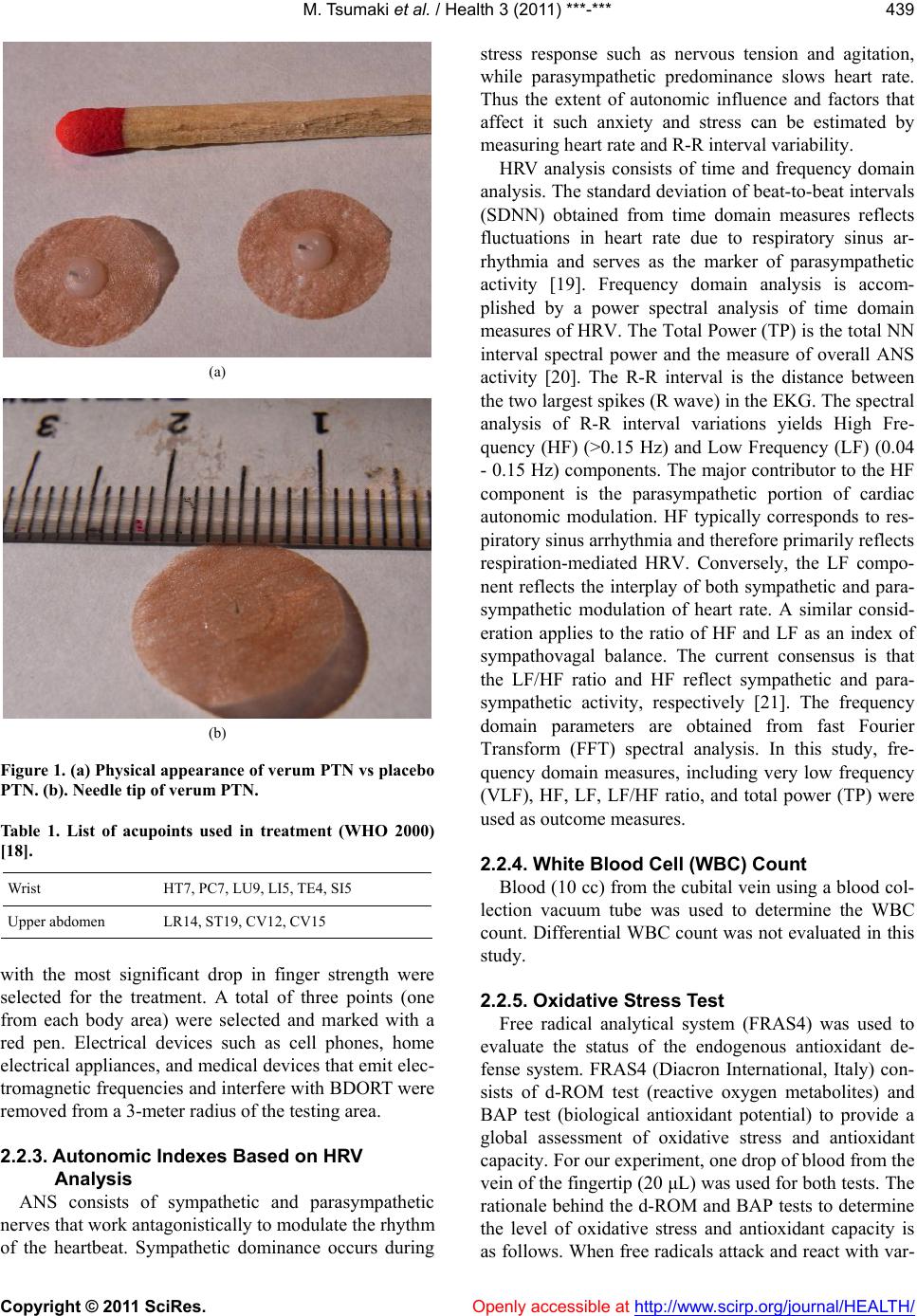 M. Tsumaki et al. / Health 3 (2011) ***-* ** Copyright © 2011 SciRes. Openly accessible at http://www.scirp.org/journal/HEALTH/ 439 (a) (b) Figure 1. (a) Physical appearance of verum PTN vs placebo PTN. (b). Needle tip of verum PTN. Table 1. List of acupoints used in treatment (WHO 2000) [18]. Wr ist HT7, PC7, LU9, LI5, TE4, SI5 Upper abdomen LR14, ST19, CV12, CV15 with the most significant drop in finger strength were selected for the treatment. A total of three points (one from each body area) were selected and marked with a red pen. Electrical devices such as cell phones, home electrical appliances, and medical devices that emit elec- tromagnetic frequencies and interfere with BDORT were removed from a 3-meter radius of the testing area. 2.2.3. Autonomic Indexes Based on HRV Analysis ANS consists of sympathetic and parasympathetic nerves that work antagonistically to modulate the rhythm of the heartbeat. Sympathetic dominance occurs during stress response such as nervous tension and agitation, while parasympathetic predominance slows heart rate. Thus the extent of autonomic influence and factors that affect it such anxiety and stress can be estimated by measuring heart rate and R-R interval variability. HRV analysis consists of time and frequency domain analysis. The standard deviation of beat-to-beat intervals (SDNN) obtained from time domain measures reflects fluctuations in heart rate due to respiratory sinus ar- rhythmia and serves as the marker of parasympathetic activity [19]. Frequency domain analysis is accom- plished by a power spectral analysis of time domain measures of HRV. The Total Power (TP) is the total NN interval spectral power and the measure of overall ANS activity [20]. The R-R interval is the distance between the two largest spikes (R wave) in the EKG. The spectral analysis of R-R interval variations yields High Fre- quency (HF) (>0.15 Hz) and Low Frequency (LF) (0.04 - 0.15 Hz) components. The major contributor to the HF component is the parasympathetic portion of cardiac autonomic modulation. HF typically corresponds to res- piratory sinus arrhythmia and therefore primarily reflects respiration-mediated HRV. Conversely, the LF compo- nent reflects the interplay of both sympathetic and para- sympathetic modulation of heart rate. A similar consid- eration applies to the ratio of HF and LF as an index of sympathovagal balance. The current consensus is that the LF/HF ratio and HF reflect sympathetic and para- sympathetic activity, respectively [21]. The frequency domain parameters are obtained from fast Fourier Transform (FFT) spectral analysis. In this study, fre- quency domain measures, including very low frequency (VLF), HF, LF, LF/HF ratio, and total power (TP) were used as outcome measures. 2.2.4. White Blood Cell (WBC) Count Blood (10 cc) from the cubital vein using a blood col- lection vacuum tube was used to determine the WBC count. Differential WBC count was not evaluated in this study. 2.2.5. Oxidative Stress Test Free radical analytical system (FRAS4) was used to evaluate the status of the endogenous antioxidant de- fense system. FRAS4 (Diacron International, Italy) con- sists of d-ROM test (reactive oxygen metabolites) and BAP test (biological antioxidant potential) to provide a global assessment of oxidative stress and antioxidant capacity. For our experiment, one drop of blood from the vein of the fingertip (20 μL) was used for both tests. The rationale behind the d-ROM and BAP tests to determine the level of oxidative stress and antioxidant capacity is as follows. When free radicals attack and react with var- 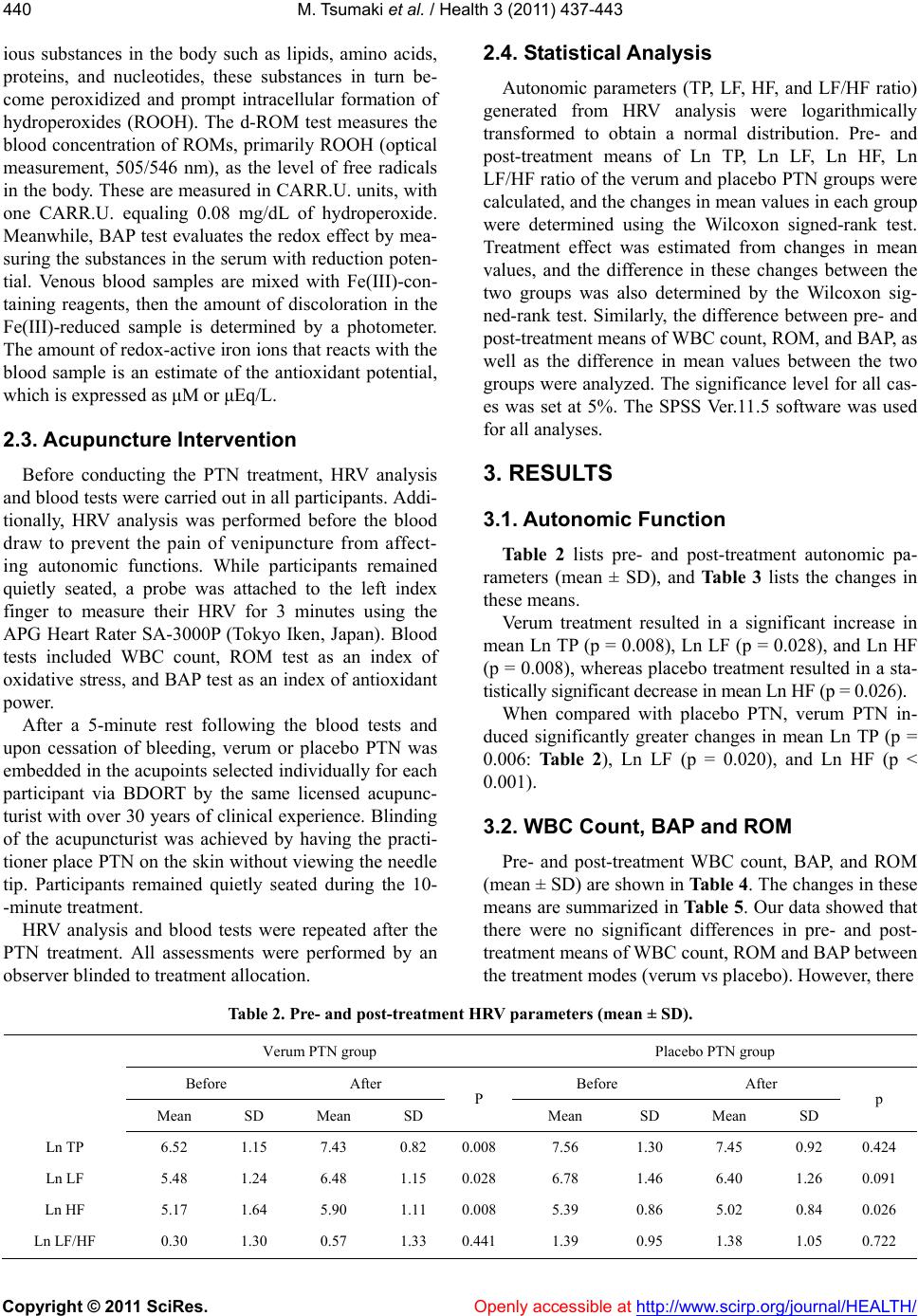 M. Tsumaki et al. / Health 3 (2011) 437-4 43 Copyright © 2011 SciRes. http://www.scirp.org/journal/HEALTH/Openly accessible at 440 ious substances in the body such as lipids, amino acids, proteins, and nucleotides, these substances in turn be- come peroxidized and prompt intracellular formation of hydroperoxides (ROOH). The d-ROM test measures the blood concentration of ROMs, primarily ROOH (optical measurement, 505/546 nm), as the level of free radicals in the body. These are measured in CARR.U. units, with one CARR.U. equaling 0.08 mg/dL of hydroperoxide. Meanwhile, BAP test evaluates the redox effect by mea- suring the substances in the serum with reduction poten- tial. Venous blood samples are mixed with Fe(III)-con- taining reagents, then the amount of discoloration in the Fe(III)-reduced sample is determined by a photometer. The amount of redox-active iron ions that reacts with the blood sample is an estimate of the antioxidant potential, which is expressed as μM or μEq/L. 2.3. Acupuncture Intervention Before conducting the PTN treatment, HRV analysis and blood tests were carried out in all participants. Addi- tionally, HRV analysis was performed before the blood draw to prevent the pain of venipuncture from affect- ing autonomic functions. While participants remained quietly seated, a probe was attached to the left index finger to measure their HRV for 3 minutes using the APG Heart Rater SA-3000P (Tokyo Iken, Japan). Blood tests included WBC count, ROM test as an index of oxidative stress, and BAP test as an index of antioxidant power. After a 5-minute rest following the blood tests and upon cessation of bleeding, verum or placebo PTN was embedded in the acupoints selected individually for each participant via BDORT by the same licensed acupunc- turist with over 30 years of clinical experience. Blinding of the acupuncturist was achieved by having the practi- tioner place PTN on the skin without viewing the needle tip. Participants remained quietly seated during the 10- -minute treatment. HRV analysis and blood tests were repeated after the PTN treatment. All assessments were performed by an observer blinded to treatment allocation. 2.4. Statistical Analysis Autonomic parameters (TP, LF, HF, and LF/HF ratio) generated from HRV analysis were logarithmically transformed to obtain a normal distribution. Pre- and post-treatment means of Ln TP, Ln LF, Ln HF, Ln LF/HF ratio of the verum and placebo PTN groups were calculated, and the changes in mean values in each group were determined using the Wilcoxon signed-rank test. Treatment effect was estimated from changes in mean values, and the difference in these changes between the two groups was also determined by the Wilcoxon sig- ned-rank test. Similarly, the difference between pre- and post-treatment means of WBC count, ROM, and BAP, as well as the difference in mean values between the two groups were analyzed. The significance level for all cas- es was set at 5%. The SPSS Ver.11.5 software was used for all analyses. 3. RESULTS 3.1. Autonomic Function Table 2 lists pre- and post-treatment autonomic pa- rameters (mean ± SD), and Ta b l e 3 lists the changes in these means. Verum treatment resulted in a significant increase in mean Ln TP (p = 0.008), Ln LF (p = 0.028), and Ln HF (p = 0.008), whereas placebo treatment resulted in a sta- tistically significant decrease in mean Ln HF (p = 0.026). When compared with placebo PTN, verum PTN in- duced significantly greater changes in mean Ln TP (p = 0.006: Table 2), Ln LF (p = 0.020), and Ln HF (p < 0.001). 3.2. WBC Count, BAP and ROM Pre- and post-treatment WBC count, BAP, and ROM (mean ± SD) are shown in Table 4. The changes in these means are summarized in Tab le 5. Our data showed that there were no significant differences in pre- and post- treatment means of WBC count, ROM and BAP between the treatment modes (verum vs placebo). However, there Table 2. Pre- and post-treatment HRV parameters (mean ± SD). Verum PTN group Placebo PTN group Before After Before After Mean SD Mean SD P Mean SD Mean SD p Ln TP 6.52 1.15 7.43 0.82 0.008 7.56 1.30 7.45 0.92 0.424 Ln LF 5.48 1.24 6.48 1.15 0.028 6.78 1.46 6.40 1.26 0.091 Ln HF 5.17 1.64 5.90 1.11 0.008 5.39 0.86 5.02 0.84 0.026 Ln LF/HF 0.30 1.30 0.57 1.33 0.441 1.39 0.95 1.38 1.05 0.722 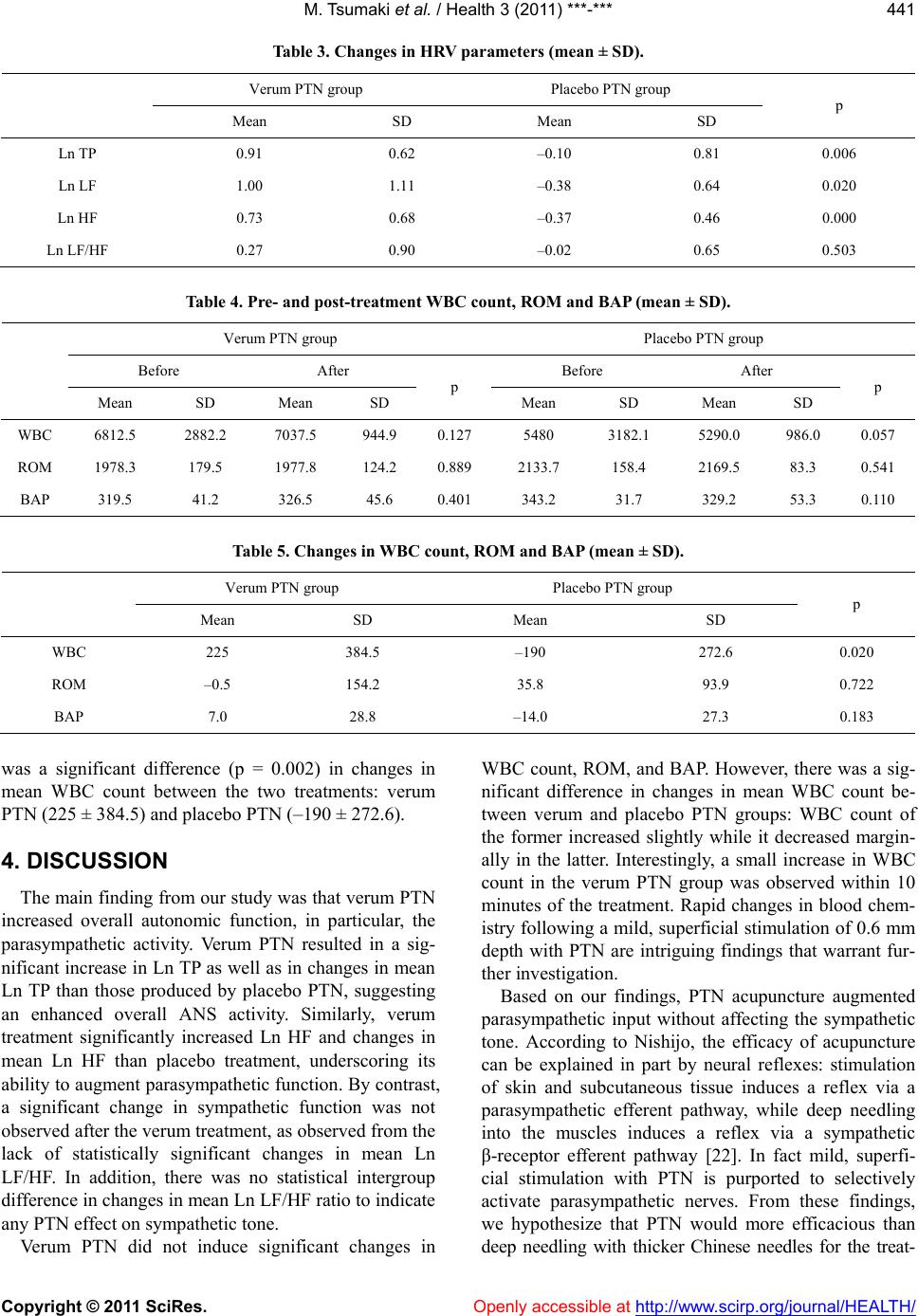 M. Tsumaki et al. / Health 3 (2011) ***-* ** Copyright © 2011 SciRes. Openly accessible at http://www.scirp.org/journal/HEALTH/ 441 Table 3. Changes in HRV parameters (mean ± SD). Verum PTN group Placebo PTN group Mean SD Mean SD p Ln TP 0.91 0.62 –0.10 0.81 0.006 Ln LF 1.00 1.11 –0.38 0.64 0.020 Ln HF 0.73 0.68 –0.37 0.46 0.000 Ln LF/HF 0.27 0.90 –0.02 0.65 0.503 Table 4. Pre- and post-treatment WBC count, ROM and BAP (mean ± SD). Verum PTN group Placebo PTN group Before After Before After Mean SD Mean SD p Mean SD Mean SD p WBC 6812.5 2882.2 7037.5 944.9 0.127 5480 3182.1 5290.0 986.0 0.057 ROM 1978.3 179.5 1977.8 124.2 0.889 2133.7 158.4 2169.5 83.3 0.541 BAP 319.5 41.2 326.5 45.6 0.401 343.2 31.7 329.2 53.3 0.110 Table 5. Changes in WBC count, ROM and BAP (mean ± SD). Verum PTN group Placebo PTN group Mean SD Mean SD p WBC 225 384.5 –190 272.6 0.020 ROM –0.5 154.2 35.8 93.9 0.722 BAP 7.0 28.8 –14.0 27.3 0.183 was a significant difference (p = 0.002) in changes in mean WBC count between the two treatments: verum PTN (225 ± 384.5) and placebo PTN (–190 ± 272.6). 4. DISCUSSION The main finding from our study was that verum PTN increased overall autonomic function, in particular, the parasympathetic activity. Verum PTN resulted in a sig- nificant increase in Ln TP as well as in changes in mean Ln TP than those produced by placebo PTN, suggesting an enhanced overall ANS activity. Similarly, verum treatment significantly increased Ln HF and changes in mean Ln HF than placebo treatment, underscoring its ability to augment parasympathetic function. By contrast, a significant change in sympathetic function was not observed after the verum treatment, as observed from the lack of statistically significant changes in mean Ln LF/HF. In addition, there was no statistical intergroup difference in changes in mean Ln LF/HF ratio to indicate any PTN effect on sympathetic tone. Verum PTN did not induce significant changes in WBC count, ROM, and BAP. However, there was a sig- nificant difference in changes in mean WBC count be- tween verum and placebo PTN groups: WBC count of the former increased slightly while it decreased margin- ally in the latter. Interestingly, a small increase in WBC count in the verum PTN group was observed within 10 minutes of the treatment. Rapid changes in blood chem- istry following a mild, superficial stimulation of 0.6 mm depth with PTN are intriguing findings that warrant fur- ther investigation. Based on our findings, PTN acupuncture augmented parasympathetic input without affecting the sympathetic tone. According to Nishijo, the efficacy of acupuncture can be explained in part by neural reflexes: stimulation of skin and subcutaneous tissue induces a reflex via a parasympathetic efferent pathway, while deep needling into the muscles induces a reflex via a sympathetic β-receptor efferent pathway [22]. In fact mild, superfi- cial stimulation with PTN is purported to selectively activate parasympathetic nerves. From these findings, we hypothesize that PTN would more efficacious than deep needling with thicker Chinese needles for the treat- 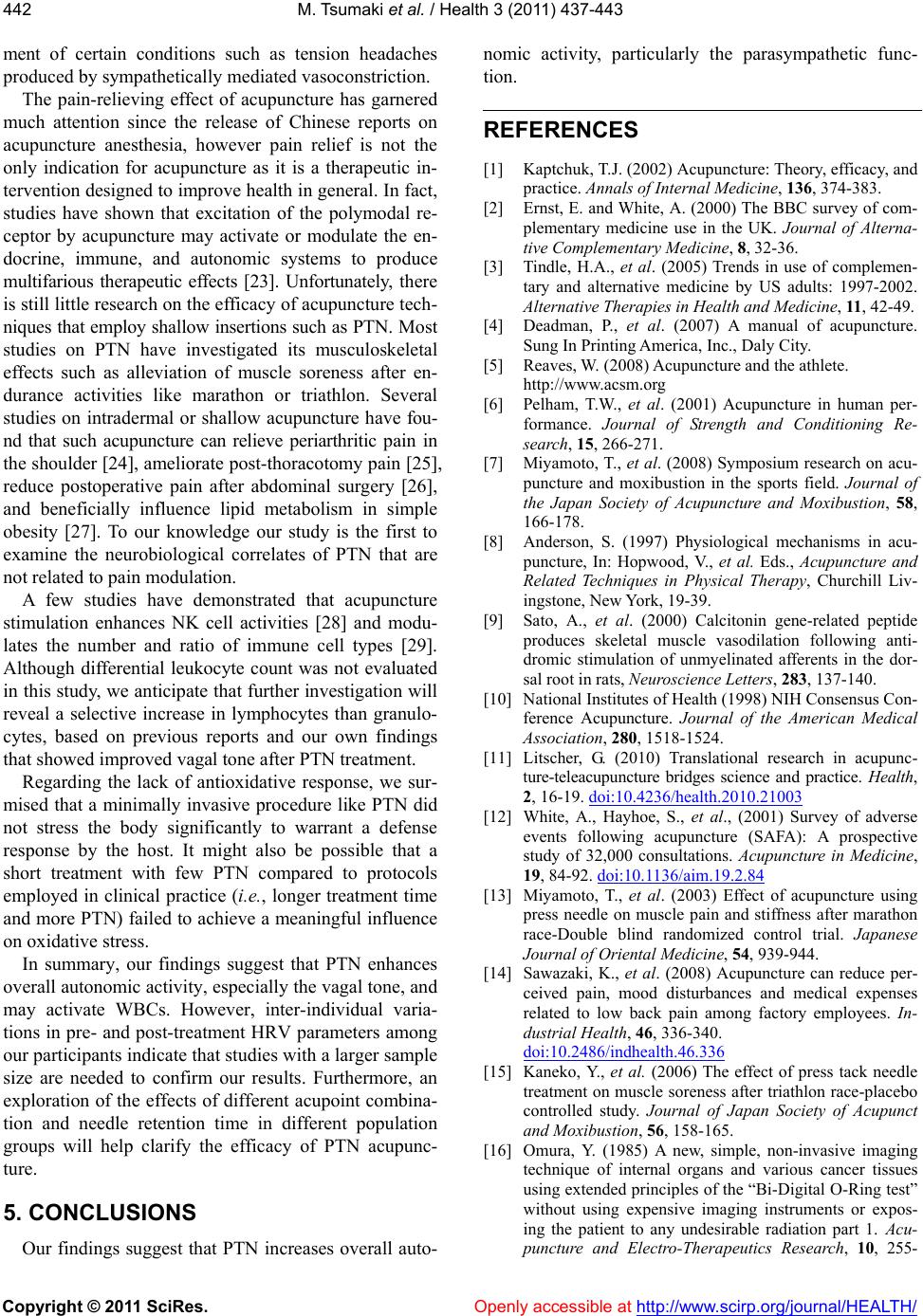 M. Tsumaki et al. / Health 3 (2011) 437-4 43 Copyright © 2011 SciRes. Openly accessible at http://www.scirp.org/journal/HEALTH/ 442 ment of certain conditions such as tension headaches produced by sympathetically mediated vasoconstriction. The pain-relieving effect of acupuncture has garnered much attention since the release of Chinese reports on acupuncture anesthesia, however pain relief is not the only indication for acupuncture as it is a therapeutic in- tervention designed to improve health in general. In fact, studies have shown that excitation of the polymodal re- ceptor by acupuncture may activate or modulate the en- docrine, immune, and autonomic systems to produce multifarious therapeutic effects [23]. Unfortunately, there is still little research on the efficacy of acupuncture tech- niques that employ shallow insertions such as PTN. Most studies on PTN have investigated its musculoskeletal effects such as alleviation of muscle soreness after en- durance activities like marathon or triathlon. Several studies on intradermal or shallow acupuncture have fou- nd that such acupuncture can relieve periarthritic pain in the shoulder [24], ameliorate post-thoracotomy pain [25], reduce postoperative pain after abdominal surgery [26], and beneficially influence lipid metabolism in simple obesity [27]. To our knowledge our study is the first to examine the neurobiological correlates of PTN that are not related to pain modulation. A few studies have demonstrated that acupuncture stimulation enhances NK cell activities [28] and modu- lates the number and ratio of immune cell types [29]. Although differential leukocyte count was not evaluated in this study, we anticipate that further investigation will reveal a selective increase in lymphocytes than granulo- cytes, based on previous reports and our own findings that showed improved vagal tone after PTN treatment. Regarding the lack of antioxidative response, we sur- mised that a minimally invasive procedure like PTN did not stress the body significantly to warrant a defense response by the host. It might also be possible that a short treatment with few PTN compared to protocols employed in clinical practice (i.e., longer treatment time and more PTN) failed to achieve a meaningful influence on oxidative stress. In summary, our findings suggest that PTN enhances overall autonomic activity, especially the vagal tone, and may activate WBCs. However, inter-individual varia- tions in pre- and post-treatment HRV parameters among our participants indicate that studies with a larger sample size are needed to confirm our results. Furthermore, an exploration of the effects of different acupoint combina- tion and needle retention time in different population groups will help clarify the efficacy of PTN acupunc- ture. 5. CONCLUSIONS Our findings suggest that PTN increases overall auto- nomic activity, particularly the parasympathetic func- tion. REFERENCES [1] Kaptchuk, T.J. (2002) Acupuncture: Theory, efficacy, and practice. Annals of Internal Medicine, 136, 374-383. [2] Ernst, E. and White, A. (2000) The BBC survey of com- plementary medicine use in the UK. Journal of Alterna- tive Complementary Medicine, 8, 32-36. [3] Tindle, H.A., et al. (2005) Trends in use of complemen- tary and alternative medicine by US adults: 1997-2002. Alternative Therapi es in Health and Medicine, 11, 42-49. [4] Deadman, P., et al. (2007) A manual of acupuncture. Sung In Printing America, Inc., Daly City. [5] Reaves, W. (2008) Acupuncture and the athlete. http://www.acsm.org [6] Pelham, T.W., et al. (2001) Acupuncture in human per- formance. Journal of Strength and Conditioning Re- search, 15, 266-271. [7] Miyamoto, T., et al. (2008) Symposium research on acu- puncture and moxibustion in the sports field. Journal of the Japan Society of Acupuncture and Moxibustion, 58, 166-178. [8] Anderson, S. (1997) Physiological mechanisms in acu- puncture, In: Hopwood, V., et al. Eds., Acupuncture and Related Techniques in Physical Therapy, Churchill Liv- ingstone, New York, 19-39. [9] Sato, A., et al. (2000) Calcitonin gene-related peptide produces skeletal muscle vasodilation following anti- dromic stimulation of unmyelinated afferents in the dor- sal root in rats, Neuroscience Letters, 283, 137-140. [10] National Institutes of Health (1998) NIH Consensus Con- ference Acupuncture. Journal of the American Medical Association, 280, 1518-1524. [11] Litscher, G. (2010) Translational research in acupunc- ture-teleacupuncture bridges science and practice. Health, 2, 16-19. doi:10.4236/health.2010.21003 [12] White, A., Hayhoe, S., et al., (2001) Survey of adverse events following acupuncture (SAFA): A prospective study of 32,000 consultations. Acupuncture in Medicine, 19, 84-92. doi:10.1136/aim.19.2.84 [13] Miyamoto, T., et al. (2003) Effect of acupuncture using press needle on muscle pain and stiffness after marathon race-Double blind randomized control trial. Japanese Journal of Oriental Medicine, 54, 939-944. [14] Sawazaki, K., et al. (2008) Acupuncture can reduce per- ceived pain, mood disturbances and medical expenses related to low back pain among factory employees. In- dustrial Health, 46, 336-340. doi:10.2486/indhealth.46.336 [15] Kaneko, Y., et al. (2006) The effect of press tack needle treatment on muscle soreness after triathlon race-placebo controlled study. Journal of Japan Society of Acupunct and Moxibustion, 56, 158-165. [16] Omura, Y. (1985) A new, simple, non-invasive imaging technique of internal organs and various cancer tissues using extended principles of the “Bi-Digital O-Ring test” without using expensive imaging instruments or expos- ing the patient to any undesirable radiation part 1. Acu- puncture and Electro-Therapeutics Research, 10, 255-  M. Tsumaki et al. / Health 3 (2011) ***-* ** Copyright © 2011 SciRes. http://www.scirp.org/journal/HEALTH/Openly accessible at 443 277. [17] Omura, Y. (1998) Practice of Bi-Digital O-Ring test. Ido- -No-Nihonsha, Yokosuka. [18] World Health Organization (2009) WHO standard acu- puncture point locations in the western pacific region 2008. Ido-No-Nippon-Sha, Yokosuka. [19] Martin, G.J., et al. (1987) Heart rate variability and sud- den death secondary to coronary artery disease during ambulatory electrocardiographic monitoring. American Journal of Cardiology, 60, 86-89. doi:10.1016/0002-9149(87)90990-8 [20] Matsumoto, T., et al. (2008) Altered autonomic nervous system activity as a potential etiological factor of pre- menstrual syndrome and premenstrual dysphoric disorder. Psychosomatic M e dicine, 48, 1011-1024. [21] Kuo, T.B., et al. (1999) Effect of aging on gender differ- ences in neural control of heart rate. American Journal of Physiology, 277, 2233-2239. [22] Nishijo, K., Mori, H., et al. (1995) Scientific approach for acupuncture. Jounal of Japan Society of Acupunct and Moxibustion, 45, 177-191. [23] Kawakita, K., et al. (2008) Do Japanese style acupunc- ture and moxibustion reduce symptoms of the common cold? Electronic Centralised Aircraft Monitor, 5, 481- 489. [24] Chen, L. (2006) Comparison of therapeutic effects be- tween normal acupuncture and shallow needling with short-needle on periarthritis of shoulder. Zhongguo Zhen Jiu, 26, 647-648. [25] Vickers, A.J., et al. (2006) Acupuncture is a feasible treatment for post-thoracotomy pain: Results of a pro- spective trial. http://www.biomedcentral.com/1471-2253/6/5 [26] Kotani, N., et al. (2001) Preoperative intradermal acu- puncture reduces postoperative pain, nausea and vomit- ing, analgesic requirement, and sympathoadrenal re- sponses. Anesthesiology, 95, 349-356. doi:10.1097/00000542-200108000-00015 [27] Wu, Z.H. (2009) Effects of the multiple needling with shallow insertion for simple obesity: A clinical observa- tion on lipid metabolism and on the chest, waist and hip circumferences. Journal of Traditional Chinese Medicine, 29, 179-181. doi:10.1016/S0254-6272(09)60060-1 [28] Sato, T., et al. (1996) Acupuncture stimulation enhances splenic natural killer cell cytotoxicity in rats. Japanese Journal of Physiology, 46, 131-136. doi:10.2170/jjphysiol.46.131 [29] Kushioka, S., et al. (2002) Assessment of acupuncture upon physiological system-qualitative and quantitative assessment on leukocyte and lymphoid cell subsets after acupuncture. Jounal of Japan Society of Acupunct and Moxibustion, 52, 17-19. |