

Paper Menu >>
Journal Menu >>
 International Journal of Clinical Medicine, 2011, 2, 196-200 doi:10.4236/ijcm.2011.23032 Published Online July 2011 (http://www.SciRP.org/journal/ijcm) Copyright © 2011 SciRes. IJCM Drug-Eluting Stent for the Treatment of Early Fistula Failure Luigi di Serafino, Laura Scudiero, Mario de Laurentis, Federica Ilardi, Fabio Magliulo, Giuseppe Carotenuto, Cinzia Perrino, Giovanni Esposito Division of Cardiology, Federico II University, Naples, Italy. Email: [email protected] Received November 26th, 2010; revised February 1st, 2011; accepted February 10th, 2011. ABSTRACT Introduction: Morbidity and mortality in chronic haemodialysis patients is related to dialysis efficiency. Several com- plications may occur with vascular access usually associated with a stenosis. This is known to occur frequently in the venous outflow. Stenosis of the arterial side is not as frequently discussed, but it is also likely to compromise fistula function. Traditionally, surgical and percutaneous interventions have been used to treat failing fistulas, but the em- ployment of drug-eluting stents for the treatmen t of failing fistulas due to the arterial sten osis ha s been described rarely. Methods: A 65-year-old male patient referred to our ambulatory because of hand ischemia during haemodialysis treatments only few days after radial-cep halic fistula creation. After physical and echo-color-doppler examination, an- giography was performed and percutaneous intervention was proposed. After the positioning of a guiding catheter, the lesion was crossed with a 0.014” guide wire followed by direct drug-eluting stent implantation. Results: Final an- giogram sho wed a good result and a preserved flow through the fistula. Six months later the patien t was asymptomatic and the fistula was still working. Conclusions: Although further prospective studies are necessary, percutaneous trans- luminal angioplasty (PTA) with drug-eluting stents implantatio n could be considered a safe and effective technique for the treatment of arteriovenous fistulas stenosis. Keywords: Arteriovenous Fistula, Percutaneous Transluminal Angioplasty, Haemodialysis, Drug-Eluting Stents 1. Introduction Autogenous fistula is a very common strategy for pa- tients with end-stage renal disease who receive haemo- dialysis. Primary placement of autogenous haemodialy- sis fistulas is preferred to other types of haemodialysis access due to benefits including longer patency, fewer infection, lower mortality and higher quality of life [1]. However, autogenous haemodialysis fistulas are also susceptible to dysfunction and failure [2]. Fistula failure can be classified as early and late. Early fistula failure refers to those cases in which the arteriovenous fistula (AVF) never develops, or it fails within the first 3 months of usage. Late failure refers to those cases that fail after 3 months of successful usage [3]. The clinical manifestations of early fistula failure are: 1) inadequate development to permit repetitive cannulation for dialysis; 2) inadequate flow limiting dialysis and 3) thrombosis. However, generally, those clinical manifestations are related to some anatomical problems [3,4], and a lesion is usually found to be the cause of the dysfunction. Al- though it has been common practice to abandon these early spoilt fistulas, aggressive evaluation and treatment of early fistula failures has been shown to result in the salvage of a large percentage of patients [4]. Several studies reported that non-maturing AVFs might be salvaged by various surgical and interventional approaches. Surgical ligation of tributaries, superficiali- zation procedures, or revision of anastomoses may sal- vage a significant number of fistulas that fail to mature adequately. Although autogenous AVFs fail to mature for several reasons, a commonly encountered angio- graphic finding is the presence of an anastomotic steno- sis [5]. Thrombosis is the most frequent AVF complica- tion resulting in the loss of access for haemodialysis. Most events of thrombosis (more than 85% of cases) coincide with the development of vascular stenosis, generally located in the venous segment proximal to the arteriovenous anastomosis. Stenosis in the arterial seg- ment has been less studied, but also compromises the patency of the vascular access, and also results in limb 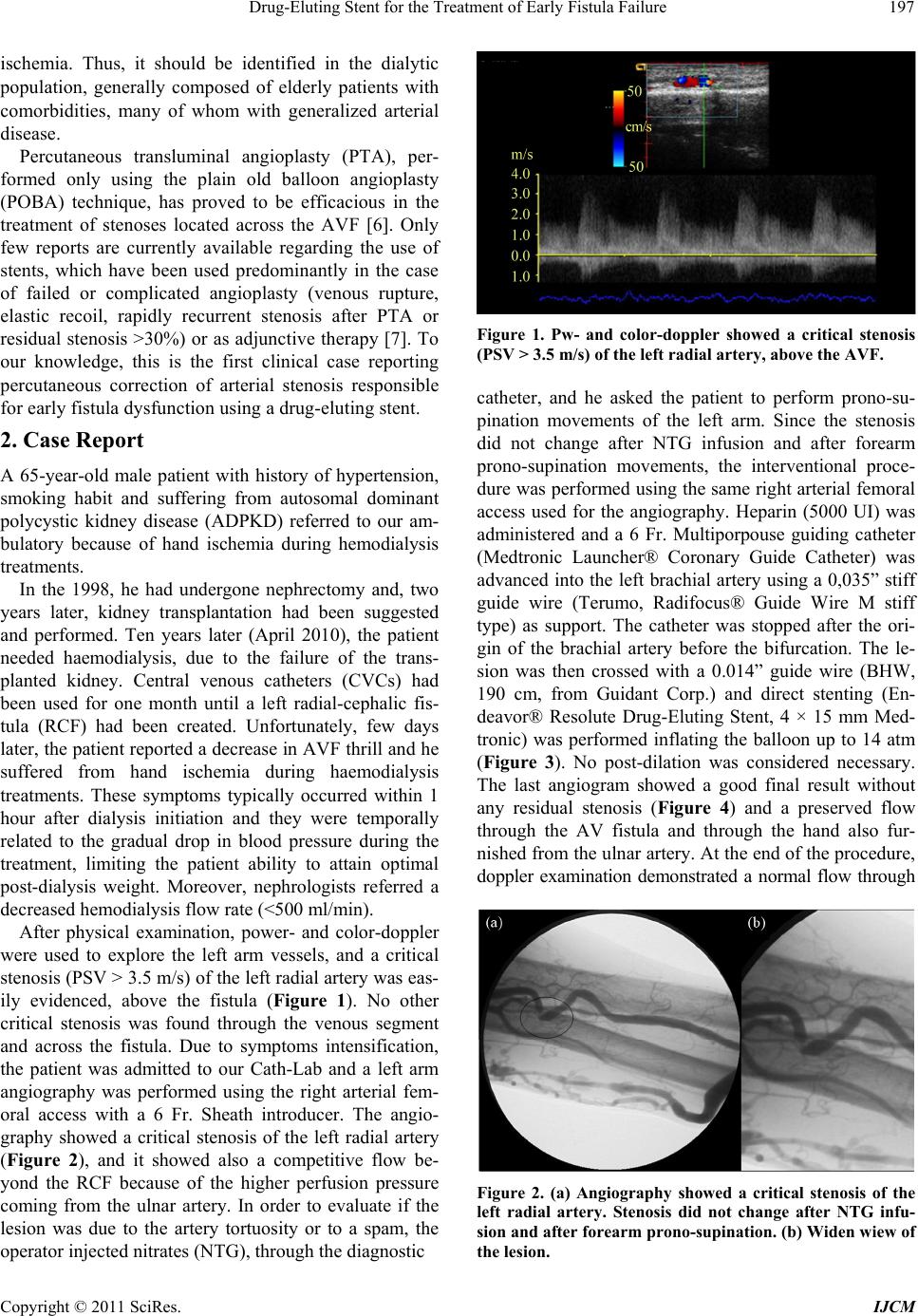 Drug-Eluting Stent for the Treatment of Early Fistula Failure197 ischemia. Thus, it should be identified in the dialytic population, generally composed of elderly patients with comorbidities, many of whom with generalized arterial disease. Percutaneous transluminal angioplasty (PTA), per- formed only using the plain old balloon angioplasty (POBA) technique, has proved to be efficacious in the treatment of stenoses located across the AVF [6]. Only few reports are currently available regarding the use of stents, which have been used predominantly in the case of failed or complicated angioplasty (venous rupture, elastic recoil, rapidly recurrent stenosis after PTA or residual stenosis >30%) or as adjunctive therapy [7]. To our knowledge, this is the first clinical case reporting percutaneous correction of arterial stenosis responsible for early fistula dysfunction using a drug-eluting stent. 2. Case Report A 65-year-old male patient with history of hypertension, smoking habit and suffering from autosomal dominant polycystic kidney disease (ADPKD) referred to our am- bulatory because of hand ischemia during hemodialysis treatments. In the 1998, he had undergone nephrectomy and, two years later, kidney transplantation had been suggested and performed. Ten years later (April 2010), the patient needed haemodialysis, due to the failure of the trans- planted kidney. Central venous catheters (CVCs) had been used for one month until a left radial-cephalic fis- tula (RCF) had been created. Unfortunately, few days later, the patient reported a decrease in AVF thrill and he suffered from hand ischemia during haemodialysis treatments. These symptoms typically occurred within 1 hour after dialysis initiation and they were temporally related to the gradual drop in blood pressure during the treatment, limiting the patient ability to attain optimal post-dialysis weight. Moreover, nephrologists referred a decreased hemodialysis flow rate (<500 ml/min). After physical examination, power- and color-doppler were used to explore the left arm vessels, and a critical stenosis (PSV > 3.5 m/s) of the left radial artery was eas- ily evidenced, above the fistula (Figure 1). No other critical stenosis was found through the venous segment and across the fistula. Due to symptoms intensification, the patient was admitted to our Cath-Lab and a left arm angiography was performed using the right arterial fem- oral access with a 6 Fr. Sheath introducer. The angio- graphy showed a critical stenosis of the left radial artery (Figure 2), and it showed also a competitive flow be- yond the RCF because of the higher perfusion pressure coming from the ulnar artery. In order to evaluate if the lesion was due to the artery tortuosity or to a spam, the operator injected nitrates (NTG), through the diagnostic Figure 1. Pw- and color-doppler showed a critical stenosis (PSV > 3.5 m/s) of the left radial artery, above the AVF. catheter, and he asked the patient to perform prono-su- pination movements of the left arm. Since the stenosis did not change after NTG infusion and after forearm prono-supination movements, the interventional proce- dure was performed using the same right arterial femoral access used for the angiography. Heparin (5000 UI) was administered and a 6 Fr. Multiporpouse guiding catheter (Medtronic Launcher® Coronary Guide Catheter) was advanced into the left brachial artery using a 0,035” stiff guide wire (Terumo, Radifocus® Guide Wire M stiff type) as support. The catheter was stopped after the ori- gin of the brachial artery before the bifurcation. The le- sion was then crossed with a 0.014” guide wire (BHW, 190 cm, from Guidant Corp.) and direct stenting (En- deavor® Resolute Drug-Eluting Stent, 4 × 15 mm Med- tronic) was performed inflating the balloon up to 14 atm (Figure 3). No post-dilation was considered necessary. The last angiogram showed a good final result without any residual stenosis (Figure 4) and a preserved flow through the AV fistula and through the hand also fur- nished from the ulnar artery. At the end of the procedure, doppler examination demonstrated a normal flow through Figure 2. (a) Angiography showed a critical stenosis of the left radial artery. Stenosis did not change after NTG infu- sion and after forearm prono-supination. (b) Widen wiew of the lesion. Copyright © 2011 SciRes. IJCM 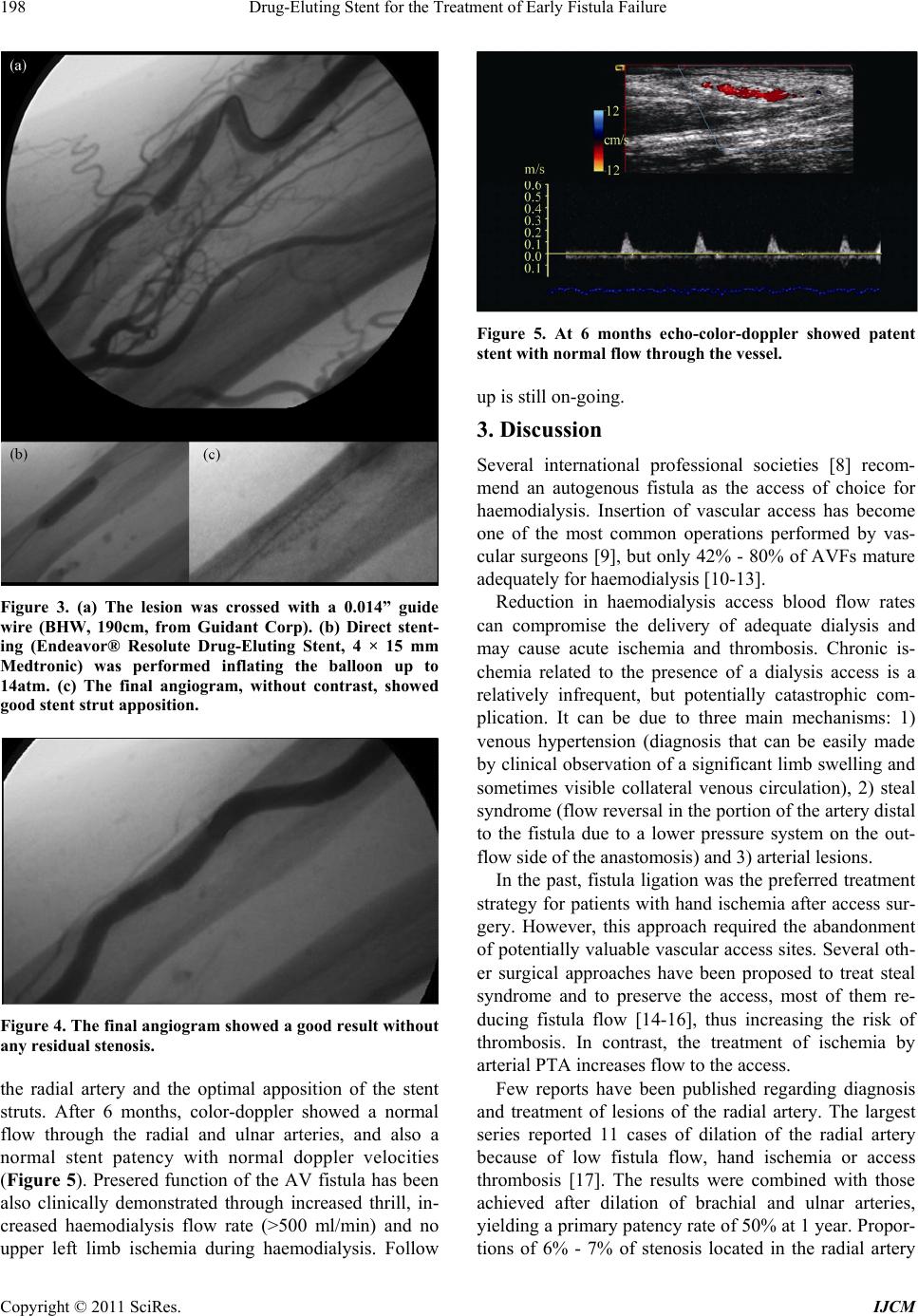 Drug-Eluting Stent for the Treatment of Early Fistula Failure 198 Figure 3. (a) The lesion was crossed with a 0.014” guide wire (BHW, 190cm, from Guidant Corp). (b) Direct stent- ing (Endeavor® Resolute Drug-Eluting Stent, 4 × 15 mm Medtronic) was performed inflating the balloon up to 14atm. (c) The final angiogram, without contrast, showed good stent strut apposition. Figure 4. The final angiogram showed a good result without any residual stenosis. the radial artery and the optimal apposition of the stent struts. After 6 months, color-doppler showed a normal flow through the radial and ulnar arteries, and also a normal stent patency with normal doppler velocities (Figure 5). Presered function of the AV fistula has been also clinically demonstrated through increased thrill, in- creased haemodialysis flow rate (>500 ml/min) and no upper left limb ischemia during haemodialysis. Follow Figure 5. At 6 months echo-color-doppler showed patent stent with normal flow through the vessel. up is still on-going. 3. Discussion Several international professional societies [8] recom- mend an autogenous fistula as the access of choice for haemodialysis. Insertion of vascular access has become one of the most common operations performed by vas- cular surgeons [9], but only 42% - 80% of AVFs mature adequately for haemodialysis [10-13]. Reduction in haemodialysis access blood flow rates can compromise the delivery of adequate dialysis and may cause acute ischemia and thrombosis. Chronic is- chemia related to the presence of a dialysis access is a relatively infrequent, but potentially catastrophic com- plication. It can be due to three main mechanisms: 1) venous hypertension (diagnosis that can be easily made by clinical observation of a significant limb swelling and sometimes visible collateral venous circulation), 2) steal syndrome (flow reversal in the portion of the artery distal to the fistula due to a lower pressure system on the out- flow side of the anastomosis) and 3) arterial lesions. In the past, fistula ligation was the preferred treatment strategy for patients with hand ischemia after access sur- gery. However, this approach required the abandonment of potentially valuable vascular access sites. Several oth- er surgical approaches have been proposed to treat steal syndrome and to preserve the access, most of them re- ducing fistula flow [14-16], thus increasing the risk of thrombosis. In contrast, the treatment of ischemia by arterial PTA increases flow to the access. Few reports have been published regarding diagnosis and treatment of lesions of the radial artery. The largest series reported 11 cases of dilation of the radial artery because of low fistula flow, hand ischemia or access thrombosis [17]. The results were combined with those achieved after dilation of brachial and ulnar arteries, yielding a primary patenc y rate of 50% at 1 year. Propor- tions of 6% - 7% of stenosis located in the radial artery Copyright © 2011 SciRes. IJCM 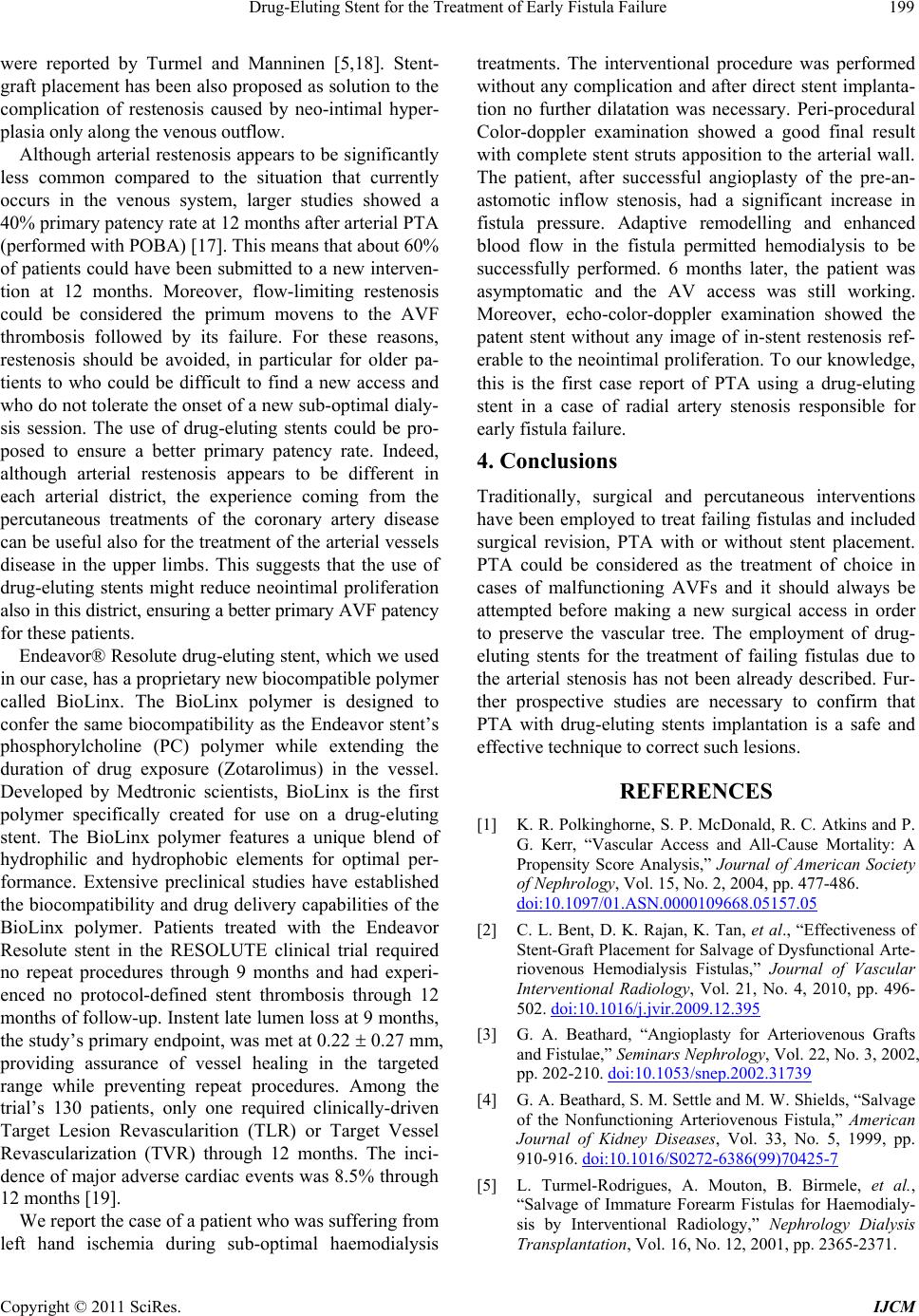 Drug-Eluting Stent for the Treatment of Early Fistula Failure199 were reported by Turmel and Manninen [5,18]. Stent- graft placement has been also proposed as solution to the complication of restenosis caused by neo-intimal hyper- plasia only along the venous outflow. Although arterial restenosis appears to be significantly less common compared to the situation that currently occurs in the venous system, larger studies showed a 40% primary patency rate at 12 months after arterial PTA (performed with POBA) [17]. This means that about 60% of patients could have been submitted to a new interven- tion at 12 months. Moreover, flow-limiting restenosis could be considered the primum movens to the AVF thrombosis followed by its failure. For these reasons, restenosis should be avoided, in particular for older pa- tients to who could be difficult to find a new access and who do not tolerate the onset of a new su b-optimal dialy- sis session. The use of drug-eluting stents could be pro- posed to ensure a better primary patency rate. Indeed, although arterial restenosis appears to be different in each arterial district, the experience coming from the percutaneous treatments of the coronary artery disease can be useful also for the treatment of the arterial vessels disease in the upper limbs. This suggests that the use of drug-eluting stents might reduce neointimal proliferation also in this district, ensuring a better primary AVF patency for these patients. Endeavor® Resolute drug-eluting stent, which we used in our case, has a proprietary new biocompatible polymer called BioLinx. The BioLinx polymer is designed to confer the same biocompatibility as the Endeavor stent’s phosphorylcholine (PC) polymer while extending the duration of drug exposure (Zotarolimus) in the vessel. Developed by Medtronic scientists, BioLinx is the first polymer specifically created for use on a drug-eluting stent. The BioLinx polymer features a unique blend of hydrophilic and hydrophobic elements for optimal per- formance. Extensive preclinical studies have established the biocompatibility and drug delivery capabilities of the BioLinx polymer. Patients treated with the Endeavor Resolute stent in the RESOLUTE clinical trial required no repeat procedures through 9 months and had experi- enced no protocol-defined stent thrombosis through 12 months of follow-up. Instent late lumen loss at 9 months, the study’s primary endpoint, was met at 0.22 0.27 mm, providing assurance of vessel healing in the targeted range while preventing repeat procedures. Among the trial’s 130 patients, only one required clinically-driven Target Lesion Revascularition (TLR) or Target Vessel Revascularization (TVR) through 12 months. The inci- dence of major adverse cardiac events was 8.5 through 12 months [19]. We report the case of a patient who was suffering from left hand ischemia during sub-optimal haemodialysis treatments. The interventional procedure was performed without any complication and after direct stent implanta- tion no further dilatation was necessary. Peri-procedural Color-doppler examination showed a good final result with complete stent struts apposition to the arterial wall. The patient, after successful angioplasty of the pre-an- astomotic inflow stenosis, had a significant increase in fistula pressure. Adaptive remodelling and enhanced blood flow in the fistula permitted hemodialysis to be successfully performed. 6 months later, the patient was asymptomatic and the AV access was still working. Moreover, echo-color-doppler examination showed the patent stent without any image of in-stent restenosis ref- erable to the neointimal pro liferation. To our knowledge, this is the first case report of PTA using a drug-eluting stent in a case of radial artery stenosis responsible for early fistula failure. 4. Conclusions Traditionally, surgical and percutaneous interventions have been employed to treat failing fistulas and included surgical revision, PTA with or without stent placement. PTA could be considered as the treatment of choice in cases of malfunctioning AVFs and it should always be attempted before making a new surgical access in order to preserve the vascular tree. The employment of drug- eluting stents for the treatment of failing fistulas due to the arterial stenosis has not been already described. Fur- ther prospective studies are necessary to confirm that PTA with drug-eluting stents implantation is a safe and effective technique to correct such lesions. REFERENCES [1] K. R. Polkinghorne, S. P. McDonald, R. C. Atkins and P. G. Kerr, “Vascular Access and All-Cause Mortality: A Propensity Score Analysis,” Journal of American Society of Nephrology, Vol. 15, No. 2, 2004, pp. 477-486. doi:10.1097/01.ASN.0000109668.05157.05 [2] C. L. Bent, D. K. Rajan, K. Tan, et al., “Effectiveness of Stent-Graft Placement for Salvage of Dysfunctional Arte- riovenous Hemodialysis Fistulas,” Journal of Vascular Interventional Radiology, Vol. 21, No. 4, 2010, pp. 496- 502. doi:10.1016/j.jvir.2009.12.395 [3] G. A. Beathard, “Angioplasty for Arteriovenous Grafts and Fistulae,” Seminars Nephrology, Vol. 22, No. 3, 2002, pp. 202-210. doi:10.1053/snep.2002.31739 [4] G. A. Beathard, S. M. Settle and M. W. Shields, “Salvage of the Nonfunctioning Arteriovenous Fistula,” American Journal of Kidney Diseases, Vol. 33, No. 5, 1999, pp. 910-916. doi:10.1016/S0272-6386(99)70425-7 [5] L. Turmel-Rodrigues, A. Mouton, B. Birmele, et al., “Salvage of Immature Forearm Fistulas for Haemodialy- sis by Interventional Radiology,” Nephrology Dialysis Transplantation, Vol. 16, No. 12, 2001, pp. 2365-2371. Copyright © 2011 SciRes. IJCM  Drug-Eluting Stent for the Treatment of Early Fistula Failure Copyright © 2011 SciRes. IJCM 200 doi:10.1093/ndt/16.12.2365 [6] D. G. Miquelin, L. F. Reis, A. A. da Silva and J. M. de Godoy, “Percutaneous Transluminal Angioplasty in the Treatment of Stenosis of Arteriovenous Fistulae for He- modialysis,” International Archives Medicine, Vol. 1, No. 1, 2008, p. 16. doi:10.1186/1755-7682-1-16 [7] M. R. Chan, S. Bedi, R. J. Sanchez, et al., “Stent Place- ment versus Angioplasty Improves Patency of Arterio- venous Grafts and Blood Flow of Arteriovenous Fistu- lae,” Clinical Journal of the American Society Nephrol- ogy, Vol. 3, No. 3, 2008, pp. 699-705. doi:10.2215/CJN.04831107 [8] S. Ohira, H. Naito, I. Amano, et al., “2005 Japanese So- ciety for Dialysis Therapy Guidelines for Vascular Ac- cess Construction and Repair for Chronic Hemodialysis,” Therapeutic Apheresis Dialysis, Vol. 10, No. 5, 2006, pp. 449-462. doi:10.1111/j.1744-9987.2006.00410.x [9] J. M. Weiswasser, D. Kellicu t, S. Arora and A. N. Sidawy, “Strategies of Arteriovenous Dialysis Access,” Seminars Vascular Surgery, Vol. 17, No. 1, 2004, pp. 10-18. doi:10.1053/j.semvascsurg.2003.11.008 [10] A. Asif, P. Roy-Chaudhury and G. A. Beathard, “Early Arteriovenous Fistula Failure: A Logical Proposal for When and How to Intervene,” Clinical Journal of Ameri- can Society Nephrology, Vol. 1, No. 2, 2006, pp. 332-339. doi:10.2215/CJN.00850805 [11] S. T. Patel, J. Hughes and J. L. Mills Sr, “Failure of Arte- riovenous Fistula Maturation: An Unintended Conse- quence of Exceeding Dialysis Outcome Quality Initiative Guidelines for Hemodialysis Access,” Journal of Vascu- lar Surgery, Vol. 38, No. 3, 2003, pp. 439-445. doi:10.1016/S0741-5214(03)00732-8 [12] S. S. Berman and A. T. Gentile, “Impact of Secondary Procedures in Autogenous Arteriovenous Fistula Matura- tion and Maintenance,” Journal of Vascular Surgery, Vol. 34, No. 5, 2001, pp. 866-871. [13] L. M. Dember, G. J. Beck, M. Allon, et al., “Effect of Clopidogrel on Early Failure of Arteriovenous Fistulas for Hemodialysis: A Randomized Controlled Trial,” The Journal of American Medical Association, Vol. 299, No. 18, 2008, pp. 2164-2171. [14] M. Haimov, H. Schanzer and M. Skladani, “Pathogenesis and Management of Upper-Extremity Ischemia Following Angioaccess Surgery,” Blood Purification, Vol. 14, No. 5, 1996, pp. 350-354. doi:10.1159/000170286 [15] J. C. West, D. J. Bertsch, S. L. Peterson, et al., “Arterial Insufficiency in Hemodialysis Access Procedures: Cor- rection by ‘Banding’ Technique,” Transplantation Pro- ceedings, Vol. 23, No. 2, 1991, pp. 1838-1840. [16] A. B. Redfern and N. B. Zimmerman, “Neurologic and Ischemic Complications of Upper Extremity Vascular Access for Dialysis,” The Journal of Hand Surgery, Vol. 20, No. 2, 1995, pp. 199-204. doi:10.1016/S0363-5023(05)80007-3 [17] A. Guerra, A. Raynaud, B. Beyssen, J. Y. Pagny, M. Sapoval and C. Angel, “Arterial Percutaneous Angio- plasty in Upper Limbs with Vascular Access Devices for Haemodialysis,” Nephrology Dialysis Transplantation, Vol. 17, No. 5, 2002, pp. 843-851. doi:10.1093/ndt/17.5.843 [18] H. I. Manninen, E. Kaukanen, K. Makinen and P. Karha- paa, “Endovascular Salvage of Nonmaturing Autogenous Hemodialysis Fistulas: Comparison with Endovascular Therapy of Failing Mature Fistulas,” Journal of Vascular Interventional Radiology, Vol. 19, No. 6, 2008, pp. 870- 876. doi:10.1016/j.jvir.2008.02.024 [19] I. T. Meredith, S. Worthley, R. Whitbourn, et al., “Clini- cal and Angiographic Results with the Next-Generation Resolute Stent System: A Prospective, Multicenter, First- in-human Trial,” JACC: Cardiovasc Interventions, Vol. 2, No. 10, 2009, pp. 977-985. doi:10.1016/j.jcin.2009.07.007 |