

Paper Menu >>
Journal Menu >>
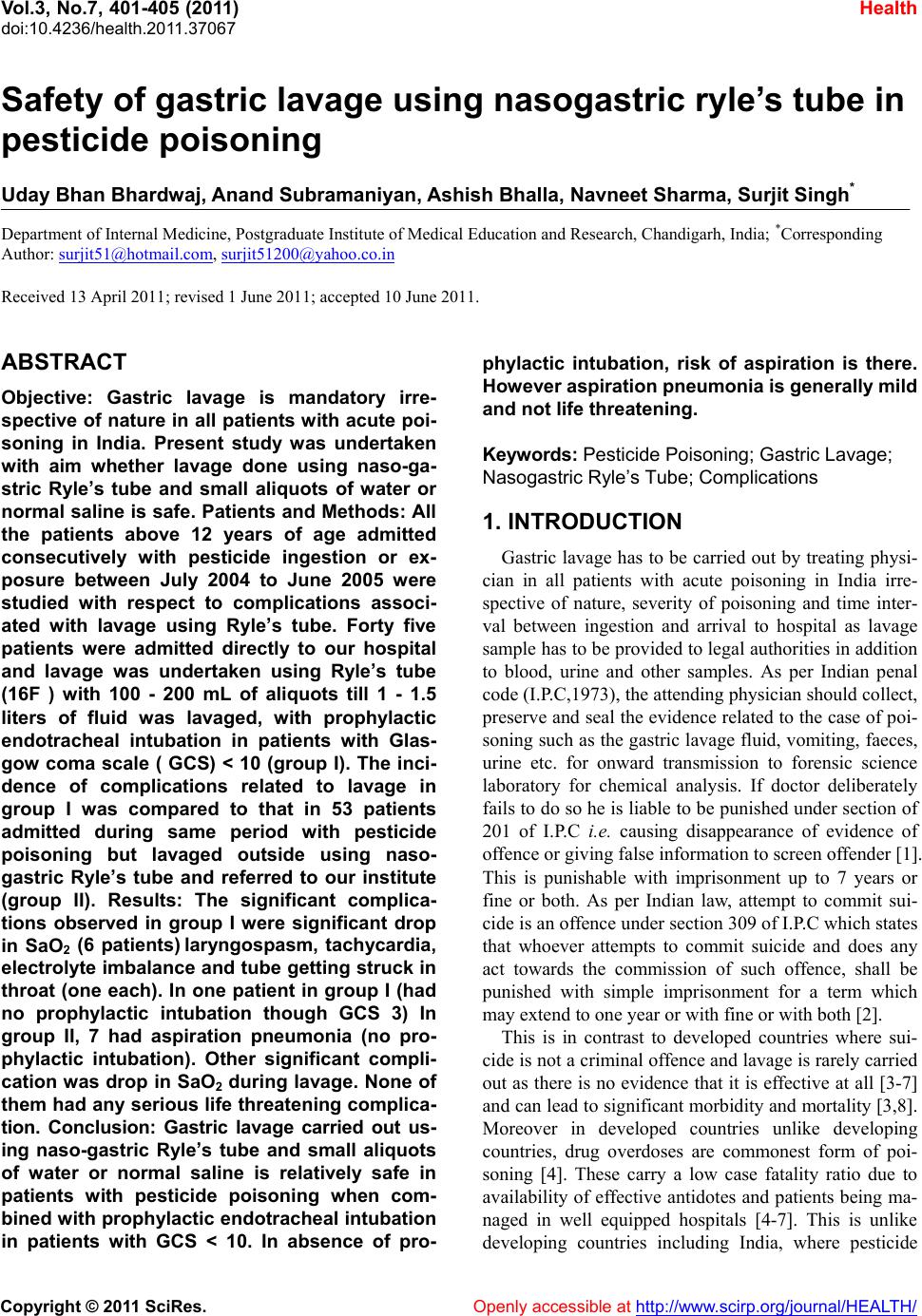 Vol.3, No.7, 401-405 (2011) doi:10.4236/health.2011.37067 Copyright © 2011 SciRes. Openly accessible at http://www.scirp.org/journal/HEALTH/ Health Safety of gastric lavage using nasogastric ryle’s tube in pesticide poisoning Uday Bhan Bhardwaj, Anand Subramaniyan, Ashish Bhalla, Navneet Sharma, Surjit Singh* Department of Internal Medicine, Postgraduate Institute of Medical Education and Research, Chandigarh, India; *Corresponding Author: [email protected], [email protected] Received 13 April 2011; revised 1 June 2011; accepted 10 June 2011. ABSTRACT Objective: Gastric lavage is mandatory irre- spective of nature in all patients w ith acute poi- soning in India. Present study was undertaken with aim whether lavage done using naso-ga- stric Ryle’s tube and small aliquots of water or normal saline is safe. Patients and Methods: All the patients above 12 years of age admitted consecutively with pesticide ingestion or ex- posure between July 2004 to June 2005 were studied with respect to complications associ- ated with lavage using Ryle’s tube. Forty five patients were admitted directly to our hospital and lavage was undertaken using Ryle’s tube (16F ) with 100 - 200 mL of aliquots till 1 - 1.5 liters of fluid was lavaged, with prophylactic endotracheal intubation in patients with Glas- gow coma scale ( GCS) < 10 (group I). The inci- dence of complications related to lavage in group I was compared to that in 53 patients admitted during same period with pesticide poisoning but lavaged outside using naso- gastric Ryle’s tube and referred to our institute (group II). Results: The significant complica- tions observed in group I were significant drop in SaO2 (6 patients) laryngospasm, tachycardia, electrolyte imbalance and tube getting struck in throat (one each). In one patient in group I (had no prophylactic intubation though GCS 3) In group II, 7 had aspiration pneumonia (no pro- phylactic intubation). Other significant compli- cation was drop in SaO2 during lavage. None of them had any serious life threatening complica- tion. Conclusion: Gastric lavage carried out us- ing naso-gastric Ryle’s tube and small aliquots of water or normal saline is relatively safe in patients with pesticide poisoning when com- bined with prophylactic endotracheal intubation in patients with GCS < 10. In absence of pro- phylactic intubation, risk of aspiration is there. However aspiration pneumonia is generally mild and not life threatening. Keywords: Pesticide Poisoning; Gastric Lav age; Nasogastric Ryle’s Tube; Complicat ions 1. INTRODUCTION Gastric lavage has to be carried out by treating physi- cian in all patients with acute poisoning in India irre- spective of nature, severity of poisoning and time inter- val between ingestion and arrival to hospital as lavage sample has to be provided to legal authorities in addition to blood, urine and other samples. As per Indian penal code (I.P.C,1973), the attending physician should collect, preserve and seal the evidence related to the case of poi- soning such as the gastric lavage fluid, vomiting, faeces, urine etc. for onward transmission to forensic science laboratory for chemical analysis. If doctor deliberately fails to do so he is liable to be punished under section of 201 of I.P.C i.e. causing disappearance of evidence of offence or giving false information to screen offender [1]. This is punishable with imprisonment up to 7 years or fine or both. As per Indian law, attempt to commit sui- cide is an offence under section 309 of I.P.C which states that whoever attempts to commit suicide and does any act towards the commission of such offence, shall be punished with simple imprisonment for a term which may extend to one year or with fine or wi t h both [2]. This is in contrast to developed countries where sui- cide is not a criminal offence and lavage is rarely carried out as there is no evidence that it is effective at all [3-7] and can lead to significant morbidity and mortality [3,8 ]. Moreover in developed countries unlike developing countries, drug overdoses are commonest form of poi- soning [4]. These carry a low case fatality ratio due to availability of effective antidotes and patients being ma- naged in well equipped hospitals [4-7]. This is unlike developing countries including India, where pesticide 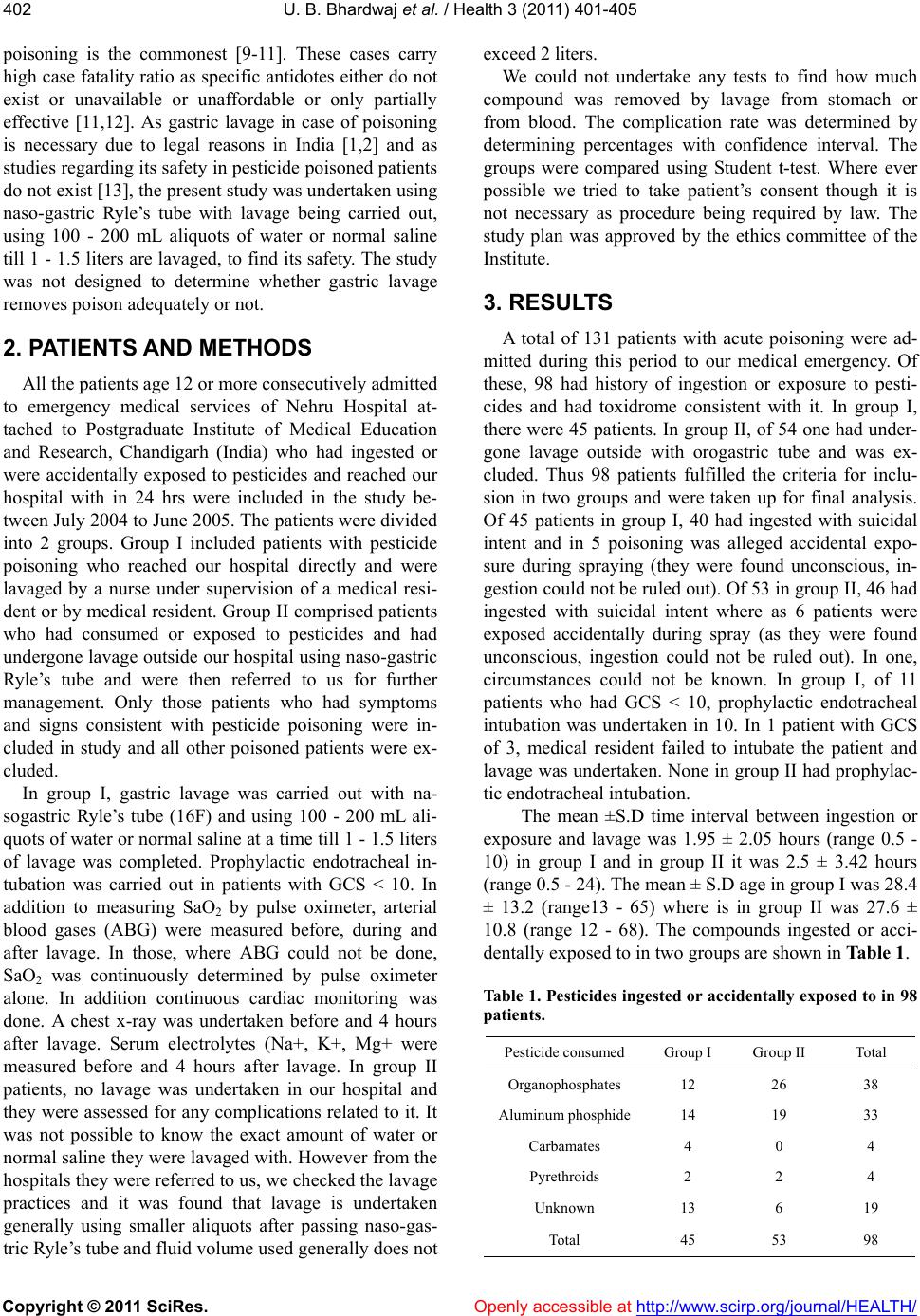 U. B. Bhardwaj et al. / Health 3 (2011) 401-405 Copyright © 2011 SciRes. Openly accessible at http://www.scirp.org/journal/HEALTH/ 402 poisoning is the commonest [9-11]. These cases carry high case fatality ratio as specific antidotes eith er do n ot exist or unavailable or unaffordable or only partially effective [11,12]. As gastric lavage in case of poisoning is necessary due to legal reasons in India [1,2] and as studies regarding its safety in pesticide poisoned patients do not ex ist [13], th e pr esent stu d y was undertak en using naso-gastric Ryle’s tube with lavage being carried out, using 100 - 200 mL aliquots of water or normal saline till 1 - 1.5 liters are lavaged, to find its safety. The study was not designed to determine whether gastric lavage removes poison adequately or not. 2. PATIENTS AND METHODS All the patients age 12 or more consecutively admitted to emergency medical services of Nehru Hospital at- tached to Postgraduate Institute of Medical Education and Research, Chandigarh (India) who had ingested or were accidentally exposed to pesticides and reached our hospital with in 24 hrs were included in the study be- tween July 2004 to June 2005. The patien ts were div ided into 2 groups. Group I included patients with pesticide poisoning who reached our hospital directly and were lavaged by a nurse under supervision of a medical resi- dent or by medical resident. Group II comprised patients who had consumed or exposed to pesticides and had undergone lavage outside our hospital using naso-gastric Ryle’s tube and were then referred to us for further management. Only those patients who had symptoms and signs consistent with pesticide poisoning were in- cluded in study and all other poisoned patients were ex- cluded. In group I, gastric lavage was carried out with na- sogastric Ryle’s tube (16F) and using 100 - 200 mL ali- quots of water or normal saline at a time till 1 - 1.5 liters of lavage was completed. Prophylactic endotracheal in- tubation was carried out in patients with GCS < 10. In addition to measuring SaO2 by pulse oximeter, arterial blood gases (ABG) were measured before, during and after lavage. In those, where ABG could not be done, SaO2 was continuously determined by pulse oximeter alone. In addition continuous cardiac monitoring was done. A chest x-ray was undertaken before and 4 hours after lavage. Serum electrolytes (Na+, K+, Mg+ were measured before and 4 hours after lavage. In group II patients, no lavage was undertaken in our hospital and they were assessed for any complications related to it. It was not possible to know the exact amount of water or normal saline they were lavaged with. However fro m the hospitals they were referred to us, we checked the lavage practices and it was found that lavage is undertaken generally using smaller aliquots after passing naso-gas- tric Ryle’s tube and fluid volume used generally does not exceed 2 liters. We could not undertake any tests to find how much compound was removed by lavage from stomach or from blood. The complication rate was determined by determining percentages with confidence interval. The groups were compared using Student t-test. Where ever possible we tried to take patient’s consent though it is not necessary as procedure being required by law. The study plan was approved by the ethics committee of the Institute. 3. RESULTS A total of 131 patients with acute poisoning were ad- mitted during this period to our medical emergency. Of these, 98 had history of ingestion or exposure to pesti- cides and had toxidrome consistent with it. In group I, there were 45 patien ts. In group II, of 54 one had under- gone lavage outside with orogastric tube and was ex- cluded. Thus 98 patients fulfilled the criteria for inclu- sion in two groups and were taken up for final analysis. Of 45 patients in group I, 40 had ingested with suicidal intent and in 5 poisoning was alleged accidental expo- sure during spraying (they were found unconscious, in- gestion could no t be ruled out). Of 53 in group II, 46 had ingested with suicidal intent where as 6 patients were exposed accidentally during spray (as they were found unconscious, ingestion could not be ruled out). In one, circumstances could not be known. In group I, of 11 patients who had GCS < 10, prophylactic endotracheal intubation was undertaken in 10. In 1 patient with GCS of 3, medical resident failed to intubate the patient and lavage was under taken. None in group II had prophylac- tic endotracheal intu bation. The mean ±S.D time interval between ingestion or exposure and lavage was 1.95 ± 2.05 hours (range 0.5 - 10) in group I and in group II it was 2.5 ± 3.42 hours (range 0.5 - 24). The mean ± S.D age in grou p I was 28.4 ± 13.2 (range13 - 65) where is in group II was 27.6 ± 10.8 (range 12 - 68). The compounds ingested or acci- dentally exposed to in two groups are shown in Table 1. Table 1. Pesticides ingested or acc identally exposed to in 98 patients. Pesticide consumed Group I Group II Total Organophosphates 12 26 38 Aluminum phosphide14 19 33 Carbamates 4 0 4 Pyrethroids 2 2 4 Unknown 13 6 19 Total 45 53 98 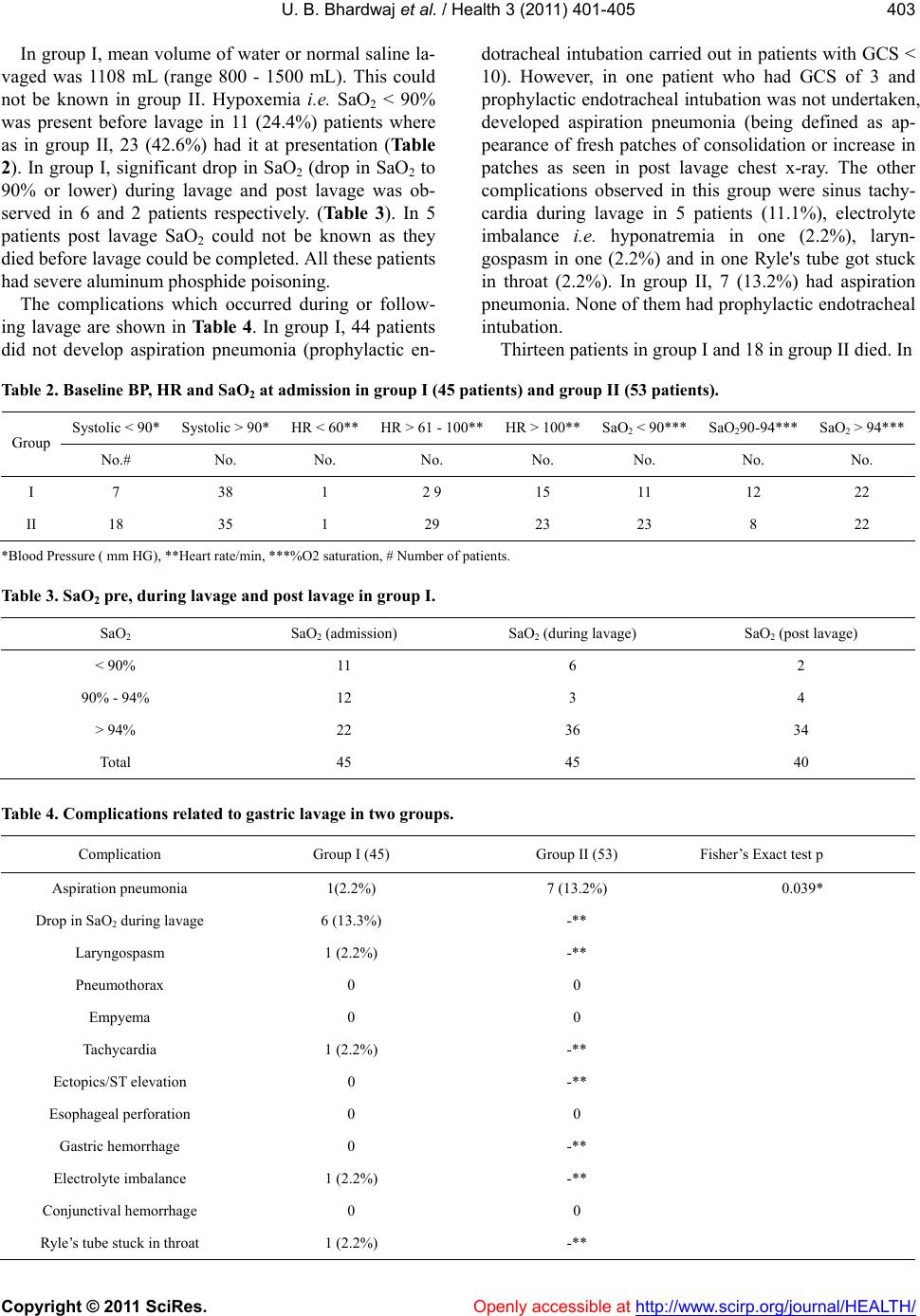 U. B. Bhardwaj et al. / Health 3 (2011) 401-405 Copyright © 2011 SciRes. http://www.scirp.org/journal/HEALTH/Openly accessible at 403 In group I, mean volume of water or normal saline la- vaged was 1108 mL (range 800 - 1500 mL). This could not be known in group II. Hypoxemia i.e. SaO2 < 90% was present before lavage in 11 (24.4%) patients where as in group II, 23 (42.6%) had it at presentation (Table 2). In group I, significant drop in SaO2 (drop in SaO2 to 90% or lower) during lavage and post lavage was ob- served in 6 and 2 patients respectively. (Tab le 3 ). In 5 patients post lavage SaO2 could not be known as they died before lavage could be completed. All these patients had severe aluminum phosphide poisoning. The complications which occurred during or follow- ing lavage are shown in Table 4. In group I, 44 patients did not develop aspiration pneumonia (prophylactic en- dotracheal intubation carried out in patients with GCS < 10). However, in one patient who had GCS of 3 and prophylactic endotracheal intubation was not undertaken, developed aspiration pneumonia (being defined as ap- pearance of fresh patches of consolidation or increase in patches as seen in post lavage chest x-ray. The other complications observed in this group were sinus tachy- cardia during lavage in 5 patients (11.1%), electrolyte imbalance i.e. hyponatremia in one (2.2%), laryn- gospasm in one (2.2%) and in one Ryle's tube got stuck in throat (2.2%). In group II, 7 (13.2%) had aspiration pneumonia. None of them had prophylactic endotracheal intubation. Thirteen patients in group I and 18 in group II died. In Table 2. Baseline BP, HR and SaO2 at admission in group I (45 patients) and group II (53 patients). Systolic < 90* Systolic > 90* HR < 60** HR > 61 - 100**HR > 100**SaO2 < 90***SaO290-94*** SaO2 > 94*** Group No.# No. No. No. No. No. No. No. I 7 38 1 2 9 15 11 12 22 II 18 35 1 29 23 23 8 22 *Blood Pres sure ( mm HG), **Heart rate/min, ***%O2 satur ation, # Number of patients. Table 3. SaO2 pre, during lavage and post lavage in group I. SaO2 SaO2 (admission) SaO2 (dur in g lavag e) SaO2 (post lavage) < 90% 11 6 2 90% - 94% 12 3 4 > 94% 22 36 34 Total 45 45 40 Table 4. Complications related to gastric lavage in two groups. Complication Group I (45) Group II (53) Fisher’s Exact test p Aspiration pneumonia 1(2.2%) 7 (13.2%) 0.039* Drop in SaO2 during lavage 6 (13.3%) -** Laryngospasm 1 (2.2%) -** Pneumothorax 0 0 Empyema 0 0 Tachycardia 1 (2.2%) -** Ectopics/ST elevation 0 -** Esophageal perforation 0 0 Gastric hemorrhage 0 -** Electrolyte imbalance 1 (2.2%) -** Conjunctival hemorrhage 0 0 Ryle’s tube stuck in throat 1 (2.2%) -** 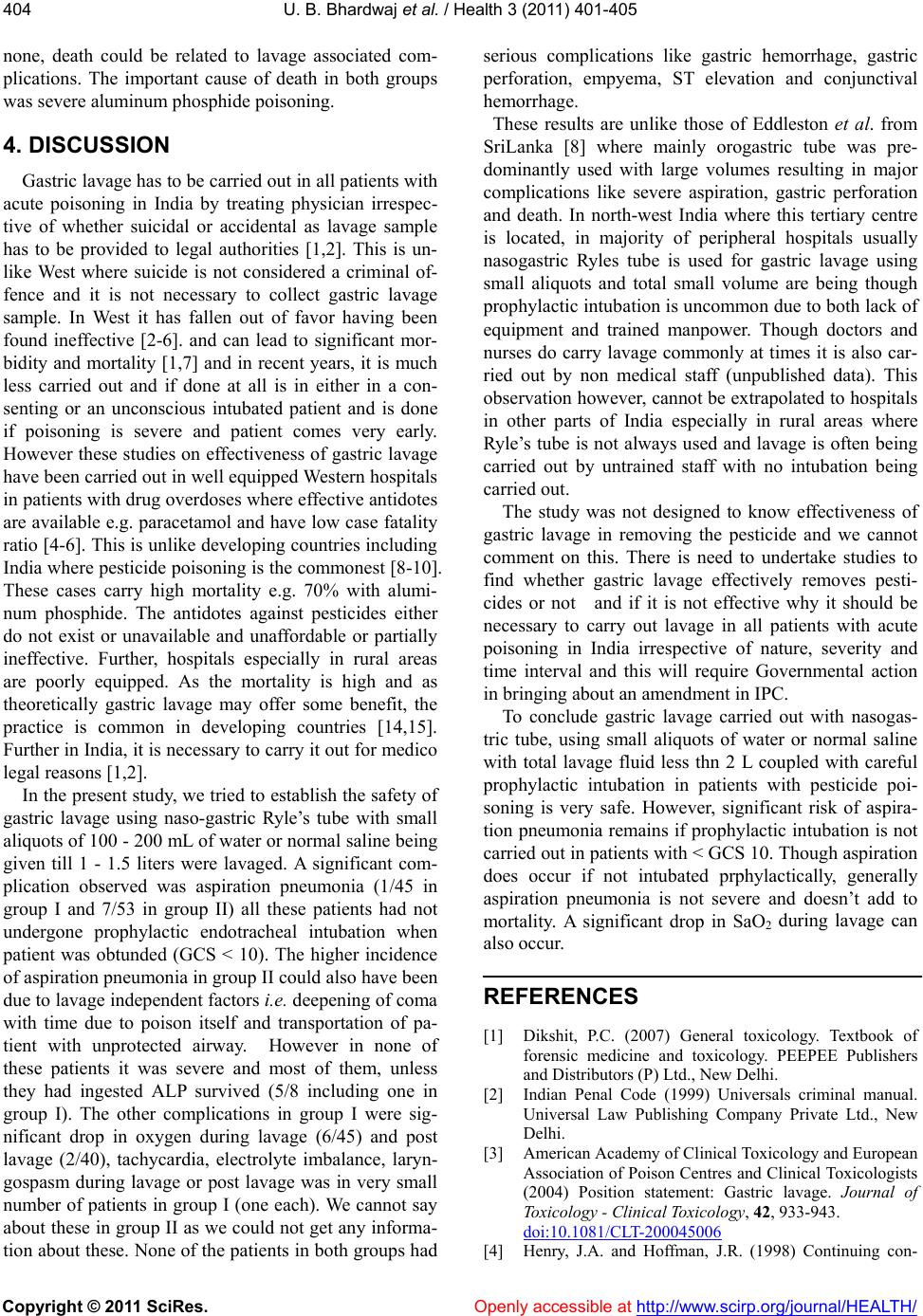 U. B. Bhardwaj et al. / Health 3 (2011) 401-405 Copyright © 2011 SciRes. Openly accessible at http://www.scirp.org/journal/HEALTH/ 404 none, death could be related to lavage associated com- plications. The important cause of death in both groups was severe aluminum phosphide poisoning. 4. DISCUSSION Gastric lavage has to be carried out in all patients with acute poisoning in India by treating physician irrespec- tive of whether suicidal or accidental as lavage sample has to be provided to legal authorities [1,2]. This is un- like West where suicide is not considered a criminal of- fence and it is not necessary to collect gastric lavage sample. In West it has fallen out of favor having been found ineffective [2-6]. and can lead to significant mor- bidity and mortality [1,7] and in recent years, it is much less carried out and if done at all is in either in a con- senting or an unconscious intubated patient and is done if poisoning is severe and patient comes very early. However these studies on effectiveness of gastric lavage have been carried out in well eq u ipped Western ho sp itals in patients with drug overdoses wh ere effective antidotes are available e.g. paracetamol and have low case fatality ratio [4-6]. This is un like developing countries including India where pesticide poisoning is the commonest [8-10]. These cases carry high mortality e.g. 70% with alumi- num phosphide. The antidotes against pesticides either do not exist or unavailable and unaffordable or partially ineffective. Further, hospitals especially in rural areas are poorly equipped. As the mortality is high and as theoretically gastric lavage may offer some benefit, the practice is common in developing countries [14,15]. Further in India, it is necessary to carry it out for medico legal reasons [1,2]. In the present study, we tried to establish the safety of gastric lavage using naso-gastric Ryle’s tube with small aliquots of 100 - 200 mL of water or normal saline being given till 1 - 1.5 liters were lavaged. A significant com- plication observed was aspiration pneumonia (1/45 in group I and 7/53 in group II) all these patients had not undergone prophylactic endotracheal intubation when patient was obtunded (GCS < 10). The higher incidence of aspiration pneumonia in group II could also have been due to lavage independent factors i.e. deep enin g of co ma with time due to poison itself and transportation of pa- tient with unprotected airway. However in none of these patients it was severe and most of them, unless they had ingested ALP survived (5/8 including one in group I). The other complications in group I were sig- nificant drop in oxygen during lavage (6/45) and post lavage (2/40), tachycardia, electrolyte imbalance, laryn- gospasm during lavage or post lavage was in very small number of patients in group I (one each). We cannot say about these in group II as we could not get any informa- tion about these. None of the patients in both groups had serious complications like gastric hemorrhage, gastric perforation, empyema, ST elevation and conjunctival hemorrhage. These results are unlike those of Eddleston et al. from SriLanka [8] where mainly orogastric tube was pre- dominantly used with large volumes resulting in major complications like severe aspiration, gastric perforation and death. In north-west India where this tertiary centre is located, in majority of peripheral hospitals usually nasogastric Ryles tube is used for gastric lavage using small aliquots and total small volume are being though prophylactic intubation is uncommon due to both lack of equipment and trained manpower. Though doctors and nurses do carry lavage commonly at times it is also car- ried out by non medical staff (unpublished data). This observation however, cannot be extrapolated to hospitals in other parts of India especially in rural areas where Ryle’s tube is not always used and lavage is often being carried out by untrained staff with no intubation being carried out. The study was not designed to know effectiveness of gastric lavage in removing the pesticide and we cannot comment on this. There is need to undertake studies to find whether gastric lavage effectively removes pesti- cides or not and if it is not effective why it should be necessary to carry out lavage in all patients with acute poisoning in India irrespective of nature, severity and time interval and this will require Governmental action in bringing about an amendment in IPC. To conclude gastric lavage carried out with nasogas- tric tube, using small aliquots of water or normal saline with total lavage fluid less thn 2 L coupled with careful prophylactic intubation in patients with pesticide poi- soning is very safe. However, significant risk of aspira- tion pneumonia remains if prophylactic intubation is not carried out in patients with < GCS 10. Though aspiration does occur if not intubated prphylactically, generally aspiration pneumonia is not severe and doesn’t add to mortality. A significant drop in SaO2 during lavage can also occur. REFERENCES [1] Dikshit, P.C. (2007) General toxicology. Textbook of forensic medicine and toxicology. PEEPEE Publishers and Distributors (P) Ltd., New Delhi. [2] Indian Penal Code (1999) Universals criminal manual. Universal Law Publishing Company Private Ltd., New Delhi. [3] American Academy of Clinical Toxicology and European Association of Poison Centres and Clinical Toxicologists (2004) Position statement: Gastric lavage. Journal of Toxicology - Clinical Toxicology, 42, 933-943. doi:10.1081/CLT-200045006 [4] Henry, J.A. and Hoffman, J.R. (1998) Continuing con-  U. B. Bhardwaj et al. / Health 3 (2011) 401-405 Copyright © 2011 SciRes. Openly accessible at http://www.scirp.org/journal/HEALTH/ 405 troversy on gut decontamination. Lancet, 352, 420-421. doi:10.1016/S0140-6736(05)79183-2 [5] Bond, G.R. (2002) The role of activated charcoal and gastric emptying in gastrointestinal decontamination: A state of art review. American Journal of Emergency Medicine, 39, 237-286. [6] Ardagh, M., Flood, D. and Tait, C. (2001) Limiting the use of gastro-intestinal decontamination does not worsen the outcome from deliberate self poisoning. The New Zealand Medical Journal, 114, 423-425. [7] Gunnell, D., Ho, D.D. and Murray, V. (2004) Medical management of deliberate drug overdose-a neglected area of suicide prevention. Emergency Medicine Journal, 21, 35-38. doi:10.1136/emj.2003.000935 [8] Eddleston, M., et al . (2007) The hazards of gastric lavage for intentional self poisoning in a resource poor location. Clinical To xicol ogy, 45, 136-143. doi:10.1080/15563650601006009 [9] Singh, S., Wig, N., Chaudhary, D., Sood, N.K. and Sharma, B.K. (1997) Changing pattern of acute poison- ing in adult: Experience of a large Northwest Indian hos- pital (1970-1989). Journal of Association of Physicians of India, 45, 194-197. [10] Singh, D., Jit, I. and Tyagi, S. (1999) Changing trends in acute poisoning in Chandigarh zone: A 25 years autopsy experience from a tertiary care hospital in northern India. The American Journal of Forensic Medicine and Pa- thology, 20, 203-210. doi:10.1097/00000433-199906000-00019 [11] Eddleston, M. (2000) Pattern and problems of deliberate self poisoning in the developing world. The Quart Jour- nal, 93, 715-731. [12] Eddleston, M., Senarathna, I., Mohmad, F., Buckley, N., Juszczak, E., et al. (2003) Deaths due to absence of an affordable antitoxin for plant poisoning. Lancet, 362, 1041-1044. doi:10.1016/S0140-6736(03)14415-7 [13] Eddleston, M., Singh, S. and Buckley, N. (2007) Acute organophosphorus poisoning. Clinical Evidence Hand- book. British Medical Journal Publishing Group, London, 413-415. [14] Bhattarai, M.D. (2000) Gastric lavage is perhaps more important in developing countries. BMJ, 320, 711. doi:10.1136/bmj.320.7236.711 [15] Fernando, R. (1998) Management of acute poisoning. The National Poisons Information Centre in Sri Lanka, Colombo. |