

Paper Menu >>
Journal Menu >>
 Intelligent Information Ma nagement, 2011, 3, 137-141 doi: 10.4236/iim.2011.34017 Published Online July 2011 (http://www.SciRP.org/journal/iim) Copyright © 2011 SciRes. IIM A Dynamic Cross Contagion Model of Curr ency Crisis between Two Countries* Yirong Ying1, Xiangqing Zou1, Ke Chen1,2, Yuyuan Tong1 1 Shanghai University, Shanghai, China 2 Chongqing Jiaotong University, Chongqing, China E-mail: [email protected] Received March 31, 2011; revised April 26, 2011; accepted May 10, 2011 Abstract The contagion aspect of the currency crisis is an important research issue today. In this paper, we set up a dynamic differential model of currency crisis cross contagions between two countries by expanding general- ized logistics model, and analyze all kinds of possible equilibrium conditions. It is probably a new idea of studying currency crisis contagion mechanism. Keywords: Cross Contagion, Currency Crisis, Differential Dynamic Model 1. Introduction Since 1970s, currency crisis have occurred frequently on a global scale. Especially, in the past twenty years, there have happened several currency crises with significant influence: European exchange rate system crisis in 1992-1993, Mexican crisis in 1994-1995, southeast Asian crisis in 1997-1998, Russian rubles crisis in 1998, Brazilian curren cy crisis in 1998-1999, Turkish lire crisis in 2000-2001, Argentine peso crisis in 2001-2002 and the global crisis triggered by American subprime crisis in 2007. They may be caused by unreasonable domestic economic structures, heavy debt, unsuccessful monetary policy or external shocks caused by international finan- cial speculators. However the worse thing than crises happening frequ ently is crisis contagions within a region or global area. This leads to more crises impacts on the economic or financial system over the world. And the crisis contagions tend to be stronger and stronger, wider and wider. From the phenomenon perspective, the simple reason of stronger and wider crises contagions is that the continuous development of international trade and capi- tal flows make closer and closer relations of global economy and finance. But beyond the simple reason, what is complex mechanism of monetary crisis contag ion? It will be the focus of this paper. Since three generations of models were developed to explain financial crises, many scholars have done a lot in the area of currency crisis contagion mechanism and con- tagion path. Olivier Loisel and Philippe Martin (2001) presented a micro-fou nded model where governments had an incentive to devalue to increase the national market share in a monopolistically competitive sector. The con- clusion showed that the more important trade competition, the more likely self-fulfilling speculative crises and the larger the set of multiple equilibria. They also concluded that coordination decreased the possibility of simultane- ous self-fulfilling speculative crises in the region and re- duced the set of multiple equilibria. However, regional coordination, even though welfare improving, makes countries more dependent on other countries’ fundamen- tals so that it may induce more contagion [1]. Helmut Stix (2007) studied the effects of France interventions during the 1992-1993 European Monetary System crises. In his paper, a Markov Switching model is estimated where interventions influence the probabilities of transition be- tween one calm and turbulent regime [2]. Eelke de Jong, Willem F. C, Verschoor and Remco C. J. Zw inkels (2009) estimated a dynamic hetero-generous agent model for the British pound during the European monetary system crisis and illustrate the ch ain of events leading to the suspension of the pound from the exchange rate mechanism in terms of switching beliefs [3]. Li Gang, Pan Hao-min and Jia Wei (2009) empirically studied spatial convergence and contagious pathes of financial crisis using methods of spatial statistical analysis. They concluded that conta- gious paths o f subprime crisis in the United States are the location of geographic regions, G7 political groups, trade *This work has been supported by the Research Fund of Program Found- ation of Education Ministry of China (10YJA790233). 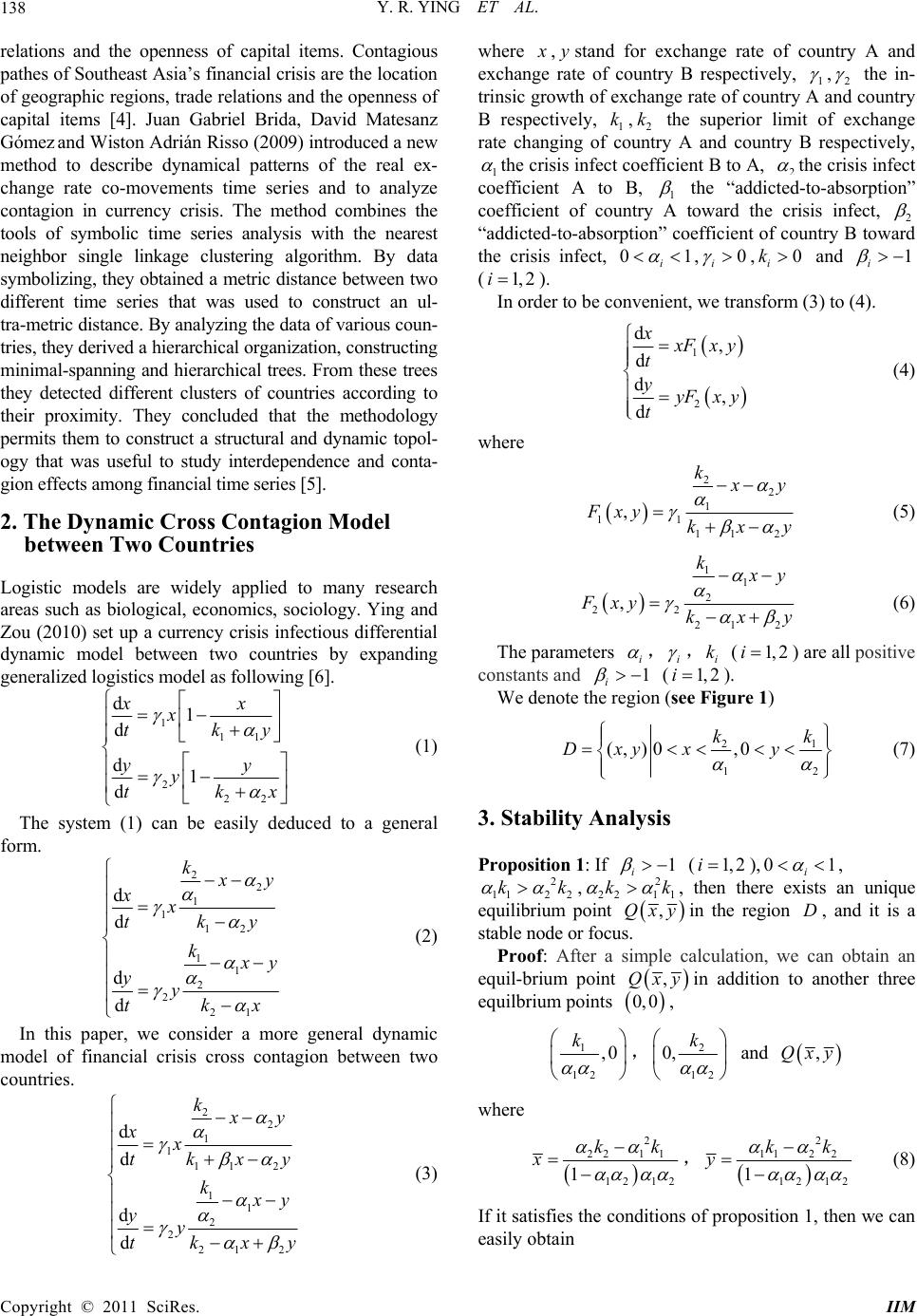 Y. R. YING ET AL. Copyright © 2011 SciRes. IIM 138 relations and the openness of capital items. Contagious pathes of Southeast Asia’s financial crisis a re the location of geographic regions, trade relations and the openness of capital items [4]. Juan Gabriel Brida, David Matesanz Gómez and Wiston Adrián Risso (2009) introduced a new method to describe dynamical patterns of the real ex- change rate co-movements time series and to analyze contagion in currency crisis. The method combines the tools of symbolic time series analysis with the nearest neighbor single linkage clustering algorithm. By data symbolizing, they obtained a metric distance between two different time series that was used to construct an ul- tra-metric distance. By analyzing the data of various coun- tries, they derived a hierarchical organization, constructing minimal-spanning and hierarchical trees. From these trees they detected different clusters of countries according to their proximity. They concluded that the methodology permits them to construct a structural and dynamic topol- ogy that was useful to study interdependence and conta- gion effects among financial tim e series [5]. 2. The Dynamic Cross Contagion Model between Two Countries Logistic models are widely applied to many research areas such as biological, economics, sociology. Ying and Zou (2010) set up a currency crisis infectious differential dynamic model between two countries by expanding generalized logistics model as following [6]. 111 222 d1 d d1 d xx x tky yy y tkx (1) The system (1) can be easily deduced to a general form. 22 1 112 11 2 221 d d d d k x y xx tky k x y yy tkx (2) In this paper, we consider a more general dynamic model of financial crisis cross contagion between two countries. 22 1 111 2 11 2 221 2 d d d d k x y xx tkxy k x y yy tkxy (3) where x ,ystand for exchange rate of country A and exchange rate of country B respectively, 1 ,2 the in- trinsic growth of exchang e rate of country A and country B respectively, 1 k,2 k the superior limit of exchange rate changing of country A and country B respectively, 1 the crisis infect coefficient B to A, 2 the crisis infect coefficient A to B, 1 the “addicted-to-absorption” coefficient of country A toward the crisis infect, 2 “addi cted-to-absorp tion” coefficient of country B toward the crisis infect, 01 i ,0 i ,0 i k and 1 i (1, 2i ). In order to be convenient, we transform (3) to (4). 1 2 d, d d, d x x Fxy t yyFx y t (4) where 22 1 11 11 2 , k x y Fxy kxy (5) 11 2 22 21 2 , k x y Fxy kxy (6) The parameters i ,i ,i k (1, 2i) ar e all positive constants and 1 i (1, 2i ). We denote the region (see Figure 1) 21 12 (, )0,0 kk Dxy xy (7) 3. Stability Analysis Proposition 1: If 1 i (1, 2i),01 i , 2 112 2 kk ,2 22 11 kk , then there exists an unique equilibrium point ,Qxyin the region D, and it is a stable node or focus. Proof: After a simple calculation, we can obtain an equil-brium point ,Qxyin addition to another three equilbrium points 0,0 , 1 12 ,0 k ,2 12 0, k and ,Qxy where 2 221 1 12 12 1 kk x , 2 112 2 12 12 1 kk y (8) If it satisfies the conditions of proposition 1, then we can easily obtain 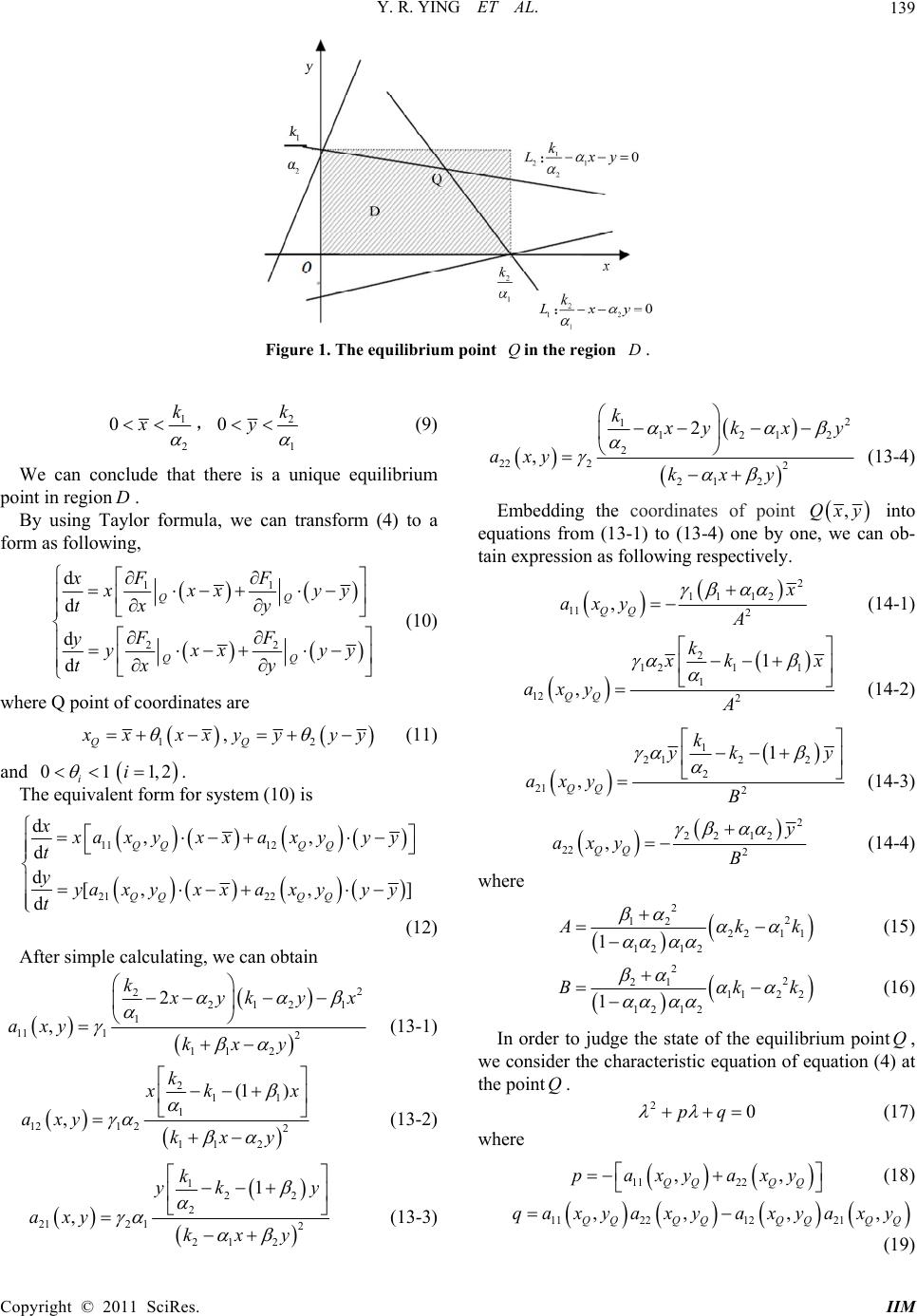 Y. R. YING ET AL. Copyright © 2011 SciRes. IIM 139 Figure 1. The equilibrium point Qin the region D. 1 2 0k x ,2 1 0k y (9) We can conclude that there is a unique equilibrium point in regionD. By using Taylor formula, we can transform (4) to a form as following, 11 22 d d d d QQ QQ FF x x xx yy tx y FF y y xx yy tx y (10) where Q point of coordinates are 1Q x xxx , 2Q y yyy (11) and 01 i 1, 2i. The equivalent form for system (10) is 11 12 21 22 d,, d d[,, ] d QQ QQ QQ QQ x x axyxx axyyy t yyaxyx xaxyyy t (12) After simple calculating, we can obtain 2 2212 1 1 11 12 11 2 2 , k x ykyx axy kxy (13-1) 211 1 121 22 11 2 (1 ) , k x kx axy kxy (13-2) 122 2 212 12 21 2 1 , k yk y axykxy (13-3) 2 11212 2 22 22 21 2 2 , k x yk xy axy kxy (13-4) Embedding the coordinates of point ,Qxy into equations from (13-1) to (13-4) one by one, we can ob- tain expression as following respectively. 2 11 12 11 2 , QQ x axy A (14-1) 2 121 1 1 12 2 1 , QQ k x kx axy A (14-2) 1 212 2 2 21 2 1 , QQ k yk y axy B (14-3) 2 22 12 22 2 , QQ y axyB (14-4) where 22 12 221 1 12 12 1 A kk (15) 22 21 112 2 12 12 1 Bkk (16) In order to judge the state of the equilibrium pointQ, we consider the characteristic equation of equation (4) at the pointQ. 20pq (17) where 11 22 ,, QQ QQ paxyaxy (18) 11 221221 ,, ,, QQQQQQ QQ qaxyaxya xya xy (19) 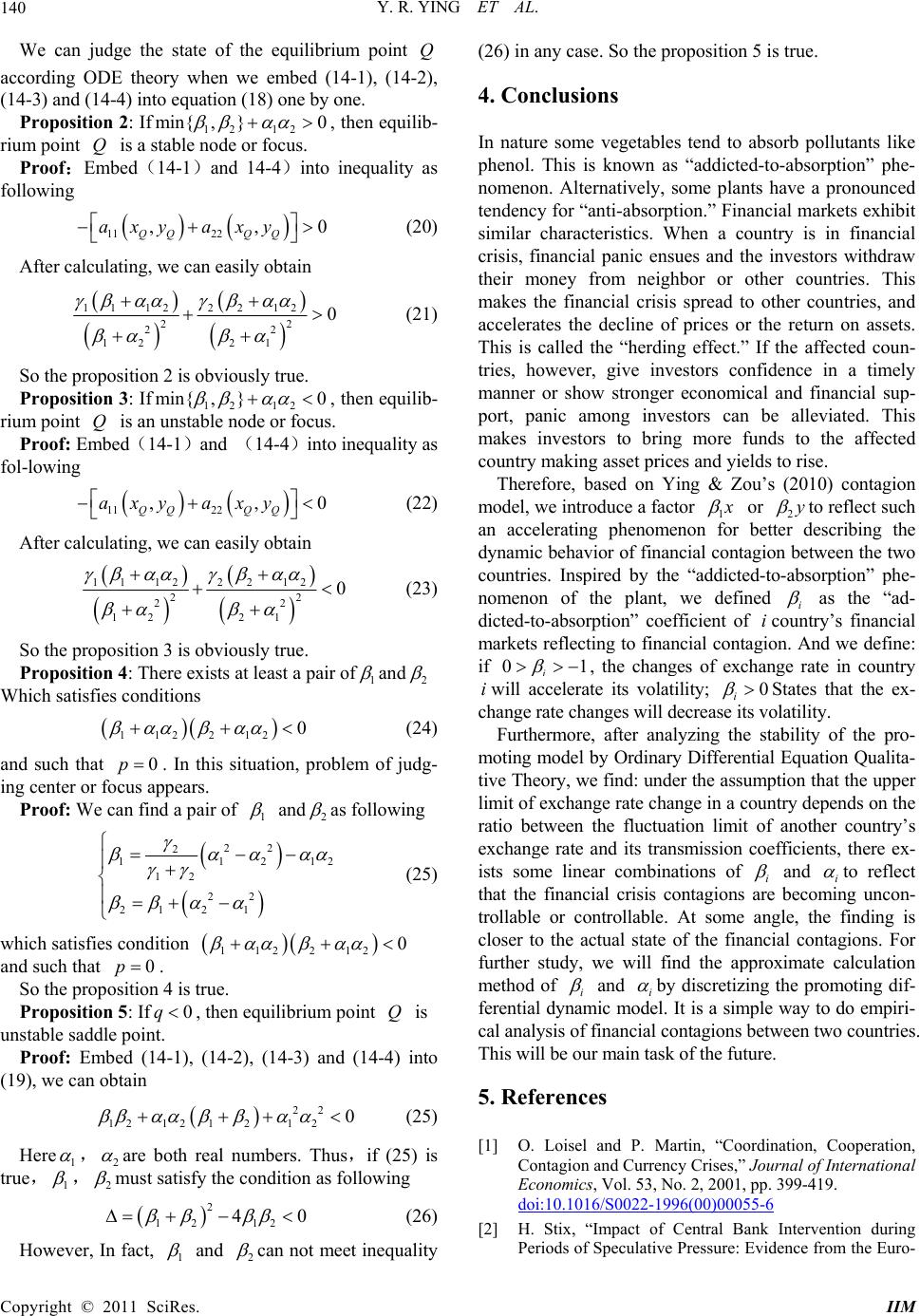 Y. R. YING ET AL. Copyright © 2011 SciRes. IIM 140 We can judge the state of the equilibrium point Q according ODE theory when we embed (14-1), (14-2), (14-3) and (1 4-4) into equation (18) one by one. Proposition 2: If12 12 min{ ,}0 , then equilib- rium point Q is a stable node or focus. Proof:Embed(14-1 )and 14-4)into inequality as following 11 22 ,,0 QQ QQ axy axy (20) After calculating, we can easily obtain 1 1122212 22 22 12 21 0 (21) So the proposition 2 is obviously true. Proposition 3: If12 12 min{ ,}0 , then equilib- rium point Q is an unstable node or focus. Proof: Embed(14 -1)and (14-4)into inequality as fol-lowing 11 22 ,,0 QQ QQ axy axy (22) After calculating, we can easily obtain 1 1122212 22 22 12 21 0 (23) So the proposition 3 is obviously true. Proposition 4: There exists at least a pair of1 and 2 Which satisfies conditions 1122120 (24) and such that 0p. In this situation, problem of judg- ing center or focus appears. Proof: We can find a pair of 1 and2 as following 22 2 11212 12 22 212 1 (25) which satisfies condition 112 2120 and such that 0p. So the proposition 4 is true. Proposition 5: If0q, then equilibrium point Q is unstable saddle point. Proof: Embed (14-1), (14-2), (14-3) and (14-4) into (19), we can obtain 22 1212121 20 (25) Here 1 ,2 are both real numbers. Thus,if (25) is true,1 ,2 must satisfy the condition as following 2 12 12 40 (26) However, In fact, 1 and 2 can not meet inequality (26) in any case. So the proposition 5 is true. 4. Conclusions In nature some vegetables tend to absorb pollutants like phenol. This is known as “addicted-to-absorption” phe- nomenon. Alternatively, some plants have a pronounced tendency for “anti-absorption.” Financial markets exhibit similar characteristics. When a country is in financial crisis, financial panic ensues and the investors withdraw their money from neighbor or other countries. This makes the financial crisis spread to other countries, and accelerates the decline of prices or the return on assets. This is called the “herding effect.” If the affected coun- tries, however, give investors confidence in a timely manner or show stronger economical and financial sup- port, panic among investors can be alleviated. This makes investors to bring more funds to the affected country making asset prices and yields to rise. Therefore, based on Ying & Zou’s (2010) contagion model, we introduce a factor 1 x or 2y to reflect such an accelerating phenomenon for better describing the dynamic behavior of financial contagion between the two countries. Inspired by the “addicted-to-absorption” phe- nomenon of the plant, we defined i as the “ad- dicted-to-absorption” coefficient of icountry’s financial markets reflecting to financial contagion. And we define: if 01 i , the changes of exchange rate in country iwill accelerate its volatility; 0 i States that the ex- change rate changes will decrease its volatility. Furthermore, after analyzing the stability of the pro- moting model by Ordinary Differential Equation Qualita- tive Theory, we find: under the assumption that the upper limit of exchange rate change in a country depends on the ratio between the fluctuation limit of another country’s exchange rate and its transmission coefficients, there ex- ists some linear combinations of i and i to reflect that the financial crisis contagions are becoming uncon- trollable or controllable. At some angle, the finding is closer to the actual state of the financial contagions. For further study, we will find the approximate calculation method of i and i by discretizing the promoting dif- ferential dynamic model. It is a simple way to do empiri- cal analysis of financial contagions between two countries. This will be our main task of the future. 5. References [1] O. Loisel and P. Martin, “Coordination, Cooperation, Contagion and Currency Crises,” Journal of International Economics, Vol. 53, No. 2, 2001, pp. 399-419. doi:10.1016/S0022-1996(00)00055-6 [2] H. Stix, “Impact of Central Bank Intervention during Periods of Speculative Pressure: Evidence from the Euro-  Y. R. YING ET AL. Copyright © 2011 SciRes. IIM 141 pean Monetary System,” German Economic Review, Vol. 8, No. 3, 2007, pp. 399-427. doi:10.1111/j.1468-0475.2007.00412.x [3] E. de Jong, W. Verschoor and R. Zwinkels, “A Hetero- geneous Route to the European Monetary System Crisis,” Applied Economics Letters, Vol. 16, No. 9, 2009, pp. 929- 932. doi:10.1080/13504850701222152 [4] G. Li, H. M. Pan and W. Jia “Statistics for Microarrays: Design, Analysis,” Statistical Research, Vol. 26, No. 12, 2009, pp. 81-87. [5] J. G. Brida, D. M. Gómez and W. A. Risso, “Symbolic Hierarchical Analysis in Currency Markets: an Applica- tion to Contagion in Currency Crises,” Expert Systems with Applications, Vol. 36, No. 4, 2009, pp. 7721-7728. doi:10.1016/i.eswa.2008.09.038 [6] Y. R. Ying and X. Q. Zou, “Study on a Contagion Model of Currency Crisis between Two Countries,” Molecular Biology, Biophysics and Bioengineering of the CMBB, Qiqihar, China, 2010, pp. 599-602. |