

Paper Menu >>
Journal Menu >>
 International Journal of Clinical Medicine, 2011, 2, 346-351 doi:10.4236/ijcm.2011.23060 Published Online July 2011 (http://www.SciRP.org/journal/ijcm) Copyright © 2011 SciRes. IJCM Quality of Life of Patients with Metastatic Breast Cancer Treated with Epirubicin and Docetaxel* Jaana Korpela1, Pekka Mali1, Anne Kaljonen2, Eeva Salminen1 1Department of Oncology and Radiotherapy, Turku University Hospital, Turku, Finland; 2 Turku Institute for Child and Youth Research, University of Turku, Turku, Finland. Email: [email protected] Received April 24th, 2011; revised May 28th, 2011; accepted June 16th, 2011. ABSTRACT This phase II study assessed the clinical response and short-term quality of life of patients receiving first-line chemo- therapy with epirubicin-docetaxel combination for metastatic breast cancer. Thirty-one breast cancer patients were treated with epirubicin (75 mg/m2 for 15 minutes) followed one hour later by a one-hour infusion of docetaxel (75 mg/m2) q3w. EORTC QLQ-C30 and EORTC QLQ-BR23 forms were filled in at baseline, and at th e second and eighth cycle of chemotherapy. The combination of epirubicin and docetaxel provided a high degree of clinical benefit. Clinical response was observed in 17 patients (55 %), including five (16%) complete responses and 12 (39%) partial responses. Of responding and stable patients 23 (74%) maintained the same status for at least six months (clinical benefit). The mean survival time was 40.8 months. Du ring the treatment the emotional fun ctioning improved and the concerns abou t the future were relieved. Some aspects of quality of life were impaired, with slightly decreased physical and cognitive functioning, distress related to body image and hair loss, and adverse effects of chemotherapy. Overall, the global quality of life was maintained. Keywords: Metastatic Breast Cancer, Chemotherapy, Epirubicin, Docetaxel, Quality of Life 1. Introduction As metastatic breast cancer still remains essentially in- curable, the main goals of therapy include treatment of symptoms and maintaining the quality of life, as well as a delay in disease progression and prolongation of over- all survival. As women with metastatic breast cancer have a relatively short expected survival time, the im- pact on quality of life is an important factor to consider when making treatment decisions. The adverse effects of treatment should be kept as low as possible and small gains must be weighed against the severity of adverse effects. Collection of data from formal quality of life instruments can broaden the parameters of benefit be- yond response and survival, and can allow more accu- rate determination of the supportive and ameliorative interventions needed by the patients. Nevertheless, per- haps due to methodological difficulties, many clinical trials in metastatic breast cancer have been published without quality of life data [1]. Chemotherapy is the mainstay of treatment for me- tastatic breast cancer patients with hormone receptor- negative disease or with hormone receptor-positive dis- ease which h as become resis tant to en docr ine ther apy, or is rapidly progressive and life-threatening. Anthracy- cline- and taxane- based therapies have shown the high- est degree of response in metastatic breast cancer. Tax- ane-containing regimens are associated with increased overall survival [2]. Relatively few studies have reported the effect of the combination of anthracyclines and tax- anes on the quality of life among women treated first-line for metastatic breast cancer [3-8]. Even less is known about the effects of epirubicin and docetaxel combination on the quality of life. To our knowledge previously only Yeo et al. have reported the effects of an epirubicin and docetaxel combination on the quality of life in metastatic breast cancer [9]. Previously, we have reported the efficacy, toxicity and cost of treatment with the combination of epirubicin and docetaxel in metastatic breast cancer [10-12]. This report assessed the short-term quality of life outcome. 2. Methods 2.1. Patients and Treatment Originally thirty-eight patients with metastatic breast *Supported by the Cancer Society of South-Western Finland (JK).  Quality of Life of Patients with Metastatic Breast Cancer Treated with Epirubicin and Docetaxel347 cancer were treated with the combination of epirubicin and docetaxel. In this report on ly the 35 Finnish-speaking patients were included. Eligibility criteria for the epiru- bicin-docetaxel study included written informed consent, age 18 - 75 years, ECOG performance status <2, white blood cell count >3000/mm3, platelet count >130,000/ mm3, and liver function <3 times the normal value. Pre- vious adjuvant treatment with CMF (cyclophos- phamide, methotrexate and 5-fluorouracil) or CEF (cyclo-phos- phamide, epirubicin and 5-fluorouracil) was allowed, as were prior hormonal therapy or radiotherapy. Exclusion criteria included brain or leptomeningeal involvement and active infection. The study was conducted according to the ethical standards described in the Helsinki Decla- ration. The protocol was approved by the Ethical Com- mittee of Turku University Hospital and written informed consent w as obtained f rom the pat ients. The patients were treated with epirubicin (75 mg/m2 15-minute infusion) followed one hour later by docetaxel (75 mg/m2, one-hour infusion) every three weeks. The doses were based on earlier studies that have demon- strated the applicable levels without growth factor sup- port [13,14]. Mid -cycle co unts were taken on d ay 10 - 11. The aim was to give eight cycles to responding/stable patients. The starting dose of 75 mg/m2 for both epirubi- cin and docetaxel was reduced by 25% if the patient was hospitalized due to febrile neutropenia, required antibi- otics, or developed prolonged neutropenia. Premedica- tion of prednisolone (40 mg) was given orally the night before treatment and continued b.i.d. on days 1 - 3. A prophylactic anti-emetic was given according to routine practice (5HT-blocker prior to chemotherapy infu sion). 2.2. Response Response was defined according to WHO criteria after the third cycle and at close of treatment [15]. Clinical benefit was calculated for responding and stable patients maintaining the same status for at least six months. The mean follow-up time was 79.9 months. 2.3. Quality of Life Evaluations and Statistical Analysis Quality of life was assessed with the European Organ iza- tion for Research and Treatment of Cancer Quality of Life Questionnaire EORTC QLQ-C30 version +3 [16] and the QLQ-BR23 Breast module [17]. The patients filled in the EORTC QLQ-C30 forms at baseline, just before the second and eighth cycle, and three months after the last cycle. EORTC QLQ-C30 raw scores were calculated according to guidelines, yielding a range of 0 - 100. A high score on the functiona l or global qu ality of life scale represents a better level of functioning, and a high score on the symptom or item scale represents more symptoms. According to Osoba et al., a difference of 5 to 10 points on a 0 to 100 scale is considered a small clinically significant change, a difference of 10 to 20 points a moderate change, and changes greater than 20 points would be interpreted as large changes in quality of life [18]. The comparisons of quality of life scores at different time points were carried out with analysis of variance for repeated measurements. The analyses were per- formed using the MIXED procedure (SAS system for Windows XP version 9 .1.3 2003) which offers a sophis- ticated tool for analysis of follow-up data with possible missing data during follow-up (Littell R, Milliken GA, Stroup W, Wolfinger RD. SAS® system for Mixed Models. Cary, NC: SAS Institute, Inc, 1996). P-values less than 0.05 were considered statistically significant. The survival analysis was estimated using the Kaplan- Meier technique. 3. Results 3.1. Patient Characteristics and Treatment Patient characteristics are shown in Table 1. The mean age was 50 years (range 35 - 72 years). The mean ECOG performance status was 1 (range 0 - 2) before chemo- therapy. Twenty-seven patients (87%) received all the planned eight cycles. 3.2. Response Clinical response was achieved by seventeen patients (55%), including five (16%) complete responses (CR) and twelve (39%) partial responses (PR). Twenty-three patients (74%) showed clinical benefit, i.e. responding and stable patients (CR, PR and NC) maintaining the same status for at least six months (Table 2). The mean overall survival time was 40.8 months (SD 23.8). 3.3. Quality of life Of the 35 Finnish-speaking patients originally in the epirubicin-docetaxel study, four patients had to be ex- cluded: baseline data were missing for two patients, one patient filled in the baseline questionnaire one day after the first cycle instead of on the recommended date, and one patient was non-evaluable for response and was therefore excluded. Thirty-one patients filled in the questionnaire at baseline before the first cycle, twenty- four just before the second, and twenty-five before the eighth cycle. Because only seven patients filled in the questionnaire at the control visit three months after the treatment, it was decided to leave this last visit out of the analysis. The patients whose disease progressed (4 pa- tients) did not fill in the questionnaires at the last cycle as they did not attend the last visits either. The results from the quality of life questionnaires are Copyright © 2011 SciRes. IJCM 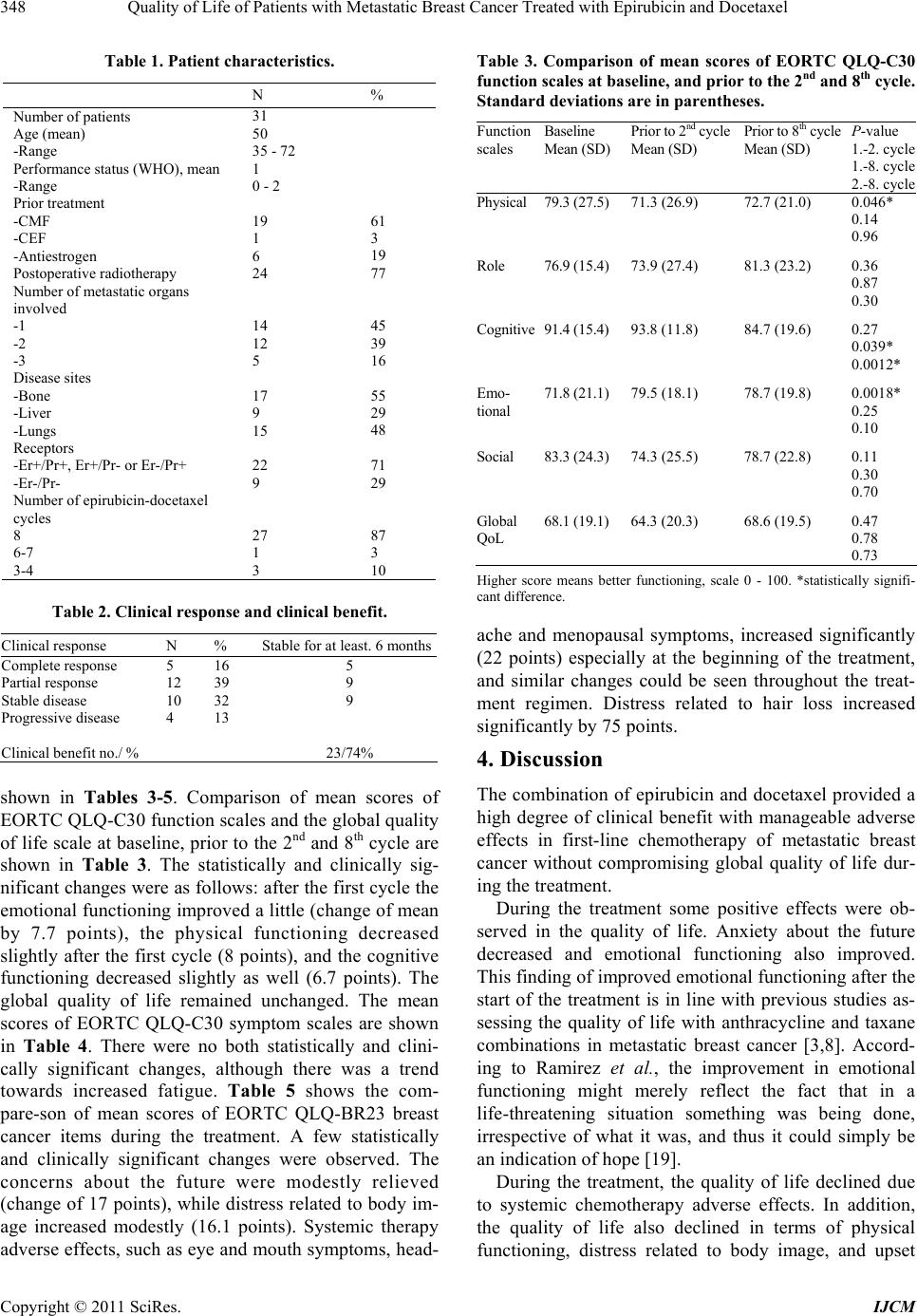 Quality of Life of Patients with Metastatic Breast Cancer Treated with Epirubicin and Docetaxel 348 Table 1. Patient characteristics. N % Number of patients Age (mean) -Range Performance status (WHO), mean -Range Prior treatment -CMF -CEF -Antiestrogen Postoperative radiotherapy Number of metastatic organs involved -1 -2 -3 Disease sites -Bone -Liver -Lungs Receptors -Er+/Pr+, Er+/Pr- or Er-/Pr+ -Er-/Pr- Number of epirubicin-docetaxel cycles 8 6-7 3-4 31 50 35 - 72 1 0 - 2 19 1 6 24 14 12 5 17 9 15 22 9 27 1 3 61 3 19 77 45 39 16 55 29 48 71 29 87 3 10 Table 2. Clinical response and clinical benefit. Clinical response N % Stable for at least. 6 months Complete response Partial response Stable disease Progressive disease 5 12 10 4 16 39 32 13 5 9 9 Clinical benefit no./ % 23/74% shown in Tables 3-5. Comparison of mean scores of EORTC QLQ-C30 function scales and the global quality of life scale at baseline, prior to the 2nd and 8th cycle are shown in Table 3. The statistically and clinically sig- nifica nt changes we re as follows : after the first cycle th e emotional functioning improved a little (change of mean by 7.7 points), the physical functioning decreased slightly after the first cycle (8 points), and the cognitive functioning decreased slightly as well (6.7 points). The global quality of life remained unchanged. The mean scores of EORTC QLQ-C30 symptom scales are shown in Table 4. There were no both statistically and clini- cally significant changes, although there was a trend towards increased fatigue. Table 5 shows the com- pare-son of mean scores of EORTC QLQ-BR23 breast cancer items during the treatment. A few statistically and clinically significant changes were observed. The concerns about the future were modestly relieved (change of 17 points), while distress related to body im- age increased modestly (16.1 points). Systemic therapy advers e effects, such as eye and mout h symptoms, he ad- Table 3. Comparison of mean scores of EORTC QLQ-C30 function scales at baseline, and prior to the 2 nd and 8th cy cle. Standard deviations are in parentheses. Function scales Baseline Mean (SD) Prior to 2nd cycle Mean (SD) Prior to 8th cycl e Mean (SD) P-value 1.-2. cycle 1.-8. cycle 2.-8. cycle Physical 79.3 (27.5) 71.3 (26.9) 72.7 (21.0) 0.046* 0.14 0.96 Ro le 76.9 (15.4) 73.9 (27.4) 81.3 (23.2) 0.36 0.87 0.30 Cognitive 91.4 (15.4) 93.8 (11.8) 84.7 (19.6) 0.27 0.039* 0.0012* Emo- tional 71.8 (21.1) 79.5 (18.1) 78.7 (19.8) 0.0018* 0.25 0.10 Social 83.3 (24.3 ) 74.3 (25.5) 78.7 (22.8) 0.11 0.30 0.70 Global QoL 68.1 (19.1) 64.3 (20.3) 68.6 (19.5) 0.47 0.78 0.73 Higher score means better functioning, scale 0 - 100. *statistically signifi- cant difference. ache and menopausal symptoms, increased significantly (22 points) especially at the beginning of the treatment, and similar changes could be seen throughout the treat- ment regimen. Distress related to hair loss increased significantly by 75 points. 4. Discussion The combination of epirubicin and docetaxel provided a high degree of clinical benefit with manageable adverse effects in first-line chemotherapy of metastatic breast cancer without compromising global quality of life dur- ing the treatment. During the treatment some positive effects were ob- served in the quality of life. Anxiety about the future decreased and emotional functioning also improved. This finding of improved emotional functioning after the start of the treatment is in line with previous studies as- sessing the quality of life with anthracycline and taxane combinations in metastatic breast cancer [3,8]. Accord- ing to Ramirez et al., the improvement in emotional functioning might merely reflect the fact that in a life-threatening situation something was being done, irrespective of what it was, and thus it could simply be an indication of hope [19]. During the treatment, the quality of life declined due to systemic chemotherapy adverse effects. In addition, the quality of life also declined in terms of physical functioning, distress related to body image, and upset Copyright © 2011 SciRes. IJCM 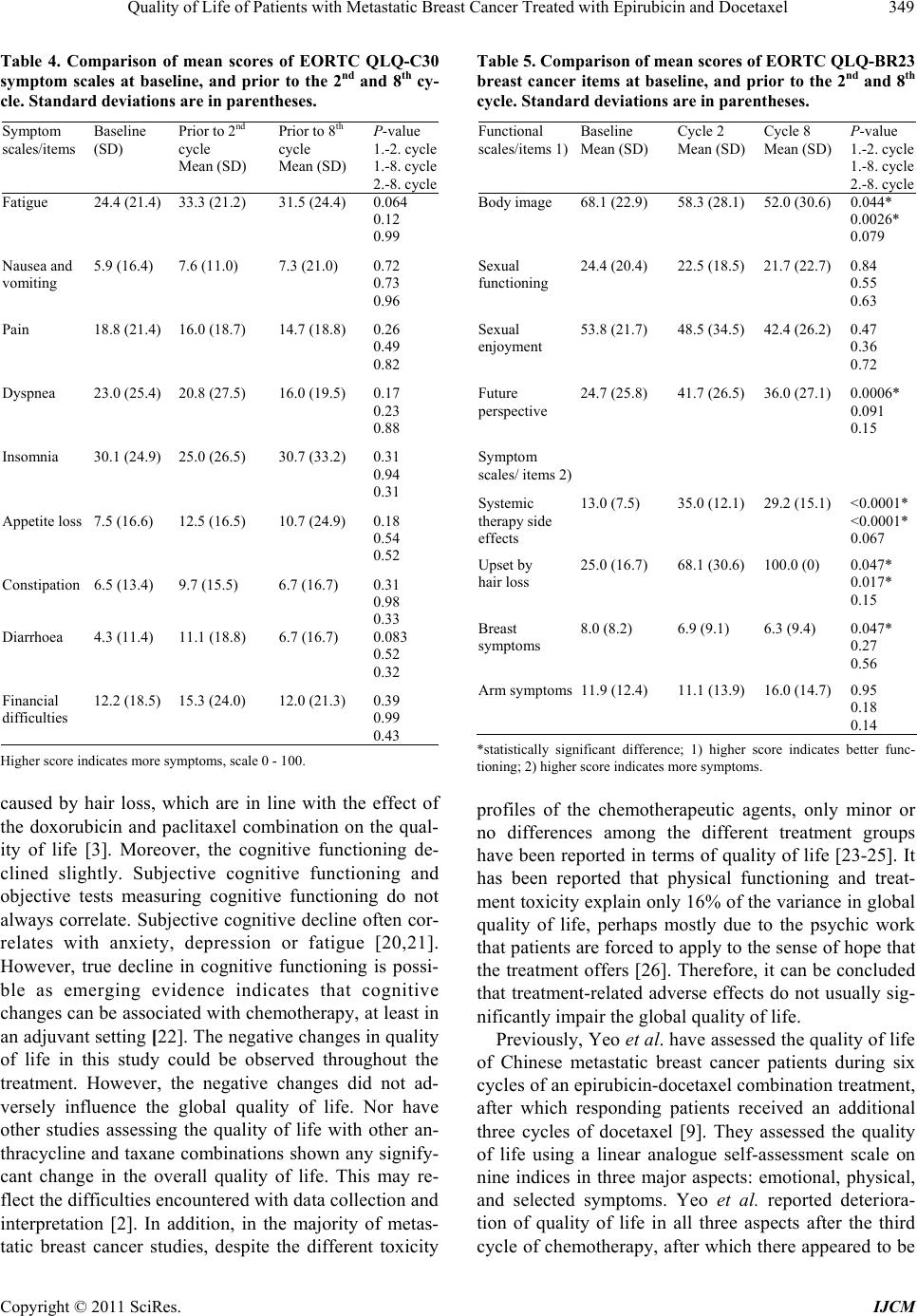 Quality of Life of Patients with Metastatic Breast Cancer Treated with Epirubicin and Docetaxel349 Table 4. Comparison of mean scores of EORTC QLQ-C30 symptom scales at baseline, and prior to the 2nd and 8th cy- cle. Standard deviations are in parentheses. Symptom scales/items Baseline (SD) Prior to 2nd cycle Mean (SD) Prior to 8th cycle Mean (SD) P-value 1.-2. cycle 1.-8. cycle 2.-8. cycle Fatigue 24.4 (21.4) 33.3 ( 21.2) 31.5 (24.4) 0.064 0.12 0.99 Nausea and vomiting 5.9 (16.4) 7.6 (11.0) 7.3 (21.0) 0.72 0.73 0.96 Pain 18.8 (21.4) 16.0 (18.7) 14.7 (18.8) 0.26 0.49 0.82 Dyspnea 23.0 (25.4) 20.8 (27.5) 16.0 (19.5) 0.17 0.23 0.88 Insomnia 30.1 (2 4.9) 25.0 (26.5) 30.7 (33.2) 0.31 0.94 0.31 Appetite loss 7.5 (16.6) 12.5 (16.5) 10.7 (24.9) 0.18 0.54 0.52 Constipation 6.5 (13.4) 9.7 (15.5) 6.7 (16.7) 0.31 0.98 0.33 Diarrhoea 4.3 (11.4) 11.1 (18.8) 6.7 ( 16 .7) 0.083 0.52 0.32 Financial difficulties 12.2 (18.5) 15.3 (24.0) 12.0 (21.3) 0.39 0.99 0.43 Higher score indicates more symptoms, scale 0 - 100. caused by hair loss, which are in line with the effect of the doxorubicin and paclitaxel combination on the qual- ity of life [3]. Moreover, the cognitive functioning de- clined slightly. Subjective cognitive functioning and objective tests measuring cognitive functioning do not always correlate. Subjective cognitive decline often cor- relates with anxiety, depression or fatigue [20,21]. However, true decline in cognitive functioning is possi- ble as emerging evidence indicates that cognitive changes can be associated with chemotherapy, at least in an adjuvant setting [22]. The negative changes in quality of life in this study could be observed throughout the treatment. However, the negative changes did not ad- versely influence the global quality of life. Nor have other studies assessing the quality of life with other an- thracycline and taxane combinations shown any signify- cant change in the overall quality of life. This may re- flect the difficulties encountered with data collection and interpretation [2]. In addition, in the majority of metas- tatic breast cancer studies, despite the different toxicity Table 5. Comparison of mean scores of EORTC QLQ-BR23 breast cancer items at baseline, and prior to the 2nd and 8th cycle. Standard deviations are in parentheses. Functional scales/items 1)Baseline Mean (SD) Cycle 2 Mean (SD) Cycle 8 Mean (SD) P-value 1.-2. cycle 1.-8. cycle 2.-8. cycle Body image 68.1 (22.9) 58.3 (28.1) 52.0 (30.6) 0.044* 0.0026* 0.079 Sexual functioning 24.4 (20.4) 22.5 (18.5) 21.7 (22.7) 0.84 0.55 0.63 Sexual enjoyment 53.8 (21.7) 48.5 (34.5) 42.4 (26.2) 0.47 0.36 0.72 Future perspective 24.7 (25.8) 41.7 (26.5) 36.0 (27.1) 0.0006* 0.091 0.15 Symptom scales/ items 2) Systemic therapy side effects 13.0 (7.5) 35.0 (12.1) 29.2 (15.1) <0.0001* <0.0001* 0.067 Upset by hair loss 25.0 (16.7) 68.1 (30.6) 100.0 (0) 0.047* 0.017* 0.15 Breast symptoms 8.0 (8.2) 6.9 (9.1) 6.3 (9.4) 0.047* 0.27 0.56 Arm symptoms11.9 (12.4) 11.1 (13.9) 16.0 (14.7) 0.95 0.18 0.14 *statistically significant difference; 1) higher score indicates better func- tioning; 2) higher score indicate s more symptoms. profiles of the chemotherapeutic agents, only minor or no differences among the different treatment groups have been reported in terms of quality of life [23-25]. It has been reported that physical functioning and treat- ment toxicity explain only 16% of the variance in global quality of life, perhaps mostly due to the psychic work that patien ts are forc ed to ap ply to the sense of hope that the treatment offers [26]. Therefore, it can be concluded that treatment-related adverse effects do not usually sig- nificantly impair the global quality of life. Previously, Yeo et al. have assessed the quality of life of Chinese metastatic breast cancer patients during six cycles of an epirubicin-docetaxel combination treatment, after which responding patients received an additional three cycles of docetaxel [9]. They assessed the quality of life using a linear analogue self-assessment scale on nine indices in three major aspects: emotional, physical, and selected symptoms. Yeo et al. reported deteriora- tion of quality of life in all three aspects after the third cycle of ch emotherapy, after which there appeared to be Copyright © 2011 SciRes. IJCM  Quality of Life of Patients with Metastatic Breast Cancer Treated with Epirubicin and Docetaxel 350 some improvement. However, the quality of life did not return to baseline level although there was a trend to- wards improved emotional functioning at the end of the treatment. Our assessment was more comprehensive and detailed using validated quality of life questionnaires. Due to the differences in the methods, it is somewhat difficult to compare the results between the studies. In terms of physical functioning, our results are quite simi- lar, but we found no statistically significant changes in terms of pain, nausea or appetite. The results concern- ing emotional functioning were different during the chemotherapy. Nevertheless, in both studies, there was a trend towards better emotional functioning at the end of the treatment. The major limitation of our quality of life study, in addition to the small sample size, is the number of missing questionnaires. The most common reasons for missing data were progressive disease (four patients) and administrative factors such as incomplete collection of questionnaires. In the literature, many other authors have shown that institutional and administrative factors tend to be more influential than patient factors at least until performance status deteriorates [3,27,28]. The dropout of the patients with progressive disease is of major concern because it distorts the results. The num- ber of dropouts overestimates the effect of therapy on quality of life as patients with progressive disease and poor performance tolerated treatments poorly. Missing data form one of the greatest methodological challenges in cancer quality of life research [29]. In conclusion, the combination of epirubicin and do- cetaxel showed clinical benefit among a good number of patients in first-line chemotherapy of metastatic breast cancer with manageable adverse effects. During the treatment the emotional functioning improved and con- cerns about the future were relieved. Some aspects of quality of life were impaired, with slightly decreased physical and cognitive functioning, distress related to changes in body image and hair loss, and other adverse effects of chemotherapy. However, the global quality of life was maintained. REFERENCES [1] N. Wilcken and R. Dear, “Chemotherapy in Metastatic Breast Cancer: A Summary of All Randomised Trials Reported 2000-2007,” European Journal of Cancer, Vol. 44, No. 15, 2008, pp. 2218-2225. doi:10.1016/j.ejca.2008.07.019 [2] D. Ghersi, N. Wilcken and R. J. Simes, “A Systematic Review of Taxane-Containing Regimens for Metastatic Breast Cancer,” British Journal of Cancer, Vol. 93, No. 3, 2005, pp. 293-301. doi:10.1038/sj.bjc.6602680 [3] A. Bottomley, L. Biganzoli, T. Cufer, et al., “Randomize d, Controlled Trial Investigating Short-Term Health-Related Quality of Life with Doxorubicin and Paclitaxel versus Doxorubicin and Cyclophosphamide as First-Line Che- motherapy in Patients with Metastatic Breast Cancer: Eu- ropean Organization for Research and Treatment of Can- cer Breast Cancer Group, Investigational Drug Branch for Breast Cancer and the New Drug Development Group Study,” Journal of Clinical Oncology, Vol. 22, No. 13, 2004, pp. 2576-2586. doi:10.1200/JCO.2004.02.037 [4] P. A. Cassier, S. Chabaud, V. Trillet-Lenoir, et al., “A Phase-III Trial of Doxorubicin and Docetaxel versus Doxorubicin and Paclitaxel in Metastatic Breast Cancer: Results of the ERASME 3 Study,” Breast Cancer Re- search and Treatment, Vol. 109, No. 2, 2008, pp. 343- 350. doi:10.1007/s10549-007-9651-3 [5] J. M. Nabholtz, C. Falkson, D. Campo, et al., “Docetaxel and Doxorubicin Compared with Doxorubicin and Cyclophosphamide as First-Line Chemotherapy for Me- tastatic Breast Cancer: Results of a Randomized, Multi- center, Phase III Trial,” Journal of Clinical Oncology, Vol. 21, No. 6, 2003, pp. 968-975. doi:10.1200/JCO.2003.04.040 [6] J. Jassem, T. Pienkowski, A. Pluzanska, et al., “Doxoru- bicin and Paclitaxel versus Fluorouracil, Doxorubicin and Cyclophosphamide as First-Line Therapy for Women with Metastatic Breast Cancer: Final Results of a Randomized Phase III Multicenter Trial,” Journal of Clinical Oncol- ogy, Vol. 19, No. 6, 2001, pp. 1707-1715. [7] G. W. Sledge, D. Neuberg, P. Bernardo, et al., “Phase III Trial of Doxorubicin, Paclitaxel, and the Combination of Doxorubicin and Paclitaxel as Front-Line Chemotherapy for Metastatic Breast Cancer: An Intergroup Trial (E11- 93),” Journal of Clinical Oncology, Vol. 21, No. 4, 2003, pp. 588-592. doi:10.1200/JCO.2003.08.013 [8] H. Svensson, Z. Einbeigi, H. Johansson, T. Hatschek and Y. Brandberg, “Quality of Life in Women with Metastatic Breast Cancer during 9 Months after Randomization in the TEX Trial (Epirubicin and Paclitaxel w/o Capecit- abine),” Breast Cancer Research and Treatment, Vol. 123, No. 3, 2010, pp. 785-793. doi:10.1007/s10549-010-1084-8 [9] W. Yeo, T. S. Mok, K. K. Tse, et al., “Phase II Study of Docetaxel and Epirubicin in Chinese Patients with Me- tastatic Breast Cancer,” Anticancer Drugs, Vol. 13, No. 6, 2002, pp. 655-662. doi:10.1097/00001813-200207000-00013 [10] J. Korpela and E. Salminen, “Neutropenic Infections Add Significant Costs to Palliative Chemotherapy in Breast Cancer,” Anticancer Research, Vol. 22, No. 2B, 2002, pp. 1337-1340. [11] E. Salminen, J. Korpela, M. Varpula, et al., “Epirubi- cin/Docetaxel Regimen in Progressive Breast Cancer-A Phase II Study,” Anticancer Drugs, Vol. 13, No. 9, 2002, pp. 925-929. doi:10.1097/00001813-200210000-00004 [12] E. Salminen, K. Syvanen, J. Korpela, et al., “Docetaxel with Epirubicin-Investigations on Cardiac Safety,” Anti- cancer Drugs, Vol. 14, No. 1, 2003, pp. 73-77. doi:10.1097/00001813-200301000-00010 Copyright © 2011 SciRes. IJCM  Quality of Life of Patients with Metastatic Breast Cancer Treated with Epirubicin and Docetaxel Copyright © 2011 SciRes. IJCM 351 [13] V. Dieras, “Review of Docetaxel/Doxorubicin Combina- tion in Metastatic Breast Cancer,” Oncology (Williston Park), Vol. 11, No. 8, 1997, pp. 31-33. [14] E. Salminen, M. Bergman, S. Huhtala and E. Ekholm, “Docetaxel: Standard Recommended Dose of 100 mg/m(2) is Effective But not Feasible for Some Metas- tatic Breast Cancer Patients Heavily Pretreated with Che- motherapy-A Phase II Single-Center Study,” Journal of Clinical Oncology, Vol. 17, No. 4, 1999, pp. 1127-31. [15] A. B. Miller, B. Hoogstraten, M. Staquet and A. Winkler, “Reporting Results of Cancer Treatment,” Cancer, Vol. 47, No. 1, pp. 207-214. doi:10.1002/1097-0142(19810101)47:1<207::AID-CNCR 2820470134>3.0.CO;2-6 [16] N. K. Aaronson, S. Ahmedzai, B. Bergman, et al., “The European Organization for Research and Treatment of Cancer QLQ-C30: A Quality-of-Life Instrument for Use in International Clinical Trials in Oncology,” Journal of the National Cancer Institute, Vol. 85, No. 5, 1993, pp. 365-376. doi:10.1093/jnci/85.5.365 [17] M. A. Sprangers, M. Groenvold, J. I. Arraras, et al., “The European Organization for Research and Treatment of Cancer Breast Cancer-Specific Quality-of-Life Question- naire Module: First Results from a Three-Country Field Study,” Journal of Clinical Oncology, Vol. 14, No. 10, 1996, pp. 2756-2768. [18] D. Osoba, G. Rodrigues, J. Myles, B. Zee and J. Pater, “Interpreting the Significance of Changes in Health-Re- lated Quality-of-Life Scores,” Journal of Clinical Oncol- ogy, Vol. 16, No. 1, 1998, pp. 139-144. [19] A. J. Ramirez, K. E. Towlson, M. S. Leaning, M. A. Richards and R. D. Rubens, “Do Patients with Advanced Breast Cancer Benefit from Chemotherapy?” British Journal of Cancer, Vol. 78, No. 11, 1998, pp. 1488-1494. doi:10.1038/bjc.1998.711 [20] F. S. van Dam, S. B. Schagen, M. J. Muller, et al., “Im- pairment of Cognitive Function in Women Receiving Adjuvant Treatment for High-Risk Breast Cancer: High- Dose versus Standard-Dose Chemotherapy,” Journal of the National Cancer Institute, Vol. 90, No. 3, 1998, pp. 210-218. doi:10.1093/jnci/90.3.210 [21] S. A. Castellon, P. A. Ganz, J. E. Bower, L. Petersen, L. Abraham and G. A. Greendale, “Neurocognitive Per- formance in Breast Cancer Survivors Exposed to Adju- vant Chemotherapy and Tamoxifen,” Journal of Clinical and Experimental Neuropsychology, Vol. 26, No. 7, 2004, pp. 955-969. doi:10.1080/13803390490510905 [22] J. Vardy, J. S. Wefel, T. Ahles, I. F. Tannock and S. B. Schagen, “Cancer and Cancer-Therapy Related Cognitive Dysfunction: An International Perspective from the Ven- ice Cognitive Workshop,” Annals of Oncology, Vol. 19, No. 4, 2008, pp. 623-629. doi:10.1093/annonc/mdm500 [23] L. Hakamies-Blomqvist, M. Luoma, J. Sjostrom, et al., “Quality of Life in Patients with Metastatic Breast Cancer Receiving Either Docetaxel or Sequential Methotrexate and 5-Fluorouracil. A Multicentre Randomised Phase III Trial by the Scandinavian Breast Group,” European Journal of Cancer, Vol. 36, No. 11, 2000, pp. 1411-1417. doi:10.1016/S0959-8049(00)00126-X [24] A. Bottomley and P. Therasse, “Quality of Life in Pa- tients Undergoing Systemic Therapy for Advanced Breast Cancer,” The Lancet Oncology, Vol. 3, No. 10, 2002, pp. 620-628. doi:10.1016/S1470-2045(02)00876-8 [25] G. Fountzilas, U. Dafni, M. A. Dimopoulos, et al., “A Randomized Phase III Study Comparing Three Anthracy- cline-Free Taxane-Based Regimens, as First Line Che- motherapy, in Metastatic Breast Cancer: A Hellenic Co- operative Oncology Group Study,” Breast Cancer Re- search and Treatment, Vol. 115, No. 1, 2009, pp. 87-99. doi:10.1007/s10549-008-0047-9 [26] L. Hakamies-Blomqvist, M. L. Luoma, J. Sjostrom, et al.,“Timing of Quality of Life (QoL) Assessments as a Source of Error in Oncological Trials,” Journal of Ad- vanced Nursing, Vol. 35, No. 5, 2001, pp. 709-716. doi:10.1046/j.1365-2648.2001.01903.x [27] P. Hopwood, A. Harvey, J. Davies, et al., “Survey of the Administration of Quality of Life (QL) Questionnaires in Three Multicentre Randomised Trials in Cancer. The Medical Research Council Lung Cancer Working Party the CHART Steering Committee,” European Journal of Cancer, Vol. 34, No. 1, 1998, pp. 49-57. doi:10.1016/S0959-8049(97)00347-X [28] P. Hopwood, R. J. Stephens and D. Machin. “Approaches to the Analysis of Quality of Life Data: Experiences Gained from a Medical Research Council Lung Cancer Working Party Palliative Chemotherapy Trial,” Quality of Life Research, Vol 3, No. 5, 1994, pp. 339-352. doi:10.1007/BF00451726 [29] C. C. Gotay, J. Lipscomb and C. F. Snyder, “Reflections on Findings of the Cancer Outcomes Measurement Working Group: Moving to the Next Phase,” Journal of the National Cancer Institute, Vol. 97, No. 21, 2005, pp. 1568-1574. doi:10.1093/jnci/dji337 |