

Paper Menu >>
Journal Menu >>
 Applied Mathematics, 2011, 2, 801-807 doi:10.4236/am.2011.27107 Published Online July 2011 (http://www.SciRP.org/journal/am) Copyright © 2011 SciRes. AM A New Navigation Force Model for the Earth’s Albedo and Its Effects on the Orbital Motion of an Artificial Satellite Yehia A. Abdel-Aziz1,2, Afaf M. Abdel-Hameed1, Khalil I. Khalil1 1National Research Institute of Astronomy and Geophysics (NRIAG), Helwan, Cairo, Egypt 2Mathematics Department Faculty of Sciences, Hail University, Hail, Saudi Arabia E-mail: [email protected] Received March 16, 2011; revised April 6, 2011; accepted April 9, 2011 Abstract In this paper, we developed a new approach of an analytical model to calculate the radial and transversal components of the acceleration due to the effects of Earth’s albedo. Its effects on the orbital motion of an artificial satellite are introduced. It is assumed that the satellite’s horizon is illuminated and the sun lies on the equator. The magnitudes of those components are obtained and their effects on orbital evolution have been tested for different satellites elements. The perturbations in orbital elements due to Earth’s albedo have been obtained using Lagrange Planetary equation in Gaussian form, in particular the case of LAGEOS satel- lite, have been found using this new analytical formalism. Keywords: Satellite Dynamics, Non-Gravitational Forces, Albedo Effect, Orbital Perturbations, Lagrange Planetary Equations 1. Introduction Satellite orbital dynamics is primarily influenced by the earth gravitational field, but there are several other fac- tors which affect orbital motion and must be taken into account in order to prevent escape from the desired orbit and collision with another satellite or space debris in the neighboring orbit. The precise knowledge of the position and velocities of an artificial satellite is essential to the current technologies involving geodetic, communications satellites and GPS system as in Jaggi [1]. Such precisions require accurate models of perturbing gravitational and non-gravitational accelerations which affect the motion of an Earth satellite. Gravitational perturbations are dominating the force spectrum for most earth orbits. They are caused by non-uniform mass distribution inside the Earth, ocean, atmosphere, Earth tides, and by third body attraction (Sun, Moon, planets). These perturbations can be mod- eled with a high level of confidence as all of them are conservative causing mainly periodic changes in the orbit energy). A complementary class of orbit perturbation is denoted as non-gravitational. This class comprises aero- dynamic forces, direct and indirect radiation pressure effects, thermal radiation, and charged particle drag. Models of these non gravitational forces are affected by uncertainties in the molecule-surface and photon-surface interaction processes, in molecule and photon flux mod- els, and in the solar and geomagnetic activity levels and their effect on the thermosphere an ionosphere. Some of these perturbations cause a secular, time-proportional decrease of the orbital energy, and hence in the orbital altitude. For low-Earth orbits (LEO), these altitude de- cays must be compensated by periodic maintenance ma- neuver. Earth’s albedo effect is one of the most interesting non-gravitational forces, which have significant effects on the orbital motion. Albedo is the fraction of solar en- ergy reflected diffusely from the planet back into space ([2]). It is the measure of the reflectivity of the planet’s surface. Therefore, the Earth albedo can be defined as the frac- tion of incident solar radiation returned to the space from the Earth’s surface as in Marconi [3] radiation reflectedbackto the space Albedo incident radiation A detailed review of Earth’s albedo as constant or variable with the changing of the latitude is performed by Green [4] and Sehnal [5]. Sehnal considered the Earth’s albedo as the potential function of the Earth. The Earth’s albedo was considered as constant in the 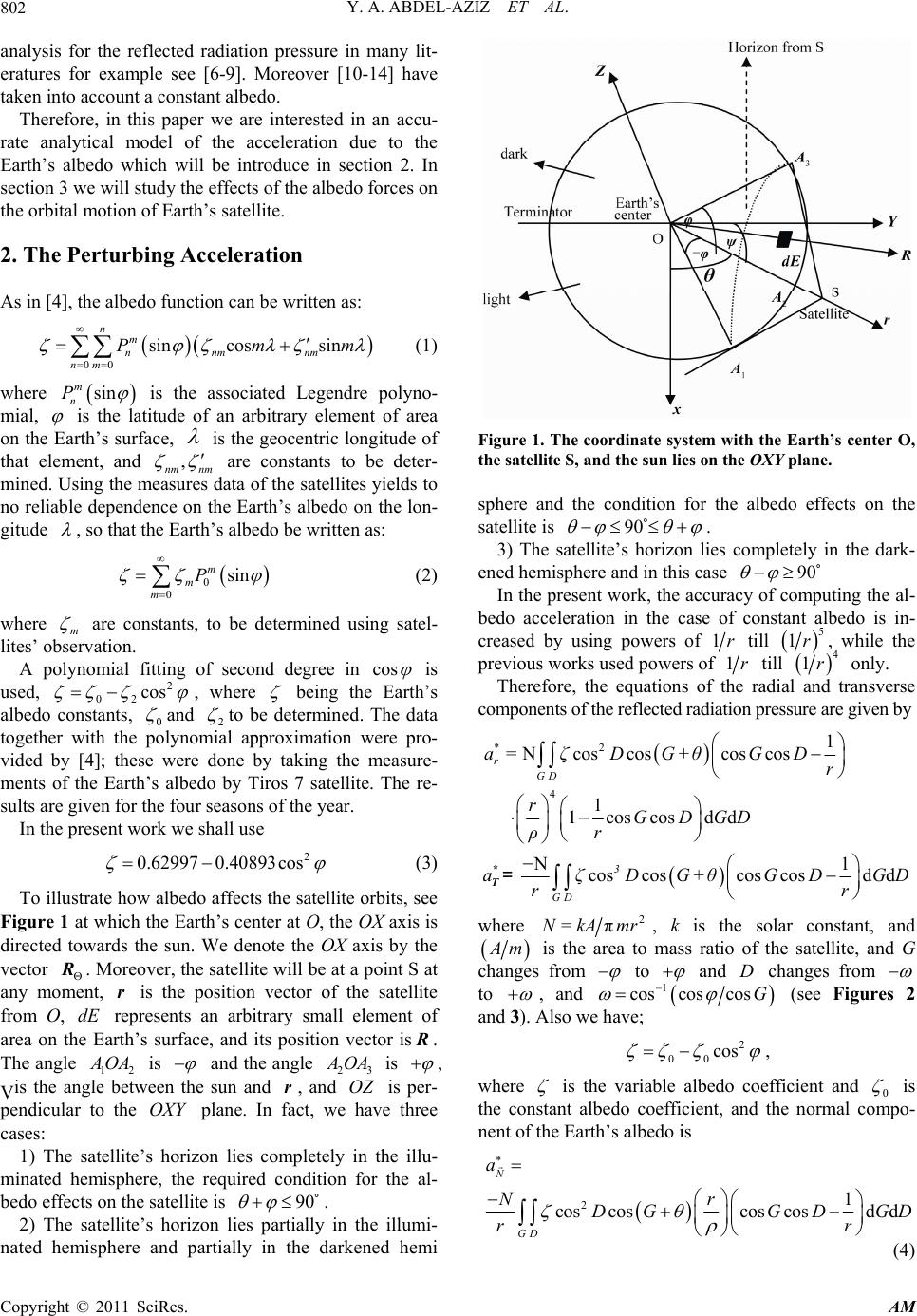 Y. A. ABDEL-AZIZ ET AL. 802 m analysis for the reflected radiation pressure in many lit- eratures for example see [6-9]. Moreover [10-14] have taken into account a constant albedo. Therefore, in this paper we are interested in an accu- rate analytical model of the acceleration due to the Earth’s albedo which will be introduce in section 2. In section 3 we will study the effects of the albedo forces on the orbital motion of Earth’s satellite. 2. The Perturbing Acceleration As in [4], the albedo function can be written as: 00 sin cossin nm nnmnm nm Pm (1) where sin m n P is the associated Legendre polyno- mial, is the latitude of an arbitrary element of area on the Earth’s surface, is the geocentric longitude of that element, and nm nm , are constants to be deter- mined. Using the measures data of the satellites yields to no reliable dependence on the Earth’s albedo on the lon- gitude , so that the Earth’s albedo be written as: 0 0 sin m m m P (2) where m are constants, to be determined using satel- lites’ observation. A polynomial fitting of second degree in cos is used, 02 2 cos , where being the Earth’s albedo constants, 0 and 2 to be determined. The data together with the polynomial approximation were pro- vided by [4]; these were done by taking the measure- ments of the Earth’s albedo by Tiros 7 satellite. The re- sults are given for the four seasons of the year. In the present work we shall use 2 0.62997 0.40893cos (3) To illustrate how albedo affects the satellite orbits, see Figure 1 at which the Earth’s center at O, the OX axis is directed towards the sun. We denote the OX axis by the vector . Moreover, the satellite will be at a point S at any moment, is the position vector of the satellite from O, represents an arbitrary small element of area on the Earth’s surface, and its position vector is R dE r R . The angle 12 A OA is and the angle 23 A OA is , Vis the angle between the sun and , and is per- pendicular to the plane. In fact, we have three cases: rOZ OXY 1) The satellite’s horizon lies completely in the illu- minated hemisphere, the required condition for the al- bedo effects on the satellite is 90 ˚. 2) The satellite’s horizon lies partially in the illumi- nated hemisphere and partially in the darkened hemi Figure 1. The coordinate system with the Earth’s center O, the satellite S, and the sun lies on the OXY plane . sphere and the condition for the albedo effects on the satellite is 90 ˚. 3) The satellite’s horizon lies completely in the dark- ened hemisphere and in this case 90 ˚ In the present work, the accuracy of computing the al- bedo acceleration in the case of constant albedo is in- creased by using powers of 1r till 5 1r, while the previous works used powers of 1r till 4 1r only. Therefore, the equations of the radial and transverse components of the reflected radiation pressure are given by *2 4 1 = Ncoscoscoscos 1 1coscosdd N1 coscoscoscosd d r GD 3 GD aζDG+θGD r rGDGD ρr aζDG+θGD GD rr * T where 2 πN=kAmr, k is the solar constant, and A m is the area to mass ratio of the satellite, and G changes from to and changes from D to , and cos s 1co cos G (see Figures 2 and 3). Also we have; 2 00 cos , where is the variable albedo coefficient and 0 is the constant albedo coefficient, and the normal compo- nent of the Earth’s albedo is 21 coscoscoscosd d N GD a Nr DGGD G rr D (4) Copyright © 2011 SciRes. AM 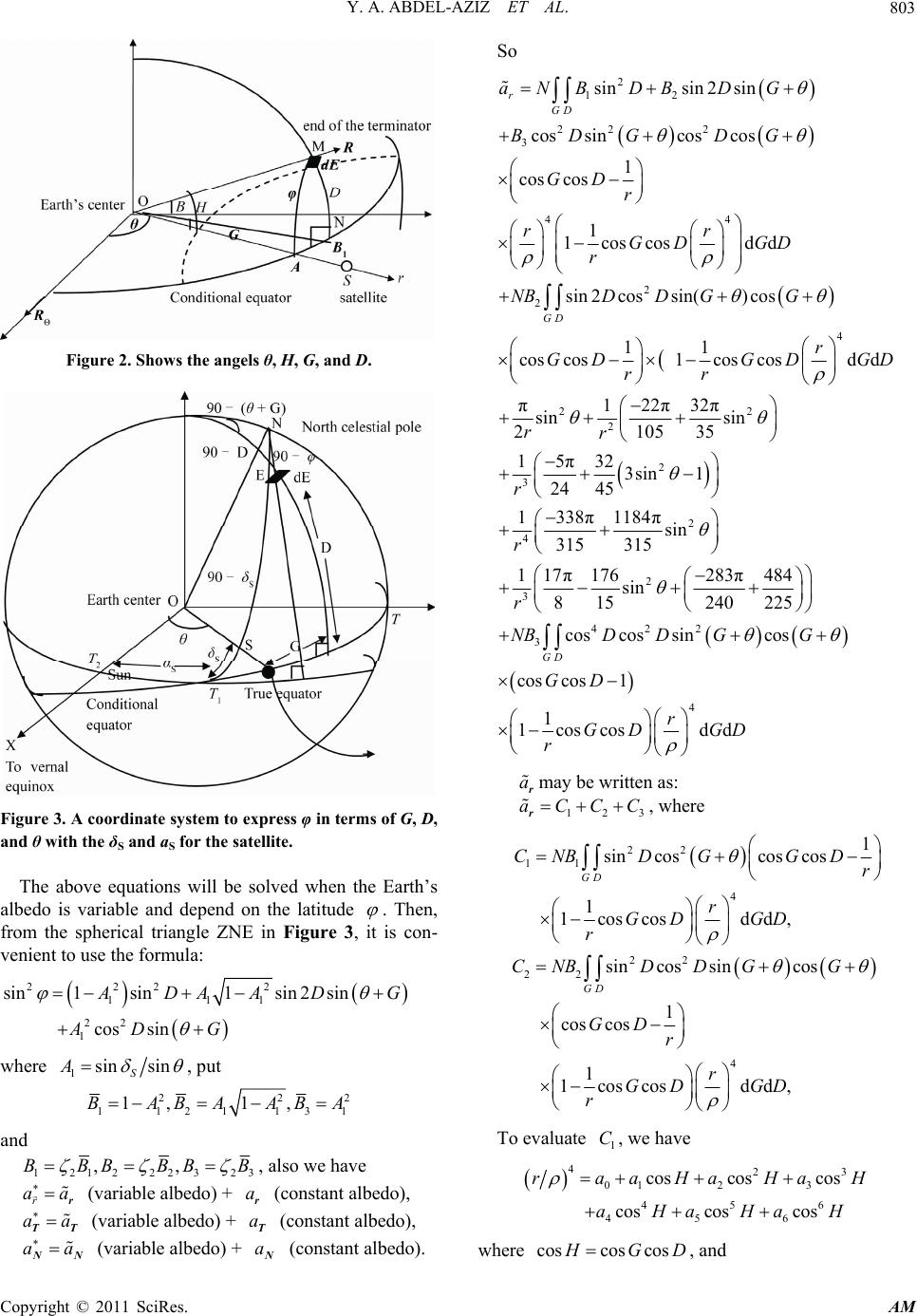 Y. A. ABDEL-AZIZ ET AL. 803 Figure 2. Shows the angels θ, H, G, and D. Figure 3. A coordinate system to express φ in terms of G, D, and θ with the δS and aS for the satellite. The above equations will be solved when the Earth’s albedo is variable and depend on the latitude . Then, from the spherical triangle ZNE in Figure 3, it is con- venient to use the formula: 222 2 111 22 1 sin1sin1sin 2sin cos sin A DA ADG AD G where 1sin sin S A , put 22 112113 1, 1,BABAAB 2 1 A and 12122232 ,,BBBBB 3 B T N , also we have r aa r (variable albedo) + (constant albedo), ar aa T (variable albedo) + (constant albedo), aT aa N (variable albedo) + (constant albedo). aN So 2 12 22 2 3 44 2 2 4 sinsin2sin cos sincos cos 1 cos cos 1 1coscosd d sin2cossin() cos 11 cos cos1cos cosdd πsin 2 r GD GD aNBDBD G BDG DG GD r rr GD GD r NBDD GG r GDGD GD rr r 22 2 2 3 2 4 2 3 422 3 122π32πsin 105 35 15π32 3sin 1 24 45 1 338π1184 πsin 315 315 117π176 283π484 sin 815240 225 cos cos sincos cos cos1 1 1cos cos GD r r r r NBDDGG GD r GD r 4 ddGD 3 a rmay be written as: 12 aCCC r , where 22 11 4 22 22 4 1 sincoscos cos 1 1coscosdd, sincos sincos 1 cos cos 1 1coscosdd, GD GD CNBDGG D r r GD GD r CNBDD GG GD r r GD GD r To evaluate , we have 1 C 423 01 23 456 456 cos coscos cos cos cos raaHaHa aHaHaH H where coscos cos H GD , and Copyright © 2011 SciRes. AM 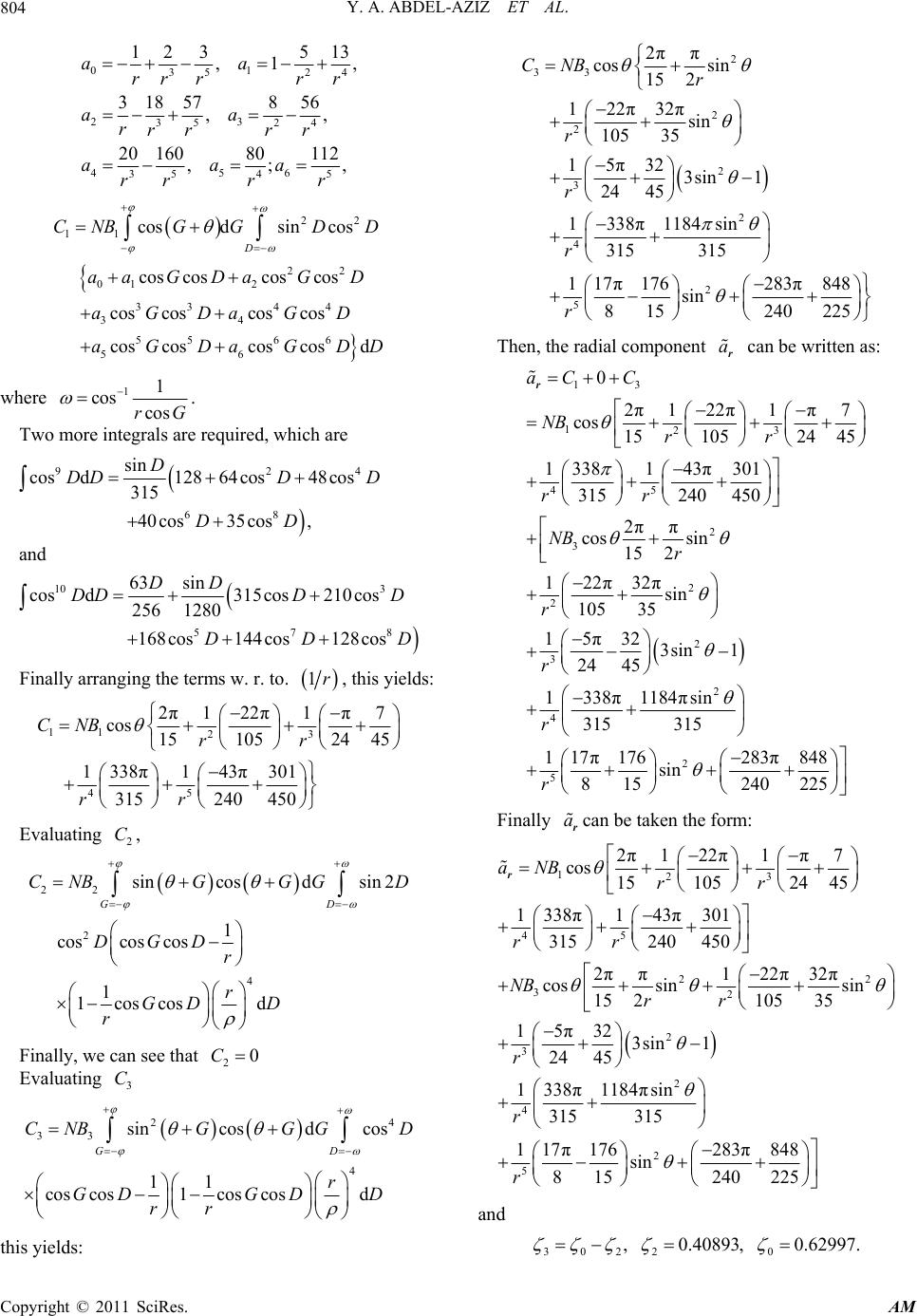 Y. A. ABDEL-AZIZ ET AL. 804 01 35 24 23 35 24 456 354 5 12 3513 ,1 318578 56 ,, 20 16080112 ,; aa rr rrr aa rrr rr aaa rrrr , , D 22 11 22 01 2 33 44 34 55 66 56 cosdsin cos cos coscoscos cos coscos cos cos coscos cosd D CNBGGD D aaG DaGD aGDaGD aGDaGD where 11 cos cosrG . Two more integrals are required, which are 92 68 10 3 57 sin cosd128 64cos48cos 315 40cos35cos, and 63 sin cosd315 cos210cos 256 1280 168cos144cos128cos D DDD D DD DD DDD D DD 4 8 D Finally arranging the terms w. r. to. 1r , this yields: 11 23 45 2π122π1π7 cos 1510524 45 1 338π143π301 315240 450 CNB rr rr Evaluating , 2 C 22 2 4 sincosdsin 2 1 coscos cos 1 1coscosd GD CNBGGG D DGD r r GD D r Finally, we can see that 20C Evaluating 3 C 24 33 4 sincosdcos 11 coscos1cos cosd GD CNBGGG D r GDGD D rr this yields: 2 33 2 2 2 3 2 4 2 5 2ππ cos sin 15 2 122π32πsin 105 35 15π32 3sin 1 24 45 1338π1184 sin 315 315 117π176 283π848 sin 815240 225 CNB r r r r r Then, the radial component can be written as: a r 13 123 45 2 3 2 2 2 3 4 0 2π122π1π7 cos 1510524 45 1 338143π301 315240450 2ππ cos sin 15 2 122π32πsin 105 35 15π323sin 1 24 45 1 338π11 315 aC C NB rr rr NB r r r r r 2 2 5 84 πsin 315 117π176 283π848 sin 815240 225r Finally can be taken the form: a r 123 45 22 32 2 3 2 4 2π122π1π7 cos 1510524 45 1 338π143π301 315240 450 2ππ 122π32π cos sinsin 15 210535 15π32 3sin 1 24 45 1 338π1184πsin 315 3 aNB rr rr NB rr r r r 2 5 15 117π176 283π848 sin 815240 225r and 3022 0 , 0.40893, 0.62997. Copyright © 2011 SciRes. AM 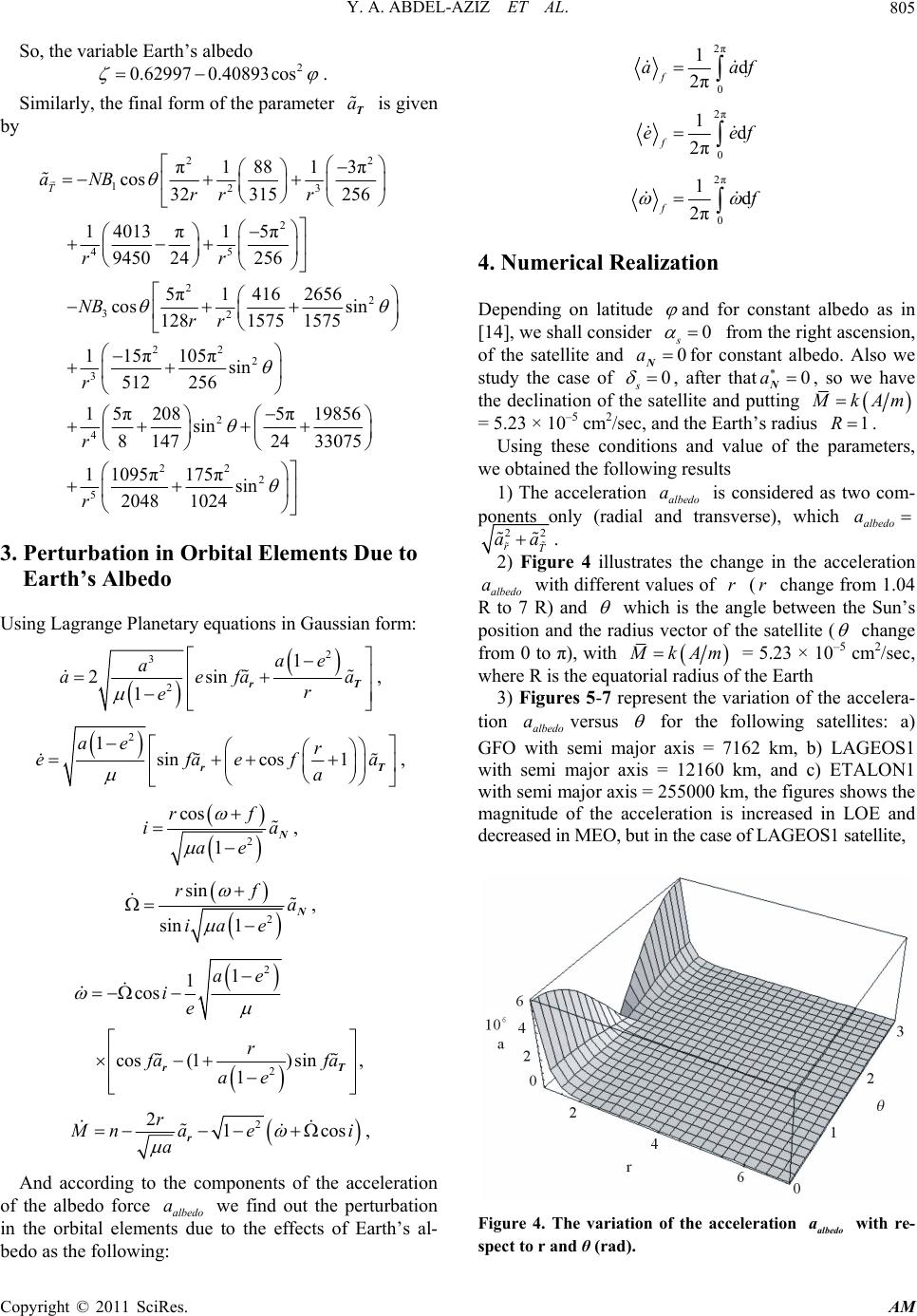 Y. A. ABDEL-AZIZ ET AL. 805 So, the variable Earth’s albedo 2 0.62997 0.40893cos . Similarly, the final form of the parameter is given by a T 22 123 2 45 2 2 32 22 2 3 2 4 π18813π cos 32 315256 14013 π15π 945024256 5π1 4162656 cos sin 1281575 1575 115π105πsin 512 256 15π208 sin 8147 T aNB rrr rr NB rr r r 22 2 5 5π19856 24 33075 11095π175πsin 2048 1024r 3. Perturbation in Orbital Elements Due to Earth’s Albedo Using Lagrange Planetary equations in Gaussian form: 2 3 2 1 2sin 1 ae a aefa r e rT a , 2 1sincos 1 ae r efaef a r a T , 2 cos 1 rf ia ae N, 2 sin sin 1 rf a ia e N, 2 2 1 1 cos cos(1)sin , 1 ae ie r fa fa ae rT 2 21c ros M nae a ri bedo as the following: , And according to the components of the acceleration of the albedo force we find out the perturbation in the orbital elements due to the effects of Earth’s al- albedo a 2π 0 1d 2π f aa f 2π 0 1d 2π f ee f 2π 0 1d 2π f f 4. Numerical Realization Depending on latitude and for constant albedo as in [14], we shall consider 0 s from the right ascension, of the satellite and a0 N constant albedo. Also we study the case of for 0 s , ate after that0a N, so we have the declination of tllite and puhe stting M kAm = 5.23 × 10⁻⁵ cm2/sec, and the Earth’s radius 1R . Using these conditions and value of the eters, param w onsidered as two com- po e obtained the following results 1) The acceleration albedo a is c nents only (radial aansverse), which albedo a nd tr 22 rT aa . 2) Figure 4 illustrates the change in the acceleration albedo with different values of r (r change from 1.04 R) and a R to 7 which is the angle between the Sun’s position and theadius vector of the satellite ( r change from 0 to π), with M kAm = 5.23 × 10⁻⁵ cm2/sec, where R is the equaf the Earth 3) Figures 5-7 represent the variation of t torial radius he accelera- tio o n albedo aversus for the following satellites: a) GFOsemi mr axis = 7162 km, b) LAGEOS1 with semi major axis = 12160 km, and c) ETALON1 with semi major axis = 255000 km, the figures shows the magnitude of the acceleration is increased in LOE and decreased in MEO, but in the case of LAGEOS1 satellite, with ajo Figure 4. The variation of the acceleration with re albedo a- spect to r and θ (rad). Copyright © 2011 SciRes. AM 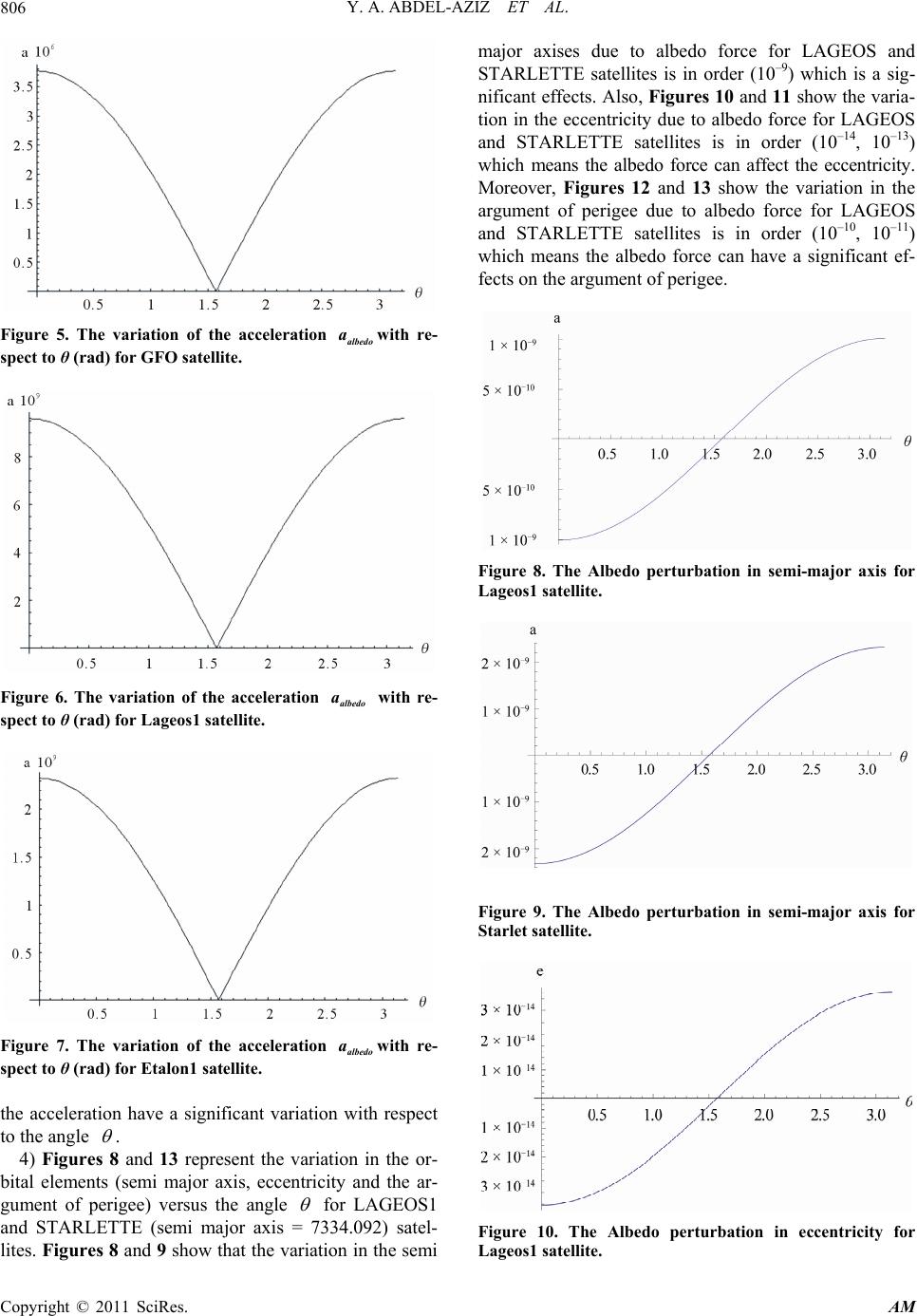 Y. A. ABDEL-AZIZ ET AL. 806 Figure 5. The variation of the accelerationwith re albedo a- spect to θ (rad) for GFO satellite. Figure 6. The variation of the acceleration with re albedo a- spect to θ (rad) for Lageos1 satellite. Figure 7. The variation of the accelerationwith re e acceleration have a significant variation with respect albedo a- spect to θ (rad) for Etalon1 satellite. th to the angle . 4) Figures8 an d 13 represent the variation in the or- bital elements (semi major axis, eccentricity and the ar- gument of perigee) versus the angle for LAGEOS1 and STARLETTE (semi major axis = 7334.092) satel- lites. Figures 8 and 9 show that the variation in the semi major axises due to albedo force for LAGEOS and STARLETTE satellites is in order (10–9) which is a sig- nificant effects. Also, Figures 10 and 11 show the varia- tion in the eccentricity due to albedo force for LAGEOS and STARLETTE satellites is in order (10–14, 10–13) which means the albedo force can affect the eccentricity. Moreover, Figures 12 and 13 show the variation in the argument of perigee due to albedo force for LAGEOS and STARLETTE satellites is in order (10–10, 10–11) which means the albedo force can have a significant ef- fects on the argument of perigee. Figure 8. The Albedo perturbation in semi-major axis for Lageos1 satellite. igure 9. The Albedo perturbation in semi-major axis for F Starlet satellite. Figure 10. The Albedo perturbation in eccentricity fo Lageos1 satellite. r Copyright © 2011 SciRes. AM 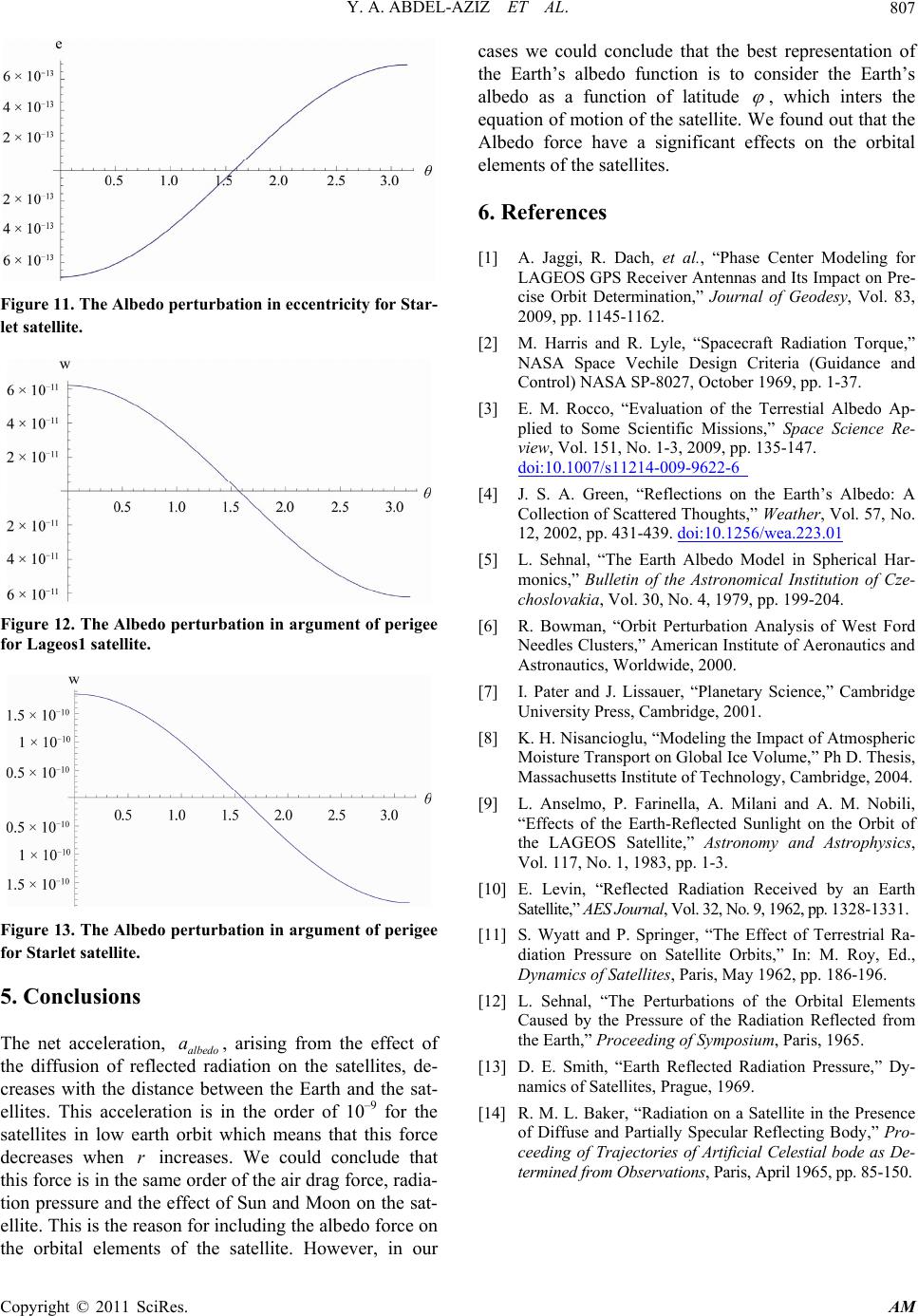 Y. A. ABDEL-AZIZ ET AL. Copyright © 2011 SciRes. AM 807 Figure 11. The Albedo perturbation in eccentricity for Star- let satellite. Figure 12. The Albedo per turbation in argument of perigee for Lageos1 satellite. Figure 13. The Albedo per turbation in argument of perigee for Starlet satellite. n, , arising from the effect of radiatio 5. Conclusions The net acceleratio albedo a the diffusion of reflectedn on the satellites, de- creases with the distance between the Earth and the sat- ellites. This acceleration is in the order of 10–9 for the satellites in low earth orbit which means that this force decreases when r increases. We could conclude that this force is in the same order of the air drag force, radia- tion pressure and the effect of Sun and Moon on the sat- ellite. This is the reason for including the albedo force on the orbital elements of the satellite. However, in our cases we could conclude that the best representation of the Earth’s albedo function is to consider the Earth’s albedo as a function of latitude , which inters the equation of motion of the satellite. We found out that the Albedo force have a significant effects on the orbital elements of the satellites. 6. References [1] A. Jaggi, R. D LAGEOS GPS ach, et al.ter Modeling for Receiver Antenn Its Impact on Pre- ignia (Guidance and e Re- , “Phase Cen as and Criter cise Orbit Determination,” Journal of Geodesy, Vol. 83, 2009, pp. 1145-1162. [2] M. Harris and R. Lyle, “Spacecraft Radiation Torque,” NASA Space Vechile Des Control) NASA SP-8027, October 1969, pp. 1-37. [3] E. M. Rocco, “Evaluation of the Terrestial Albedo Ap- plied to Some Scientific Missions,” Space Scienc view, Vol. 151, No. 1-3, 2009, pp. 135-147. doi:10.1007/s11214-009-9622-6 [4] J. S. A. Green, “Reflections on the Earth’s Collection of Scattered Thoughts,” Albedo: A Weather, Vol. 57, No. 12, 2002, pp. 431-439. doi:10.1256/wea.223.01 [5] L. Sehnal, “The Earth Albedo Model in Spherical Har- monics,” Bulletin of the Astronomical Institution of Cze- utics and lume,” Ph D. Thesis, o. 9, 1962, pp. 1328-1331. m eflecting Body,” Pro- choslovakia, Vol. 30, No. 4, 1979, pp. 199-204. [6] R. Bowman, “Orbit Perturbation Analysis of West Ford Needles Clusters,” American Institute of Aerona Astronautics, Worldwide, 2000. [7] I. Pater and J. Lissauer, “Planetary Science,” Cambridge University Press, Cambridge, 2001. [8] K. H. Nisancioglu, “Modeling the Impact of Atmospheric Moisture Transport on Global Ice Vo Massachusetts Institute of Technology, Cambridge, 2004. [9] L. Anselmo, P. Farinella, A. Milani and A. M. Nobili, “Effects of the Earth-Reflected Sunlight on the Orbit of the LAGEOS Satellite,” Astronomy and Astrophysics, Vol. 117, No. 1, 1983, pp. 1-3. [10] E. Levin, “Reflected Radiation Received by an Earth Satellite,” AES Journal, Vol. 32, N [11] S. Wyatt and P. Springer, “The Effect of Terrestrial Ra- diation Pressure on Satellite Orbits,” In: M. Roy, Ed., Dynamics of Satellites, Paris, May 1962, pp. 186-196. [12] L. Sehnal, “The Perturbations of the Orbital Elements Caused by the Pressure of the Radiation Reflected fro the Earth,” Proceeding of Symposium, Paris, 1965. [13] D. E. Smith, “Earth Reflected Radiation Pressure,” Dy- namics of Satellites, Prague, 1969. [14] R. M. L. Baker, “Radiation on a Satellite in the Presence of Diffuse and Partially Specular R ceeding of Trajectories of Artificial Celestial bode as De- termined from Observations, Paris, April 1965, pp. 85-150. |