

Paper Menu >>
Journal Menu >>
 American Journal of Computational Mathematics, 2011, 1, 104-110 doi:10.4236/ajcm.2011.12010 Published Online June 2011 (http://www.scirp.org/journal/ajcm) Copyright © 2011 SciRes. AJCM An Exponential Series Method for the Solution of Free Convection Boundary Layer Flow in a Saturated Porous Medium Vishwanath B. Awati1, N. M. Bujurke2, Ramesh B. Kudenatti3 1Department of Mat hem at i cs, Maharani’s Science College for Women, Bangalore, India 2Department of Mat hem at i cs, Karnatak University, Dharwad, India 3Department of Mat hem at i cs, Bangalore Uni versi t y, Bangalore, India E-mail: [email protected] Received March 30, 2011; revised May 6, 2011; acce pted May 15, 2011 Abstract Third order nonlinear ordinary differential equation, subject to appropriate boundary conditions, arising in fluid mechanics is solved exactly using more suggestive schemes-Dirichlet series and method of stretching variables. These methods have advantages over pure numerical methods in obtaining derived quantities ac- curately for various values of the parameters involved at a stretch and are valid in a much larger domain compared with classical numerical schemes. Keywords: Boundary Layer Equations, Stretching Surface, Dirichlet Series, Powell’s Method, Stretching of Variables. 1. Introduction In this article we consider the effect of blowing and suc- tion along a vertical flat plate on free convection in air or water which are of significant interest in recent years. Earliest study on this topic was by Eichhorn (1960) who investigated the effects of both wall temperature and the blowing or suction velocity with prescribed power func- tions of distance from the leading edge. Eichhorn (1960) shows that the similarity solutions for the problem are possible if the exponents in the prescribed power func- tions are related in a particular manner. Sparrow and Celss (1961) show a perturbation method for analyzing more general problem with arbitrary values of exponents and these results were confirmed by Mabuchi (1960) by an integral method. Our aim here is to present qualitative features of the physical problems of interest. Majority of the problems considered here are from fluid dynamics. The residual warm water discharged from a geothermal power plant is disposed of through subsurface re-injection wells which can be idealized as vertical plane surface in porous me- dium. The buoyancy flow past bodies immersed in a saturated porous medium have been studied by Cheng (1977, 1977). Merkin (1978) investigated the effect of uniform mass flux on the fr ee convection boundar y layer on a vertical wall in a saturated porous medium. Cheng and Minkowycz (1977) have studied similarity solution for the case of wall temperature and suction velocity varying as powers of x, the longitudinal distance. In all cases, the numerical solutions have been given for se- lected values of para meter s involved. The third order nonlinear ordinary differential equa- tions over an infinite interval with suction/injection pa- rameter w f appear in various branches of physics and engineering and are of special interest. In very few cases, they have analytical solution. Sakiadias (1961) investi- gated the boundary layer flow on continuous solid sur- face with a constant speed. Erickson et al. (1966) have studied the problem of moving surface with suction or injection. Since the surface is flexible the filament may be stretched during the course of ejection and so only the surface velocity deviates without being uniform. Samuel and Hall (1973), who investigated, the similarity solution for laminar boundary layer on a continuous moving po- rous surface, obtain a series with exponential terms as their solutions. The heat and mass transfer on stretching sheet with suction or blowing was investigated by Gupta and Gupta (1977). Ackroyed (1978) obtains the series solution of steady two dimensional laminar boundary 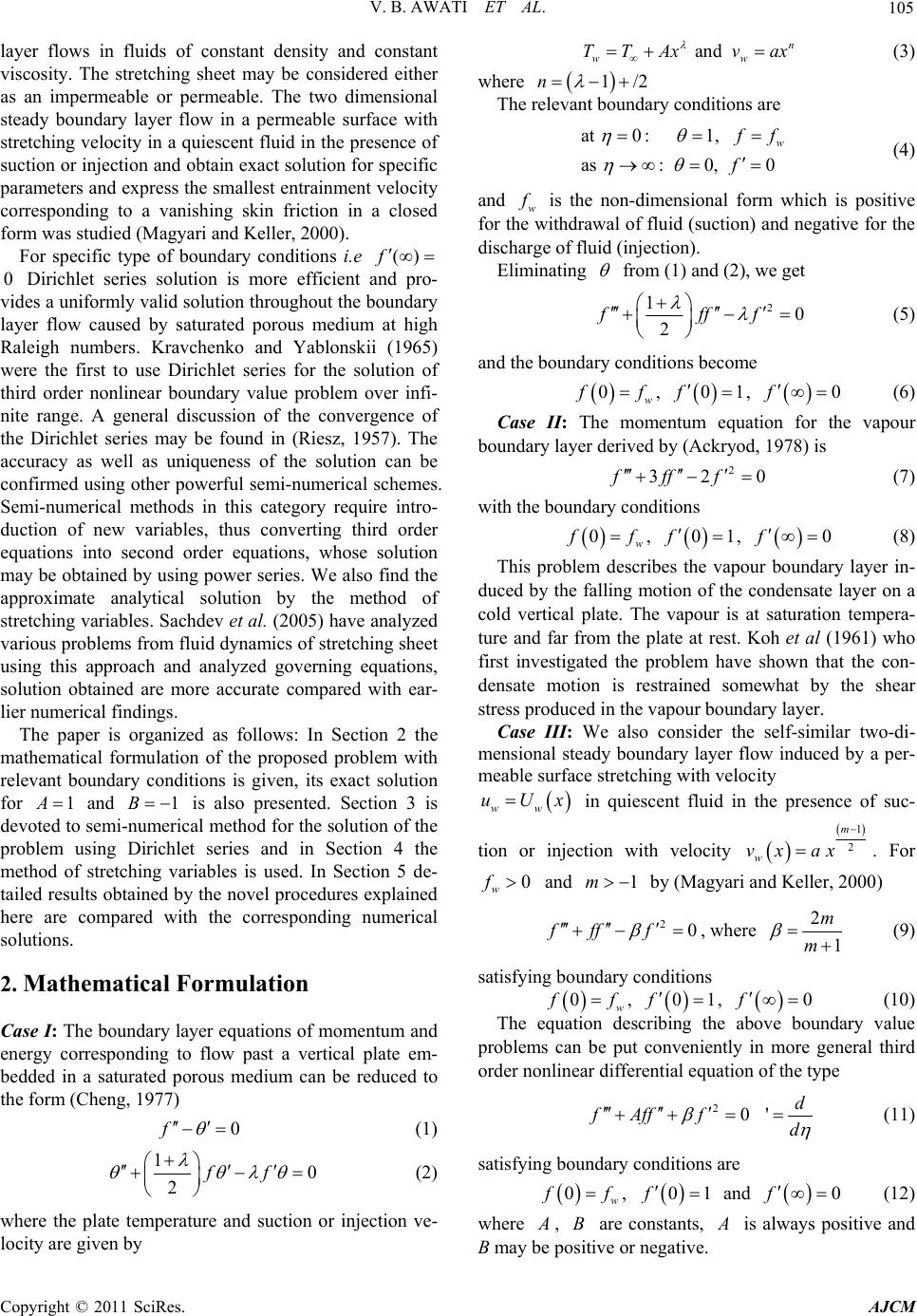 V. B. AWATI ET AL. 105 layer flows in fluids of constant density and constant viscosity. The stretching sheet may be considered either as an impermeable or permeable. The two dimensional steady boundary layer flow in a permeable surface with stretching velocity in a quiescent fluid in the presence of suction or injection and obtain exact solution fo r specific parameters and express the smallest entrainment velocity corresponding to a vanishing skin friction in a closed form was studied (Magyari and Keller, 2000). For specific type of boundary conditions i.e ()f Dirichlet series solution is more efficient and pro- vides a uniformly valid solution throughout the boundary layer flow caused by saturated porous medium at high Raleigh numbers. Kravchenko and Yablonskii (1965) were the first to use Dirichlet series for the solution of third order nonlinear boundary value problem over infi- nite range. A general discussion of the convergence of the Dirichlet series may be found in (Riesz, 1957). The accuracy as well as uniqueness of the solution can be confirmed using other powerful semi-numerical schemes. Semi-numerical methods in this category require intro- duction of new variables, thus converting third order equations into second order equations, whose solution may be obtained by using power series. We also find the approximate analytical solution by the method of stretching variables. Sachdev et al. (2005) have analyzed various problems from fluid dynamics of stretching sheet using this approach and analyzed governing equations, solution obtained are more accurate compared with ear- lier numerical findings. 0 The paper is organized as follows: In Section 2 the mathematical formulation of the proposed problem with relevant boundary conditions is given, its exact solution for 1 A and is also presented. Section 3 is devoted to semi-numerical method for the solution of the problem using Dirichlet series and in Section 4 the method of stretching variables is used. In Section 5 de- tailed results obtained by the nov el procedures explained here are compared with the corresponding numerical solutions. 1B 2. Mathematical For mulation Case I: The boundary layer equations of momentu m and energy corresponding to flow past a vertical plate em- bedded in a saturated porous medium can be reduced to the form (Cheng, 1977) 0f (1) 10 2ff w (2) where the plate temperature and suction or injection ve- locity are given by and n w TTAx vax (3) where 1/2 n The relevant b oundary conditions are at 0: 1, as : 0, 0 w f f f (4) and w f is the non-dimensional form which is positive for the withdrawal of fluid (suction) and negative for the discharge of fluid (injection). Eliminating from (1) and (2), we get 2 10 2 ffff (5) and the boundary conditions become 0w f f , , (6) 01f 0f Case II: The momentum equation for the vapour boundary layer derived by (Ackryod, 1978) is 2 32ffff 0 (7) with the boundar y conditions 0w f f , 01f, (8) 0f This problem describes the vapour boundary layer in- duced by the falling motion of the condensate layer on a cold vertical plate. The vapour is at saturation tempera- ture and far from the plate at rest. Koh et al (1961) who first investigated the problem have shown that the con- densate motion is restrained somewhat by the shear stress produced in the vapour bo undary layer. Case III: We also consider the self-similar two-di- mensional steady boundary layer flow induced by a per- meable surface stretching with velocity ww uUx in quiescent fluid in the presence of suc- tion or injection with velocity 1 2 m w vx ax . For and by (Magyari and Keller, 2000) 0 w f1m 20fff f , where 2 1 m m (9) satisfying boundary conditions 0w f f , 01f, (10) 0f The equation describing the above boundary value problems can be put conveniently in more general third order nonlinear differential equation of the type 20fAff f 'd d (11) satisfying boundary con ditions are 0w f f , 0f1 and (12) 0f where A , are constants, B A is always positive and B may be positive or negative. Copyright © 2011 SciRes. AJCM 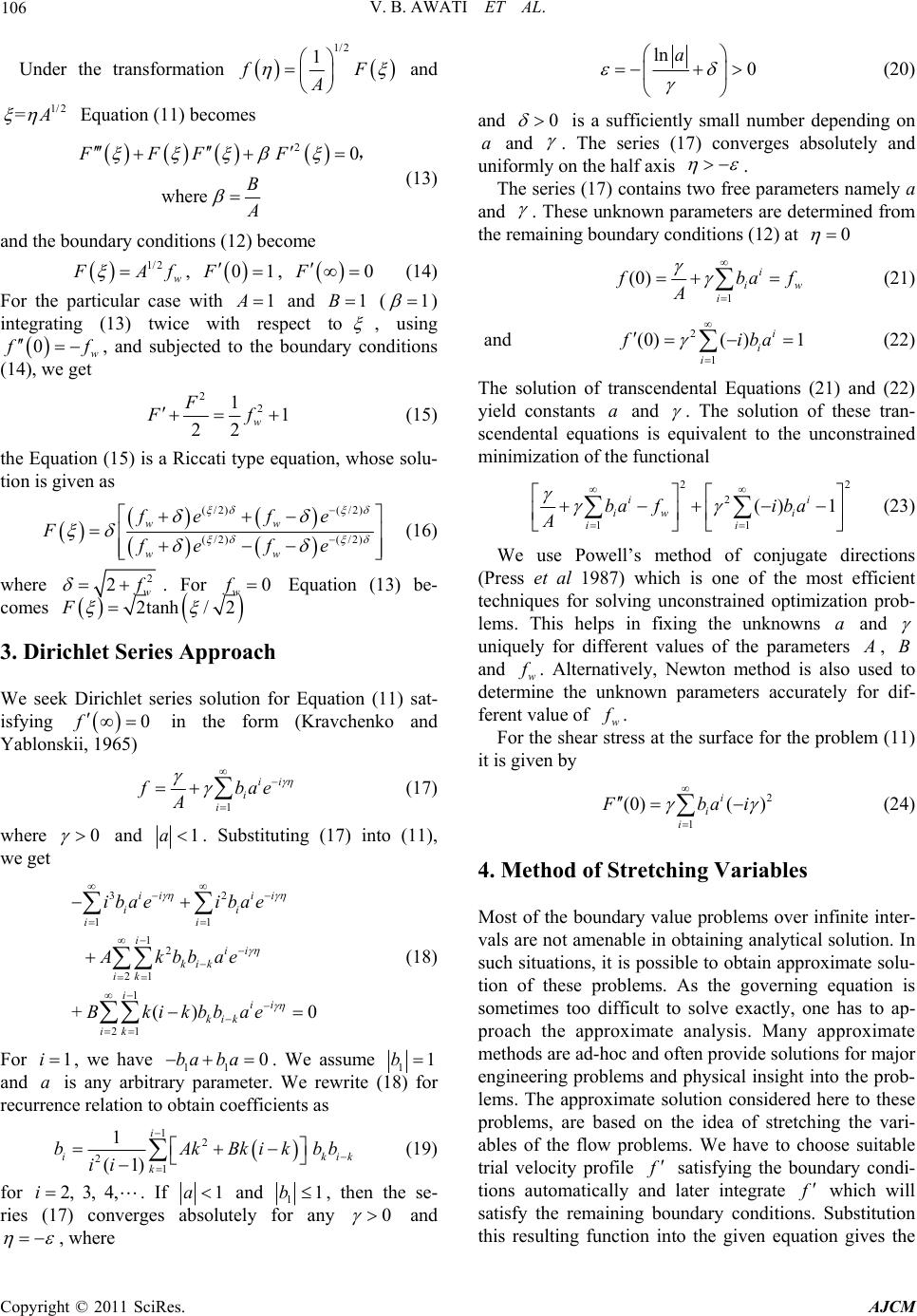 106 V. B. AWATI ET AL. Under the transformation 1/2 1 fF A and 1/2 = A Equation (11) becomes 2 0 where FFFF B A , (13) and the boundary conditions (12) become 1/2w F Af , , (14) 01F 0F For the particular case with 1 A and ( 1B1 ) integrating (13) twice with respect to , using 0w f f , and subjected to the boundary conditions (14), we get 22 11 22 w F Ff (15) the Equation (15) is a Riccati typ e equation, whose solu- tion is given as (/2) (/2) (/2) (/2) ww ww fe fe Ffe fe (16) where 2 2w f . For Equation (13) be- comes 0 w f 22tanh/F 3. Dirichlet Series Approach We seek Dirichlet series solution for Equation (11) sat- isfying in the form (Kravchenko and Yablonskii, 1965) 0f 1 ii i i fba Ae (17) where 0 and 1a. Substituting (17) into (11), we get 32 11 12 21 1 21 + ()0 ii ii ii ii iii kik ik iii kik ik ibae ibae Akbbae Bkikbbae (18) For , we have 11 . We assume 1i0ba ba 11b and is any arbitrary parameter. We rewrite (18) for recurrence relation to obtain coefficients as a 12 21 1 (1) i i k bAkBkik ii k ik bb (19) for . If 2, 3, 4,i1a and 11b, then the se- ries (17) converges absolutely for any 0 and , where ln 0 a (20) and 0 is a sufficiently small number depending on and a . The series (17) converges absolutely and uniformly on the half axis . The series (17) contains two free parameters namely a and . These unkno wn parameters are d etermined from the remaining boundary conditions (12) at 0 1 (0) i i iw f ba f A (21) and 2 1 (0)( )1 i i i fib a (22) The solution of transcendental Equations (21) and (22) yield constants and a . The solution of these tran- scendental equations is equivalent to the unconstrained minimization of the functional 22 2 11 () 1 ii iw i ii bafi ba A (23) We use Powell’s method of conjugate directions (Press et al 1987) which is one of the most efficient techniques for solving unconstrained optimization prob- lems. This helps in fixing the unknowns and a uniquely for different values of the parameters A , and w B f . Alternatively, Newton method is also used to determine the unknown parameters accurately for dif- ferent value of w f . For the shear stress at the surface for the problem (11) it is given by 2 1 (0)( ) i i i F ba i (24) 4. Method of Stretching Variables Most of the boundary value problems over infinite inter- vals are not amenable in obtaining analytical solution. In such situations, it is possible to obtain approximate solu- tion of these problems. As the governing equation is sometimes too difficult to solve exactly, one has to ap- proach the approximate analysis. Many approximate methods are ad-hoc and often provide solutions for major engineering problems and physical insight into the prob- lems. The approximate solution considered here to these problems, are based on the idea of stretching the vari- ables of the flow problems. We have to choose suitable trial velocity profile f satisfying the boundary condi- tions automatically and later integrate f which will satisfy the remaining boundary conditions. Substitution his resulting function into the given equation gives the t Copyright © 2011 SciRes. AJCM 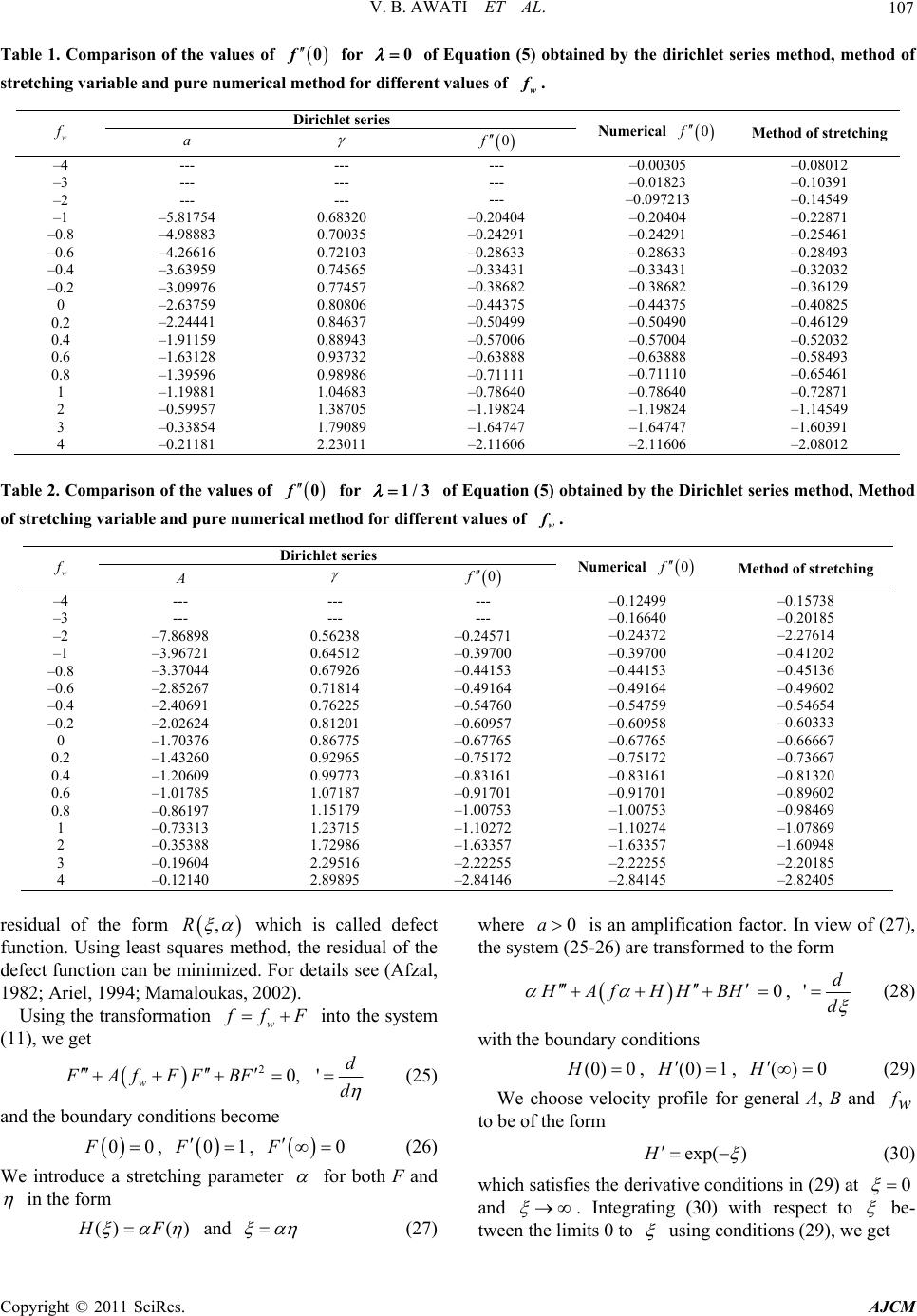 V. B. AWATI ET AL. Copyright © 2011 SciRes. AJCM 107 Table 1. Comparison of the values of f or f0 0 of Equation (5) obtained by the dirichlet series method, method of stretching variable and pure numerical method for different values of . w f Dirichlet series w f a 0f Numerical 0f Method of stretching –4 –3 –2 –1 –0.8 –0.6 –0.4 –0.2 0 0.2 0.4 0.6 0.8 1 2 3 4 --- --- --- –5.81754 –4.98883 –4.26616 –3.63959 –3.09976 –2.63759 –2.24441 –1.91159 –1.63128 –1.39596 –1.19881 –0.59957 –0.33854 –0.21181 --- --- --- 0.68320 0.70035 0.72103 0.74565 0.77457 0.80806 0.84637 0.88943 0.93732 0.98986 1.04683 1.38705 1.79089 2.23011 --- --- --- –0.20404 –0.24291 –0.28633 –0.33431 –0.38682 –0.44375 –0.50499 –0.57006 –0.63888 –0.71111 –0.78640 –1.19824 –1.64747 –2.11606 –0.00305 –0.01823 –0.097213 –0.20404 –0.24291 –0.28633 –0.33431 –0.38682 –0.44375 –0.50490 –0.57004 –0.63888 –0.71110 –0.78640 –1.19824 –1.64747 –2.11606 –0.08012 –0.10391 –0.14549 –0.22871 –0.25461 –0.28493 –0.32032 –0.36129 –0.40825 –0.46129 –0.52032 –0.58493 –0.65461 –0.72871 –1.14549 –1.60391 –2.08012 Table 2. Comparison of the values of for f01 /3 of Equation (5) obtained by the Dirichlet series method, Method of stretching variable and pure numerical method for different values of w f . Dirichlet series w f A 0f Numerical 0f Method of stretching –4 –3 –2 –1 –0.8 –0.6 –0.4 –0.2 0 0.2 0.4 0.6 0.8 1 2 3 4 --- --- –7.86898 –3.96721 –3.37044 –2.85267 –2.40691 –2.02624 –1.70376 –1.43260 –1.20609 –1.01785 –0.86197 –0.73313 –0.35388 –0.19604 –0.12140 --- --- 0.56238 0.64512 0.67926 0.71814 0.76225 0.81201 0.86775 0.92965 0.99773 1.07187 1.15179 1.23715 1.72986 2.29516 2.89895 --- --- –0.24571 –0.39700 –0.44153 –0.49164 –0.54760 –0.60957 –0.67765 –0.75172 –0.83161 –0.91701 –1.00753 –1.10272 –1.63357 –2.22255 –2.84146 –0.12499 –0.16640 –0.24372 –0.39700 –0.44153 –0.49164 –0.54759 –0.60958 –0.67765 –0.75172 –0.83161 –0.91701 –1.00753 –1.10274 –1.63357 –2.22255 –2.84145 –0.15738 –0.20185 –2.27614 –0.41202 –0.45136 –0.49602 –0.54654 –0.60333 –0.66667 –0.73667 –0.81320 –0.89602 –0.98469 –1.07869 –1.60948 –2.20185 –2.82405 residual of the form ,R which is called defect function. Using least squares method, the residual of the defect function can be minimized. For details see (Afzal, 1982; Ariel, 1994; Mamaloukas, 2002). where is an amplification factor. In view of (27), the system (25-26) are transformed to the form 0a 22 0 w HAf HHBH , 'd d (28) Using the transformation w f fF into the system (11), we get with the boundary conditions (0) 0H , (0) 1H , (29) () 0H 20, w FAfFFBF 'd d (25) We choose velocity profile for general A, B and f w to be of the form and the boundary conditions become 00F, 01F , (26) 0F exp( )H (30) We introduce a stretching parameter for both F and in the form which satisfies the derivative conditions in (29) at 0 and . Integrating (30) with respect to be- ween the limits 0 to () ()HF and (27) using conditions (29), we get t 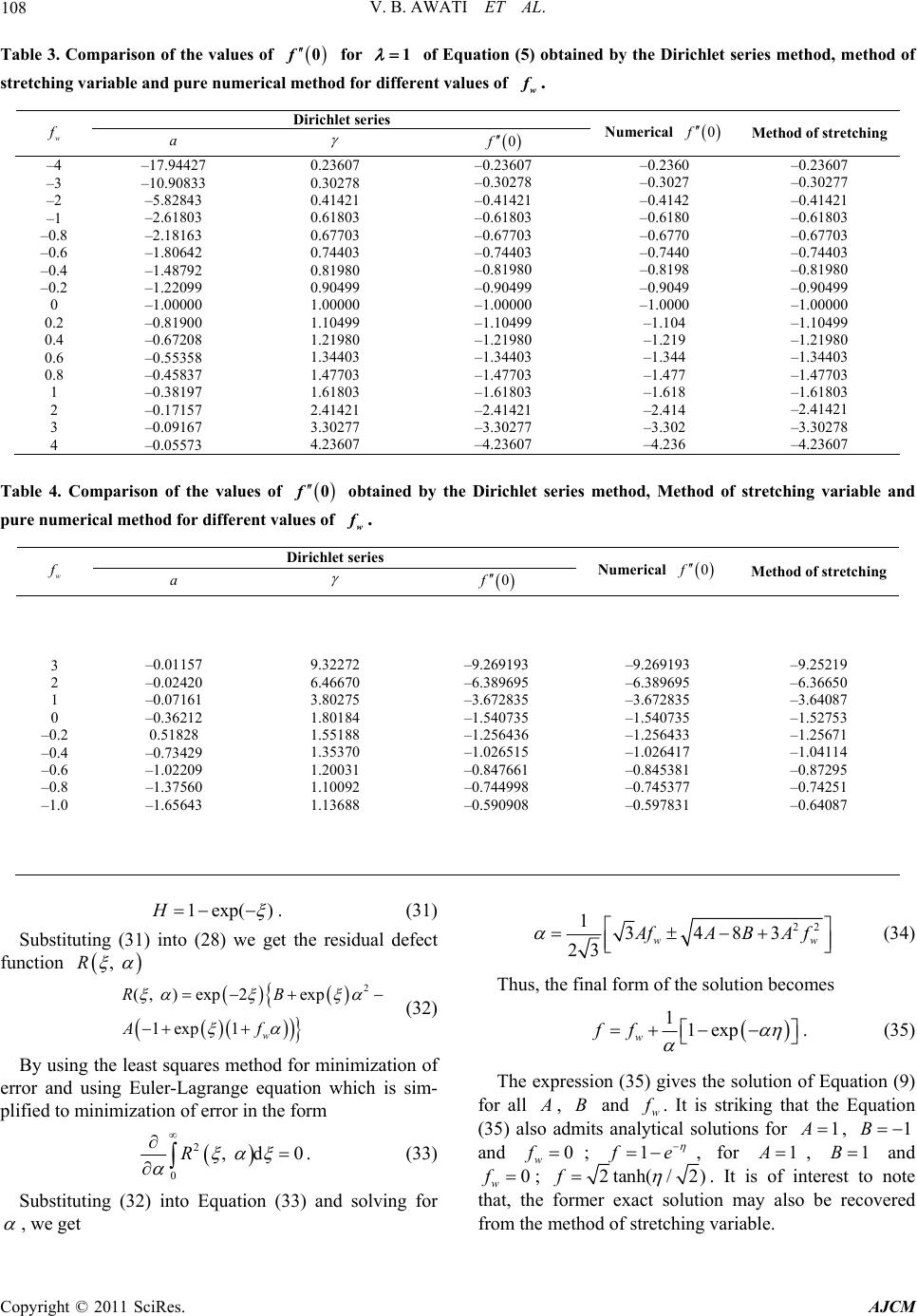 V. B. AWATI ET AL. Copyright © 2011 SciRes. AJCM 108 Table 3. Comparison of the values of for f01 of Equation (5) obtained by the Dirichlet series method, method of stretching variable and pure numerical method for different values of w f . Dirichlet series w f a 0f Numerical 0f Method of stretching –4 –3 –2 –1 –0.8 –0.6 –0.4 –0.2 0 0.2 0.4 0.6 0.8 1 2 3 4 –17.94427 –10.90833 –5.82843 –2.61803 –2.18163 –1.80642 –1.48792 –1.22099 –1.00000 –0.81900 –0.67208 –0.55358 –0.45837 –0.38197 –0.17157 –0.09167 –0.05573 0.23607 0.30278 0.41421 0.61803 0.67703 0.74403 0.81980 0.90499 1.00000 1.10499 1.21980 1.34403 1.47703 1.61803 2.41421 3.30277 4.23607 –0.23607 –0.30278 –0.41421 –0.61803 –0.67703 –0.74403 –0.81980 –0.90499 –1.00000 –1.10499 –1.21980 –1.34403 –1.47703 –1.61803 –2.41421 –3.30277 –4.23607 –0.2360 –0.3027 –0.4142 –0.6180 –0.6770 –0.7440 –0.8198 –0.9049 –1.0000 –1.104 –1.219 –1.344 –1.477 –1.618 –2.414 –3.302 –4.236 –0.23607 –0.30277 –0.41421 –0.61803 –0.67703 –0.74403 –0.81980 –0.90499 –1.00000 –1.10499 –1.21980 –1.34403 –1.47703 –1.61803 –2.41421 –3.30278 –4.23607 Table 4. Comparison of the values of obtained by the Dirichlet series method, Method of stretching variable and pure numerical method for different values of f0 w f . Dirichlet series w f a 0f Numerical 0f Method of stretching 3 2 1 0 –0.2 –0.4 –0.6 –0.8 –1.0 –0.01157 –0.02420 –0.07161 –0.36212 0.51828 –0.73429 –1.02209 –1.37560 –1.65643 9.32272 6.46670 3.80275 1.80184 1.55188 1.35370 1.20031 1.10092 1.13688 –9.269193 –6.389695 –3.672835 –1.540735 –1.256436 –1.026515 –0.847661 –0.744998 –0.590908 –9.269193 –6.389695 –3.672835 –1.540735 –1.256433 –1.026417 –0.845381 –0.745377 –0.597831 –9.25219 –6.36650 –3.64087 –1.52753 –1.25671 –1.04114 –0.87295 –0.74251 –0.64087 1 exp()H . (31) Substituting (31) into (28) we get the residual defect function ,R 2 (,) exp2exp 1exp1 w RB Af (32) By using the least square s method for minimization of error and using Euler-Lagrange equation which is sim- plified to minimization of error in the form 2 0 ,dR 0 . (33) Substituting (32) into Equation (33) and solving for , we get 22 13483 23 ww A fABAf (34) Thus, the final form of the solution becomes 11exp w ff . (35) The expression (35) gives the solution of Equation (9) for all A , and w B f . It is striking that the Equation (35) also admits analytical solutions for 1 A , 1B and w0f ; 1 f e , for 1 A , 1B and w0f ; 2ta/2nh( )f. It is of interest to note that, the former exact solution may also be recovered from the method of stretching variable. 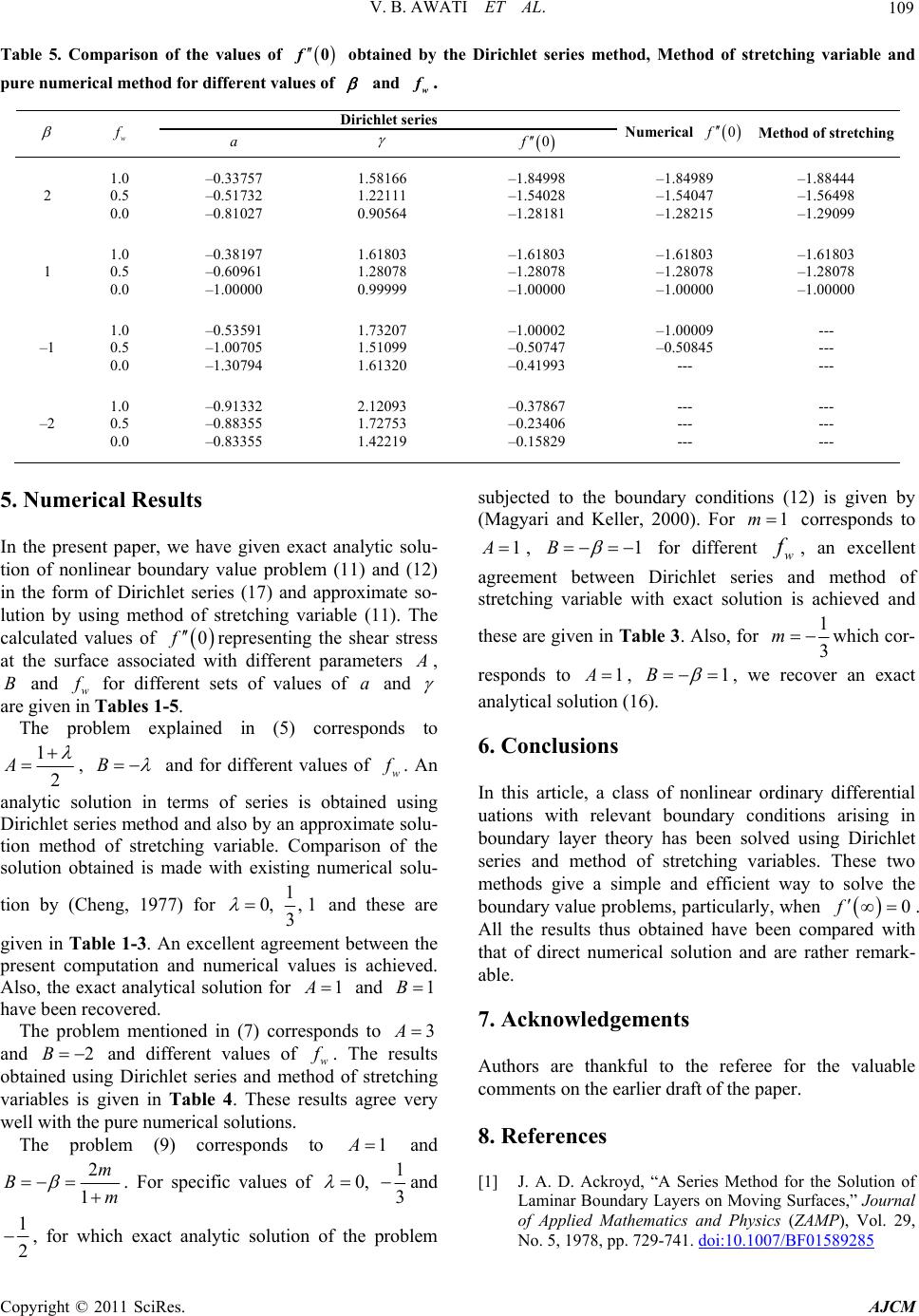 V. B. AWATI ET AL. Copyright © 2011 SciRes. AJCM 109 Table 5. Comparison of the values of obtained by the Dirichlet series method, Method of stretching variable and pure numerical method for different values of f0 and w f . Dirichlet series w f a 0f Numerical 0f Method of stretching 2 1.0 0.5 0.0 –0.33757 –0.51732 –0.81027 1.58166 1.22111 0.90564 –1.84998 –1.54028 –1.28181 –1.84989 –1.54047 –1.28215 –1.88444 –1.56498 –1.29099 1 1.0 0.5 0.0 –0.38197 –0.60961 –1.00000 1.61803 1.28078 0.99999 –1.61803 –1.28078 –1.00000 –1.61803 –1.28078 –1.00000 –1.61803 –1.28078 –1.00000 –1 1.0 0.5 0.0 –0.53591 –1.00705 –1.30794 1.73207 1.51099 1.61320 –1.00002 –0.50747 –0.41993 –1.00009 –0.50845 --- --- --- --- –2 1.0 0.5 0.0 –0.91332 –0.88355 –0.83355 2.12093 1.72753 1.42219 –0.37867 –0.23406 –0.15829 --- --- --- --- --- --- 5. Numerical Results In the present paper, we have given exact analytic solu- tion of nonlinear boundary value problem (11) and (12) in the form of Dirichlet series (17) and approximate so- lution by using method of stretching variable (11). The calculated values of representing the shear stress at the surface associated with different parameters 0f A , and w B f for different sets of values of and a are give n i n Tables 1-5. The problem explained in (5) corresponds to 1 2 A , B and for different values of w f . An analytic solution in terms of series is obtained using Dirichlet series method and also by an approximate solu- tion method of stretching variable. Comparison of the solution obtained is made with existing numerical solu- tion by (Cheng, 1977) for 1 0, , 1 3 and these are given in Table 1-3. An excellent agreement between the present computation and numerical values is achieved. Also, the exact analytical solution for 1 A and 1B have been recovered. The problem mentioned in (7) corresponds to 3A and and different values of w 2B f . The results obtained using Dirichlet series and method of stretching variables is given in Table 4. These results agree very well with the pure numerical solutions. The problem (9) corresponds to 1 A and 2 1 m Bm . For specific values of 1 0, 3 and 1 2 , for which exact analytic solution of the problem subjected to the boundary conditions (12) is given by (Magyari and Keller, 2000). For corresponds to 1m 1 A , 1B for different w f , an excellent agreement between Dirichlet series and method of stretching variable with exact solution is achieved and these are given in Table 3 . Also, for 1 3 mwhich cor- responds to 1 A , 1B , we recover an exact analytical solution (16). 6. Conclusions In this article, a class of nonlinear ordinary differential uations with relevant boundary conditions arising in boundary layer theory has been solved using Dirichlet series and method of stretching variables. These two methods give a simple and efficient way to solve the boundary value problems, particularly, when 0f . All the results thus obtained have been compared with that of direct numerical solution and are rather remark- able. 7. Acknowledgements Authors are thankful to the referee for the valuable comments on the earlier draft of the paper. 8. References [1] J. A. D. Ackroyd, “A Series Method for the Solution of Laminar Boundary Layers on Moving Surfaces,” Journal of Applied Mathematics and Physics (ZAMP), Vol. 29, No. 5, 1978, pp. 729-741. doi:10.1007/BF01589285 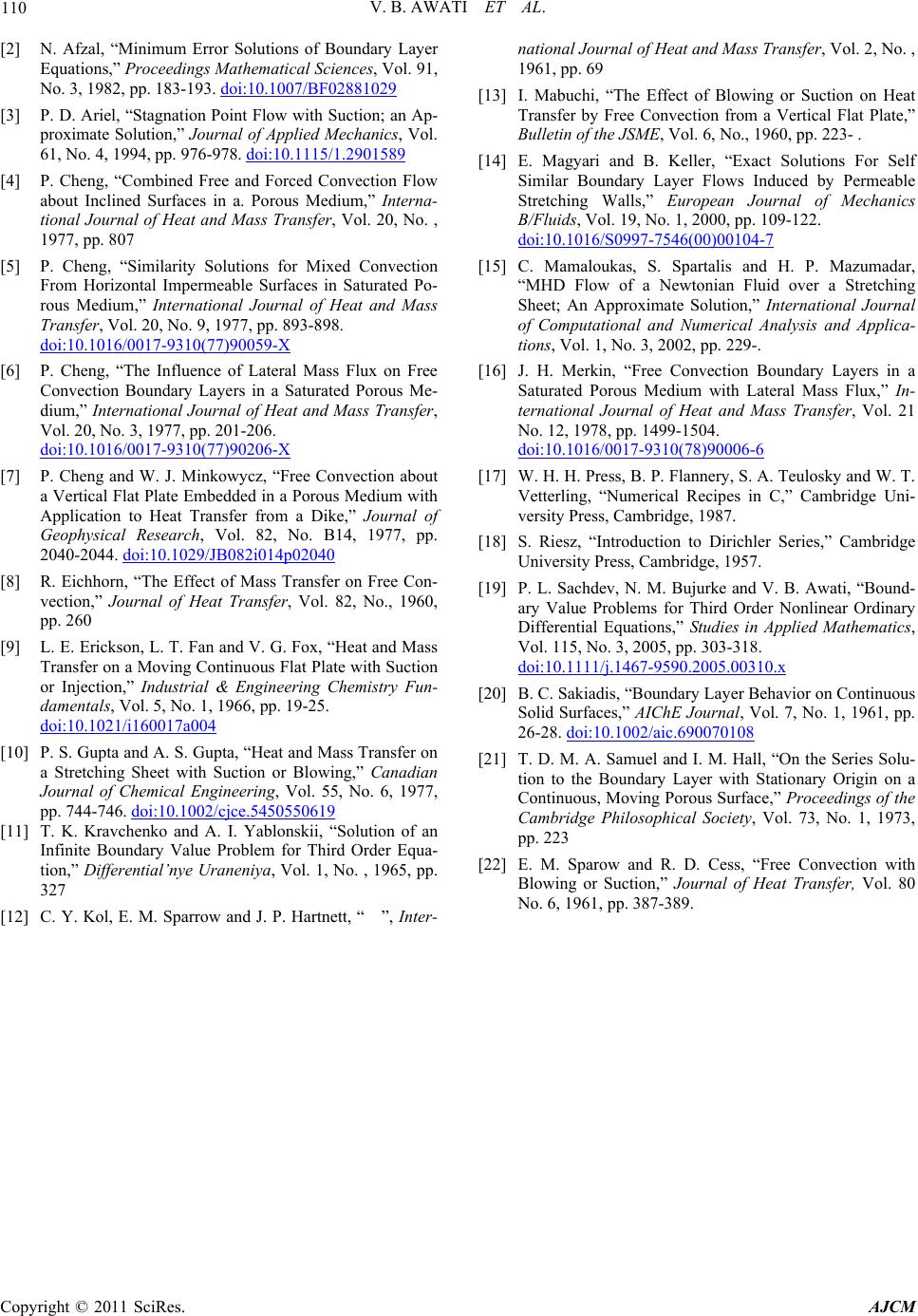 110 V. B. AWATI ET AL. [2] N. Afzal, “Minimum Error Solutions of Boundary Layer Equations,” Proceedings Mathematical Sciences, Vol. 91, No. 3, 1982, pp. 183-193. doi:10.1007/BF02881029 [3] P. D. Ariel, “Stagnation Point Flow with Suction; an Ap- proximate Solution,” Journal of Applied Mechanics, Vol. 61, No. 4, 1994, pp. 976-978. doi:10.1115/1.2901589 [4] P. Cheng, “Combined Free and Forced Convection Flow about Inclined Surfaces in a. Porous Medium,” Interna- tional Journal of Heat and Mass Transfer, Vol. 20, No. , 1977, pp. 807 [5] P. Cheng, “Similarity Solutions for Mixed Convection From Horizontal Impermeable Surfaces in Saturated Po- rous Medium,” International Journal of Heat and Mass Transfer, Vol. 20, No. 9, 1977, pp. 893-898. doi:10.1016/0017-9310(77)90059-X [6] P. Cheng, “The Influence of Lateral Mass Flux on Free Convection Boundary Layers in a Saturated Porous Me- dium,” International Journal of Heat and Mass Transfer, Vol. 20, No. 3, 1977, pp. 201-206. doi:10.1016/0017-9310(77)90206-X [7] P. Cheng and W. J. Minkowycz, “Free Convection about a Vertical Flat Plate Embedded in a Porous Medium with Application to Heat Transfer from a Dike,” Journal of Geophysical Research, Vol. 82, No. B14, 1977, pp. 2040-2044. doi:10.1029/JB082i014p02040 [8] R. Eichhorn, “The Effect of Mass Transfer on Free Con- vection,” Journal of Heat Transfer, Vol. 82, No., 1960, pp. 260 [9] L. E. Erickson, L. T. Fan and V. G. Fox, “Heat and Mass Transfer on a Moving Continuous Flat Plate with Suction or Injection,” Industrial & Engineering Chemistry Fun- damentals, Vol. 5, No. 1, 1966, pp. 19-25. doi:10.1021/i160017a004 [10] P. S. Gupta and A. S. Gupta, “Heat and Mass Transfer on a Stretching Sheet with Suction or Blowing,” Canadian Journal of Chemical Engineering, Vol. 55, No. 6, 1977, pp. 744-746. doi:10.1002/cjce.5450550619 [11] T. K. Kravchenko and A. I. Yablonskii, “Solution of an Infinite Boundary Value Problem for Third Order Equa- tion,” Differential’nye Uraneniya, Vol. 1, No. , 1965, pp. 327 [12] C. Y. Kol, E. M. Sparrow and J. P. Hartnett, “ ”, Inter- national Journal of Heat and Mass Transfer, Vol. 2, No. , 1961, pp. 69 [13] I. Mabuchi, “The Effect of Blowing or Suction on Heat Transfer by Free Convection from a Vertical Flat Plate,” Bulletin of the JSME, Vol. 6, No., 1960, pp. 223- . [14] E. Magyari and B. Keller, “Exact Solutions For Self Similar Boundary Layer Flows Induced by Permeable Stretching Walls,” European Journal of Mechanics B/Fluids, Vol. 19, No. 1, 2000, pp. 109-122. doi:10.1016/S0997-7546(00)00104-7 [15] C. Mamaloukas, S. Spartalis and H. P. Mazumadar, “MHD Flow of a Newtonian Fluid over a Stretching Sheet; An Approximate Solution,” International Journal of Computational and Numerical Analysis and Applica- tions, Vol. 1, No. 3, 2002, pp. 229-. [16] J. H. Merkin, “Free Convection Boundary Layers in a Saturated Porous Medium with Lateral Mass Flux,” In- ternational Journal of Heat and Mass Transfer, Vol. 21 No. 12, 1978, pp. 1499-1504. doi:10.1016/0017-9310(78)90006-6 [17] W. H. H. Press, B. P. Flannery, S. A. Teulosky and W. T. Vetterling, “Numerical Recipes in C,” Cambridge Uni- versity Press, Cambridge, 1987. [18] S. Riesz, “Introduction to Dirichler Series,” Cambridge University Press, Cambridge, 1957. [19] P. L. Sachdev, N. M. Bujurke and V. B. Awati, “Bound- ary Value Problems for Third Order Nonlinear Ordinary Differential Equations,” Studies in Applied Mathematics, Vol. 115, No. 3, 2005, pp. 303-318. doi:10.1111/j.1467-9590.2005.00310.x [20] B. C. Sakiadis, “Boundary Layer Behavior on Continuous Solid Surfaces,” AIChE Journal, Vol. 7, No. 1, 1961, pp. 26-28. doi:10.1002/aic.690070108 [21] T. D. M. A. Samuel and I. M. Hall, “On the Series Solu- tion to the Boundary Layer with Stationary Origin on a Continuous, Moving Porous Surface,” Proceedings of the Cambridge Philosophical Society, Vol. 73, No. 1, 1973, pp. 223 [22] E. M. Sparow and R. D. Cess, “Free Convection with Blowing or Suction,” Journal of Heat Transfer, Vol. 80 No. 6, 1961, pp. 387-389. Copyright © 2011 SciRes. AJCM |