

Paper Menu >>
Journal Menu >>
 Psychology 2011. Vol.2, No.3, 248-253 Copyright © 2011 SciRes. DOI:10.4236/psych.2011.23039 Personality of Students of Economics, Medicine, and Verbal Communication: Preliminary Results Jörg Richter1, Rosina Neumann2 1Centre for Child and Adolescent Mental Health, Oslo, Norway; 2Faculty of Philosophy, University of Rostock, Rostock, Germany. Email: [email protected] Received December 18th, 2010; revised March 18th, 2011; accepted April 20th, 2011. Differences on personality between students of economics, medicine and verbal communication should be ex- plored by means of the Temperament and Character Inventory. Students of economics are mainly characterized by lower harm avoidance and lower reward dependence and higher self directedness than medical students and students of verbal communication. Students of all groups seem to overestimate their self-directedness with eco- nomical students showing the most pronounced tendency of overrating, whereas medical students tend to over- rate their cooperativeness more than the students from the other groups. The obvious disturbed self-evaluation corresponds to the students’ professional orientation. The students can be characterized by specific and varying types and impact of social desirability depending on their professional career. Keywords: Personality, Temperament, Character, University Students Introduction The personality of university students has been the subject of various investigations, which however focused mainly on rela- tionships between personality characteristics and academic performance. E.g., studies in students of economics showed that those who were more introvert according to the broad Myers- Briggs categories and who found their source of energy in the inner life of ideas or concepts, performed better than extroverts in principles of economics. This tendency seemed to persist throughout the university training (Ziegert, 2000; Borg & Stranahan, 2002a, 2002b). Furthermore, students with SJ (sensing and judging) temperaments, i.e. who trust data and information perceived thru the five senses, who focus on details and specifics, work sequentially and prefer experience-guided learning, and who have a practical and present orientation com- bined with goal orientation and structured goal planning, per- formed significantly better than those of a SP (sensing and per- ceiving) temperament, i.e. who also trust data and information from the five senses but combined with rather spontaneous and flexible preferences and a tendency to avoid quick decisions. By using the NEO-PI-R questionnaire which is based on the Five-Factor Model of personality (Costa & McCrae, 1992), Lievens, Coetsier, de Fruyr, & de Maeseneer (2002) showed that medical students were characterized as highly extrovert without significant differences compared to students of law, economics, psychology, pedagogical sciences and political and social sciences. Additionally, medical students obtained the highest scores on agreeableness and average scores for con- sciousness, openness to experience and neuroticism. The two dimensions on which, among others, medical students and stu- dents of economics differed from students of mainly applied sciences (engineering) refer to interpersonal relationships such as extraversion (sociable and extrovert vs. shy and introvert) indicating the frequency of relationships and agreeableness (warm and friendly vs. cold and aloof) indicating the quality of relationships. More recently, Cloninger (Cloninger, Przybeck, Svrakic, & Wetzel, 1994) proposed a new psychobiological model of per- sonality. An assumed distinction between temperament and character seems to be related to differences in major brain sys- tems for the adaptation to the experiences on various levels which can be described as the contrast between percept versus concept, emotion versus volition, instinct versus will, and habit versus cognition. The temperament dimensions are defined to be genetically homogenous and independently inherited. These inherited neurophysiological mechanisms influence tendencies to activate (novelty seeking—NS), maintain (reward depend- ence—RD), or inhibit (harm avoidance—HA) behaviour and determine the perception of the environment and society. Ac- cording to this theory, HA reflects a heritable bias in the inhibi- tion or cessation of behaviours. Subjects high in HA are pessi- mistic, worrying, and fatigable, shy with strangers, and become tense in unfamiliar situations. NS is viewed as a tendency to- wards exhilaration in response to novel stimuli or cues. Sub- jects scoring high in NS are described as showing an increased frequency of explanatory behaviour, impulsive decision-making, a quick loss of temper and active avoidance of frustration. RD reflects a tendency to maintain or pursue ongoing behaviours. People with high scores on RD are sentimental, socially at- tached and dependent on the approval of others. Persistence (PS), the fourth temperament dimension, reflects the persever- ance in behaviour despite frustration and fatigue. Character is defined as individual differences in self-con- cepts, which vary in the extent to which a person identifies him/herself as an autonomous individual (self-directedness— SD), as an integrated part of the humanity (cooperativeness— CO), and as an integral part of the whole universe (self-tran- scendence—ST). It represents the second domain of personality, which is predominantly determined by socialisation processes  J. RICHTER ET AL. 249 during the life span. Changes in cognition and the self-concept during the development of personality are supposed to be re- lated to personal, social, moral, and spiritual maturation. An individual, who is low in SD, could be described as irresponsi- ble, aimless, undisciplined in behaviour and of poor im- pulse-control in general. CO is related to the extent to which a person identifies himself or herself as an integral part of the society as a whole. Uncooperative individuals are characterised as hostile, aggressive, hateful, and as revengeful opportunists. ST reflects the tendency of identification with unity of all things and is associated with deficits in transpersonal identifi- cation or conscience. Individuals low in ST show conventional and materialistically oriented behaviour with little or no con- cern for absolute ideas, such as goodness and universal har- mony. The theory assumes that personality is determined by an interaction between social, environmental, and genetic influ- ences during the whole life span. Based on this theory, Vaidya and colleagues (2005) investi- gated a large sample of medical students by means of the re- lated questionnaire, the Temperament and Character Inventory (Cloninger et al., 1994), with focus on differences in personal- ity characteristics between students of various medical speciali- ties. The authors described mainly differences between the students groups concerning temperament dimensions, i.e., fu- ture surgeons were lower in HA and RD than others, students choosing primary care specialities, emergency medicine, ob- stetrics and gynaecology were high on RD with paediatricians scoring highest. This topic of personality differences between medical stu- dents who decided for various medical specialties has of been investigated primarily suggesting that those who preferred any surgical specialty described themselves as being more resistant to stress and having high self-esteem (Linn & Zeppa, 1984); as more masculine and lower on depression (Zeldow & Daugherty, 1991); or as high on impulsive sensation seeking and low on neuroticism-anxiety (Hojat & Zuckerman, 2008) compared to medical students who preferred other specialties. For example, those who were interested in a hospital-based specialty scored lower on sociability. Generally, persons who have decided to study at university will assume some kind of managing or leading position after some years of occupation. Investigations revealed differences in personality characteristics between students of various speciali- ties (Buddeberg-Fischer, Klaghofer, Abel, & Buddeberg, 2003). From an organizational psychological perspective, personality characteristics assessed by measures of the five factor model of personality were found associated with career interests corre- sponding to types of occupational environment based on Hol- land’s theory of career interest (1985, 1994). Strong associa- tions were particularly found between the enterprising (indi- viduals with this interest type generally like persuading or di- recting others more than working on scientific or complicated topics) and artistic (individuals with this interest type generally like working with creative ideas and self-expression more than routines and rules) vocational interest type and the openness and extraversion personality traits in meta-analyses (Larson, Rottinghaus & Borgen, 2002; Barrick, Mount, & Gupta, 2003). However, we could not find any longitudinal investigation that followed the personality development from a university student to a more or less successful professional career. There- fore, we decided to initiate a 20 years survey of personality in university students of various specialities with waves of two years interval. The following research questions will be inves- tigated: (A) Are there differences between medical students, of verbal communication and communication disturbances and students of economics concerning personality characteristics? (B) Can the personality characteristics of these student groups as assessed by the Myers-Briggs temperament types and/or by the NEO-PI-R be confirmed by the TCI (i.e., a cross-validation of former results and of the construct validation of the TCI)? (C) Are the responses of students from various specialities differ- ently determined by tendencies of self-presentation (i.e., of varying impact of social desirability)? (D) Are there differences in the development of personality characteristics throughout the period of university training and subsequent years depending on the speciality, place of work, position, and/or major changes in private life? Preliminary results of the 1st wave of this survey are pre- sented below. The study design does not allow addressing the research question D at this juncture. Methods Sample Students of economics (n = 84), medicine (n = 65), and of verbal communication and communication disturbances (n = 43)1 of the University of Rostock, Germany, were willing to participate voluntarily in a 20-years follow-up study on person- ality characteristics between January 2004 and June 2005. It represents a convenient sample. The mean age was 22.4 ± 2.4 years. There was no significant difference between the three study groups according to age (F = 0.38; p = 0.687) or gender (χ2 = 0.43; approx. p = 0.805). In the instruction, it was clearly stated that this investigation cannot be performed anonymously due to its repeated measures design. We intend investigating the students very two years by the Temperament and Character Inventory and a life event list. Measurement The Temperament and Character Inventory (TCI) (Cloninger et al., 1994) was used to measure temperament and character as major personality domains. It measures the four temperament dimensions based on Cloninger’s unified biosocial theory of personality: NS (novelty seeking) and HA (harm avoidance), both composed of four lower-order subscales; RD (reward de- pendence), composed of three subscales; and, PS (persistence), as a single-scale dimension; as well as the three character di- mensions: SD (self-directedness) and CO (cooperativeness), each comprising five lower-order dimensions, and ST (self transcendence) with three subscales. 1Currently, this is a B.A. study at the Philosophical Faculty, University o f Rostock, mainly aiming to teach pedagogs in a wide range of applied com- munication sciences with the focus from rehabilitation centres and schools for disabled children to communication disturbances in intercultural team-work. Students should become prepared to deal with phenomena o f verbal communication that deviate from common communication processes. Furthermore, they are trained in understanding and management of disturbed communication in various contexts (http://www.phf.uni-rostock.de/insti- tut/igerman/spr_komm/html/studiengang.html).  J. RICHTER ET AL. 250 The inventory is a self-administered paper-and-pencil test of 240 items of a true/false format. It takes about 20 to 30 minutes to complete. Its psychometric properties have been demon- strated separately for versions of several languages (for the German version Richter, Eisemann, Richter & Cloninger, 1999) using established personality theories, in different groups of normals and patients, and with respect to neurobiological pa- rameters. Statistics To compare the mean scores between the students` groups, t-tests for independent groups, one-way ANOVAs concerning the personality scores and multiple ANOVAs concerning the personality profile were calculated. In order to evaluate the impact of self-presentation, the so-called performance scores, personality scores derived by multiple regression analysis from validity scores indicating the individual formal response style, were compared with the real response scores by paired-sample t-test (Table 2). Results At the dimensional and sub-scale level, students of econom- ics scored lower on ‘NS3 Extravagance vs. Reserve’, ‘HA1 Anticipatory Worry vs. Optimism’, ‘HA3 Shyness with Strang- ers’, HA dimension, ‘RD1 Extravagance vs. Reserve’, RD di- mension, whereas they obtained higher scores on ‘SD3 re- sourcefulness vs. inertia’, ‘SD5 Congruent second nature vs. bad habits’ and the SD dimension than medical students fol- lowed by the students of verbal communication sciences. Medical students and students of verbal communication did not significantly differ in any of the personality scores (Table 1). Economics students and those of communication were similar on ‘CO5 Pure hearted principles vs. self-serving advantage’ whereas medical students reached higher scores. At the multivariate level, we found a main effect for the stu- dents’ specialty at the level of the sub-scales (Wilks’ λ = 0.625; F (50/322) = 1.75; p = 0.002; η.2 = 0.21; Power = 1.00) based on significant effects on NS3, HA1, HA3, HA4, RD1, SD2, SD3, SD5, and CO5). In a MANOVA using the TCI dimen- sions, main effects for students’ specialty (Wilks’ λ = 0.817; F (14/366) = 2.77; p = 0.001; η.2 = 0.094; Power = 0.992—based on HA, RD and SD) and gender (Wilks’ λ = 0.920; F (7/182) = 2.27; p = 0.030; η.2 = 0.080; Power = 0.830—based on CO) occurred. The significant differences (paired sample t-tests) between the test scores of the students and the corresponding, evaluated performance scores make us assume that students of all groups seem to overestimate their SD (self-directedness) with eco- nomical students showing the most pronounced tendency of overrating, whereas medical students tend to overrate their CO (cooperativeness) more than the students from the other groups. Additionally, students of economics and medical students overrate their persistence. However, the students of social communication and the medical students seem to a somewhat lesser degree overrate their reward dependence whereas the economical students, on average, highly underrate their HA (harm avoidance). Concerning the number of students who over- or underrate their personality traits, about one third of all students overrate their self-directedness (Table 3) with an over- representation of females (40% vs. 25%) and most pronounced among the medical students (42% vs. 18%). Furthermore, about one sixth of the medical and one seventh of the economics stu- dents overrate their persistence, one tenth of the medical stu- dents overrate their cooperative abilities, one tenth of the stu- dents of verbal communication overrate their dependency on rewards and one fifth of the students of economics underrate their harm avoidance. Female medical students generally show a trend of overrating in any of the personality dimensions. Covariance analyses of the group differences lent support to the assumption that a response bias of over- or underrating the personality significantly influences the personality scores ex- cept of reward dependence (Table 3). Discussion The aim of the investigation was to establish baseline data of a longitudinal study on personality development of future lead- ers of various professions. Furthermore, differences on person- ality between students of economics, medicine and verbal communication sciences should be explored by means of the Temperament and Character Inventory (TCI). The interpretation of these preliminary results from the 1st wave of this survey is limited by its relatively small sample size. However, on the long run data from this prospective investiga- tion should enable us to draw conclusions about possible im- portant personality traits of the various professions which be more markedly developed during university training and during the first years of the occupational practice. Several differences, especially between students of econom- ics and the both other groups, i.e. students of medicine and of verbal communication, were found (research question A). Eco- nomics students described themselves as more reserved, con- trolled and restrained, frugal or stingy (NS3) as well as more uninhibited, nonchalant, carefree (HA1), bold, forward, outgo- ing and seldom inhibited by uncertainty of unfamiliarity (HA3) and rather practical, tough minded, odd, aloof with difficulties to establish social rapport (RD1), generally more practical, cold, withdrawn, detached, and independent (RD) compared with medical students and students of communication. The latter group reported an even lower degree of these characteristics than the medical students. Furthermore, students of economics rated themselves as more resourceful, effective, productive, competent, and innovative, and tended to look at difficult situa- tions rather as challenges or opportunities (SD3), with a higher self-discipline, more rarely confusing their priorities and feeling, more often safe and self-trusting (SD5), as well as they describe themselves generally as more mature, strong, responsible, goal- oriented, reliable, and constructive (SD) compared with medi- cal students and students of communication. On the other hand, economics students described themselves as more opportunistic with a tendency to treat people unfairly in a self-serving manner, behaving more often manipulative and deceitful (CO5) as compared with the other two groups. These differences corre- spond mainly to those based on other measurements like the NEO-PI and the Myers-Briggs temperament types and, there- fore, have to be regarded as a construct validation of these re- sults and as construct volition of the TCI (question B).  J. RICHTER ET AL. 251 Table 1. Comparisons of means of the personality scores among student groups. Medicals students Economics students Communication students Medical vs. Economics1 post hoc Medical vs. Communication Economics vs. Communication 3 post hoc 1 way ANOVA Significant Post hoc tests/P N = 65 N = 84 N = 43 t p t p t p F Sig. 1 3 Age 22.3 ± 2.4 22.4 ± 2.3 22.7 ± 2.8 −0.34 0.733−0.82 0.416−0.61 0.540 0.38 0.687 NS1 7.1 ± 2.5 7.2 ± 2.1 7.3 ± 2.0 −0.30 0.764−0.65 0.517−0.46 0.646 0.23 0.798 NS2 4.1 ± 2.5 4.0 ± 2.2 4.3 ± 2.0 0.27 0.791−0.46 0.647−0.78 0.436 0.27 0.764 NS3 5.6 ± 2.0 4.9 ± 1.8 6.0 ± 2.0 2.17 0.032−0.90 0.370−2.90 0.004 4.69 0.010 0.014 NS4 4.3 ± 1.7 4.2 ± 1.9 4.6 ± 1.6 .44 0.661−0.91 0.367−1.27 0.206 0.85 0.431 NS 21.1 ± 6.1 20.3 ± 5.0 22.3 ± 4.4 .87 0.387−1.07 0.284−2.16 0.033 1.95 0.145 HA1 4.5 ± 2.6 3.7 ± 1.8 5.0 ± 2.7 2.29 0.024−0.84 0.414−3.22 0.002 5.21 0.006 0.074 0.009 HA2 3.9 ± 2.0 3. 7 ± 1.9 4.5 ± 1.6 0.57 0.570−1.65 0.101−2.36 0.020 2.58 0.079 0.077 HA3 4.0 ± 2.1 3.0 ± 1.9 3. 8 ± 1.9 2.99 0.0030.440.661−2.27 0.025 5.26 0.006 0.0080.084 HA4 2.8 ± 1.8 2.2 ± 1.8 3.0 ± 2.2 1.97 0.051−0.64 0.525−2.29 0.024 3.31 0.039 0.060 HA 15.2 ± 6.2 12.6 ± 5.4 16.3 ± 6.1 2.75 0.007−0.92 0.359−3.53 0.001 6.96 0.001 0.0220.002 RD1 6.4 ± 2.1 5.5 ± 1.9 6.5 ± 1.8 2.90 0.004−0.35 0.727−3.09 0.002 6.38 0.002 0.0100.010 RD3 5.9 ± 2. 0 5.9 ± 2.0 6.6 ± 1.5 −0.03 0.979−1.78 0.079−1.82 0.071 1.85 0.159 RD4 4.1 ± 1.3 3.8 ± 1.4 4.2 ± 1.3 1.55 0.124−0.30 0.763−1.67 0.098 1.90 0.153 RD 16.4 ± 3.9 15.1 ± 3.9 17.3 ± 3.3 2.01 .046−1.21 0.229−3.10 0.002 5.15 0.007 0.008 PS 4.6 ± 2.1 4. 7 ± 2.0 3.9 ± 1.9 −0.30 0.7621.78 0.0792.25 0.026 2.52 0.084 0.094 SD1 6.2 ± 1.7 6.6 ± 1.6 6.1 ± 2.2 −1.26 0.2110.3620.7181.42 0.157 1.25 0.290 SD2 6.4 ± 1.6 6.8 ± 1.4 6.0 ± 1.8 −1.60 0.1121.14 0.2562.67 0.009 3.61 0.029 0.027 SD3 3.9 ± 1.3 4.4 ± 0.9 3.7 ± 1.4 −2.83 0.005 0.920.3593.69 0.001 6.92 0.001 0.0270.002 SD4 7.0 ± 2.8 7.6 ± 2.6 6.9 ± 2.6 −1.42 0.1570.16 0.8741.47 0.145 1.47 0.233 SD5 8.6 ± 2.2 9.3 ± 1.9 8.1 ± 2.4 −2.02 0.046 1.190.2373.08 0.003 4.95 0.008 0.008 SD 32.1 ± 6.8 34.7 ± 5.7 30.7 ± 8.1 −2.46 0.015 0.950.3433.15 0.002 5.55 0.005 0.069 0.006 CO1 6.8 ± 1.2 6.9 ± 1.5 6.4 ± 1.7 −0.20 0.8391.41 0.1611.52 0.131 1.44 0.239 CO2 4.9 ± 1.2 4.9 ± 1.2 5.0 ± 1.4 −0.33 0.742−0.55 0.583−0.29 0.769 0.16 0.855 CO3 6.3 ± 1.0 6.0 ± 1.2 6.0 ± 1.0 1.23 0.2211.560.1210.39 0.698 1.25 0.288 CO4 7.4 ± 2.4 6.5 ± 2.8 6.6 ± 2.9 2.26 0.0251.660.100−0.26 0.793 2.64 0.074 0.085 CO5 7.2 ± 1.1 6. 7 ± 1.6 7.0 ± 1.2 2.44 0.0160.870.389−1.33 0.188 3.26 0.041 0.040 C 32.7 ± 4.6 31.0 ± 5.7 30. 9 ± 5.7 1.92 0.0571.630.106−0.04 0.965 204 0.133 ST1 4.4 ± 2.8 4.1 ± 2.5 4.4 ± 2.4 0.62 0.533−0.08 0.936−0.68 0.501 0.30 0.742 ST2 2.3 ± 1.6 1.8 ± 1.5 2.3 ± 1.8 1.98 0.050−0.15 0.882−1.86 0.066 2.57 0.079 ST3 4.7 ± 3.5 4. 4 ± 3.2 5.5 ± 3.5 0.44 0.657−1.24 0.219−1.76 0.081 1.53 0.220 ST 11. 3 ± 6.3 10.3 ± 5.6 12.2 ± 6.3 1.04 0.300−0.76 0.451−1.79 0.076 1.59 0.207 NS1 exploratory excitability vs. rigidity, NS2 impulsiveness vs. reflection, NS3 extravagance vs. reserve, NS4 disorderliness vs. Regimentation, HA1 anticipatory worry vs. optimism, HA2 fear of uncertainty vs. confidence, HA3 shyness vs. gregariousness, HA4 Fatigability and Asthenia vs. Vigor, RD1 sentimentality vs. insensitiveness, RD3 attachment vs. detachment, RD4 dependence vs. Independence, SD1 responsibility vs. blaming, SD2 purposefulness vs. lack of goal direction, SD3 resourcefulness vs. inertia, SD4 self-acceptance vs. self-striving, SD5 impulse control vs. bad habits, CO1 social acceptance vs. social intolerance, CO2 empathy vs. social disinterest, ST3 spiritual acceptance vs. rational materialism CO3 helpfulness vs. unhelpfulness, CO4 compassion vs. revengefulness, CO5 pure hearted principles vs. self-serving advan- tage, ST1 creative self-forgetfulness vs. self-conscious experience, ST2 transpersonal identification vs. personal identification. 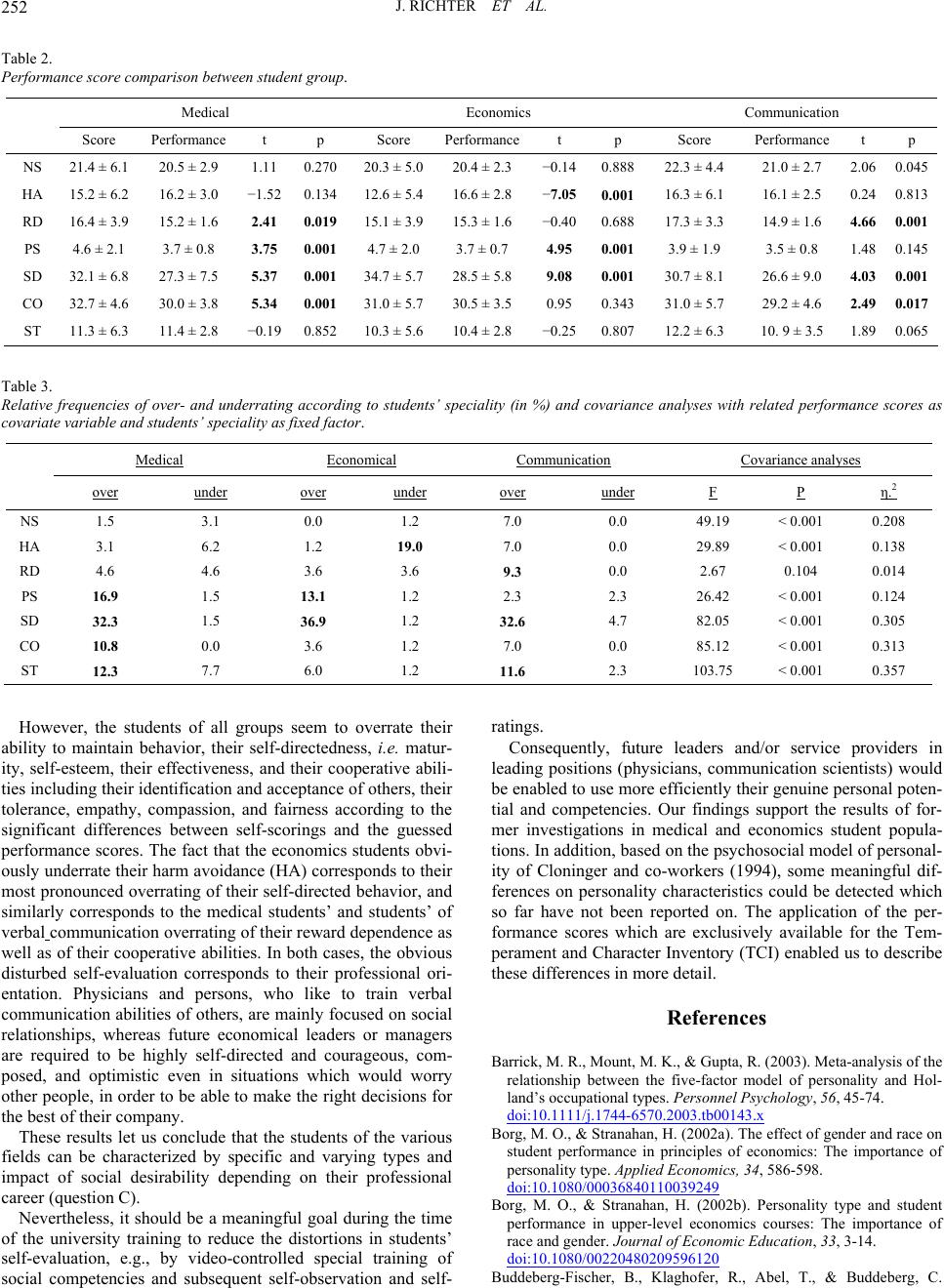 J. RICHTER ET AL. 252 Table 2. Performance score comparison between student group. Medical Economics Communication Score Performance t p Score Performancet p Score Performance t p NS 21.4 ± 6.1 20.5 ± 2.9 1.11 0.270 20.3 ± 5.020.4 ± 2.3 −0.140.88822.3 ± 4.4 21.0 ± 2.7 2.060.045 HA 15.2 ± 6.2 16.2 ± 3.0 −1.52 0.134 12.6 ± 5.416.6 ± 2.8 −7.05 0.001 16.3 ± 6.1 16.1 ± 2.5 0.240.813 RD 16.4 ± 3.9 15.2 ± 1.6 2.41 0.019 15.1 ± 3.915.3 ± 1.6 −0.400.68817.3 ± 3.3 14.9 ± 1.6 4.66 0.001 PS 4.6 ± 2.1 3.7 ± 0.8 3.75 0.001 4.7 ± 2.0 3.7 ± 0.7 4.95 0.0013.9 ± 1.9 3.5 ± 0.8 1.480.145 SD 32.1 ± 6.8 27.3 ± 7.5 5.37 0.001 34.7 ± 5.728.5 ± 5.8 9.08 0.00130.7 ± 8.1 26.6 ± 9.0 4.03 0.001 CO 32.7 ± 4.6 30.0 ± 3.8 5.34 0.001 31.0 ± 5.730.5 ± 3.5 0.95 0.34331.0 ± 5.7 29.2 ± 4.6 2.49 0.017 ST 11.3 ± 6.3 11.4 ± 2.8 −0.19 0.852 10.3 ± 5.610.4 ± 2.8 −0.250.80712.2 ± 6.3 10. 9 ± 3.5 1.890.065 Table 3. Relative frequencies of over- and underrating according to students’ speciality (in %) and covariance analyses with related performance scores as covariate variable and students’ speciality as fixed factor. Medical Economical Communication Covariance analyses over under over under over under F P η.2 NS 1.5 3.1 0.0 1.2 7.0 0.0 49.19 < 0.001 0.208 HA 3.1 6.2 1.2 19.0 7.0 0.0 29.89 < 0.001 0.138 RD 4.6 4.6 3.6 3.6 9.3 0.0 2.67 0.104 0.014 PS 16.9 1.5 13.1 1.2 2.3 2.3 26.42 < 0.001 0.124 SD 32.3 1.5 36.9 1.2 32.6 4.7 82.05 < 0.001 0.305 CO 10.8 0.0 3.6 1.2 7.0 0.0 85.12 < 0.001 0.313 ST 12.3 7.7 6.0 1.2 11.6 2.3 103.75 < 0.001 0.357 However, the students of all groups seem to overrate their ability to maintain behavior, their self-directedness, i.e. matur- ity, self-esteem, their effectiveness, and their cooperative abili- ties including their identification and acceptance of others, their tolerance, empathy, compassion, and fairness according to the significant differences between self-scorings and the guessed performance scores. The fact that the economics students obvi- ously underrate their harm avoidance (HA) corresponds to their most pronounced overrating of their self-directed behavior, and similarly corresponds to the medical students’ and students’ of verbal communication overrating of their reward dependence as well as of their cooperative abilities. In both cases, the obvious disturbed self-evaluation corresponds to their professional ori- entation. Physicians and persons, who like to train verbal communication abilities of others, are mainly focused on social relationships, whereas future economical leaders or managers are required to be highly self-directed and courageous, com- posed, and optimistic even in situations which would worry other people, in order to be able to make the right decisions for the best of their company. These results let us conclude that the students of the various fields can be characterized by specific and varying types and impact of social desirability depending on their professional career (question C). Nevertheless, it should be a meaningful goal during the time of the university training to reduce the distortions in students’ self-evaluation, e.g., by video-controlled special training of social competencies and subsequent self-observation and self- ratings. Consequently, future leaders and/or service providers in leading positions (physicians, communication scientists) would be enabled to use more efficiently their genuine personal poten- tial and competencies. Our findings support the results of for- mer investigations in medical and economics student popula- tions. In addition, based on the psychosocial model of personal- ity of Cloninger and co-workers (1994), some meaningful dif- ferences on personality characteristics could be detected which so far have not been reported on. The application of the per- formance scores which are exclusively available for the Tem- perament and Character Inventory (TCI) enabled us to describe these differences in more detail. References Barrick, M. R., Mount, M. K., & Gupta, R. (2003). Meta-analysis of the relationship between the five-factor model of personality and Hol- land’s occupational types. Personnel Psychology, 56, 45-74. doi:10.1111/j.1744-6570.2003.tb00143.x Borg, M. O., & Stranahan, H. (2002a). The effect of gender and race on student performance in principles of economics: The importance of personality type. Applied Economics, 34, 586-598. doi:10.1080/00036840110039249 Borg, M. O., & Stranahan, H. (2002b). Personality type and student performance in upper-level economics courses: The importance of race and gender. Journal of E conomic Education, 33, 3-14. doi:10.1080/00220480209596120 Buddeberg-Fischer, B., Klaghofer, R., Abel, T., & Buddeberg, C. 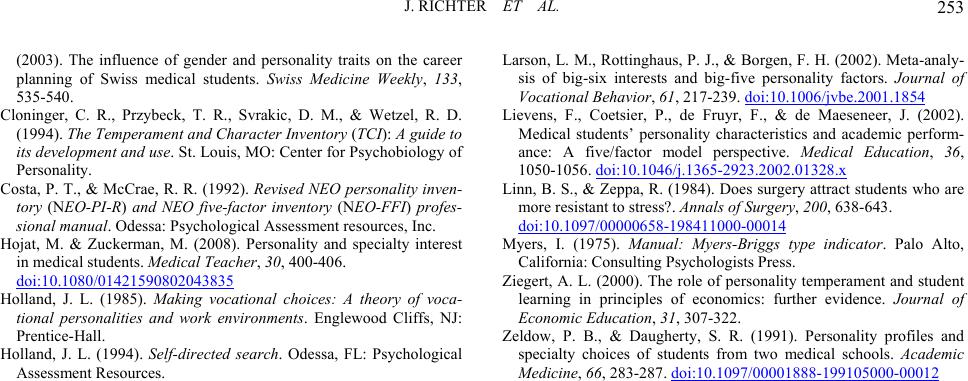 J. RICHTER ET AL. 253 (2003). The influence of gender and personality traits on the career planning of Swiss medical students. Swiss Medicine Weekly, 133, 535-540. Cloninger, C. R., Przybeck, T. R., Svrakic, D. M., & Wetzel, R. D. (1994). The Temperament and Character Inventory (TCI): A guide to its development and use. St. Louis, MO: Center for Psychobiology of Personality. Costa, P. T., & McCrae, R. R. (1992). Revised NEO personality inven- tory (NEO-PI-R) and NEO five-factor inventory (NEO-FFI) profes- sional manual. Odessa: Psychological Assessment resources, Inc. Hojat, M. & Zuckerman, M. (2008). Personality and specialty interest in medical students. Medical Teacher, 30, 400-406. doi:10.1080/01421590802043835 Holland, J. L. (1985). Making vocational choices: A theory of voca- tional personalities and work environments. Englewood Cliffs, NJ: Prentice-Hall. Holland, J. L. (1994). Self-directed search. Odessa, FL: Psychological Assessment Resources. Larson, L. M., Rottinghaus, P. J., & Borgen, F. H. (2002). Meta-analy- sis of big-six interests and big-five personality factors. Journal of Vocational Behavior, 61, 217-239. doi:10.1006/jvbe.2001.1854 Lievens, F., Coetsier, P., de Fruyr, F., & de Maeseneer, J. (2002). Medical students’ personality characteristics and academic perform- ance: A five/factor model perspective. Medical Education, 36, 1050-1056. doi:10.1046/j.1365-2923.2002.01328.x Linn, B. S., & Zeppa, R. (1984). Does surgery attract students who are more resistant to stress?. Annals of Surgery, 200, 638-643. doi:10.1097/00000658-198411000-00014 Myers, I. (1975). Manual: Myers-Briggs type indicator. Palo Alto, California: Consulting Psychologists Press. Ziegert, A. L. (2000). The role of personality temperament and student learning in principles of economics: further evidence. Journal of Economic Education, 31, 307-322. Zeldow, P. B., & Daugherty, S. R. (1991). Personality profiles and specialty choices of students from two medical schools. Academic Medicine, 66, 283-287. doi:10.1097/00001888-199105000-00012 |