

Paper Menu >>
Journal Menu >>
 International Journal of Organic Chemistry, 2011, 1, 33-36 doi:10.4236/ijoc.2011.12006 Published Online June 2011 (http://www.SciRP.org/journal/ijoc) Copyright © 2011 SciRes. IJOC A Facile and Inexpensive Synthesis of 6-Ethynylbipyridine Jianqiang Huo, John O. Hoberg Department of C hemi st ry , University of Wyoming, Laramie, USA E-mail: [email protected] Received April 6, 2011; revised May 16, 2011; accepted May 21, 2011 Abstract An inexpensive synthesis of 6-ethynylbipyridine has been accomplished using Sonogashira coupling of 2-bromo-6-iodopyridine with 2-methyl-3-butyn-2-ol. Subsequent Stille coupling with 2-(trimethylstannanyl) pyridine and hydrolysis provided the target compound in an overall high yield. Keywords: 6-Ethynylbipyridine, 2-Bromo-6-Iodopyridine, 2-Methyl-3-Butyne-2-ol, Palladium Coupling 1. Introduction Bipyridines are widely used structures that are found in a large range of functions. These include ligands in coor- dination chemistry, photocatalysts, functionalized poly- mers, sensors, supramolecular assemblies and met- allo-DNA conjugates. Thus, their importance in inor- ganic, organic and medicinal chemistry cannot be over- stated. The syntheses of functionalized 2,2’-bipyridines for the above areas are therefore needed and although numerous methods exist in the literature inexpensive and facile procedures are desirable. One such bipyridine is 6-ethynylbipyridine (1), which has the ability to undergo Sonogashira coupling to a host of other materials and has therefore been used in the synthesis of metallo-DNA conjugates [1], nucleosides bearing metal complexes for antiviral activity [2-4] and photoactive materials [5-8]. The reported synthesis [1] (Scheme 1) relies on a Stille reaction in the first step for the formation of 6-bromo- 2,2’-bipyridine (a Suzuki coupling has also been reported in 54% yield [9]), which, in a second step, undergoes further coupling of the resulting bromobipyridine prod- uct with the expensive trimethylacetylene (TMSA). We recently required large amounts of this material and en- visioned that both these issues could easily be resolved by the use of alternative reagents. 2. Results Our strategy for an alternative synthesis involved the use of 2-bromo-6-iodopyridine and 2-methyl-3-butyn-2-ol as replacement reagents (Scheme 2). The synthesis of 2-bromo-6-iodopyridine has been reported in which a bromine-magnesium exchange using iPrMgCl in THF is employed [10], however we found this procedure diffi- cult to reproduce. Therefore, we adapted Peterson’s [11] procedure, in which the formation of 2-bromo-6-lithio- pyridine is accomplished using n-butyllithium in di- chloromethane. Treatment of this with iodine provided 2 in high yield. Sonogashira coupling of 2 with 2-methyl- 3-butyn-2-ol proceeded in excellent yield as expected, and overcomes the use of expensive TMSA as the cost of 2-methyl-3-butyn-2-ol is inconsequential. We did at- tempt to couple 2-methyl-3-butyn-2-ol with 2,6-dibro- mopyridine, however unacceptable yields and complex mixtures resulted. Stille coupling of 3 with 2-(trimethylstannyl)pyridine [12] gave 4 in excellent yield, which was easily hydrolized to give target bipyridine 1 in an overall very good yield. In conclusion, we have developed an inexpensive and facile synthesis of 6-ethynylbipyridine. In particular, a ro- bust synthesis of 2-bromo-6-iodopyridine (2) has been ac- complished, which is critical to this chemistry and is a compound used in a variety of other reported couplings NBr Br + N Me3Sn PdL4 toluene reflux 67% NBr N TMSA PdL2Cl2 CuI Et3N, THF 89% N NTMS KF THF, MeOH 98% N N 1 Scheme 1 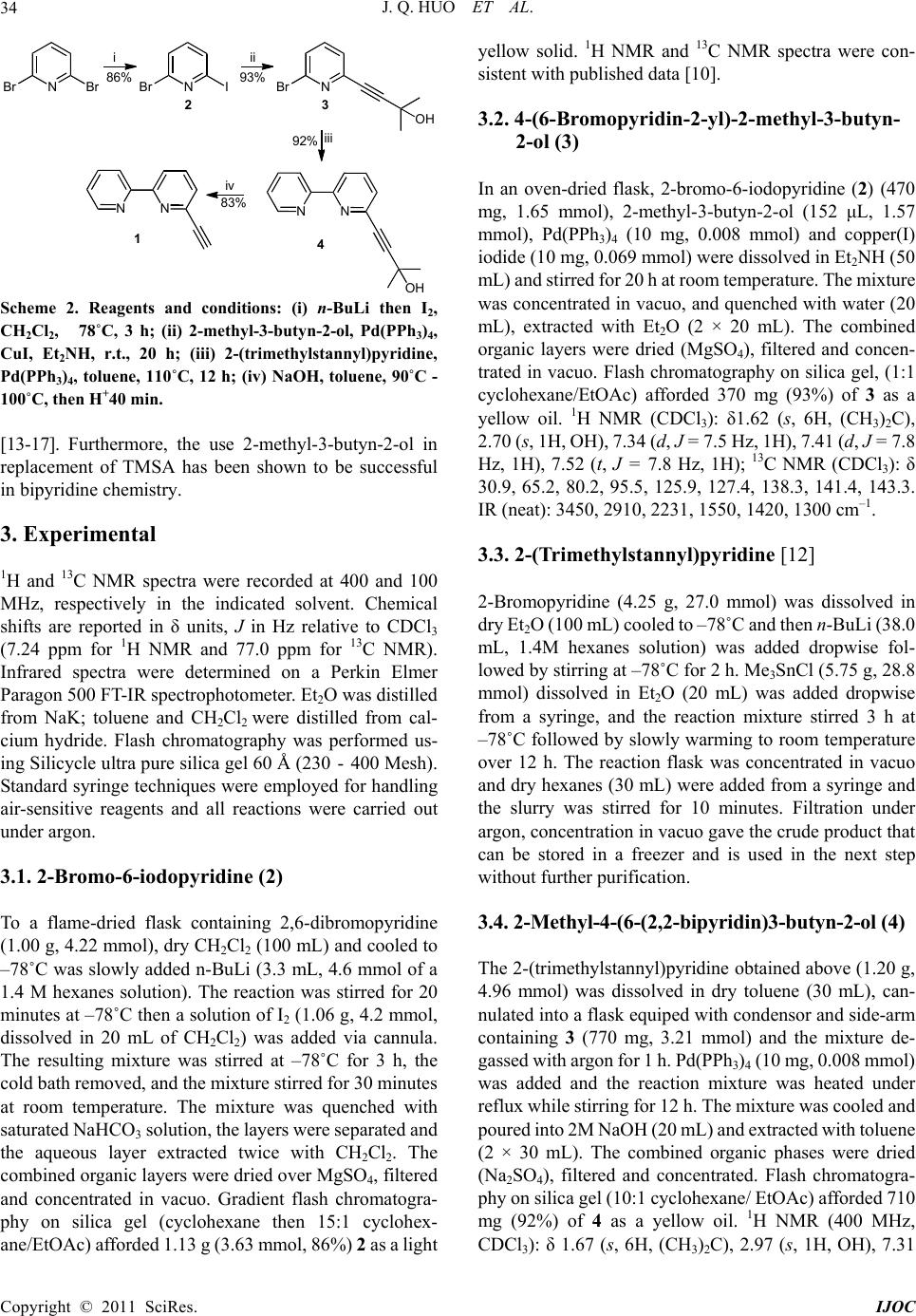 J. Q. HUO ET AL. 34 NBr BrNBr I NBr i 2 ii 3OH iii N OH N N N 4 1 iv 86% 93% 83% 92% Scheme 2. Reagents and conditions: (i) n-BuLi then I2, CH2Cl2, 78˚C, 3 h; (ii) 2-methyl-3-butyn-2-ol, Pd(PPh3)4, CuI, Et2NH, r.t., 20 h; (iii) 2-(trimethylstannyl)pyridine, Pd(PPh3)4, toluene, 110˚C, 12 h; (iv) NaOH, toluene, 90˚C - 100˚C, then H+40 min. [13-17]. Furthermore, the use 2-methyl-3-butyn-2-ol in replacement of TMSA has been shown to be successful in bipyridine chemistry. 3. Experimental 1H and 13C NMR spectra were recorded at 400 and 100 MHz, respectively in the indicated solvent. Chemical shifts are reported in δ units, J in Hz relative to CDCl3 (7.24 ppm for 1H NMR and 77.0 ppm for 13C NMR). Infrared spectra were determined on a Perkin Elmer Paragon 500 FT-IR spectrophotometer. Et2O was distilled from NaK; toluene and CH2Cl2 were distilled from cal- cium hydride. Flash chromatography was performed us- ing Silicycle ultra pure silica gel 60 Å (230 - 400 Mesh). Standard syringe techniques were employed for handling air-sensitive reagents and all reactions were carried out under argon. 3.1. 2-Bromo-6-iodopyridine (2) To a flame-dried flask containing 2,6-dibromopyridine (1.00 g, 4.22 mmol), dry CH2Cl2 (100 mL) and cooled to –78˚C was slowly added n-BuLi (3.3 mL, 4.6 mmol of a 1.4 M hexanes solution). The reaction was stirred for 20 minutes at –78˚C then a solution of I2 (1.06 g, 4.2 mmol, dissolved in 20 mL of CH2Cl2) was added via cannula. The resulting mixture was stirred at –78˚C for 3 h, the cold bath removed, and the mixture stirred for 30 minutes at room temperature. The mixture was quenched with saturated NaHCO3 solution, the layers were separated and the aqueous layer extracted twice with CH2Cl2. The combined organic layers were dried over MgSO4, filtered and concentrated in vacuo. Gradient flash chromatogra- phy on silica gel (cyclohexane then 15:1 cyclohex- ane/EtOAc) afforded 1.13 g (3.63 mmol, 86%) 2 as a light yellow solid. 1H NMR and 13C NMR spectra were con- sistent with published data [10]. 3.2. 4-(6-Bromopyridin-2-yl)-2-methyl-3-butyn- 2-ol (3) In an oven-dried flask, 2-bromo-6-iodopyridine (2) (470 mg, 1.65 mmol), 2-methyl-3-butyn-2-ol (152 μL, 1.57 mmol), Pd(PPh3)4 (10 mg, 0.008 mmol) and copper(I) iodide (10 mg, 0.069 mmol) were dissolved in Et2NH (50 mL) and stirred for 20 h at room temperature. The mixture was concentrated in vacuo, and quenched with water (20 mL), extracted with Et2O (2 × 20 mL). The combined organic layers were dried (MgSO4), filtered and concen- trated in vacuo. Flash chromatography on silica gel, (1:1 cyclohexane/EtOAc) afforded 370 mg (93%) of 3 as a yellow oil. 1H NMR (CDCl3): δ1.62 (s, 6H, (CH3)2C), 2.70 (s, 1H, OH), 7.34 (d, J = 7.5 Hz, 1H), 7.41 (d, J = 7.8 Hz, 1H), 7.52 (t, J = 7.8 Hz, 1H); 13C NMR (CDCl3): δ 30.9, 65.2, 80.2, 95.5, 125.9, 127.4, 138.3, 141.4, 143.3. IR (neat): 3450, 2910, 2231, 1550, 1420, 1300 cm–1. 3.3. 2-(Trimethylstannyl)pyridine [12] 2-Bromopyridine (4.25 g, 27.0 mmol) was dissolved in dry Et2O (100 mL) cooled to –78˚C and then n-BuLi (38.0 mL, 1.4M hexanes solution) was added dropwise fol- lowed by stirring at –78˚C for 2 h. Me3SnCl (5.75 g, 28.8 mmol) dissolved in Et2O (20 mL) was added dropwise from a syringe, and the reaction mixture stirred 3 h at –78˚C followed by slowly warming to room temperature over 12 h. The reaction flask was concentrated in vacuo and dry hexanes (30 mL) were added from a syringe and the slurry was stirred for 10 minutes. Filtration under argon, concentration in vacuo gave the crude product that can be stored in a freezer and is used in the next step without further purification. 3.4. 2-Methyl-4-(6-(2,2-bipyridin)3-butyn-2-ol (4) The 2-(trimethylstannyl)pyridine obtained above (1.20 g, 4.96 mmol) was dissolved in dry toluene (30 mL), can- nulated into a flask equiped with condensor and side-arm containing 3 (770 mg, 3.21 mmol) and the mixture de- gassed with argon for 1 h. Pd(PPh3)4 (10 mg, 0.008 mmol) was added and the reaction mixture was heated under reflux while stirring for 12 h. The mixture was cooled and poured into 2M NaOH (20 mL) and extracted with toluene (2 × 30 mL). The combined organic phases were dried (Na2SO4), filtered and concentrated. Flash chromatogra- phy on silica gel (10:1 cyclohexane/ EtOAc) afforded 710 mg (92%) of 4 as a yellow oil. 1H NMR (400 MHz, CDCl3): δ 1.67 (s, 6H, (CH3)2C), 2.97 (s, 1H, OH), 7.31 Copyright © 2011 SciRes. IJOC 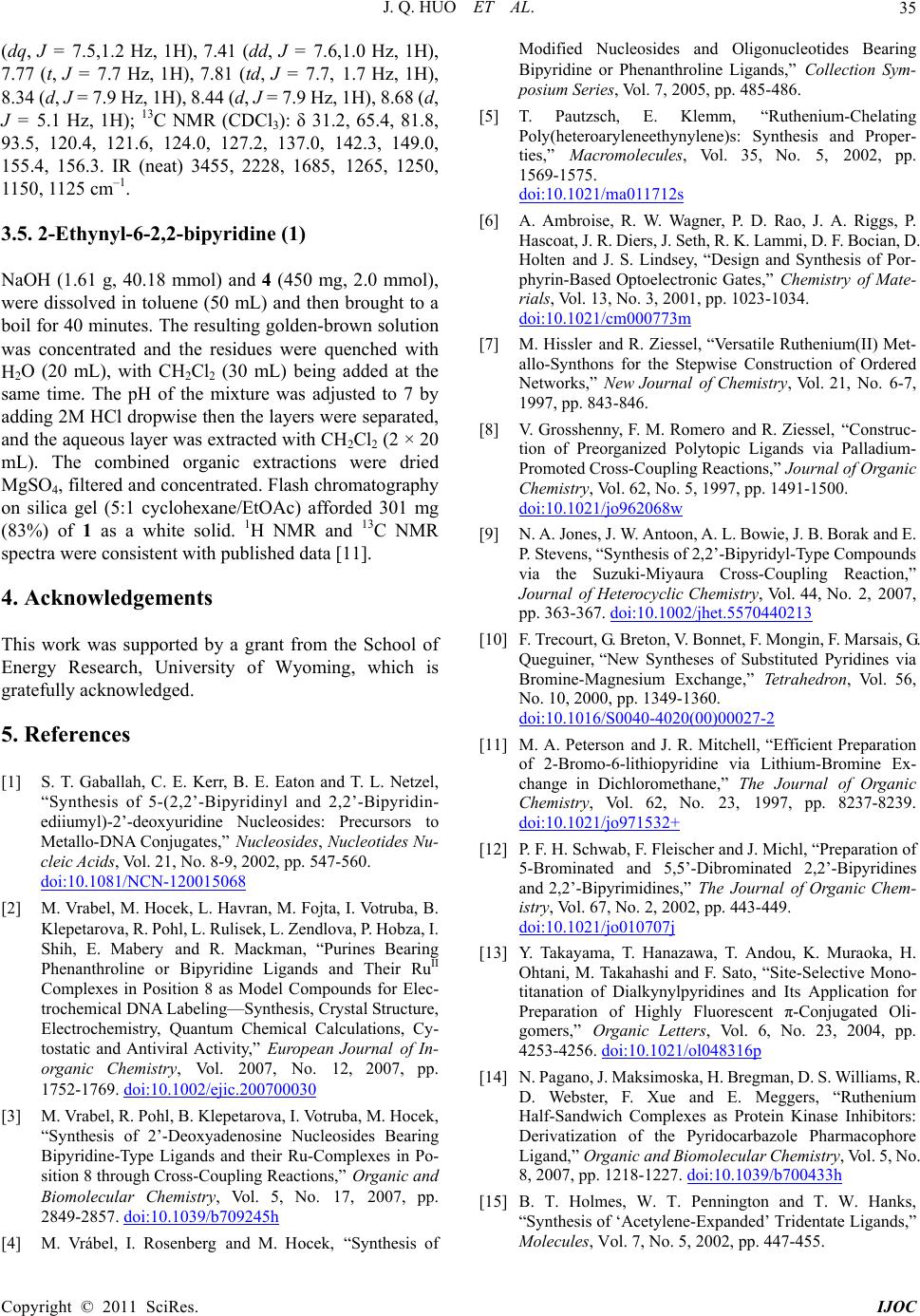 J. Q. HUO ET AL.35 (dq, J = 7.5,1.2 Hz, 1H), 7.41 (dd, J = 7.6,1.0 Hz, 1H), 7.77 (t, J = 7.7 Hz, 1H), 7.81 (td, J = 7.7, 1.7 Hz, 1H), 8.34 (d, J = 7.9 Hz, 1H), 8.44 (d, J = 7.9 Hz, 1H), 8.68 (d, J = 5.1 Hz, 1H); 13C NMR (CDCl3): δ 31.2, 65.4, 81.8, 93.5, 120.4, 121.6, 124.0, 127.2, 137.0, 142.3, 149.0, 155.4, 156.3. IR (neat) 3455, 2228, 1685, 1265, 1250, 1150, 1125 cm–1. 3.5. 2-Ethynyl-6-2,2-bipyridine (1) NaOH (1.61 g, 40.18 mmol) and 4 (450 mg, 2.0 mmol), were dissolved in toluene (50 mL) and then brought to a boil for 40 minutes. The resulting golden-brown solution was concentrated and the residues were quenched with H2O (20 mL), with CH2Cl2 (30 mL) being added at the same time. The pH of the mixture was adjusted to 7 by adding 2M HCl dropwise then the layers were separated, and the aqueous layer was extracted with CH2Cl2 (2 × 20 mL). The combined organic extractions were dried MgSO4, filtered and concentrated. Flash chromatography on silica gel (5:1 cyclohexane/EtOAc) afforded 301 mg (83%) of 1 as a white solid. 1H NMR and 13C NMR spectra were consistent with published data [11]. 4. Acknowledgements This work was supported by a grant from the School of Energy Research, University of Wyoming, which is gratefully acknowledged. 5. References [1] S. T. Gaballah, C. E. Kerr, B. E. Eaton and T. L. Netzel, “Synthesis of 5-(2,2’-Bipyridinyl and 2,2’-Bipyridin- ediiumyl)-2’-deoxyuridine Nucleosides: Precursors to Metallo-DNA Conjugates,” Nucleosides, Nucleotides Nu- cleic Aci ds , Vol. 21, No. 8-9, 2002, pp. 547-560. doi:10.1081/NCN-120015068 [2] M. Vrabel, M. Hocek, L. Havran, M. Fojta, I. Votruba, B. Klepetarova, R. Pohl, L. Rulisek, L. Zendlova, P. Hobza, I. Shih, E. Mabery and R. Mackman, “Purines Bearing Phenanthroline or Bipyridine Ligands and Their RuII Complexes in Position 8 as Model Compounds for Elec- trochemical DNA Labeling—Synthesis, Crystal Structure, Electrochemistry, Quantum Chemical Calculations, Cy- tostatic and Antiviral Activity,” European Journal of In- organic Chemistry, Vol. 2007, No. 12, 2007, pp. 1752-1769. doi:10.1002/ejic.200700030 [3] M. Vrabel, R. Pohl, B. Klepetarova, I. Votruba, M. Hocek, “Synthesis of 2’-Deoxyadenosine Nucleosides Bearing Bipyridine-Type Ligands and their Ru-Complexes in Po- sition 8 through Cross-Coupling Reactions,” Organic and Biomolecular Chemistry, Vol. 5, No. 17, 2007, pp. 2849-2857. doi:10.1039/b709245h [4] M. Vrábel, I. Rosenberg and M. Hocek, “Synthesis of Modified Nucleosides and Oligonucleotides Bearing Bipyridine or Phenanthroline Ligands,” Collection Sym- posium Series, Vol. 7, 2005, pp. 485-486. [5] T. Pautzsch, E. Klemm, “Ruthenium-Chelating Poly(heteroaryleneethynylene)s: Synthesis and Proper- ties,” Macromolecules, Vol. 35, No. 5, 2002 1569-1575. , pp. doi:10.1021/ma011712s [6] A. Ambroise, R. W. Wagner, P. D. Rao, J. A. Riggs, P. Hascoat, J. R. Diers, J. Seth, R. K. Lammi, D. F. Bocian, D. Holten and J. S. Lindsey, “Design and Synthesis of Por- phyrin-Based Optoelectronic Gates,” Chemi rials, Vol. 13, No. 3, 2001, pp stry of Mate- . 1023-1034. doi:10.1021/cm000773m [7] M. Hissler and R. Ziessel, “Versatile Ruthenium(II) Met- allo-Synthons for the Stepwise Construction of Ordered Networks,” New Journal of Chemistry, Vol. 21, No. 6-7, ganic , 1997, pp. 1491-1500. 1997, pp. 843-846. [8] V. Grosshenny, F. M. Romero and R. Ziessel, “Construc- tion of Preorganized Polytopic Ligands via Palladium- Promoted Cross-Coupling Reactions,” Journal of Or Chemistry, Vol. 62, No. 5 doi:10.1021/jo962068w [9] N. A. Jones, J. W. Antoon, A. L. Bowie, J. B. Borak and E. P. Stevens, “Synthesis of 2,2’-Bipyridyl-Type Compounds via the Suzuki-Miyaura Cross-Coupling Reaction,” Journal of Heterocyclic Chemistry, Vol. 44, No. 2, 2007, pp. 363-367. doi:10.1002/jhet.5570440213 [10] F. Trecourt, G. Breton, V. Bonnet, F. Mongin, F. Marsais, G. Queguiner, “New Syntheses of Substituted Pyridines via Bromine-Magnesium Exchange No. 10, 2000, pp. 1349-1360. ,” Tetrahedron, Vol. 56, doi:10.1016/S0040-4020(00)00027-2 [11] M. A. Peterson and J. R. Mitchell, “Efficient Preparation of 2-Bromo-6-lithiopyridine via Lithium-Bromine Ex- change in Dichloromethane,” The Journal of Organic Chemistry, Vol. 62, No. 23, 1997, pp. 8237-8239. doi:10.1021/jo971532+ [12] P. F. H. Schwab, F. Fleischer and J. Michl, “Preparation of 5-Brominated and 5,5’-Dibrominated 2,2’-Bipyridines and 2,2’-Bipyrimidines,” The Journal of istry, Vol. 67, No. 2, 200 Organic Chem- 2, pp. 443-449. doi:10.1021/jo010707j [13] Y. Takayama, T. Hanazawa, T. Andou, K. Muraoka, H. Ohtani, M. Takahashi and F. Sato, “Site-Selective Mono- titanation of Dialkynylpyridines and Its Application for Preparation of Highly Fluorescent π-Conjugated Oli- gomers,” Organic Letters, Vol. 6, No. 23, 2004, pp. 4253-4256. doi:10.1021/ol048316p [14] N. Pagano, J. Maksimoska, H. Bregman, D. S. Williams, R. D. Webster, F. Xue and E. Meggers, “Ruthenium Half-Sandwich Complexes as Protein Kinase Inhibitors: Derivatization of the Pyridocarbazole Pharmacophore Ligand,” Or ganic and Biomolecular Chemistry, Vol. 5, No. 8, 2007, pp. 1218-1227. doi:10.1039/b700433h [15] B. T. Holmes, W. T. Pennington and T. W. Hanks, “Synthesis of ‘Acetylene-Expanded’ Tridentate Molecules, Vol. 7, No. 5 Ligands,” , 2002, pp. 447-455. Copyright © 2011 SciRes. IJOC  J. Q. HUO ET AL. Copyright © 2011 SciRes. IJOC 36 doi:10.3390/70500447 [16] F. Cottet and M. Schlosser, “Trifluoromethyl-Substituted Pyridines through Displacement of Iodine by in situ Generated (Trifluoromethyl)copper,” European Journal of Organic Chemistry, Vol. 2002, No. 2, 2002, pp. 327-330. doi:10.1002/1099-0690(20021)2002:2<327::AID-EJOC3 27>3.0.CO;2-V [17] M. Benaglia, F. Ponzini, C. R. Woods and J. S. Siegel, “Synthesis of Oligopyridines and Their Metal Complexes as Precursors to Topologically Interesting Molecules,” Organic Letters, Vol. 3, No. 7, 2001, pp. 967-969. |