

Paper Menu >>
Journal Menu >>
 International Journal of Organic Chemistry, 2011, 1, 47-52 doi:10.4236/ijoc.2011.12009 Published Online June 2011 (http://www.SciRP.org/journal/ijoc) Copyright © 2011 SciRes. IJOC A Facile Synthesis of 2-Amino-5-cyano-4, 6-disubstitutedpyrimidines under MWI Kishor S. Jain*, Swapnil K. Chaudhari, Nikhil S. More, Kapil D. More, Sachin A. Wakedkar, M. K. Kathiravan P. G. Research Centre, Department of Pharmaceutical Chemistry, Sinhgad College of Pharmacy, Pune, India. E-mail: [email protected] Received May 21, 2011; revised June 20, 2011; accepted July 1, 2011 Abstract Microwave Assisted Organic Synthesis (MAOS) is energy efficient and effective tool to speed up the syn- thesis for drug discovery process. In the present study we report a novel protocol for the rapid, high throughput synthesis of mononuclear 2-amino-5-cyano-4,6-disubstituted pyrimidines, adaptable to parallel synthesis for compound libraries. The overall reaction time in hrs has been reduced to 25 - 50 minutes with improved yields. Keywords: Microwave Assisted Organic Synthesis (MAOS), 2-Amino-5-Cyano-2, 6-Disubstitutedpyrimidines, α-Cyanoketene S,S-Acetals 1. Introduction Mononuclear pyrimidines exhibit a wide range of me- dicinal activities and are isomeric with two other forms of diazine. Physiologically important nucleic acids bases as well as some vitamins are pyrimidine derivatives [1,2]. The major approach to the synthesis of mononuclear pyrimidines is the principal synthesis, involving the condensation of N-C-N fragment with an appropriate functionalized 3-carbon unit [3]. Various synthetic me- thods and reaction conditions have been employed for the synthesis of mononuclear pyrimidines in the litera- ture [4-17]. The reported methods for the syntheses of mononu- clear pyrimidines have one or the other limitations such as more number of steps, use of carcinogenic reagents like benzene, pyridine and lengthy reaction time. In many syntheses volatile organic solvents are used, which are detrimental to the environment and are to be recov- ered. The generalized method for the synthesis of mononu- clear pyrimidines is by the cyclocondensation of α- cyanoketene S,N-acetals with guanidine in DMF under reflux for 24 - 36 hr. The α-cyanoketene S,N-acetals were prepared through the nucleophilic displacement of the 3-methylthio group of the corresponding α-cyanoke- tene S,S-acetals with various amines [16]. Tominaga et al. [18] have further improved on the synthesis of mononuclear pyrimidines by direct one pot synthesis through Multi Component Reaction (MCR) of α-Cyanoketenes S,S-acetals, appropriate amine and gua- nidine carbonate (Scheme 1). The solvent employed was pyridine and overall reaction time was 24 - 36 hr. Microwave Assisted Organic Synthesis (MAOS) is an invaluable technology for drug discovery applications as it dramatically reduces reaction time, which makes it ideal for rapid reaction scouting and optimization, al- lowing rapid synthesis of large number of NCEs and their libraries. It is an efficient synthetic tool and its benefit has been well documented [19-22]. In continua- tion to our ongoing work on green chemical techniques [23], herein we report a novel, hitherto unreported pro- tocol for the rapid synthesis of mononuclear 2-amino-5- cyano-4,6-disubstituted-pyrimidines under MWI. (Mic- rowave Irradiation) 2. Results and Discussion The α-cyanoketene S,S-acetals such as di-(methylthio) methylene malononitrile 1 and ethyl-2,2-di(methyl- thio)methylene cyanoacetate 2 were prepared as per re- ported method [16]. The α-cyanoketene S,S-acetals 1 and 2 were converted to corresponding S,N-acetals by reacting with appropriate primary as well as secondary amine in ethanol under microwave at 80 W (Scheme 2). Secondary amine being more reactive underwent nucleophilic 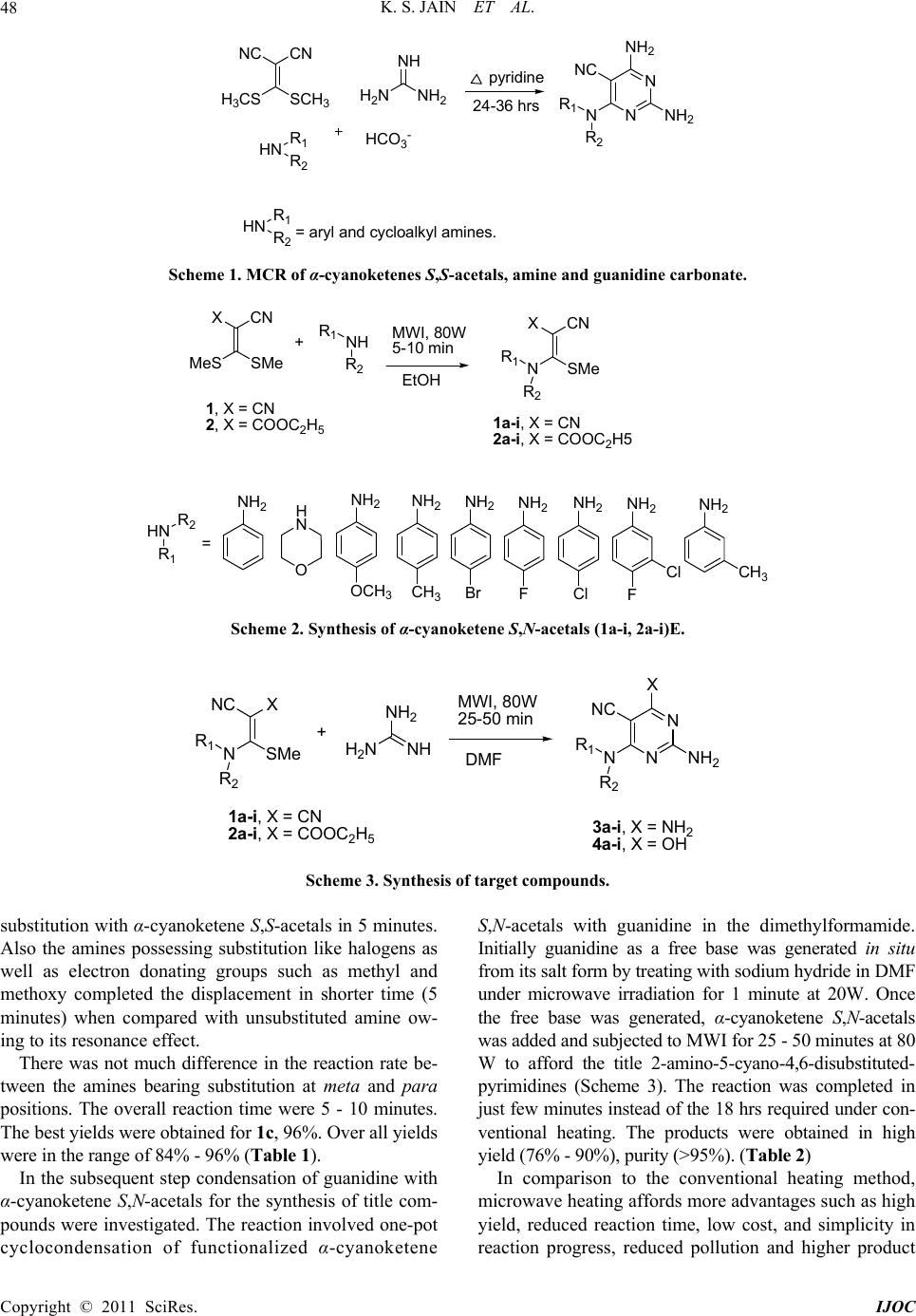 K. S. JAIN ET AL. 48 CNNC H 3 CS SCH 3 HN R 1 R 2 NH H 2 NNH 2 24-36 hrs pyridine = aryl and cycloalkyl amines. N N NH 2 NC N R 1 R 2 NH 2 HCO 3- HN R 1 R 2 Scheme 1. MCR of α-cyanoketenes S,S-acetals, amine and guanidine carbonate. NH 2 NH 2 NH 2 NH 2 Cl CH 3 OCH 3 O H N NH 2 Br NH 2 F NH 2 F NH 2 CH 3 = Cl HN R 1 R 2 CNX SMeMeS +CN X SMeN 1, X = CN 2, X = COO C 2 H 5 EtOH 1a-i, X = CN 2a-i, X = COOC 2 H5 NH R 2 R 1 R 2 R 1 MWI, 80W 5-10 min Scheme 2. Synthesis of α-cyanoketene S,N-acetals (1a-i, 2a-i)E. + X NC SMeN 1a-i , X = CN 2a-i , X = COOC 2 H 5 DMF 3a-i , X = NH 2 4a-i , X = OH R 2 R 1 MWI, 80W 25-50 minNC N R 2 R 1 N N NH 2 NH 2 NHH 2 N X Scheme 3. Synthesis of target compounds. substitution with α-cyanoketene S,S-acetals in 5 minutes. Also the amines possessing substitution like halogens as well as electron donating groups such as methyl and methoxy completed the displacement in shorter time (5 minutes) when compared with unsubstituted amine ow- ing to its resonance effect. There was not much difference in the reaction rate be- tween the amines bearing substitution at meta and para positions. The overall reaction time were 5 - 10 minutes. The best yields were obtained for 1c, 96%. Over all yields were in the range of 84% - 96% (Table 1). In the subsequent step condensation of guanidine with α-cyanoketene S,N-acetals for the synthesis of title com- pounds were investigated. The reaction involved one-pot yclocondensation of functionalized α-cyanoketene c S,N-acetals with guanidine in the dimethylformamide. Initially guanidine as a free base was generated in situ from its salt form by treating with sodium hydride in DMF under microwave irradiation for 1 minute at 20W. Once the free base was generated, α-cyanoketene S,N-acetals was added and subjected to MWI for 25 - 50 minutes at 80 W to afford the title 2-amino-5-cyano-4,6-disubstituted- pyrimidines (Scheme 3). The reaction was completed in just few minutes instead of the 18 hrs required under con- ventional heating. The products were obtained in high yield (76% - 90%), purity (>95%). (Table 2) In comparison to the conventional heating method, microwave heating affords more advantages such as high yield, reduced reaction time, low cost, and simplicity in reaction progress, reduced pollution and higher product Copyright © 2011 SciRes. IJOC 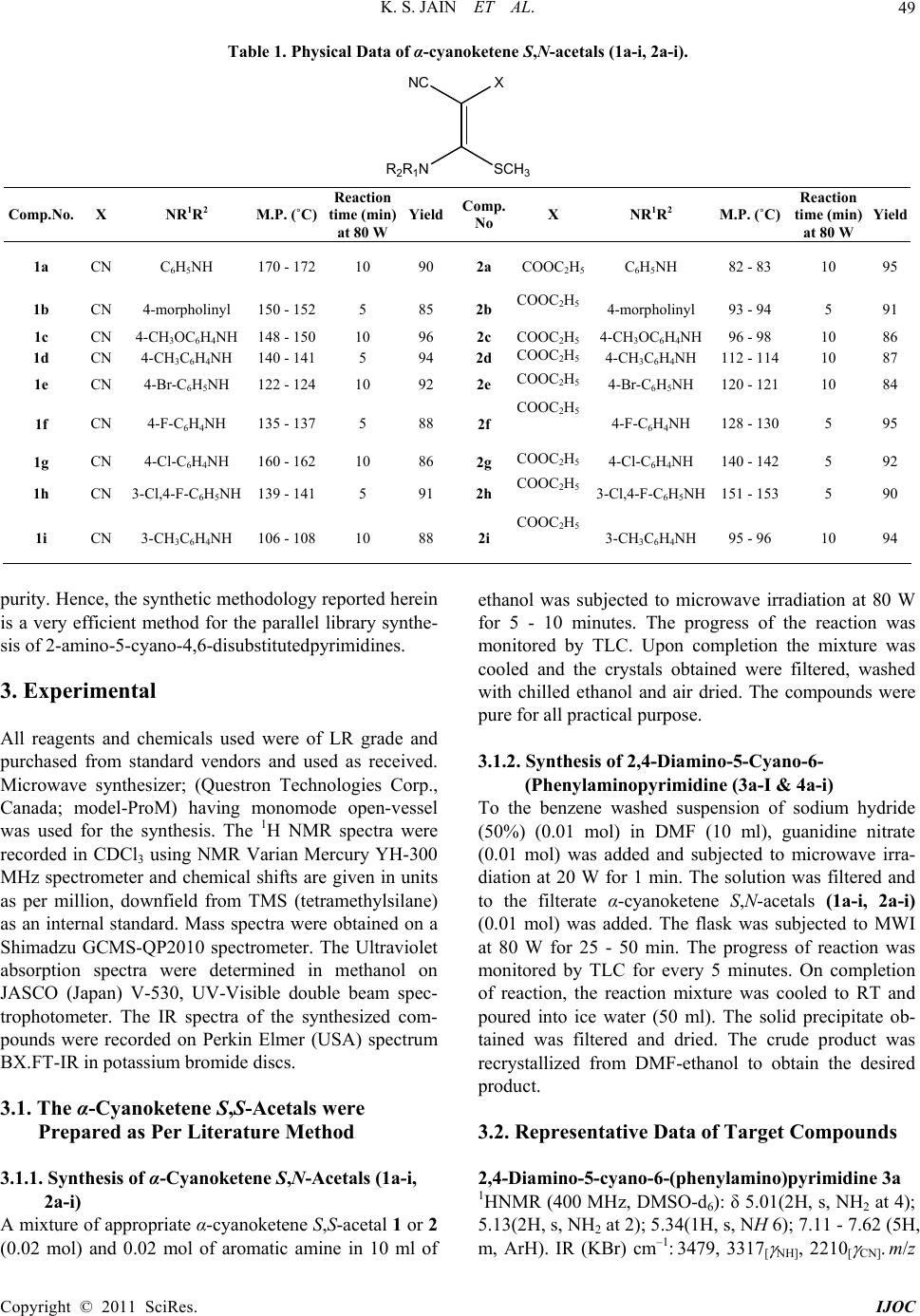 K. S. JAIN ET AL.49 Table 1. Physical Data of α-cyanoketene S,N-acetals (1a-i, 2a-i). XNC SCH3 R2R1N Comp.No. X NR1R2 M.P. (˚C) Reaction time (min) at 80 WYield Comp. No X NR1R2 M.P. (˚C) Reaction time (min) at 80 W Yield 1a CN C6H5NH 170 - 172 10 90 2a COOC2H5C6H5NH 82 - 83 10 95 1b CN 4-morpholinyl 150 - 152 5 85 2b COOC2H54-morpholinyl 93 - 94 5 91 1c CN 4-CH3OC6H4NH148 - 150 10 96 2c COOC2H54-CH3OC6H4NH 96 - 98 10 86 1d CN 4-CH3C6H4NH 140 - 141 5 94 2d COOC2H54-CH3C6H4NH 112 - 114 10 87 1e CN 4-Br-C6H5NH 122 - 124 10 92 2e COOC2H54-Br-C6H5NH 120 - 121 10 84 1f CN 4-F-C6H4NH 135 - 137 5 88 2f COOC2H5 4-F-C6H4NH 128 - 130 5 95 1g CN 4-Cl-C6H4NH 160 - 162 10 86 2g COOC2H54-Cl-C6H4NH 140 - 142 5 92 1h CN 3-Cl,4-F-C6H5NH139 - 141 5 91 2h COOC2H53-Cl,4-F-C6H5NH 151 - 153 5 90 1i CN 3-CH3C6H4NH 106 - 108 10 88 2i COOC2H5 3-CH3C6H4NH 95 - 96 10 94 purity. Hence, the synthetic methodology reported herein is a very efficient method for the parallel library synthe- sis of 2-amino-5-cyano-4,6-disubstitutedpyrimidines. 3. Experimental All reagents and chemicals used were of LR grade and purchased from standard vendors and used as received. Microwave synthesizer; (Questron Technologies Corp., Canada; model-ProM) having monomode open-vessel was used for the synthesis. The 1H NMR spectra were recorded in CDCl3 using NMR Varian Mercury YH-300 MHz spectrometer and chemical shifts are given in units as per million, downfield from TMS (tetramethylsilane) as an internal standard. Mass spectra were obtained on a Shimadzu GCMS-QP2010 spectrometer. The Ultraviolet absorption spectra were determined in methanol on JASCO (Japan) V-530, UV-Visible double beam spec- trophotometer. The IR spectra of the synthesized com- pounds were recorded on Perkin Elmer (USA) spectrum BX.FT-IR in potassium bromide discs. 3.1. The α-Cyanoketene S,S-Acetals were Prepared as Per Literature Method 3.1.1. Synthesis of α-Cyanoketene S,N-Acetals (1a-i, 2a-i) A mixture of appropriate α-cyanoketene S,S-acetal 1 or 2 (0.02 mol) and 0.02 mol of aromatic amine in 10 ml of ethanol was subjected to microwave irradiation at 80 W for 5 - 10 minutes. The progress of the reaction was monitored by TLC. Upon completion the mixture was cooled and the crystals obtained were filtered, washed with chilled ethanol and air dried. The compounds were pure for all practical purpose. 3.1.2. Synthesis of 2,4-Diamino-5-Cyano-6- (Phenylaminopyrimidine (3a-I & 4a-i) To the benzene washed suspension of sodium hydride (50%) (0.01 mol) in DMF (10 ml), guanidine nitrate (0.01 mol) was added and subjected to microwave irra- diation at 20 W for 1 min. The solution was filtered and to the filterate α-cyanoketene S,N-acetals (1a-i, 2a-i) (0.01 mol) was added. The flask was subjected to MWI at 80 W for 25 - 50 min. The progress of reaction was monitored by TLC for every 5 minutes. On completion of reaction, the reaction mixture was cooled to RT and poured into ice water (50 ml). The solid precipitate ob- tained was filtered and dried. The crude product was recrystallized from DMF-ethanol to obtain the desired product. 3.2. Representative Data of Target Compounds 2,4-Diamino-5-cyano-6-(phenylamino)pyrimidine 3a 1HNMR (400 MHz, DMSO-d6): δ 5.01(2H, s, NH2 at 4); 5.13(2H, s, NH2 at 2); 5.34(1H, s, NH 6); 7.11 - 7.62 (5H, m, ArH). IR (KBr) cm–1: 3479, 3317[ NH], 2210[ CN]. m/z Copyright © 2011 SciRes. IJOC 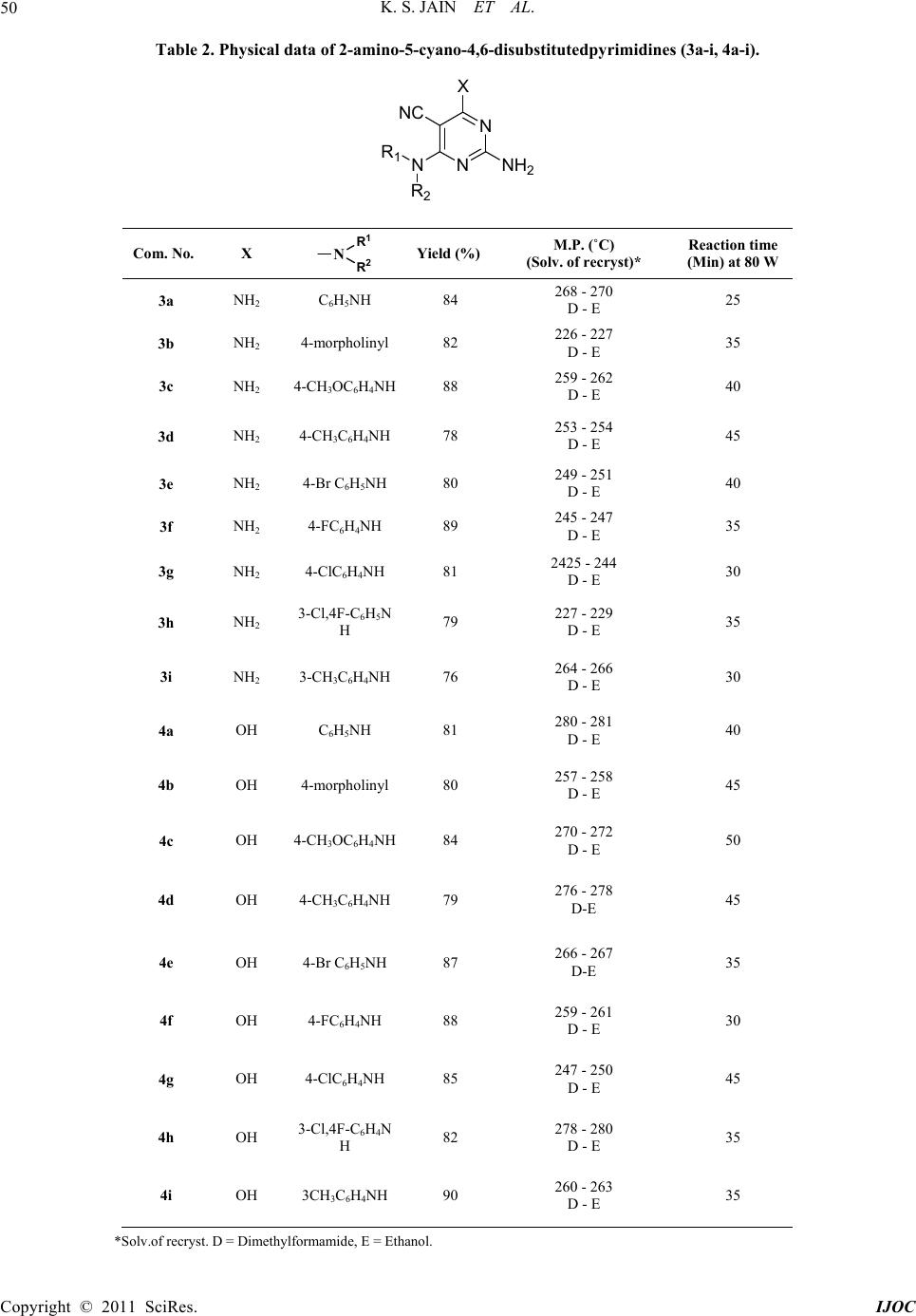 K. S. JAIN ET AL. 50 Table 2. Physical data of 2-amino-5-cyano-4,6-disubstitutedpyrimidines (3a-i, 4a-i). N N X N R 1 R 2 NC NH 2 Com. No. X N R 1 R 2 Yield (%)M.P. (˚C) (Solv. of recryst)* Reaction time (Min) at 80 W 3a NH2 C 6H5NH 84 268 - 270 D - E 25 3b NH2 4-morpholinyl 82 226 - 227 D - E 35 3c NH2 4-CH3OC6H4NH88 259 - 262 D - E 40 3d NH2 4-CH3C6H4NH 78 253 - 254 D - E 45 3e NH2 4-Br C6H5NH 80 249 - 251 D - E 40 3f NH2 4-FC6H4NH 89 245 - 247 D - E 35 3g NH2 4-ClC6H4NH 81 2425 - 244 D - E 30 3h NH2 3-Cl,4F-C6H5N H 79 227 - 229 D - E 35 3i NH2 3-CH3C6H4NH 76 264 - 266 D - E 30 4a OH C6H5NH 81 280 - 281 D - E 40 4b OH 4-morpholinyl 80 257 - 258 D - E 45 4c OH 4-CH3OC6H4NH84 270 - 272 D - E 50 4d OH 4-CH3C6H4NH 79 276 - 278 D-E 45 4e OH 4-Br C6H5NH 87 266 - 267 D-E 35 4f OH 4-FC6H4NH 88 259 - 261 D - E 30 4g OH 4-ClC6H4NH 85 247 - 250 D - E 45 4h OH 3-Cl,4F-C6H4N H 82 278 - 280 D - E 35 4i OH 3CH3C6H4NH 90 260 - 263 D - E 35 *Solv.of recryst. D = Dimethylformamide, E = Ethanol. Copyright © 2011 SciRes. IJOC  K. S. JAIN ET AL.51 226 (M+). Anal. Calcd. for C11H10N6: C, 58.40; H, 4.46; N, 37.15; found C, 58.76; H, 4.76; N, 37.43. 2,4-Diamino-5-cyano-6-(4-morpholinyl)pyrimidine 3b 1HNMR (400 MHz, DMSO-d6): δ 3.54 - 3.76(4H, m, -NH(CH2-)2); 3.84-4.12 (4H, m, O-(CH2-)2]; 6.51(2H, s, NH2 at 4); 6.69(2H, s, NH2 at 2). IR (KBr) cm–1: 3466, 3358[ NH], 2216[ CN]. m/z 220(M+). Anal. Calcd. for C9H12N6O: C, 49.08; H, 5.49; N, 38.16; found C, 49.32; H, 5.68; N, 38.29. 2,4-Diamino-5-cyano-6-[(4-methoxyphenyl)amino]p yrimidine 3c 1HNMR (400 MHz, DMSO-d6): δ 3.73(3H, s, OCH3); 4.0 - 4.31(4H, s, NH2 at 2 and 4); 6.85 - 7.33 (4H, m, Ar-H). IR (KBr) cm–1: 3416, 3374 [ NH], 2208 [ CN]. m/z 256(M+). Anal. Calcd. for C12H12N6O: C, 56.24; H, 4.72; N, 32.79; found C, 56.35; H, 4.45; N, 32.93. 2,4-diamino-5cyano-6-[(4-methylphenyl)amino]pyri midine 3d 1HNMR (400 MHz, DMSO-d6): δ 3.4(3H, s, ArCH3 at 6); 6.6(4H, m, NH2 at 2 and 4); 8.4(4H, m, ArH at 6). IR (KBr) cm–1: 3474, 3289, 3153[ NH], 2188[ CN]. m/z 240(M+). Anal. Calcd. for C12H12N6: C, 59.99; H, 5.03; N, 34.98 ; found C, 59.84; H, 5.34; N, 34.87. 2,4-diamino-5-cyano-6-[(4-chlorophenyl)amino]pyr imidine 3g 1HNMR (400 MHz, DMSO-d6): δ 3.4(3H, s, ArCH3 at 6); 6.6(4H, m, NH2 at 2 and 4); 8.4(1H, s, ArH at 6). IR (KBr) cm–1: 3324, 3178[ NH], 2190[ CN]. m/z 260(M+). Anal. Calcd. for C11H9N6Cl: C, 50.68; H, 3.48; N, 32.24; found C, 50.43; H, 3.62; N, 32.26. 2-amino-4-hydroxy-5-cyano-6-(4-morpholinyl)pyri midine 4b 1HNMR (400 MHz, DMSO-d6): δ 2.9[s, -N(CH2-)2]; 3.8[s, O-(CH2-)2]; 6 (2H, s, NH2 at 2); 7.4( s, 1H, OH at 4). IR (KBr) cm–1: 3357, 3115[ NH], 2922[ C-H], 2182[ CN], 1628[ CONH]. m/z 221(M+). Anal. Calcd. for C9H11N5O2: C, 48.86; H, 5.01; N, 31.66; found C, 48.74; H, 5.44; N, 31.34. 2-amino-4-hydroxy-5-cyano-6-[(4-flurophenyl)ami no]pyrimidine 4f 1HNMR (400 MHz, DMSO-d6): δ 4.2(2H, s, NH2 at 4); 5.07(1H, s, OH); 6.72(5H,m, Ar-H ). IR (KBr) cm–1: 3476, 3296[ NH], 2916.12[ C-H], 2211[ CN] 1654, 1618[ CONH]. m/z 245(M+). Anal. Calcd. for C11H8N5OF: C, 53.88; H, 3.29; N, 28.56; found C, 53.73; H, 3.08; N, 28.32. 4. Conclusions We have described a new, rapid and a versatile approach by MAOS for the synthesis of 2-amino-5-cyano-4,6- disubstitutedpyrimidines in a highly efficient way. Fur- ther work is in progress with respect to diversity oriented synthesis of mononuclear pyrimidines and their biologi- cal screening. 5. Acknowledgements The authors acknowledge the contributions of Prof. M. N. Navale, President, & Dr. (Mrs.) S. M. Navale, Secretary, Sinhgad Technical Education Society, Pune for provid- ing facilities to carry out the synthetic work and basic spectroscopic analysis. The Mass and NMR were done at Department of Chemistry, Saurashtra University, Rajkot, India and University of Pune, India, respectively. 6. References [1] K. S. Jain, T. S. Chitre, P. B. Miniyar, M. K. Kathiravan, V. Bendre, V. Veer, S. Shahane and C. Shishoo, “Bio- logical and Medical Significance of Pyrimidines,” Cur- rent Science, Vol. 90, 2006, pp. 793-799. [2] R. Butler, “The Structure, Reactions, Synthesis, and Uses of Heterocyclic Compounds,” In: A. Katritzky and C. Rees, Ed., Comprehensive Heterocyclic Chemistry, Per- gamon Press, Oxford, Vol. 5, 1984, pp. 796-798. [3] D. Brown, “Pyrimidines and Their Benzo Derivatives,” In: A. Katritzky and C. Rees, Ed., Comprehensive Heterocyc- lic Chemistry, Pergamon Press, Oxford, Vol. 2, 1984, pp. 57-61. doi:10.1016/B978-008096519-2.00035-7 [4] R. J. Vishnu, V. Berge and A. Dirk, “Synthesis of Pyrimidines and Fused Pyrimidines as Leishmanicides and Herbicides,” Advanced Synthesis and Catalysis, Vol. 331, No. 6, 1989, pp. 893-905. doi:10.1002/prac.19893310603 [5] H. Kristison and O. Kristinson, “Substituted Pyrimidi- nes,” Chemical Abstract, 1988, Vol. 108, Article ID: 186761. [6] B. Detlef, G. Wagner and Z. Chem, Vol. 25, 1985, p. 141. [7] E. Kniner, F. Eberhard and K. Regina, Chemical Abstract, Vol. 98, 1983, Article ID: 215609. [8] J. Bagli, “Amino-Pyrimidine Derivatives,” Chemical Abstract, Vol. 103, 1985, Article ID: 6358. [9] M. Perez, J. Soto, “Synthesis of 6-Alkoxy-2-amino-5- cyanopyrimidines through Sodium Alkoxide-Induced Re- giospecific Cyclization of 1,3-Dicarbonitriles,” Synthesis, Vol. 12, 1981, pp. 955-958. doi:10.1055/s-1981-29654 [10] A. Kumar, V. Agrawal, H. Ila and H. Jujappa, “A Novel and Convenient Synthesis of 2-Amino-4-(N-alkyl-N- arylamino)-pyrimidines using Poolarized Ketene S,S- and S,N-Acetals,” Synthesis, Vol. 9, 1980, pp. 748-751. doi:10.1055/s-1980-29200 [11] J. Asserka, H. Schwelmlan and J. Perine, Chemical Ab- stract, Vol. 122, 1995, Article ID: 239716. [12] Z. Folki and A. Salaman, “Chemische Berichte,” Euro- pean Journal of Inorganic Chemistry, Vol. 74, No. 7, 1941, p. 1126. [13] S. Nishiqate, K. Senqa, K. Arda, T. Takabatake and F. Yosuda, “Condensation Reactions of Ethyl Ethoxy- Copyright © 2011 SciRes. IJOC  K. S. JAIN ET AL. Copyright © 2011 SciRes. IJOC 52 methylenecyanoacetate with Amidines,” Chemical and Pharmaceutical Bulletin, Vol. 18, No. 5, 1970, pp. 1003-1007. [14] P. Juby, T. Hudyma, M. Brown, M. Essery and R. Par- tyka, “Antiallergy Agents. 2. 2-Phenyl-5-(1H-tetrazol-5-yl pyrimidin-4(3H)-ones,” Journal of Medicinal Chemistry, Vol. 25, No. 10, 1982, pp. 1145-1150. doi:10.1021/jm00352a009 [15] A. Abd-Elfattah, S. Hussain, A. El-Reedy and N. Yousif, “Reactions with α-Substituted Cinnamonitriles: A Novel Synthesis of Prylpyrimidines,” Tetrahedron, Vol. 39, No. 19, 1983, pp. 3197-3199. doi:10.1016/S0040-4020(01)91566-2 [16] V. Bhadti, Ph.D Thesis, Gujrat University, 1985. [17] S. Goswami. A. Hazra and S. Jana, “One-Pot Two-Step Solvent-Free Rapid and Clean Synthesis of 2-(Substituted Amino)-pyrimidines by Microwave Irradiation,” Bulletin of the Chemical Society of Japan, Vol. 82, No. 9, 2009, pp. 1175-1181. doi:10.1246/bcsj.82.1175 [18] Y. Tominaga and Y. Matsuda, “Synthesis of Heterocyclic Compounds Using Nitro Ketene Dithioacetal,” Journal of Heterocyclic Chemistry, Vol. 22, No. 4, 1985, pp. 937- 949. doi:10.1002/jhet.5570220401 [19] J. Bariwal, J. Trivedi and E. Van der Eycken, “Micro- wave Irradiation and Multicomponent Reactions,” In: R. V. A. Orru, Ed., Top Heterocyclic Chemistry, Springer- Verlag, Berlin Heidelberg, 2010, Vol. 25, pp. 169-230. [20] C. Kappe, A. Stadler, R. Mannhold, H. Kubinyi and G. Folkers, “Methods and Principles in Medicinal Chemistry: Microwaves in Organic and Medicinal Chemistry, Vol- ume 25,” Wiley, New Jersey, 2005, pp. 9-24. [21] C. Kappe and D. Dallinger, “The Impact of Microwave Synthesis on Drug Discovery,” Nature Reviews Drug Discovery, Vol. 5, 2006, pp. 51-63. doi:10.1038/nrd1926 [22] K. Jain, R. Kulkarni, J. Bariwal and D. Jain, “Impact of Microwave Assisted Heating on the Combinatorial and Parallel Syntheses of Compound Libraries for New Drug Discovery,” Indian Drugs, Vol. 46, 2009, pp. 747-771. [23] K. Jain, J. Bariwal, M. Kathiravan, V. Raskar, G. Wank- hede, N. Londhe and S. Dighe, “An Efficient and Rapid Synthesis of 2-Amino-4-arylthiazoles Employing Micro- wave Irradiation in Water,” Green and Sustainable Chemistry, Vol. 1, No. 2, 2011, pp. 35-38. doi:10.4236/gsc.2011.12007 |