

Paper Menu >>
Journal Menu >>
 International Journal of Astronomy and Astrophysics , 2011, 1, 39-44 doi:10.4236/ijaa.2011.12006 Published Online June 2011 (http://www.SciRP.org/journal/ijaa) Copyright © 2011 SciRes. IJAA Discrete Scale Relativity and SX Phoenicis Variable Stars Robert Louis Oldershaw 12 Emily Lane, Amherst, Massachusetts, USA E-mail: [email protected] Received April 28, 2011; revised May 29, 2011; accepted June 3, 2011 Abstract Discrete Scale Relativity proposes a new symmetry principle called discrete cosmological self-similarity which relates each class of systems and phenomena on a given scale of nature’s discrete cosmological hier- archy to the equivalent class of analogue systems and phenomena on any other scale. The new symmetry principle can be understood in terms of discrete scale invariance involving the spatial, temporal and dynamic parameters of all systems and phenomena. This new paradigm predicts a rigorous discrete self-similarity between Stellar Scale variable stars and Atomic Scale excited atoms undergoing energy-level transitions and sub-threshold oscillations. Previously, methods for demonstrating and testing the proposed symmetry princi- ple have been applied to RR Lyrae, Scuti and ZZ Ceti variable stars. In the present paper we apply the same analytical methods and diagnostic tests to a new class of variable stars: SX Phoenicis variables. Dou- ble-mode pulsators are shown to provide an especially useful means of testing the uniqueness and rigor of the conceptual principles and discrete self-similar scaling of Discrete Scale Relativity. These research efforts will help theoretical physicists to understand the fundamental discrete self-similarity of nature, and to model both stellar and atomic systems with one unified physics. Keywords: Discrete Scale Relativity, SX Phe Variables, Rydberg Atoms, Quantum Cosmology 1. Introduction 1.1. Preliminary Discussion of Discrete Cosmological Self-Similarity The arguments presented below are based on the Self- Similar Cosmological Paradigm (SSCP) [1-6] which has been developed over a period of more than 30 years, and can be unambiguously tested via its definitive predictions [1,4] concerning the nature of the galactic dark matter. Briefly, the discrete self-similar paradigm focuses on na- ture’s fundamental organizational principles and symme- tries, emphasizing nature’s intrinsic hierarchical organiza- tion of systems from the smallest observable subatomic particles to the largest observable superclusters of galaxies. The new discrete fractal paradigm also highlights the fact that nature’s global hierarchy is highly stratified. While the observable portion of the entire hierarchy encompasses nearly 80 orders of magnitude in mass, three relatively narrow mass ranges, each extending for only about 5 or- ders of magnitude, account for ≥ 99% of all mass observed in the cosmos. These dominant mass ranges: roughly 10–27 g to 10–22 g, 1028 g to 1033 g and 1038 g to 1043 g, are re- ferred to as the Atomic, Stellar and Galactic Scales, re- spectively. The cosmological scales constitute the discrete self-similar scaffolding of the observable portion of na- ture’s quasi-continuous hierarchy. At present the number of scales cannot be known, but for reasons of natural phi- losophy it is tentatively proposed that there are a denu- merable infinite number of cosmological scales, ordered in terms of their intrinsic ranges of space, time and mass scales. A third general principle of the new paradigm is that the cosmological scales are rigorously self-similar to one another, such that for each class of fundamental parti- cles, composite systems or physical phenomena on a given scale there is a corresponding class of particles, systems or phenomena on all other cosmological scales. Specific self-similar analogues from different scales have rigor- ously analogous morphologies, kinematics and dynamics. When the general self-similarity among the discrete scales is exact, the paradigm is referred to as Discrete Scale Relativity [5] and nature’s global space-time geometry manifests a new universal symmetry principle: discrete self-similarity or discrete scale invariance. Based upon decades of studying the scaling relation- ships among analogue systems from the Atomic, Stellar  R. L. OLDERSHAW 40 and Galactic Scales [1-6], a close approximation to na- ture’s discrete self-similar scale transformation equations for the length (L), time (T) and mass (M) parameters of analogue systems on neighboring cosmological scales and –1, as well as for all dimensional constants, are as follows. L = L –1 (1) T = T –1 (2) M = D M –1 (3) The self-similar scaling constants and D have been determined empirically and are equal to 5.2 × 10¹⁷ and 3.174, respectively [1-6]. The value of D is 1.70 × 1056. Different cosmological scales are designated by the dis- crete index ( , –2, –1, 0, 1, 2, ) and the Atomic, Stellar and Galactic Scales are usually assigned = –1, = 0 and = +1, respectively. The fundamental self-similarity of the SSCP and the recursive character of the discrete scaling equations sug- gest that nature is an infinite discrete fractal, in terms of its morphology, kinematics and dynamics. The underly- ing principle of the paradigm is discrete scale invariance and the physical embodiment of that principle is the dis- crete self-similarity of nature’s physical systems. Perhaps the single most thorough and accessible resource for ex- ploring the SSCP and Discrete Scale Relativity is the author’s website [6]. 1.2. Discrete Self-Similarity of Variable Stars and Excited Atoms Discrete Scale Relativity hypothesizes that each well- defined class of systems on a given cosmological scale has a discrete self-similar class of analogue systems on any other cosmological scales x. Given their mass ranges, radius ranges, frequency ranges, morphologies and spherically harmonic oscillation phenomena, Dis- crete Scale Relativity uniquely, unambiguously and quantitatively identifies variable stars as discrete scale invariant analogues of excited atoms undergoing energy- level transitions, or oscillating with sub-threshold ampli- tudes at the allowed frequencies of a limited set of en- ergy-level transitions. The latter subclass of multiple- period/low-amplitude oscillators can be interpreted as systems in sub-threshold superposition states. In four previous papers the discrete self-similarity among three different classes of variable stars and their classes of analogue systems on the Atomic Scale was quantitatively demonstrated and empirically tested. Paper (I) [7] identified RR Lyrae variables as analogues of he- lium atoms on the basis of their narrow mass range. Given that one atomic mass unit (amu) equals approxi- mately 1.67 × 10⁻²⁴ g, one can use Equation (3) to de- termine that one stellar mass unit (SMU) equals ap- proximately 0.145 M. The average mass of a RR Lyrae star (0.6 M) can then be divided by 0.145 M/SMU to yield a value of 4 SMU. Using the period (P) distribu- tion for RR Lyrae variables, the pn n3p0 relation for Rydberg atoms, and the temporal scaling of Equation (2), one can identify the relevant principal quantum numbers (n) for RR Lyrae stars as predominantly n = 7 to n = 10. Because RR Lyrae variables are primarily fundamental radial-mode oscillators, we can assume that the most probable angular quantum numbers (l) are l = 0 or l = 1. It was further assumed that the analogue transitions are most likely to be single-level transitions. To test the foregoing conceptual and quantitative analysis of the discrete self-similarity between RR Lyrae stars and neu- tral helium atoms in Rydberg states undergoing sin- gle-level transitions between n = 7 and n = 10, with l = 0 or 1, a high resolution [8] period spectrum for 84 RR Lyrae stars was compared with a predicted period spec- trum derived by scaling the empirical helium transition data in accordance with Equation (2). Ten separate peak and gap structures identified in the stellar period spec- trum were found to correspond quantitatively to coun- terpart peaks and gaps in the scaled helium period spec- trum. In Paper (II) [9] the same analysis was extended to a very large sample of over 7,600 RR Lyrae stars, and again the quantitative match between the observed and predicted period spectra supported the proposed discrete self-similarity hypothesis, albeit with some loss of reso- lution due to the sample size. In Paper (III) [10] the same analytical approach was applied to high-amplitude Scuti variables. This class of variable stars was found to correspond to a heterogene- ous class of systems with masses ranging from 10 SMU to 17 SMU. The period distribution indicated transitions in the n = 3 to n = 6 range and l values were again in the 0 to 1 range. A specific Scuti variable, GSC 00144 - 03031, was identified as a neutral carbon atom undergo- ing a 12C [1s22s22p5p 4p, (J = 0), 1S] transition. Once again, there was an apparently unique agreement be- tween the observed oscillation period for the variable star and the predicted period derived from the atomic data for the identified atomic analogue. Finally, in Paper (IV) [11] the enigmatic class of ZZ Ceti variable stars was analyzed within the context of Discrete Scale Relativity. Two properties of this class of variable stars argue that it is much more heterogeneous than the RR Lyrae class or the Scuti stars. Firstly, the mass range of roughly 0.6 M to 1.10 M corresponds to atoms with masses in the 4 to 8 amu range, i.e., 4,6He, 6,7,8Li, 7,8Be and 8B, with the overwhelming majority ex- pected to be analogues of 4He and 7Li. Secondly, the broad and relatively erratic period spectrum for this class Copyright © 2011 SciRes. IJAA 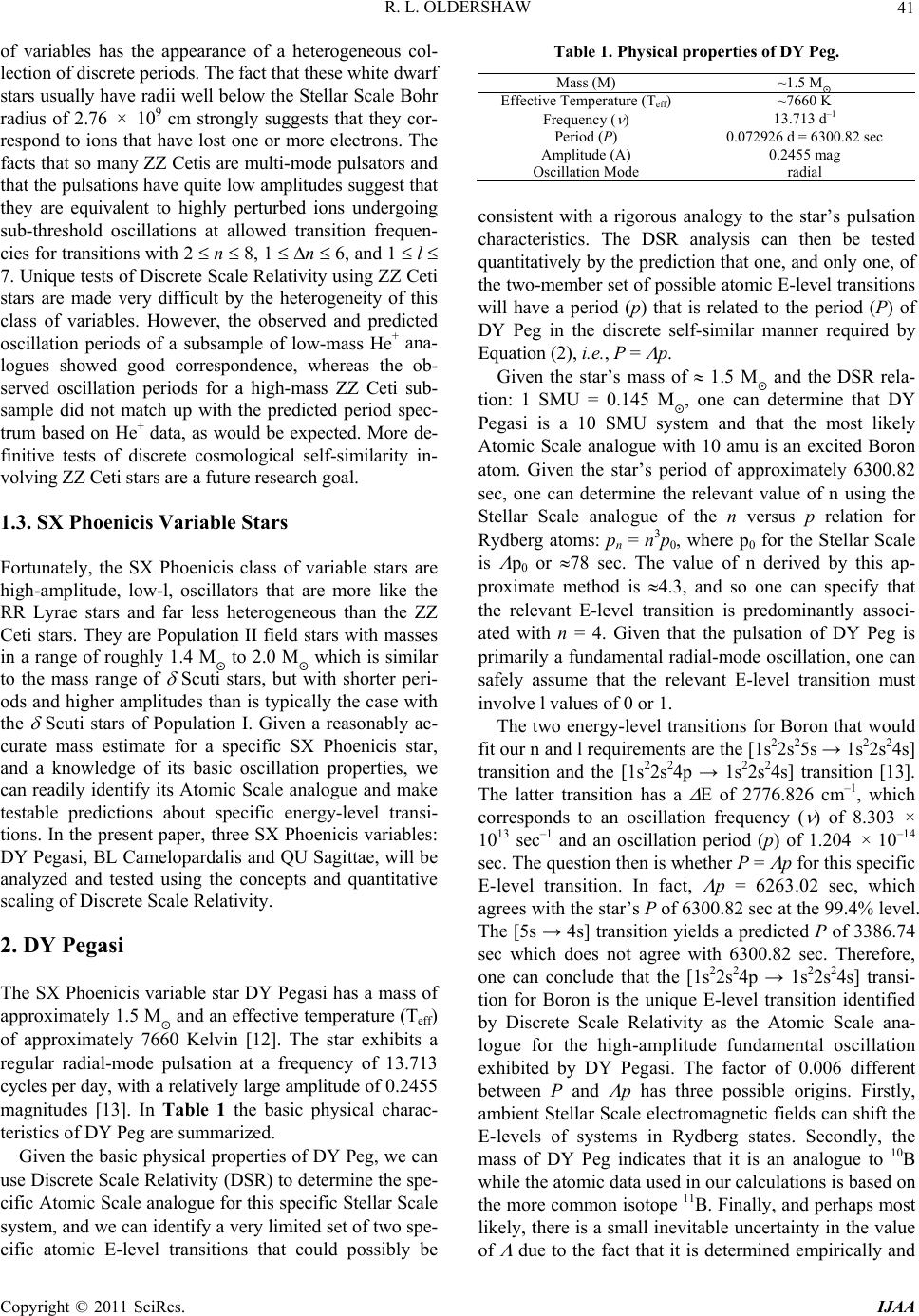 R. L. OLDERSHAW41 of variables has the appearance of a heterogeneous col- lection of discrete periods. The fact that these white dwarf stars usually have radii well below the Stellar Scale Bohr radius of 2.76 × 109 cm strongly suggests that they cor- respond to ions that have lost one or more electrons. The facts that so many ZZ Cetis are multi-mode pulsators and that the pulsations have quite low amplitudes suggest that they are equivalent to highly perturbed ions undergoing sub-threshold oscillations at allowed transition frequen- cies for transitions with 2 n 8, 1 n 6, and 1 l 7. Unique tests of Discrete Scale Relativity using ZZ Ceti stars are made very difficult by the heterogeneity of this class of variables. However, the observed and predicted oscillation periods of a subsample of low-mass He+ ana- logues showed good correspondence, whereas the ob- served oscillation periods for a high-mass ZZ Ceti sub- sample did not match up with the predicted period spec- trum based on He+ data, as would be expected. More de- finitive tests of discrete cosmological self-similarity in- volving ZZ Ceti stars are a future research goal. 1.3. SX Phoenicis Variable Stars Fortunately, the SX Phoenicis class of variable stars are high-amplitude, low-l, oscillators that are more like the RR Lyrae stars and far less heterogeneous than the ZZ Ceti stars. They are Population II field stars with masses in a range of roughly 1.4 M to 2.0 M which is similar to the mass range of Scuti stars, but with shorter peri- ods and higher amplitudes than is typically the case with the Scuti stars of Population I. Given a reasonably ac- curate mass estimate for a specific SX Phoenicis star, and a knowledge of its basic oscillation properties, we can readily identify its Atomic Scale analogue and make testable predictions about specific energy-level transi- tions. In the present paper, three SX Phoenicis variables: DY Pegasi, BL Camelopardalis and QU Sagittae, will be analyzed and tested using the concepts and quantitative scaling of Discrete Scale Relativity. 2. DY Pegasi The SX Phoenicis variable star DY Pegasi has a mass of approximately 1.5 M and an effective temperature (Teff) of approximately 7660 Kelvin [12]. The star exhibits a regular radial-mode pulsation at a frequency of 13.713 cycles per day, with a relatively large amplitude of 0.2455 magnitudes [13]. In Table 1 the basic physical charac- teristics of DY Peg are summarized. Given the basic physical properties of DY Peg, we can use Discrete Scale Relativity (DSR) to determine the spe- cific Atomic Scale analogue for this specific Stellar Scale system, and we can identify a very limited set of two spe- cific atomic E-level transitions that could possibly be Table 1. Physical properties of DY Peg. Mass (M) ~1.5 M Effective Temperature (Teff) ~7660 K Frequency ( ) 13.713 d–1 Period (P) 0.072926 d = 6300.82 sec Amplitude (A) 0.2455 mag Oscillation Mode radial consistent with a rigorous analogy to the star’s pulsation characteristics. The DSR analysis can then be tested quantitatively by the prediction that one, and only one, of the two-member set of possible atomic E-level transitions will have a period (p) that is related to the period (P) of DY Peg in the discrete self-similar manner required by Equation (2), i.e., P = p. Given the star’s mass of 1.5 M and the DSR rela- tion: 1 SMU = 0.145 M, one can determine that DY Pegasi is a 10 SMU system and that the most likely Atomic Scale analogue with 10 amu is an excited Boron atom. Given the star’s period of approximately 6300.82 sec, one can determine the relevant value of n using the Stellar Scale analogue of the n versus p relation for Rydberg atoms: pn = n3p0, where p0 for the Stellar Scale is p0 or 78 sec. The value of n derived by this ap- proximate method is 4.3, and so one can specify that the relevant E-level transition is predominantly associ- ated with n = 4. Given that the pulsation of DY Peg is primarily a fundamental radial-mode oscillation, one can safely assume that the relevant E-level transition must involve l values of 0 or 1. The two energy-level transitions for Boron that would fit our n and l requirements are the [1s22s25s → 1s22s24s] transition and the [1s22s24p → 1s22s24s] transition [13]. The latter transition has a E of 2776.826 cm–1, which corresponds to an oscillation frequency ( ) of 8.303 × 10¹³ sec–1 and an oscillation period (p) of 1.204 × 10⁻¹⁴ sec. The question then is whether P = p for this specific E-level transition. In fact, p = 6263.02 sec, which agrees with the star’s P of 6300.82 sec at the 99.4% level. The [5s → 4s] transition yields a predicted P of 3386.74 sec which does not agree with 6300.82 sec. Therefore, one can conclude that the [1s22s24p → 1s22s24s] transi- tion for Boron is the unique E-level transition identified by Discrete Scale Relativity as the Atomic Scale ana- logue for the high-amplitude fundamental oscillation exhibited by DY Pegasi. The factor of 0.006 different between P and p has three possible origins. Firstly, ambient Stellar Scale electromagnetic fields can shift the E-levels of systems in Rydberg states. Secondly, the mass of DY Peg indicates that it is an analogue to 10B while the atomic data used in our calculations is based on the more common isotope 11B. Finally, and perhaps most likely, there is a small inevitable uncertainty in the value of due to the fact that it is determined empirically and Copyright © 2011 SciRes. IJAA 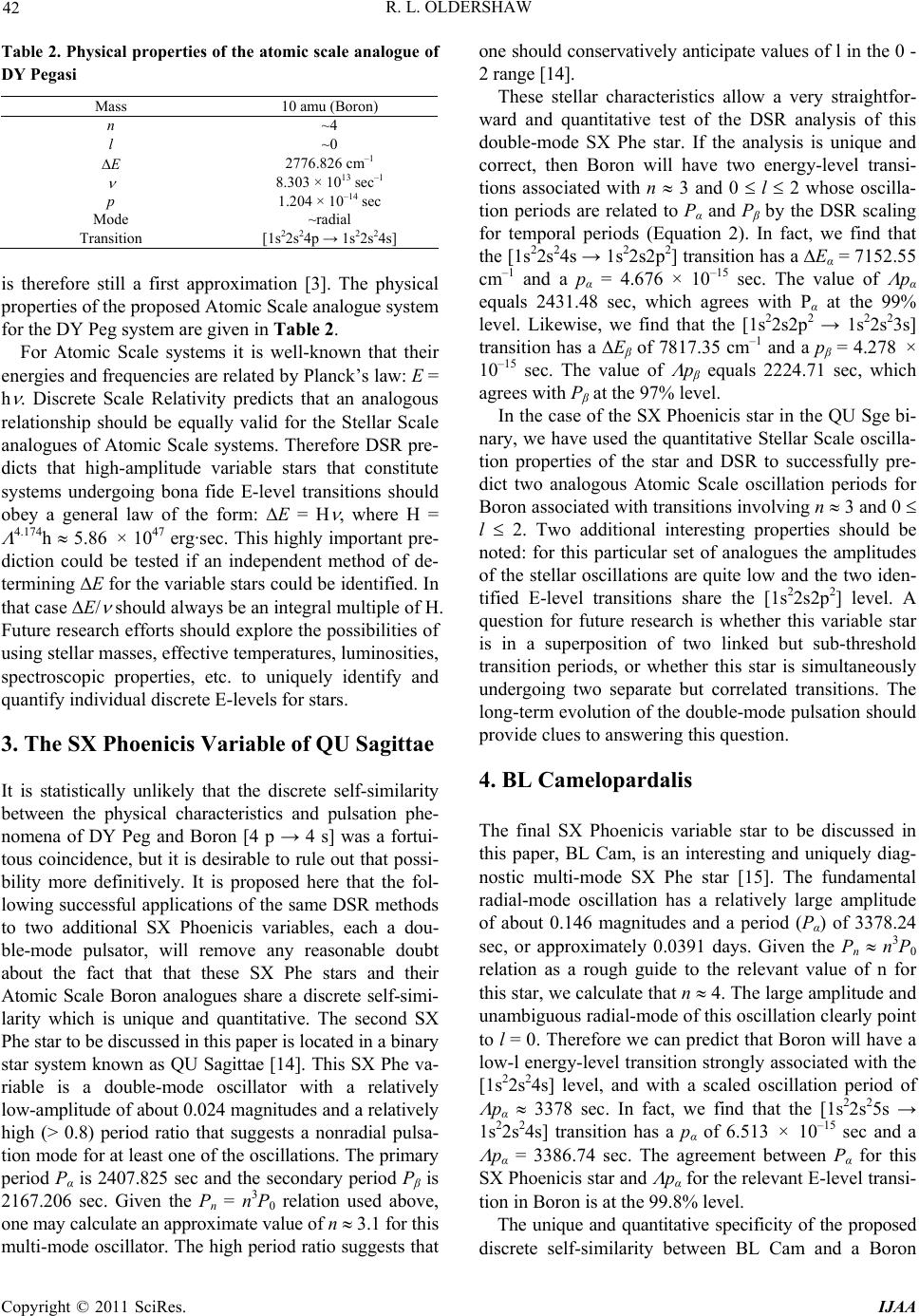 R. L. OLDERSHAW 42 Table 2. Physical properties of the atomic scale analogue of DY Pegasi Mass 10 amu (Boron) n ~4 l ~0 E 2776.826 cm–1 8.303 × 10¹³ sec–1 p 1.204 × 10⁻¹⁴ sec Mode ~radial Transition [1s22s24p → 1s22s24s] is therefore still a first approximation [3]. The physical properties of the proposed Atomic Scale analogue system for the DY Peg system are given in Table 2. For Atomic Scale systems it is well-known that their energies and frequencies are related by Planck’s law: E = h . Discrete Scale Relativity predicts that an analogous relationship should be equally valid for the Stellar Scale analogues of Atomic Scale systems. Therefore DSR pre- dicts that high-amplitude variable stars that constitute systems undergoing bona fide E-level transitions should obey a general law of the form: E = H , where H = 4.174h 5.86 × 1047 erg·sec. This highly important pre- diction could be tested if an independent method of de- termining E for the variable stars could be identified. In that case E/ should always be an integral multiple of H. Future research efforts should explore the possibilities of using stellar masses, effective temperatures, luminosities, spectroscopic properties, etc. to uniquely identify and quantify individual discrete E-levels for stars. 3. The SX Phoenicis Variable of QU Sagittae It is statistically unlikely that the discrete self-similarity between the physical characteristics and pulsation phe- nomena of DY Peg and Boron [4 p → 4 s] was a fortui- tous coincidence, but it is desirable to rule out that possi- bility more definitively. It is proposed here that the fol- lowing successful applications of the same DSR methods to two additional SX Phoenicis variables, each a dou- ble-mode pulsator, will remove any reasonable doubt about the fact that that these SX Phe stars and their Atomic Scale Boron analogues share a discrete self-simi- larity which is unique and quantitative. The second SX Phe star to be discussed in this paper is located in a binary star system known as QU Sagittae [14]. This SX Phe va- riable is a double-mode oscillator with a relatively low-amplitude of about 0.024 magnitudes and a relatively high (> 0.8) period ratio that suggests a nonradial pulsa- tion mode for at least one of the oscillations. The primary period Pα is 2407.825 sec and the secondary period Pβ is 2167.206 sec. Given the Pn = n3P0 relation used above, one may calculate an approximate value of n 3.1 for this multi-mode oscillator. The high period ratio suggests that one should conservatively anticipate values of l in the 0 - 2 range [14]. These stellar characteristics allow a very straightfor- ward and quantitative test of the DSR analysis of this double-mode SX Phe star. If the analysis is unique and correct, then Boron will have two energy-level transi- tions associated with n 3 and 0 l 2 whose oscilla- tion periods are related to Pα and Pβ by the DSR scaling for temporal periods (Equation 2). In fact, we find that the [1s22s24s → 1s22s2p2] transition has a Eα = 7152.55 cm–1 and a pα = 4.676 × 10⁻¹⁵ sec. The value of pα equals 2431.48 sec, which agrees with Pα at the 99% level. Likewise, we find that the [1s22s2p2 → 1s22s23s] transition has a Eβ of 7817.35 cm–1 and a pβ = 4.278 × 10⁻¹⁵ sec. The value of pβ equals 2224.71 sec, which agrees with Pβ at the 97% level. In the case of the SX Phoenicis star in the QU Sge bi- nary, we have used the quantitative Stellar Scale oscilla- tion properties of the star and DSR to successfully pre- dict two analogous Atomic Scale oscillation periods for Boron associated with transitions involving n 3 and 0 l 2. Two additional interesting properties should be noted: for this particular set of analogues the amplitudes of the stellar oscillations are quite low and the two iden- tified E-level transitions share the [1s22s2p2] level. A question for future research is whether this variable star is in a superposition of two linked but sub-threshold transition periods, or whether this star is simultaneously undergoing two separate but correlated transitions. The long-term evolution of the double-mode pulsation should provide clues to answering this question. 4. BL Camelopardalis The final SX Phoenicis variable star to be discussed in this paper, BL Cam, is an interesting and uniquely diag- nostic multi-mode SX Phe star [15]. The fundamental radial-mode oscillation has a relatively large amplitude of about 0.146 magnitudes and a period (Pα) of 3378.24 sec, or approximately 0.0391 days. Given the Pn n3P0 relation as a rough guide to the relevant value of n for this star, we calculate that n 4. The large amplitude and unambiguous radial-mode of this oscillation clearly point to l = 0. Therefore we can predict that Boron will have a low-l energy-level transition strongly associated with the [1s22s24s] level, and with a scaled oscillation period of pα 3378 sec. In fact, we find that the [1s22s25s → 1s22s24s] transition has a pα of 6.513 × 10⁻¹⁵ sec and a pα = 3386.74 sec. The agreement between Pα for this SX Phoenicis star and pα for the relevant E-level transi- tion in Boron is at the 99.8% level. The unique and quantitative specificity of the proposed discrete self-similarity between BL Cam and a Boron Copyright © 2011 SciRes. IJAA  R. L. OLDERSHAW43 atom undergoing a [5s → 4s] transition between Rydberg states can be further verified by taking advantage of the multi-mode pulsation of this star. Several of the additional pulsation periods appear to be close multiples (e.g., 2Pα) and combinations (e.g., Pα + Pβ) which are not particularly diagnostic. However, one pulsation period (Pβ) at 2727.65 sec (or about 0.03157 days) clearly appears to be an inde- pendent oscillation period that does provide a confirma- tory test of the DSR analysis. Using the Pn n3P0 relation we find that this oscillation is associated with n 3. Since it is a relatively low amplitude oscillation (0.007 mag), and since the ratio of the fundamental period and this sec- ondary period indicates that it is a radial first overtone pulsation [15]. We can expect l 1 for this oscillation. Therefore we can predict that Boron will have an E-level transition associated with n 3 and l 1 that has an oscil- lation period pβ which scales to approximately pβ 2728 sec in accordance with Equation (2). We may further ex- pect, on the basis of finding that the two modes of the double-mode pulsator of QU Sge appeared to be linked transitions (i.e., they shared a common E-level), that the two oscillation periods of BL Cam are also linked. In fact, our highly unique 4-part prediction is vindicated in a con- vincing manner. The [1s22s24s → 1s22s23p] transition for Boron is: 1) associated with n 3, 2) involves a change of l from l = 0 to l = 1, 3) is linked to the fundamental oscil- lation period through the common 4s E-level, and 4) has a pβ of 2719.11 sec, which agrees with the predicted pe- riod of 2727.65 sec at the 99.7% level. This empirical support for the theoretical hypothesis of discrete cosmological self-similarity between BL Cam and an excited Boron atom undergoing E-level transitions in the 3 n 5 range, with 0 l 1, certainly appears to be quite definitive. Coincidence is not a viable explana- tion for these successful results, and the 4-part specificity of the empirical testing would appear to minimize the possibility of subjectivity or arbitrariness in the analysis. 5. Conclusions Given the masses and period data for three SX Phoenicis variables, we have been able to make predictions about specific energy-level transitions of a specific type of ex- cited atom (Boron). Technically these predictions are di- agnostic retrodictions since the Atomic Scale data was published before the tests were conducted. For each of the five indentified pulsation periods, the Stellar Scale oscilla- tion period was approximately times larger than the uniquely specified Atomic Scale oscillation period, with an average agreement at the 99% level. Two of the SX Phe stars analyzed here were double-mode pulsators that allowed additional degrees of specificity in testing the discrete cosmological self-similarity between SX Phe stars and excited Boron atoms oscillating at published E-level transition frequencies. The probability is exceedingly small that five multi-part tests, involving mass, n, l, and frequency values, could succeed in this manner by chance or even by the use of subjective methodology. Therefore, a high degree of discrete self-similarity between these stel- lar/atomic analogues from neighboring Scales of nature’s discrete cosmological hierarchy appears to have been veri- fied quantitatively. Some additional comments and questions for future research are as follows. 1) Clearly stellar mass is, or should be, the definitive parameter in classifying variable stars, as is the case with atoms. Although periods, pulsation modes, temperatures and spectroscopic properties are useful diagnostic char- acteristics, variable stars should be ordered and classified primarily by their masses in rigorous analogy to the Atomic Scale classification of atomic elements. 2) It will be of interest to explore the apparent cou- pling of double-mode pulsations, wherein a shared E-level is identified. This phenomenon has been docu- mented for QU Sge, BL Cam and the δ Scuti star GSC 00144-03031 [10]. Is this a common characteristic of all double-mode Stellar Scale variables? What physical mechanism could explain this coupling of simultaneous oscillation phenomena? Is an analogous Atomic Scale phenomena known? 3) Are the low-amplitude oscillations of multi-mode variable stars sub-threshold oscillations that would be virtually unobservable in Atomic Scale systems, since they would be below the energy threshold required for emission of quanta? 4) Planck discovered the famous relation E = h for atoms, and Discrete Scale Relativity predicts an equivalent relation E = H for the high-amplitude variable stars. We can measure stellar values quite accurately and we can predict that H = ( D + 1h) or about 5.86 × 1047 erg·sec in accordance with the discrete scale invariance of DSR [5]. If there were a way to define the Stellar Scale E-levels, the proposed E = H relation could be empirically tested. Taken together the evidence for discrete self-similarity involving RR Lyrae stars, δ Scuti stars, ZZ Ceti stars, SX Phoenicis stars, and their respective Atomic Scale ana- logues are very strong and cannot be due to coincidence or subjective methods. Discrete scale invariance allows one to investigate equivalent systems that differ in lengths and temporal periods by a scale factor of 5.2 × 10¹⁷, and that differ in masses and energies by a scale factor of 1.70 × 1056. If the reality of Discrete Scale Relativity were established and accepted, the resulting paradigmatic advance would create a very rich potential for new breakthroughs in our understanding of stellar Copyright © 2011 SciRes. IJAA  R. L. OLDERSHAW Copyright © 2011 SciRes. IJAA 44 and atomic systems. 6. References [1] R. L. Oldershaw, “The Self-Similar Cosmological Para- digm―A New Test and Two New Predictions,” Astro- physical Journal, Vol. 322, No. 1, 1987, pp. 34-36. doi:10.1086/165699 [2] R. L. Oldershaw, “Self-Similar Cosmological Model: Introduction and Empirical Tests,” International Journal of Theoretical Physics, Vol. 28, No. 6, 1989, pp. 669-694. doi:10.1007/BF00669984 [3] R. L. Oldershaw, “Self-Similar Cosmological Model: Technical Details, Predictions, Unresolved Issues and Implications,” International Journal of Theoretical Phys- ics, Vol. 28, No. 12, 1989, pp. 1503-1532. doi:10.1007/BF00671591 [4] R. L. Oldershaw, “Mass Estimates for Galactic Dark Matter Objects as a Test of a Fractal Cosmological Para- digm,” Fractals, Vol. 10, No. 1, 2002, pp. 27-38. doi:10.1142/S0218348X02000987 [5] R. L. Oldershaw, “Discrete Scale Relativity,” Astrophy- sics and Space Science, Vol. 311, No. 4, 2007, pp. 413- 433. doi:10.1007/s10509-007-9557-x [6] R. L. Oldershaw, “Fractal Cosmology Website,” 2007. http://www.amherst.edu/~rloldershaw [7] R. L. Oldershaw, “The Meaning of the Fine Structure Constant,” Electronic Journal of Theoretical Physics, Vol. 5, No. 17, 2008, pp. 207-214. [8] I. Soszynski, et al., “The Optical Gravitational Lensing Experiment. Catalog of RR Lyrae Stars in the Large Ma- gellanic Cloud,” Acta Astronomica, Vol. 53, 2003, pp. 93-116. www.arxiv.org/pdf/astro-ph/0306041 [9] R. L. Oldershaw, “Discrete Self-Similarity of RR Lyrae Stars: II. Period Spectrum for a Very Large Sample,” 2008. http://www.arxiv.org/ftp/astro-ph/papers/0606/0606128.p df [10] R. L. Oldershaw, “Discrete Cosmological Self-Si- milar- ity and Delta Scuti Stars,” 2008. http://www.arxiv.org/ftp/astro-ph/papers/0601/0601038.p df [11] R. L. Oldershaw, “ZZ Ceti Stars: Fractal Analogues of Excited He+ Ions,” 2009. http://www.arxiv.org/ftp/astro-ph/papers/0602/0602451.p df [12] E. G. Hintz, M. D. Joner and M. Ivanushkina, “Period Changes in the SX Phoenicis Star DY Pegasi,” Publica- tions of the Astronomical Society of the Pacific, Vol. 116, No. 820, 2004, pp. 543-553. doi:10.1086/420858 [13] J. N. Fu, et al., “Pulsations and Period Changes of the SX Phoenicis Star DY Pegasi,” Publications of the Astro- nomical Society of the Pacific, Vol. 121, No. 877, 2009, pp. 251-259. doi:10.1086/597829 [14] Y. B. Jeon, et al., “Discovery of an SX Phoenicis Type Pulsating Component in the Algol-Type Semidetached Eclipsing Binary QU Sagittae in M71,” The Astrophys Journal Letters, Vol. 636, No. 2, 2006, pp. 129-132. doi:10.1086/500263 [15] S. Fauvaud, et al., “A Comprehensive Study of the SX Phoenicis Star BL Camelopardalis,” Astron & Astrophy- sics, Vol. 451, No. 3, 2006, pp. 999-1008. doi:10.1051/0004-6361:20053841 |