

Paper Menu >>
Journal Menu >>
 Open Journal of Obstetrics and Gynecology, 2011, 1, 36-41 doi:10.4236/ojog.2011.12008 Published Online June 2011 (http://www.SciRP.org/journal/ojog/ OJOG ). Published Online June 2011 in SciRes. http://www.scirp.org/journal/OJOG Defining prediabetes in polycystic ovarian syndrome Mark P. Trolice College of Medicine, University of Central Florida, Orlando, USA. Email: [email protected] Received 21 April 2011; revised 25 May 2011; accepted 3 June 2011. ABSTRACT Objective: The article will review the associations between Prediabetes (PD) and Polycystic Ovarian Syndrome (PCOS) and present factors that decrease the progression of PD into type 2 diabetes mellitus (T2DM).Metformin will also be examined for its role in ovulation induction, pregnancy and ameliorating the metabolic syndrome. Study Design: Medline search. Methods of study: Keyword search: Predia- betes (PD), Polycystic Ovarian Syndrome (PCOS), Metformin, Glucose Tolerance Test (GTT), Type 2 Diabetes Mellitus. Results: As the most common en- docrinopathy during the reproductive years, PCOS has a genetic multifactorial inheritance and is associ- ated with a high risk of insulin resistance. The use of metformin has shown mixed results in this patient population as a therapy to improve ovulation func- tion and the metabolic syndrome and showed no de- finitive reduction in the rate of miscarriage. PCOS patients are significantly predisposed to PD and T2DM. Conclusion: Lifestyle changes such as weight loss and physical activity reduce the progression of PD into T2DM in PCOS patients. The new AACE and ADA guidelines establish simplified methods of screening and treating PD. The role of metformin remains undefined in the infertile PCOS patient. Keywords: Polycystic Ovarian Syndrome; Prediabetes; Impaired Glucose Tolerance; Impaired Fasting Glucose; Type 2 Diabetes 1. INTRODUCTION Polycystic Ovarian Syndrome (PCOS) is the most pre- valent endocrinopathy during the reproductive years, affecting 5% - 10% of women [1]. PCOS is classically associated with ovulatory dysfunction and hyperandro- genism. In 2003, an expert conference was organized in Rotterdam in May of 2003, co-sponsored by the Euro- pean Society for Human Reproduction and Embryology (ESHRE) and the American Society for Reproductive Medicine (ASRM) resulting in revised criteria for mak- ing the diagnosis of PCOS using two of the following three features: 1) oligo- or anovulation (i.e. cycle inter- val >35 d or <8 cycles/yr); 2) clinical or biochemical signs of hyperandrogenism (i.e., demonstrated by ele- vated total or free testosterone, DHEAS, free androgen index [2] or signs of hirsutism or acne; 3) ultrasound evidence of polycystic ovaries (12 or more follicles in each ovary (2 mm - 9 mm), and/or increased ovarian volume (>10 mL)—all at the exclusion of other etiolo- gies (hyperprolactinemia, thyroid dysfunction, androgen- secreting tumors, non-classic adrenal hyperplasia) [3,4]. Despite its prevalence, PCOS remains an enigma result- ing in significant patient frustration and physician con- fusion for the most appropriate method of diagnosis and management. In addition to the reproductive health issues of ab- normal uterine bleeding, anovulation, infertility, and endometrial hyperplasia, PCOS patients are at higher prevalence for the metabolic syndrome, namely ab- dominal obesity, dyslipidemia, hypertension, and pre- diabetes (PD). The National Cholesterol Education Pro- gram Adult Treatment Panel (NCEPATP) defined the metabolic syndrome as the presence of three of the five following factors: waist circumference greater than 88 cm in females; fasting serum glucose 110 mg/dl or more; fasting serum triglycerides greater than 150 mg/dl; se- rum HDL-cholesterol less than 50 mg/dl; and blood pressure greater than 130/85 mm Hg [5]. The metabolic syndrome occurs at an increased overall prevalence rate of 43% - 47% in women with PCOS [6]. One of met- formin’s actions is 5-AMP-activated protein kinase (AMPK) pathway. While obesity, type 2 diabetes melli- tus (T2DM), and the metabolic syndrome are all disor- ders of energy balance and AMPK appears to regulate this system, perhaps the role of metformin in improving the metabolic syndrome is through this mechanism [7]. To date, there is no definitive evidence demonstrating the benefit of metformin in PCOS patients as a treatment or prevention for metabolic. As a result, lifestyle modi- fications remain the mainstay for patients with the me- tabolic syndrome.  M. P. Trolice / Open Journal of Obstetrics and Gynecology 1 (2011) 36-41 37 While all medical issues should be addressed in PCOS patients, particularly those trying to conceive, PD can be elusive and requires vigilance with formal testing. Fur- thermore, there is an indolent but clear progression of PD to T2DM unless intervention is applied early. This article will serve to elucidate the morbid association of PCOS with PD by examining the insulin resistance con- nection, and presenting new guidelines from the Ameri- can Association of Clinical Endocrinologists and Amer- ican Diabetes Association to simplify methods of diag- nosing and treating PD as well as to decrease the pro- gression into T2DM. 2. REPRODUCTIVE CONSEQUENCES Approximately 40% of female infertility is attributed to ovulation dysfunction of which PCOS is the prevailing diagnosis. Multiple regimens (beyond the scope of this article) have been presented for ovulation induction par- ticularly in PCOS patients resistant to clomiphene citrate, including the addition of metformin (see below), yet this latter agent has not been shown to be as effective as clomiphene. The second ESHRE/ASRM-Sponsored PCOS Consensus Workshop Group in 2007 concluded clomiphene citrate is the first line agent for ovulation induction followed by gonadotropins or laparoscopy ovarian diathermy [8]. The expert panel concluded met- formin should be limited to PCOS patients with glucose intolerance as current evidence does not support the rou- tine use of metformin in ovulation induction. Metformin appears to be superior to placebo regarding ovulation induction for PCOS patients [9]. Controversy remains when metformin is compared with clomiphene. A recent meta analysis and clinical trial demonstrates improve- ment in ovulation with metformin [10,11] contrary to a Cochrane Review stating limited improvement of met- formin vs. clomiphene [12] and an excellent randomized control trial showing superiority of clomiphene over metformin [13]. It is plausible the disparity in results from these studies may be attributed to patient hetero- geneity, i.e. BMI, genotype, androgen levels, ethnicity, and racial differences [14]. Aromatase inhibitors such as letrozole and anastrozole have been studied as alternatives to clomiphene. A recent meta-analysis to compare clinical efficacy and safety showed no difference between letrozole and cloimiphene regarding miscarriage, pregnancy rates and multiple pregnancy rates and concluded equal effectiveness of the two drugs for ovulation induction in PCOS patients [15]. Anastrozole is inferior to clomiphene and should not be used as a first line for ovulation induction [16]. Both letrozole and anastrozole use for ovulation induction are non-FDA approved applications. Furthermore, weight loss has demonstrated the same efficacy in inducing ovulation as metformin [17]. Though a patient should strive for a BMI of less than 27 kg/m2, to improve ovu- lation and pregnancy rates, a weight loss of only 2% to 5% may restore normal menstrual function [18-20]. PCOS is not only a common cause of infertility but has been indicated as a risk factor for spontaneous abor- tions (SAB), particularly among women treated with assisted reproductive technology [21-23]. When con- trolled for confounding effects of body mass index (BMI), age and PCOS status, insulin resistance signifi- cantly increases the risk for SAB [24] estimated to be in the range from 39%-73%, far exceeding the general population [25]. Recent studies have indicated that hy- perinsulinemia, obesity, and hyperandrogenemia all may be a source for the increased SAB rate due to adverse affects on the function of the endometrium [26-28]. Though once thought to be a significant enhancement to the treatment of SAB in PCOS patients, the role of metformin is ambiguous. The first double blind placebo controlled trial comparing metformin and clomiphene citrate in non-obese PCOS patients, revealed metformin was superior in terms of achieved pregnancies (15.1% vs 7.2%), lower abortion rate and increased live births [11]. However, a recent meta analysis failed to demonstrate any benefit from metformin use before pregnancy on preventing miscarriage in PCOS patients [29]. The Cochrane Database concluded that current studies did not support the reduction in miscarriage in PCOS pa- tients undergoing IVF while on metformin [30]. 3. THE INSULIN RESISTANCE CONNECTION PCOS is well supported to have a genetic multifactorial inheritance. Insulin resistance (IR) is found in 65-70% of PCOS patients when various diagnostic tools are utilized, including the cumbersome hyperinsulinemic euglycemic clamp study [31,32] While the exact etiology of IR re- mains unclear, the prevailing theory is a post insulin receptor defect affecting signal transduction resulting in an increase in ovarian and adrenal androgens [33-36]. Up to 65% - 70% of PCOS women are obese and of- ten have insulin resistance placing them at risk for overt diabetes [37]. The impact of PCOS on impaired glucose uptake is dramatically shown by lean PCOS demon- strating the same degree of insulin resistance as ovula- tory obese women [37]. To further illustrate this point, PCOS patients are more insulin resistant than age- and BMI-matched non-PCOS controls, irrespective of BMI [8]. The relationship of insulin resistance and PCOS underscores the need for performing a 2hr GTT in all PCOS patients since a fasting glucose alone will has a false negative rate of up to 30% in diagnosing PD [38]. Hyperinsulinemia acts synergistically with increased C opyright © 2011 SciRes. OJOG 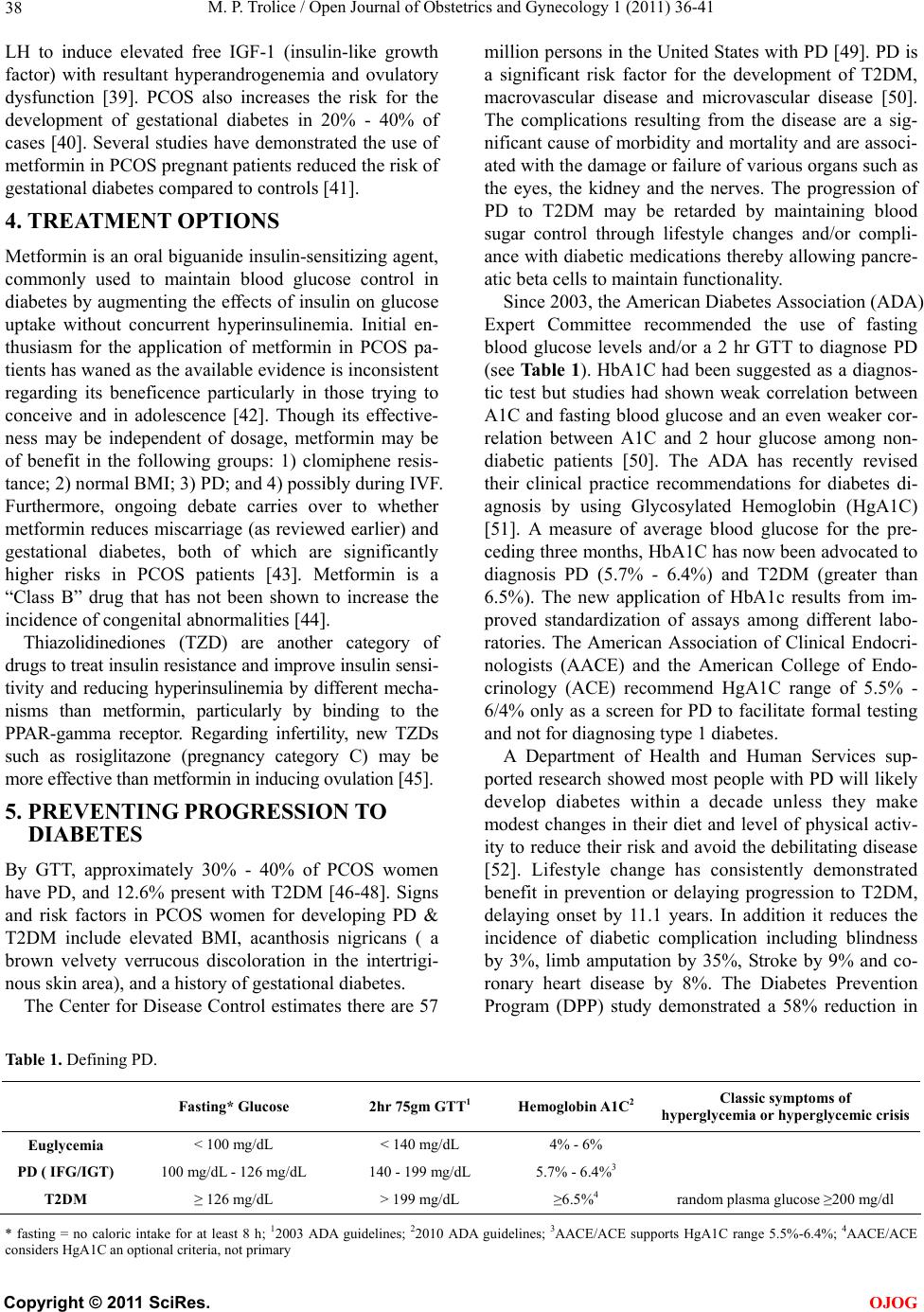 M. P. Trolice / Open Journal of Obstetrics and Gynecology 1 (2011) 36-41 Copyright © 2011 SciRes. 38 OJOG LH to induce elevated free IGF-1 (insulin-like growth factor) with resultant hyperandrogenemia and ovulatory dysfunction [39]. PCOS also increases the risk for the development of gestational diabetes in 20% - 40% of cases [40]. Several studies have demonstrated the use of metformin in PCOS pregnant patients reduced the risk of gestational diabetes compared to controls [41]. 4. TREATMENT OPTIONS Metformin is an oral biguanide insulin-sensitizing agent, commonly used to maintain blood glucose control in diabetes by augmenting the effects of insulin on glucose uptake without concurrent hyperinsulinemia. Initial en- thusiasm for the application of metformin in PCOS pa- tients has waned as the available evidence is inconsistent regarding its beneficence particularly in those trying to conceive and in adolescence [42]. Though its effective- ness may be independent of dosage, metformin may be of benefit in the following groups: 1) clomiphene resis- tance; 2) normal BMI; 3) PD; and 4) possibly during IVF. Furthermore, ongoing debate carries over to whether metformin reduces miscarriage (as reviewed earlier) and gestational diabetes, both of which are significantly higher risks in PCOS patients [43]. Metformin is a “Class B” drug that has not been shown to increase the incidence of congenital abnormalities [44]. Thiazolidinediones (TZD) are another category of drugs to treat insulin resistance and improve insulin sensi- tivity and reducing hyperinsulinemia by different mecha- nisms than metformin, particularly by binding to the PPAR-gamma receptor. Regarding infertility, new TZDs such as rosiglitazone (pregnancy category C) may be more effective than metformin in inducing ovulation [45]. 5. PREVENTING PROGRESSION TO DIABETES By GTT, approximately 30% - 40% of PCOS women have PD, and 12.6% present with T2DM [46-48]. Signs and risk factors in PCOS women for developing PD & T2DM include elevated BMI, acanthosis nigricans ( a brown velvety verrucous discoloration in the intertrigi- nous skin area), and a history of gestational diabetes. The Center for Disease Control estimates there are 57 million persons in the United States with PD [49]. PD is a significant risk factor for the development of T2DM, macrovascular disease and microvascular disease [50]. The complications resulting from the disease are a sig- nificant cause of morbidity and mortality and are associ- ated with the damage or failure of various organs such as the eyes, the kidney and the nerves. The progression of PD to T2DM may be retarded by maintaining blood sugar control through lifestyle changes and/or compli- ance with diabetic medications thereby allowing pancre- atic beta cells to maintain functionality. Since 2003, the American Diabetes Association (ADA) Expert Committee recommended the use of fasting blood glucose levels and/or a 2 hr GTT to diagnose PD (see Tabl e 1). HbA1C had been suggested as a diagnos- tic test but studies had shown weak correlation between A1C and fasting blood glucose and an even weaker cor- relation between A1C and 2 hour glucose among non- diabetic patients [50]. The ADA has recently revised their clinical practice recommendations for diabetes di- agnosis by using Glycosylated Hemoglobin (HgA1C) [51]. A measure of average blood glucose for the pre- ceding three months, HbA1C has now been advocated to diagnosis PD (5.7% - 6.4%) and T2DM (greater than 6.5%). The new application of HbA1c results from im- proved standardization of assays among different labo- ratories. The American Association of Clinical Endocri- nologists (AACE) and the American College of Endo- crinology (ACE) recommend HgA1C range of 5.5% - 6/4% only as a screen for PD to facilitate formal testing and not for diagnosing type 1 diabetes. A Department of Health and Human Services sup- ported research showed most people with PD will likely develop diabetes within a decade unless they make modest changes in their diet and level of physical activ- ity to reduce their risk and avoid the debilitating disease [52]. Lifestyle change has consistently demonstrated benefit in prevention or delaying progression to T2DM, delaying onset by 11.1 years. In addition it reduces the incidence of diabetic complication including blindness by 3%, limb amputation by 35%, Stroke by 9% and co- ronary heart disease by 8%. The Diabetes Prevention Program (DPP) study demonstrated a 58% reduction in Table 1. Defining PD. Fasting* Glucose 2hr 75gm GTT1 Hemoglobin A1C2 Classic symptoms of hyperglycemia or h y pe r g l yc emic crisis Euglycemia < 100 mg/dL < 140 mg/dL 4% - 6% PD ( IFG/IGT) 100 mg/dL - 126 mg/dL 140 - 199 mg/dL 5.7% - 6.4%3 T2DM ≥ 126 mg/dL > 199 mg/dL ≥6.5%4 random plasma glucose ≥200 mg/dl * fasting = no caloric intake for at least 8 h; 12003 ADA guidelines; 22010 ADA guidelines; 3AACE/ACE supports HgA1C range 5.5%-6.4%; 4AACE/ACE considers HgA1C an optional criteria, not primary 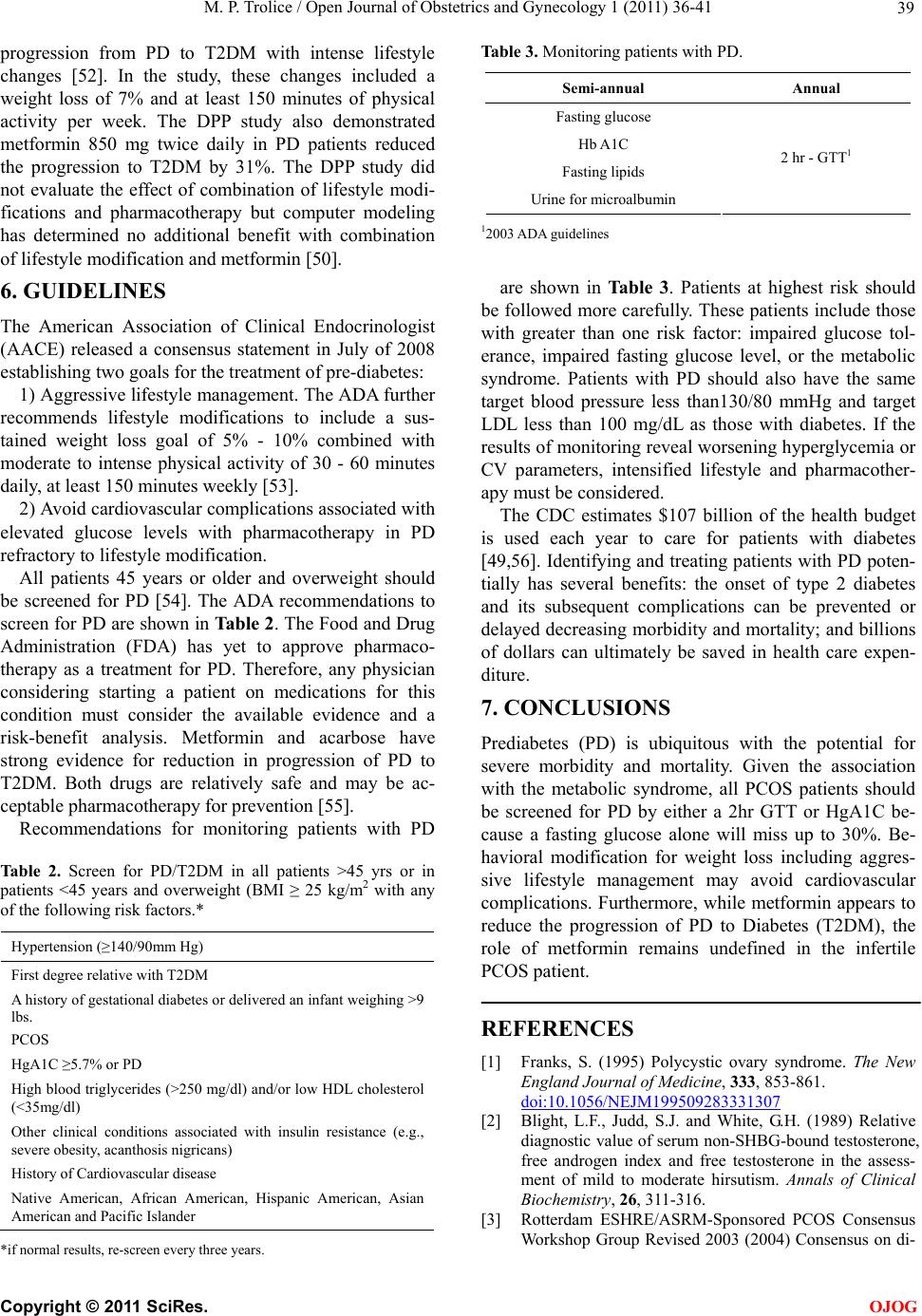 M. P. Trolice / Open Journal of Obstetrics and Gynecology 1 (2011) 36-41 39 progression from PD to T2DM with intense lifestyle changes [52]. In the study, these changes included a weight loss of 7% and at least 150 minutes of physical activity per week. The DPP study also demonstrated metformin 850 mg twice daily in PD patients reduced the progression to T2DM by 31%. The DPP study did not evaluate the effect of combination of lifestyle modi- fications and pharmacotherapy but computer modeling has determined no additional benefit with combination of lifestyle modification and metformin [50]. 6. GUIDELINES The American Association of Clinical Endocrinologist (AACE) released a consensus statement in July of 2008 establishing two goals for the treatment of pre-diabetes: 1) Aggressive lifestyle management. The ADA further recommends lifestyle modifications to include a sus- tained weight loss goal of 5% - 10% combined with moderate to intense physical activity of 30 - 60 minutes daily, at least 150 minutes weekly [53]. 2) Avoid cardiovascular complications associated with elevated glucose levels with pharmacotherapy in PD refractory to lifestyle modification. All patients 45 years or older and overweight should be screened for PD [54]. The ADA recommendations to screen for PD are shown in Table 2. The Food and Drug Administration (FDA) has yet to approve pharmaco- therapy as a treatment for PD. Therefore, any physician considering starting a patient on medications for this condition must consider the available evidence and a risk-benefit analysis. Metformin and acarbose have strong evidence for reduction in progression of PD to T2DM. Both drugs are relatively safe and may be ac- ceptable pharmacotherapy for prevention [55]. Recommendations for monitoring patients with PD Table 2. Screen for PD/T2DM in all patients >45 yrs or in patients <45 years and overweight (BMI ≥ 25 kg/m2 with any of the following risk factors.* Hypertension (≥140/90mm Hg) First degree relative with T2DM A history of gestational diabetes or delivered an infant weighing >9 lbs. PCOS HgA1C ≥5.7% or PD High blood triglycerides (>250 mg/dl) and/or low HDL cholesterol (<35mg/dl) Other clinical conditions associated with insulin resistance (e.g., severe obesity, acanthosis nigricans) History of Cardiovascular disease Native American, African American, Hispanic American, Asian American and Pacific Islander *if normal results, re-screen every three years. Table 3. Monitoring patients with PD. Semi-annual Annual Fasting glucose Hb A1C Fasting lipids Urine for microalbumin 2 hr - GTT1 12003 ADA guidelines are shown in Ta b le 3 . Patients at highest risk should be followed more carefully. These patients include those with greater than one risk factor: impaired glucose tol- erance, impaired fasting glucose level, or the metabolic syndrome. Patients with PD should also have the same target blood pressure less than130/80 mmHg and target LDL less than 100 mg/dL as those with diabetes. If the results of monitoring reveal worsening hyperglycemia or CV parameters, intensified lifestyle and pharmacother- apy must be considered. The CDC estimates $107 billion of the health budget is used each year to care for patients with diabetes [49,56]. Identifying and treating patients with PD poten- tially has several benefits: the onset of type 2 diabetes and its subsequent complications can be prevented or delayed decreasing morbidity and mortality; and billions of dollars can ultimately be saved in health care expen- diture. 7. CONCLUSIONS Prediabetes (PD) is ubiquitous with the potential for severe morbidity and mortality. Given the association with the metabolic syndrome, all PCOS patients should be screened for PD by either a 2hr GTT or HgA1C be- cause a fasting glucose alone will miss up to 30%. Be- havioral modification for weight loss including aggres- sive lifestyle management may avoid cardiovascular complications. Furthermore, while metformin appears to reduce the progression of PD to Diabetes (T2DM), the role of metformin remains undefined in the infertile PCOS patient. REFERENCES [1] Franks, S. (1995) Polycystic ovary syndrome. The New England Journal of Medicine, 333, 853-861. doi:10.1056/NEJM199509283331307 [2] Blight, L.F., Judd, S.J. and White, G.H. (1989) Relative diagnostic value of serum non-SHBG-bound testosterone, free androgen index and free testosterone in the assess- ment of mild to moderate hirsutism. Annals of Clinical Biochemistry, 26, 311-316. [3] Rotterdam ESHRE/ASRM-Sponsored PCOS Consensus Workshop Group Revised 2003 (2004) Consensus on di- C opyright © 2011 SciRes. OJOG  M. P. Trolice / Open Journal of Obstetrics and Gynecology 1 (2011) 36-41 40 agnostic criteria and long-term health risks related to po- lycystic ovary syndrome. Fertility and Sterility, 81, 19-25. doi:10.1016/j.fertnstert.2003.10.004 [4] Rotterdam ESHRE/ASRM-Sponsored PCOS Consensus Workshop Group Revised 2003 (2004) Consensus on di- agnostic criteria and long-term health risks related to po- lycystic ovary syndrome (PCOS). Human Reproduction, 19, 41-47. doi:10.1093/humrep/deh098 [5] Third Report of the National Cholesterol Education Pro- gram (NCEP) (2002) Expert panel on detection, evalua- tion, and treatment of high blood cholesterol in adults (adult treatment panel III) final report. Circulation, 106, 3143-3421. [6] Apridonidze, T., Essah, P.A., Iuorno, M.J. and Nestler, J.E. (2005) Prevalence and characteristics of the meta- bolic syndrome in women with polycystic ovary syn- drome. The Journal of Clinical Endocrinology & Me- tabolism, 90, 1929-1935. doi:10.1210/jc.2004-1045 [7] Palomba, S., Falbo, A., Zullo, F. and Orio, F. (2009) Evidence-based and potential benefits of metformin in the polycystic ovary syndrome: A comprehensive review. Endocrine Review, 30, 1-50. doi:10.1210/er.2008-0030 [8] Thessaloniki ESHRE/ASRM-Sponsored PCOS Consen- sus Workshop Group (2008) Consensus on infertility treatment related to polycystic ovary syndrome. Fertility and Sterility, 89, 505-522. [9] Lord, J.M., Flight, I.H.K. and Norman, R.J. (2003) Met- formin in polycystic ovary syndrome: Systematic review and meta-analysis. British Medical Journal, 327, 951- 953. doi:10.1136/bmj.327.7421.951 [10] Creanga, A.A., Bradley, H.M., McCormick, C. and Wit- kop, C.T. (2008) Use of metformin in polycystic ovary syndrome: A meta-analysis. Obstetrics & Gynecology, 111, 959-968. doi:10.1097/AOG.0b013e31816a4ed4 [11] Palomba, S., Orio, F., Falbo, A., Manguso, F., Russo, T., Cascella, T., et al. (2005) Prospective paralell random- ized double blind, double-dummy controlled clinical trial comparing clomiphene citrate and metformin as the first line treatment for ovulation induction in non-obese ano- vulatory women with polycystic ovary syndrome. The Journal of Clinical Endocrinology & Metabolism, 90, 4068-4074. doi:10.1210/jc.2005-0110 [12] Tang, T., Lord, J.M., Norman, R.J., Yasmin, E. and Balen, A.H. (2010) Insulin-sensitising drugs (metformin, rosig- litazone, pioglitazone, D-chiro-inositol) for women with polycystic ovary syndrome, oligo amenorrhoea and sub- fertility. Cochrane Database of Systematic Reviews, CD003053. [13] Legro, R.S., Barnhart, H.X., et al. (2007) Clomiphene, metformin, or both for infertility in the polycystic ovary syndrome. New England Journal of Medicine, 35 6, 551- 566. doi:10.1056/NEJMoa063971 [14] Barbieri, R.L. (2007) Clomiphene versus metformin for ovulation induction in polycystic ovary syndrome: the winner is …. The Journal of Clinical Endocrinology & Metabolism, 92, 3399-3401. doi:10.1210/jc.2007-1393 [15] He, D., Jiang, F. (2011) Meta-analysis of letrozole versus clomiphene citrate in polycystic ovary syndrome. Re- productive BioMedicine Online, (Epub ahead of print) [16] Tredway, D., Schertz, J.C., Bock, D., Hemsey, G. and Diamond, M.P. (2011) Anastrozole vs. clomiphene citrate in infertile women with ovulatory dysfunction: A phase II, randomized, dose-finding study. Fertility and Sterility, 95, 1549-1551. doi:10.1016/j.fertnstert.2010.12.064 [17] Tang, T., Glanville, J., Hayden, C.J., White, D., Barth, J.H. and Balen, A.H. (2006) Combined lifestyle modifi- cation and metformin in obese patients with polycystic ovary syndrome: A randomized, placebo-controlled, dou- ble blind multicentre study. Human Reproduction, 21, 80-89. doi:10.1093/humrep/dei311 [18] Clark, A.M., Thornley, B., Tomlinson, L., Galletley, C. and Norman, R.J. (1998) Weight loss in obese infertile women results in improvement in reproductive outcome for all forms of fertility treatment. Human Reproduction, 13, 1502-1505. doi:10.1093/humrep/13.6.1502 [19] Hollmann, M., Runnebaum B. and Gerhard, I. (1996) Effects of weight loss on the hormonal profile in obese, infertile women. Human Reproduction, 11, 1884-1891. [20] Huber-Buchholz, M.M., Carey, D.G. and Norman, R.J. (1999) Restoration of reproductive potential by lifestyle modification in obese polycystic ovary syndrome: Role of insulin sensitivity and luteinizing hormone. The Jour- nal of Clinical Endocrinology & Metabolism, 84, 1470- 1474. doi:10.1210/jc.84.4.1470 [21] Balen, A.H., et al. (1993) Miscarriage rates following in vitro fertilization are increased in women with polycystic ovaries and reduced by pituitary desensitization with bu- serlin. Human Reproduction, 8, 959-964. [22] Gray, R.H. and Wu, L.Y. (2000) Subfertility and risk of spontaneous abortion. American Journal Public Health, 90, 1452-1454. doi:10.2105/AJPH.90.9.1452 [23] Khattab, S., et al. (2006) Metformin reduces abortion in pregnant women with polycystic ovary syndrome. Gy- necological Endocrinology, 22, 680-684. doi:10.1080/09513590601010508 [24] Li, T., et al. (2007) Insulin Resistance Increases the Risk of Spontaneous abortion after Assisted Reproduction Technology Treatment. The Journal of Clinical Endocri- nology & Metabolism, 92, 1430-1433. doi:10.1210/jc.2006-1123 [25] Glueck, C.J., et al. (2001) Continuing metformin throughout pregnancy with polycystic ovary syndrome appears to safely reduce first-trimester spontaneous abor- tion: A pilot study. Fertility and Sterility, 75, 46-52. doi:10.1016/S0015-0282(00)01666-6 [26] Jakubowicz, D.J., et al. (2001) Insulin reduction with metformin increases luteal phase serum glycodelin and insulin-like growth factor-binding protein 1 concentra- tions and enhances uterine vascularity and blood flow in polycystic ovary syndrome. Journal Clinical Endocri- nology Metabolism, 86, 1126-1133. doi:10.1210/jc.86.3.1126 [27] Jakubowicz, D.J., et al. (2004) Reduced serum gly- codelin and insulin-like growth factor-binding protein-1 in women with polycystic ovary syndrome during first trimester of pregnancy. Journal Clinical Endocrinology Metabolism, 89, 833-839. doi:10.1210/jc.2003-030975 [28] Cocksedge1, K.A., Li, T.-C., Saravelos, S.H. and Met- wally, M. (2008) A reappraisal of the role of polycystic ovary syndrome in recurrent miscarriage. Reproductive BioMedicine Online, 17, 151-160. [29] Palomba, S., Falbo, A., et al. (2009) Effect of preconcep- tional metformin on abortion risk in polycystic ovary syndrome: A systematic review and meta-analysis of C opyright © 2011 SciRes. OJOG  M. P. Trolice / Open Journal of Obstetrics and Gynecology 1 (2011) 36-41 Copyright © 2011 SciRes. 41 OJOG randomized controlled trials. Fertility and Sterility, 92, 1646-1458. doi:10.1016/j.fertnstert.2008.08.087 [30] LO, T., Costello, M.F., Andriolo, R.B. and Freitas, V. (2009) Metformin treatment before and during IVF or ICSI in women with polycystic ovary syndrome. Coch- rane Database of Systematic Reviews. [31] Burghen, G.A., Givens, J.R. and Kitabchi, A.E. (1980) Correlation of hyperandrogenism with hyperinsulinism in polycystic ovarian disease. The Journal of Clinical En- docrinology & Metabolism, 50, 113-116. doi:10.1210/jcem-50-1-113 [32] DeUgarte, C.M., Barolucci, A.A. and Azziz, R. (2005) Prevalence of insulin resistance in the polycystic ovary syndrome using the homeostasis model assessment. Fer- tility and Sterility, 83, 1454-1460. doi:10.1016/j.fertnstert.2004.11.070 [33] Legro, R.S., Driscoll, D., Strauss 3rd, J.F., Fox, J. and Dunaif, A. (1998) Evidence for a genetic basis for hy- perandrogenemia in polycystic ovary syndrome. Pro- ceedings of the National Academy of Sciences, 95, 14956- 14960. doi:10.1073/pnas.95.25.14956 [34] Yildiz, B.O., Yarali, H., Oguz, H. and Bayraktar, M. (2003) Glucose intolerance, insulin resistance, and hy- perandrogenemia in first degree relatives of women with polycystic ovary syndrome. The Journal of Clinical En- docrinology & Metabolism, 88, 2031-2036. doi:10.1210/jc.2002-021499 [35] Yilmaz, M., Bukan, N., Ersoy, R., Karakoc, A., Yetkin, I., Ayvaz, G., Cakir, N. and Arslan, M. (2005) Glucose in- tolerance, insulin resistance and cardiovascular risk fac- tors in first degree relatives of women with polycystic ovary syndrome. Human Reproduction, 20, 2414-2420. doi:10.1093/humrep/dei070 [36] Norman, R.J., Masters, S. and Hague, W. (1996) Hyper- insulinemia is common in family members of women with polycystic ovary syndrome. Fertility and Sterility, 66, 942-947. [37] Dunaif, A., Segal, K.R., Shelley, D.R., Green, G., Dobr- jansky, A. and Licholai, T. (1992) Evidence for distinc- tive and intrinsic defects in insulin action in polycystic ovary syndrome. Diabetes, 41, 1257-1266. doi:10.2337/diabetes.41.10.1257 [38] Unwin, N., Shaw, J., Zimmet, P. and Alberti, K.G. (2002) Impaired glucose tolerance and impaired fasting glycae- mia: the current status on definition and intervention. Diabetic Medicine, 19, 708-723. doi:10.1046/j.1464-5491.2002.00835.x [39] Gupta, S., Metterle, L., Thakkar, P., Surti, N., Chandra, A. and Agarwal, A. (2009) Ovulation induction in polycystic ovarian syndrome. Archives of Medical Science, 5, S132- S142. [40] Radon, P.A., McMahon, M.J. and Meyer, W.R. (1999) Impaired glucose tolerance in pregnant women with po- lycystic ovary syndrome. Obstetrics & Gynecology, 94, 194-197. doi:10.1016/S0029-7844(99)00252-5 [41] Glueck, C.J., Wang, P., Kobayashi, S., Phillips, H. and Sieve-Smith, L. (2002) Metformin therapy throughout pregnancy reduces the development of gestational diabe- tes in women with polycystic ovary syndrome. Fertility and Sterility, 77, 20-525. doi:10.1016/S0015-0282(01)03202-2 [42] Legro, R. (2008) Impact of metformin, oral contracep- tives, and lifestyle modification on polycystic ovary syn- drome in obese adolescent women: Do we need a new drug? The Journal of Clinical Endocrinology & Metabo- lism, 93, 4218-4214. doi:10.1210/jc.2008-1994 [43] Cocksedge, K. (2008) A reappraisal of the role of poly- cystic ovary syndrome in recurrent miscarriage. Repro- ductive BioMedicin e Online, 17, 151-161. doi:10.1016/S1472-6483(10)60304-5 [44] Coetzee, E.J. and Jackson, W.P. (1984) Oral hypoglyce- mics in the first trimester and fetal outcome. South Afri- can Medical Journal, 65, 635-637. [45] Rouzi, A.A. and Ardawi, M.S. (2006) A randomized con- trolled trial of the efficacy of rosiglitazone and clomi- phene citrate versus metformin and clomiphene citrate in women with clomiphene citrate-resistant polycystic ovary syndrome. Fertility and Sterility, 85, 428-435. doi:10.1016/j.fertnstert.2005.07.1312 [46] Talbott, E.O., Zborowski, J.V. and Boudreaux, M.Y. (2004) Do women with polycystic ovary syndrome have an increased risk of cardiovascular disease? Review of the evidence. Minerva Ginecologica, 56, 27-39. [47] Ehrmann, D.A., Barnes, R.B., Rosenfield, R.L., Cavag- han, M.K. and Imperial, J. (1999) Prevalence of impaired glucose tolerance and diabetes in women with polycystic ovary syndrome. Diabetes Care, 22, 141-146. doi:10.2337/diacare.22.1.141 [48] Legro, R.S., Kunselman, A.R., Dodson, W.C. and Dunaif, A. (1999) Prevalence and predictors of risk for type 2 diabetes mellitus and impaired glucose tolerance in po- lycystic ovary syndrome: A prospective, controlled study in 254 affected women. The Journal of Clinical Endo- crinology & Metabolism, 84, 165-169. doi:10.1210/jc.84.1.165 [49] CDC (2008) National Diabetes Fact Sheet. http://www.cdc.gov/diabetes/pubs/pdf/ndfs_2007.pdf. [50] Aroda, V.R. and Ratner, R. (2008) Approach to the pa- tient with prediabetes. The Journal of Clinical Endocri- nology & Metabolism, 93, 3259-3265. doi:10.1210/jc.2008-1091 [51] American Diabetes Association Position Statement (2010) Diabetes Care, 33, S11-61. [52] Diabetes Prevention Program. August 2006 (Cited 2008 October 30). http://diabetes.niddk.nih.gov/dm/pubs/preventionprogra m/. [53] Deatcher, J.V. (2008) Prediabetes. The American Journal of Nursing, 108, 77-79. [54] Sherwin, R.S., et al. (2002) The prevention or delay of type 2 diabetes. Diabetes Care, 25, 742-749. doi:10.2337/diacare.25.4.742 [55] AACE. (2008) American College of Endocrinology con- sensus statement on the diagnosis and management of Pre-Diabetes in the continuum of hyperglycemia-When do the risks of diabetes begin? 23 July 2008. http://www.aace.com/meetings/consensus/hyperglycemia /hyperglycemia.pdf. [56] Cowie, C.C., et al. (2008) Economic costs of diabetes in the U.S. in 2007. Diabetes Care, 31, 596-615. |