

Paper Menu >>
Journal Menu >>
 Open Journal of Acoustics 2011. Vol.1, No.1, 9-14 Copyright © 2011 SciRes. DOI:10.4236/oja.2011.11002 Synthesis and Ultrasonic Characterization of Cu/PVP Nanoparticles-Polymer Suspensions Giridhar Mishra1, Satyendra Kumar Verma1, Devraj Singh2*, Pramod Kumar Yadawa2, Raja Ram Yadav1 1Department of Physics, University of Allahabad, Allahabad, India; 2Department of Applied Sciences, Amity School of Engineering and Technology, New Delhi, India. *Email: [email protected] Received June 2nd, 2011; revised June 19th, 2011; accepted June 24th, 2011. A polymer colloidal solution having dispersed nanoparticles of Cu metal has been developed using a novel chemical method. Colloidal solutions of representative concentrations of 0.2 to 2.0 wt% Cu-nanoparticles con- tents in the primary solutions were prepared to study the modified ultrasonic attenuation and ultrasonic velocity in polyvinyl pyrrolidone (PVP) polymer molecules on incorporating the Cu-nanoparticles. The synthesized cop- per metal nanoparticles dispersed in the polymer solutions were characterized by UV-Visible absorption spec- troscopy, X-ray diffraction (XRD) and Transmission electron microscopy (TEM). The nanofluid sample showed a symmetrical peak at 592 nm due to the surface plasmon resonance of the copper nanoparticles. XRD results confirmed that copper nanoparticles were crystalline in the colloidal solution. The TEM micrograph revealed spherical copper nanoparticles having diameter in the range 10 - 40 nm. A characteristic behaviour of the ultra- sonic velocity and the attenuation are observed at the particular temperature/particle concentration. It reveals that the colloidal suspension occurs in divided groups in the small micelles. The results are discussed in correlation with the thermophysical properties predicting the enhanced thermal conductivity of the samples. Keywords: Nanofluids, Colloids, Thermal Properties, Nanoparticles, Ultrasonic Properties Introduction Nanoparticles with sizes in the nm range are used extensively (Kota, 2007; Gatos, 2007; Cheng, 2008; Giraldo, 2008; Arribas, 2009; & Singh, 2009). Most of work on nanohybrids deals with materials in the solid state. However, nanofluids are no less interesting. Such fluids containing small amounts of metal (Cu, Ag etc.) or nonmetal (SiC, Al2O3, TiO2, CuO etc.) nanoparticles exhibit substantially enhanced thermal conductivity compared to the base fluids. Therefore, nanofluids can be used as heat transfer fluids; the thermal conductivity of the latter determines the efficiency of heat exchange systems. Heat transfer fluids with higher efficiency allow reduction of the sizes of heat ex- change systems, thus miniaturization of devices. For example, a small amount ( < 2wt%) of Cu nanoparticles or carbon nano- tubes dispersed in ethylene glycol or petroleum increases the inherently poor thermal conductivity of the liquid by 40% and 150% respectively. The thermal conductivity of nanofluid plays an important role in the development of energy-efficient heat transfer devices. However, the thermal conductivities of the working fluids such as ethylene glycol, water, and engine oil are relatively lower than those of solid particles. Therefore, the development of advanced heat transfer fluids with higher ther- mal conductivity is thus in a strong need now a days. The cen- tury-old technique used to increase cooling rates is to disperse millimetre or micrometer-sized particles in heat transfer fluids. The major problem with suspensions containing millimeter or micrometer-sized particles is the rapid settling of these particles. Furthermore, such particles are not applicable to microsystems because they can clog micro channels. Nanomaterials have unique mechanical, optical electrical, magnetic and thermal properties. Nanofluids (nanoparticles-fluid suspensions) are engineered by suspending nanoparticles in traditional heat transfer fluids such as water, oil, polymers and ethylene glycol. A very small amount of guest nanoparticles, when dispersed uniformly and suspended stably in host fluids, can provide dramatic improvements in the thermal properties of host fluids. More recently there has been an increasing interest in the acoustical properties of suspensions for acoustic telemetry through drilling fluids as well as arising demand for ultrasonic particle size instrumentation. Commercial instrument have been developed to characterize the properties of suspensions using ultrasound (Kytömaa, 1995). Several scientists have made the study of ultrasonic propagation behaviour through the suspen- sion of solid particles particularly in micrometer or millimeter size in a liquid aiming to identify the mechanism that enable useful information to be extracted from the behaviour of ultra- sonic properties, such as particle size, concentration and me- chanical properties of the constituents (Biwa, 2004; Mbhele, 2003; Ensminger, 2005; & Shin, 2004). Polymers have been found effective stabilizers of colloidal metal nanoparticles. Recently, polymer nanofluids are the subject of considerable interest because of the unique properties that can be achieved with these materials. At the same time, because of their high surface to volume ratio, nanoparticles suspended polymer ma- trix significantly are revealing some new properties which are not present in either of the pure materials. Therefore, the inves- tigation of the influence of nanoparticles on the properties of a polymer matrix is necessary in order to be able to better predict the final properties of the complex fluids. In the present work we have made the study of the ultrasonic attenuation and veloc- 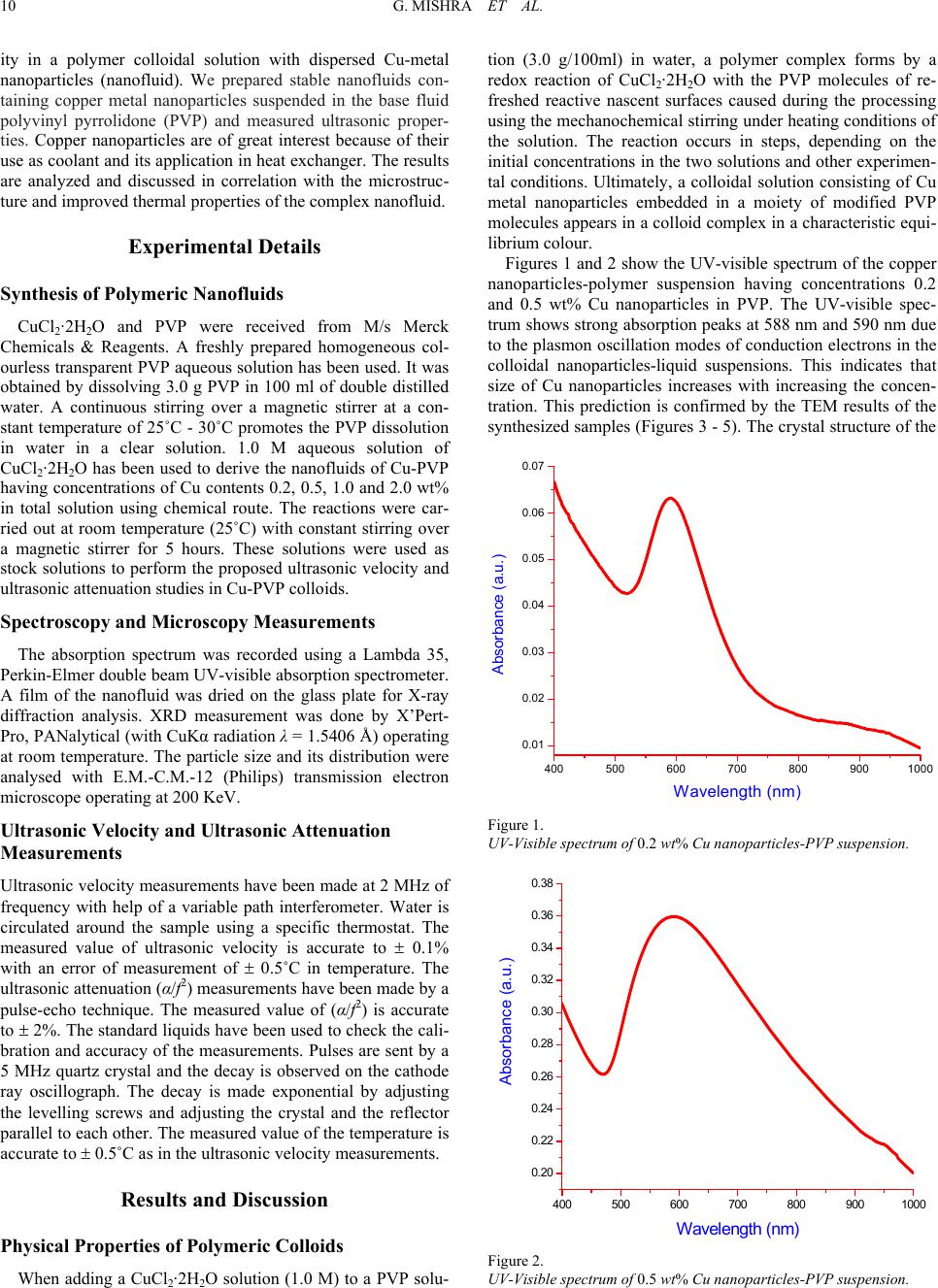 G. MISHRA ET AL. 10 ity in a polymer colloidal solution with dispersed Cu-metal nanoparticles (nanofluid). We prepared stable nanofluids con- taining copper metal nanoparticles suspended in the base fluid polyvinyl pyrrolidone (PVP) and measured ultrasonic proper- ties. Copper nanoparticles are of great interest because of their use as coolant and its application in heat exchanger. The results are analyzed and discussed in correlation with the microstruc- ture and improved thermal properties of the complex nanofluid. Experimental Details Synthesis of Polymeric Nanofluids CuCl2·2H2O and PVP were received from M/s Merck Chemicals & Reagents. A freshly prepared homogeneous col- ourless transparent PVP aqueous solution has been used. It was obtained by dissolving 3.0 g PVP in 100 ml of double distilled water. A continuous stirring over a magnetic stirrer at a con- stant temperature of 25˚C - 30˚C promotes the PVP dissolution in water in a clear solution. 1.0 M aqueous solution of CuCl2·2H2O has been used to derive the nanofluids of Cu-PVP having concentrations of Cu contents 0.2, 0.5, 1.0 and 2.0 wt% in total solution using chemical route. The reactions were car- ried out at room temperature (25˚C) with constant stirring over a magnetic stirrer for 5 hours. These solutions were used as stock solutions to perform the proposed ultrasonic velocity and ultrasonic attenuation studies in Cu-PVP colloids. Spectroscopy and Microscopy Me asurements The absorption spectrum was recorded using a Lambda 35, Perkin-Elmer double beam UV-visible absorption spectrometer. A film of the nanofluid was dried on the glass plate for X-ray diffraction analysis. XRD measurement was done by X’Pert- Pro, PANalytical (with CuKα radiation λ = 1.5406 Å) operating at room temperature. The particle size and its distribution were analysed with E.M.-C.M.-12 (Philips) transmission electron microscope operating at 200 KeV. Ultrasonic Velocity and Ultrasonic Attenuation Measurements Ultrasonic velocity measurements have been made at 2 MHz of frequency with help of a variable path interferometer. Water is circulated around the sample using a specific thermostat. The measured value of ultrasonic velocity is accurate to 0.1% with an error of measurement of 0.5˚C in temperature. The ultrasonic attenuation (α/f2) measurements have been made by a pulse-echo technique. The measured value of (α/f2) is accurate to 2%. The standard liquids have been used to check the cali- bration and accuracy of the measurements. Pulses are sent by a 5 MHz quartz crystal and the decay is observed on the cathode ray oscillograph. The decay is made exponential by adjusting the levelling screws and adjusting the crystal and the reflector parallel to each other. The measured value of the temperature is accurate to 0.5˚C as in the ultrasonic velocity measurements. Results and Discussion Physical Properties of Polymeric Colloids When adding a CuCl2·2H2O solution (1.0 M) to a PVP solu- tion (3.0 g/100ml) in water, a polymer complex forms by a redox reaction of CuCl2·2H2O with the PVP molecules of re- freshed reactive nascent surfaces caused during the processing using the mechanochemical stirring under heating conditions of the solution. The reaction occurs in steps, depending on the initial concentrations in the two solutions and other experimen- tal conditions. Ultimately, a colloidal solution consisting of Cu metal nanoparticles embedded in a moiety of modified PVP molecules appears in a colloid complex in a characteristic equi- librium colour. Figures 1 and 2 show the UV-visible spectrum of the copper nanoparticles-polymer suspension having concentrations 0.2 and 0.5 wt% Cu nanoparticles in PVP. The UV-visible spec- trum shows strong absorption peaks at 588 nm and 590 nm due to the plasmon oscillation modes of conduction electrons in the colloidal nanoparticles-liquid suspensions. This indicates that size of Cu nanoparticles increases with increasing the concen- tration. This prediction is confirmed by the TEM results of the synthesized samples (Figures 3 - 5). The crystal structure of the 400 500 600 700 800 9001000 0.01 0.02 0.03 0.04 0.05 0.06 0.07 Absorbance (a.u.) Wavelength (nm) Figure 1. UV-Visible spectrum of 0.2 wt% Cu nanoparticles-PVP suspension. 400 500 600 700 800 9001000 0.20 0.22 0.24 0.26 0.28 0.30 0.32 0.34 0.36 0.38 Absorbance (a.u.) Wavelength (nm) Figure 2. UV-Visible spectrum of 0.5 wt% Cu nanoparticles-PVP suspension. 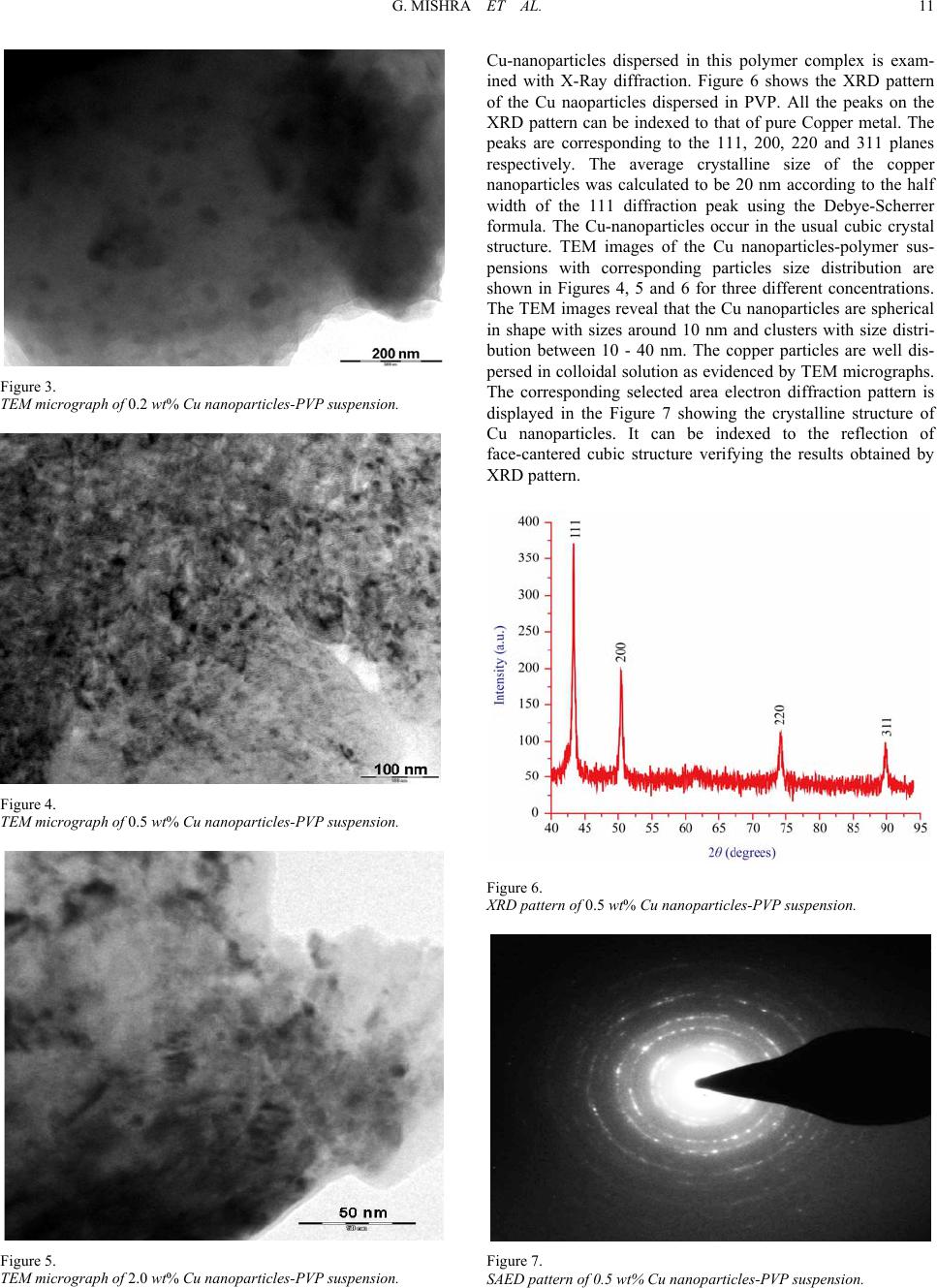 G. MISHRA ET AL. 11 Figure 3. TEM micrograph of 0.2 wt% Cu nanoparticles-PVP suspension. Figure 4. TEM micrograph of 0.5 wt% Cu nanoparticles-PVP suspension. Figure 5. TEM micrograph of 2.0 wt% Cu nanoparticles-PVP suspension. Cu-nanoparticles dispersed in this polymer complex is exam- ined with X-Ray diffraction. Figure 6 shows the XRD pattern of the Cu naoparticles dispersed in PVP. All the peaks on the XRD pattern can be indexed to that of pure Copper metal. The peaks are corresponding to the 111, 200, 220 and 311 planes respectively. The average crystalline size of the copper nanoparticles was calculated to be 20 nm according to the half width of the 111 diffraction peak using the Debye-Scherrer formula. The Cu-nanoparticles occur in the usual cubic crystal structure. TEM images of the Cu nanoparticles-polymer sus- pensions with corresponding particles size distribution are shown in Figures 4, 5 and 6 for three different concentrations. The TEM images reveal that the Cu nanoparticles are spherical in shape with sizes around 10 nm and clusters with size distri- bution between 10 - 40 nm. The copper particles are well dis- persed in colloidal solution as evidenced by TEM micrographs. The corresponding selected area electron diffraction pattern is displayed in the Figure 7 showing the crystalline structure of Cu nanoparticles. It can be indexed to the reflection of face-cantered cubic structure verifying the results obtained by XRD pattern. Figure 6. XRD pattern of 0.5 wt% Cu nanoparticles-PVP suspension. Figure 7. SAED pattern of 0.5 wt% Cu nanoparticles-PVP suspension.  G. MISHRA ET AL. 12 Ultrasonic Velocity and Ultrasonic Attenuation As the ultrasonic velocity/attenuation is highly sensitive to the local structure, we applied it here to examine its value in Cu-PVP polymer colloids at various temperatures. The results of the temperature dependent ultrasonic velocity and ultrasonic attenuation are presented in Figures 7 and 8 respectively. The results are showing the effect of Cu nanoparticles on the ultrasonic velocity and attenuation. Figure 8 shows that the ultrasonic velocity in Cu-PVP increases with temperature and for higher temperatures it becomes constant. From Figure 9, we find that maximum value of attenuation ( /f2) is at 25˚C in 0.2 wt% Cu-PVP polymer colloid sample. Also, there are charac- teristic minima for different concentrations respectively. A perusal of ultrasonic velocity and attenuation plots reveals that the temperature dependency of the ultrasonic velocity and the ultrasonic attenuation does not follow a linear curve. This seems to be in contrary to the results in a sample of pure Cu metal. In general, as in other materials (Mougin, 2003), both the Figure 8. Temperature dependent ultrasonic velocity in Cu-PVP nanofluids. Figure 9. Temperature dependent ultrasonic attenuation in Cu-PVP nanofluids. ultrasonic velocity and the ultrasonic attenuation are quite sen- sitive to the particles size, morphology and dispersion of the particles. A macroscopic interaction of Cu nanoparticles with the PVP molecules appears to be a critical parameter to control their final values in this specific example of an inorganic-or- ganic polymer nanocolloidal solution. The effective attenuation in this example can be expressed as: α = αp +αm + αpm (1) where αp is the contribution from the Cu-metal, αm is the coun- terpart contribution from the polymer matrix, αpm describes the change in the final α-value owing to a macroscopic interaction between the two components in a Cu-PVP nanocolloid struc- ture and associated modified thermophysical properties of the nanofluid. Biwa et al. (Biwa, 2004) analysed the ultrasonic attenuation in millimeter sized particles-reinforced polymers by a differen- tial scheme and found good agreement between the theory and experiments. The wave attenuation in these composites is a complex process where the viscoelastic loss and the scattering loss coexist. It is also important to recognize that the relative contributions of these loss mechanisms may change not only depending on the acoustic properties of the constituent (matrix and particles) but also according to the particle size, particle concentration and the frequency of interest. In the differential scheme, the changes of macroscopic properties of the complex due to infinitesimal increase of particles concentration are given in differential (incremental) forms. Thus the composite with the particle volume fraction is regarded as a homogeneous effective medium with the equivalent macroscopic properties given by the Lame moduli λ and μ as well as the density (ρ). The com- plex moduli λ and μ of an isotropic viscoelastic medium can be given in terms of the ultrasonic velocities and ultrasonic at- tenuation coefficients of longitudinal and shear waves. The complete description of this theoretical model which we have tried to apply is given in the literature (Biwa, 2004). The sig- nificant attenuation due to scattering by the particles-reinforced was incorporated in the total attenuation in their theoretical model (Biwa, 2004). The observed attenuation in our case could not be explained by the exact theoretical model following the differential scheme. We found that the attenuation due to scattering from the Cu-nanoparticles in the nanofluid is not significant. It is also important to note that the characteristic behaviour of the ultrasonic attenuation in the Cu + PVP nano-colloids is not found in any of the individual components of the composite (Abdul, 1982; & Awasthi, 2005). Calculated value of the ultrasonic attenuation in the sample (0.2wt% of the Cu nanoparticles) at 30˚C following the differential scheme including the ultrasonic absorption due to nanoparticles and thermo-elastic loss following the Mason scheme comes 85.54 × 10⁻³ Np/cm. Here the thermal conductivity ‘K’ of the nanopar- ticles for the calculation of thermo-elastic loss has been taken following the molecular dynamics method. Here we incorpo- rated the attenuation due to thermoelastic loss determined by the formula αTh = ω2 < j i > 2KT/(2ρ5 L V). Here K is thermal conductivity, ω(2πf) is frequency of the ultrasonic wave, j i is Gruneisen number, T is the temperature in Kelvin scale, ρ is the density, VL is the ultrasonic wave velocity. Here we have not incorporated the thermal conductivity of complex thermoe- lastic medium of our nanofluid as it is not known to us. As the above formulations attenuation due to thermoelastic mechanism 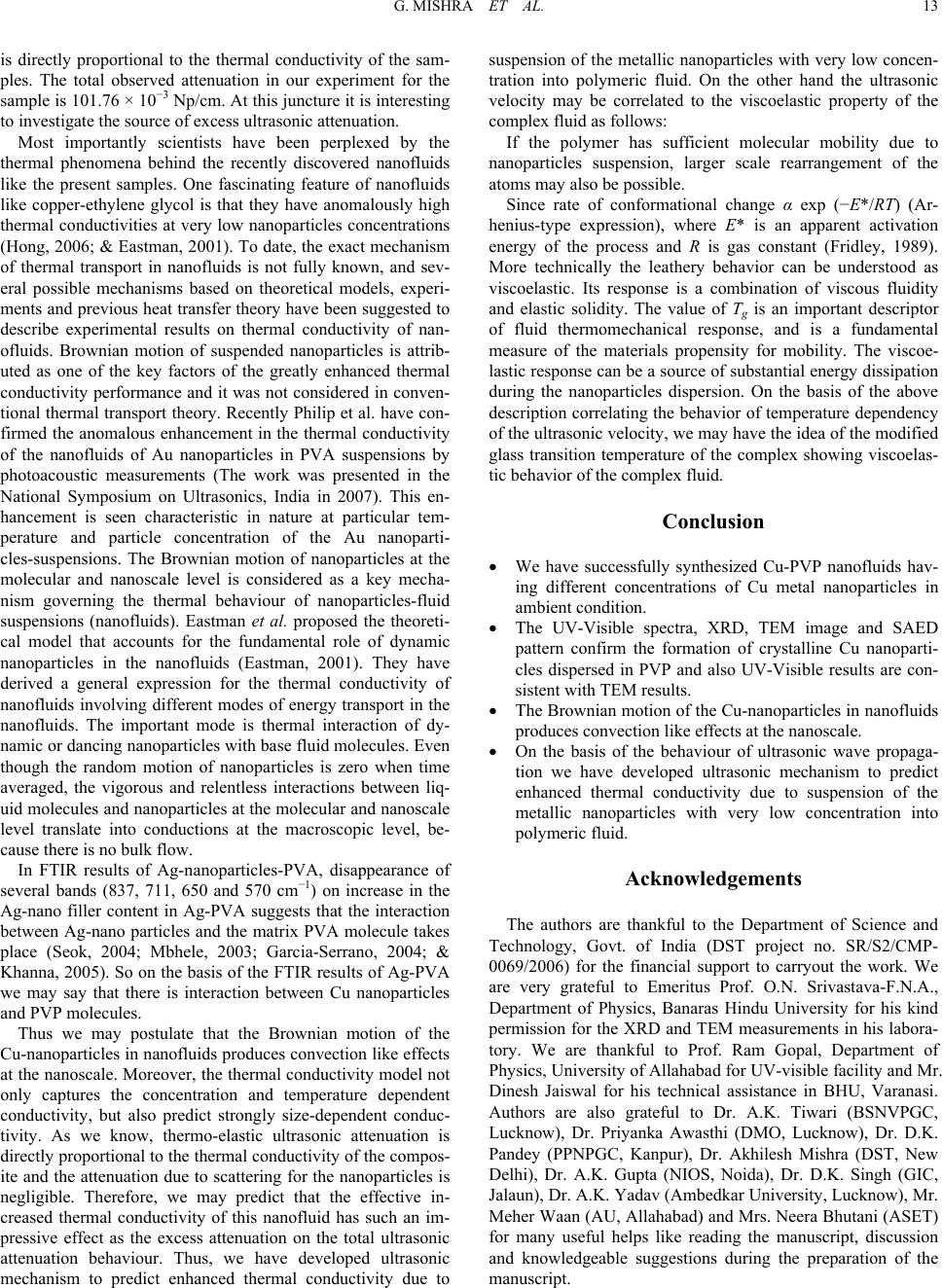 G. MISHRA ET AL. 13 is directly proportional to the thermal conductivity of the sam- ples. The total observed attenuation in our experiment for the sample is 101.76 × 10⁻³ Np/cm. At this juncture it is interesting to investigate the source of excess ultrasonic attenuation. Most importantly scientists have been perplexed by the thermal phenomena behind the recently discovered nanofluids like the present samples. One fascinating feature of nanofluids like copper-ethylene glycol is that they have anomalously high thermal conductivities at very low nanoparticles concentrations (Hong, 2006; & Eastman, 2001). To date, the exact mechanism of thermal transport in nanofluids is not fully known, and sev- eral possible mechanisms based on theoretical models, experi- ments and previous heat transfer theory have been suggested to describe experimental results on thermal conductivity of nan- ofluids. Brownian motion of suspended nanoparticles is attrib- uted as one of the key factors of the greatly enhanced thermal conductivity performance and it was not considered in conven- tional thermal transport theory. Recently Philip et al. have con- firmed the anomalous enhancement in the thermal conductivity of the nanofluids of Au nanoparticles in PVA suspensions by photoacoustic measurements (The work was presented in the National Symposium on Ultrasonics, India in 2007). This en- hancement is seen characteristic in nature at particular tem- perature and particle concentration of the Au nanoparti- cles-suspensions. The Brownian motion of nanoparticles at the molecular and nanoscale level is considered as a key mecha- nism governing the thermal behaviour of nanoparticles-fluid suspensions (nanofluids). Eastman et al. proposed the theoreti- cal model that accounts for the fundamental role of dynamic nanoparticles in the nanofluids (Eastman, 2001). They have derived a general expression for the thermal conductivity of nanofluids involving different modes of energy transport in the nanofluids. The important mode is thermal interaction of dy- namic or dancing nanoparticles with base fluid molecules. Even though the random motion of nanoparticles is zero when time averaged, the vigorous and relentless interactions between liq- uid molecules and nanoparticles at the molecular and nanoscale level translate into conductions at the macroscopic level, be- cause there is no bulk flow. In FTIR results of Ag-nanoparticles-PVA, disappearance of several bands (837, 711, 650 and 570 cm−1) on increase in the Ag-nano filler content in Ag-PVA suggests that the interaction between Ag-nano particles and the matrix PVA molecule takes place (Seok, 2004; Mbhele, 2003; Garcia-Serrano, 2004; & Khanna, 2005). So on the basis of the FTIR results of Ag-PVA we may say that there is interaction between Cu nanoparticles and PVP molecules. Thus we may postulate that the Brownian motion of the Cu-nanoparticles in nanofluids produces convection like effects at the nanoscale. Moreover, the thermal conductivity model not only captures the concentration and temperature dependent conductivity, but also predict strongly size-dependent conduc- tivity. As we know, thermo-elastic ultrasonic attenuation is directly proportional to the thermal conductivity of the compos- ite and the attenuation due to scattering for the nanoparticles is negligible. Therefore, we may predict that the effective in- creased thermal conductivity of this nanofluid has such an im- pressive effect as the excess attenuation on the total ultrasonic attenuation behaviour. Thus, we have developed ultrasonic mechanism to predict enhanced thermal conductivity due to suspension of the metallic nanoparticles with very low concen- tration into polymeric fluid. On the other hand the ultrasonic velocity may be correlated to the viscoelastic property of the complex fluid as follows: If the polymer has sufficient molecular mobility due to nanoparticles suspension, larger scale rearrangement of the atoms may also be possible. Since rate of conformational change α exp (−E*/RT) (Ar- henius-type expression), where E* is an apparent activation energy of the process and R is gas constant (Fridley, 1989). More technically the leathery behavior can be understood as viscoelastic. Its response is a combination of viscous fluidity and elastic solidity. The value of Tg is an important descriptor of fluid thermomechanical response, and is a fundamental measure of the materials propensity for mobility. The viscoe- lastic response can be a source of substantial energy dissipation during the nanoparticles dispersion. On the basis of the above description correlating the behavior of temperature dependency of the ultrasonic velocity, we may have the idea of the modified glass transition temperature of the complex showing viscoelas- tic behavior of the complex fluid. Conclusion We have successfully synthesized Cu-PVP nanofluids hav- ing different concentrations of Cu metal nanoparticles in ambient condition. The UV-Visible spectra, XRD, TEM image and SAED pattern confirm the formation of crystalline Cu nanoparti- cles dispersed in PVP and also UV-Visible results are con- sistent with TEM results. The Brownian motion of the Cu-nanoparticles in nanofluids produces convection like effects at the nanoscale. On the basis of the behaviour of ultrasonic wave propaga- tion we have developed ultrasonic mechanism to predict enhanced thermal conductivity due to suspension of the metallic nanoparticles with very low concentration into polymeric fluid. Acknowledgements The authors are thankful to the Department of Science and Technology, Govt. of India (DST project no. SR/S2/CMP- 0069/2006) for the financial support to carryout the work. We are very grateful to Emeritus Prof. O.N. Srivastava-F.N.A., Department of Physics, Banaras Hindu University for his kind permission for the XRD and TEM measurements in his labora- tory. We are thankful to Prof. Ram Gopal, Department of Physics, University of Allahabad for UV-visible facility and Mr. Dinesh Jaiswal for his technical assistance in BHU, Varanasi. Authors are also grateful to Dr. A.K. Tiwari (BSNVPGC, Lucknow), Dr. Priyanka Awasthi (DMO, Lucknow), Dr. D.K. Pandey (PPNPGC, Kanpur), Dr. Akhilesh Mishra (DST, New Delhi), Dr. A.K. Gupta (NIOS, Noida), Dr. D.K. Singh (GIC, Jalaun), Dr. A.K. Yadav (Ambedkar University, Lucknow), Mr. Meher Waan (AU, Allahabad) and Mrs. Neera Bhutani (ASET) for many useful helps like reading the manuscript, discussion and knowledgeable suggestions during the preparation of the manuscript.  G. MISHRA ET AL. 14 References Abdul, A., Richard, A.P., & Jacques, E. (1982). Ultrasonic studies of aqueous solutions of Polyvinylalcohol. Polymer, 23, 1446-1450. doi:10.1016/0032-3861(82)90242-7 Arribas, A., Bermudez, M.-D., Brostow, W., Carrion-Vilches, F.-J., & Olea-Mejia, O. (2009). Scratch resistance of a polycarbonate + or- ganoclay nanohybrid. Express Polymer Letters, 3, 621-629. doi:10.3144/expresspolymlett.2009.78 Awasthi, P. (2005). Non-destructive Ultrasonic Characterization of Conensed Materials, Ph. D. Thesis, Allahabad: University of Alla- habad. Biwa, S., Watanabe, Y. Motogi, S., & Ohna, N. (2004). Analysis of ultrasonic attenuation in particle-reinforced plastics by a differential scheme. Ultrasonics, 43, 5-12. doi:10.1016/j.ultras.2004.03.002 Cheng, L., E. Bandarra Filho, P., & Thome, J.R. (2008). Nanofluid two-phase flow and thermal physics: A new research frontier of nanotechnology and its challenges. Journal of Nanoscience & Nanotechnology, 8, 3315–3332. doi:10.1166/jnn.2008.413 Eastman, J.A., Choi, S.U.S., Li, S., Yu, W., & Thompson, L.J. (2001). Anomalously increased effective thermal conductivities of ethylene glycol-based nanofluids containing copper nanoparticles. Applied Physics Letters, 78, 718-720. doi:10.1063/1.1341218 Ensminger, D., & Bond, L.J. (2005). Ultrasonics: Fundamentals, Technology and Applications, 3rd revised edn., New York: M. Deker. Fridley W.N. (1989). Creep and Relaxation of Nonlinear Viscoelastic Materials. New York: Dover Publications. Garcia-Serrano, J., Galindo, A.G., & Pal, U. (2004). Au-Al2O3 nano- composites: XPS and FTIR spectroscopic studies. Solar Energy Ma- terials & Solar Cells, 82, 291-298. doi:10.1016/j.solmat.2004.01.026 Gatos, K.G., Kameo, K., & Karger-Kocsis (2007). On the friction and sliding wear of rubber/layered silicate nanocomposites. Express Polymer Letters, 1, 27-31. doi:10.3144/expresspolymlett.2007.6 Giraldo, L.F., Brostow, W., Devaux, E., Lopez, B.L., & Perez, L.D. (2008). Scratch and wear resistance of polyamide 6 reinforced with multiwall carbon nanotubes. Journal of Nanoscience & Nanotech- nology, 8, 3176-3183. doi:10.1166/jnn.2008.092 Hong, K. S. (2006). Thermal conductivity of Fe nanofluids depending on the cluster size of nanoparticles. Applied Physics Letters, 88, 031901-031903. doi:10.1063/1.2166199 Khanna, P.K., Singh, N., Charan, S., Subbarao, V.V.V.S., Gokhale, R., & Mulik, U.P. (2005). Synthesis and characterization of Ag/PVA nanocomposite by chemical reduction method. Materials Chemistry and Physics, 93, 117-121. doi:10.1016/j.matchemphys.2005.02.029 Kota, A.K., Cipriano, B.H., Powell, D., Raghavan, S.R., & Bruck, H.A. (2007). Quantitative characterization of the formation of an inter- penetrating phase composite in polystyrene from the percolation of multiwalled carbon nanotubes. Nanotechnology, 18, 505705-505711. doi:10.1088/0957-4484/18/50/505705 Kytömaa, H. K. (1995). Theory of sound propagation in suspensions: a guide to particle size and concentration characterization. Powder Technology, 82, 115-121. doi:10.1016/0032-5910(94)02901-Y Mbhele, Z.H., Salemane, M.G., VanSittert, C.G.C.E., Nedeljkovic, J.M., Djokovic V., & Lugt, A.S. (2003). Fabrication and characterization of silver-polyvinyl alcohol nanocomposites. Chemical Materials, 15, 5019-5024. doi:10.1021/cm034505a Mougin, P., Wilkinson, D., Roberts, K.J., Jacks, R., & Kippax, P. (2003). Sensitivity of particle sizing by ultrasonic attenuation spec- troscopy to material properties. Powder Technlogy., 134, 243-248. doi:10.1016/j.powtec.2003.08.051 Seok, P.J., & Choi, S.U.S. (2004). Role of Brownian motion in the enhanced thermal conductivity of nanofluids. Applied Physics Letters, 84, 4316-4318. doi:10.1063/1.1756684 Shin, H.S., Choi, H.C., Jung, Y., Kim, S.B., Song, H.J., & Shin, H. J. (2004). Chemical and size effects of nanocomposites of silver and polyvinyl pyrrolidone determined by X-ray photoemission spectros- copy. Chemical Physics Letters, 383, 418-422. doi:10.1016/j.cplett.2003.11.054 Singh, D.K., Pandey, D.K., & Yadav, R.R. (2009). An ultrasonic char- acterization of ferrofluid. Ultrasonics, 49, 634-637. doi:10.1016/j.ultras.2009.03.005 |