

Paper Menu >>
Journal Menu >>
 Psychology 2011. Vol.2, No.3, 254-260 Copyright © 2011 SciRes. DOI:10.4236/psych.2011.23040 Cognitive Impairment and Dangerous Driving: A Decision Making Model for the Psychologist to Balance Confidentiality with Safety Christopher Love1, Jennifer Costillo2, Robert Welsh2, Sheryn Scott2, David Brokaw2 1Patton State Hospital, Patton, USA; 2Azusa Pacific University, Azusa, USA. Email: [email protected] Received October 7th, 2010; revised December 22nd, 2010; accepted February 3rd, 2011. The Transitional Opportunity Partnership (TOP) is a framework for psychological care of cognitively impaired individuals. In this paper we address the issues associated with cognitively impaired drivers and how the TOP model can assist psychologists in managing the ethical, legal, and moral dilemmas that often occur with this challenging population. This paper offers suggestions for how to therapeutically manage the privilege of driving with cognitively impaired individuals, through client education, increasing awareness of client resistance or in- capacity to recognize impairment, and proactive intervention. Keywords: Cognitive Disorder s, Policy, Ethics, Law, Driving Treating or evaluating cognitively impaired individuals can present unique challenges to the psychologist. Consider, for example, the psychologist who needs to decide if the individual is safe to operate a motor vehicle and is faced with competing ethical and legal dilemmas. On one side of this dilemma, the psychologist may be subject to civil litigation on grounds of failing to protect the public from a dangerous driver if an acci- dent occurred. On the other hand, mental health professionals, who breech confidentiality by reporting a potentially impaired driver to family members, a medical advisory board, or De- partment of Motor Vehicles (DMV) without client consent may be held liable for breaking confidentiality (Niveau & Kel- ley-Pushas, 2001; Smith-Bell & Winslade, 1994). Although several states mandate reporting cognitively impaired drivers (Gerber, Henry, Bunn, Baumel & Stacy, 1989; American Medical Association [AMA], 2008), the literature indicates that many cognitively impaired drivers continue to drive, even after being advised of their risk to society (Lipski, 1997; Valcour, Masaki, & Blanchette, 2002). Furthermore, most states do not mandate reporting of cognitive impairment to Medical Advi- sory Boards or Departments of Motor Vehicles. Presently, there are twenty-two states that have no shielding laws protecting a medical practitioner who reports a cognitively impaired client to governmental authorities (AMA, 2008). With this in mind, this article highlights options for main- taining quality client care while also balancing public safety and confidentiality. We propose a systemic and proactive model for making decisions about, and with, cognitively im- paired clients. This model builds ethical and legal decision- making into a cooperative and supporting network of relation- ships that anticipates restrictive life transitions and difficult conversations. A Decision Making-Model: Transitional Opportunity Partnershi A core requirement of any decision making model is ad- vanced preparation that anticipates foreseeable risks and opti- mizes flexible solutions. The Transitional Opportunity Partner- ship (TOP) focuses on preparation as a key element of care for the cognitively impaired client. Following an evaluation that reveals the presence of mild to moderate cognitive impairment, two immediate concerns for the client and for society are pre- sent. First, how the client will get home from the practitioner's office and second how he or she will be cared for in the days and months to follow. The TOP model provides psychologists with responses to client statements that are guided by ethical principles that safe- guard the legitimat e needs of both the client a nd society. There are four primary domains that comprise this model: (1) struc- turing informed consent and client preparation, (2) psychologist responses to client assessment results, (3) an ethical framework for supporting the client, and (4) creating a client assistance team to ensure continuity of client care. As the psychologist explains the TOP model with a client, it is necessary to main- tain a supportive therapeutic relationship in all phases of care. One primary goal of the TOP model is client satisfaction with the psychological services regardless of the outcomes of the evaluation. TOP Domain One: Informed Consent When using the TOP model, the practitioner must first de- termine whether the client is able to adequately understand the details of the informed consent (American Bar Association  C. LOVE ET AL. 255 [ABA], 2005). For example, if the client demonstrates difficul- ties with orientation or basic memory recall, it may be neces- sary to contact family members or close friends of the client who may assist him or her in understanding what is presented in the informed consent. Whenever possible, it may be helpful for the client to bring a trusted family member or friend to the initial meeting. In cases of advanced age or foreseeable im- pairment, attention should be given to proper room lighting, ambient noise or confusion, text size on the forms, and the speed of delivery of the psychologists comments (ABA, 2005). A sample informed consent form with these conditions in mind is included at the end of this article (Appendix A). Mandated reporting requirements and public safety. In treat- ing clients with possible cognitive impairment, practitioners are faced with the difficult challenge of maintaining client confi- dentiality in light of their commitment to protect society from potentially dangerous persons who are under their care (APA, 2002). The TOP model advocates that a psychologist’s advance preparation is the key to successful informed consent. Educat- ing the client about the multiple roles of a psychologist, in- cluding a guardian of public safety, will assist the client to un- derstand the obligations of the practitioner. It is the responsibility of the psychologist to fully inform his or her client of the reasonable purpose and expectations of an assessment before a truly informed consent is provided (APA, 2002). Concerning a potentially impaired driver, a simple reci- tation of legal statutes about driver capacities may be insuffi- cient to inform the client of links between driving ability and cognitive capacity. The conscientious psychologist will dia- logue with a client regarding his or her previous attitudes about driving and potential loss of ability to safely operate an auto- mobile in society. Building upon the client's previous thinking about safe driving and the safety of others, the psychologist prepares the client for the possibility that lifestyle changes could include the revocation of driving privileges. Elements of informed consent and coordinating care. In line with the primary theme of preparation in the TOP model, a detailed informed consent will address the possibility that the client is experiencing notable cognitive changes, which may represent a higher risk of danger to the public while operating an automobile (Carr, Duchek, & Morris, 2000). The following elements of the TOP model informed consent intend to protect the client from danger due to cognitive decline and protect the psychologist from legal risk due to a potential breech of confi- dentiality: (1) family or supportive caregiver information, (2) client’s present means of getting home safely, (3) relevant stat- utes or regulations related to impaired driving, (4) responsibili- ties of the practitioner to protect the confidentiality of the client except as permitted by law, and (5) acknowledgment of intent to release potential client information, as necessary, to family members, other medical professionals, and governmental agen- cies to facilitate ongoing care and safety of the client. All of this should take place prior to conducting a formal cognitive assessment. Giving Feedback. One feature of cognitive impairment is that the client may not accept the results of the assessment (Knop- man, Boeve, & Petersen, 2003, p. 1291; Messinger-Rapport & Rader, 2000). Upon completion of the clinical interview and formal assessment, the psychologist should possess enough data to formulate a diagnostic impression. From this point, if cognitive impairment is indicated, an individual’s ability to drive safely may be sufficiently compromised and consequently make him or her a danger to society. Psychologists may be obligated by state law to protect clients from danger to them- selves or others in the event of foreseeable danger, as suggested by Currie v. United States, 1986 (Stenger, 1996). The prospect of gaining client permission to report the client to a govern- mental authority for retesting or otherwise encumbering the client’s present freedoms is likely to engender client disdain or outright refusal (Gammon & Hulston, 1995; Jennings, 2001). If the client rejects the results of the assessment, the psy- chologist will already have exercised due diligence within the TOP model to inform the client of his or her duty to society as a licensed driver. As part of the TOP informed consent process, the psychologist will obtain written acknowledgment from the client that he or she has received the results of the assessment, even if the client desires to keep his or her impairment a secret from family or friends (Appendix B). Drawing upon the previ- ous discussion during the TOP informed consent process of the client’s attitudes about dangerous driving, the psychologist seeks to link the client’s present impairment with potential risks to the client and others while in his or her present condition. At the same time, regardless of the assessment results, the empha- sis of building a trusting and collaborative therapeutic relation- ship with the client remains a priority. TOP Domain Two: Response to Assessment Having already determined the client’s present transportation to the office through the informed consent procedures, the dis- covery of cognitive impairment may be a surprise to the client; however, the TOP model will have prepared the psychologist with an immediate contingency plan (Appendix C). Although most clients will likely accept the suggestions of the psycholo- gist, the potential exists for certain clients to refuse to involve others in his or her care. For the client, it is important to con- tinue to offer to arrange alternative transportation to get him or her home safely. In the event that the client refuses to join with the practitioner in collaborative care, the client is to be given a signed and dated summary statement (Appendix D) of his or her present cognitive functioning, which includes the legal and ethical risks of driving an automobile while experiencing cog- nitive loss (Appendix E). Once the client has left the office, the practitioner documents the discussion of driving safety with the client and the client’s refusal to accept alternative transportation. At this point, the practitioner also prepares the requisite forms for notifying the appropriate authorities, such as the Depart- ment of Motor Vehicles or Medical Advisory Board, of the potential danger of the client. TOP Domain Three: Ethical Framework As implied above, a foundational framework of ethical commitment to the client and the duty owed to protect society should be threaded throughout the mental health professional’s response to the assessment results. Whether or not the client contests the results of the assessment battery will determine which ethical issues are present, if any. The client who accepts the results and recommendations of the practitioner will most likely actively participate in the recommendations suggested to  C. LOVE ET AL. 256 him or her, thus reducing the possibility of an ethical dilemma. However, the ethical situation becomes more complicated is reluctant to accept the findings. Depending on the state, the reporting of cognitive impairment may be a voluntary issue or mandated for physicians and surgeons to report impairments that negatively effect driving ability (AMA, 2008). In Califor- nia, for example, mental health professionals are potential sources of evaluative data for licensing qualifications relative to the cognitive functioning of a particular client-driver (Califor- nia Vehicle Code [CVC] § 12806c, 2004). As recommended by the American Psychiatric Association’s Presidential Task Force on the Assessment of Age-Consistent Memory Decline and De- mentia (1998), determining cognitive impairment involves a systemic, multidisciplinary evaluation. Mental health care pro- fessionals hold a position of influence with clients and are ob- ligated to protect their health and safety (California Business and Professions Code [BPC] § 2900, 2004). Nevertheless, whether or not the client resides in a mandated reporting state, the mental health professional should consult with the client’s primary or referring physician concerning the client’s level of impairment, as will already have been arranged with the client during the TOP informed consent process. In a mandated re- porting state such as California, where confidentiality issues are considered subordinate to public safety (California Evidence Code [EC] § 1024, 2005), the mental health professional may risk legal penalties for breech of confidentiality. However, is- sues of public safety and cognitively impaired drivers are pres- ently being adjudicated in the “Santa Monica Farmer’s Market Crash” (Spano & Groves, 2006), which concerns legal penalties and applicable culpability for severe cognitive impairment while driving. TOP Domain Four: Client Assistance Team Support of family members and the inclusion of community resource services are essential in properly facilitating the im- pending life transitions for the cognitively impaired (Hunt, 2003). These social resources provide the core support of a structured team-based approach to successfully processing a difficult transitional period as the client attempts to balance his or her need for autonomy with the realities of decreased cogni- tive ability. Unfortunately, many cognitively impaired clients tend to isolate themselves from social interaction (Holmén, Ericsson, & Winblad, 2000), and some do not have close family members. Thus, it is all the more important for the practitioner to assist the client by establishing a formal Client Assistance Team, as included in the TOP model. The Client Assistance Team assumes the following: (1) the client agrees to have family members and other helpers assist him or her with his or her impairment, (2) the client desires help with his or her impairment, and (3) the client has identified the team members he or she desires. Once a Client Assistance Team is identified, the practitioner and client schedule an initial meeting when all members of the team can be present. At the initial meeting, a presentation of the client's current cognitive status is given to members for the purpose of their being better able to assist the client in restructuring his or her life under a positive and forward-looking manner in regard to alternative possibilities. Once the Client Assistance Team is established and the cli- ent’s condition is better understood by the members, the practi- tioner educates the team members as to the various roles (Johnson, 1999; Menne, Kinney, & Morhardt, 2002) that must be fulfilled in helping the client to transition from previous levels of autonomy into a more support oriented lifestyle. Such roles may include: (1) team leader, (2) listener/encourager, (3) physical caregiver, (4) story teller, (5) financial monitor, (6) community activities facilitator, (7) insurance coordinator, (8) health care advocate, and (9) health care professionals. While establishing these roles, it is important to avoid any suggestion to the client that he or she is less valued or less important to the well being of the extended family. Certain daily functions may be more difficult with the onset of cognitive impairment; how- ever, these difficulties do not relieve the family for the basic human responsibilities of respect and affirmation toward a cog- nitively impaired relative. The role of the Lead Team Member (LTM) should be desig- nated by the client during the initial Client Assistance Team meeting. The LTM is a non-professional person who may or may not be a member of the client’s immediate family. If the client and the full team, agree on the selection of the LTM, then the practitioner, the client, and the LTM will be designated as the Team Leadership Council (TLC). The role of the TLC is to communicate the client’s status and transitional progress to the rest of the Client Assistance Team, as well as to disseminate TLC information to other team members for action and to process team feedback to the TLC. By establishing a good TLC, and including other helpful members on the Client Assistance Team, the team will be able to assist the client without over-burdening him or her with too many details. Conclusion The cognitively impaired driver represents a potential risk to society while behind the wheel. A multisystemic, multi-level approach to care for the cognitively impaired provides the best hope of identifying and fulfilling the life goals of the client. Fulfillment of these life goals enhances the meaning of life for the client and instills client satisfaction in his or her ongoing sense of autonomy and perceived freedoms. Utilizing the TOP model is one way to address the complex and varying needs and goals of cognitively impaired clients who desire to drive an automobile. Within this model, gaining a client's trust and as- sisting him or her in building a supportive structure to facilitate his or her goals is difficult work. However, incorporating a team-based approach diversifies the creative input, which can influence a client’s attitude toward his or her situation and of- fers the enhanced wisdom of multiple perspectives on the cli- ent’s changing reality. The practitioner is but one member within a team effort to help clients adjust their life priorities to protect themselves as well as others in society. References American Bar Association. (2005). Assessment of older adults with diminished capacity . Washington, D.C.: Author . American Medical Association. (2002). E-2.24 Impaired Drivers and Their Physicians. Chicago: Author. American Psychological Association. (2002). Ethical principles and code of conduct. American Psychologi st, 57, 1060-1073. doi:10.1037/0003-066X.57.12.1060  C. LOVE ET AL. 257 APA Presidential Task Force on the Assessment of Age-Consistent Memory Decline and Dementia (1998). Guidelines for the evaluation of dementia and age-related cognitive decline. Washington, DC: American Psychological Association. Berger, J. T., Rosner, F., Kark, P., & Bennett, A. J. (2000). Reporting by physicians of impaired drivers and potentially impaired drivers. Journal of General Interna l M e d i c i n e , 15, 667-672. doi:10.1046/j.1525-1497.2000.04309.x California Business and Profess ion al Cod e, § 2960 (2004). California Civil Code, § 1708 (2004) . California Evidence Code, § 1024 (2005). California Vehicle Code, § 12806 (2004). Carr, D. B., Duchek, J., & Morris, J. C. (2000). Characteristics of motor vehicle crashes of drivers with dementia of the Alzheimer type. Journal of the American Ge r i atrics Society, 48, 18-22. Currie v. United States, 644 F. Supp. 1074; 1986 U.S. Dist. LEXIS 19491. Dubinsky, R. M., Stein, A. C., & Lyons, K. (2000). Practice parameter: Risk of driving and Alzheimer’s disease (an evidence-based review) —Report of the Quality Standards Subcommittee of the American Academy of Neurology. Neurology, 54, 2205-2211. Ewing v. Goldstein, 120 Cal. App. 4th 807; 15 Cal. Rptr. 3d 864; 2004 Cal. App. LEXIS 1131; 2004 Cal. Daily Op. Service 6427; 2004 Daily Journal DAR 8707. Faulkner, A., Maguire, P., & Regnard, C. (1994). Breaking bad news—a flow diagram . Palliative Medicine, 8, 145-151. doi:10.1177/026921639400800208 Folstein, M. F., Folstein, S. E., & McHugh, P. R. (1975). “Mini-mental state”. A practical method for grading the cognitive state of patients for the clinician. Journal of Psychiatric Resea rch, 12, 189-198. doi:10.1016/0022-3956(75)90026-6 Gammon, T. E., & Hulston, J. K. (1995). The duty of mental health providers to restrain their patients or warn third parties. Missouri Law Review, 60, 749-797. Gerber, T., Henry, M. E., Bunn, G., Baumel, E., & Stacy, A. (1989). A state population-based statutory reporting of dementias. Journal American Medical Record Association , 60, 24-32. Hinton, W. L., & Levkoff, S. (1999). Constructing Alzheimer’s: Narra- tives of lost identities, confusion and loneliness in old age. Culture, Medicine & Psychiatry, Special Issue: Aging, Ethnicity, and Demen- tia: Family Caregiving, 23, 453-475. Holmén, K., Ericsson, K., & Winblad, B. (2000). Social and emotional loneliness among non-demented and demented elderly people. Ar- chives of Gerontology and Geriatric s, 31, 177-192. doi:10.1016/S0167-4943(00)00070-4 Hunt, L. A. (2003). Driving and dementia. Generations, 27, 34-38. Jennings, B. (2001). Freedom fading: On dementia, best interests, and public safety. Georgia Law Revie w As so cia ti on , 35, 593-619. Johnson, T. F. (1999). Ethical issues in decision making: A balanced interest perspective. In T. F. Johnson (Ed.), Handbook on ethical is- sues in aging (pp. 326-339). Westport, CT: Greenwood Press. Knopman, D. S., Boeve, B. F., & Petersen, R. C. (2003). Essentials of the proper diagnoses of mild cognitive impairment, dementia, and major subtypes of dementia. Mayo Clinic Proceedings, 78, 1290- 1 3 08 . doi:10.4065/78.10.1290 Lipski, P. S. (1997). Driving and dementia: A cause for concern. The Medical Journal of Australia, 167 , 453-454. Menne, H. L., Kinney, J. M., & Morhardt, D. J. (2002). ‘Trying to continue to do as much as they can do’: Theoretical insights regard- ing continuity and meaning making in the face of dementia. The In- ternational Journal of So c i al Research & Practice, 1, 367-382. Messinger-Rapport, B., & Rader, E. (2000). High risk on the highway: How to identify and treat the impaired older driver. Geriatrics, 55, 32-45. Morris, J. C. (1993). The clinical dementia rating (CDR): Current ver- sion and scoring rules. Neurology, 43, 2412-2414. Niveau, G., & Kelley-Puskas, M. (2001). Psychiatric disorders and fitness to drive. Journal of M ed ic a l Ethics, 27, 36-39. doi:10.1136/jme.27.1.36 Reger, M. A., Welsh, R. K., Watson, G. S., Cholerton, B., Baker, L. D., & Craft, S. (2004). The relationship between neuropsychological functioning and driving ability in dementia: A meta-analysis. Neuro- psychology, 18, 85-93. doi:10.1037/0894-4105.18.1.85 Rowland v. Christian, 69 Cal. 2d 108; 443 P.2d 561; 70 Cal. Rptr. 97; 1968 Cal. LEXIS 231; 32 A.L.R.3d 496. Small, G. W., Rabins, P. V., Barry, P. P., Buckholtz, N. S., & DeKosky, S. T., et al. (1997). Diagnosis and treatment of Alzheimer disease and related disorders: Consensus statement of the American Associa- tion for Geriatric Psychiatry, the Alzheimer’s Association, and the American Geriatrics Society. Journal of the American Medical Asso- ciation, 278, 1363-1371. doi:10.1001/jama.278.16.1363 Smith-Bell, M., & Winslade, W. J. (1994). Privacy, confidentiality, and privilege in psychotherapeutic relationships. American Journal of Orthopsychiatry, 64, 180-193. doi:10.1037/h0079520 Spano, J., & Groves, M. (2006). Driver guilty of felony in market crash. The Los Angeles Times, Main News; Metro Desk; Part A; Page. 1. Stenger, C. E. (1996). Taking Tarasoff where no one has gone before: Looking at “duty to warn” under the AIDS crisis. St. Louis Univer- sity Public Law Review, 15, 471-504. Tarasoff v. Regents of University of California, 13 Cal. 3d 177; 529 P.2d 553; 118 Cal. Rptr. 129; 1974 Cal. LEXIS 376. Tarasoff v. Regents of University of California, 17 Cal. 3d 425; 551 P.2d 334; 131 Cal. Rptr. 14; 1976 Cal. LEXIS 297; 83 A.L.R.3d 1166. Valcour, V. G., Masaki, K. H., & Blanchette, P. L. (2002). Self-r epor ted driving, cognitive status, and physician awareness of cognitive im- pairment. Journal of the American Geria t r i c S o c i e t y , 50, 1265-1267. doi:10.1046/j.1532-5415.2002.50314.x Woods, R. T. (1996). Psychological “therapies” in dementia. In R. T. Woods, (Ed.), Handbook of the clinical psychology of ageing (pp. 575-600). Oxford, England: John Wiley & Sons. 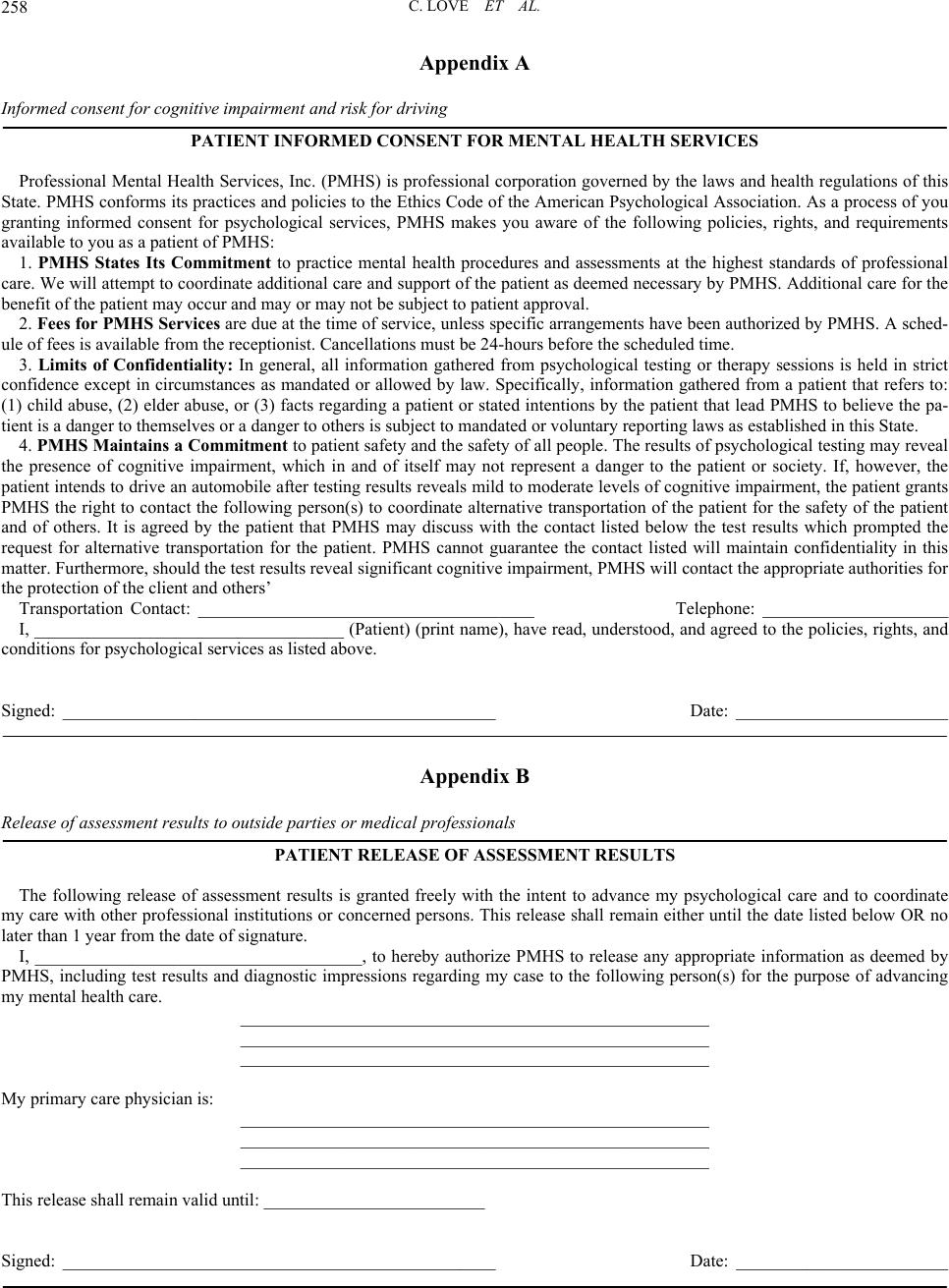 C. LOVE ET AL. 258 Appendix A Informed consent for cognitive impairment and risk for driving PATIENT INFORMED CONSENT FOR MENTAL HEALTH SERVICES Professional Mental Health Services, Inc. (PMHS) is professional corporation governed by the laws and health regulations of this State. PMHS conforms its practices and policies to the Ethics Code of the American Psychological Association. As a process of you granting informed consent for psychological services, PMHS makes you aware of the following policies, rights, and requirements available to you as a patient of PMHS: 1. PMHS States Its Commitment to practice mental health procedures and assessments at the highest standards of professional care. We will attempt to coordinate additional care and support of the patient as deemed necessary by PMHS. Additional care for the benefit of the patient may occur and may or may not be subject to patient approval. 2. Fees for PMHS Services are due at the time of service, unless specific arrangements have been authorized by PMHS. A sched- ule of fees is available from the receptionist. Cancellations must be 24-hours before the scheduled time. 3. Limits of Confidentiality: In general, all information gathered from psychological testing or therapy sessions is held in strict confidence except in circumstances as mandated or allowed by law. Specifically, information gathered from a patient that refers to: (1) child abuse, (2) elder abuse, or (3) facts regarding a patient or stated intentions by the patient that lead PMHS to believe the pa- tient is a danger to themselves or a danger to others is subject to mandated or voluntary reporting laws as established in this State. 4. PMHS Maintains a Commitment to patient safety and the safety of all people. The results of psychological testing may reveal the presence of cognitive impairment, which in and of itself may not represent a danger to the patient or society. If, however, the patient intends to drive an automobile after testing results reveals mild to moderate levels of cognitive impairment, the patient grants PMHS the right to contact the following person(s) to coordinate alternative transportation of the patient for the safety of the patient and of others. It is agreed by the patient that PMHS may discuss with the contact listed below the test results which prompted the request for alternative transportation for the patient. PMHS cannot guarantee the contact listed will maintain confidentiality in this matter. Furthermore, should the test results reveal significant cognitive impairment, PMHS will contact the appropriate authorities for the protection of the client and others’ Transportation Contact: ______________________________________ Telephone: _____________________ I, ___________________________________ (Patient) (print name), have read, understood, and agreed to the policies, rights, and conditions for psychological services as listed above. Signed: _________________________________________________ Date: ________________________ Appendix B Release of assessment results to outside parties or medical professionals PATIENT RELEASE OF ASSESSMENT RESULTS The following release of assessment results is granted freely with the intent to advance my psychological care and to coordinate my care with other professional institutions or concerned persons. This release shall remain either until the date listed below OR no later than 1 year from the date of signature. I, _____________________________________, to hereby authorize PMHS to release any appropriate information as deemed by PMHS, including test results and diagnostic impressions regarding my case to the following person(s) for the purpose of advancing my mental he alth care. _____________________________________________________ _____________________________________________________ _____________________________________________________ My primary care physician is: _____________________________________________________ _____________________________________________________ _____________________________________________________ This release shall remain valid until: _________________________ Signed: _________________________________________________ Date: ________________________ 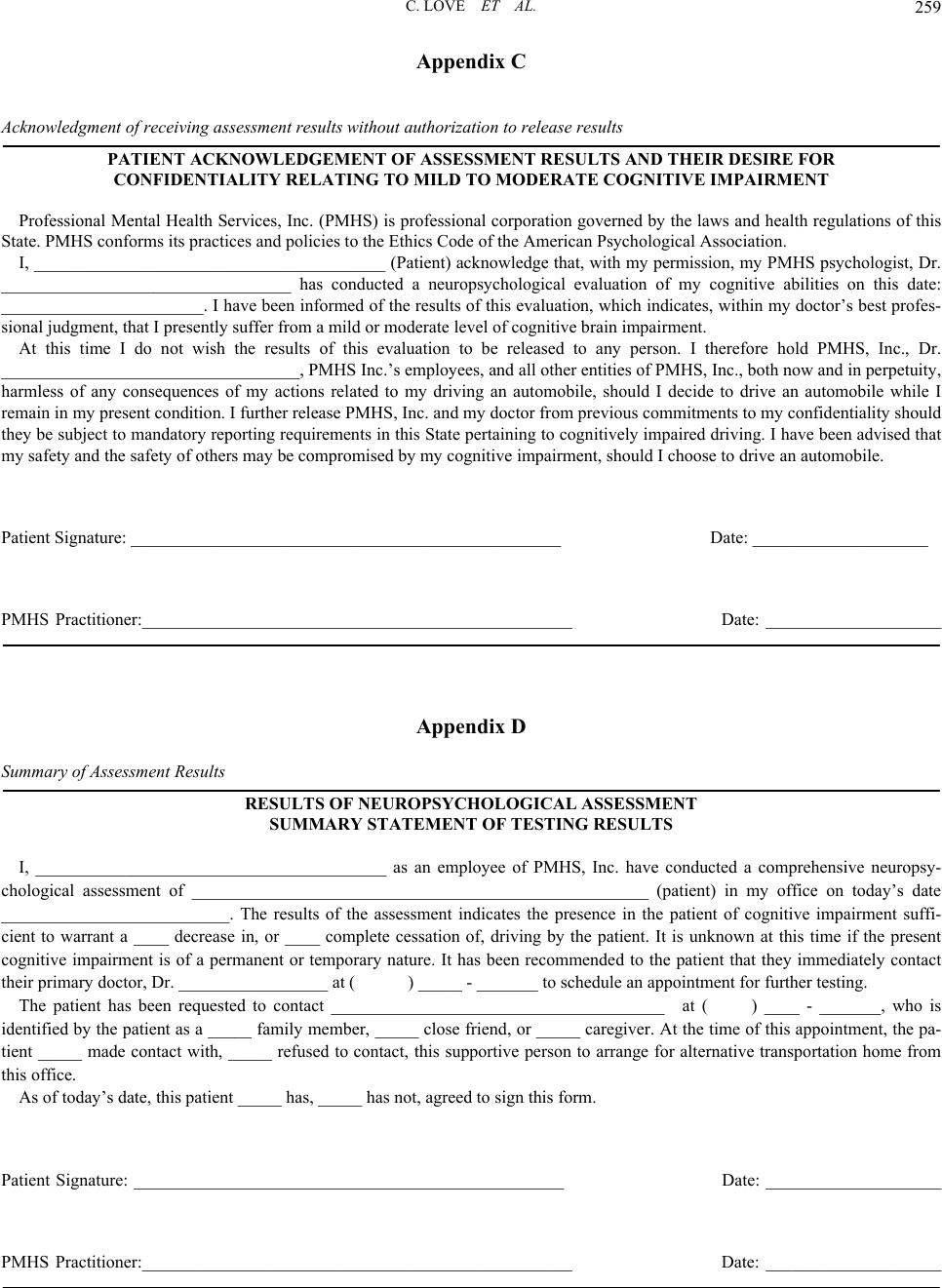 C. LOVE ET AL. 259 Appendix C Acknowledgment of receiving assessment results without authorization to release results PATIENT ACKNOWLEDGEMENT OF ASSESSMENT RESULTS AND THEIR DESIRE FOR CONFIDENTIALITY RELATING TO MILD TO MODERATE COGNITIVE IMPAIRMENT Professional Mental Health Services, Inc. (PMHS) is professional corporation governed by the laws and health regulations of this State. PMHS conforms its practices and policies to the Ethics Code of the American Psychological Association. I, ________________________________________ (Patient) acknowledge that, with my permission, my PMHS psychologist, Dr. _________________________________ has conducted a neuropsychological evaluation of my cognitive abilities on this date: _______________________. I have been informed of the results of this evaluation, which indicates, within my doctor’s best profes- sional judgment, that I presently suffer from a mild or moderate level of cognitive brain impairment. At this time I do not wish the results of this evaluation to be released to any person. I therefore hold PMHS, Inc., Dr. __________________________________, PMHS Inc.’s employees, and all other entities of PMHS, Inc., both now and in perpetuity, harmless of any consequences of my actions related to my driving an automobile, should I decide to drive an automobile while I remain in my present condition. I further release PMHS, Inc. and my doctor from previous commitments to my confidential ity should they be subject to mandatory reporting requirements in this State pertaining to cognitively impaired driving. I have been advised that my safety and the safety of others may be compromised by my cognitive impairment, should I choose to drive an automobile. Patient Signature: _________________________________________________ Date: ____________________ PMHS Practitioner:_________________________________________________ Date: ____________________ Appendix D Summary of Assessment Results RESULTS OF NEUROPSYCHOLOGICAL ASSESSMENT SUMMARY STATEMENT OF TESTING RESULTS I, ________________________________________ as an employee of PMHS, Inc. have conducted a comprehensive neuropsy- chological assessment of ____________________________________________________ (patient) in my office on today’s date __________________________. The results of the assessment indicates the presence in the patient of cognitive impairment suffi- cient to warrant a ____ decrease in, or ____ complete cessation of, driving by the patient. It is unknown at this time if the present cognitive impairment is of a permanent or temporary nature. It has been recommended to the patient that they immediately contact their primary doctor, Dr. _________________ at ( ) _____ - _______ to schedule an appointment for further testing. The patient has been requested to contact ______________________________________ at ( ) ____ - _______, who is identified by the patient as a _____ family member, _____ close friend, or _____ caregiver. At the time of this appointment, the pa- tient _____ made contact with, _____ refused to contact, this supportive person to arrange for alternative transportation home from this office. As of today’s date, this patient _____ has, _____ has not, agreed to sign this form. Patient Signature: _________________________________________________ Date: ____________________ PMHS Practitioner:_________________________________________________ Date: ____________________ 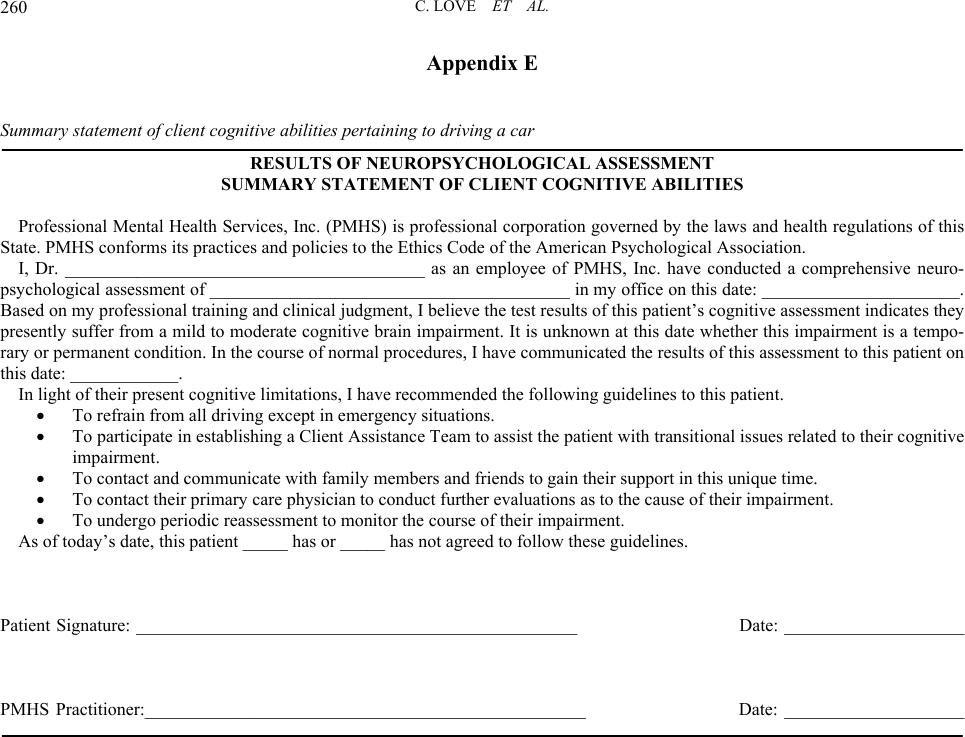 C. LOVE ET AL. 260 Appendix E Summary statement of client cognitive abilities pertaining to driving a car RESULTS OF NEUROPSYCHOLOGICAL ASSESSMENT SUMMARY STATEMENT OF CLIENT COGNITIVE ABILITIES Professional Mental Health Services, Inc. (PMHS) is professional corporation governed by the laws and health regulations of this State. PMHS conforms its practices and policies to the Ethics Code of the American Psychological Association. I, Dr. ________________________________________ as an employee of PMHS, Inc. have conducted a comprehensive neuro- psychological assessment of ________________________________________ in my office on this date: ______________________. Based on my professional training and clinical judgment, I believe the test results of this patient’s cognitive assessment indicates they presently suffer from a mild to moderate cognitive brain impairment. It is unknown at this date whether this impairment is a tempo- rary or permanent condition. In the course of normal procedures, I have communicated the results of this assessment to this patient on this date: ____________. In light of their present cognitive limitations, I have recommended the following guidelines to this patient. To refrain from all driving except in emergency situations. To participate in establishing a Client Assistance Team to assist the patient with transitional issues related to their cognitive impairment. To contact and communicate with family members and friends to gain their support in this unique time. To contact their primary care physician to conduct further evaluations as to t h e c ause of their impairme n t . To undergo periodic reassessment to monitor the course of their impairment. As of today’s date, this patient _____ has or _____ has not agreed to follow these guidelines. Patient Signature: _________________________________________________ Date: ____________________ PMHS Practitioner:_________________________________________________ Date: ____________________ |