P. Krishna et al.
6. DL and UL Throughput Calculations for LTE TDD
TDD system throughput calculations are somewhat complex as compared to FDD system as same spectrum is
used by uplink, downlink and for the guard period (Used for transition from downlink to uplink) [9].
For throughput calculation, suppose:
Bandwidth—20 MHz
Multiplexing Scheme-TDD
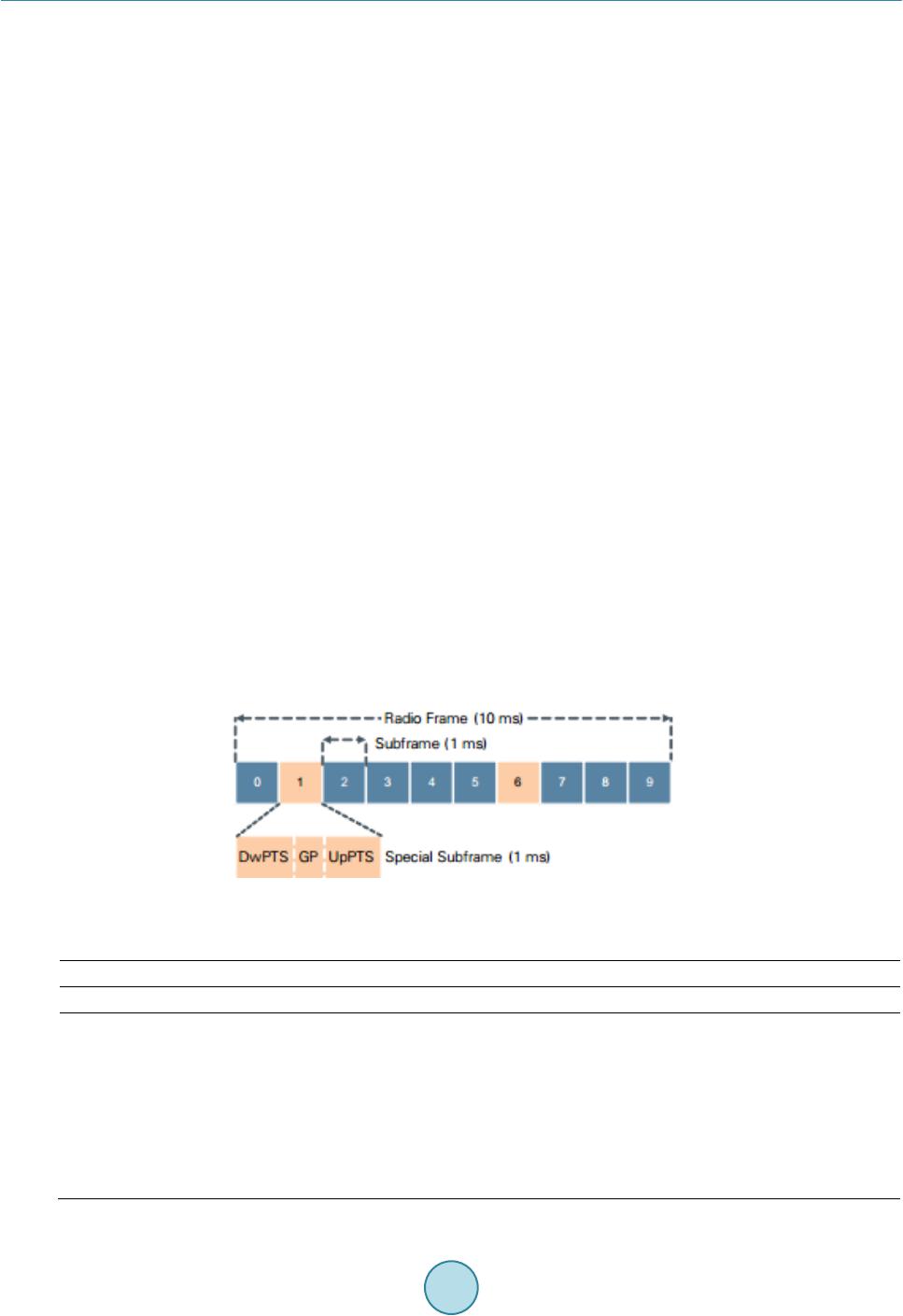
TDD Configuration-2 (D-6, S-2 and U-2)
Special Sub frame configuration-7 (DwPTS-10, GP-2 and UpPTS-2)
UE category-Cat. 3
Modulation supported—as per Cat 3 TBS index 26 for DL (75376 for 100 RBs) and 21 for UL (51024 for 100
RBs). Throughput in TDD can be calculated by following formula
DL Throughput = Number of Chains × TB size × (Contribution by DL Sub frame + Contribution by DwPTS
in SSF).
UL Throughput = Number of Chains × TB size × (Contribution by UL Sub frame + Contribution by UpPTS
in SSF). TB size for DL is 75376 and for UL it is 51,024 for category 3 UE.
Let’s calculate throughput for the above assumptions:
DL throughput = 2 × 75376 × [(0.6 + 0.2 × (10/14)]
Here 0.6% or 60% contribution is by 6 DL sub frame and [0.2(10/14)] factor contribution by Special sub
frame comes twice whose 10 symbols out of 14 are for downlink.
So DL throughput = 2 × 75376 × (0.742857) = 111.9872 Mbps − 112 Mbps.
In same manner UL throughput will be
UL throughput = 1 × 51024 × [(0.2 + 0.2 × (2/14)]
Here 0.2% or 20% contribution is by 2 UL sub frame and [0.2 × (2/14)] factor contribution by Special sub
frame comes twice whose 2 symbols out of 14 are for uplink.
So UL throughput = 1 × 51024 × (0.228571) = 11.66263 − 12 Mbps.
7. Conclusion
In this paper, we discussed about LTE system throughput calculation for both TDD and FDD system. 3 GPP
LTE technology support both TDD and FDD multiplexing. The paper describes all the factors which affect the
throughput like Bandwidth, Modulation, UE category and multiplexing. It also describes how we get throughput
300 Mbps in DL and 75 Mbps in UL and what are assumptions taken to calculate the same. Paper describes the
steps and formulae to calculate the throughput for FDD system for TDD Configuration 1 and Configuration 2.
References
[1] Dahlman, E., Parkvall, S. and Skold, J. (2011) 4G LTE/LTE-Advanced for Mobile Broadband. Academic Press.
[2] Sesia, S., Toufik, I. and Baker, M. Lte-The Umts Long Term Evolution from Theory to Practice. 2nd Edition.
[3] Boccardi, F., Clerckx, B., Ghosh, A., Hardouin, E., Jongren, G., Kusume, K., Onggosanusi, E. and Tang, Y. (2012)
Multiple-Antenna Techniques in LTE-Advanced. IEEE Communications Magazine, 50, 114-121
[4] 3GPP TS 36.213. Evolved Universal Terrestrial Radio Access (E-UTRA) Physical Layer Procedures.
[5] (2009) 3GPP LTE for TDD Spectrum in the Americas.
[6] Ratasuk, R., et al. (2008) TDD Design for UMTS Long Term Evolution. PIMRC-2008, Cannes.
[7] Holma, H. and Toskala, A. (2009) LTE for UMTS: OFDMA and SC-FDMA Based Radio Access, 267.
[8] (2013) Cisco Visual Networking Index: Global Mobile Data Traffic Forecast Update, 2012-2017.
[9] Toward 4G. http://www.nttdocomo.com/technologies/future/toward/index.html