

Paper Menu >>
Journal Menu >>
 Journal of Cancer Therapy, 2011, 2, 176-180 doi:10.4236/jct.2011.22022 Published Online June 2011 (http://www.SciRP.org/journal/jct) Copyright © 2011 SciRes. JCT Frequency of Bcr-Abl Fusion Oncogene Splice Variants Associated with Chronic Myeloid Leukemia (CML) Zafar Iqbal1,2,3#, Fatima Manzoor1*, Mudassar Iqbal1,4, Shahid Ali5, Nadeem Sheikh6, Mahwish Khan1,3, Aamer Aleem7, Tanveer Akhtar1 1Molecular Genetic Pathology (MGP) Unit, Department of Pathology, College of Medicine and King Khalid University Hospital, King Saud University, Riyadh, Saudi Arabia; 2Hematology, Oncology and Pharmacogenetic Engineering Sciences (HOPES) Group, Health Sciences Research Laboratories, Faculty of Biological Sciences, Department of Zoology, University of the Punjab, Lahore, Pakistan; 3Functional Molecular Biology/Hematology and Oncology Group, Centre for Research in Molecular Medicine and Institute for Molecular Biology and Biotechnology, The University of Lahore, Lahore, Pakistan; 4Department of Medicine, Kyrgyz State Medical Academy, Bishkek, Kyrgyzstan;5National Genetics Laboratory Lahore, Pakistan; 6Molecular Biology Laboratory, Depart- ment of Zoology, University of the Punjab, Lahore, Pakistan; 7Division of Hematology and Oncology, Department of Medicine, College of Medicine and King Khalid University Hospital, King Saud University, Riyadh, Saudi Arabia. Email: #[email protected], #[email protected] Received April 9th, 2010; revised April 2nd, 2011; accepted April 15th, 2011. ABSTRACT BCR-ABL fusion oncogene originates from the reciprocal translocation of chromosome 9 and 22 t(9;22) (q34;q11). It translates a chimeric protein, p210, characterized by constitutive activation of its tyrosine kinase, which triggers leu- kemogenic pathways resulting in onset of chronic myeloid leukemia (CML). In CML, the classic fusion is b2a2 or b3a2 fusing exon 13 (b2) or exon 14 (b3) of BCR to exon 2 (a2) of ABL. The type of bcr/abl transcripts may be associated with different prognosis and hence useful in therapeutic plan. This study was conducted to calculate the frequency of these splice variants as the frequencies of different fusion oncogenes associated with leukaemia can vary in different geographica l regions du e to interplay of genetic varia tion in different ethnic popu lation s, diverse environ men tal factors and living style. A very sensitive nested RT-PCR wa s established to detect BCR-ABL splice variants in CML. Sensitivity of RT-PCR assay was of the order of 10–6. Thirty CML patients were subjected to BCR-ABL analysis. Out of 30 Paki- stani patients, 19 (64%) expressed b3a2 while 11 (36%) expressed b2a2 transcript. This shows that BCR-ABL splice variants differ in their frequencies which may have an effect on biology and implications for prognosis and manage- ment of BCR-ABL posi t i ve Le ukemias. Keywords: BCR-ABL Positive Leukemia, Leukemia Cytogenetics , Philadelphia Chromosome, Chronic Myeloid Leukemia, BCR-ABL Alternative Splicing, BCR-ABL Splice Variants, Leukemia Alternative Splicing, Pharmacogenetics 1. Introduction Cytogenetically chronic myeloid leukemia (CML) is characterized by the presence of Philadelphia (Ph) chro- mosome, the diagnostic hallmark of CML, which is pre- sent in majority of CML patients. It originates from the reciprocal translocation of chromosome 9 and 22 t(9;22) (q34;q11) [1]. This reciprocal translocation gives rise to BCR-ABL fusion oncogene, which translates a chimeric protein, p210BCR-ABL that is characterized by constitu- tive activation of its tyrosine kinase activity. In CML, the classic fusion is b2a2 or b3a2 fusing exon 13 (b2) or exon 14 (b3) of BCR to exon 2 (a2) of ABL [2,3]. Both b3a2 and b2a2 transcripts can be formed as a result of alternative splicing. These transcripts lead to the produc- tion of an 8.5 kb transcript coding for a 210-KDa (p210) chimeric protein [4,5]. This constitutively active cyto- plasmic tyrosine kinase does not block differentiation, but enhances proliferation and viability of myeloid line- age cells and leads to development of CML [6]. *Authors contributed equally to this work and thus share first author- ship. 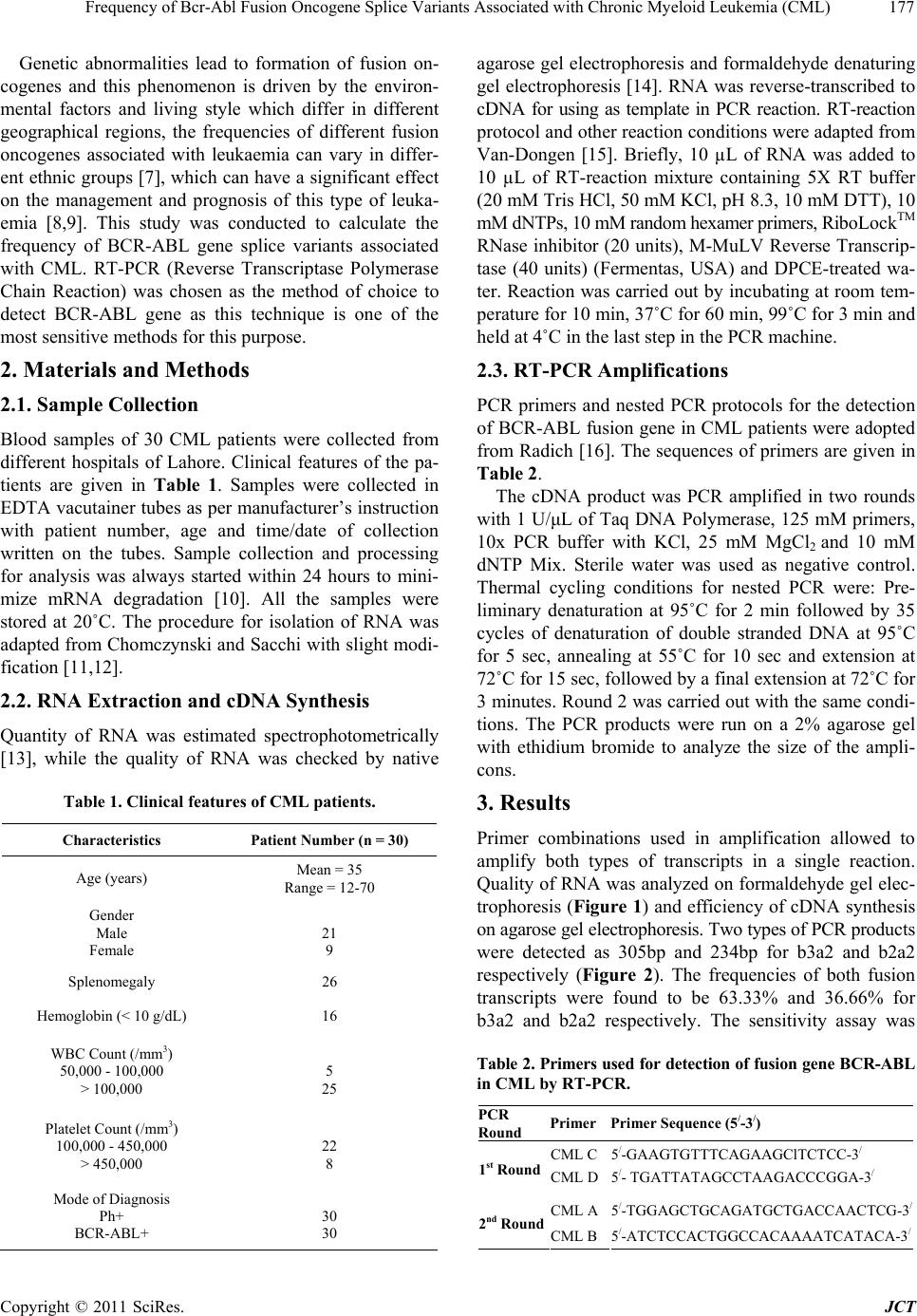 Frequency of Bcr-Abl Fusion Oncogene Splice Variants Associated with Chronic Myeloid Leukemia (CML) 177 Genetic abnormalities lead to formation of fusion on- cogenes and this phenomenon is driven by the environ- mental factors and living style which differ in different geographical regions, the frequencies of different fusion oncogenes associated with leukaemia can vary in differ- ent ethnic groups [7], which can have a significant effect on the management and prognosis of this type of leuka- emia [8,9]. This study was conducted to calculate the frequency of BCR-ABL gene splice variants associated with CML. RT-PCR (Reverse Transcriptase Polymerase Chain Reaction) was chosen as the method of choice to detect BCR-ABL gene as this technique is one of the most sensitive methods for this purpose. 2. Materials and Methods 2.1. Sample Collection Blood samples of 30 CML patients were collected from different hospitals of Lahore. Clinical features of the pa- tients are given in Table 1. Samples were collected in EDTA vacutainer tubes as per manufacturer’s instruction with patient number, age and time/date of collection written on the tubes. Sample collection and processing for analysis was always started within 24 hours to mini- mize mRNA degradation [10]. All the samples were stored at 20˚C. The procedure for isolation of RNA was adapted from Chomczynski and Sacchi with slight modi- fication [11,12]. 2.2. RNA Extraction and cDNA Synthesis Quantity of RNA was estimated spectrophotometrically [13], while the quality of RNA was checked by native Table 1. Clinical features of CML patients. Characteristics Patient Number (n = 30) Age (years) Mean = 35 Range = 12-70 Gender Male Female 21 9 Splenomegaly 26 Hemoglobin (< 10 g/dL) 16 WBC Count (/mm3) 50,000 - 100,000 > 100,000 5 25 Platelet Count (/mm3) 100,000 - 450,000 > 450,000 22 8 Mode of Diagnosis Ph+ BCR-ABL+ 30 30 agarose gel electrophoresis and formaldehyde denaturing gel electrophoresis [14]. RNA was reverse-transcribed to cDNA for using as template in PCR reaction. RT-reaction protocol and other reaction conditions were adapted from Van-Dongen [15]. Briefly, 10 µL of RNA was added to 10 µL of RT-reaction mixture containing 5X RT buffer (20 mM Tris HCl, 50 mM KCl, pH 8.3, 10 mM DTT), 10 mM dNTPs, 10 mM random hexamer primers, RiboLockTM RNase inhibitor (20 units), M-MuLV Reverse Transcrip- tase (40 units) (Fermentas, USA) and DPCE-treated wa- ter. Reaction was carried out by incubating at room tem- perature for 10 min, 37˚C for 60 min, 99˚C for 3 min and held at 4˚C in the last step in the PCR machine. 2.3. RT-PCR Amplifications PCR primers and nested PCR protocols for the detection of BCR-ABL fusion gene in CML patients were adopted from Radich [16]. The sequences of primers are given in Table 2. The cDNA product was PCR amplified in two rounds with 1 U/μL of Taq DNA Polymerase, 125 mM primers, 10x PCR buffer with KCl, 25 mM MgCl2 and 10 mM dNTP Mix. Sterile water was used as negative control. Thermal cycling conditions for nested PCR were: Pre- liminary denaturation at 95˚C for 2 min followed by 35 cycles of denaturation of double stranded DNA at 95˚C for 5 sec, annealing at 55˚C for 10 sec and extension at 72˚C for 15 sec, followed by a final extension at 72˚C for 3 minutes. Round 2 was carried out with the same condi- tions. The PCR products were run on a 2% agarose gel with ethidium bromide to analyze the size of the ampli- cons. 3. Results Primer combinations used in amplification allowed to amplify both types of transcripts in a single reaction. Quality of RNA was analyzed on formaldehyde gel elec- trophoresis (Figure 1) and efficiency of cDNA synthesis on agarose gel electrophoresis. Two types of PCR products were detected as 305bp and 234bp for b3a2 and b2a2 respectively (Figure 2). The frequencies of both fusion transcripts were found to be 63.33% and 36.66% for b3a2 and b2a2 respectively. The sensitivity assay was Table 2. Primers used for detec tion of fusion gene BCR- ABL in CML by RT-PCR. PCR Round PrimerPrimer Sequence (5/-3/) CML C5/-GAAGTGTTTCAGAAGClTCTCC-3/ 1st RoundCML D5/- TGATTATAGCCTAAGACCCGGA-3/ CML A5/-TGGAGCTGCAGATGCTGACCAACTCG-3/ 2nd RoundCML B5/-ATCTCCACTGGCCACAAAATCATACA-3/ Copyright © 2011 SciRes. JCT 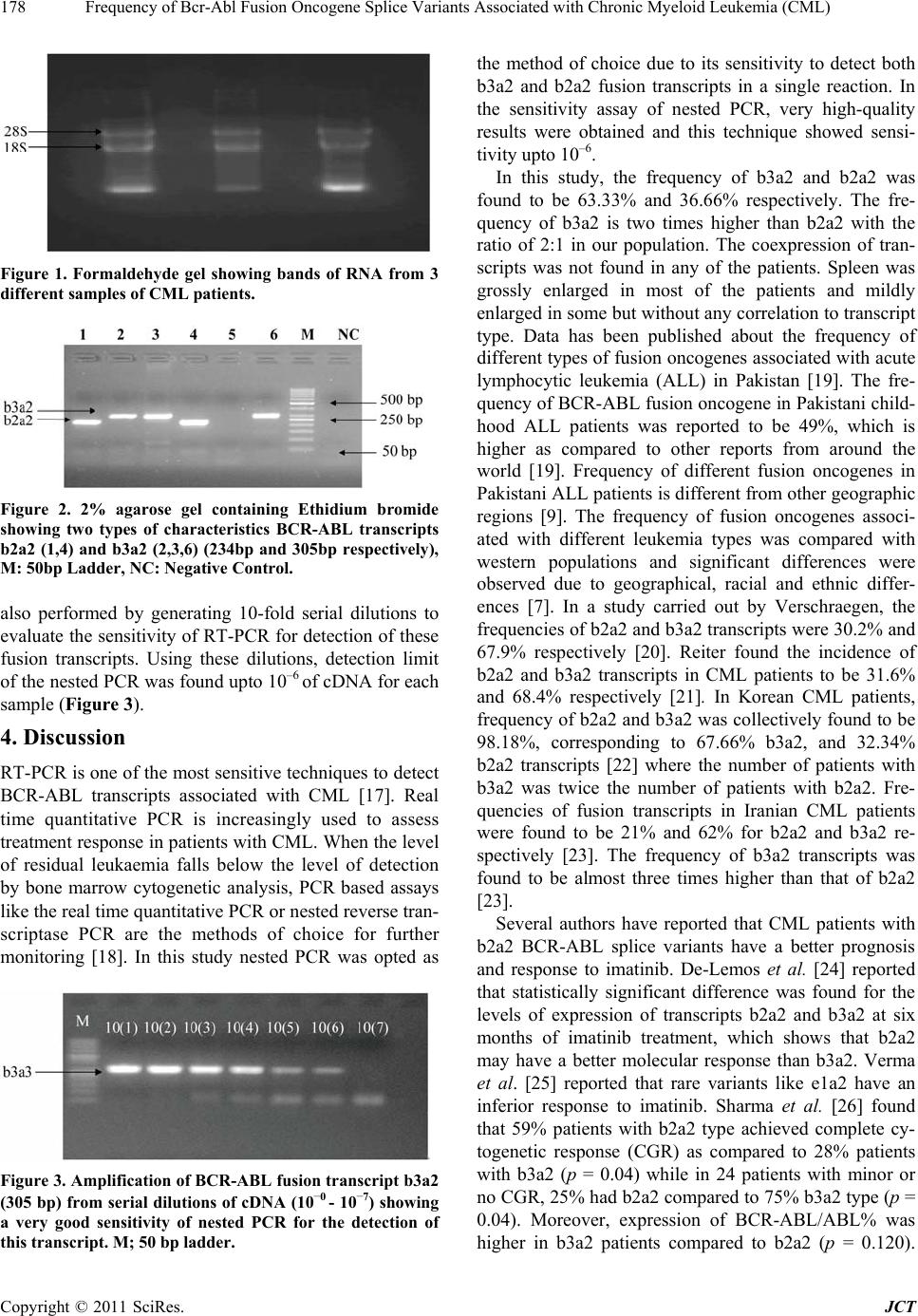 Frequency of Bcr-Abl Fusion Oncogene Splice Variants Associated with Chronic Myeloid Leukemia (CML) 178 Figure 1. Formaldehyde gel showing bands of RNA from 3 different samples of CML patients. Figure 2. 2% agarose gel containing Ethidium bromide showing two types of characteristics BCR-ABL transcripts b2a2 (1,4) and b3a2 (2,3,6) (234bp and 305bp respectively), M: 50bp Ladder, NC: Negative Control. also performed by generating 10-fold serial dilutions to evaluate the sensitivity of RT-PCR for detection of these fusion transcripts. Using these dilutions, detection limit of the nested PCR was found upto 10–6 of cDNA for each sample (Figure 3). 4. Discussion RT-PCR is one of the most sensitive techniques to detect BCR-ABL transcripts associated with CML [17]. Real time quantitative PCR is increasingly used to assess treatment response in patients with CML. When the level of residual leukaemia falls below the level of detection by bone marrow cytogenetic analysis, PCR based assays like the real time quantitative PCR or nested reverse tran- scriptase PCR are the methods of choice for further monitoring [18]. In this study nested PCR was opted as Figure 3. Amplification of BCR-ABL fusion transcript b3a2 (305 bp) from serial dilutions of cDNA (10–0 - 10–7) showing a very good sensitivity of nested PCR for the detection of this transcript. M; 50 bp ladder. the method of choice due to its sensitivity to detect both b3a2 and b2a2 fusion transcripts in a single reaction. In the sensitivity assay of nested PCR, very high-quality results were obtained and this technique showed sensi- tivity upto 10–6. In this study, the frequency of b3a2 and b2a2 was found to be 63.33% and 36.66% respectively. The fre- quency of b3a2 is two times higher than b2a2 with the ratio of 2:1 in our population. The coexpression of tran- scripts was not found in any of the patients. Spleen was grossly enlarged in most of the patients and mildly enlarged in some but without any correlation to transcript type. Data has been published about the frequency of different types of fusion oncogenes associated with acute lymphocytic leukemia (ALL) in Pakistan [19]. The fre- quency of BCR-ABL fusion oncogene in Pakistani child- hood ALL patients was reported to be 49%, which is higher as compared to other reports from around the world [19]. Frequency of different fusion oncogenes in Pakistani ALL patients is different from other geographic regions [9]. The frequency of fusion oncogenes associ- ated with different leukemia types was compared with western populations and significant differences were observed due to geographical, racial and ethnic differ- ences [7]. In a study carried out by Verschraegen, the frequencies of b2a2 and b3a2 transcripts were 30.2% and 67.9% respectively [20]. Reiter found the incidence of b2a2 and b3a2 transcripts in CML patients to be 31.6% and 68.4% respectively [21]. In Korean CML patients, frequency of b2a2 and b3a2 was collectively found to be 98.18%, corresponding to 67.66% b3a2, and 32.34% b2a2 transcripts [22] where the number of patients with b3a2 was twice the number of patients with b2a2. Fre- quencies of fusion transcripts in Iranian CML patients were found to be 21% and 62% for b2a2 and b3a2 re- spectively [23]. The frequency of b3a2 transcripts was found to be almost three times higher than that of b2a2 [23]. Several authors have reported that CML patients with b2a2 BCR-ABL splice variants have a better prognosis and response to imatinib. De-Lemos et al. [24] reported that statistically significant difference was found for the levels of expression of transcripts b2a2 and b3a2 at six months of imatinib treatment, which shows that b2a2 may have a better molecular response than b3a2. Verma et al. [25] reported that rare variants like e1a2 have an inferior response to imatinib. Sharma et al. [26] found that 59% patients with b2a2 type achieved complete cy- togenetic response (CGR) as compared to 28% patients with b3a2 (p = 0.04) while in 24 patients with minor or no CGR, 25% had b2a2 compared to 75% b3a2 type (p = 0.04). Moreover, expression of BCR-ABL/ABL% was higher in b3a2 patients compared to b2a2 (p = 0.120). Copyright © 2011 SciRes. JCT 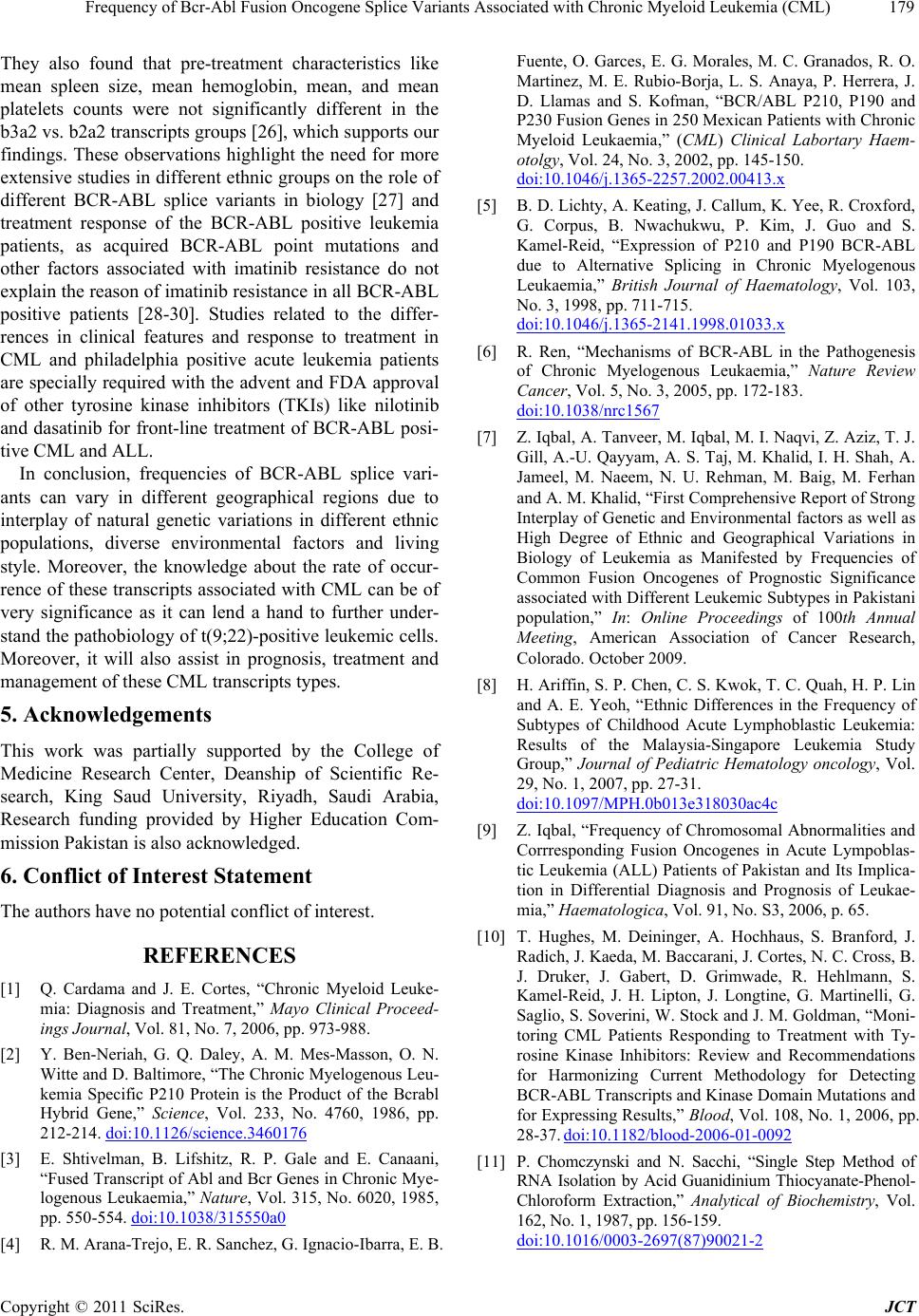 Frequency of Bcr-Abl Fusion Oncogene Splice Variants Associated with Chronic Myeloid Leukemia (CML) 179 They also found that pre-treatment characteristics like mean spleen size, mean hemoglobin, mean, and mean platelets counts were not significantly different in the b3a2 vs. b2a2 transcripts groups [26], which supports our findings. These observations highlight the need for more extensive studies in different ethnic groups on the role of different BCR-ABL splice variants in biology [27] and treatment response of the BCR-ABL positive leukemia patients, as acquired BCR-ABL point mutations and other factors associated with imatinib resistance do not explain the reason of imatinib resistance in all BCR-ABL positive patients [28-30]. Studies related to the differ- rences in clinical features and response to treatment in CML and philadelphia positive acute leukemia patients are specially required with the advent and FDA approval of other tyrosine kinase inhibitors (TKIs) like nilotinib and dasatinib for front-line treatment of BCR-ABL posi- tive CML and ALL. In conclusion, frequencies of BCR-ABL splice vari- ants can vary in different geographical regions due to interplay of natural genetic variations in different ethnic populations, diverse environmental factors and living style. Moreover, the knowledge about the rate of occur- rence of these transcripts associated with CML can be of very significance as it can lend a hand to further under- stand the pathobiology of t(9;22)-positive leukemic cells. Moreover, it will also assist in prognosis, treatment and management of these CML transcripts types. 5. Acknowledgements This work was partially supported by the College of Medicine Research Center, Deanship of Scientific Re- search, King Saud University, Riyadh, Saudi Arabia, Research funding provided by Higher Education Com- mission Pakistan is also acknowledged. 6. Conflict of Interest Statement The authors have no potential conflict of interest. REFERENCES [1] Q. Cardama and J. E. Cortes, “Chronic Myeloid Leuke- mia: Diagnosis and Treatment,” Mayo Clinical Proceed- ings Journal, Vol. 81, No. 7, 2006, pp. 973-988. [2] Y. Ben-Neriah, G. Q. Daley, A. M. Mes-Masson, O. N. Witte and D. Baltimore, “The Chronic Myelogenous Leu- kemia Specific P210 Protein is the Product of the Bcrabl Hybrid Gene,” Science, Vol. 233, No. 4760, 1986, pp. 212-214. doi:10.1126/science.3460176 [3] E. Shtivelman, B. Lifshitz, R. P. Gale and E. Canaani, “Fused Transcript of Abl and Bcr Genes in Chronic Mye- logenous Leukaemia,” Nature, Vol. 315, No. 6020, 1985, pp. 550-554. doi:10.1038/315550a0 [4] R. M. Arana-Trejo, E. R. Sanchez, G. Ignacio-Ibarra, E. B. Fuente, O. Garces, E. G. Morales, M. C. Granados, R. O. Martinez, M. E. Rubio-Borja, L. S. Anaya, P. Herrera, J. D. Llamas and S. Kofman, “BCR/ABL P210, P190 and P230 Fusion Genes in 250 Mexican Patients with Chronic Myeloid Leukaemia,” (CML) Clinical Labortary Haem- otolgy, Vol. 24, No. 3, 2002, pp. 145-150. doi:10.1046/j.1365-2257.2002.00413.x [5] B. D. Lichty, A. Keating, J. Callum, K. Yee, R. Croxford, G. Corpus, B. Nwachukwu, P. Kim, J. Guo and S. Kamel-Reid, “Expression of P210 and P190 BCR-ABL due to Alternative Splicing in Chronic Myelogenous Leukaemia,” British Journal of Haematology, Vol. 103, No. 3, 1998, pp. 711-715. doi:10.1046/j.1365-2141.1998.01033.x [6] R. Ren, “Mechanisms of BCR-ABL in the Pathogenesis of Chronic Myelogenous Leukaemia,” Nature Review Cancer, Vol. 5, No. 3, 2005, pp. 172-183. doi:10.1038/nrc1567 [7] Z. Iqbal, A. Tanveer, M. Iqbal, M. I. Naqvi, Z. Aziz, T. J. Gill, A.-U. Qayyam, A. S. Taj, M. Khalid, I. H. Shah, A. Jameel, M. Naeem, N. U. Rehman, M. Baig, M. Ferhan and A. M. Khalid, “First Comprehensive Report of Strong Interplay of Genetic and Environmental factors as well as High Degree of Ethnic and Geographical Variations in Biology of Leukemia as Manifested by Frequencies of Common Fusion Oncogenes of Prognostic Significance associated with Different Leukemic Subtypes in Pakistani population,” In: Online Proceedings of 100th Annual Meeting, American Association of Cancer Research, Colorado. October 2009. [8] H. Ariffin, S. P. Chen, C. S. Kwok, T. C. Quah, H. P. Lin and A. E. Yeoh, “Ethnic Differences in the Frequency of Subtypes of Childhood Acute Lymphoblastic Leukemia: Results of the Malaysia-Singapore Leukemia Study Group,” Journal of Pediatric Hematology oncology, Vol. 29, No. 1, 2007, pp. 27-31. doi:10.1097/MPH.0b013e318030ac4c [9] Z. Iqbal, “Frequency of Chromosomal Abnormalities and Corrresponding Fusion Oncogenes in Acute Lympoblas- tic Leukemia (ALL) Patients of Pakistan and Its Implica- tion in Differential Diagnosis and Prognosis of Leukae- mia,” Haematologica, Vol. 91, No. S3, 2006, p. 65. [10] T. Hughes, M. Deininger, A. Hochhaus, S. Branford, J. Radich, J. Kaeda, M. Baccarani, J. Cortes, N. C. Cross, B. J. Druker, J. Gabert, D. Grimwade, R. Hehlmann, S. Kamel-Reid, J. H. Lipton, J. Longtine, G. Martinelli, G. Saglio, S. Soverini, W. Stock and J. M. Goldman, “Moni- toring CML Patients Responding to Treatment with Ty- rosine Kinase Inhibitors: Review and Recommendations for Harmonizing Current Methodology for Detecting BCR-ABL Transcripts and Kinase Domain Mutations and for Expressing Results,” Blood, Vol. 108, No. 1, 2006, pp. 28-37. doi:10.1182/blood-2006-01-0092 [11] P. Chomczynski and N. Sacchi, “Single Step Method of RNA Isolation by Acid Guanidinium Thiocyanate-Phenol- Chloroform Extraction,” Analytical of Biochemistry, Vol. 162, No. 1, 1987, pp. 156-159. doi:10.1016/0003-2697(87)90021-2 Copyright © 2011 SciRes. JCT  Frequency of Bcr-Abl Fusion Oncogene Splice Variants Associated with Chronic Myeloid Leukemia (CML) Copyright © 2011 SciRes. JCT 180 [12] P. Chomczynski, “A Reagent for the Single-Step Simul- taneous Isolation of RNA, DNA and Proteins from Cell and Tissue Samples,” Biotechniques, Vol. 15, No. 3, 1993, pp. 532-537. [13] J. A. Glasel, “Validity of Nucleic Acid Purities Monitored by A260/A280 Absorbance Ratios,” Biotechniques, Vol. 18, No. 1, 1995, pp. 62-63. [14] J. Sambrook and W. D. Russel, “Molecular Cloning,” A Laboratory Manual, Cold Spring Harbor Laboratory Press, New York, 2001. [15] J. J. Van-Dongen, E. A. Macintyre, J. A. Gabert, E. De- labesse, V. Rossi, G. Saglio and E. Gottardi, “Standard- ized RT-PCR Analysis of Fusion Genes Transcripts from Chromosome Aberrations in Acute Leukemia for Detec- tion of Minimal Residual Disease,” Report of the BIO- MED-I Concerted Action: Investigation of Minimal Re- sidual Disease in Acute Leukemia, Leukemia, Vol. 13, No. 12, 1999, pp. 1901-1928. [16] J. P. Radich, G. Gehly, T. Gooley, E. Bryant, R. A. Clift, S. Collins, S. Edmands, J. Kirk, A. Lee and P. Kessler, “Polymerase Chain Reaction Detection of the BCR-ABL Fusion Transcript After Allogeneic Marrow Transplan- tation for Chronic Myeloid Leukemia: Results and Impli- cations in 346 Patients,” Blood, Vol. 85, No. 9, 1995, pp. 2632-2638. [17] J. Q. Guo, H. Lin, H. Kantarjian, M. Talpaz, R. Champlin, M. Andreeff, A. Glassman and R. B. Arlinghaus, “Com- parison of Competitive-Nested PCR and Real-Time PCR in Detecting BCR-ABL Fusion Transcripts in Chronic Myeloid Leukemia Patients,” Leukemia, Vol. 16, No. 12, 2002, pp. 2447-2453. doi:10.1038/sj.leu.2402730 [18] S. Menif, S. Zarrouki, R. Jeddi, N. ben Alaya, Z. B. Ali, H. B. Abid, S. Hdeiji, M. Elloumi, A. Khlif, B. Meddeb and K. Dellagi, “A Quantitative Detection of Bcr-Abl Transcripts in Chronic Myeloid Leukemia,” Pathologie Biologie, Vol. 57, No, 5, 2009, pp. 388-391. doi:10.1016/j.patbio.2007.12.010 [19] Z. Iqbal and A. Tanveer, “High Incidence of Bcr-Abl Fusion Oncogene in Pakistani Childhood Acute Lymp- hoid Leukaemia (ALL) Patients Reflects Ethnic Differ- ences in Molecular Genetics of ALL,” Haematologica, Vol. 91, No. S3, 2006, p. 65. [20] C. F. Verschraegen, H. M. Kantarjian, C. Hirsch-Ginsberg, M. S. Lee, S. O’Brien, M. B. Rios, S. A. Stass, M. Keating and M. Talpaz, “The Breakpoint Cluster Region Site in Pa- tients with Philadelphia Chromosome-Positive Chronic Myelogenous Leukemia,” Clinical, Laboratory, and Prog- nostic Correlations, Cancer, Vol. 76, No. 6, 1995, pp. 992-997. doi:10.1002/1097-0142(19950915)76:6<992::AID-CNCR 2820760612>3.0.CO;2-L [21] E. Reiter, H. T. Greinix, S. Brugger, F. Keil, W. Rabitsch, C. Mannhalter, I. Schwarzinger, P. Höcker, G. Fischer, K. Dieckmann, W. Hinterberger, W. Linkesch, B. Schneider, K. Lechner and P. Kalhs, “Long-Term Follow-Up after allogeneic Stem Cell Transplantation for Chronic Mye- logenous Leukemia,” Bone Marrow Transplant, Vol. 22, No. S4, 1998, pp. S86-S88. [22] H. G. Goh, J. Y. Hwang, S. H. Kim, Y. H. Lee, Y. L. Kim and D. W. Kim, “Comprehensive Analysis of BCR-ABL Transcript Types in Korean CML Patients Using a Newly Developed Multiplex RT-PCR,” Translational Research, Vol. 148, No. 1, 2006, pp. 249-256. [23] M. Yaghmaie, S. H. Ghaffari, A. Ghavamzadeh, K. Ali- moghaddam, M. Jahani, S. A. Mousavi, M. Irvani, B. Bahar and I. Bibordi, “Frequency of BCR-ABL Fusion Transcripts in Iranian Patients with Chronic Myeloid Leukemia,” Archives of Iranian Medicine, Vol. 11, No. 3, 2008, pp. 247-251. [24] J. A. de Lemos, C. M. de Oliveira, A. C. Scerni, A. Q. Bentes, A. C. Beltrão, I. R. Bentes, T. C. Azevedo, L. M. Maradei-Pereira, “Differential Molecular Response of the Transcripts B2A2 and B3A2 to Imatinib Mesylate in Chronic Myeloid Leukemia,” Genetics and Molecular Research, Vol. 4, No. 4, 30 December 2005, pp. 803-811. [25] D. Verma, H. M. Kantarjian, D. Jones, R. Luthra, G. Borthakur, S. Verstovsek, M. B. Rios and J. Cortes, “Chronic Myeloid Leukemia (CML) with P190 BCR-ABL: Analysis of Characteristics, Outcomes, and Prognostic Sig- nificance,” Blood, Vol. 114, No. 11, 10 September 2009, pp. 2232-2235. doi:10.1182/blood-2009-02-204693 [26] P. Sharma, L. Kumar, S. Mohanty and V. Kochupillai, “Response to Imatinib Mesylate in Chronic Myeloid Leukemia Patients with Variant BCR-ABL fusion Tran- scripts,” Ann Hematology, Vol. 89, No. 3, March 2010, pp. 241-247. doi:10.1007/s00277-009-0822-7 [27] Z. Iqbal, M. Iqbal and T. Akhter, “Frequency of BCR-ABL Fusion Oncogene in Pakistani Childhood Acute Lymphoid Leukemia (ALL) Patients Reflects Eth- nic Differences in Molecular Genetics of ALL,” Journal of Pediatric Hematology/Oncology, Vol. 29, No. 8, Au- gust 2007, p. 585. doi:10.1097/MPH.0b013e3180f61bcf [28] F. X. Gruber, T. Lundán, R. Goll, A. Silye, I. Mikkola, O. P. Rekvig, S. Knuutila, K. Remes, T. Gedde-Dahl, K. Porkka and H. Hjorth-Hansen, “BCR-ABL Isoforms As- sociated with Intrinsic or Acquired Resistance to Imatinib: More Heterogeneous than just ABL Kinase Domain Point Mutations?” Medical Oncology, 8 January 2011. [29] Z. Iqbal, M. Iqbal, M. Akhtar, M. I. Naqvi, A. H. Tahir, T. J. Gill, et al., “Presence of Prior-to-Treatment BCR-ABL Mutations In CD34 + CD38-Stem Cells of Newly Diag- nosed Chronic Phase CML Patients and Their Correlation with Imatinib Resistance: Implications of Cancer Pharma- cogenomics and Pre-Therapeutic Genetic Testing in Per- sonalized Treatment of BCR-ABL+Leukemia Blood,” Vol. 116, No. 21, November 2010, p. 2278. [30] C. M. Lucas, R. J. Harris, A. Giannoudis, A. Davies, K. Knight, S. J. Watmough, L. Wang, R. E. Clark, “Chronic Myeloid Leukemia Patients with the E13a2 BCR-ABL Fusion Transcript have Inferior Responses to Imatinib Compared to Patients with the E14a2 Transcript,” Haematologica, Vol. 94, No. 10, October 2009, pp. 1362-1367. doi:10.3324/haematol.2009.009134 |