

Paper Menu >>
Journal Menu >>
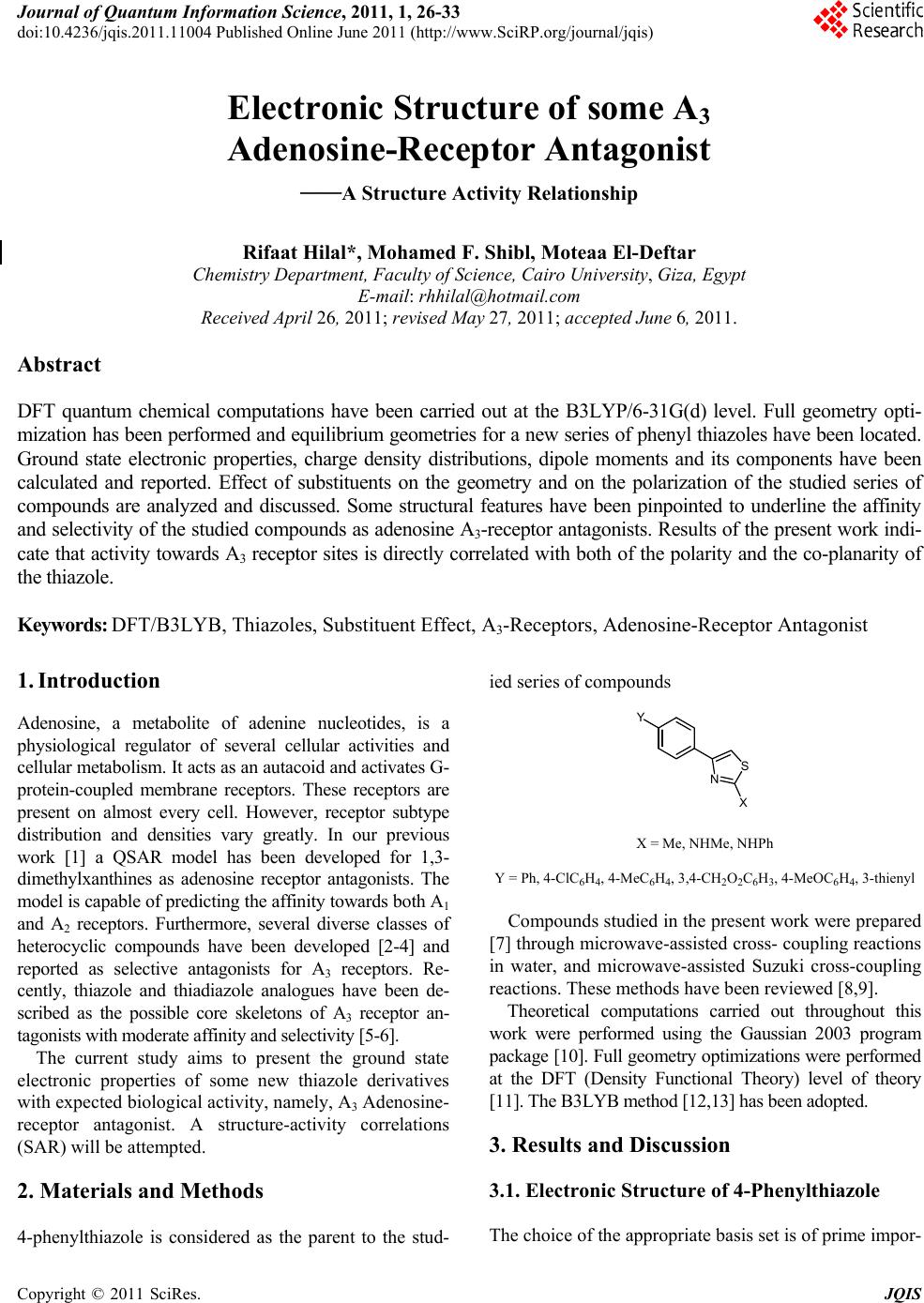 Journal of Quantum Informatio n Science, 2011, 1, 26-33 doi:10.4236/jqis.2011.11004 Published Online June 2011 (http://www.SciRP.org/journal/jqis) Copyright © 2011 SciRes. JQIS Electronic Structure of some A3 Adenosine-Receptor Antagonist ——A Structure Activity Relationship Rifaat Hilal*, Mohamed F. Shibl, Moteaa El-Deftar Chemistry Department, Faculty of Science, Cairo University, Giza, Egypt E-mail: [email protected] Received April 26, 2011; revised May 27, 2011; accepted June 6, 2011. Abstract DFT quantum chemical computations have been carried out at the B3LYP/6-31G(d) level. Full geometry opti- mization has been performed and equilibrium geometries for a new series of phenyl thiazoles have been located. Ground state electronic properties, charge density distributions, dipole moments and its components have been calculated and reported. Effect of substituents on the geometry and on the polarization of the studied series of compounds are analyzed and discussed. Some structural features have been pinpointed to underline the affinity and selectivity of the studied compounds as adenosine A3-receptor antagonists. Results of the present work indi- cate that activity towards A3 receptor sites is directly correlated with both of the polarity and the co-planarity of the thiazole. Keywords: DFT/B3LYB, Thiazoles, Substituent Effect, A3-Receptors, Adenosine-Receptor Antagonist 1. Introduction Adenosine, a metabolite of adenine nucleotides, is a physiological regulator of several cellular activities and cellular metabolism. It acts as an autacoid and activates G- protein-coupled membrane receptors. These receptors are present on almost every cell. However, receptor subtype distribution and densities vary greatly. In our previous work [1] a QSAR model has been developed for 1,3- dimethylxanthines as adenosine receptor antagonists. The model is capable of predicting the affinity towards both A1 and A2 receptors. Furthermore, several diverse classes of heterocyclic compounds have been developed [2-4] and reported as selective antagonists for A3 receptors. Re- cently, thiazole and thiadiazole analogues have been de- scribed as the possible core skeletons of A3 receptor an- tagonists with moderate affinity and selectivity [5-6]. The current study aims to present the ground state electronic properties of some new thiazole derivatives with expected biological activity, namely, A3 Adenosine- receptor antagonist. A structure-activity correlations (SAR) will be attempted. 2. Materials and Methods 4-phenylthiazole is considered as the parent to the stud- ied series of compounds Y NS X X = Me, NHMe, NHPh Y = Ph, 4-ClC 6 H 4 , 4-MeC 6 H 4 , 3,4-CH 2 O 2 C 6 H 3 , 4-MeOC 6 H 4 , 3-thienyl Compounds studied in the present work were prepared [7] through microwave-assisted cross- coupling reactions in water, and microwave-assisted Suzuki cross-coupling reactions. These methods have been reviewed [8,9]. Theoretical computations carried out throughout this work were performed using the Gaussian 2003 program package [10]. Full geometry optimizations were performed at the DFT (Density Functional Theory) level of theory [11]. The B3LYB method [12,13] has been adopted. 3. Results and Discussion 3.1. Electronic Structure of 4-Phenylthiazole The choice of the appropriate basis set is of prime impor- 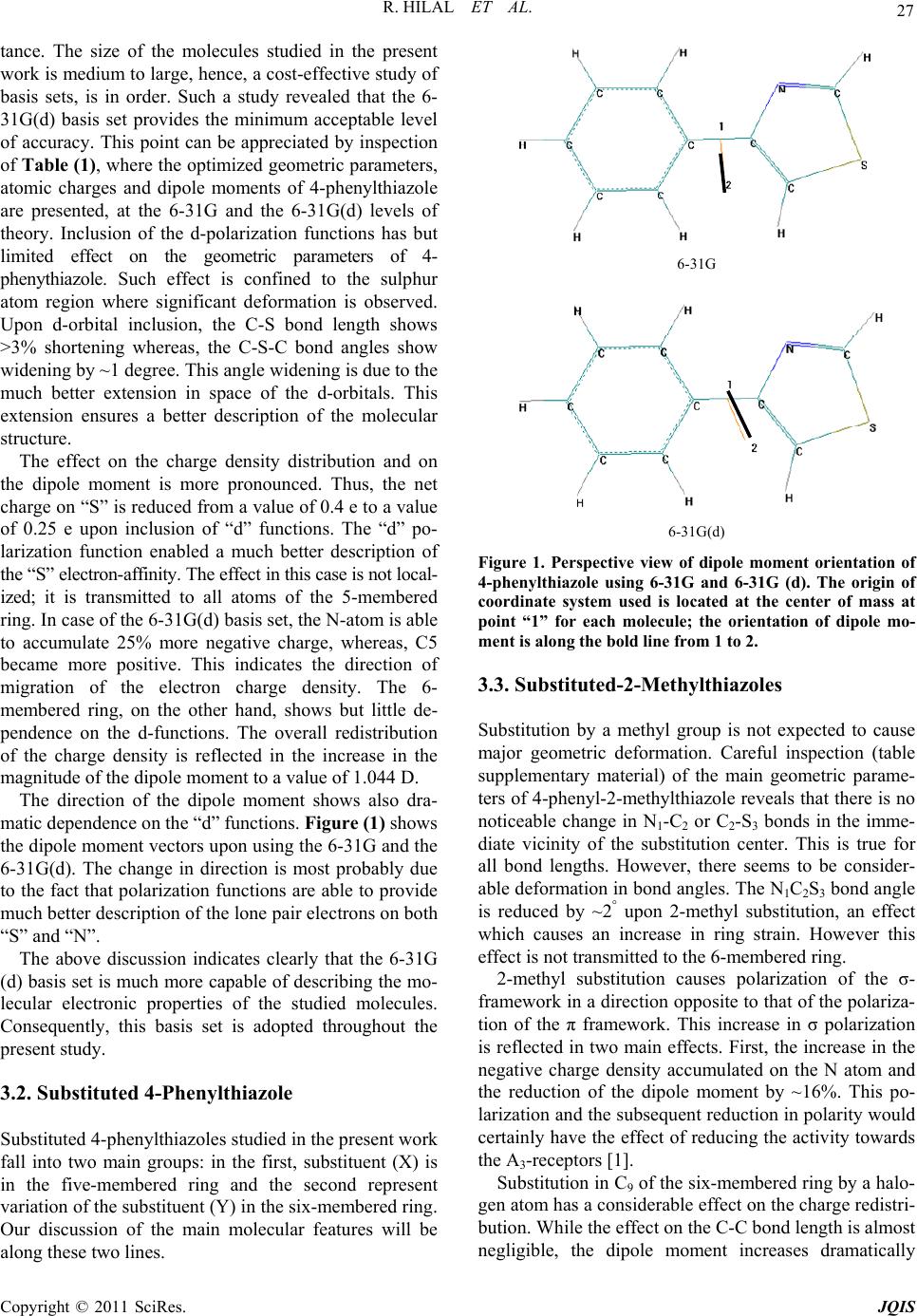 R. HILAL ET AL. Copyright © 2011 SciRes. JQIS 27 tance. The size of the molecules studied in the present work is medium to large, hence, a cost-effective study of basis sets, is in order. Such a study revealed that the 6- 31G(d) basis set provides the minimum acceptable level of accuracy. This point can be appreciated by inspection of Ta ble (1), where the optimized geometric parameters, atomic charges and dipole moments of 4-phenylthiazole are presented, at the 6-31G and the 6-31G(d) levels of theory. Inclusion of the d-polarization functions has but limited effect on the geometric parameters of 4- phenythiazole. Such effect is confined to the sulphur atom region where significant deformation is observed. Upon d-orbital inclusion, the C-S bond length shows >3% shortening whereas, the C-S-C bond angles show widening by ~1 degree. This angle widening is due to the much better extension in space of the d-orbitals. This extension ensures a better description of the molecular structure. The effect on the charge density distribution and on the dipole moment is more pronounced. Thus, the net charge on “S” is reduced from a value of 0.4 e to a value of 0.25 e upon inclusion of “d” functions. The “d” po- larization function enabled a much better description of the “S” electron-affinity. The effect in this case is not local- ized; it is transmitted to all atoms of the 5-membered ring. In case of the 6-31G(d) basis set, the N-atom is able to accumulate 25% more negative charge, whereas, C5 became more positive. This indicates the direction of migration of the electron charge density. The 6- membered ring, on the other hand, shows but little de- pendence on the d-functions. The overall redistribution of the charge density is reflected in the increase in the magnitude of the dipole moment to a value of 1.044 D. The direction of the dipole moment shows also dra- matic dependence on the “d” functions. Figur e ( 1 ) shows the dipole moment vectors upon using the 6-31G and the 6-31G(d). The change in direction is most probably due to the fact that polarization functions are able to provide much better description of the lone pair electrons on both “S” and “N”. The above discussion indicates clearly that the 6-31G (d) basis set is much more capable of describing the mo- lecular electronic properties of the studied molecules. Consequently, this basis set is adopted throughout the present study. 3.2. Substituted 4-Phenylthiazole Substituted 4-phenylthiazoles studied in the present work fall into two main groups: in the first, substituent (X) is in the five-membered ring and the second represent variation of the substituent (Y) in the six-membered ring. Our discussion of the main molecular features will be along these two lines. 6-31G 6-31G(d) Figure 1. Perspective view of dipole moment orientation of 4-phenylthiazole using 6-31G and 6-31G (d). The origin of coordinate system used is located at the center of mass at point “1” for each molecule; the orientation of dipole mo- ment is along the bold line from 1 to 2. 3.3. Substituted-2-Methylthiazoles Substitution by a methyl group is not expected to cause major geometric deformation. Careful inspection (table supplementary material) of the main geometric parame- ters of 4-phenyl-2-methylthiazole reveals that there is no noticeable change in N1-C2 or C2-S3 bonds in the imme- diate vicinity of the substitution center. This is true for all bond lengths. However, there seems to be consider- able deformation in bond angles. The N1C2S3 bond angle is reduced by ~2° upon 2-methyl substitution, an effect which causes an increase in ring strain. However this effect is not transmitted to the 6-membered ring. 2-methyl substitution causes polarization of the σ- framework in a direction opposite to that of the polariza- tion of the π framework. This increase in σ polarization is reflected in two main effects. First, the increase in the negative charge density accumulated on the N atom and the reduction of the dipole moment by ~16%. This po- larization and the subsequent reduction in polarity would certainly have the effect of reducing the activity towards the A3-receptors [1]. Substitution in C9 of the six-membered ring by a halo- gen atom has a considerable effect on the charge redistri- bution. While the effect on the C-C bond length is almost negligible, the dipole moment increases dramatically 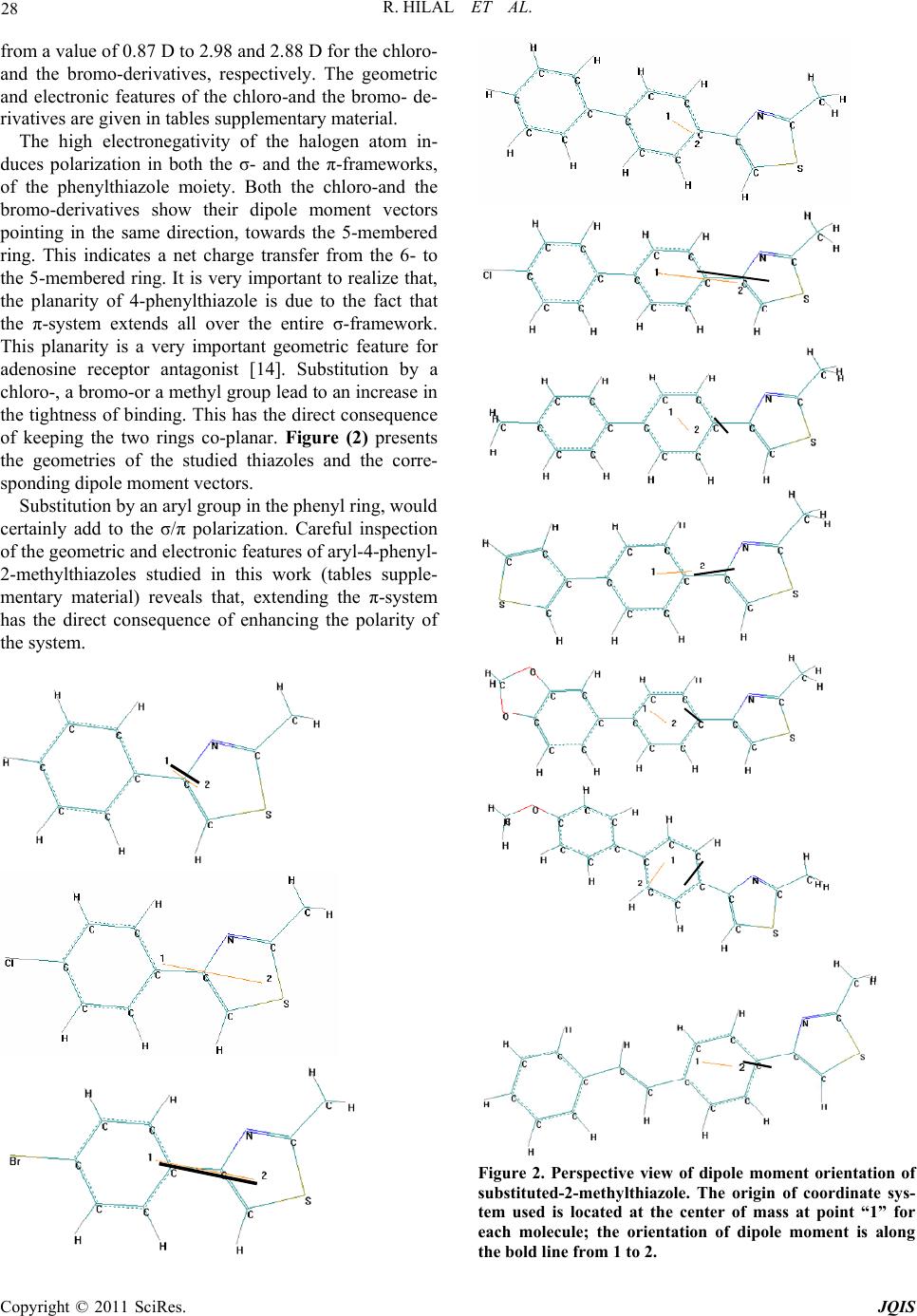 R. HILAL ET AL. Copyright © 2011 SciRes. JQIS 28 from a value of 0.87 D to 2.98 and 2.88 D for the chloro- and the bromo-derivatives, respectively. The geometric and electronic features of the chloro-and the bromo- de- rivatives are given in tables supplementary material. The high electronegativity of the halogen atom in- duces polarization in both the σ- and the π-frameworks, of the phenylthiazole moiety. Both the chloro-and the bromo-derivatives show their dipole moment vectors pointing in the same direction, towards the 5-membered ring. This indicates a net charge transfer from the 6- to the 5-membered ring. It is very important to realize that, the planarity of 4-phenylthiazole is due to the fact that the π-system extends all over the entire σ-framework. This planarity is a very important geometric feature for adenosine receptor antagonist [14]. Substitution by a chloro-, a bromo-or a methyl group lead to an increase in the tightness of binding. This has the direct consequence of keeping the two rings co-planar. Figure (2) presents the geometries of the studied thiazoles and the corre- sponding dipole moment vectors. Substitution by an aryl group in the phenyl ring, would certainly add to the σ/π polarization. Careful inspection of the geometric and electronic features of aryl-4-phenyl- 2-methylthiazoles studied in this work (tables supple- mentary material) reveals that, extending the π-system has the direct consequence of enhancing the polarity of the system. Figure 2. Perspective view of dipole moment orientation of substituted-2-methylthiazole. The origin of coordinate sys- tem used is located at the center of mass at point “1” for each molecule; the orientation of dipole moment is along the bold line from 1 to 2. 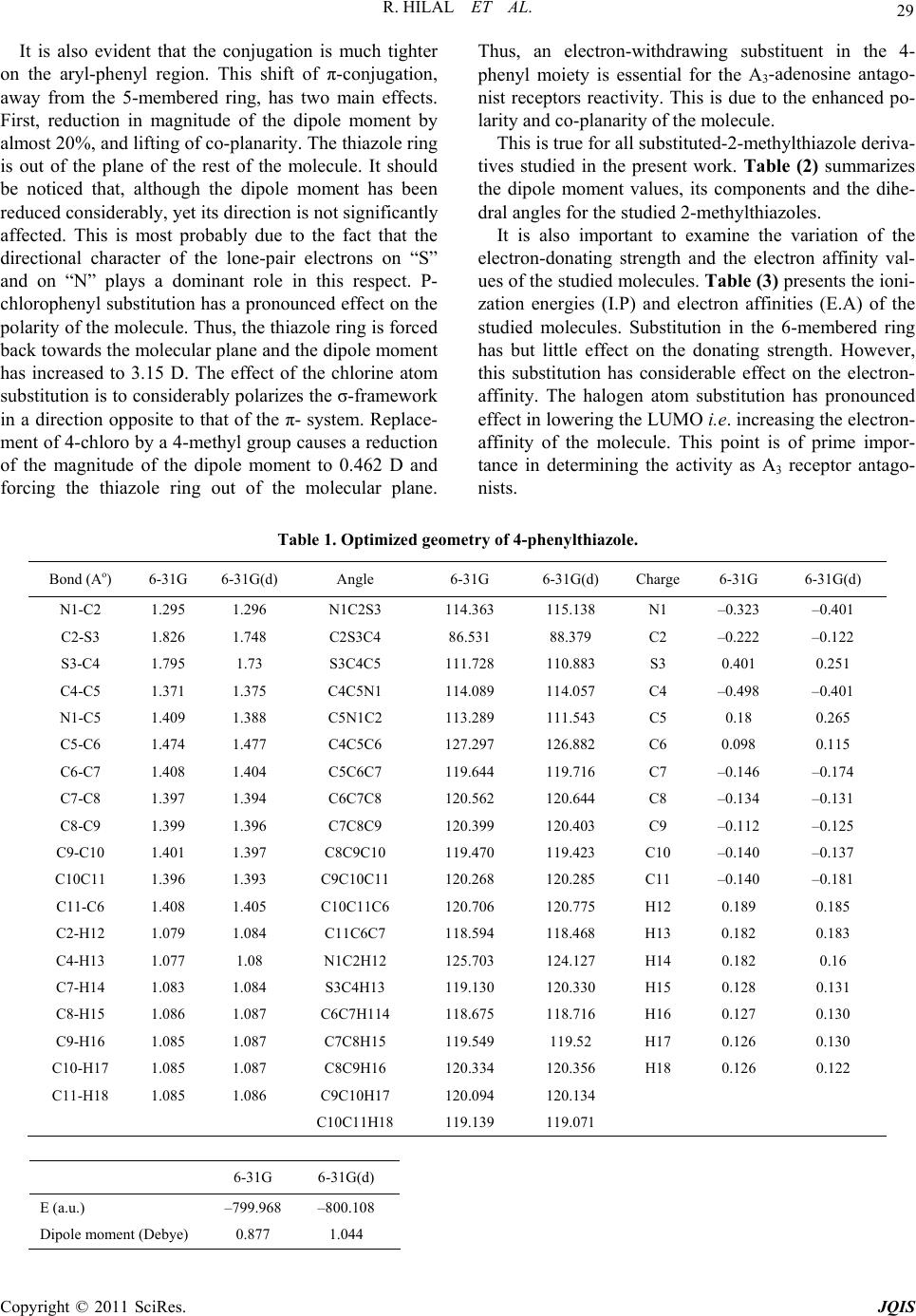 R. HILAL ET AL. Copyright © 2011 SciRes. JQIS 29 It is also evident that the conjugation is much tighter on the aryl-phenyl region. This shift of π-conjugation, away from the 5-membered ring, has two main effects. First, reduction in magnitude of the dipole moment by almost 20%, and lifting of co-planarity. The thiazole ring is out of the plane of the rest of the molecule. It should be noticed that, although the dipole moment has been reduced considerably, yet its direction is not significantly affected. This is most probably due to the fact that the directional character of the lone-pair electrons on “S” and on “N” plays a dominant role in this respect. P- chlorophenyl substitution has a pronounced effect on the polarity of the molecule. Thus, the thiazole ring is forced back towards the molecular plane and the dipole moment has increased to 3.15 D. The effect of the chlorine atom substitution is to considerably polarizes the σ-framework in a direction opposite to that of the π- system. Replace- ment of 4-chloro by a 4-methyl group causes a reduction of the magnitude of the dipole moment to 0.462 D and forcing the thiazole ring out of the molecular plane. Thus, an electron-withdrawing substituent in the 4- phenyl moiety is essential for the A3-adenosine antago- nist receptors reactivity. This is due to the enhanced po- larity and co-planarity of the molecule. This is true for all substituted-2-methylthiazole deriva- tives studied in the present work. Table (2) summarizes the dipole moment values, its components and the dihe- dral angles for the studied 2-methylthiazoles. It is also important to examine the variation of the electron-donating strength and the electron affinity val- ues of the studied molecules. Table (3) presents the ioni- zation energies (I.P) and electron affinities (E.A) of the studied molecules. Substitution in the 6-membered ring has but little effect on the donating strength. However, this substitution has considerable effect on the electron- affinity. The halogen atom substitution has pronounced effect in lowering the LUMO i.e. increasing the electron- affinity of the molecule. This point is of prime impor- tance in determining the activity as A3 receptor antago- nists. Table 1. Optimized geometry of 4-phenylthiazole. Bond (Ao) 6-31G 6-31G(d) Angle 6-31G 6-31G(d) Charge 6-31G 6-31G(d) N1-C2 1.295 1.296 N1C2S3 114.363 115.138 N1 –0.323 –0.401 C2-S3 1.826 1.748 C2S3C4 86.531 88.379 C2 –0.222 –0.122 S3-C4 1.795 1.73 S3C4C5 111.728 110.883 S3 0.401 0.251 C4-C5 1.371 1.375 C4C5N1 114.089 114.057 C4 –0.498 –0.401 N1-C5 1.409 1.388 C5N1C2 113.289 111.543 C5 0.18 0.265 C5-C6 1.474 1.477 C4C5C6 127.297 126.882 C6 0.098 0.115 C6-C7 1.408 1.404 C5C6C7 119.644 119.716 C7 –0.146 –0.174 C7-C8 1.397 1.394 C6C7C8 120.562 120.644 C8 –0.134 –0.131 C8-C9 1.399 1.396 C7C8C9 120.399 120.403 C9 –0.112 –0.125 C9-C10 1.401 1.397 C8C9C10 119.470 119.423 C10 –0.140 –0.137 C10C11 1.396 1.393 C9C10C11 120.268 120.285 C11 –0.140 –0.181 C11-C6 1.408 1.405 C10C11C6 120.706 120.775 H12 0.189 0.185 C2-H12 1.079 1.084 C11C6C7 118.594 118.468 H13 0.182 0.183 C4-H13 1.077 1.08 N1C2H12 125.703 124.127 H14 0.182 0.16 C7-H14 1.083 1.084 S3C4H13 119.130 120.330 H15 0.128 0.131 C8-H15 1.086 1.087 C6C7H114 118.675 118.716 H16 0.127 0.130 C9-H16 1.085 1.087 C7C8H15 119.549 119.52 H17 0.126 0.130 C10-H17 1.085 1.087 C8C9H16 120.334 120.356 H18 0.126 0.122 C11-H18 1.085 1.086 C9C10H17 120.094 120.134 C10C11H18 119.139 119.071 6-31G 6-31G(d) E (a.u.) –799.968 –800.108 Dipole moment (Debye) 0.877 1.044 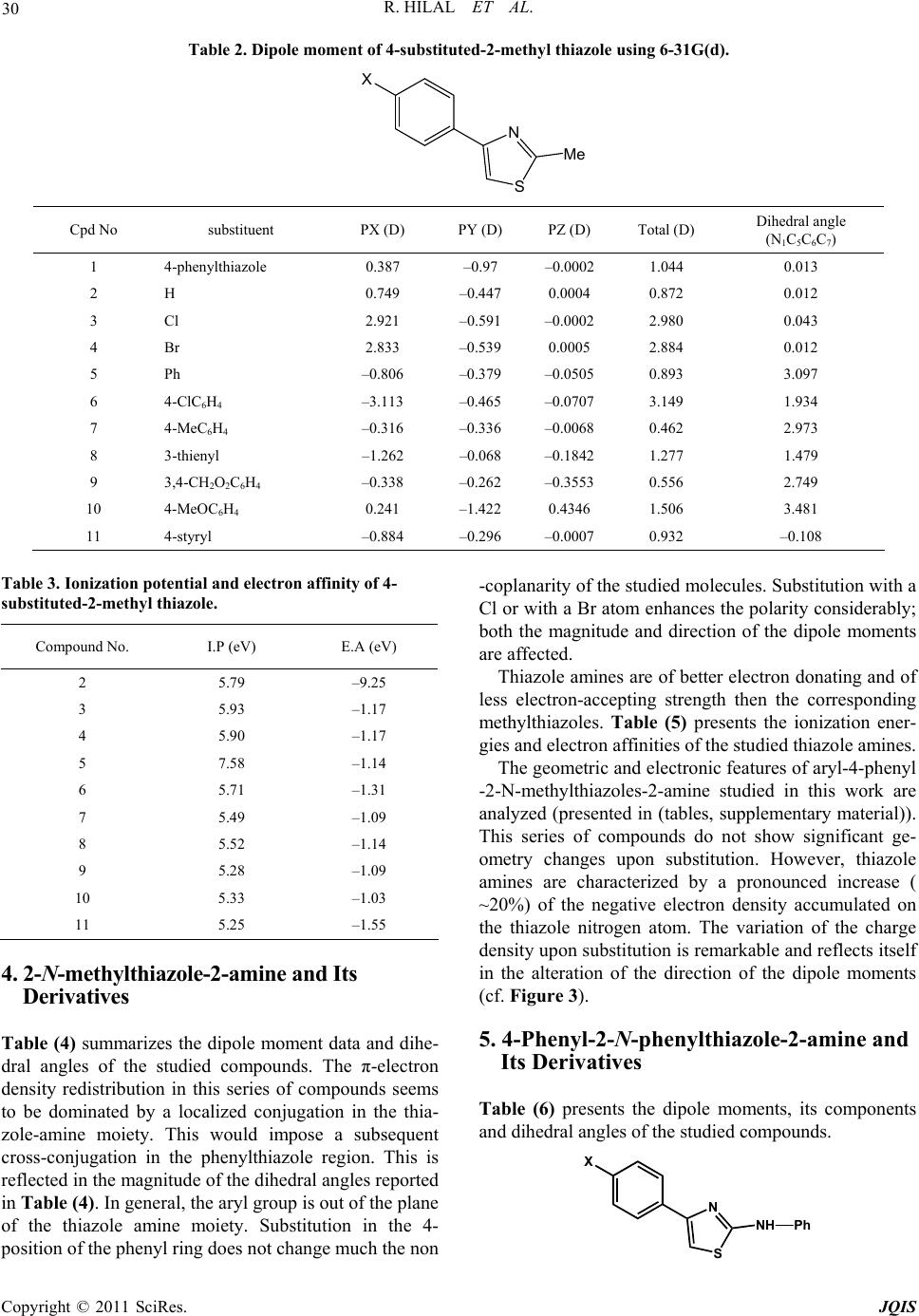 R. HILAL ET AL. Copyright © 2011 SciRes. JQIS 30 Table 2. Dipole moment of 4-substituted-2-methyl thiazole using 6-31G(d). S N X Me Cpd No substituent PX (D) PY (D) PZ (D) Total (D) Dihedral angle (N1C5C6C7) 1 4-phenylthiazole 0.387 –0.97 –0.0002 1.044 0.013 2 H 0.749 –0.447 0.0004 0.872 0.012 3 Cl 2.921 –0.591 –0.0002 2.980 0.043 4 Br 2.833 –0.539 0.0005 2.884 0.012 5 Ph –0.806 –0.379 –0.0505 0.893 3.097 6 4-ClC6H4 –3.113 –0.465 –0.0707 3.149 1.934 7 4-MeC6H4 –0.316 –0.336 –0.0068 0.462 2.973 8 3-thienyl –1.262 –0.068 –0.1842 1.277 1.479 9 3,4-CH2O2C6H4 –0.338 –0.262 –0.3553 0.556 2.749 10 4-MeOC6H4 0.241 –1.422 0.4346 1.506 3.481 11 4-styryl –0.884 –0.296 –0.0007 0.932 –0.108 Table 3. Ionization potential and electron affinity of 4- substituted-2-methyl thiazole. Compound No. I.P (eV) E.A (eV) 2 5.79 –9.25 3 5.93 –1.17 4 5.90 –1.17 5 7.58 –1.14 6 5.71 –1.31 7 5.49 –1.09 8 5.52 –1.14 9 5.28 –1.09 10 5.33 –1.03 11 5.25 –1.55 4. 2-N-methylthiaz ole-2-amine and Its Derivatives Table (4) summarizes the dipole moment data and dihe- dral angles of the studied compounds. The π-electron density redistribution in this series of compounds seems to be dominated by a localized conjugation in the thia- zole-amine moiety. This would impose a subsequent cross-conjugation in the phenylthiazole region. This is reflected in the magnitude of the dihedral angles reported in Table (4). In general, the aryl group is out of the plane of the thiazole amine moiety. Substitution in the 4- position of the phenyl ring does not change much the non -coplanarity of the studied molecules. Substitution with a Cl or with a Br atom enhances the polarity considerably; both the magnitude and direction of the dipole moments are affected. Thiazole amines are of better electron donating and of less electron-accepting strength then the corresponding methylthiazoles. Table (5) presents the ionization ener- gies and electron affinities of the studied thiazole amines. The geometric and electronic features of aryl-4-phenyl -2-N-methylthiazoles-2-amine studied in this work are analyzed (presented in (tables, supplementary material)). This series of compounds do not show significant ge- ometry changes upon substitution. However, thiazole amines are characterized by a pronounced increase ( ~20%) of the negative electron density accumulated on the thiazole nitrogen atom. The variation of the charge density upon substitution is remarkable and reflects itself in the alteration of the direction of the dipole moments (cf. Figure 3). 5. 4-Phenyl-2-N-phenylthiazole-2-amine and Its Derivatives Table (6) presents the dipole moments, its components and dihedral angles of the studied compounds. S N X NH Ph 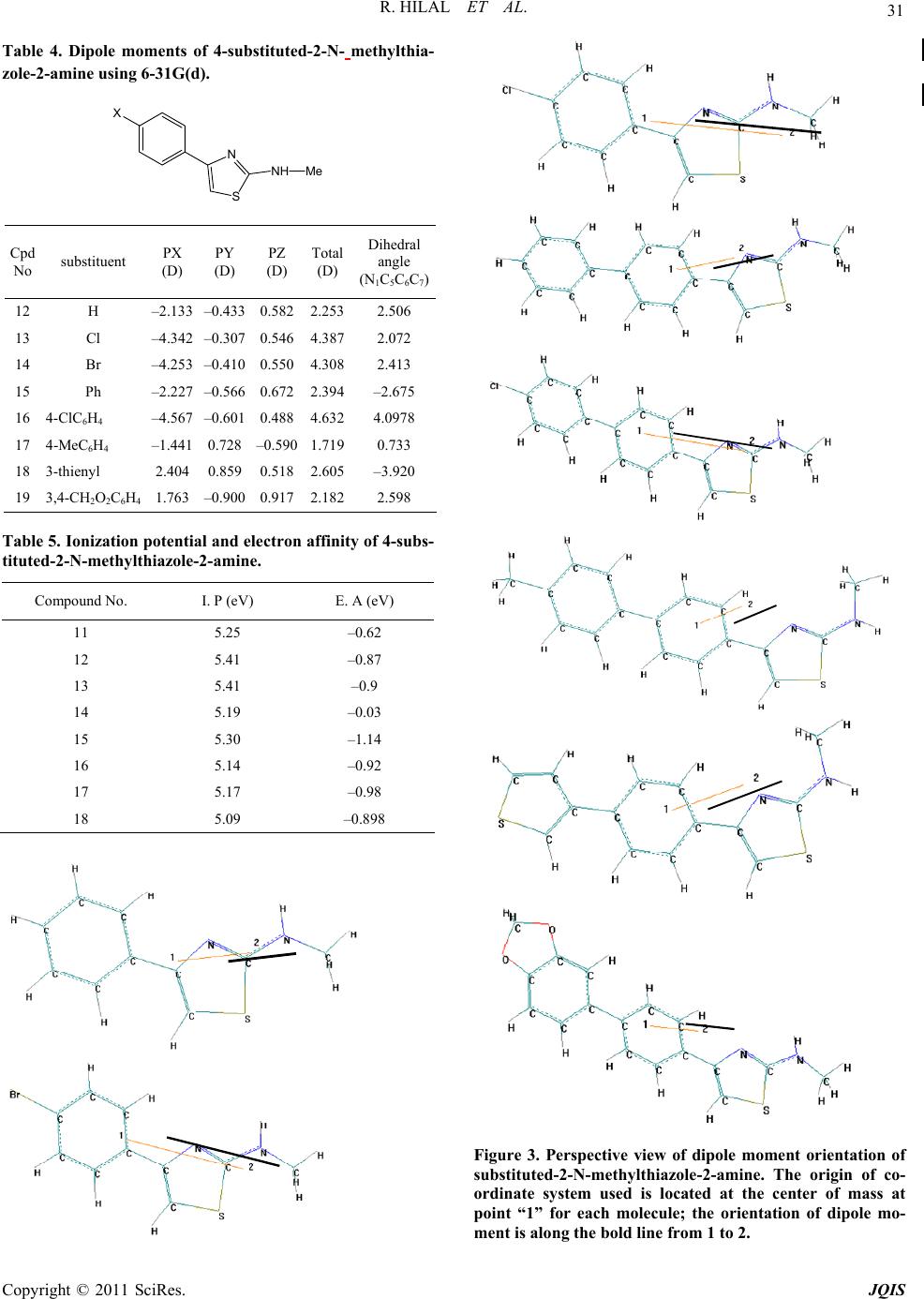 R. HILAL ET AL. Copyright © 2011 SciRes. JQIS 31 Table 4. Dipole moments of 4-substituted-2-N- methylthia- zole-2-amine using 6-31G(d). S N X NH Me Cpd No substituent PX (D) PY (D) PZ (D) Total (D) Dihedral angle (N1C5C6C7) 12 H –2.133 –0.433 0.582 2.253 2.506 13 Cl –4.342 –0.307 0.546 4.387 2.072 14 Br –4.253 –0.410 0.550 4.308 2.413 15 Ph –2.227 –0.566 0.672 2.394 –2.675 16 4-ClC6H4 –4.567 –0.601 0.488 4.632 4.0978 17 4-MeC6H4 –1.441 0.728 –0.590 1.719 0.733 18 3-thienyl 2.404 0.859 0.518 2.605 –3.920 19 3,4-CH2O2C6H4 1.763 –0.900 0.917 2.182 2.598 Table 5. Ionization potential and electron affinity of 4-subs- tituted-2-N-methylthiazole-2-amine. Compound No. I. P (eV) E. A (eV) 11 5.25 –0.62 12 5.41 –0.87 13 5.41 –0.9 14 5.19 –0.03 15 5.30 –1.14 16 5.14 –0.92 17 5.17 –0.98 18 5.09 –0.898 Figure 3. Perspective view of dipole moment orientation of substituted-2-N-methylthiazole-2-amine. The origin of co- ordinate system used is located at the center of mass at point “1” for each molecule; the orientation of dipole mo- ment is along the bold line from 1 to 2. 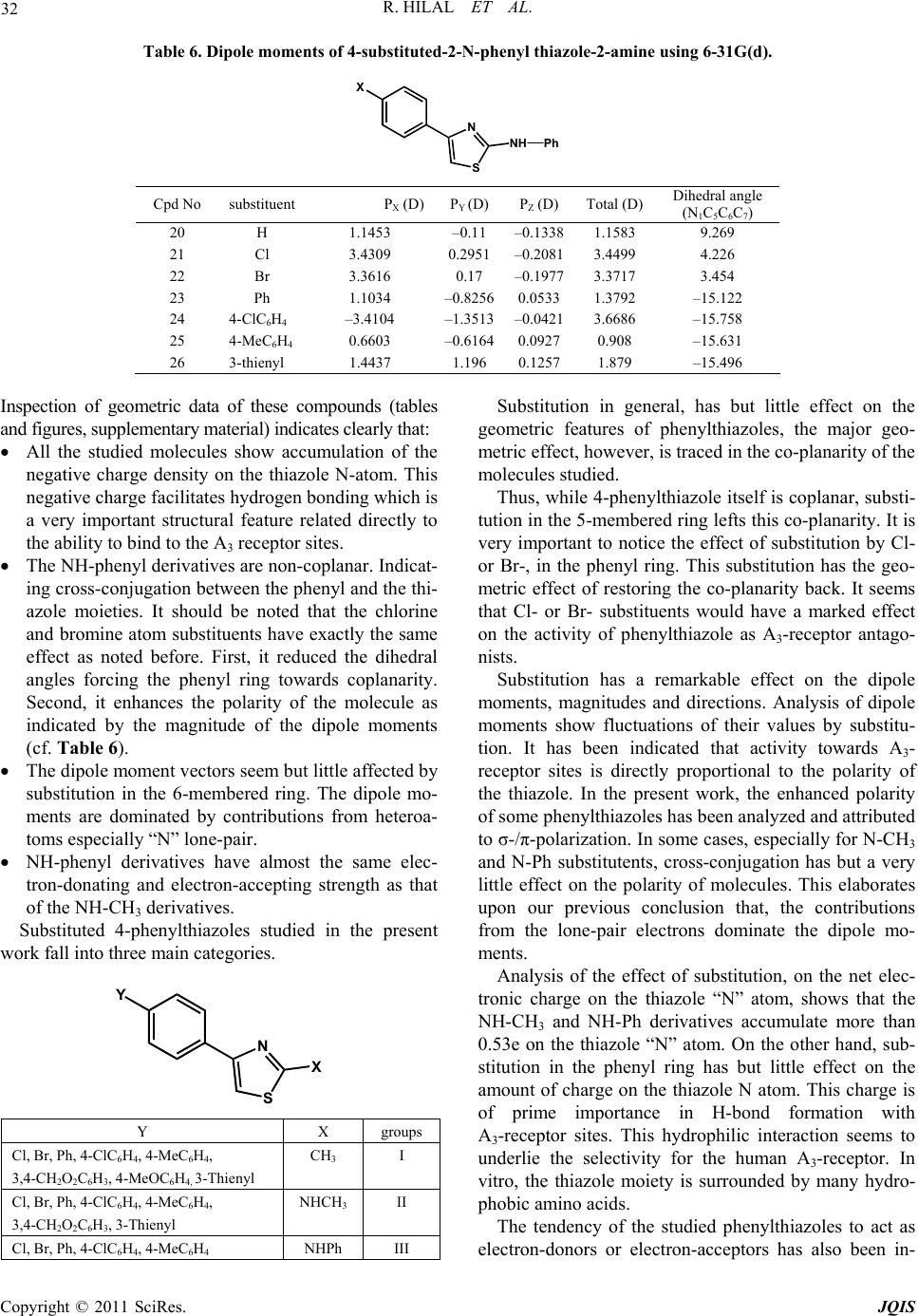 R. HILAL ET AL. Copyright © 2011 SciRes. JQIS 32 Table 6. Dipole moments of 4-substituted-2-N-phenyl thiazole-2-amine using 6-31G(d). S N X NH Ph Cpd No substituent PX (D)PY (D) PZ (D) Total (D)Dihedral angle (N1C5C6C7) 20 H 1.1453 –0.11 –0.13381.1583 9.269 21 Cl 3.4309 0.2951–0.20813.4499 4.226 22 Br 3.3616 0.17 –0.19773.3717 3.454 23 Ph 1.1034 –0.82560.05331.3792 –15.122 24 4-ClC6H4 –3.4104 –1.3513–0.04213.6686 –15.758 25 4-MeC6H4 0.6603 –0.61640.09270.908 –15.631 26 3-thienyl 1.4437 1.196 0.12571.879 –15.496 Inspection of geometric data of these compounds (tables and figures, supplementary material) indicates clearly that: All the studied molecules show accumulation of the negative charge density on the thiazole N-atom. This negative charge facilitates hydrogen bonding which is a very important structural feature related directly to the ability to bind to the A3 receptor sites. The NH-phenyl derivatives are non-coplanar. Indicat- ing cross-conjugation between the phenyl and the thi- azole moieties. It should be noted that the chlorine and bromine atom substituents have exactly the same effect as noted before. First, it reduced the dihedral angles forcing the phenyl ring towards coplanarity. Second, it enhances the polarity of the molecule as indicated by the magnitude of the dipole moments (cf. Table 6). The dipole moment vectors seem but little affected by substitution in the 6-membered ring. The dipole mo- ments are dominated by contributions from heteroa- toms especially “N” lone-pair. NH-phenyl derivatives have almost the same elec- tron-donating and electron-accepting strength as that of the NH-CH3 derivatives. Substituted 4-phenylthiazoles studied in the present work fall into three main categories. S N Y X Y X groups Cl, Br, Ph, 4-ClC6H4, 4-MeC6H4, 3,4-CH2O2C6H3, 4-MeOC6H4, 3-Thienyl CH3 I Cl, Br, Ph, 4-ClC6H4, 4-MeC6H4, 3,4-CH2O2C6H3, 3-Thienyl NHCH3 II Cl, Br, Ph, 4-ClC6H4, 4-MeC6H4 NHPh III Substitution in general, has but little effect on the geometric features of phenylthiazoles, the major geo- metric effect, however, is traced in the co-planarity of the molecules studied. Thus, while 4-phenylthiazole itself is coplanar, substi- tution in the 5-membered ring lefts this co-planarity. It is very important to notice the effect of substitution by Cl- or Br-, in the phenyl ring. This substitution has the geo- metric effect of restoring the co-planarity back. It seems that Cl- or Br- substituents would have a marked effect on the activity of phenylthiazole as A3-receptor antago- nists. Substitution has a remarkable effect on the dipole moments, magnitudes and directions. Analysis of dipole moments show fluctuations of their values by substitu- tion. It has been indicated that activity towards A3- receptor sites is directly proportional to the polarity of the thiazole. In the present work, the enhanced polarity of some phenylthiazoles has been analyzed and attributed to σ-/π-polarization. In some cases, especially for N-CH3 and N-Ph substitutents, cross-conjugation has but a very little effect on the polarity of molecules. This elaborates upon our previous conclusion that, the contributions from the lone-pair electrons dominate the dipole mo- ments. Analysis of the effect of substitution, on the net elec- tronic charge on the thiazole “N” atom, shows that the NH-CH3 and NH-Ph derivatives accumulate more than 0.53e on the thiazole “N” atom. On the other hand, sub- stitution in the phenyl ring has but little effect on the amount of charge on the thiazole N atom. This charge is of prime importance in H-bond formation with A3-receptor sites. This hydrophilic interaction seems to underlie the selectivity for the human A3-receptor. In vitro, the thiazole moiety is surrounded by many hydro- phobic amino acids. The tendency of the studied phenylthiazoles to act as electron-donors or electron-acceptors has also been in- 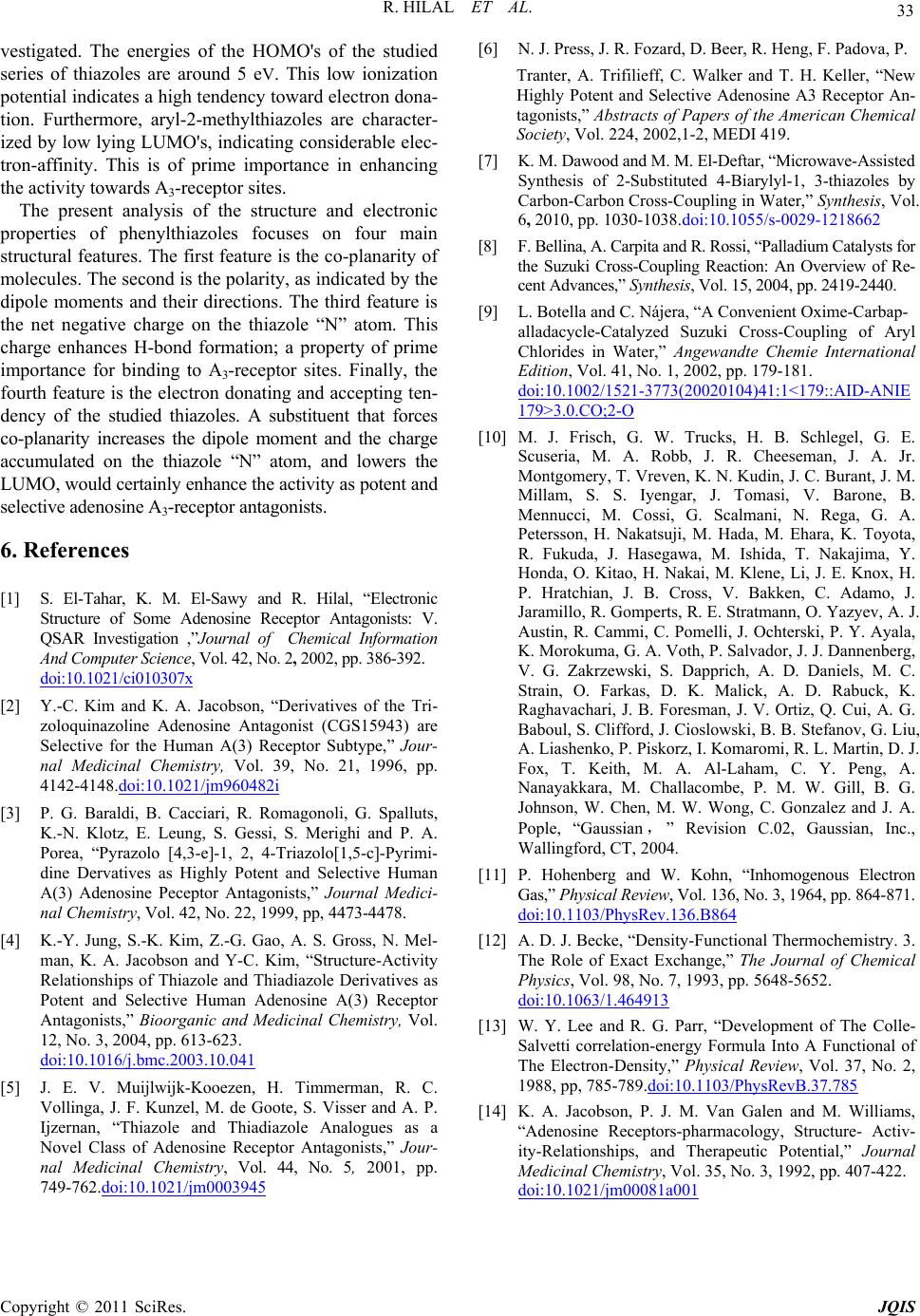 R. HILAL ET AL. Copyright © 2011 SciRes. JQIS 33 vestigated. The energies of the HOMO's of the studied series of thiazoles are around 5 eV. This low ionization potential indicates a high tendency toward electron dona- tion. Furthermore, aryl-2-methylthiazoles are character- ized by low lying LUMO's, indicating considerable elec- tron-affinity. This is of prime importance in enhancing the activity towards A3-receptor sites. The present analysis of the structure and electronic properties of phenylthiazoles focuses on four main structural features. The first feature is the co-planarity of molecules. The second is the polarity, as indicated by the dipole moments and their directions. The third feature is the net negative charge on the thiazole “N” atom. This charge enhances H-bond formation; a property of prime importance for binding to A3-receptor sites. Finally, the fourth feature is the electron donating and accepting ten- dency of the studied thiazoles. A substituent that forces co-planarity increases the dipole moment and the charge accumulated on the thiazole “N” atom, and lowers the LUMO, would certainly enhance the activity as potent and selective adenosine A3-receptor antagonists. 6. References [1] S. El-Tahar, K. M. El-Sawy and R. Hilal, “Electronic Structure of Some Adenosine Receptor Antagonists: V. QSAR Investigation ,”Journal of Chemical Information And Computer Science, Vol. 42, No. 2, 2002, pp. 386-392. doi:10.1021 /ci010307x [2] Y.-C. Kim and K. A. Jacobson, “Derivatives of the Tri- zoloquinazoline Adenosine Antagonist (CGS15943) are Selective for the Human A(3) Receptor Subtype,” Jour- nal Medicinal Chemistry, Vol. 39, No. 21, 1996, pp. 4142-4148.doi:10.1021/jm960482i [3] P. G. Baraldi, B. Cacciari, R. Romagonoli, G. Spalluts, K.-N. Klotz, E. Leung, S. Gessi, S. Merighi and P. A. Porea, “Pyrazolo [4,3-e]-1, 2, 4-Triazolo[1,5-c]-Pyrimi- dine Dervatives as Highly Potent and Selective Human A(3) Adenosine Peceptor Antagonists,” Journal Medici- nal Chemistry, Vol. 42, No. 22, 1999, pp, 4473-4478. [4] K.-Y. Jung, S.-K. Kim, Z.-G. Gao, A. S. Gross, N. Mel- man, K. A. Jacobson and Y-C. Kim, “Structure-Activity Relationships of Thiazole and Thiadiazole Derivatives as Potent and Selective Human Adenosine A(3) Receptor Antagonists,” Bioorganic and Medicinal Chemistry, Vol. 12, No. 3, 2004, pp. 613-623. doi:10.1016/j.bmc.2003.10.041 [5] J. E. V. Muijlwijk-Kooezen, H. Timmerman, R. C. Vollinga, J. F. Kunzel, M. de Goote, S. Visser and A. P. Ijzernan, “Thiazole and Thiadiazole Analogues as a Novel Class of Adenosine Receptor Antagonists,” Jour- nal Medicinal Chemistry, Vol. 44, No. 5, 2001, pp. 749-762.doi:10.1021/jm0003945 [6] N. J. Press, J. R. Fozard, D. Beer, R. Heng, F. Padova, P. Tranter, A. Trifilieff, C. Walker and T. H. Keller, “New Highly Potent and Selective Adenosine A3 Receptor An- tagonists,” Abstracts of Pape rs of the American Chemical Society, Vol. 224, 2002,1-2, MEDI 419. [7] K. M. Dawood and M. M. El-Deftar, “Microwave-Assisted Synthesis of 2-Substituted 4-Biarylyl-1, 3-thiazoles by Carbon-Carbon Cross-Coupling in Water,” Synthesis, Vol. 6, 2010, pp. 1030-1038.doi:10.1055/s-0029-1218662 [8] F. Bellina, A. Carpita and R. Rossi, “Palladium Catalysts for the Suzuki Cross-Coupling Reaction: An Overview of Re- cent Advances,” Synthesis, Vol. 15, 2004, pp. 2419-2440. [9] L. Botella and C. Nájera, “A Convenient Oxime-Carbap- alladacycle-Catalyzed Suzuki Cross-Coupling of Aryl Chlorides in Water,” Angewandte Chemie International Edition, Vol. 41, No. 1, 2002, pp. 179-181. doi:10.1002/1521-3773(20020104)41:1<179::AID-ANIE 179>3.0.CO;2-O [10] M. J. Frisch, G. W. Trucks, H. B. Schlegel, G. E. Scuseria, M. A. Robb, J. R. Cheeseman, J. A. Jr. Montgomery, T. Vreven, K. N. Kudin, J. C. Burant, J. M. Millam, S. S. Iyengar, J. Tomasi, V. Barone, B. Mennucci, M. Cossi, G. Scalmani, N. Rega, G. A. Petersson, H. Nakatsuji, M. Hada, M. Ehara, K. Toyota, R. Fukuda, J. Hasegawa, M. Ishida, T. Nakajima, Y. Honda, O. Kitao, H. Nakai, M. Klene, Li, J. E. Knox, H. P. Hratchian, J. B. Cross, V. Bakken, C. Adamo, J. Jaramillo, R. Gomperts, R. E. Stratmann, O. Yazyev, A. J. Austin, R. Cammi, C. Pomelli, J. Ochterski, P. Y. Ayala, K. Morokuma, G. A. Voth, P. Salvador, J. J. Dannenberg, V. G. Zakrzewski, S. Dapprich, A. D. Daniels, M. C. Strain, O. Farkas, D. K. Malick, A. D. Rabuck, K. Raghavachari, J. B. Foresman, J. V. Ortiz, Q. Cui, A. G. Baboul, S. Clifford, J. Cioslowski, B. B. Stefanov, G. Liu, A. Liashenko, P. Piskorz, I. Komaromi, R. L. Martin, D. J. Fox, T. Keith, M. A. Al-Laham, C. Y. Peng, A. Nanayakkara, M. Challacombe, P. M. W. Gill, B. G. Johnson, W. Chen, M. W. Wong, C. Gonzalez and J. A. Pople, “Gaussian,” Revision C.02, Gaussian, Inc., Wallingford, CT, 2004. [11] P. Hohenberg and W. Kohn, “Inhomogenous Electron Gas,” Physical Review, Vol. 136, No. 3, 1964, pp. 864-871. doi:10.1103/PhysRev.136.B864 [12] A. D. J. Becke, “Density-Functional Thermochemistry. 3. The Role of Exact Exchange,” The Journal of Chemical Physics, Vol. 98, No. 7, 1993, pp. 5648-5652. doi:10.1063/1.464913 [13] W. Y. Lee and R. G. Parr, “Development of The Colle- Salvetti correlation-energy Formula Into A Functional of The Electron-Density,” Physical Review, Vol. 37, No. 2, 1988, pp, 785-789.doi:10.1103/PhysRevB.37.785 [14] K. A. Jacobson, P. J. M. Van Galen and M. Williams, “Adenosine Receptors-pharmacology, Structure- Activ- ity-Relationships, and Therapeutic Potential,” Journal Medicinal Chemistry, Vol. 35, No. 3, 1992, pp. 407-422. doi:10.1021/jm00081a001 |