

Paper Menu >>
Journal Menu >>
 American Journal of Plant Sciences, 2011, 2, 217-222 doi:10.4236/ajps.2011.22023 Published Online June 2011 (http://www.SciRP.org/journal/ajps) Copyright © 2011 SciRes. AJPS In Vitro Somatic Embryogenesis in Some Oil Yielding Tropical Tree Species Premananda Das The Science Foundation for Tribal & Rural Resource Development, Bhubaneswar, India. Email: [email protected] Received February 20th, 2011; revised April 11th, 2011; accepted April 16th, 2011. ABSTRACT Somatic embryogenesis was achieved in two oil yielding tropical tree species i.e. Simarouba glauca & Azadirachta in- dica using immature zygotic embryos as explants on Murashige and Skoog (MS) medium supplemented with 0.5 - 1.5 mg/l benzylaminopurine (BA) and 2.0 - 3.0 mg/l NAA (1-napthaleneacetic acid) or 2,4-D (2,4-dichlorophenoxyacetic acid) and 3% sucrose. MS medium containing 1.0 mg/l BA and 2.0 mg/l NAA was noted to be the most effective in in- ducing friable embryogenic callus (FEC) in Simarouba glauca; the number of somatic embryos per culture varied in MS medium supplemented with 1.0 - 1.5 mg/l BA and 1.0 mg/l NAA. In Azad irachta ind ica, somatic emb ryos d eveloped on MS medium supplemented with 0.5 mg/l BA and 1.5 - 2.0 mg/l 2,4-D which were in various shapes and sizes after the first subculture on MS medium supplemented with 0.25 mg/l abscisic acid. The somatic embryos which developed shoots were isolated and rooted in 1/2 strength MS medium supplem ented with 0.25 mg/l abscisic acid and 2% sucrose. About 25% of embryos germinated within 20 days of culture in ca se of Simarouba glauca and 62% in Azadirachta in- dica. The so matic embryo-derived plantlets were transferred to the field after being hard ened in the climate contro lled hardening chamber. Keywords: Somatic Embryogenesis, Immature Zygotic Embryos, Growth Regulators, Oil Yielding Tropical Tree 1. Introduction Simarouba glauca Linn. (Simaroubaceae) a multipurpose fast growing tree from Amazon rainforest and other tropical areas in Mexico, Cuba, Haita, Jamaica and Cen- tral America is grown for seed oil, medicines, firewood and revegetation of barren wastelands even under mois- ture and nutrient stress. Azadirachta indica A.Juss. (Meliaceae), popularly called the neem tree, is distributed in the tropical and subtropical regions of the world [1]. A native of India and Myanmar, Azadirachta indica was introduced to Africa, the Middle East, South America and Australia. All parts of these plants including fruit, seed, leaf, root and bark are used for their medicinal pro- perties. The neem tree repor tedly contains more than 100 bioactive compounds. The most important bioactive com- pound is azadirachtin, other compounds are gedunin, nimbin and sodium nimbinate. Some plants of Simarouba glauca and Azadirachta indica bear fruits in profusion, hence were considered as elite candidates for cloning. Regeneration of plants via somatic embryogenesis has been preferred as a method for multiplication of valuable germplasm in many woody species. Somatic embryo- genesis was reported for a number of dicotyledonous and monocotyledonous angiosperms but fewer woody species [2-4]. Woody species were recalcitrant to in vitro cultu re and regeneration and most of those reports focused on propagation or multiplication through organogenesis us- ing various explants. There are number of reports on so- matic embryogenesis of woody species [5-11]. It was thought that plants must coordinate the growth of root and shoot meristems to maintain an appropriate balance of root and shoot organs, respond and adapt to various environmental conditions to achieve an inter-meristem coordination for growth and development involving the interplay of several long-range signals [12,13]. In this study the requirements of culture media, including environ- mental conditions for induction of somatic embryogenesis, maturation and germination of the somatic embryos in economically important oil yielding tropical tree species for their adaptability t o harsh conditi ons were investigated. 2. Materials and Methods 2.1. Plant Material Immature fruits (drupe) of Simarouba glauca and Aza-  In Vitro Somatic Embryogenesis in Some Oil Yielding Tropical Tree Species 218 dirachta indica were collected from elite trees growing in dry deciduous forests 50 - 60 days after fruit set. The fruits were washed with 2% (w/v) detergent solution (Teepol) for 10 min, further ringed with 70% ethanol for 1 min, surface sterilized with 0.1% (w/v) aqueous solu- tion of mercuric chloride for 15 min, followed by three 5 min rinses in sterile distilled water. Embryonic axis along with cotyledons were aseptically cultured on Murashige and Skoog [14] medium supplemented with various con- centrations of BA or Kn (0, 0.25, 0.5, 1.0, 1.5, 2.0 mg/l), NAA or 2,4-D (0, 0.5, 1.0, 1.5, 2.0, 3.0 mg/l) alone or in combinations for callus induction. The pH of the media was adjusted to 5.7 using 0.1N NaOH or 0.1N HCl prior to addition of 0.8% (w/v) agar (Qualigen, India). Rou- tinely, 20 ml of molten medium was dispensed into 25 × 150 mm glass tubes (Borosil, India), capped with non- absorbent cotton plugs wrapped in one layer of cheese- cloth. The cultures were sterilized at 121˚C and 104 kPa for 15 mi n. 2.2. Induction of Somatic Embryogenesis Callus mass (500 ± 20 mg) was transferred to MS me- dium supplemented with different concentrations of BA, kinetin and 2,4-D or NAA (0, 0.25, 0.5, 1.0, 1.5, 2.0 , 2.5 and 3.0 mg/l) singly or in combinations for induction of somatic embryogenesis. L-proline or L-glutamine was added to the culture medium to enhance the embryogenic potential. The cultures were incubated under 16h photo- period with light intensity of 55 µmol·m–2·s–1 provided by cool, white fluorescent lamps (Phillips, India) at 25˚C ± 2˚C. Subculturing was made every 4 week intervals. The media were solidified with 0.8% agar-agar. Mor- phological changes were recorded through visual obser- vations at 3-week intervals. The embryogenic response and number of somatic embryos per culture were re- corded. Each treatment had 20 replicates and the experi- ment was repeated three times. Data were also recorded in respect to embryogenic frequency, number of embryos and frequency of normal embryos per culture. 2.3. Maturation and Germination of Somatic Embryos The somatic embryos were transferred to various culture media with (0.1 - 0.25 mg/l abscisic acid and 2% sucrose) or without growth regulators for maturation and germi- nation. The cultures were routinely sub-cultured at 4-week intervals. In another experiment, the cultures were kept in the dark for 2 weeks which were then trans- ferred to the light for germination of somatic embryos. In all the experiments, each treatment consisted of 10 repli- cations and the experiments were repeated three times. The somatic embryos were transferred to 1/2 MS me- dium supplemented with 2% sucrose and abscisic acid (0.1 - 0.25 mg/l) for germination. 3. Results and Discussion 3.1. Induction of Somatic Embryogenesis The effects of the different growth regulators on em- bryogenic callus induction are indicated in Table 1. Fri- able calli developed from immature zygotic embryos within 3 - 4 weeks of culture on MS medium supple- mented with various concentrations of auxins and cyto- kinins. The maximum proliferation of callu s was noted in the medium containing BA and NAA or 2,4-D. Kinetin was not as effective in callus induction as BA. BA with 2,4-D in the medium was observed to be better for callus proliferation. The proliferated calli were subsequently sub-cultured on various media for embryogenesis. Em- bryogenic callus mass developed on MS medium sup- plemented with 0.5 - 2.0 mg/l BA and 2.0 - 3.0 mg/l NAA in S. glauca and 0.5 mg/l BA and 1.0 - 2.0 mg/l 2,4-D in case of A. indica.. The medium devoid of growth regulators did not help in proliferation of em- bryogenic calli. The maximum rate of embryogenic cal- lus proliferation was noted on MS medium supplemented with 1.0 - 1.5 mg/l BA and 2.0 mg/l NAA in Simarouba glauca and 0.5 - 1.0 mg/l BA and 1.0 - 2.0 mg/l 2,4-D in Azadirachta indica (Figures 1(a)-(b) and 2(a), Tabl e 1). Proliferation of friable embryogenic calli in terms of fresh weight was better in the medium having BA as compared to Kn. Similar responses were observed when 2,4-D was replaced with NAA. BA at a concentration of 1.0 mg/l along with 2.0 mg/l NAA improved the rate of embryogenic callus proliferation and improved the pro- duction of somatic embryos per culture; though NAA helped in th e proliferation of embryogenic callu s as good as the 2,4-D, few somatic embryos developed in Sima- rouba glauca. However, the medium supplemented with 0.5 mg/l BA and 1.5 mg/l 2,4-D showed a higher rate of proliferation of embryogenic calli in A. indica (Table 2). Embryogenic callus induction was faster in S. glauca in the media containing NAA as compared to those having 2,4-D; 2,4-D, however, showed better results in A. indica. Embryo development in somatic cells was often accom- panied with cellular stress. Moreover, NAA, the most frequently used compound for induction of somatic em- bryogenesis (Figure 2(b)), was known to activate many stress related genes supporting the hypothesis that somati c embryogenesis resulted due to extreme stress response of cultured cells. Proline acted as a potential antioxidant, which helped in ameliorating the stress [15]. Moon et al [8] reported that MS medium containing 3% sucrose, 1.0 g/l glutamine along with 2,4-D helped in development of somatic embryos in Oplopanax elatus. ABA and acti- ated charcoal appeared to be very important agents for v Copyright © 2011 SciRes. AJPS 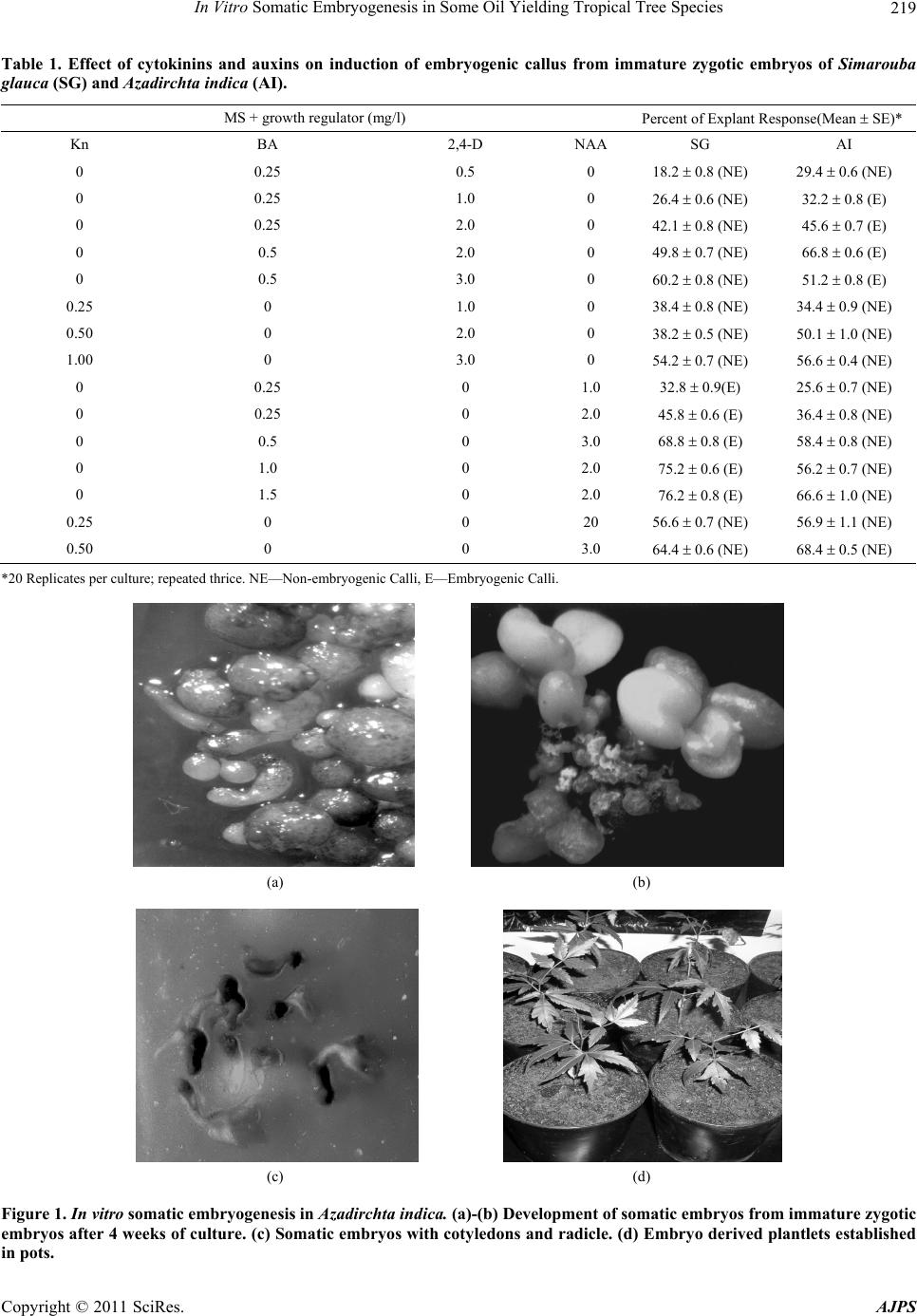 In Vitro Somatic Embryogenesis in Some Oil Yielding Tropical Tree Species Copyright © 2011 SciRes. AJPS 219 Table 1. Effect of cytokinins and auxins on induction of embryogenic callus from immature zygotic embryos of Simarouba glauca (SG) and Azadirchta indica (AI). MS + growth regulator (mg/l) Percent of Explant Response(Mean SE)* Kn BA 2,4-D NAA SG AI 0 0.25 0.5 0 18.2 0.8 (NE) 29.4 0.6 (NE) 0 0.25 1.0 0 26.4 0.6 (NE) 32.2 0.8 (E) 0 0.25 2.0 0 42.1 0.8 (NE) 45.6 0.7 (E) 0 0.5 2.0 0 49.8 0.7 (NE) 66.8 0.6 (E) 0 0.5 3.0 0 60.2 0.8 (NE) 51.2 0.8 (E) 0.25 0 1.0 0 38.4 0.8 (NE) 34.4 0.9 (NE) 0.50 0 2.0 0 38.2 0.5 (NE) 50.1 1.0 (NE) 1.00 0 3.0 0 54.2 0.7 (NE) 56.6 0.4 (NE) 0 0.25 0 1.0 32.8 0.9(E) 25.6 0.7 (NE) 0 0.25 0 2.0 45.8 0.6 (E) 36.4 0.8 (NE) 0 0.5 0 3.0 68.8 0.8 (E) 58.4 0.8 (NE) 0 1.0 0 2.0 75.2 0.6 (E) 56.2 0.7 (NE) 0 1.5 0 2.0 76.2 0.8 (E) 66.6 1.0 (NE) 0.25 0 0 20 56.6 0.7 (NE) 56.9 1.1 (NE) 0.50 0 0 3.0 64.4 0.6 (NE) 68.4 0.5 (NE) *20 Replicates per culture; repeated thrice. NE—Non-embryogenic Ca l li, E—E mbryogenic Calli. (a) (b) (c) (d) Figure 1. In vitro somatic embryogenesis in Azadirchta indica. (a)-(b) Development of somatic embryos from immature zygotic embryos after 4 weeks of culture. (c) Somatic embryos with cotyledons and radicle. (d) Embryo derived plantlets established in pots. 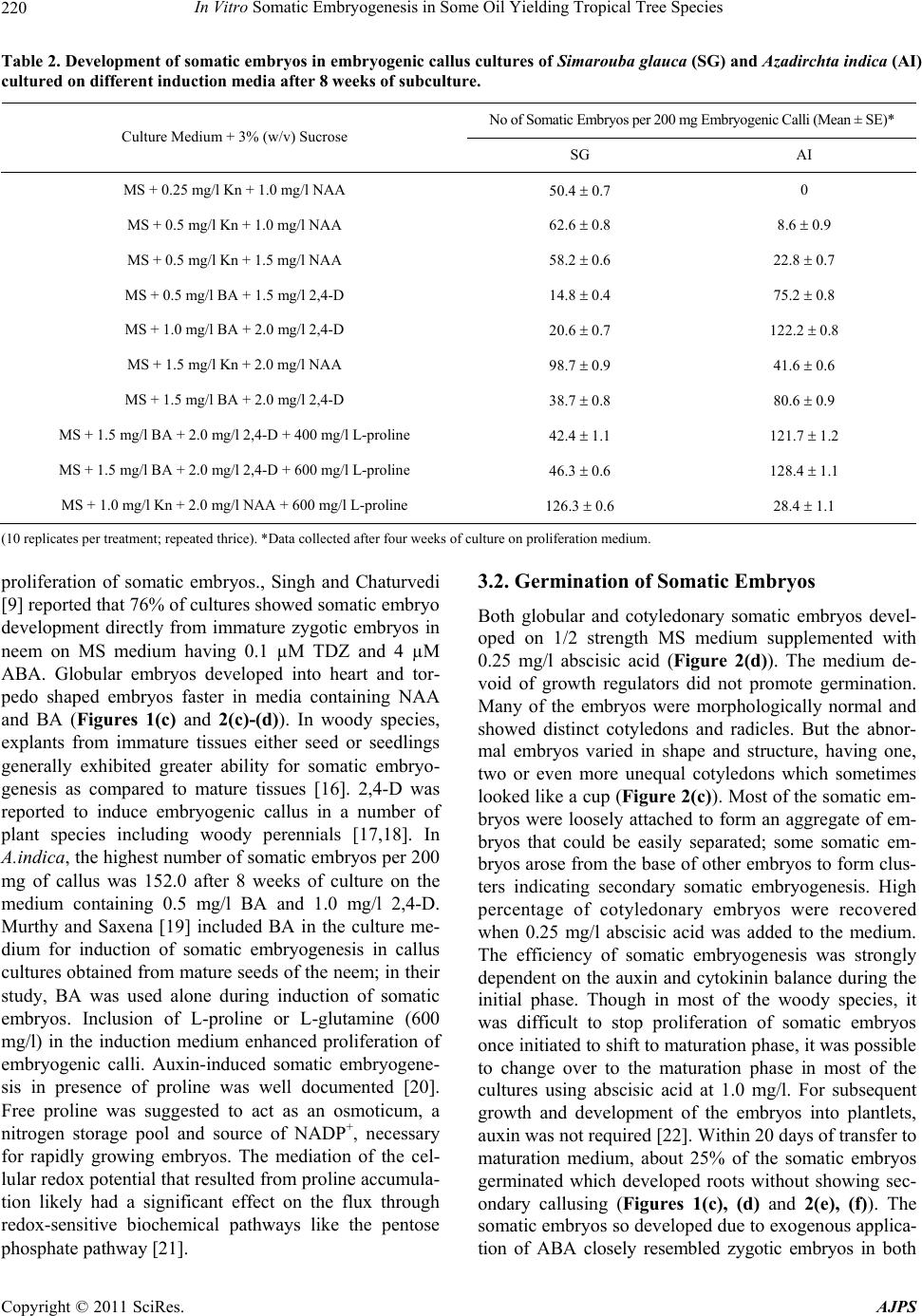 In Vitro Somatic Embryogenesis in Some Oil Yielding Tropical Tree Species 220 Table 2. Development of somatic embryos in embryogenic callus cultures of Simarouba glauca (SG) and Azadirchta indica (AI) cultured on different induction media after 8 weeks of subculture. No of Somatic Em bryos p er 200 m g Embr yogenic Cal li (Mean ± SE) * Culture Medium + 3% ( w/v) Sucrose SG AI MS + 0.25 mg/l Kn + 1. 0 mg/l NAA 50.4 0.7 0 MS + 0.5 mg/l Kn + 1.0 mg/l NAA 62.6 0.8 8.6 0.9 MS + 0.5 mg/l Kn + 1.5 mg/l NAA 58.2 0.6 22.8 0.7 MS + 0.5 mg/l BA + 1.5 mg/l 2,4-D 14.8 0.4 75.2 0.8 MS + 1.0 mg/l BA + 2.0 mg/l 2,4-D 20.6 0.7 122.2 0.8 MS + 1.5 mg/l Kn + 2.0 mg/l NAA 98.7 0.9 41.6 0.6 MS + 1.5 mg/l BA + 2.0 mg/l 2,4-D 38.7 0.8 80.6 0.9 MS + 1.5 mg/l BA + 2.0 mg/l 2,4-D + 400 mg/l L-proline 42.4 1.1 121.7 1.2 MS + 1.5 mg/l BA + 2.0 mg/l 2,4-D + 600 mg/l L-proline 46.3 0.6 128.4 1.1 MS + 1.0 mg/l Kn + 2.0 mg/l NAA + 600 mg/l L-proline 126.3 0.6 28.4 1.1 (10 replicates per treatment; repeated thrice). *Data collected after four weeks of culture on proliferation medium. proliferation of somatic embryos., Singh and Chaturvedi [9] reported that 76% of cultures showed somatic embryo development directly from immature zygotic embryos in neem on MS medium having 0.1 µM TDZ and 4 µM ABA. Globular embryos developed into heart and tor- pedo shaped embryos faster in media containing NAA and BA (Figures 1(c) and 2(c)-(d)). In woody species, explants from immature tissues either seed or seedlings generally exhibited greater ability for somatic embryo- genesis as compared to mature tissues [16]. 2,4-D was reported to induce embryogenic callus in a number of plant species including woody perennials [17,18]. In A.indica, the highest number of somatic embryos per 200 mg of callus was 152.0 after 8 weeks of culture on the medium containing 0.5 mg/l BA and 1.0 mg/l 2,4-D. Murthy and Saxena [19] included BA in the culture me- dium for induction of somatic embryogenesis in callus cultures obtained from mature seeds of the neem; in their study, BA was used alone during induction of somatic embryos. Inclusion of L-proline or L-glutamine (600 mg/l) in the induction medium enhanced proliferation of embryogenic calli. Auxin-induced somatic embryogene- sis in presence of proline was well documented [20]. Free proline was suggested to act as an osmoticum, a nitrogen storage pool and source of NADP+, necessary for rapidly growing embryos. The mediation of the cel- lular redox potential that resulted fro m proline accumula- tion likely had a significant effect on the flux through redox-sensitive biochemical pathways like the pentose phosphate pathway [21]. 3.2. Germination of Somatic Embryos Both globular and cotyledonary somatic embryos devel- oped on 1/2 strength MS medium supplemented with 0.25 mg/l abscisic acid (Figure 2(d)). The medium de- void of growth regulators did not promote germination. Many of the embryos were morphologically normal and showed distinct cotyledons and radicles. But the abnor- mal embryos varied in shape and structure, having one, two or even more unequal cotyledons which sometimes looked like a cup (Figure 2(c)). Most of the somatic em- bryos were loosely attached to form an aggregate of em- bryos that could be easily separated; some somatic em- bryos arose from the base of other embryos to form clus- ters indicating secondary somatic embryogenesis. High percentage of cotyledonary embryos were recovered when 0.25 mg/l abscisic acid was added to the medium. The efficiency of somatic embryogenesis was strongly dependent on the auxin and cytokinin balance during the initial phase. Though in most of the woody species, it was difficult to stop proliferation of somatic embryos once initiated to sh ift to maturation phase, it was possible to change over to the maturation phase in most of the cultures using abscisic acid at 1.0 mg/l. For subsequent growth and development of the embryos into plantlets, auxin was not required [22]. Within 20 days of transfer to maturation medium, about 25% of the somatic embryos germinated which developed roots without showing sec- ondary callusing (Figures 1(c), (d) and 2(e), (f)). The somatic embryos so developed due to exogenous applica- ion of ABA closely resembled zygotic embryos in both t Copyright © 2011 SciRes. AJPS 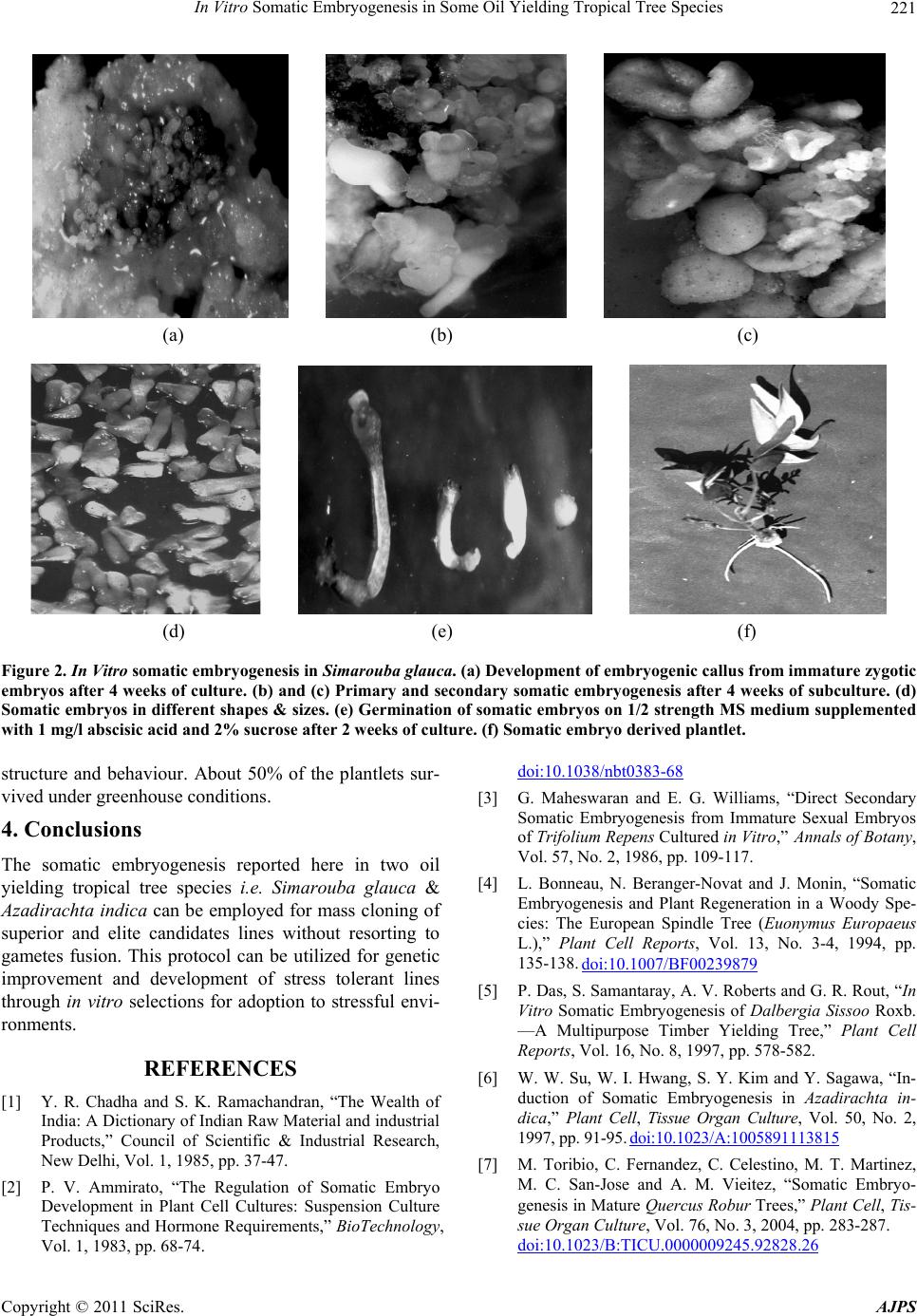 In Vitro Somatic Embryogenesis in Some Oil Yielding Tropical Tree Species221 (a) (b) (c) (d) (e) (f) Figure 2. In Vitro somatic embryogenesis in Simarouba glauca. (a) Development of embry ogenic callus from immature zygotic embryos after 4 weeks of culture. (b) and (c) Primary and secondary somatic embryogenesis after 4 we eks of subculture. (d) Somatic embryos in different shapes & sizes. (e) Germination of somatic embryos on 1/2 strength MS medium supplemented with 1 mg/l abscisic acid and 2% sucrose after 2 weeks of culture. (f) Somatic embryo derived plantlet. structure and behaviour. About 50% of the plantlets sur- vived unde r greenhouse cond i t ions. 4. Conclusions The somatic embryogenesis reported here in two oil yielding tropical tree species i.e. Simarouba glauca & Azadirachta indica can be employed for mass cloning of superior and elite candidates lines without resorting to gametes fusion. This protocol can be utilized for genetic improvement and development of stress tolerant lines through in vitro selections for adoption to stressful envi- ronments. REFERENCES [1] Y. R. Chadha and S. K. Ramachandran, “The Wealth of India: A Dictionary of Indian Raw Material and industrial Products,” Council of Scientific & Industrial Research, New Delhi, Vol. 1, 1985, pp. 37-47. [2] P. V. Ammirato, “The Regulation of Somatic Embryo Development in Plant Cell Cultures: Suspension Culture Techniques and Hormone Requirements,” BioTechnology, Vol. 1, 1983, pp. 68-74. doi:10.1038/nbt0383-68 [3] G. Maheswaran and E. G. Williams, “Direct Secondary Somatic Embryogenesis from Immature Sexual Embryos of Trifolium Repens Cultured in Vitro,” Annals of Botany, Vol. 57, No. 2, 1986, pp. 109-117. [4] L. Bonneau, N. Beranger-Novat and J. Monin, “Somatic Embryogenesis and Plant Regeneration in a Woody Spe- cies: The European Spindle Tree (Euonymus Europaeus L.),” Plant Cell Reports, Vol. 13, No. 3-4, 1994, pp. 135-138. doi:10.1007/BF00239879 [5] P. Das, S. Samantaray , A. V. Roberts and G. R. Rout, “In Vitro Somatic Embryogenesis of Dalbergia Sissoo Roxb. —A Multipurpose Timber Yielding Tree,” Plant Cell Reports, Vol. 16, No. 8, 1997, pp. 578-582. [6] W. W. Su, W. I. Hwang, S. Y. Kim and Y. Sagawa, “In- duction of Somatic Embryogenesis in Azadirachta in- dica,” Plant Cell, Tissue Organ Culture, Vol. 50, No. 2, 1997, pp. 91-95. doi:10.1023/A:1005891113815 [7] M. Toribio, C. Fernandez, C. Celestino, M. T. Martinez, M. C. San-Jose and A. M. Vieitez, “Somatic Embryo- genesis in Mature Quercus Robur Trees,” Plant Cell, Tis- sue Organ Culture, Vol. 76, No. 3, 2004, pp. 283-287. doi:10.1023/B:TICU.0000009245.92828.26 Copyright © 2011 SciRes. AJPS  In Vitro Somatic Embryogenesis in Some Oil Yielding Tropical Tree Species 222 [8] H. K. Moon, J. A. Kim, S. Y. Park, Y. W. Kim and H. D. Kang, “Somatic Embryogenesis and Plantlet Formation from a Rare and Endangered Tree Species, Oplopanax elatas,” Journal of Plant Biology, Vol. 49, No. 4, 2006, pp. 320-325. doi:10.1007/BF03031163 [9] M. Singh and R. Chaturvedi, “An Efficient Protocol for Cyclic Somatic Embryogenesis in Neem (Azadirachta In- dica A.Juss.),” International Journal of Civil & Environ- mental Engineering, Vol. 1, 2009, pp. 49-51. [10] P. Das, “Mass Cloning of Rose and Mussaenda, Popular Garden Plants via Somatic Embryogenesis,” Horticul- tural Science, Vol. 37, No. 2, 2010, pp. 70-78. [11] P. Das, “Somatic Embryogenesis in Four Tree Legumes,” Biotechnology Research International, Vol. 1, 2011, Ar- ticle ID 737636, pp. 1-8. [12] Q. Jiang and P. M. Gresshoff, “Shoot Control of Hyper- nodulation and Aberrant Root Formation in the Har-1 Mutant of Lotus Japonicus. Funct,” Plant Biology, Vol. 29, No. 11, 2002, pp. 1371-1376. [13] I. R. Searle, A. E. Men, T. S. Laniya, D. M. Buzas, I. Iturbe-Ormaetxe, B. J. Carroll and P. M. Gresshoff, “Long Distance Signaling in Nodulation Directed by a Clavata 1-Like Receptor Kinase,” Science, Vol. 299, No. 5603, 2003, pp. 109-112. doi:10.1126/science.1077937 [14] T. Murashige and F. Skoog, “A Revised Medium for Rapid Growth and Bioassay with Tobacco Tissue Cul- tures,” Plant Physiology, Vol. 15, 1962, pp. 473-497. doi:10.1111/j.1399-3054.1962.tb08052.x [15] T. P. Pasternak, E. Prinsen, F. Ayaydin, P. Miskolczi, G. Potter and H. Asard, “The Role of Auxin, Ph and Stress in the Activation of Embryogenic Cell Division in Leaf Protoplast Derived Cells of Alfalfa,” Plant Physiology, Vol. 129, No. 4, 2002, pp. 1807-1819. doi:10.1104/pp.000810 [16] R. L. Mott, “Tree,” In: B. V. Conger, Ed., Cloning Agri- cultural Plants via in Vitro Techniques, CRC Press, Boca Raton, 1981, pp. 217-256. [17] B. O. C. Ortiz, M. E. P. Reyes and E. P. M. Balch, “So- matic Embryogenesis and Plant Regeneration in A. Far- nesiana and A. Schaffneri,” In Vitro Cellular & Devel- opmental Biology, Vol. 36, No. 4, 2000, pp. 268-272. doi:10.1007/s11627-000-0049-8 [18] C. Akula, A. Akula and R. Drew, “Somatic Embryogene- sis in Clonal Neem, A. Indica A. Juss. and Analysis for in Vitro Azadirachtin Production,” In Vitro Cellular & De- velopmental Biology, Vol. 39, No. 3, 2003, pp. 304-310. doi:10.1079/IVP2003415 [19] B. N. S. Murthy and P. K. Saxena, “Somatic Embryo- genesis and Plant Regeneration of Neem (A. Indica A. Juss.),” Plant Cell Reports, Vol. 17, No. 6-7, 1998, pp. 469-475. doi:10.1007/s002990050427 [20] K. Shetty and B. D. Mckersie, “Proline, Thioproline, and Potassium Mediated Stimulation of Somatic Embryo- genesis in Alfalfa (Medicago Sativa L.),” Plant Science, Vol. 88, No. 2, 1993, pp. 185-193. doi:10.1016/0168-9452(93)90090-M [21] S. K. Ghanti, K. G. Sujata, S. Rao, M. Udayakumar and P. B. K. Kishore, “Role of Enzymes and Identification of Stage—Specific Proteins in Developing Somatic Em- bryos of Chickpea (Cicer Arietinum L.),” In Vitro Cellu- lar & Developmental Biology—Plant, Vol. 45, No. 6, 2009, pp. 667-672. doi:10.1007/s11627-009-9197-7 [22] L. Radojevic, “L. Plant Regeneration of Aesculus Hippo- castanum L. (Horse Chestnut) through Somatic Embryo- genesis,” Journal of Plant Physiology, Vol. 132, No. 3, 1988, pp. 322-326. Copyright © 2011 SciRes. AJPS |