

Paper Menu >>
Journal Menu >>
 Creative Education 2011. Vol.2, No.2, 71-75 Copyright © 2011 SciRes. DOI:10.4236/ce.2011.22010 E-Learning Effects on Teaching at ALBORZ High School (Iran) Jalal Heshmatpanah, Abbas Ali Lotfi Neyestanak* Department of Engineering, Islamic Azad University, Shahre Rey Branch, Tehran, Iran. Email: [email protected] Received April 17th, 2011; revised May 10th, 2011; accepted May 30th, 2011. Considering the advantages of e-learning, some investigations were performed to study customizing this method in teaching. This is the result of an experience which was conducted in one of Iranian high school (ALBORZ). The objective was to find a proper way while using internet facilities to teach courses which comply with exist- ing teaching regulations in Iran. Keywords: Education, E-Learning, IT Technolog y, Physic Course Introduction Educators must embrace e-learning solutions if they want to ensure that every student has a quality educational experience. But before e-learning can achieve widespread acceptance in public schools, educators and policy makers must expand their notion of education to include online courses and digital mate- rials used to enhance classroom instruction (Collins, 2004). E-learning could have potentially main results on the way higher education is designed. E-Learning may offer schools with a means of more than the newly formed rivalry, by taking full advantage of their traditional, already established reputa- tions. E-learning can also provide a model for students on how to become self directed independent learners. For lecturers, e-learning programs represent a change in teaching style. The precise nature of the change is difficult to quantify, however allocation of sufficient time and resources, combined with managerial support, will help staff through the period of transition (Singh, 2005). At present, every school plans to use e-learning advantages to develop students’ desired learning content and offer students the new way to learn. The following scenario describes real problems from the edu- cation trenches and the e-learning solutions that resolved them. In a village one course teacher resigned in spite the princi- pal’s best efforts, there’s still no teacher for that course. How can the class get its requirement? An online course class solved the problem. The students “at- tended class” in the computer lab, submitted their homework and took exams online, and participated in online discussions. With a staff member acting as a mentor, the students kept up with their studies and continued learning. At the end of the year, staff and students judged the replacement class a success thanks to the student’s efforts, the quality of their online course, the skill of their online instructor, and the support of their in school mentor. Using e-learning, if students have computers and internets, students can learn anytime and anywhere, can use materials repeatedly, and can study the difficult part for them. Second, teacher should use e-learning teaching strategy to strength stu- dents’ learning motivation. Regarding to the advantages of e-learning it was decided to perform some investigations in order to customize existing experiences at ALBORZ high school in Iran. This point of study is designed for students of ALBORZ high school in different learning accounting method to show the different achievement and motivation of learning. Recognizing the Obstacles and Important Parameters The first investigation held in summer of 2009 there were 45 students and the project’s goals were: 1) Finding necessary sources in internet for teaching these courses in this manner. 2) Teaching students for searching by means of search en- gines. 3) Teaching software for designing web pages (Park, 2008; Davidson & Mylonas, 2004). We found that proficiency to English language was effective on the quality of students’ works. The following parameters were important: 1) Gaining complete proficiency to computer skills for ac- cessing to the sources. The graph of this parameter versus time (month) is shown in the Figure 1. 2) Conversant with the computer software in order to design web page. Figure 2 shows effect of this result. 3) Complete proficiency on English language that it is shown in Figure 3. 4) Ability to observe, which consist of three parameters: a) Associated time to that subject, b) Curiosity, c) Raised questions. 5) Familiarity with concept of Network and using it. Graphs of these parameters versus time (month) are shown in the Fig- ures 4 and 5. Parameter Measurements For instance the parameters, which were considered for eva- 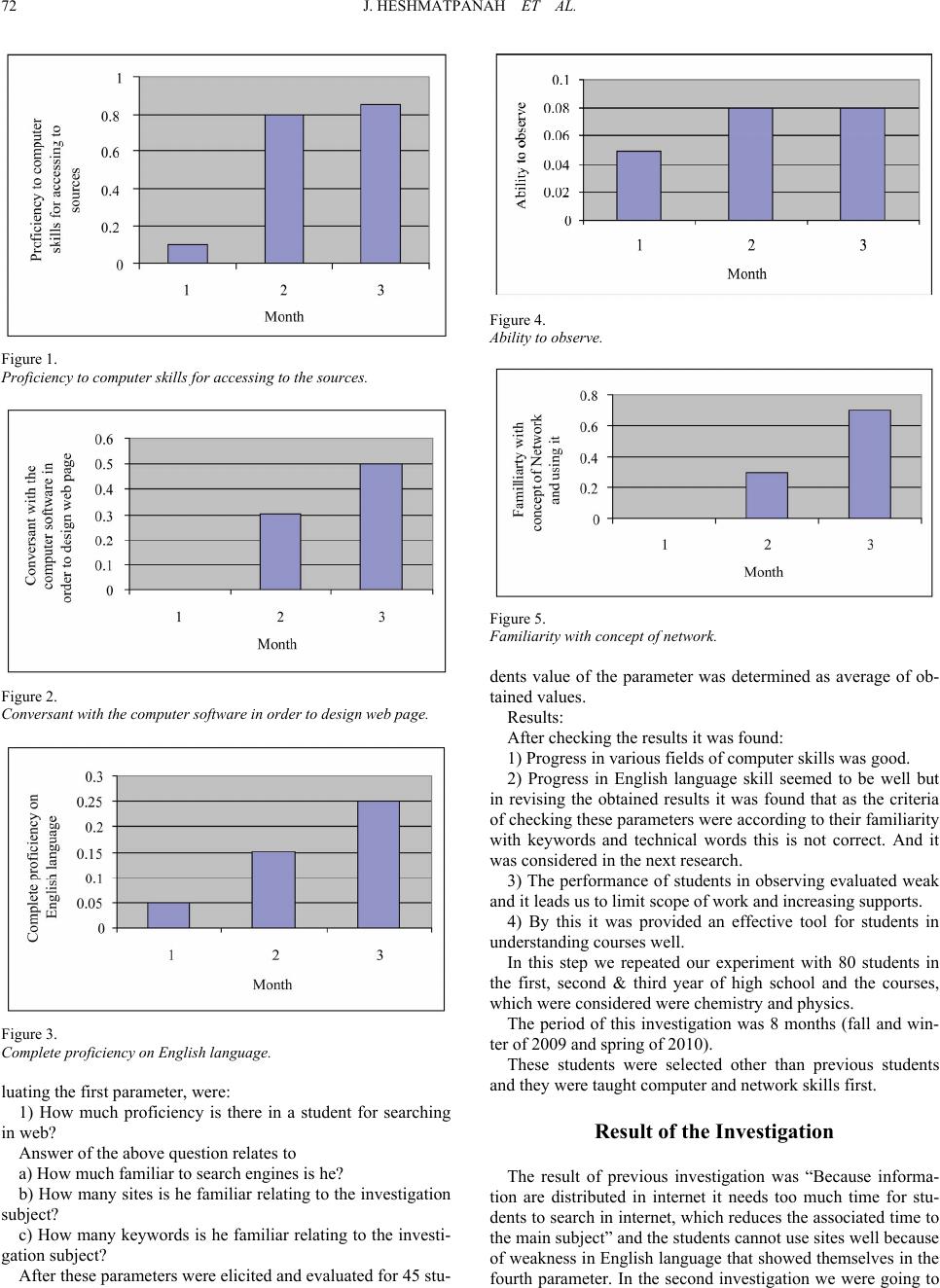 J. HESHMATPANAH ET AL. 72 Figure 1. Proficiency to computer skills for accessing to the sources. Figure 2. Conversant with the computer software in order to des i gn web page. Figure 3. Complete proficiency on E n g lish language. luating the first parameter, were: 1) How much proficiency is there in a student for searching in web? Answer of the above question relates to a) How much familiar to search engines is he? b) How many sites is he familiar relating to the investigation subject? c) How many keywords is he familiar relating to the investi- gation subject? After these parameters were elicited and evaluated for 45 stu- Figure 4. Ability to observe. Figure 5. Familiarity with concept of network. dents value of the parameter was determined as average of ob- tained values. Results: After checking the results it was found: 1) Progress in various fields of computer skills was good. 2) Progress in English language skill seemed to be well but in revising the obtained results it was found that as the criteria of checking these parameters were according to their familiarity with keywords and technical words this is not correct. And it was considered in the next research. 3) The performance of students in observing evaluated weak and it leads us to limit scope of work and increasing supports. 4) By this it was provided an effective tool for students in understanding courses well. In this step we repeated our experiment with 80 students in the first, second & third year of high school and the courses, which were considered were chemistry and physics. The period of this investigation was 8 months (fall and win- ter of 2009 and spring of 2010). These students were selected other than previous students and they were taught computer and network skills first. Result of the Investigation The result of previous investigation was “Because informa- tion are distributed in internet it needs too much time for stu- dents to search in internet, which reduces the associated time to the main subject” and the students cannot use sites well because of weakness in English language that showed themselves in the fourth parameter. In the second investigation we were going to  J. HESHMATPANAH ET AL. 73 reduce these effects. Solution The template is designed so that author affiliations are not repeated each time for multiple authors of the same affiliation. Please keep your affiliations as succinct as possible (for exam- ple, do not differentiate among departments of the same or- ganization). This template was designed for two affiliations. 1) For author/s of only one affiliation (Heading 3): To change the default, adjust the template as follows. a) Selection (Heading 4): Highlight all author and affiliation lines. b) Change number of columns: Select the Columns icon from the MS Word Standard toolbar and then select “1 Column” from the selection palette. In order to reduce above mentioned factors the following ac- tivities were considered: 1) Proper internet resources in the field of physics and chem- istry were extracted and prepared for them in order to avoid searching in internet Searching in internet is considered as a general skill, which without that they cannot access to this training trend (Duncan, 2001; Arnold, 2004; Griffth, 2001). 2) Preparing teachers for explaining downloaded files to stu- dents, which reduces needs of English language skills for stu- dents. 3) In this method teacher will present his lesson by means of network for the students. In this method classes were divided to 24 students in each class that every two student could access to one computer and the teacher used Netop software for teaching. By using the above, the fourth parameter (Ability of observ- ing in learning) progressed. We have shown its curve in Figure 6. For evaluating this parameter we chose the following crite- ria’s: 1) Associated time. 2) Curiousity. 3) Number of asked questions. Associated time: Maximum grade belonged to the students that devoted 10 hours out of class for investigation. Curiosity: Maximum grade belonged to the student who gathered at least 10 points in his investigation fields. Number of asked questions: Figure 6. Ability of observing in learning. According to the number of questions that students asked in thei r field of study, t hey have been evaluated. Maximum mark belonged to the student who raised at least 100 questions during period of course. Mark of every student is determined by Maximum number, which got among above items. Curve 6 shows that students have progressed but its rate is low, in order to override this and increase the rate, we proposed an interactive training. Environment that students can change the parameters and observe the results, revising this showed that have not had a jump in fourth parameter. Investigation on curve of fourth parameter revealed that: 1) We must apply experienced teacher in this field, using these auxiliary tools needs more familiarities with these tools. 2) Because this was an innovation on training (in Iran) other factors influenced the training trend, for example we recog- nized that in the search time students eager to enter other sites, which do not relate to the searched subject. 3) In Iran teaching is based on lectures (oral) and using ob- serving tools (Lab. a n d etc.) are rarely used. 4) Lack of special web pages for supporting students during homework and also accessible out of class. 5) Lack of motivation factors: In these kinds of activities, one of the main goals is getting mark as in this investigation got marks are not registered we could recognize lack of motivation. 6) Lack of having proper concept by students and their par- ents on teaching based on IT tools made some bad effects on performance. Third Investigation In order to solve detected problems on the second investiga- tion, this time we did our investigation by 60 students, which were on the first year of high school and we used this tool for teaching in their formal class time. The subject of courses were physics, chemistry, mathematics and English language course according to their curriculum these were 6 hours in week except English language ,which was five hours in a week. These 60 students were organized on two classes and each class contained 30 students. We tried to control parameters, which were effective on ob- serving environment. We obtained the following curve (Figure 7), which was the result of considering, in an eight months period (fall and winter Figure 7. Ability of observing in learning.  J. HESHMATPANAH ET AL. 74 2009 and spring of 2010). As we can observe controlling six factors have had serious effect on increasing fourth parameter and we can see a jump in the third month, which after our revising it, revealed that is as result of preparing computer site of high school for using stu- dents. In this investigation we considered extraordinary programs like electronic classes in order to motivate students to partici- pate in research activities and getting proper result. Figures 8(a) and (b) shown the schematic of physic course of this (a) (b) Figure 8. Physics course environment.  J. HESHMATPANAH ET AL. 75 software (Lee, 2005; Kanuka, 2006). Conclusion The goal of this paper was to present e-learning as a new method for teaching, and to get to know the main aspects of it, so as to figure out the way it work, and which changes in the society should be required to achieve it. The investigation was held in three steps and the following results were obtained in each step: 1) In the first step parameters which were important were recognized and a proper procedure was determined for evaluat- ing. 2) In the second step a solution was raised to control the im- portant parame ters, which were gained as result of first investi- gation. It resulted to get better results but not as good as our need. 3) In the third step by using the results of previous investiga- tions we could achieve to more proper result. Because there are various parameters, effective on the results we are going to find minimum threshold for each parameter to get the optimum solution in the next investigation. References Arnold, B. (2004). Physical processes. London: Hodder & Stoughton. Collins, S. R. (2004). E-learning frameworks for NCLB. U.S. Depart- ment of Education Secretary’s, No Child Left behind Leadership Summit. Duncan, T., & Murr ay, J. (2001). GCSE physics. London: Mur ray. Griffth, T. (2001) The physics of every day phenomena. Columbus: McGrow Hill. Kanuka, H., & Rourke, L. (2006). The impact of e-learning on higher education. 7th International Conference on Information Technology Based Higher Education and Training, 922-926. Lee, J., Su, F., Chan, C., & Shan, H. (2005). E-learning for teachers on water environment education. 3rd International Conference on In- formation Technology: Research and Education, 50-54. Mylonas, P., Karpouzis, K., Andreou, G., & Kollias, S. (2004). To- wards a personalized e-learning scheme for teachers. International Conference on Advanced Lear n ing Technologies, 560-564. doi:10.1109/ICALT.2004.1357477 Park, N., Kim, H., Kim, K., Park, H., Chun, J., & Hwang, Y. (2008). An elearning activity control model for SCORM’s sequencing pre- requisites. Fourth International Conference on Semantics, Knowl- edge and Grid, 322-329. doi:10.1109/SKG.2008.62 Singh, G., O’Donoghue, J., & Worton, H. (2005) A study into the ef- fects of elearning on higher education. Journal of University Teach- ing and Learning Practice, 2, 13-24. http://webphysics.davidson.edu/Applets/App. |