

Paper Menu >>
Journal Menu >>
 Journal of Environmental Protection, 2011, 2, 460-464 doi:10.4236/jep.2011.24053 Published Online June 2011 (http://www.SciRP.org/journal/jep) Copyright © 2011 SciRes. JEP Radioactivity in Surface Soils around the Proposed Sites for Titanium Mining Project in Kenya M. K. Osoro1, I. V. S. Rathore2, M. J. Mangala3, A. O. Mustapha4 1Department of Physics, Kenyatta University, Nairobi, Kenya; 2Department of Physics, Northern India Engineering College, Babu Banari Das University, Nairobi, Kenya; 3Institute of Nuclear Science and Technology, University of Nairobi, Nairobi, Kenya; 4Department of Physics, University of Agriculture, Abeokuta, Abeokuta, Nigeria. Email: [email protected] Received March 3rd, 2010; revised March 9th, 2011; accepted April 23rd, 2011. ABSTRACT Radioactivity measurements were carried ou t around Maumba and Nguluku villages, two of the proposed sites for tita- nium mining in the coastal area of Kenya. Samples of surface soils were analyzed using a HPGe gamma spectrometer. The average activity co ncentrations for 226Ra, 232Th and 40K are 20.9 7.6, 27.6 9.1 and 69.5 16.5 Bqkg–1, respec- tively. The absorbed dose rates in air, calculated on the basis of the measured activity concentrations, range from 9.8 to 50.0 nGyh–1, with an average of 29.2 nGyh–1. These values are below the global population-weighted mean, and they should be considered when p lanning app ropriate mon ito ring and su rveillance programmes du ring the mining op era tion, as well as the reclamation and restoration programmes after mining. Keywords: Radioactivity Measurements, Titanium Mining, Absorbed Dose Rates, Natural Background Radiation 1. Introduction The ambient natural background radiation is usually of little or no radiological concern, and it varies from one location to another depending partly on the local geology. Mining and other industrial activities such as oil and gas exploration, extraction and purification of water, etc. can enhance the natural background radiation to levels that are not insignificant from radiation protection point of view [1,2]. Mining results in large volumes of materials containing natural radionuclides – the so called naturally occurring radioactive materials (NORM). This is not restricted to uranium and thorium ores, it is also true for other raw materials like heavy mineral sands, phosphate rocks, etc. Tiomin Resources Inc., the Canadian mining company, discovered vast deposits of titanium in the coastal area Kenya [3]. Earlier appraisal of the areas’ mineral poten- tial [4] shows that most of the south coastal area of Kenya is underlain by the Duruma group consisting of the coarse-grained Taru and the fine-grained Maji-ya- Chumvi formations. Two of the deposits in Kwale dis- trict; the Central Dune at Maumba and South Dune at Nguluku constitute the Kwale titanium mining project, with a mineral reserve of 140.8 million tones (Figure 1). The average ore body composition is 3.48% heavy min- erals, and the expected annual yield is 77,000 tonnes of rutile, 38,000 tonnes of zircon and 330,000 tonnes of ilmenite [3]. According to the mining company, the pro- posed operations will involve clearing the vegetation, removing and stockpiling the topsoil for further use in rehabilitation process, excavation of the dunes using bucket wheel excavators or scrapers and, transportation of the ore-bearing sand to the wet plant where the heavy minerals will be separated from sand. The final products will be transported from the mine sites to a ship-loading facility that will be constructed at Likoni, in Mombasa. It is estimated that mining activities in each of the two sites will take seven years. The main source of surface water in the area is the Mukurumudzi river, a perennial river that flows from northwest to southeast and drains into the Indian ocean near Gazi Bay. Human population in these areas is esti- mated to be about 3,000 [5]. The project was put on hold because local residents and other stakeholders raised se- rious social, economic, environmental and radiological questions, which are still being addressed. Enhancement 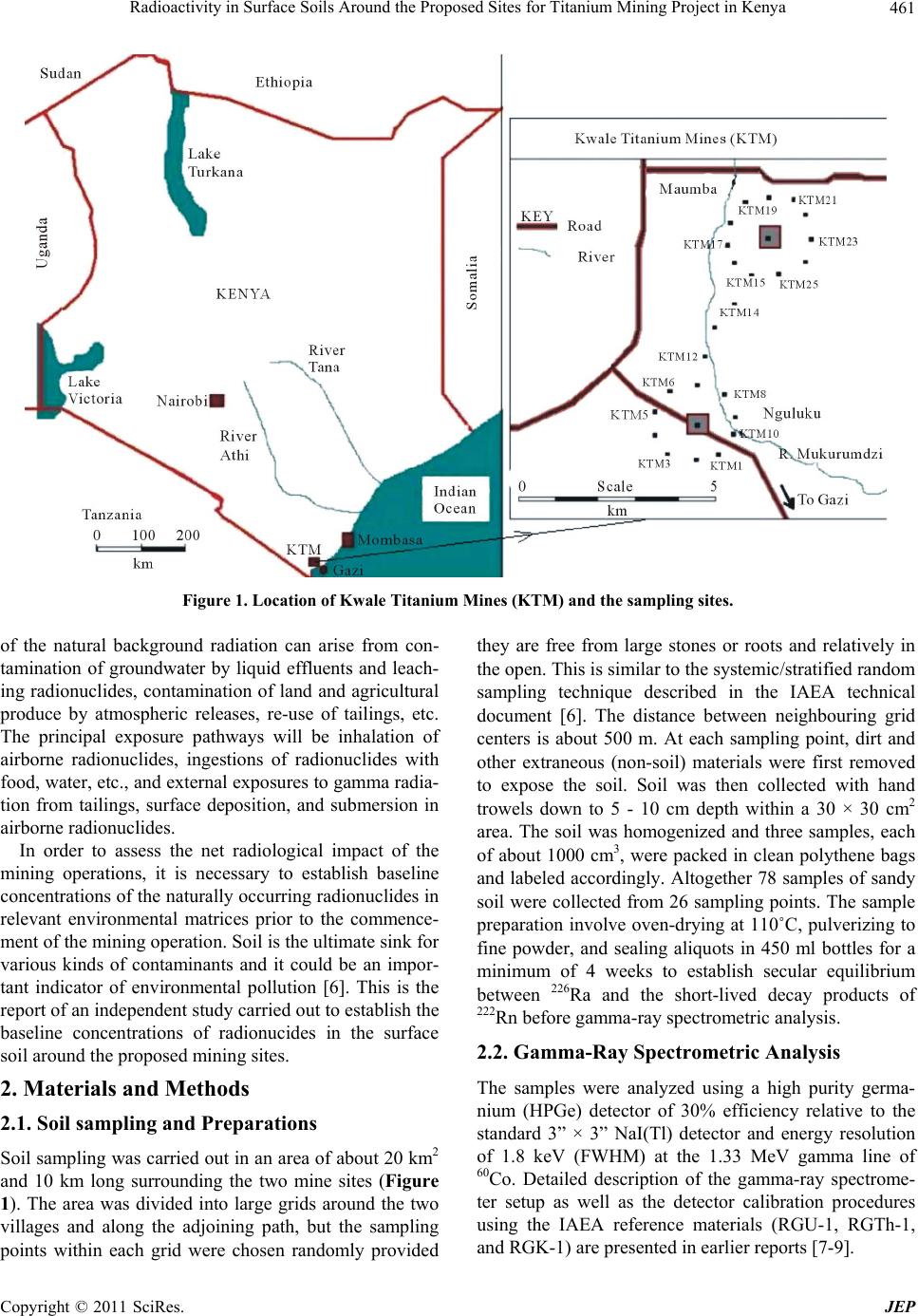 Radioactivity in Surface Soils Around the Proposed Sites for Titanium Mining Project in Kenya461 Figure 1. Location of Kwale Titanium Mines (KTM) and the sampling sites. of the natural background radiation can arise from con- tamination of groundwater by liquid effluents and leach- ing radionuclides, contamination of land and agricultural produce by atmospheric releases, re-use of tailings, etc. The principal exposure pathways will be inhalation of airborne radionuclides, ingestions of radionuclides with food, water, etc., and external exposures to gamma radia- tion from tailings, surface deposition, and submersion in airborne r ad ionucli d es . In order to assess the net radiological impact of the mining operations, it is necessary to establish baseline concentrations of the naturally occurring radionuclides in relevant environmental matrices prior to the commence- ment of the mining operation. Soil is th e ultimate sin k fo r various kinds of contaminants and it could be an impor- tant indicator of environmental pollution [6]. This is the report of an independent study carried out to establish the baseline concentrations of radionucides in the surface soil around the proposed mining sites. 2. Materials and Methods 2.1. Soil sampling and Preparations Soil sampling was carried out in an area of about 20 km2 and 10 km long surrounding the two mine sites (Figure 1). The area was divided into large grids around the two villages and along the adjoining path, but the sampling points within each grid were chosen randomly provided they are free from large stones or roots and relatively in the open. This is similar to the systemic/stratified random sampling technique described in the IAEA technical document [6]. The distance between neighbouring grid centers is about 500 m. At each sampling point, dirt and other extraneous (non-soil) materials were first removed to expose the soil. Soil was then collected with hand trowels down to 5 - 10 cm depth within a 30 × 30 cm2 area. The soil was homogenized and three samples, each of about 1000 cm3, were packed in clean polythene bags and labeled accordingly. Altogether 78 samples of sandy soil were collected from 26 sa mpling points. Th e sample preparation involve oven-drying at 110˚C, pulverizing to fine powder, and sealing aliquots in 450 ml bottles for a minimum of 4 weeks to establish secular equilibrium between 226Ra and the short-lived decay products of 222Rn before gamma-ray spectrometric analysis. 2.2. Gamma-Ray Spectrometric Analysis The samples were analyzed using a high purity germa- nium (HPGe) detector of 30% efficiency relative to the standard 3” × 3” NaI(Tl) detector and energy resolution of 1.8 keV (FWHM) at the 1.33 MeV gamma line of 60Co. Detailed description of the gamma-ray spectrome- ter setup as well as the detector calibration procedures using the IAEA reference materials (RGU-1, RGTh-1, and RGK-1) are presented in ea r l i e r reports [ 7-9]. Copyright © 2011 SciRes. JEP 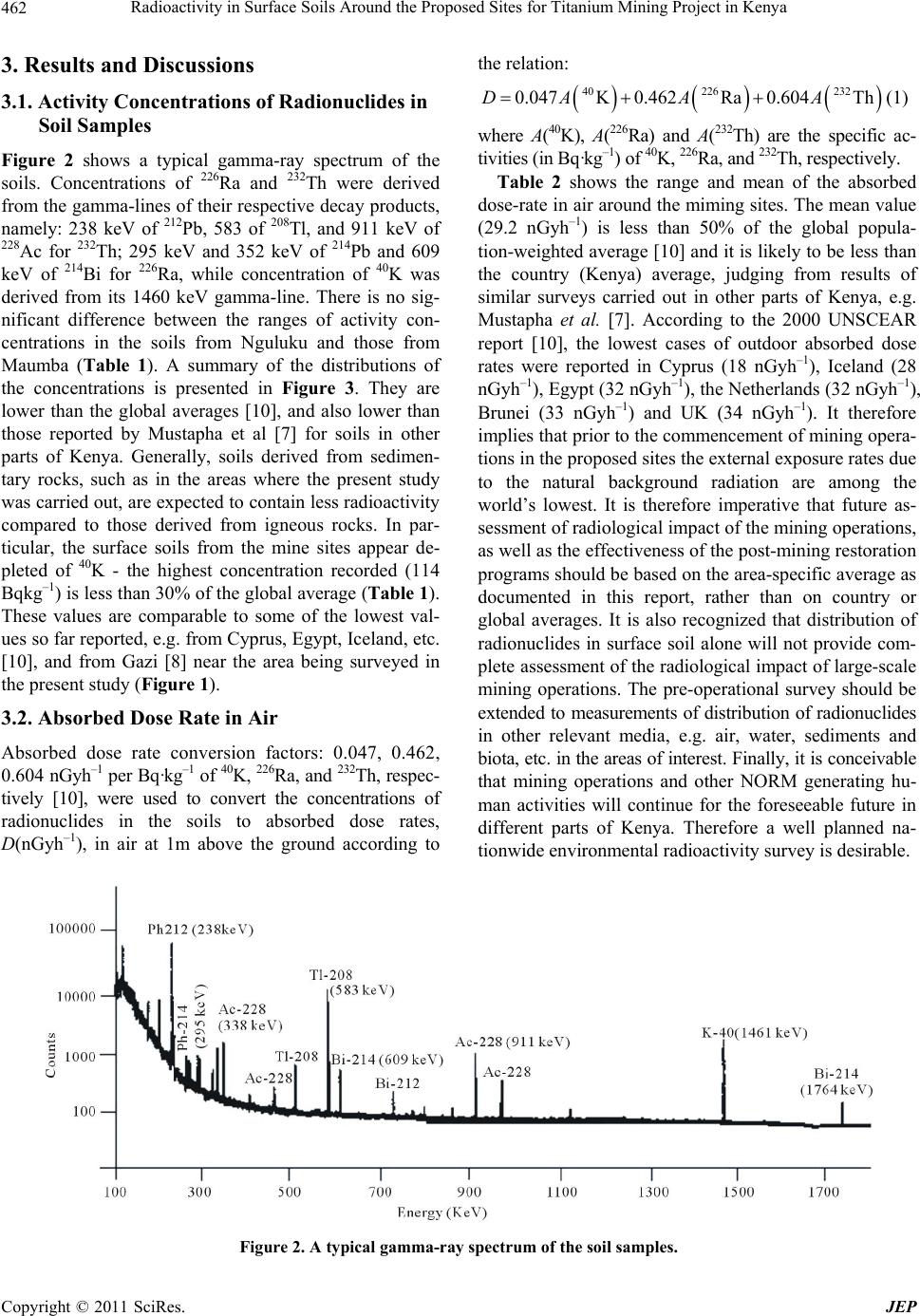 Radioactivity in Surface Soils Around the Proposed Sites for Titanium Mining Project in Kenya 462 3. Results and Discussions 3.1. Activity Concentrations of Radionuclides in Soil Samples Figure 2 shows a typical gamma-ray spectrum of the soils. Concentrations of 226Ra and 232Th were derived from the gamma-lines of their respective decay products, namely: 238 keV of 212Pb, 583 of 208Tl, and 911 keV of 228Ac for 232Th; 295 keV and 352 keV of 214Pb and 609 keV of 214Bi for 226Ra, while concentration of 40K was derived from its 1460 keV gamma-line. There is no sig- nificant difference between the ranges of activity con- centrations in the soils from Nguluku and those from Maumba (Table 1). A summary of the distributions of the concentrations is presented in Figure 3. They are lower than the global averages [10], and also lower than those reported by Mustapha et al [7] for soils in other parts of Kenya. Generally, soils derived from sedimen- tary rocks, such as in the areas where the present study was carried out, are expected to contain less radioactivity compared to those derived from igneous rocks. In par- ticular, the surface soils from the mine sites appear de- pleted of 40K - the highest concentration recorded (114 Bqkg–1) is less than 30% of the global average (Table 1 ). These values are comparable to some of the lowest val- ues so far reported, e.g. from Cyprus, Egypt, Iceland, etc. [10], and from Gazi [8] near the area being surveyed in the present study (Figure 1). 3.2. Absorbed Dose Rate in Air Absorbed dose rate conversion factors: 0.047, 0.462, 0.604 nGyh–1 per Bq·kg–1 of 40K, 226Ra, and 232Th, respec- tively [10], were used to convert the concentrations of radionuclides in the soils to absorbed dose rates, D(nGyh–1), in air at 1m above the ground according to the relation: 40 226232 0.047K 0.462Ra 0.604ThDA AA (1) where A(40K), A(226Ra) and A(232Th) are the specific ac- tivities (in Bq·kg–1) of 40K, 226Ra, and 232Th, respectively. Table 2 shows the range and mean of the absorbed dose-rate in air around the miming sites. The mean value (29.2 nGyh–1) is less than 50% of the global popula- tion-weighted average [10] and it is likely to be less than the country (Kenya) average, judging from results of similar surveys carried out in other parts of Kenya, e.g. Mustapha et al. [7]. According to the 2000 UNSCEAR report [10], the lowest cases of outdoor absorbed dose rates were reported in Cyprus (18 nGyh–1), Iceland (28 nGyh–1), Egypt (32 nGyh–1), th e Netherlands (32 nGyh –1), Brunei (33 nGyh–1) and UK (34 nGyh–1). It therefore implies that prior to the commencement of mining opera- tions in the proposed sites the external exposure rates due to the natural background radiation are among the world’s lowest. It is therefore imperative that future as- sessment of radiological impact of the mining operations, as well as the effectiveness of the post-mining restoration programs should be based on the area-specific average as documented in this report, rather than on country or global averages. It is also recognized that distribution of radionuclides in surface soil alone will not provide com- plete assessment of the radiological impact of large-scale mining operations. The pre-operational survey should be extended to measurements of distribution of radionuclides in other relevant media, e.g. air, water, sediments and biota, etc. in the areas of interest. Finally, it is conceivable that mining operations and other NORM generating hu- man activities will continue for the foreseeable future in different parts of Kenya. Therefore a well planned na- tionwide environmental radioactivity survey is desirable. Figure 2. A typical gamma-ray spectrum of the soil samples. Copyright © 2011 SciRes. JEP 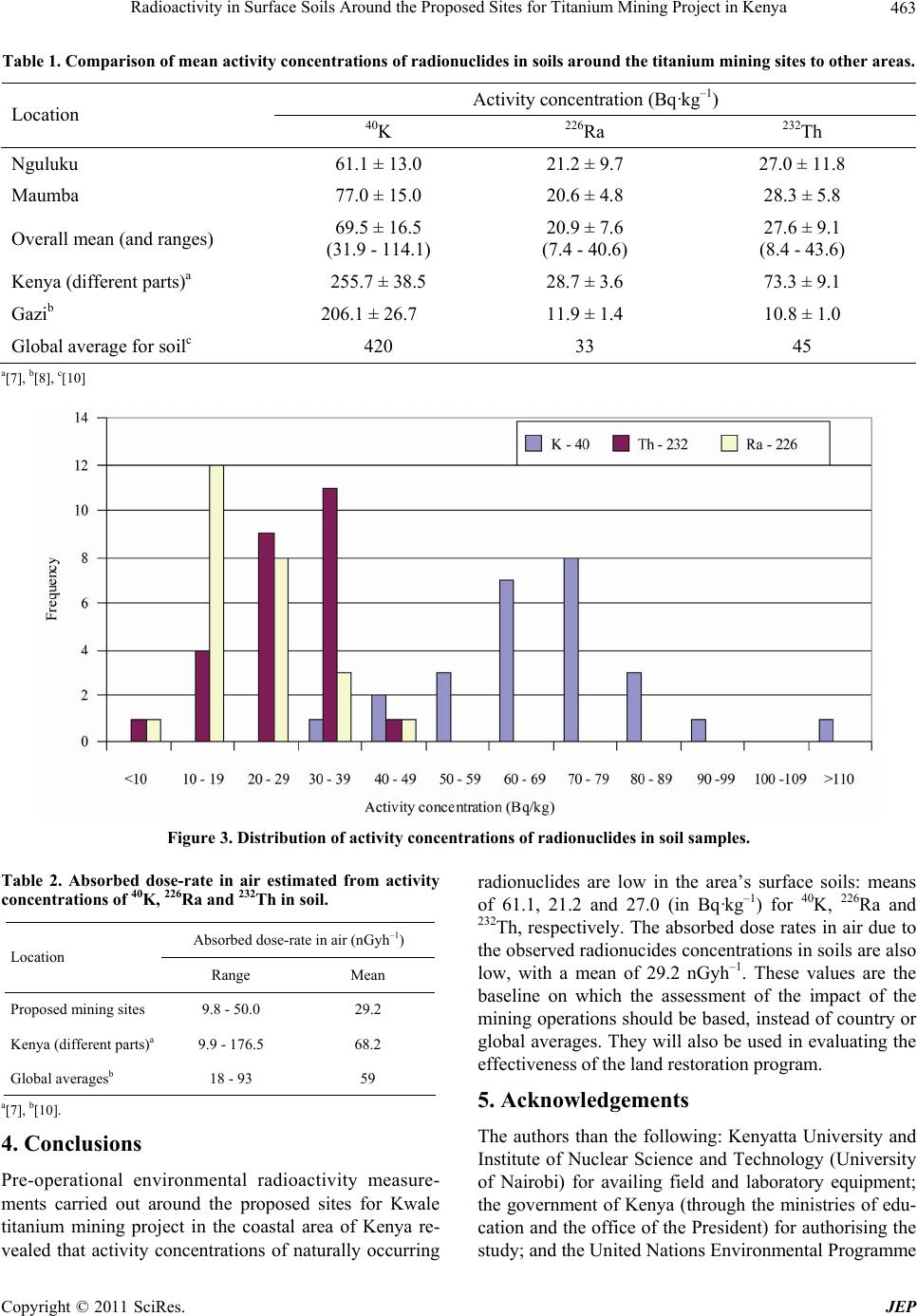 Radioactivity in Surface Soils Around the Proposed Sites for Titanium Mining Project in Kenya463 Table 1. Comparison of mean activity concentrations of radionuclides in soils around the titanium mining sites to other ar e as. Activity concentration (Bq·kg–1) Location 40K 226Ra 232Th Nguluku 61.1 ± 13.0 21.2 ± 9.7 27.0 ± 11.8 Maumba 77.0 ± 15.0 20.6 ± 4.8 28.3 ± 5.8 Overall mean (and ranges) 69.5 ± 16.5 (31.9 - 114.1) 20.9 ± 7.6 (7.4 - 40.6) 27.6 ± 9.1 (8.4 - 43.6) Kenya (differe nt parts) a 255.7 ± 38.5 28.7 ± 3.6 73.3 ± 9.1 Gazib 206.1 ± 26.7 11.9 ± 1.4 10.8 ± 1.0 Global average for soilc 420 33 45 a[7], b[8], c[10] Figure 3. Distribution of activity concentrations of radionuclides in soil samples. Table 2. Absorbed dose-rate in air estimated from activity concentrat ions of 40K, 226Ra and 232Th in soil. Absorbed dose-rate in air (nGyh–1) Location Range Mean Proposed mi ni n g sites 9.8 - 50.0 29.2 Kenya (different parts)a 9.9 - 176.5 68.2 Global averagesb 18 - 93 59 a[7], b[10]. 4. Conclusions Pre-operational environmental radioactivity measure- ments carried out around the proposed sites for Kwale titanium mining project in the coastal area of Kenya re- vealed that activity concentrations of naturally occurring radionuclides are low in the area’s surface soils: means of 61.1, 21.2 and 27.0 (in Bq·kg–1) for 40K, 226Ra and 232Th, respectively. The absorbed dose rates in air due to the observed radionucides concentrations in soils are also low, with a mean of 29.2 nGyh–1. These values are the baseline on which the assessment of the impact of the mining operations should be based, instead of country or global averages. They will also be used in evaluating the effectiveness of the land restoration program. 5. Acknowledgements The authors than the following: Kenyatta University and Institute of Nuclear Science and Technology (University of Nairobi) for availing field and laboratory equipment; the government of Kenya (through the ministries of edu- cation and the office of the President) for authorising the study; and the United Nations Environmental Programme Copyright © 2011 SciRes. JEP  Radioactivity in Surface Soils Around the Proposed Sites for Titanium Mining Project in Kenya 464 (UNEP) – Nairobi for granting access to their library. REFERENCES [1] IAEA (International Atomic Energy Agency), “Extent of Environmental Contamination by Naturally Occurring Radioactive Material (NORM) and Technological Op- tions for Mitigation,” Technical report series, No. 419, IAEA, Vienna, 2003. [2] J. Van der Steen and A. W. Van Weers, “Radiation Pro- tection,” NORM Industries 11th International Congress of the International Radiation Protection Association IRPA11, Madrid, 23-28 May 2004. [3] TRI (Tiomin Resources Inc.), Technical report on Kwale, 2004. Available at http://www.tiomin.com/s/NewsReleases.asp [4] Austromineral, “Geological Survey of Mineral and Base Metal Prospecting in the Coastal Belt, South of Mombasa (Kwale District),” In A. Horkel Ed., Kenya – Austria mineral exploration project: Report III, Vienna, 1978. [5] D, Ong’olo, “International Investment and Environmental Issues: The Case of Kenya’s Kwale Mineral Sands Pro- ject,” Investment For Development (IFD) Project Launch meeting, Jaipur, 13-14 December 2001. [6] IAEA (International Atomic Energy Agency), “Soil sam- pling for environmental contaminants,” IAEA-TECDOC- 1415, IAEA, Vienna, 2004. [7] A. O. Mustapha, J. P. Patel, and I. V. S. Rathore, “As- sessment of Human Exposures to Natural Sources of Ra- diation in Kenya,” Radiation Protection Dosimetry, Vol 82, No. 4, 1999, pp. 285-292. [8] N. O. Hashim, I. V. S. Rathore, A. M. Kinyua and A. O. Mustapha, “Natural and Artificial Radioactivity Levels in Sediments Along the Kenyan Coast,” Radiation Physics and Chemistry, Vol. 71, No. 3-4, 2004, pp. 805-806. doi:10.1016/j.radphyschem.2004.04.101 [9] A. O. Mustapha, P. Mbuzukongira and M. J. Mangala, “Occupational radiation exposures of artisans mining columbite- tantalite in the eastern Democratic Republic of Congo,” Journal of Radiological Protaction, Vol. 27, No.2, 2007, pp. 187-195. doi:10.1088/0952-4746/27/2/005 [10] UNSCEAR (United Nations Scientific Committee on Effects of Atomic Radiation), Dose assessment method- ologies UNSCEAR Report to the general assembly, New York, 2000. Copyright © 2011 SciRes. JEP |