

Paper Menu >>
Journal Menu >>
 Vol.3, No.6, 496-501 (2011) Natural Science http://dx.doi.org/10.4236/ns.2011.36069 Copyright © 2011 SciRes. OPEN ACCESS Low temperature magnetoresistive effects and coulomb blockade in La0.7Ca0.3MnO3 nanoparticles synthesis by auto-Ignition method Aamir Minhas Khan1, Arif Mumtaz2, Syed Khurshid Hasanain2, Anwar Ul Haq1 1Department of Physics, Air University, Islamabad, Pakistan; [email protected] 2Department of Physics, Quaid-I-Azam University, Islamabad, Pakistan; [email protected] Received 23 September 2010; revised 14 October 2010; accepted 30 October 2010. ABSTRACT Electrical transport properties of the La0.7Ca0.3 MnO3 nanoparticles have been investigated in the temperature range 300 to 9 K as a function of magnetic field. Samples were prepared by auto-ignition method. In low temperature regime from 40 to 9 K, an increase in the resistivity has been observed. This effect is found to decrease as magnetic field is increased. It is assumed that these effects are due to the magnetic con- tacts between the nanoparticles. Keywords: CMR (Colossal Magnetoresistance) CB (Coulomb Blockade) 1. INTRODUCTION Magnetoresistance (MR) phenomenon, in which the electrical transport properties are strongly affected by applied magnetic fields, was first reported in 1988 [1] in metallic multilayers. Similar results were followed by granular metallic systems [2,3] and in permalloy/Al2O3/ CoFe junctions [4]. All of these records show that new tools are now reachable to obtain artificial MR by ma- nipulating the micro/nanostructure of metallic com- pounds. Thus Magnetic nanoparticles exhibit interesting electronic and magnetic properties arising due to the structural and magnetic disorders in their surfaces espe- cially in nano-sized perovskites [5,6]. In early 1990s, in mixed-valence manganese oxides (hereafter referred to as manganites) a new kind of MR was rediscovered [7]. Under a field of several Tesla it was possible to achieve MR at temperatures relatively close to transition tem- perature, leading to the name of colossal MR (CMR). This class of oxides was theoretically modeled in 1950s [8,9], when the first studies were carried out on the crystallographic structure, and found to have “perovskite “structure. CMR properties of these materials make them technologically important for applications in magnetore- sistive devices [5,10], principally in magnetic recording or magnetic data storage devices. Intrinsic phase separa- tion in (CMR) material is also an important phenomenon leading to the new applications of spintronics [11,12] Within the past decade, one-dimensional nanowires and nanowire arrays have captured the interests of many groups in a wide variety of fields, mainly due to their unusual properties and potential for integration into and miniaturization of current technologies. Therefore, hole-doped manganese perovskites L1–xAxMnO3, where L and A are trivalent lanthanide and divalent alkaline earth ions respectively, have been stud- ied extensively [13,14]. By changing values of x in La1–xCaxMnO3 we may get a variety of magnetic and transport states in the material, ranging from different antiferromagnetic insulators to ferromagnetic metals. Here we focus on x = 3, because it lies in ferromagnetic /metallic phase in the phase diagram [15]. The resistivity of the nano sized manganite below 50 K under zero magnetic field is reported by many work- ers. D. Niebieskikwiat [16] synthesized magnatites by three different methods namely Gel Combustion (GC), Urea Sol-Gel (USG) and Liquid Mix (LM). The particle size in the samples was 30 nm and ρ of the samples fol- low the order ρGC > ρUSG >ρLM.. The low temperature increase of ρ was not observed in sample of 95 nm parti- cle size. MA L´opez-Quintela [17] also observed the maximum upturn in very low temperature for 60 nm as compared to 500 nm. Y. G. Zhao [18] observed the same trend in thin film, i.e. maximum upturn for 36 nm as compared to 108 nm. M. García-Hernández [6,19] also observed the maximum upturn for 20 nm as compared to 80 nm. In all of these papers explanation is followed by T–1/2 curve fitting. The T–1/2 model accounts for the low- temperature resistance of granular metals embedded within an insulating matrix, and it is only valid in the tunneling regime, where typical intergrain resistances are 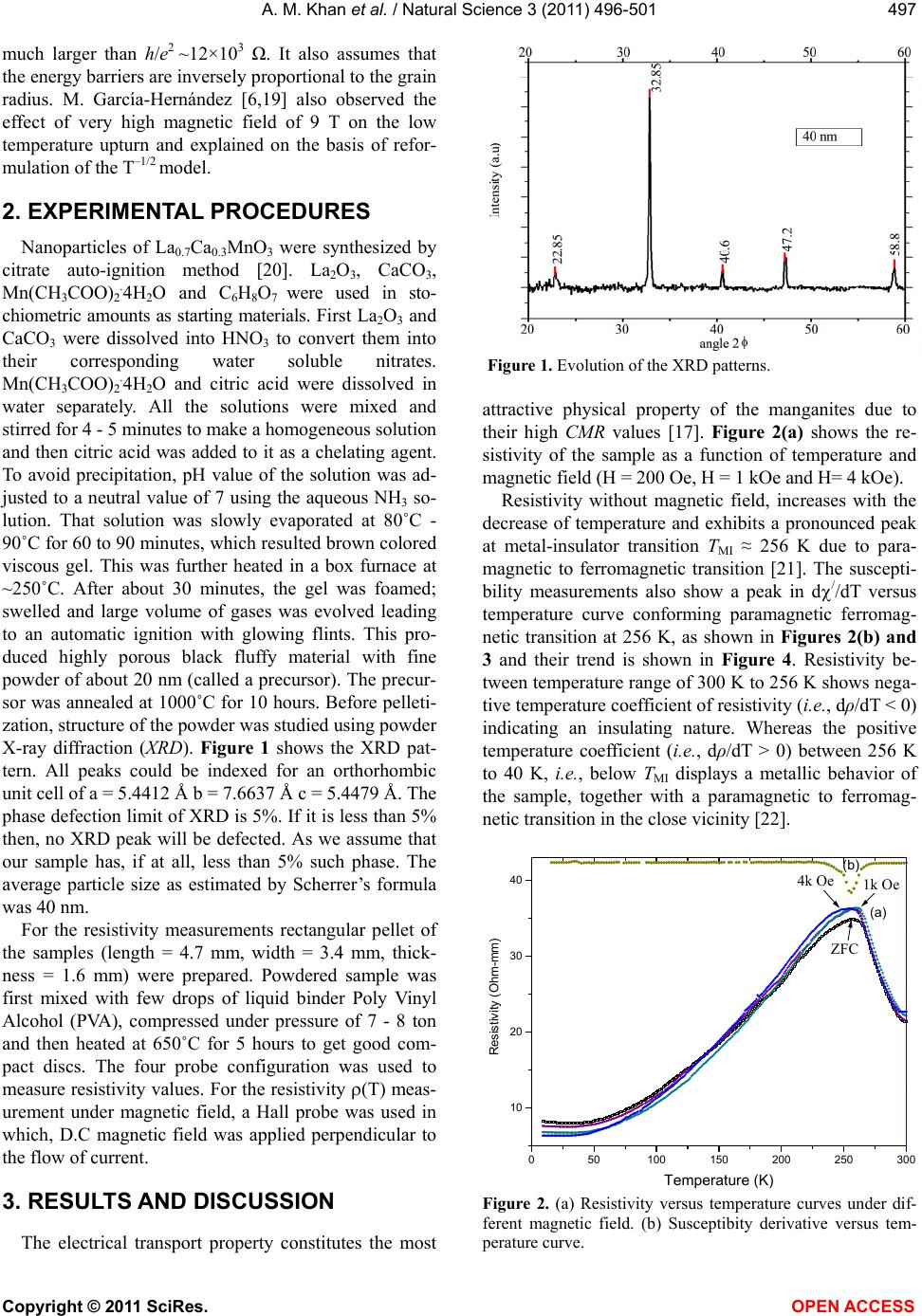 A. M. Khan et al. / Natural Science 3 (2011) 496-501 Copyright © 2011 SciRes. OPEN ACCESS 497 much larger than h/e2 ~12×103 Ω. It also assumes that the energy barriers are inversely proportional to the grain radius. M. García-Hernández [6,19] also observed the effect of very high magnetic field of 9 T on the low temperature upturn and explained on the basis of refor- mulation of the T–1/2 model. 2. EXPERIMENTAL PROCEDURES Nanoparticles of La0.7Ca0.3MnO3 were synthesized by citrate auto-ignition method [20]. La2O3, CaCO3, Mn(CH3CO O)2.4H2O and C6H8O7 were used in sto- chiometric amounts as starting materials. First La2O3 and CaCO3 were dissolved into HNO3 to convert them into their corresponding water soluble nitrates. Mn(CH3CO O)2.4H2O and citric acid were dissolved in water separately. All the solutions were mixed and stirred for 4 - 5 minutes to make a homogeneous solution and then citric acid was added to it as a chelating agent. To avoid precipitation, pH value of the solution was ad- justed to a neutral value of 7 using the aqueous NH3 so- lution. That solution was slowly evaporated at 80˚C - 90˚C for 60 to 90 minutes, which resulted brown colored viscous gel. This was further heated in a box furnace at ~250˚C. After about 30 minutes, the gel was foamed; swelled and large volume of gases was evolved leading to an automatic ignition with glowing flints. This pro- duced highly porous black fluffy material with fine powder of about 20 nm (called a precursor). The precur- sor was annealed at 1000˚C for 10 hours. Before pelleti- zation, structure of the powder was studied using powder X-ray diffraction (XRD). Figure 1 shows the XRD pat- tern. All peaks could be indexed for an orthorhombic unit cell of a = 5.4412 Å b = 7.6637 Å c = 5.4479 Å. The phase defection limit of XRD is 5%. If it is less than 5% then, no XRD peak will be defected. As we assume that our sample has, if at all, less than 5% such phase. The average particle size as estimated by Scherrer’s formula was 40 nm. For the resistivity measurements rectangular pellet of the samples (length = 4.7 mm, width = 3.4 mm, thick- ness = 1.6 mm) were prepared. Powdered sample was first mixed with few drops of liquid binder Poly Vinyl Alcohol (PVA), compressed under pressure of 7 - 8 ton and then heated at 650˚C for 5 hours to get good com- pact discs. The four probe configuration was used to measure resistivity values. For the resistivity (T) meas- urement under magnetic field, a Hall probe was used in which, D.C magnetic field was applied perpendicular to the flow of current. 3. RESULTS AND DISCUSSION The electrical transport property constitutes the most Figure 1. Evolution of the XRD patterns. attractive physical property of the manganites due to their high CMR values [17]. Figure 2(a) shows the re- sistivity of the sample as a function of temperature and magnetic field (H = 200 Oe, H = 1 kOe and H= 4 kOe). Resistivity without magnetic field, increases with the decrease of temperature and exhibits a pronounced peak at metal-insulator transition TMI ≈ 256 K due to para- magnetic to ferromagnetic transition [21]. The suscepti- bility measurements also show a peak in d//dT versus temperature curve conforming paramagnetic ferromag- netic transition at 256 K, as shown in Figures 2(b) and 3 and their trend is shown in Figure 4. Resistivity be- tween temperature range of 300 K to 256 K shows nega- tive temperature coefficient of resistivity (i.e., dρ/dT < 0) indicating an insulating nature. Whereas the positive temperature coefficient (i.e., dρ/dT > 0) between 256 K to 40 K, i.e., below TMI displays a metallic behavior of the sample, together with a paramagnetic to ferromag- netic transition in the close vicinity [22]. 050100 150 200 250 300 10 20 30 40 Temperature (K) Resistivity (Ohm-mm) (b) (a) 1k Oe 4k Oe ZFC Figure 2. (a) Resistivity versus temperature curves under dif- ferent magnetic field. (b) Susceptibity derivative versus tem- perature curve. 4k Oe1k Oe ZFC 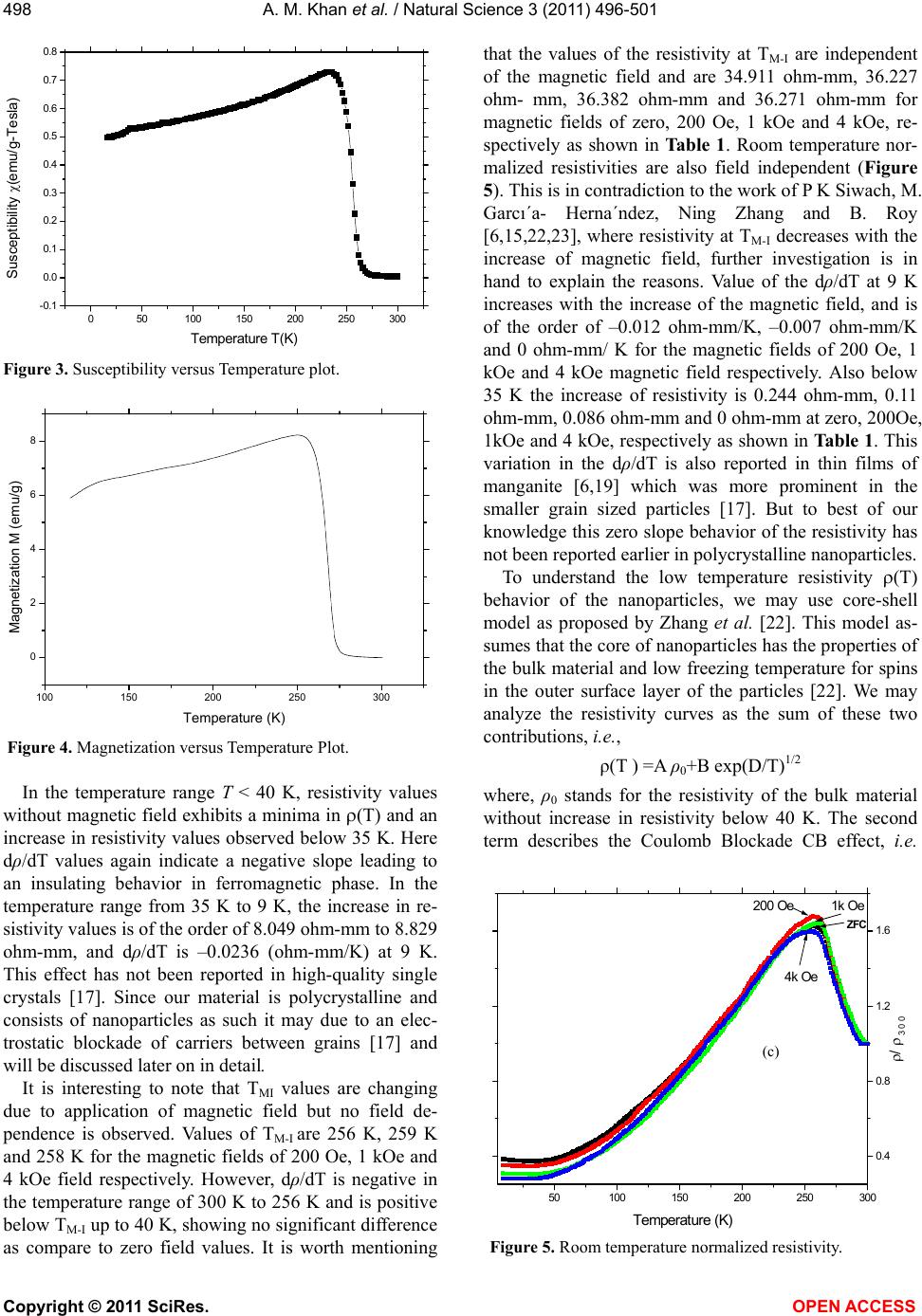 A. M. Khan et al. / Natural Science 3 (2011) 496-501 Copyright © 2011 SciRes. OPEN ACCESS 498 050100 150 200 250 300 -0.1 0.0 0.1 0.2 0.3 0.4 0.5 0.6 0.7 0.8 Susceptibility (emu/g-Tesla) Temperature T(K) Figure 3. Susceptibility versus Temperature plot. 100 150 200 250 300 0 2 4 6 8 Magnetization M (emu/g) Temperature (K) Figure 4. Magnetization versus Temperature Plot. In the temperature range T < 40 K, resistivity values without magnetic field exhibits a minima in (T) and an increase in resistivity values observed below 35 K. Here dρ/dT values again indicate a negative slope leading to an insulating behavior in ferromagnetic phase. In the temperature range from 35 K to 9 K, the increase in re- sistivity values is of the order of 8.049 ohm-mm to 8.829 ohm-mm, and dρ/dT is –0.0236 (ohm-mm/K) at 9 K. This effect has not been reported in high-quality single crystals [17]. Since our material is polycrystalline and consists of nanoparticles as such it may due to an elec- trostatic blockade of carriers between grains [17] and will be discussed later on in detail. It is interesting to note that TMI values are changing due to application of magnetic field but no field de- pendence is observed. Values of TM-I are 256 K, 259 K and 258 K for the magnetic fields of 200 Oe, 1 kOe and 4 kOe field respectively. However, dρ/dT is negative in the temperature range of 300 K to 256 K and is positive below TM-I up to 40 K, showing no significant difference as compare to zero field values. It is worth mentioning that the values of the resistivity at TM-I are independent of the magnetic field and are 34.911 ohm-mm, 36.227 ohm- mm, 36.382 ohm-mm and 36.271 ohm-mm for magnetic fields of zero, 200 Oe, 1 kOe and 4 kOe, re- spectively as shown in Table 1. Room temperature nor- malized resistivities are also field independent (Figure 5). This is in contradiction to the work of P K Siwach, M. Garcı´a- Herna´ndez, Ning Zhang and B. Roy [6,15,22,23], where resistivity at TM-I decreases with the increase of magnetic field, further investigation is in hand to explain the reasons. Value of the dρ/dT at 9 K increases with the increase of the magnetic field, and is of the order of –0.012 ohm-mm/K, –0.007 ohm-mm/K and 0 ohm-mm/ K for the magnetic fields of 200 Oe, 1 kOe and 4 kOe magnetic field respectively. Also below 35 K the increase of resistivity is 0.244 ohm-mm, 0.11 ohm-mm, 0.086 ohm-mm and 0 ohm-mm at zero, 200Oe, 1kOe and 4 kOe, respectively as shown in Table 1. This variation in the dρ/dT is also reported in thin films of manganite [6,19] which was more prominent in the smaller grain sized particles [17]. But to best of our knowledge this zero slope behavior of the resistivity has not been reported earlier in polycrystalline nanoparticles. To understand the low temperature resistivity (T) behavior of the nanoparticles, we may use core-shell model as proposed by Zhang et al. [22]. This model as- sumes that the core of nanoparticles has the properties of the bulk material and low freezing temperature for spins in the outer surface layer of the particles [22]. We may analyze the resistivity curves as the sum of these two contributions, i.e. , ρ(T ) =A ρ0+B exp(D/T)1/2 where, ρ0 stands for the resistivity of the bulk material without increase in resistivity below 40 K. The second term describes the Coulomb Blockade CB effect, i.e. 50100 150 200 250 300 0.4 0.8 1.2 1.6 ZFC (c) 1k Oe 200 Oe 4k Oe / 3 0 0 Temperature (K) Figure 5. Room temperature normalized resistivity. (c) 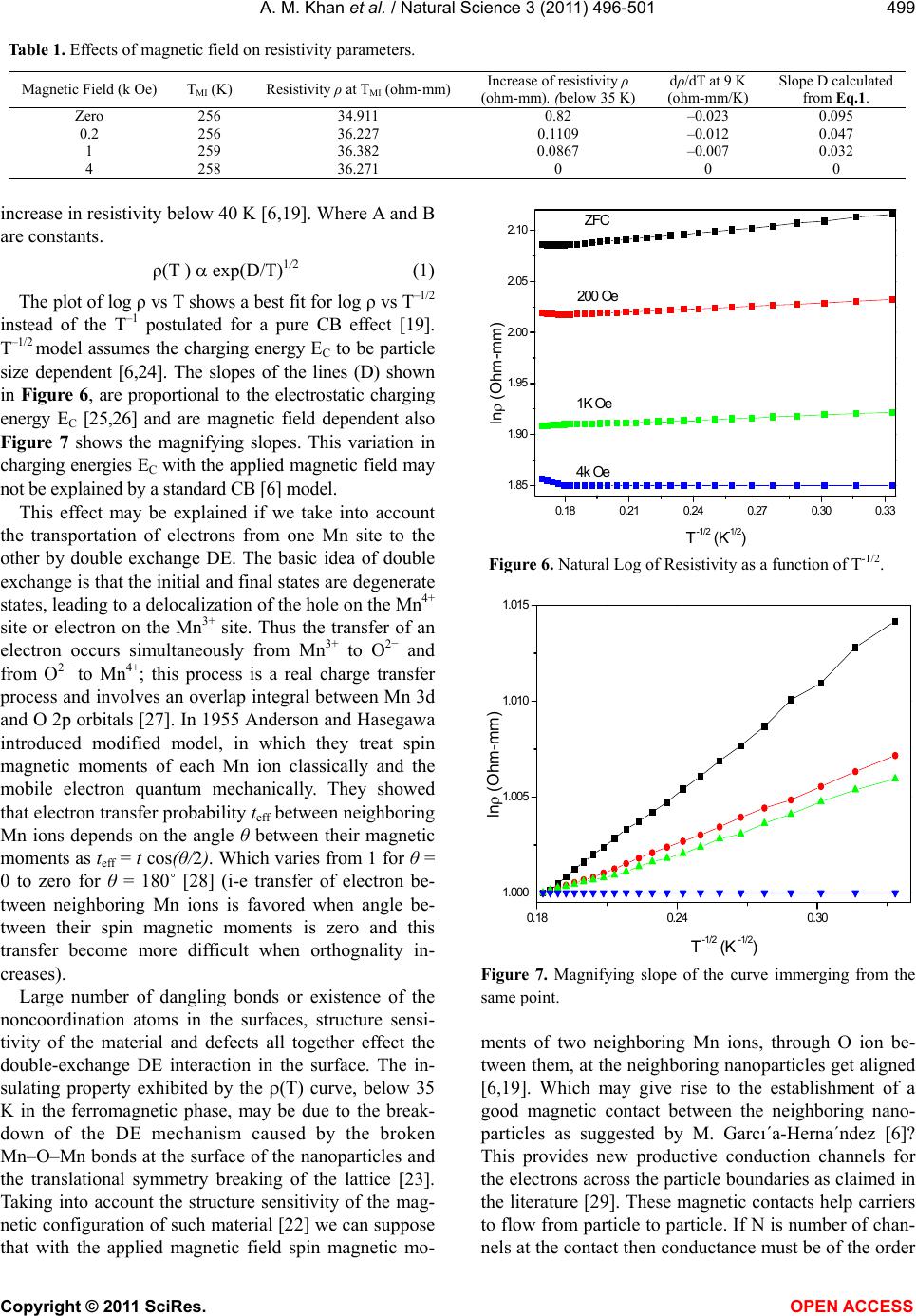 A. M. Khan et al. / Natural Science 3 (2011) 496-501 Copyright © 2011 SciRes. OPEN ACCESS 499 Table 1. Effects of magnetic field on resistivity parameters. Magnetic Field (k Oe) TMI (K) Resistivity ρ at TMI (ohm-mm) Increase of resistivity ρ (ohm-mm). (below 35 K) dρ/dT at 9 K (ohm-mm/K) Slope D calculated from Eq.1. Zero 256 34.911 0.82 –0.023 0.095 0.2 256 36.227 0.1109 –0.012 0.047 1 259 36.382 0.0867 –0.007 0.032 4 258 36.271 0 0 0 increase in resistivity below 40 K [6,19]. Where A and B are constants. ρ(T ) exp(D/T)1/2 (1) The plot of log ρ vs T shows a best fit for log ρ vs T–1/2 instead of the T–1 postulated for a pure CB effect [19]. T–1/2 model assumes the charging energy EC to be particle size dependent [6,24]. The slopes of the lines (D) shown in Figure 6, are proportional to the electrostatic charging energy EC [25,26] and are magnetic field dependent also Figure 7 shows the magnifying slopes. This variation in charging energies EC with the applied magnetic field may not be explained by a standard CB [6] model. This effect may be explained if we take into account the transportation of electrons from one Mn site to the other by double exchange DE. The basic idea of double exchange is that the initial and final states are degenerate states, leading to a delocalization of the hole on the Mn4+ site or electron on the Mn3+ site. Thus the transfer of an electron occurs simultaneously from Mn3+ to O2− and from O2− to Mn4+; this process is a real charge transfer process and involves an overlap integral between Mn 3d and O 2p orbitals [27]. In 1955 Anderson and Hasegawa introduced modified model, in which they treat spin magnetic moments of each Mn ion classically and the mobile electron quantum mechanically. They showed that electron transfer probability teff between neighboring Mn ions depends on the angle θ between their magnetic moments as teff = t cos(θ/2). Which varies from 1 for θ = 0 to zero for θ = 180˚ [28] (i-e transfer of electron be- tween neighboring Mn ions is favored when angle be- tween their spin magnetic moments is zero and this transfer become more difficult when orthognality in- creases). Large number of dangling bonds or existence of the noncoordination atoms in the surfaces, structure sensi- tivity of the material and defects all together effect the double-exchange DE interaction in the surface. The in- sulating property exhibited by the (T) curve, below 35 K in the ferromagnetic phase, may be due to the break- down of the DE mechanism caused by the broken Mn–O–Mn bonds at the surface of the nanoparticles and the translational symmetry breaking of the lattice [23]. Taking into account the structure sensitivity of the mag- netic configuration of such material [22] we can suppose that with the applied magnetic field spin magnetic mo- 0.18 0.21 0.24 0.27 0.30 0.33 1. 85 1. 90 1. 95 2. 00 2. 05 2. 10 4k Oe 1K Oe 200 Oe ZFC ln (Ohm-mm) T -1/2 (K-1/2) Figure 6. Natural Log of Resistivity as a function of T-1/2. 0.18 0.24 0.30 1.000 1.005 1.010 1.015 ln (Ohm-mm) T -1/2 (K -1/2) Figure 7. Magnifying slope of the curve immerging from the same point. ments of two neighboring Mn ions, through O ion be- tween them, at the neighboring nanoparticles get aligned [6,19]. Which may give rise to the establishment of a good magnetic contact between the neighboring nano- particles as suggested by M. Garcı´a-Herna´ndez [6]? This provides new productive conduction channels for the electrons across the particle boundaries as claimed in the literature [29]. These magnetic contacts help carriers to flow from particle to particle. If N is number of chan- nels at the contact then conductance must be of the order  A. M. Khan et al. / Natural Science 3 (2011) 496-501 Copyright © 2011 SciRes. OPEN ACCESS 500 of Ne2/h [6]. Furthermore, the capacitances of individual particles are renormalized by coupling to the other parti- cles and, therefore, are no longer determined solely by the particle radius as suggested EC = e2/4πε0εd. The fol- lowing hypothesis makes the main difference with re- spect to the standard CB model. Particle capacitances mainly depend on the quality of the contacts established with the neighboring particles and therefore on the connectivity of the system and par- ticles with good contacts show no CB effects, even if their radii are small [6], as shown in the Figure 8 for resistivity at 4 kOe (i.e. there is no rise in temperature below 0 K for 4 K Oe magnetic field). In this context, connectivity may also be understood in a broad sense. Realizations of such magnetic contacts microscopic weak links are misaligned Mn spins at the surface [29-32], distortions of the Mn-O-Mn angles due to structurally unbalanced environments at the grain sur- face and impurities or defects [6]. The blocked spins in the surface can be aligned by external magnetic field, just like in crystals [6]. The average relative angle of the local spins, in surface Δfs is larger than that in body phase Δfb at a given temperature below TC, i.e. Δfs > Δfb when T < TC. Two neighboring nanoparticles can be electrically connected only when atoms of both sides, on the edge of nanoparticle, overlap each other partly and form a Mn-O-Mn. This demands small enough interpar- ticles distance i.e. half the Mn-O-Mn bond length [22], which might be achieved by pallet preparation of the sample under high enough pressure (i.e. under 7 ton) and heating (heating at 650˚C for 5 hours). Also a Mn ion and an O–2 ion, respectively, sit at the two sides of a connective point of neighboring nanoparticles. As the field increases blocked Mn spins at the surface of a na- noparticle get align and probability of such a DE phe- nomenon at the surface increases, which depends upon 10 15 20 25 30 35 6. 5 7. 0 7. 5 8. 0 ( d ) Resistivity (Ohm-mm) 4 k Oe 1k Oe 200 Oe ZFC T e m e r a t u r e ( K ) Figure 8. Resistivity curves below 35 K. the surface spin population [22]. Magnetic field stabi- lizes the contact points which tend to strengthen cou- pling of the nanoparticles. Thus in this way coupling between neighboring nanoparticles enhances with the application of magnetic field, leading to delocalization of the charges to neighboring particles. As a result, a decrease of the resistivity is observed experimentally, upon application of a magnetic field below 35 K. 4. CONCLUSIONS Nanoparticles of La0.7Ca0.3MnO3 have been synthe- sized by citrate auto-ignition method and their electrical properties (resistivity) investigated. Below 35 K, in- crease in the resistivity values with the decrease in tem- perature is observed without magnetic field. Below 35 K charging energy was found to be sensitive to the applica- tion of a magnetic field, which could not be explained by the pure CB model. Charging effect dependence upon magnetic field was explained assuming that there exist good contacts between the neighboring nanoparticles due to alignment of the magnetic Mn spins at the sur- faces of the neighboring nanoparticles with the magnetic field. These contacts delocalize the charges to neighbor- ing nanoparticles. REFERENCES [1] Baibich, M.N., Broto, J.M., Fert, A., Nguyen, Van Dau, F., Petroff, F., Etienne, P., Creuzet, G., Friederich, A. and Chazelas, J. (1988) Giant magnetoresistance on (001)Fe/ (001) Crmagnetic superlattices. Physical Review Letters, 61, 2472-2475. doi:10.1103/PhysRevLett.61.2472 [2] Berkowitz, A.E., Mitchell, J.R., Carey, M.J., Young, A.P., Zhang, S., Spada, F.E., Parker, F.T., Hutten, A. and Tho- mas, G. (1992) Giant magnetoresistance in heterogeneous Cu–Co alloys. Physical Review Letters, 68, 3745-3748. doi:10.1103/PhysRevLett.68.3745 [3] Xiao, J.Q., Jiang, J.S. and Chien, C.L. (1992) Giant magnetoresistance in nonmultilayermagnetic systems. Physical Review Letters, 68, 3749-3752. doi:10.1103/PhysRevLett.68.3749 [4] Moodera, J.S., Kinder, L.S., Wong, T.M. and Meservey, R. (1995) Large magnetoresistance at room temperature in ferromagnetic thin films tunnel junctions. Physical Review Letters, 74, 3273-3276. doi:10.1103/PhysRevLett.74.3273 [5] McComick, P.G. and Street, R. (2003) Surface spin dis- order and exchange bais in La0.7Ca0.3MnO3 nanoparticles synthesised by mechanochemical prossesing. Reviews on Advanced Materials Science, 5, 76-81. [6] Garcı´a-Herna´ndez, M., Guinea, F., de Andre´s, A., Martı´nez, J.L., Prieto, C. and Va´zquez, L. (2000) Cou- lomb blockade versus intergrain resistance in colossal magnetoresistive manganite granular film. Physical Re- view B, 61, 9549-9552. [7] von Helmolt, R., Wecker, J., Holzapfel, B., Schultz, L. and Samwer, K. (1993) Giant negative magnetoresistance (d) 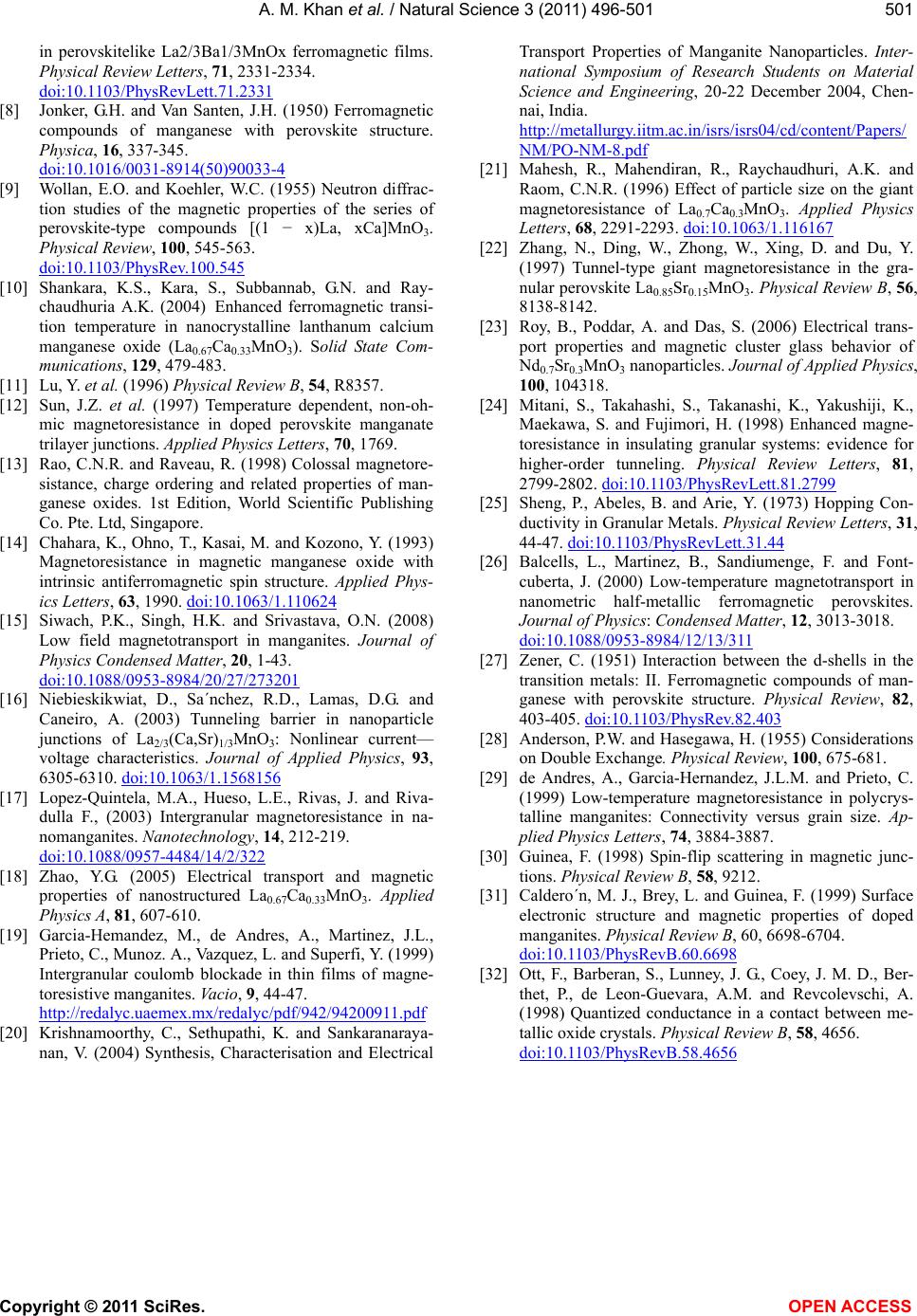 A. M. Khan et al. / Natural Science 3 (2011) 496-501 Copyright © 2011 SciRes. OPEN ACCESS 501 in perovskitelike La2/3Ba1/3MnOx ferromagnetic films. Physical Review Letters, 71, 2331-2334. doi:10.1103/PhysRevLett.71.2331 [8] Jonker, G.H. and Van Santen, J.H. (1950) Ferromagnetic compounds of manganese with perovskite structure. Physica, 16, 337-345. doi:10.1016/0031-8914(50)90033-4 [9] Wollan, E.O. and Koehler, W.C. (1955) Neutron diffrac- tion studies of the magnetic properties of the series of perovskite-type compounds [(1 − x)La, xCa]MnO3. Physical Review, 100, 545-563. doi:10.1103/PhysRev.100.545 [10] Shankara, K.S., Kara, S., Subbannab, G.N. and Ray- chaudhuria A.K. (2004) Enhanced ferromagnetic transi- tion temperature in nanocrystalline lanthanum calcium manganese oxide (La0.67Ca0.33MnO 3). Solid State Com- munications, 129, 479-483. [11] Lu, Y. et al. (1996) Physical Review B, 54, R8357. [12] Sun, J.Z. et al. (1997) Temperature dependent, non-oh- mic magnetoresistance in doped perovskite manganate trilayer junctions. Applied Physics Letters, 70, 1769. [13] Rao, C.N.R. and Raveau, R. (1998) Colossal magnetore- sistance, charge ordering and related properties of man- ganese oxides. 1st Edition, World Scientific Publishing Co. Pte. Ltd, Singapore. [14] Chahara, K., Ohno, T., Kasai, M. and Kozono, Y. (1993) Magnetoresistance in magnetic manganese oxide with intrinsic antiferromagnetic spin structure. Applied Phys- ics Letters, 63, 1990. doi:10.1063/1.110624 [15] Siwach, P.K., Singh, H.K. and Srivastava, O.N. (2008) Low field magnetotransport in manganites. Journal of Physics Condensed Matter, 20, 1-43. doi:10.1088/0953-8984/20/27/273201 [16] Niebieskikwiat, D., Sa´nchez, R.D., Lamas, D.G. and Caneiro, A. (2003) Tunneling barrier in nanoparticle junctions of La2/3(Ca,Sr)1/3MnO3: Nonlinear current— voltage characteristics. Journal of Applied Physics, 93, 6305-6310. doi:10.1063/1.1568156 [17] Lopez-Quintela, M.A., Hueso, L.E., Rivas, J. and Riva- dulla F., (2003) Intergranular magnetoresistance in na- nomanganites. Nanotechnology, 14, 212-219. doi:10.1088/0957-4484/14/2/322 [18] Zhao, Y.G. (2005) Electrical transport and magnetic properties of nanostructured La0.67Ca0.33MnO3. Applied Physics A, 81, 607-610. [19] Garcia-Hemandez, M., de Andres, A., Martinez, J.L., Prieto, C., Munoz. A., Vazquez, L. and Superfi, Y. (1999) Intergranular coulomb blockade in thin films of magne- toresistive manganites. Vacio, 9, 44-47. http://redalyc.uaemex.mx/redalyc/pdf/942/94200911.pdf [20] Krishnamoorthy, C., Sethupathi, K. and Sankaranaraya- nan, V. (2004) Synthesis, Characterisation and Electrical Transport Properties of Manganite Nanoparticles. Inter- national Symposium of Research Students on Material Science and Engineering, 20-22 December 2004, Chen- nai, India. http://metallurgy.iitm.ac.in/isrs/isrs04/cd/content/Papers/ NM/PO-NM-8.pdf [21] Mahesh, R., Mahendiran, R., Raychaudhuri, A.K. and Raom, C.N.R. (1996) Effect of particle size on the giant magnetoresistance of La0.7Ca0.3MnO3. Applied Physics Letters, 68, 2291-2293. doi:10.1063/1.116167 [22] Zhang, N., Ding, W., Zhong, W., Xing, D. and Du, Y. (1997) Tunnel-type giant magnetoresistance in the gra- nular perovskite La0.85Sr0.15MnO3. Physical Review B, 56, 8138-8142. [23] Roy, B., Poddar, A. and Das, S. (2006) Electrical trans- port properties and magnetic cluster glass behavior of Nd0.7Sr0.3MnO3 nanoparticles. Journal of Applied Physics, 100, 104318. [24] Mitani, S., Takahashi, S., Takanashi, K., Yakushiji, K., Maekawa, S. and Fujimori, H. (1998) Enhanced magne- toresistance in insulating granular systems: evidence for higher-order tunneling. Physical Review Letters, 81, 2799-2802. doi:10.1103/PhysRevLett.81.2799 [25] Sheng, P., Abeles, B. and Arie, Y. (1973) Hopping Con- ductivity in Granular Metals. Physical Review Letters, 31, 44-47. doi:10.1103/PhysRevLett.31.44 [26] Balcells, L., Martinez, B., Sandiumenge, F. and Font- cuberta, J. (2000) Low-temperature magnetotransport in nanometric half-metallic ferromagnetic perovskites. Journal of Physics: Condensed Matter, 12, 3013-3018. doi:10.1088/0953-8984/12/13/311 [27] Zener, C. (1951) Interaction between the d-shells in the transition metals: II. Ferromagnetic compounds of man- ganese with perovskite structure. Physical Review, 82, 403-405. doi:10.1103/PhysRev.82.403 [28] Anderson, P.W. and Hasegawa, H. (1955) Considerations on Double Exchange. Physical Review, 100, 675-681. [29] de Andres, A., Garcia-Hernandez, J.L.M. and Prieto, C. (1999) Low-temperature magnetoresistance in polycrys- talline manganites: Connectivity versus grain size. Ap- plied Physics Letters, 74, 3884-3887. [30] Guinea, F. (1998) Spin-flip scattering in magnetic junc- tions. Physical Review B, 58, 9212. [31] Caldero´n, M. J., Brey, L. and Guinea, F. (1999) Surface electronic structure and magnetic properties of doped manganites. Physical Review B, 60, 6698-6704. doi:10.1103/PhysRevB.60.6698 [32] Ott, F., Barberan, S., Lunney, J. G., Coey, J. M. D., Ber- thet, P., de Leon-Guevara, A.M. and Revcolevschi, A. (1998) Quantized conductance in a contact between me- tallic oxide crystals. Physical Review B, 58, 4656. doi:10.1103/PhysRevB.58.4656 |