

Paper Menu >>
Journal Menu >>
 Vol.3, No.6, 362-365 (2011) doi:10.4236/health.2011.36061 C opyright © 2011 SciRes. Openly accessible at http://www.scirp.org/journal/HEALTH/ Health Incidence of rubella IgM antibodies in individuals with febrile rash illness attending clinics in Akwa Ibom State, Nigeria, 2006-2009 Bassey Enya1*, Moses Anietie Effiong2, Udo Sunde Moffat2, Bassey Emem3 1World Health Organization Office, Abuja, Nigeria; *Corresponding Author: [email protected] 2Department of Medical Microbiology and Parasitology, Faculty of Clinical Sciences, University of Uyo, Uyo, Nigeria; 3Department of Obstetrics and Gynaecology, Faculty of Clinical Sciences, University of Uyo, Uyo, Nigeria. Received 8 March 2011; revised 20 April 2011; accepted 5 May 2011. ABSTRACT Background: Rubella is an infectious disease of public health importance because infection ac- quired during early pregnancy often results in foetal abnormalities that are classified as con- genital rubella syndrome (CRS). The burden of rubella infection in most developing countries is however not well documented because of lim- ited epidemiological data. Methods: Between 2006 and 2009, 781individuals with febrile rash illness seen in clinics in Akwa Ibom State were screened for rubella specific IgM antibodies using the ELISA technique. Statistical analysis was done using Graph prime version 5.3 statis- tical package at 95% confidence interval. The level of significance w as established at P = 0.05 using Fisher’s exact two-tailed values. Results: Of 781 individuals screened for rubella specific IgM antibodies, 94 (12%) were found to be posi- tive. Incidence of 8.7% recorded in 2006 gradu- ally rose to 9.3% in 2007, 11.6% in 2008 and 14.3% in 2009. Those in the reproductive age group (> 16 years) were most affected (51.7%). However, this w as not statistically significant (P = 0.228). Females (17.4%) were more suscepti- ble than males (6.2%) (P < 0.0001) an rural dwellers (12.8%) more susceptible than urban dwellers (10.5%) (P = 0.416). Conclusion: The study shows that the incidence of rubella in Akwa Ibom State, Nigeria is high. The lowest incidence was however found among individu- als below the reproductive age. Thus, the find- ings of this study can be used by polic y makers to model the introduction of routine rubella vaccinati on into the c ount ry’ Exp anded Program on Immunization Schedule (EPI). Keywords: Rubella-IgM Antibodies; Febrile Rash Illness; Akwa Ibom State 1. INTRODUCTION Rubella virus infection usually causes a mild disease in humans, but infection during early pregnancy often leads to severe congenital abnormalities [1]. Although the incidence of such abnormalities has declined consid- erably as a consequence of rubella immunization, the immunization rates are not optimal and infections during pregnancy still occur. According to the world health or- ganization (WHO) report [2], only 105 (49%) of 214 countries had introduced rubella vaccine in their national immunization programme [2]. Although rare, complications such as thrombocyto- paenia, encephalitis, Guillain-Barré syndrome, myocar- ditis and pericarditis may appear in adults [3]. The most serious consequences of the infection occur in newborns, particularly if the mother acquired the infection during the first trimester of gestation. This manifests in the form of congenital rubella syndrome (CRS) which may in- clude miscarriage, severe alterations in the growth and development of the foetus, and intra-uterine death [3]. In surviving infants, the usual clinical manifestations of CRS are deafness, cardiac disease, mental retardation, eye defects and insulin dependent diabetes mellitus, hepatitis, haemolytic anaemia [4] Congenital Rubella Syndrome is a disastrous systemic disease which can be prevented by vaccination during infancy and adoles- cence. WHO estimates that worldwide more than 100,000 children are born with CRS each year, most of them in developing countries [5]. Findings from a recent study in Nigeria reported the detection of anti-IgM ru- bella antibodies as a marker for recent rubella (as rec- ommended by WHO) in 3.9% of pregnant women in the 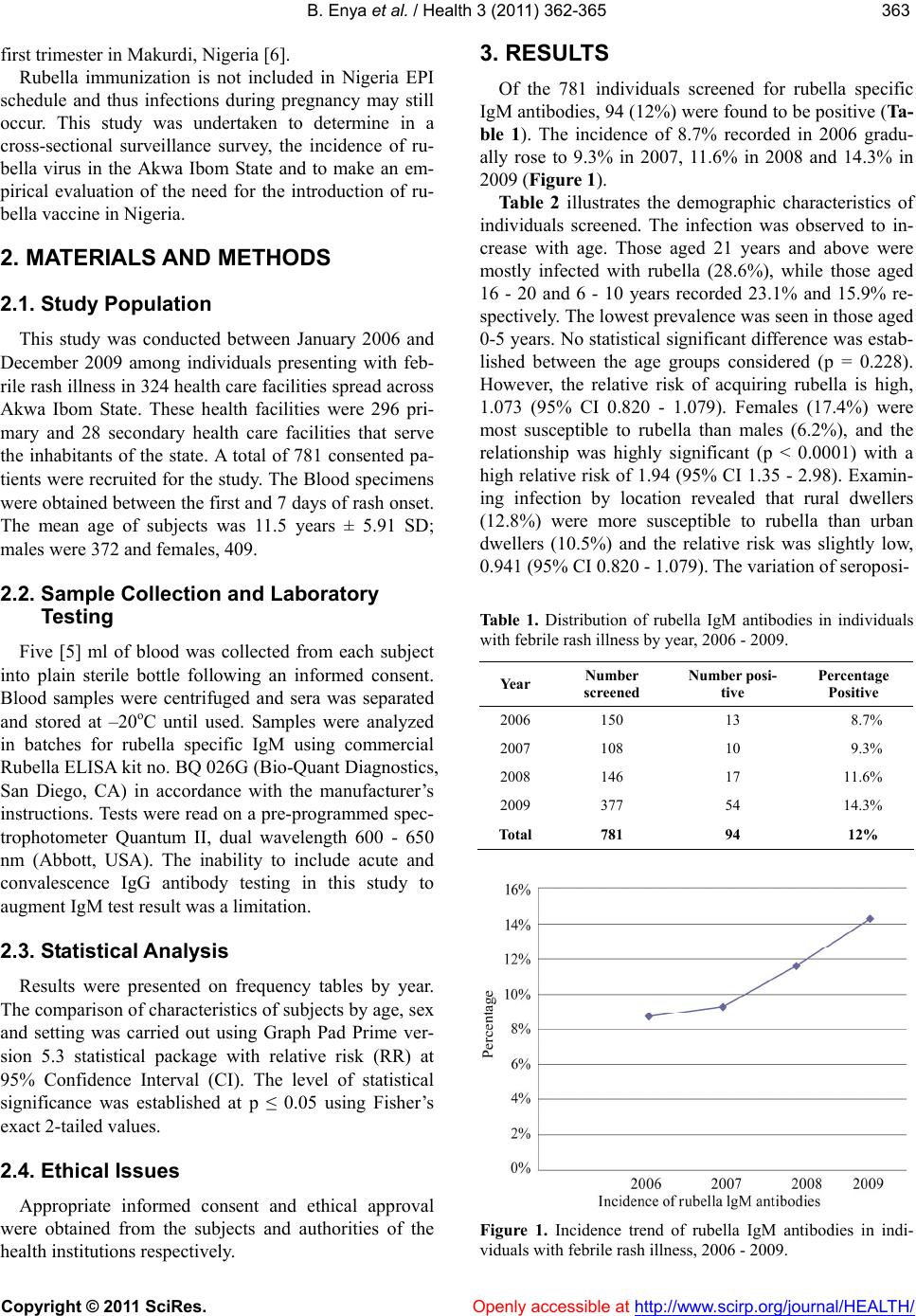 B. Enya et al. / Health 3 (2011) 362-365 Copyright © 2011 SciRes. Openly accessible at http://www.scirp.org/journal/HEALTH/ 363363 first trimester in Makurdi, Nigeria [6]. Rubella immunization is not included in Nigeria EPI schedule and thus infections during pregnancy may still occur. This study was undertaken to determine in a cross-sectional surveillance survey, the incidence of ru- bella virus in the Akwa Ibom State and to make an em- pirical evaluation of the need for the introduction of ru- bella vaccine in Nigeria. 2. MATERIALS AND METHODS 2.1. Stud y Population This study was conducted between January 2006 and December 2009 among individuals presenting with feb- rile rash illness in 324 health care facilities spread across Akwa Ibom State. These health facilities were 296 pri- mary and 28 secondary health care facilities that serve the inhabitants of the state. A total of 781 consented pa- tients were recruited for the study. The Blood specimens were obtained between the first and 7 days of rash onset. The mean age of subjects was 11.5 years ± 5.91 SD; males were 372 and females, 409. 2.2. Sample Collection and Laboratory Testing Five [5] ml of blood was collected from each subject into plain sterile bottle following an informed consent. Blood samples were centrifuged and sera was separated and stored at –20oC until used. Samples were analyzed in batches for rubella specific IgM using commercial Rubella ELISA kit no. BQ 026G (Bio-Quant Diagnostics, San Diego, CA) in accordance with the manufacturer’s instructions. Tests were read on a pre-programmed spec- trophotometer Quantum II, dual wavelength 600 - 650 nm (Abbott, USA). The inability to include acute and convalescence IgG antibody testing in this study to augment IgM test result was a limitation. 2.3. Statistical Analysis Results were presented on frequency tables by year. The comparison of characteristics of subjects by age, sex and setting was carried out using Graph Pad Prime ver- sion 5.3 statistical package with relative risk (RR) at 95% Confidence Interval (CI). The level of statistical significance was established at p ≤ 0.05 using Fisher’s exact 2-tailed values. 2.4. Ethical Issues Appropriate informed consent and ethical approval were obtained from the subjects and authorities of the health institutions respectively. 3. RESULTS Of the 781 individuals screened for rubella specific IgM antibodies, 94 (12%) were found to be positive (Ta- ble 1). The incidence of 8.7% recorded in 2006 gradu- ally rose to 9.3% in 2007, 11.6% in 2008 and 14.3% in 2009 (Figure 1). Ta b le 2 illustrates the demographic characteristics of individuals screened. The infection was observed to in- crease with age. Those aged 21 years and above were mostly infected with rubella (28.6%), while those aged 16 - 20 and 6 - 10 years recorded 23.1% and 15.9% re- spectively. The lowest prevalence was seen in those aged 0-5 years. No statistical significant difference was estab- lished between the age groups considered (p = 0.228). However, the relative risk of acquiring rubella is high, 1.073 (95% CI 0.820 - 1.079). Females (17.4%) were most susceptible to rubella than males (6.2%), and the relationship was highly significant (p < 0.0001) with a high relative risk of 1.94 (95% CI 1.35 - 2.98). Examin- ing infection by location revealed that rural dwellers (12.8%) were more susceptible to rubella than urban dwellers (10.5%) and the relative risk was slightly low, 0.941 (95% CI 0.820 - 1.079). The variation of seroposi- Table 1. Distribution of rubella IgM antibodies in individuals with febrile rash illness by year, 2006 - 2009. Year Number screened Number posi- tive Percentage Positive 2006 150 13 8.7% 2007 108 10 9.3% 2008 146 17 11.6% 2009 377 54 14.3% Total 781 94 12% Figure 1. Incidence trend of rubella IgM antibodies in indi- viduals with febrile rash illness, 2006 - 2009. 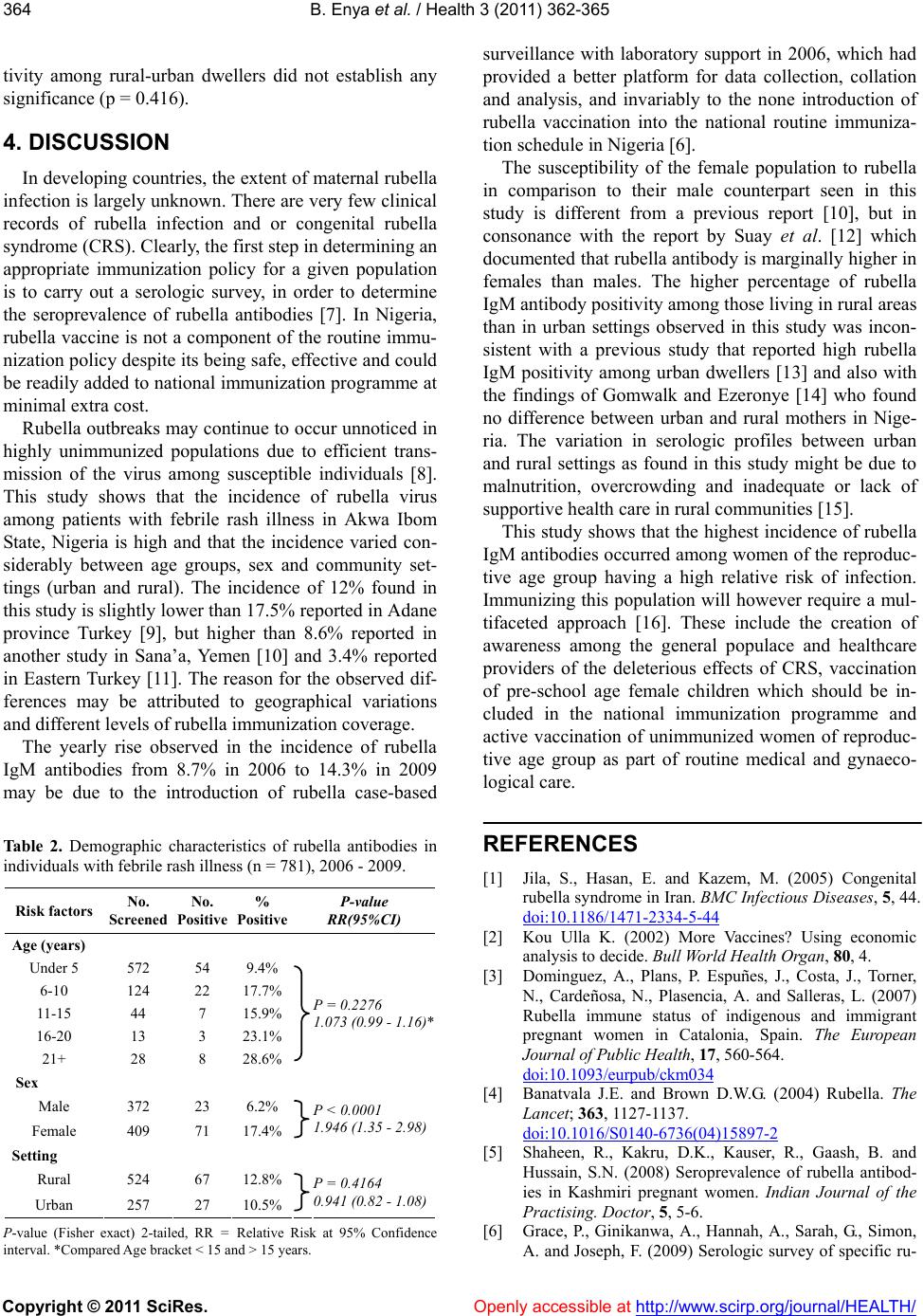 B. Enya et al. / Health 3 (2011) 362-365 Copyright © 2011 SciRes. Openly accessible at http://www.scirp.org/journal/HEALTH/ 364 tivity among rural-urban dwellers did not establish any significance (p = 0.416). 4. DISCUSSION In developing countries, the extent of maternal rubella infection is largely unknown. There are very few clinical records of rubella infection and or congenital rubella syndrome (CRS). Clearly, the first step in determining an appropriate immunization policy for a given population is to carry out a serologic survey, in order to determine the seroprevalence of rubella antibodies [7]. In Nigeria, rubella vaccine is not a component of the routine immu- nization policy despite its being safe, effective and could be readily added to national immunization programme at minimal extra cost. Rubella outbreaks may continue to occur unnoticed in highly unimmunized populations due to efficient trans- mission of the virus among susceptible individuals [8]. This study shows that the incidence of rubella virus among patients with febrile rash illness in Akwa Ibom State, Nigeria is high and that the incidence varied con- siderably between age groups, sex and community set- tings (urban and rural). The incidence of 12% found in this study is slightly lower than 17.5% reported in Adane province Turkey [9], but higher than 8.6% reported in another study in Sana’a, Yemen [10] and 3.4% reported in Eastern Turkey [11]. The reason for the observed dif- ferences may be attributed to geographical variations and different levels of rubella immunization coverage. The yearly rise observed in the incidence of rubella IgM antibodies from 8.7% in 2006 to 14.3% in 2009 may be due to the introduction of rubella case-based Table 2. Demographic characteristics of rubella antibodies in individuals with febrile rash illness (n = 781), 2006 - 2009. Risk factors No. Screened No. Positive % Positive P-value RR(95%CI) Age (years) Under 5 572 54 9.4% 6-10 124 22 17.7% 11-15 44 7 15.9% 16-20 13 3 23.1% 21+ 28 8 28.6% P = 0.2276 1.073 (0.99 - 1.16)* Sex Male 372 23 6.2% Female 409 71 17.4% P < 0.0001 1.946 (1.35 - 2.98) Setting Rural 524 67 12.8% Urban 257 27 10.5% P = 0.4164 0.941 (0.82 - 1.08) P-value (Fisher exact) 2-tailed, RR = Relative Risk at 95% Confidence interval. *Compared Age bracket < 15 and > 15 years. surveillance with laboratory support in 2006, which had provided a better platform for data collection, collation and analysis, and invariably to the none introduction of rubella vaccination into the national routine immuniza- tion schedule in Nigeria [6]. The susceptibility of the female population to rubella in comparison to their male counterpart seen in this study is different from a previous report [10], but in consonance with the report by Suay et al. [12] which documented that rubella antibody is marginally higher in females than males. The higher percentage of rubella IgM antibody positivity among those living in rural areas than in urban settings observed in this study was incon- sistent with a previous study that reported high rubella IgM positivity among urban dwellers [13] and also with the findings of Gomwalk and Ezeronye [14] who found no difference between urban and rural mothers in Nige- ria. The variation in serologic profiles between urban and rural settings as found in this study might be due to malnutrition, overcrowding and inadequate or lack of supportive health care in rural communities [15]. This study shows that the highest incidence of rubella IgM antibodies occurred among women of the reproduc- tive age group having a high relative risk of infection. Immunizing this population will however require a mul- tifaceted approach [16]. These include the creation of awareness among the general populace and healthcare providers of the deleterious effects of CRS, vaccination of pre-school age female children which should be in- cluded in the national immunization programme and active vaccination of unimmunized women of reproduc- tive age group as part of routine medical and gynaeco- logical care. REFERENCES [1] Jila, S., Hasan, E. and Kazem, M. (2005) Congenital rubella syndrome in Iran. BMC Infectious Diseases, 5, 44. doi:10.1186/1471-2334-5-44 [2] Kou Ulla K. (2002) More Vaccines? Using economic analysis to decide. Bull World Health Organ, 80, 4. [3] Dominguez, A., Plans, P. Espuñes, J., Costa, J., Torner, N., Cardeñosa, N., Plasencia, A. and Salleras, L. (2007) Rubella immune status of indigenous and immigrant pregnant women in Catalonia, Spain. The European Journal of Public Health, 17, 560-564. doi:10.1093/eurpub/ckm034 [4] Banatvala J.E. and Brown D.W.G. (2004) Rubella. The Lancet; 363, 1127-1137. doi:10.1016/S0140-6736(04)15897-2 [5] Shaheen, R., Kakru, D.K., Kauser, R., Gaash, B. and Hussain, S.N. (2008) Seroprevalence of rubella antibod- ies in Kashmiri pregnant women. Indian Journal of the Practising. Doctor, 5, 5-6. [6] Grace, P., Ginikanwa, A., Hannah, A., Sarah, G., Simon, A. and Joseph, F. (2009) Serologic survey of specific ru-  B. Enya et al. / Health 3 (2011) 362-365 Copyright © 2011 SciRes. http://www.scirp.org/journal/HEALTH/Openly accessible at 365365 bella virus IgM in the sera of pregnant women in Ma- kurdi, Benue State, Nigeria. African Journal of Repro- ductive Health, 13, 69-73. [7] Hizel S. (1995) When should rubella immunization be introduced? Postgraduate Doctor: Middle East, 18, 273. [8] Seker, S., Abasiyanik, M.F. and Salih, B.A. (2004) Ru- bella immune status of pregnant and non-pregnant women in Istanbul, Turkey. Saudi Medical Journal, 25, 575-579. [9] Sallam, T.A., Raja’a, Y.A., Benbrake, M.S., Al-Shaibani, K.S. and Al-Hababi, A.A. (2003) Prevalence of rubella antibodies among schoolgirls in Sana’a, Republic of Yemen. East Mediterr Health Journal, 9, 148-51. [10] Aytac, N., Yucel, A., Yapicioglu, H., Kibar, F., Karaomer- lioglu, O. and Akbaba, M. (2009) Rubella seroprevalence in children in Dogankent, a rural area of Adana province in Turkey, January-February 2005. Eurosurveillance, 14, 19444. [11] Gurgoze, M.K., Yılmaz, E., Godekmerdan, A., Akca, Z., Dogan, Y., Akarsu, S., et al. (2006) Seroprevalence of mumps, varicella and rubella antibodies in children 1 - 16 years of age in eastern Turkey. The Turkish Journal of Pediatrics, 48, 185-188. [12] Suay, A., Ozekinci, T., Mete, M. and Elci, S. (2004) Torch group antibody distribution in patients’ blood sent to central laboratories from various departments, in Dicle university hospital. Biotechnology & Biotechnological Equipment, 18, 143-148. [13] Yamamoto, L., Mejia, E., López, R.M., Gallardo, E. and Gómez, B. (1995) Susceptibility to rubella infection in females at high risk. Immune protection associated to population density. Tropical Geographical Medicine, 47, 235-238. [14] Gomwalk, N.E. and Ezeronye, O.U. (1985) Sero-epide- miology of rubella in Imo State of Nigeria. Transactions of the Royal Society of Tropical Medicine and Hygiene, 79, 777-780. doi:10.1016/0035-9203(85)90114-2 [15] Sadik, A., Ayten E., Tijen, O., Zafer, K., Pembe, K., et al. (1999) Rubella seroprevalence in an unvaccinated popu- lation in Izmir: recommendations for rubella vaccination in Turkey. The Pediatric Infectious Disease Journal, 18, 577-580. doi:10.1097/00006454-199907000-00003 [16] Epidemiology and Surveillance Div, National Immuniza- tion Program, et al. (2005) Achievements in Public Health: Elimination of Rubella and Congenital Rubella Syndrome—United States, 1969 - 2004. Morbidity and Mortality Wee kly Report, 54, 279-282. |