

Paper Menu >>
Journal Menu >>
 Journal of Environmental Protection, 2011, 2, 365-370 doi: 10.4236/jep.2011.24040 Published Online June 2011 (http://www.SciRP.org/journal/jep) Copyright © 2011 SciRes. JEP 365 Planning of Recreation Parks in the University Campus Anthopoulos K. Petros, George Costa Democritus University of Thrace, Department of Physical Education and Sport Science, Komotini, Greece. Email: [email protected] Received February 20th, 2011; revised March 28th, 2011; accepted May 1st, 2011. ABSTRACT The benefits of parks and recreation are very serious. The purpose of this study was to investigate the attitudes of the people that use the camp us area of Democritus universi t y of Thrace, in Komotini. There are series of factors that should be taken under consideration when campus is under planned. In this research took part 742 people and more specific, they were: under graduate students, post graduate students, tutors as well as teaching and administrative staff. An analysis of Principle components has been accomplished and 8 factors have been accrued with eigenvalue more than 1. These factors explain the 55.32% of the whole variation. The conclusion of this study was that a model for campus planning must consists of these 8 parameters: land, climate, vegetation, physical activity, environmental consciousness, daily users of territory and inhabitants of an area. Keywords: Campus, Park , Physical Activity, Questionnaire 1. Introduction Greek towns’ public space is faced, from the majority of the citizens, as an unconcerned topic. It is not recognized as a common good which is not only available to them but also it isn’t considered as an obligation to protect it. It is a totally strange thing to the citizens and for this reason it is often pollu ted or violated by them. The same behavior is noticed in the green urban space even if it is public or private. The public green outdoors is the victim of the rapid urbanization and super-construction which after 60 s, possessing it was thought a luxury but often an unnecessary one. It is a topic superficially discussed in relation to the urban lay out, putting it in contrast to the practice done in the European and international space, in which green is the major keystone in the organization and function of the urban groups. In the Greek society green public places are limited. They are not properly organized. Also, the option of the location and planting is badly selected. Green places happened accidentally according to the constructive den- sity where the latter permits it. This doesn’t enable their integration to the town’s fun ctionality. Stress is a powerful factor of mortality [1] for the hu- mans who live in modern societies or industrialized so- cieties. This phenomenon results in two things: first, it does higher the cure cost and second, there are lost working hours. Psychological health is a sign of humans’ good physical condition. U.K.D.H. [2] points that physi- cal exercise helps people feel better improving at the same time their mood and limiting their worry. Exercise increases self respect and reduces stress reactions while managing a better quality of sleep. Parks, passages and green places that exist in a town offer an active way of life prohibitin g obesity and sudd en deaths [3-6]. Natural activity benefits persons in their physical and psychological behavior [7]. When exercise is done inside the natural environment then an added factor comes on surface. A term known as green exercise is mentioned by Pretty and his colleagues. Environment must be kept intact for ethical and financial reasons [8-11]. Little attention has been given to the advantages of the psychic health. Less natural environment means bad human condition and stress higher percentage [12]. So, research results show that green contributes to the human health and helps to get over stress, while it boosts immune system. Also, it does concentration easier. Universities’ open space and tutoring quality are two contrastive things. The plan of a campus, the unity of the surroundings and the buildings help for a pleasant place not only for the students but also for the academic staff. Institutions are usually situ ated in the center of a town. So their right planning is critical. There is an attempt for 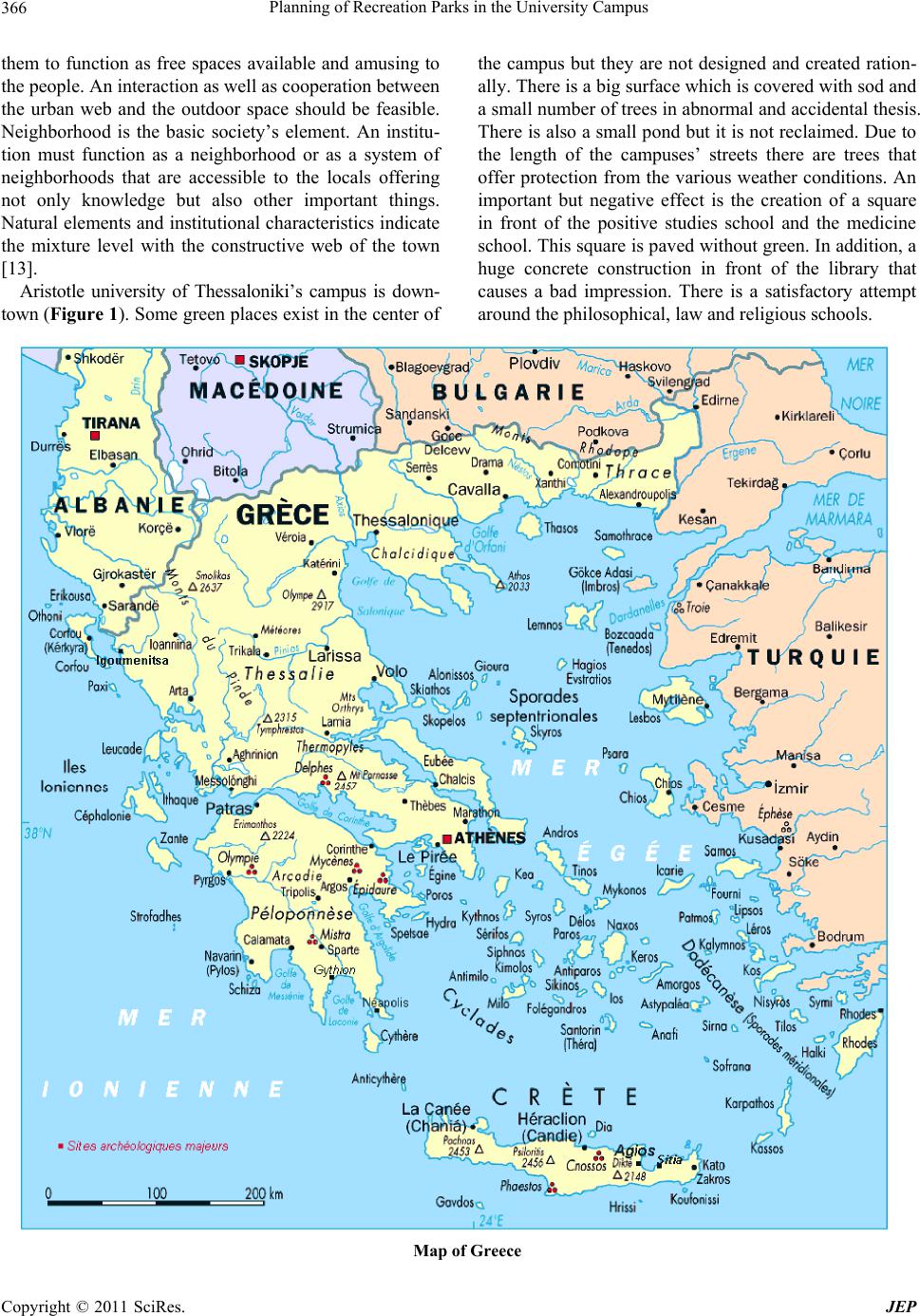 Planning of Recreation Parks in the University Campus 366 them to function as free spaces available and amusing to the people. An interaction as well as cooperation between the urban web and the outdoor space should be feasible. Neighborhood is the basic society’s element. An institu- tion must function as a neighborhood or as a system of neighborhoods that are accessible to the locals offering not only knowledge but also other important things. Natural elements and institutional ch aracteristics indicate the mixture level with the constructive web of the town [13]. Aristotle university of Thessaloniki’s campus is down- town (Figure 1). Some green places exist in the center of the campus but they are not designed and created ration- ally. There is a big surface which is covered with sod and a small number of trees in abnormal and accidental thesis. There is also a small pond but it is not reclaimed. Due to the length of the campuses’ streets there are trees that offer protection from the various weather conditions. An important but negative effect is the creation of a square in front of the positive studies school and the medicine school. This square is p aved with out green . In additio n, a huge concrete construction in front of the library that causes a bad impression. There is a satisfactory attempt around the philosophical, law and r e ligious schools. Map of Greece Copyright © 2011 SciRes. JEP 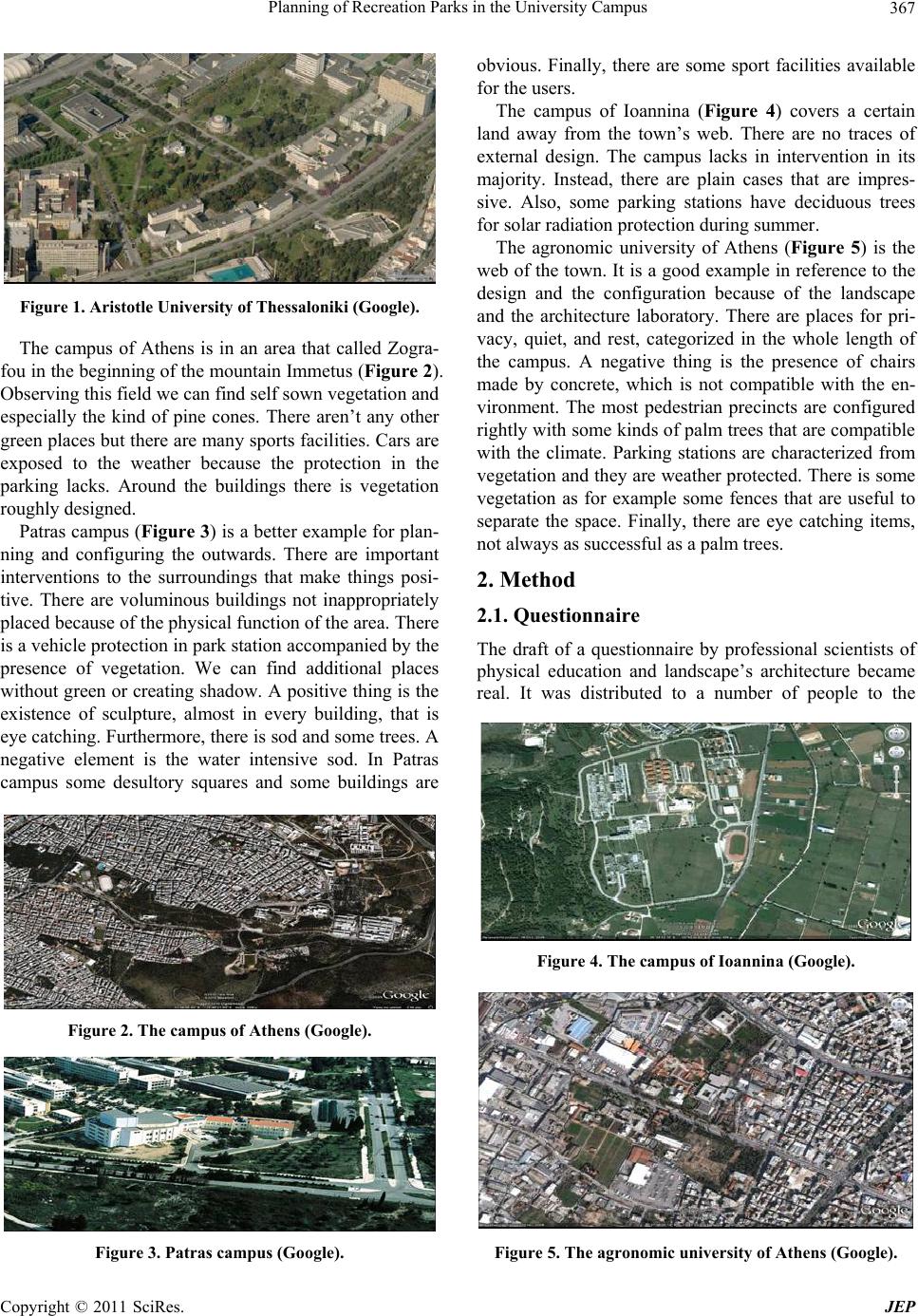 Planning of Recreation Parks in the University Campus367 Figure 1. Aristotle University of Thessaloniki (Google). The campus of Athens is in an area that called Zogra- fou in the beginning of the mountain Immetus (Figure 2). Observing this field we can find self sown vegetation and especially the kind of pine cones. There aren’t any other green places but there are many sports facilities. Cars are exposed to the weather because the protection in the parking lacks. Around the buildings there is vegetation roughly designed. Patras campus (Figure 3) is a better example for plan- ning and configuring the outwards. There are important interventions to the surroundings that make things posi- tive. There are voluminous buildings not inappropriately placed because of the physical function of the area. There is a vehicle protection in park station accompanied by the presence of vegetation. We can find additional places without green or creating shad ow. A positive thing is the existence of sculpture, almost in every building, that is eye catching. Furthermore, there is sod and some trees. A negative element is the water intensive sod. In Patras campus some desultory squares and some buildings are Figure 2. The campus of Athens (Google). Figure 3. Patras campus (Google). obvious. Finally, there are some sport facilities available for the users. The campus of Ioannina (Figure 4) covers a certain land away from the town’s web. There are no traces of external design. The campus lacks in intervention in its majority. Instead, there are plain cases that are impres- sive. Also, some parking stations have deciduous trees for solar radi at i on p rot ecti o n during summer. The agronomic university of Athens (Figure 5) is the web of the town. It is a good example in reference to the design and the configuration because of the landscape and the architecture laboratory. There are places for pri- vacy, quiet, and rest, categorized in the whole length of the campus. A negative thing is the presence of chairs made by concrete, which is not compatible with the en- vironment. The most pedestrian precincts are configured rightly with some kinds of palm trees that are compatible with the climate. Parking stations are characterized from vegetation and they are weather protected. There is some vegetation as for example some fences that are useful to separate the space. Finally, there are eye catching items, not always as successful as a palm trees. 2. Method 2.1. Questionnaire The draft of a questionnaire by professional scientists of physical education and landscape’s architecture became real. It was distributed to a number of people to the Figure 4. The campus of Ioannina (Google). Figure 5. The agronomic university of Athens (Google). Copyright © 2011 SciRes. JEP 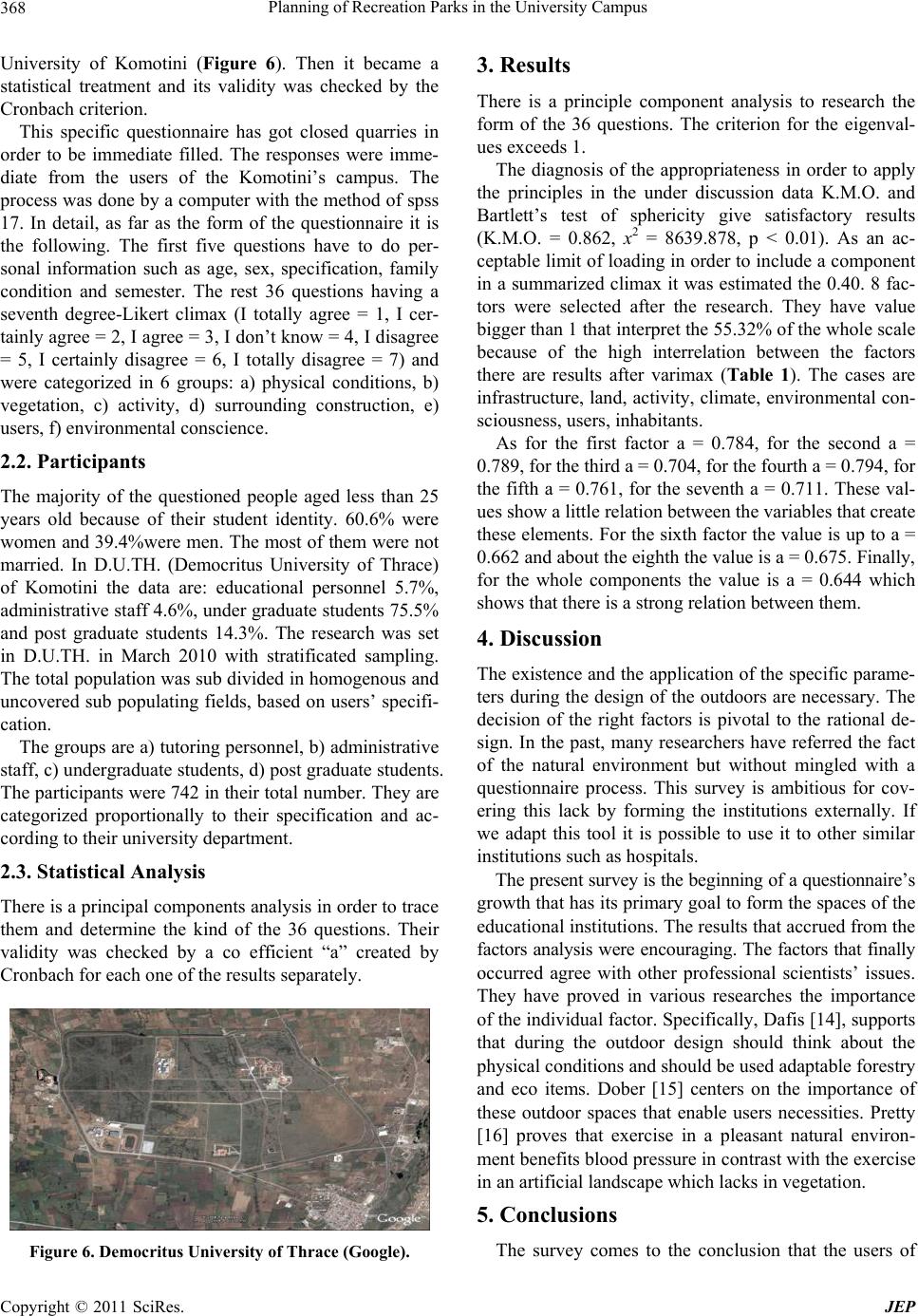 Planning of Recreation Parks in the University Campus 368 Ua has got closed quarries in or questioned people aged less than 25 oups are a) tutoring personnel, b) administrative st ents analysis in order to trace niversity of Komotini (Figure 6). Then it became statistical treatment and its validity was checked by the Cronbach criterion . This specific questionnaire der to be immediate filled. The responses were imme- diate from the users of the Komotini’s campus. The process was done by a computer with the method of spss 17. In detail, as far as the form of the questionnaire it is the following. The first five questions have to do per- sonal information such as age, sex, specification, family condition and semester. The rest 36 questions having a seventh degree-Likert climax (I totally agree = 1, I cer- tainly agree = 2, I ag ree = 3, I don’t know = 4, I disagr ee = 5, I certainly disagree = 6, I totally disagree = 7) and were categorized in 6 groups: a) physical conditions, b) vegetation, c) activity, d) surrounding construction, e) users, f) environmental conscience. 2.2. Participants The majority of the years old because of their student identity. 60.6% were women and 39.4%were men. The most of them were not married. In D.U.TH. (Democritus University of Thrace) of Komotini the data are: educational personnel 5.7%, administrative staff 4.6%, under graduate students 75.5% and post graduate students 14.3%. The research was set in D.U.TH. in March 2010 with stratificated sampling. The total population was sub divided in homogenous and uncovered sub populating fields, based on users’ specifi- cation. The gr aff, c) undergraduate students, d) post graduate students. The participants were 742 in their total number. They are categorized proportionally to their specification and ac- cording to their university department. 2.3. Statistical Analysis There is a principal compon them and determine the kind of the 36 questions. Their validity was checked by a co efficient “a” created by Cronbach for each one of the results separately. Figure 6. Democritus University of Thrace (Google). 3. omponent analysis to research the s of the appropriateness in order to apply th 0.784, for the second a = 0. e application of the specific parame- ginning of a questionnaire’s gr conclusion that the users of Results There is a principle c form of the 36 questions. The criterion for the eigenval- ues exceeds 1. The diagnosi e principles in the under discussion data K.M.O. and Bartlett’s test of sphericity give satisfactory results (K.M.O. = 0.862, x2 = 8639.878, p < 0.01). As an ac- ceptable limit of loading in order to include a component in a summarized climax it was estimated the 0.40. 8 fac- tors were selected after the research. They have value bigger than 1 that interpret the 55.32% of the whole scale because of the high interrelation between the factors there are results after varimax (Table 1). The cases are infrastructure, land, activity, climate, environmental con- sciousness, users, inhabitants. As for the first factor a = 789, for the third a = 0.704, for the fourth a = 0.794, for the fifth a = 0.761, for the seventh a = 0.711. These val- ues show a little relation between the variables that create these elements. For the sixth factor the value is up to a = 0.662 and about th e eighth the value is a = 0.675. Finally, for the whole components the value is a = 0.644 which shows that there is a strong relation between them. 4. Discussion The existence and th ters during the design of the outdoors are necessary. The decision of the right factors is pivotal to the rational de- sign. In the past, many researchers have referred the fact of the natural environment but without mingled with a questionnaire process. This survey is ambitious for cov- ering this lack by forming the institutions externally. If we adapt this tool it is possible to use it to other similar institutions such as hospitals. The present survey is the be owth that has its primary goal to form the spaces of the educational institutions. The results that accrued from the factors analysis were encouraging. The factors that finally occurred agree with other professional scientists’ issues. They have proved in various researches the importance of the individual factor. Specifically, Dafis [14], supports that during the outdoor design should think about the physical conditions and should be used adaptable forestry and eco items. Dober [15] centers on the importance of these outdoor spaces that enable users necessities. Pretty [16] proves that exercise in a pleasant natural environ- ment benefits blood pressure in contrast with the exercise in an artificial landscape which lacks in vegetation. 5. Conclusions The survey comes to the Copyright © 2011 SciRes. JEP  Planning of Recreation Parks in the University Campus Copyright © 2011 SciRes. JEP 369 omponent analysis. Table 1. Principle c Factors 1 2 3 4 5 6 7 8 Subject focus 0.679 Botanical garden 0.649 Cultural 0.593 Fences plants 0.570 Environmental inf ormation 0.556 Meeting spaces 0.554 View locations 0.551 Isolation sights 0.513 Type of soil 0.723 Soil depth 0.664 Terrain 0.577 Soil moisture 0.572 Slope land 0.531 Moderate activity 0.676 Alternative forms of activity 0.646 Extreme sports 0.621 Team sports 0.612 Sports spaces 0.572 Footpaths 0.546 Rainfall 0.794 Wind 0.723 Humidity 0.640 Trees shape 0.783 Trees colors 0.728 Trees height 0.573 Trees type 0.503 Roads 0.733 Car using 0.693 Close buildings 0.661 Materials of construction 0.657 Opinion users 0.815 Wishes users 0.795 Active participation users 0.480 Access inhabitants 0.802 Active participation inhabitants 0.731 Events 0.703 Extraction method: principal component analysis. tation me t ho d: varimax with kaiser normalition. Ro za 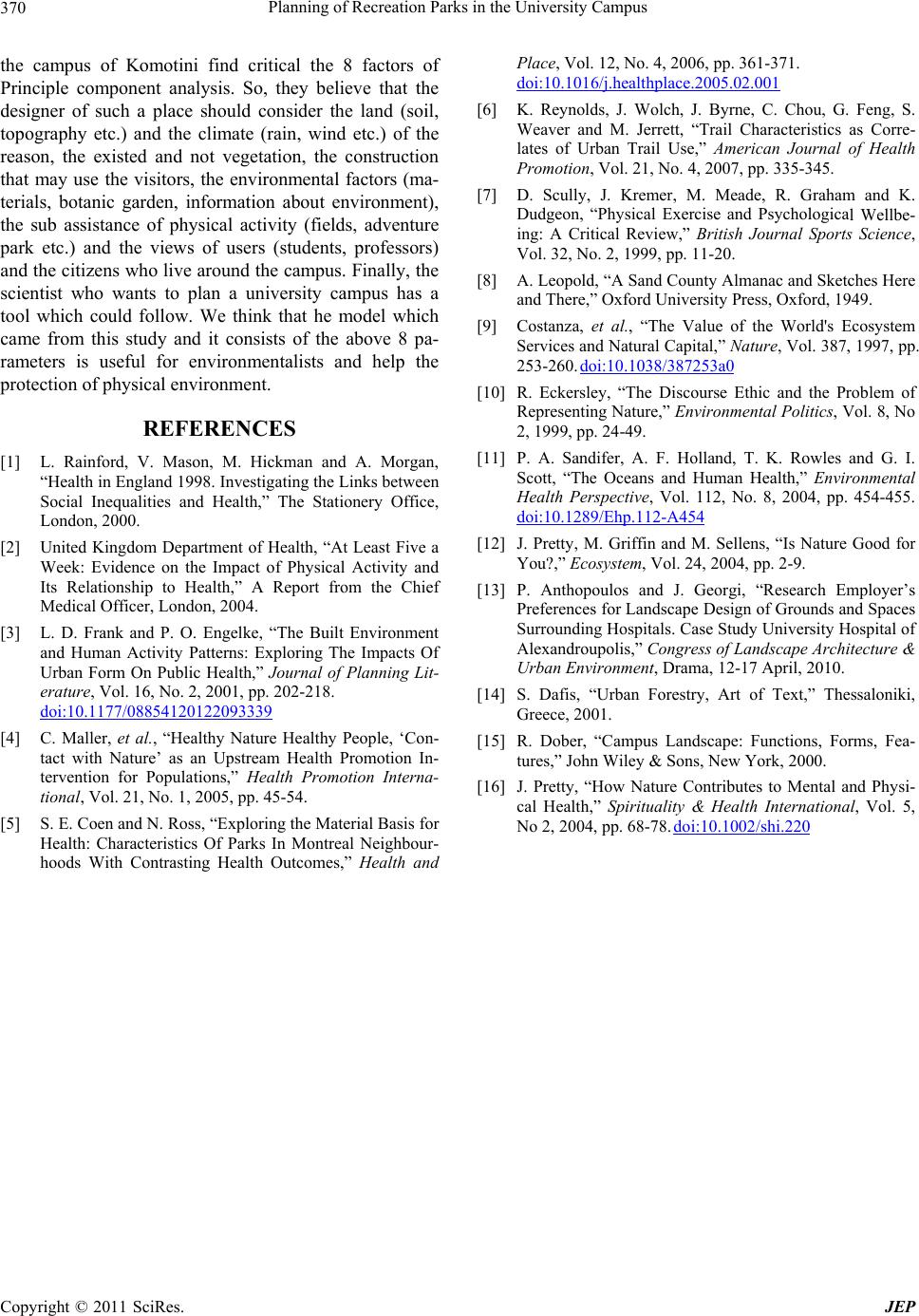 Planning of Recreation Parks in the University Campus 370 he campus of Komotini find critical the 8 factors of t Principle component analysis. So, they believe that the designer of such a place should consider the land (soil, topography etc.) and the climate (rain, wind etc.) of the reason, the existed and not vegetation, the construction that may use the visitors, the environmental factors (ma- terials, botanic garden, information about environment), the sub assistance of physical activity (fields, adventure park etc.) and the views of users (students, professors) and the citizens who live around the campus. Finally, the scientist who wants to plan a university campus has a tool which could follow. We think that he model which came from this study and it consists of the above 8 pa- rameters is useful for environmentalists and help the protection of physical enviro nment. REFERENCES son, M. Hickma[1] L. Rainford, V. Man and A. Morgan Department of Health, “At Least Five a he Built Environment , “Health in England 1998. Investigating the Links between Social Inequalities and Health,” The Stationery Office, London, 2000. [2] United Kingdom Week: Evidence on the Impact of Physical Activity and Its Relationship to Health,” A Report from the Chief Medical Officer, London, 2004. [3] L. D. Frank and P. O. Engelke, “T and Human Activity Patterns: Exploring The Impacts Of Urban Form On Public Health,” Journal of Planning Lit- erature, Vol. 16, No. 2, 2001, pp. 202-218. doi:10.1177/08854120122093339 [4] C. Maller, et al., “Healthy Nature Healthy People, ‘Con- Material Ba 12, No. 4, 2006, pp. 361-371. tact with Nature’ as an Upstream Health Promotion In- tervention for Populations,” Health Promotion Interna- tional, Vol. 21, No. 1, 2005, pp. 45-54. [5] S. E. Coen and N. Ross, “Exploring the sis for Health: Characteristics Of Parks In Montreal Neighbour- hoods With Contrasting Health Outcomes,” Health and Place, Vol. doi:10.1016/j.healthplace.2005.02.001 [6] K. Reynolds, J. Wolch, J. Byrne, C. Cho Weaver and M. Jerrett, “Trail Characu, G. Feng, S. teristics as Corre- l Wellbe- ess, Oxford, 1949. , pp. lates of Urban Trail Use,” American Journal of Health Promotion, Vol. 21, No. 4, 2007, pp. 335-345. [7] D. Scully, J. Kremer, M. Meade, R. Graham and K. Dudgeon, “Physical Exercise and Psychologica ing: A Critical Review,” British Journal Sports Science, Vol. 32, No. 2, 1999, pp. 11-20. [8] A. Leopold, “A Sand County Almanac and Sketches Here and There,” Oxford University Pr [9] Costanza, et al., “The Value of the World's Ecosystem Services and Natural Capital,” Nature, Vol. 387, 1997 253-260. doi:10.1038/387253a0 [10] R. Eckersley, “The Discourse Ethic and the Problem of Representing Nature,” Environmental Politics, Vol. 8, No and Human Health,” Environmental 2, 1999, pp. 24-49. [11] P. A. Sandifer, A. F. Holland, T. K. Rowles and G. I. Scott, “The Oceans Health Perspective, Vol. 112, No. 8, 2004, pp. 454-455. doi:10.1289/Ehp.112-A454 [12] J. Pretty, M. Griffin and M. Sellens, “Is Nature Good for You?,” Ecosystem, Vol. 24, 2004, pp. 2-9. ds and Spaces ley & Sons, New York, 2000. al, Vol. 5, [13] P. Anthopoulos and J. Georgi, “Research Employer’s Preferences for Landscape Design of Groun Surrounding Hospitals. Case Study University Hospital of Alexandroupolis,” Congress of Landscape Architecture & Urban Environment, Drama, 12-17 April, 2010. [14] S. Dafis, “Urban Forestry, Art of Text,” Thessaloniki, Greece, 2001. [15] R. Dober, “Campus Landscape: Functions, Forms, Fea- tures,” John Wi [16] J. Pretty, “How Nature Contributes to Mental and Physi- cal Health,” Spirituality & Health Internation No 2, 2004, pp. 68-78. doi:10.1002/shi.220 Copyright © 2011 SciRes. JEP |