

Paper Menu >>
Journal Menu >>
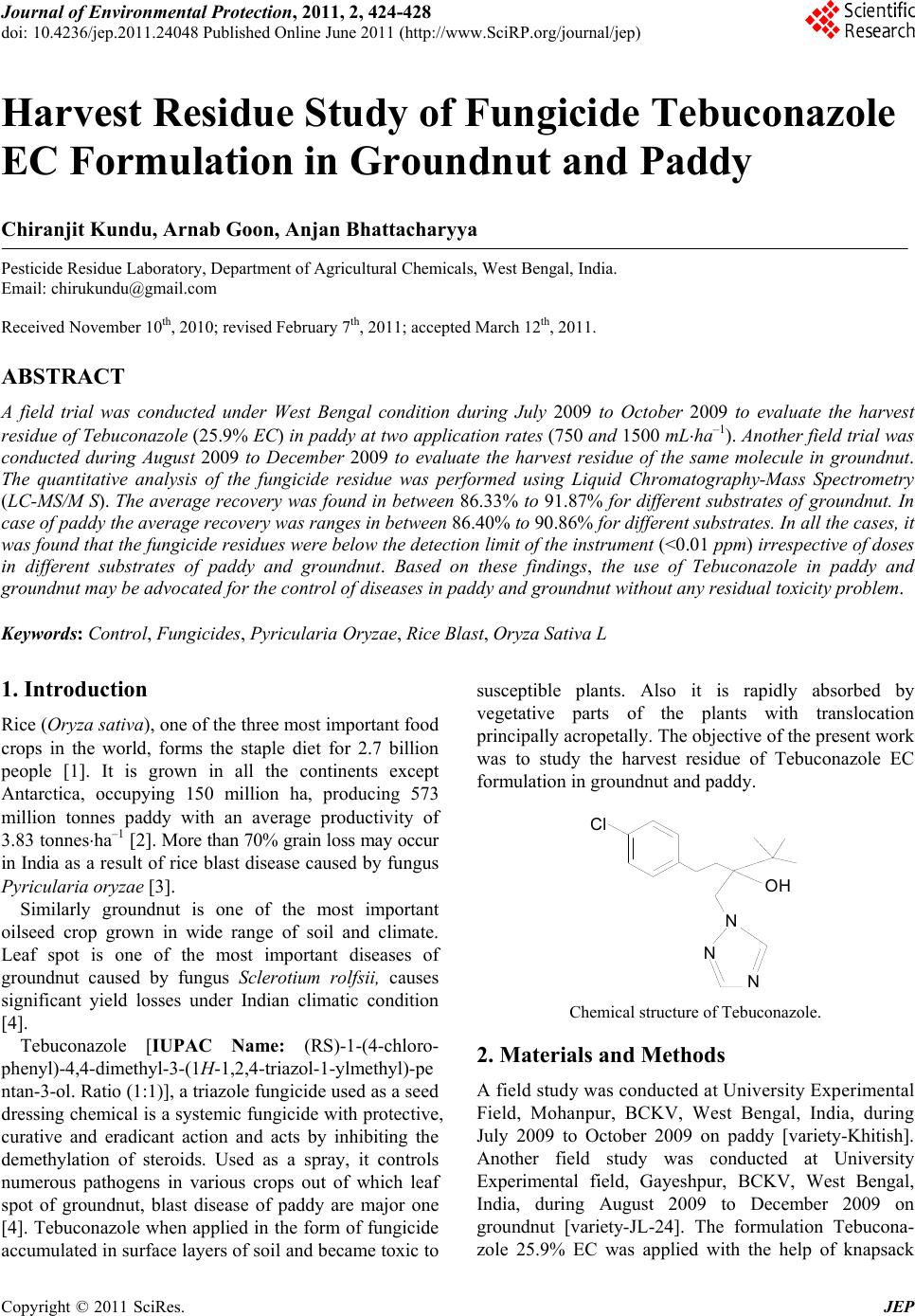 Journal of Environmental Protection, 2011, 2, 424-428 doi: 10.4236/jep.2011.24048 Published Online June 2011 (http://www.SciRP.org/journal/jep) Copyright © 2011 SciRes. JEP Harvest Residue Study of Fungicide Tebuconazole EC Formulation in Groundnut and Paddy Chiranjit Kundu, Arnab Goon, Anjan Bhattacharyya Pesticide Residue Laboratory, Department of Agricultural Chemicals, West Bengal, India. Email: [email protected] Received November 10th, 2010; revised February 7th, 2011; accepted March 12th, 2011. ABSTRACT A field trial was conducted under West Bengal condition during July 2009 to October 2009 to evaluate the harvest residue of Tebuconazole (25.9% EC) in paddy at two application rates (750 and 1500 mLha–1). Another field tria l was conducted during August 2009 to December 2009 to evaluate the harvest residue of the same molecule in groundnut. The quantitative analysis of the fungicide residue was performed using Liquid Chromatography-Mass Spectrometry (LC-MS/M S). The average recovery was found in between 86.33% to 91.87% for different substrates o f groundnut. In case of paddy the average recovery was ranges in between 86.40% to 90.86% for different substrates. In a ll the cases, it was found that the fung icide residue s were below the detection lim it of the instrum ent (<0.01 ppm) irrespective of doses in different substrates of paddy and groundnut. Based on these findings, the use of Tebuconazole in paddy and groundnut may be advocated for the control of diseases in paddy and groundnu t without any residual toxicity problem. Keywords: Control, Fungicides, Pyricularia Oryzae, Rice Blast, Oryza Sat i va L 1. Introduction Rice (Oryza sativa), one of the three most important food crops in the world, forms the staple diet for 2.7 billion people [1]. It is grown in all the continents except Antarctica, occupying 150 million ha, producing 573 million tonnes paddy with an average productivity of 3.83 tonnesha–1 [2]. More than 70% grain loss may occur in India as a result of rice blast disease caused by fungus Pyricularia or yzae [3]. Similarly groundnut is one of the most important oilseed crop grown in wide range of soil and climate. Leaf spot is one of the most important diseases of groundnut caused by fungus Sclerotium rolfsii, causes significant yield losses under Indian climatic condition [4]. Tebuconazole [IUPAC Name: (RS)-1-(4-chloro- phenyl)-4,4-dimethyl-3-(1H-1,2,4-triazol-1-ylmethyl)-pe ntan-3-ol. Ratio (1:1)], a triazole fungicide used as a seed dressing chemical is a systemic fungicide with protective, curative and eradicant action and acts by inhibiting the demethylation of steroids. Used as a spray, it controls numerous pathogens in various crops out of which leaf spot of groundnut, blast disease of paddy are major one [4]. Tebuconazole when applied in the form of fungicide accumulated in surface layers of soil and became toxic to susceptible plants. Also it is rapidly absorbed by vegetative parts of the plants with translocation principally acropetally. The objective of the present work was to study the harvest residue of Tebuconazole EC formulation in groundnut and paddy. N N N OH Cl Chemical structure of Tebuconazole. 2. Materials and Methods A field study was conducted at University Experimental Field, Mohanpur, BCKV, West Bengal, India, during July 2009 to October 2009 on paddy [variety-Khitish]. Another field study was conducted at University Experimental field, Gayeshpur, BCKV, West Bengal, India, during August 2009 to December 2009 on groundnut [variety-JL-24]. The formulation Tebucona- zole 25.9% EC was applied with the help of knapsack 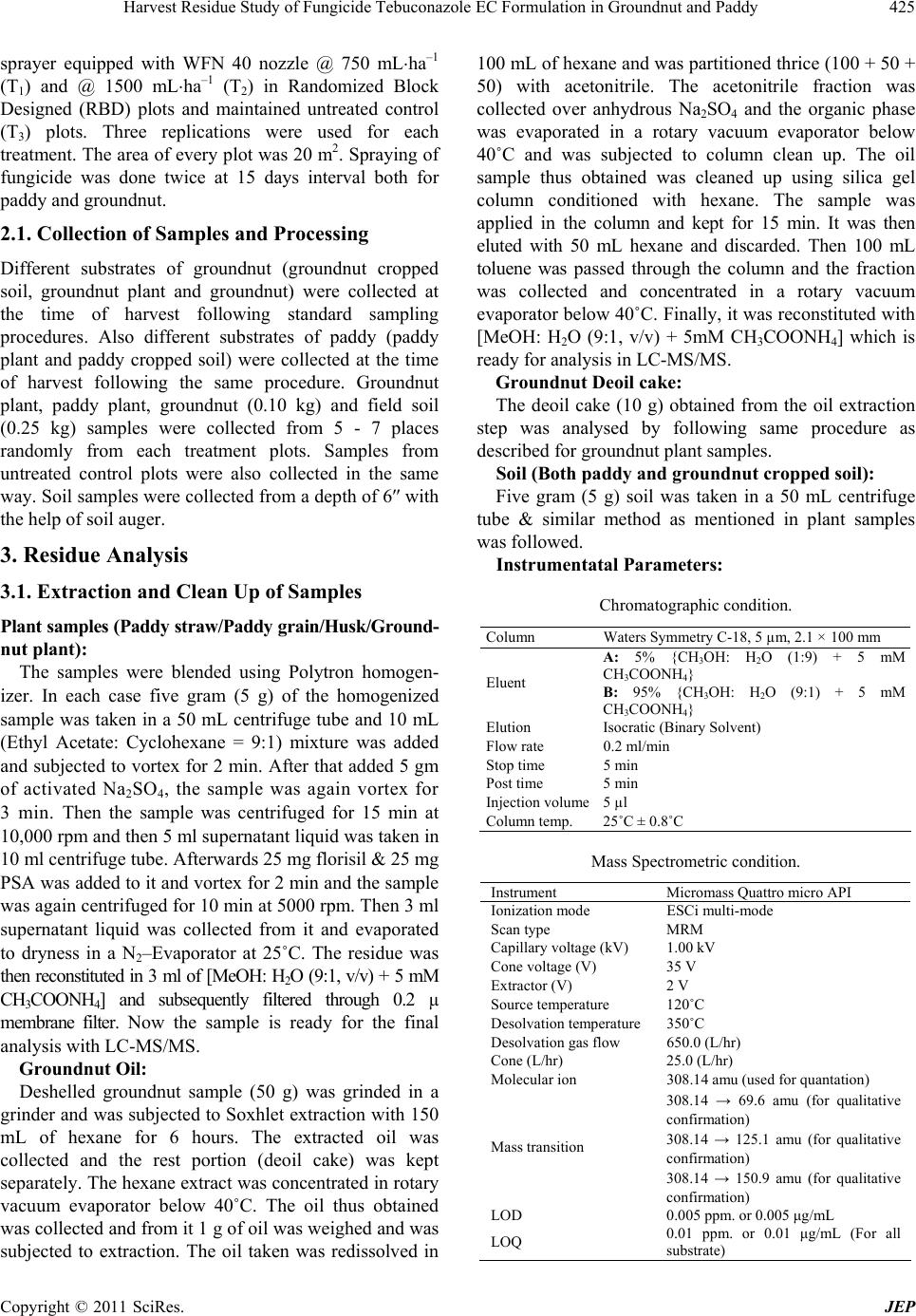 Harvest Residue Study of Fungicide Tebuconazole EC Formulation in Groundnut and Paddy425 sprayer equipped with WFN 40 nozzle @ 750 mLha–1 (T1) and @ 1500 mLha–1 (T2) in Randomized Block Designed (RBD) plots and maintained untreated control (T3) plots. Three replications were used for each treatment. The area of every plot was 20 m2. Spraying of fungicide was done twice at 15 days interval both for paddy and groundnut. 2.1. Collection of Samples and Processing Different substrates of groundnut (groundnut cropped soil, groundnut plant and groundnut) were collected at the time of harvest following standard sampling procedures. Also different substrates of paddy (paddy plant and paddy cropped soil) were collected at the time of harvest following the same procedure. Groundnut plant, paddy plant, groundnut (0.10 kg) and field soil (0.25 kg) samples were collected from 5 - 7 places randomly from each treatment plots. Samples from untreated control plots were also collected in the same way. Soil samples were collected from a depth of 6″ with the help of soil auger. 3. Residue Analysis 3.1. Extraction and Clean Up of Samples Plant samples ( Paddy stra w/Paddy g rain/Hu sk/Ground- nut plant): The samples were blended using Polytron homogen- izer. In each case five gram (5 g) of the homogenized sample was taken in a 50 mL centrifuge tube and 10 mL (Ethyl Acetate: Cyclohexane = 9:1) mixture was added and subjected to vortex for 2 min. After that added 5 gm of activated Na2SO4, the sample was again vortex for 3 min. Then the sample was centrifuged for 15 min at 10,000 rpm and then 5 ml supernatant liquid was taken in 10 ml centrifuge tube. Afterwards 25 mg florisil & 25 mg PSA was added to it and vortex for 2 min and the sample was again centrifuged for 10 min at 5000 rpm. Then 3 ml supernatant liquid was collected from it and evaporated to dryness in a N2–Evaporator at 25˚C. The residue was then reconstituted in 3 ml of [MeOH: H2O (9:1, v/v) + 5 mM CH3COONH4] and subsequently filtered through 0.2 µ membrane filter. Now the sample is ready for the final analysis with LC-MS/MS. Groundnut Oi l: Deshelled groundnut sample (50 g) was grinded in a grinder and was subjected to Soxhlet extraction with 150 mL of hexane for 6 hours. The extracted oil was collected and the rest portion (deoil cake) was kept separately. The hexane extract was concentrated in rotary vacuum evaporator below 40˚C. The oil thus obtained was collected and from it 1 g of oil was weighed and was subjected to extraction. The oil taken was redissolved in 100 mL of hexane and was partitioned thrice (100 + 50 + 50) with acetonitrile. The acetonitrile fraction was collected over anhydrous Na2SO4 and the organic phase was evaporated in a rotary vacuum evaporator below 40˚C and was subjected to column clean up. The oil sample thus obtained was cleaned up using silica gel column conditioned with hexane. The sample was applied in the column and kept for 15 min. It was then eluted with 50 mL hexane and discarded. Then 100 mL toluene was passed through the column and the fraction was collected and concentrated in a rotary vacuum evaporator below 40˚C. Finally, it was reconstituted with [MeOH: H2O (9:1, v/v) + 5mM CH3COONH4] which is ready for analysis in LC-MS/MS. Groundnut Deoil cake: The deoil cake (10 g) obtained from the oil extraction step was analysed by following same procedure as described for groundnut plant samples. Soil (Both paddy and groundnut cropped soil): Five gram (5 g) soil was taken in a 50 mL centrifuge tube & similar method as mentioned in plant samples was followed. Instrumentatal Parameters: Chromatographic condition. Column Waters Symmetry C-18, 5 µm, 2.1 × 100 mm Eluent A: 5% {CH3OH: H2O (1:9) + 5 mM CH3COONH4} B: 95% {CH3OH: H2O (9:1) + 5 mM CH3COONH4} Elution Isocratic (Binary Solvent) Flow rate 0.2 ml/min Stop time 5 min Post time 5 min Injection volume5 µl Column temp. 25˚C ± 0.8˚C Mass Spectrometric condition. Instrument Micromass Quattro micro API Ionization mode ESCi multi-mode Scan type MRM Capillary voltage (kV) 1.00 kV Cone voltage (V) 35 V Extractor (V) 2 V Source temperature 120˚C Desolvation temperature 350˚C Desolvation gas flow 650.0 (L/hr) Cone (L/hr) 25.0 (L/hr) Molecular ion 308.14 amu (used for quantation) Mass transition 308.14 → 69.6 amu (for qualitative confirmation) 308.14 → 125.1 amu (for qualitative confirmation) 308.14 → 150.9 amu (for qualitative confirmation) LOD 0.005 ppm. or 0.005 μg/mL LOQ 0.01 ppm. or 0.01 μg/mL (For all substrate) Copyright © 2011 SciRes. JEP 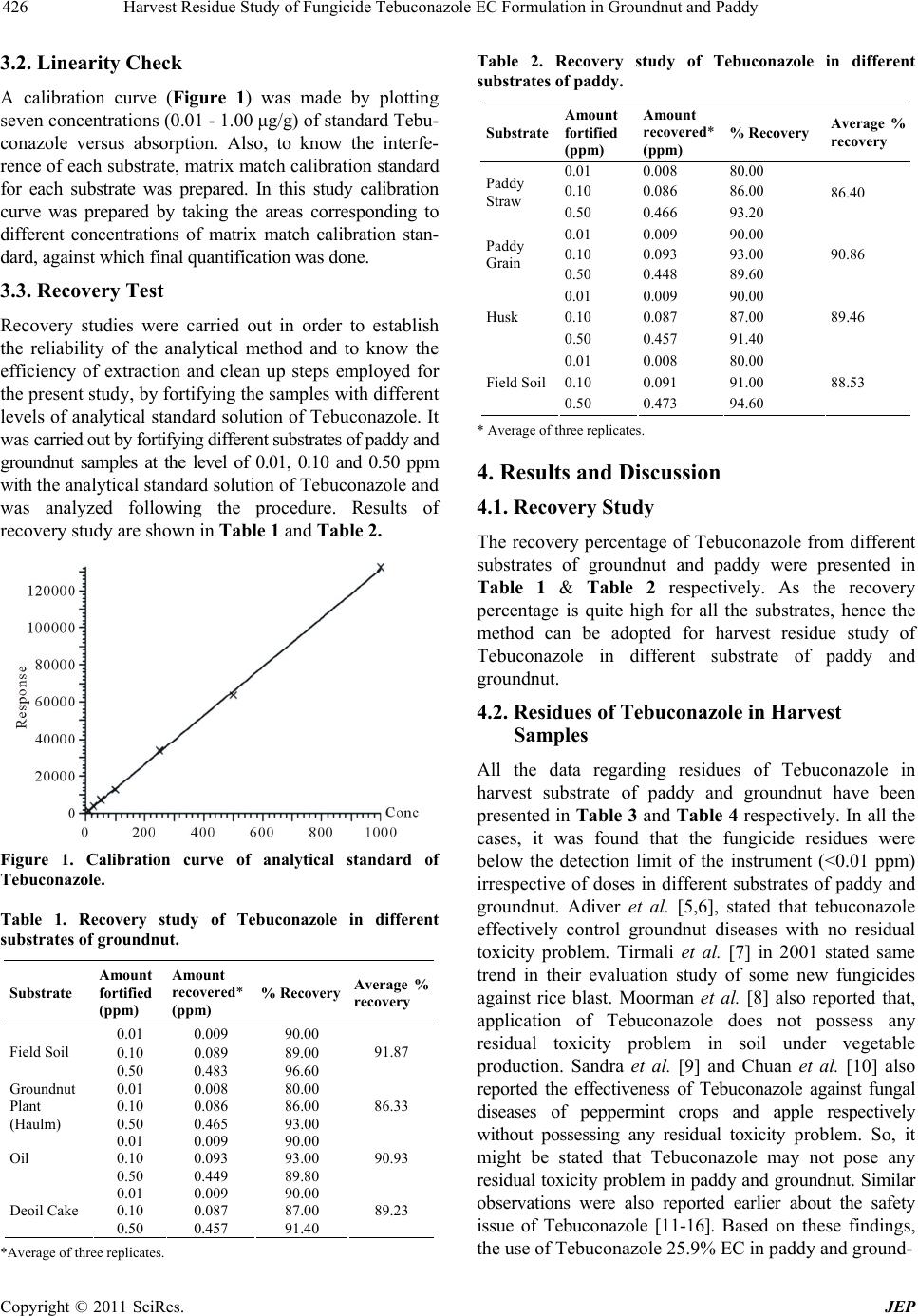 Harvest Residue Study of Fungicide Tebuconazole EC Formulation in Groundnut and Paddy 426 3.2. Linearity Check A calibration curve (Figure 1) was made by plotting seven concentrations (0.01 - 1.00 μg/g) of standard Tebu- conazole versus absorption. Also, to know the interfe- rence of each substrate, matrix match calibration standard for each substrate was prepared. In this study calibration curve was prepared by taking the areas corresponding to different concentrations of matrix match calibration stan- dard, against which final quantification was done. 3.3. Recovery Test Recovery studies were carried out in order to establish the reliability of the analytical method and to know the efficiency of extraction and clean up steps employed for the present study, by fortifying the samples with different levels of analytical standard solution of Tebuconazole. It was carried out by fortifying different substrates of paddy and groundnut samples at the level of 0.01, 0.10 and 0.50 ppm with the analytical standard solution of Tebuconazole and was analyzed following the procedure. Results of recovery study are shown in Table 1 and Table 2. Figure 1. Calibration curve of analytical standard of Tebuconazole. Table 1. Recovery study of Tebuconazole in different substrates of groundnut. Substrate Amount fortified (ppm) Amount recovered* (ppm) % Recovery Average % recovery 0.01 0.009 90.00 0.10 0.089 89.00 Field Soil 0.50 0.483 96.60 91.87 0.01 0.008 80.00 0.10 0.086 86.00 Groundnut Plant (Haulm) 0.50 0.465 93.00 86.33 0.01 0.009 90.00 0.10 0.093 93.00 Oil 0.50 0.449 89.80 90.93 0.01 0.009 90.00 0.10 0.087 87.00 Deoil Cake 0.50 0.457 91.40 89.23 *Average of three replicates. Table 2. Recovery study of Tebuconazole in different substrates of paddy. Substrate Amount fortified (ppm) Amount recovered* (ppm) % Recovery Average % recovery 0.01 0.008 80.00 0.10 0.086 86.00 Paddy Straw 0.50 0.466 93.20 86.40 0.01 0.009 90.00 0.10 0.093 93.00 Paddy Grain 0.50 0.448 89.60 90.86 0.01 0.009 90.00 0.10 0.087 87.00 Husk 0.50 0.457 91.40 89.46 0.01 0.008 80.00 0.10 0.091 91.00 Field Soil 0.50 0.473 94.60 88.53 * Average of three replicates. 4. Results and Discussion 4.1. Recovery Study The recovery percentage of Tebuconazole from different substrates of groundnut and paddy were presented in Table 1 & Table 2 respectively. As the recovery percentage is quite high for all the substrates, hence the method can be adopted for harvest residue study of Tebuconazole in different substrate of paddy and groundnut. 4.2. Residues of Tebuconazole in Harvest Samples All the data regarding residues of Tebuconazole in harvest substrate of paddy and groundnut have been presented in Tabl e 3 and Table 4 respectively. In all the cases, it was found that the fungicide residues were below the detection limit of the instrument (<0.01 ppm) irrespective of doses in different substrates of paddy and groundnut. Adiver et al. [5,6], stated that tebuconazole effectively control groundnut diseases with no residual toxicity problem. Tirmali et al. [7] in 2001 stated same trend in their evaluation study of some new fungicides against rice blast. Moorman et al. [8] also reported that, application of Tebuconazole does not possess any residual toxicity problem in soil under vegetable production. Sandra et al. [9] and Chuan et al. [10] also reported the effectiveness of Tebuconazole against fungal diseases of peppermint crops and apple respectively without possessing any residual toxicity problem. So, it might be stated that Tebuconazole may not pose any residual toxicity problem in paddy and groundnut. Similar observations were also reported earlier about the safety issue of Tebuconazole [11-16]. Based on these findings, he use of Tebuconazole 25.9% EC in paddy and ground- t Copyright © 2011 SciRes. JEP 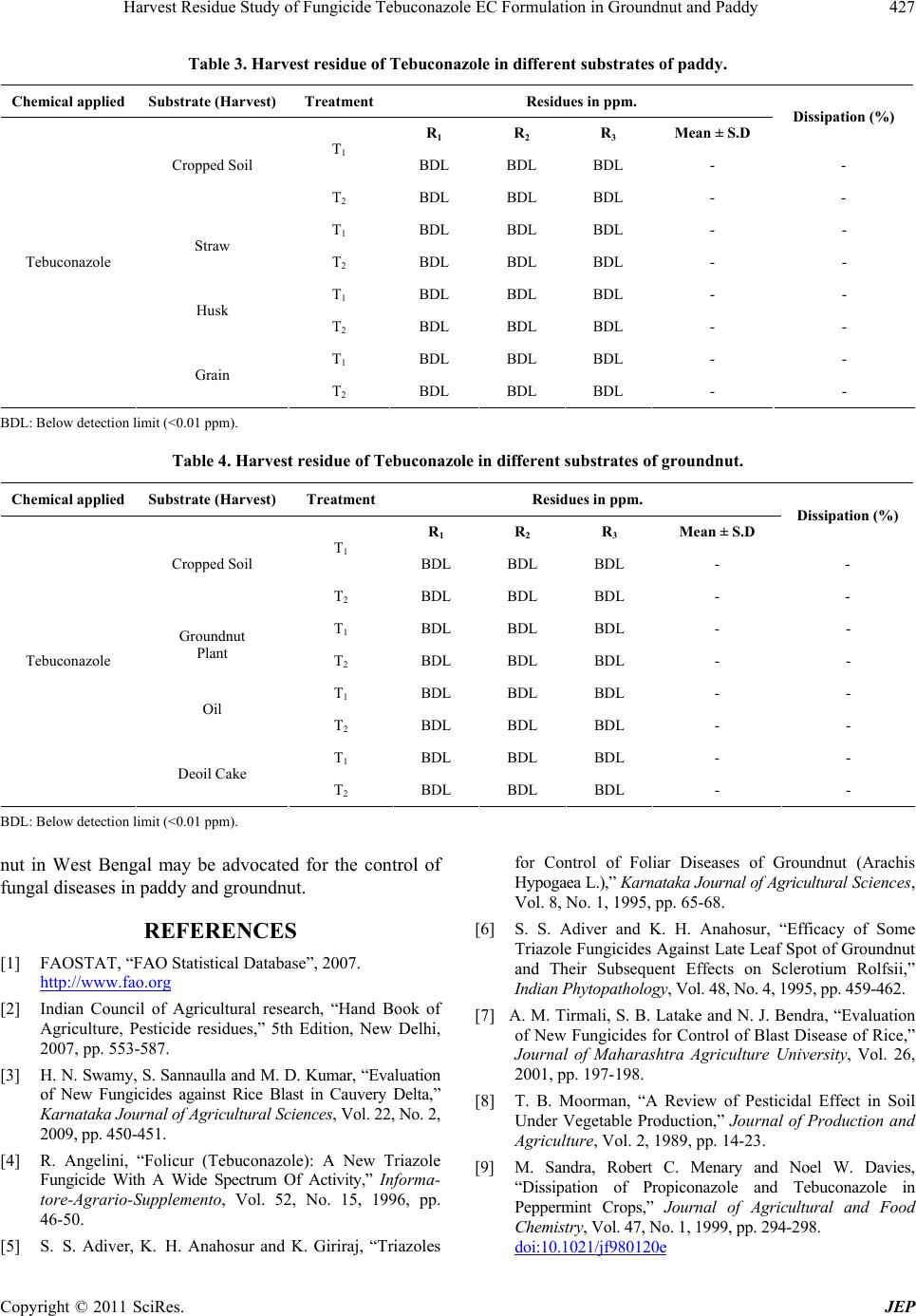 Harvest Residue Study of Fungicide Tebuconazole EC Formulation in Groundnut and Paddy Copyright © 2011 SciRes. JEP 427 Table 3. Harvest residue of Tebuconazole in different substrates of paddy. Chemical applied Substrate (Harvest) Treatment Residues in ppm. R1 R2 R 3 Mean ± S.D Dissipation (%) T1 BDL BDL BDL - - Cropped Soil T2 BDL BDL BDL - - T1 BDL BDL BDL - - Straw T2 BDL BDL BDL - - T1 BDL BDL BDL - - Husk T2 BDL BDL BDL - - T1 BDL BDL BDL - - Tebuconazole Grain T2 BDL BDL BDL - - BDL: Below detection limit (<0.01 ppm). Table 4. Harvest residue of Tebuconazole in different substrates of groundnut. Chemical applied Substrate (Harvest) Treatment Residues in ppm. R1 R2 R 3 Mean ± S.D Dissipation (%) T1 BDL BDL BDL - - Cropped Soil T2 BDL BDL BDL - - T1 BDL BDL BDL - - Groundnut Plant T2 BDL BDL BDL - - T1 BDL BDL BDL - - Oil T2 BDL BDL BDL - - T1 BDL BDL BDL - - Tebuconazole Deoil Cake T2 BDL BDL BDL - - BDL: Below detection limit (<0.01 ppm). nut in West Bengal may be advocated for the control of fungal diseases in paddy and groundnut. REFERENCES [1] FAOSTAT, “FAO Statistical Database”, 2007. http://www.fao.org [2] Indian Council of Agricultural research, “Hand Book of Agriculture, Pesticide residues,” 5th Edition, New Delhi, 2007, pp. 553-587. [3] H. N. Swamy, S. Sannaulla and M. D. Kumar, “Evaluation of New Fungicides against Rice Blast in Cauvery Delta,” Karnataka Journal of Agricultural Sciences, Vol. 22, No. 2, 2009, pp. 450-451. [4] R. Angelini, “Folicur (Tebuconazole): A New Triazole Fungicide With A Wide Spectrum Of Activity,” Informa- tore-Agrario-Supplemento, Vol. 52, No. 15, 1996, pp. 46-50. [5] S. S. Adiver, K. H. Anahosur and K. Giriraj, “Triazoles for Control of Foliar Diseases of Groundnut (Arachis Hypogaea L.),” K arnatak a Journal o f Agricultu ral S c i e n c e s , Vol. 8, No. 1, 1995, pp. 65-68. [6] S. S. Adiver and K. H. Anahosur, “Efficacy of Some Triazole Fungicides Against Late Leaf Spot of Groundnut and Their Subsequent Effects on Sclerotium Rolfsii,” Indian Phytopathology, Vol. 48, No. 4, 1995, pp. 459-462. [7] A. M. Tirmali, S. B. Latake and N. J. Bendra, “Evaluation of New Fungicides for Control of Blast Disease of Rice,” Journal of Maharashtra Agriculture University, Vol. 26, 2001, pp. 197-198. [8] T. B. Moorman, “A Review of Pesticidal Effect in Soil Under Vegetable Production,” Journal of Production and Agriculture, Vol. 2, 1989, pp. 14-23. [9] M. Sandra, Robert C. Menary and Noel W. Davies, “Dissipation of Propiconazole and Tebuconazole in Peppermint Crops,” Journal of Agricultural and Food Chemistry, Vol. 47, No. 1, 1999, pp. 294-298. doi:10.1021/jf980120e  Harvest Residue Study of Fungicide Tebuconazole EC Formulation in Groundnut and Paddy 428 [10] L. Chuan, “Determination of Tebuconazole Residue in Soil and Apple,” Journal of Anhui Agricultural Sciences, Vol. 37, No. 6, 2009, pp. 135-139. [11] European Food Safety Authority, “Modification of The Existing Mrls For Tebuconazole in Mandarins and Pass- ion Fruit,” European Food Safety Authority Journal, Vol. 7, No. 10, 2009, pp. 1368. [12] Food and Drug Administration of the United States, “Pesticide tolerances”, 2003. http://www.cfsan.fda.gov [13] M. A. Kastanias, S. Coward, A. Philippoussis and P. Diamantopoulou, “Residue Evaluation of the Azole Fungicides Prochloraz and Tebuconazole in the White Mushroom Agaricus Bisporus,” Bulletin of Environmental Contamination and Toxicology, Vol. 77, No. 1, 2006, pp. 149-154. doi:10.1007/s00128-006-1044-5 [14] K. D. Srivastava, D. V. Singh, R. Aggarwal, A. K. Dixit and P. Bahadur, “Bioefficacy and Persistence of Tebu- conazole against Loose Smut in Wheat,” Indian Phyto- pathology, Vol. 50, No. 3, 1997, pp. 434-436. [15] D. Shitienberg, “Integrated Management of Early and Late Blights of Potatoes in Israel,” African Crop Science Journal, Vol. 9, No. 1, 2001, pp. 203-207. [16] S. Mohapatra, A. Ahuja, G. K. Jagadish, G.S. Prakash and S. Kumar, “Behaviour of Trifloxystrobin and Tebucon- azole on Grapes under Semi-Arid Tropical Climatic Con- dition,” Pest Management Sciences, Vol. 66, No. 8, 2010, pp. 910-915. Copyright © 2011 SciRes. JEP |