

Paper Menu >>
Journal Menu >>
 Natural Resources, 2011, 2, 107-113 doi:10.4236/nr.2011.22015 Published Online June 2011 (http://www.scirp.org/journal/nr) Copyright © 2011 SciRes. NR 107 The Factors on Removal of Zinc Cation from Aqueous Solution by Bentonite Shuli Ding1, Juanjuan Shen1, Bohui Xu1, Qinfu Liu2, Yuzhuang Sun1 1Key Laboratory of Resources Reconnaissance of Hebei Province, Hebei University of Engineering, Handan, China; 2 School of Resources and Safety Engineering, China University of Mining & Technology, Beijing, China. E-mail: [email protected] Received January 29th, 2011; revised March 7th, 2011; accepted March 15th, 2011. ABSTRACT The removing zinc cation from aqueous solution by Ca-bentonite and Na-exchanged bentonite was studied. The factors such as the initial concentration of Zn2+, the liquid-to-solid ratio, pH, adsorption time, stirring speed, coexisting ions, temperature and bentonite particle size were investigated. The results show that the adsorption process of bentonite accorded with the Freundlich isotherm model, the removal of Zn2+ by Ca-bentonite and Na-exchanged bentonite reached equilibrium in 2 h, and adsorption of Na- bentonite was superior to Ca-bentonite. The adsorption rate of zinc increased with increasing pH, temperature, stirring speed, time span and with decreasing bentonite particle, the initial concentration of Zn2+ and the liquid-to-solid ratio. In mixed solution which contains Pb2+and Cr6+, Pb2+ has no influ- ence on the removal of Zn2+ by both the bentonites while Cr6+can decease it. Keywords: Bentonite, Zn2+, Adsorption 1. Introduction Heavy metals are typical and persistent environmental pollutants. Because of its toxicity and nonbiodegradable nature, metals are of special significance. The presence of heavy metals in wastewater and surface water is be- coming a severe environmental and public health prob- lem. Recently, natural materials, which are good sorbents and inexpensive have received much attention in heavy metal wastewater treatment [1-3]. Bentonite is the most abundant phyllosilicate mineral and its main mineral component is montmorillonite. Bentonite which was used in wastewater treatment has the advantage of simple device, low cost, no repollution etc. The adsorption capacity of montmorillonite for heavy metal ions has been concerned since 1960s [4-8]. In lit- erature various types of bentonite adsorbents have been cited. H. Omar et al. [9] investigated the adsorption po- tential of raw and formaldehyde modified-bentonite for the removal of 60Co radionuclide from radioactive waste solutions. S. T. Akar et al. [10] combined white rot fungi and montmorillonite, this proposed was successfully used to sequester of copper ions from real wastewater in continuous mode. E. Alvarez-Ayuso et al. [11], con- cluded that both the Ca-montmorillonite and na-mont- morillonite can remove heavy metals from the industrial effluent efficiently. W. Matthes et al [12]. studied sorp- tion of Al and Zr-hydroxy intercalated and pillared ben- tonite and found that the adsorption of heavy metal by montmorillonite was majorly due to the coordination of surface hydroxyl groups as well as the interchange with cation among crystal layers. The major objective of this work is to study the ad- sorption of Zn2+ in aqueous solution as well as its influ- encing factors. Handan Ca-bentonite and Na-exchanged bentonite were used in the experiments with the view to discovering their metal ion recovery potential from ef- fluents. The adsorption effect of Cr6+ and Pb2+ compete with Zn2+ in aqueous solution was analyzed. 2. Materials and Methods 2.1. Equipment The X-ray diffraction (D/max-2200 diffractometer at a scanning speed 4˚ (2θ)/min, using CuK α radition at 40kV, 100mA) was used to identify the Mineral compo- sition. 721 model spectro-photometer was used to meas- ure the content of Zn2+, Cr6+ and Pb2+ in solutions. Also, the AW120 electron balance, HJ-5 constant temperature magnetic force beater, pHS-3C acidimeter, anion and cation exchange column, GL-20G-Ⅱmodel high-speed refrigerated centrifuge and some other instruments were 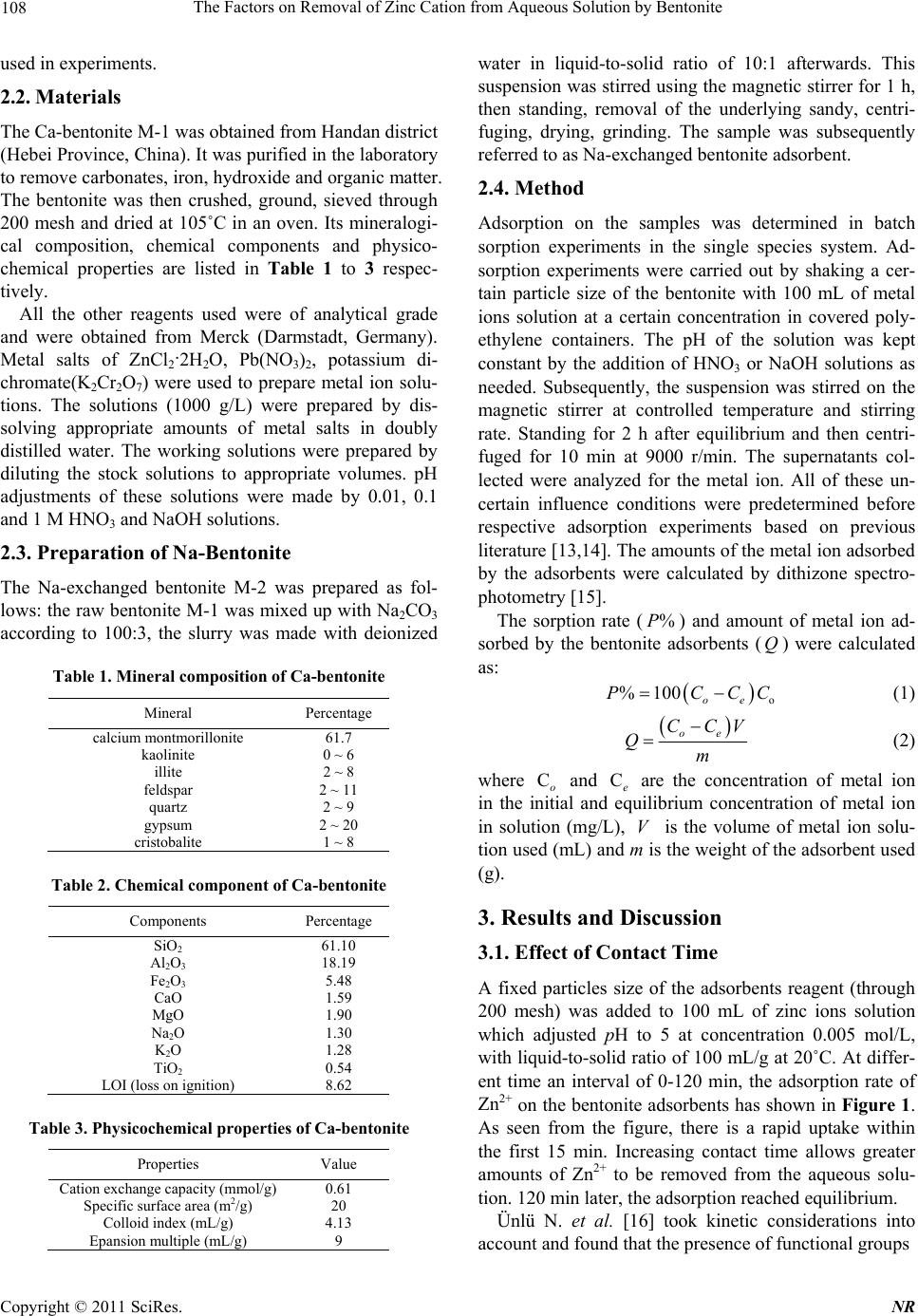 108 The Factors on Removal of Zinc Cation from Aqueous Solution by Bentonite used in experiments. 2.2. Materials The Ca-bentonite M-1 was obtained from Handan district (Hebei Province, China). It was purified in the laboratory to remove carbonates, iron, hydroxide and organic matter. The bentonite was then crushed, ground, sieved through 200 mesh and dried at 105˚C in an oven. Its mineralogi- cal composition, chemical components and physico- chemical properties are listed in Table 1 to 3 respec- tively. All the other reagents used were of analytical grade and were obtained from Merck (Darmstadt, Germany). Metal salts of ZnCl2·2H2O, Pb(NO3)2, potassium di- chromate(K2Cr2O7) were used to prepare metal ion solu- tions. The solutions (1000 g/L) were prepared by dis- solving appropriate amounts of metal salts in doubly distilled water. The working solutions were prepared by diluting the stock solutions to appropriate volumes. pH adjustments of these solutions were made by 0.01, 0.1 and 1 M HNO3 and NaOH solutions. 2.3. Preparation of Na-Bentonite The Na-exchanged bentonite M-2 was prepared as fol- lows: the raw bentonite M-1 was mixed up with Na2CO3 according to 100:3, the slurry was made with deionized Table 1. Mineral composition of Ca-bentonite Mineral Percentage calcium montmorillonite 61.7 kaolinite 0 ~ 6 illite 2 ~ 8 feldspar 2 ~ 11 quartz 2 ~ 9 gypsum 2 ~ 20 cristobalite 1 ~ 8 Table 2. Chemical component of Ca-bentonite Components Percentage SiO2 61.10 Al2O3 18.19 Fe2O3 5.48 CaO 1.59 MgO 1.90 Na2O 1.30 K2O 1.28 TiO2 0.54 LOI (loss on ignition) 8.62 Table 3. Physicochemical properties of Ca-bentonite Properties Value Cation exchange capacity (mmol/g) 0.61 Specific surface area (m2/g) 20 Colloid index (mL/g) 4.13 Epansion multiple (mL/g) 9 water in liquid-to-solid ratio of 10:1 afterwards. This suspension was stirred using the magnetic stirrer for 1 h, then standing, removal of the underlying sandy, centri- fuging, drying, grinding. The sample was subsequently referred to as Na-exchanged bentonite adsorbent. 2.4. Method Adsorption on the samples was determined in batch sorption experiments in the single species system. Ad- sorption experiments were carried out by shaking a cer- tain particle size of the bentonite with 100 mL of metal ions solution at a certain concentration in covered poly- ethylene containers. The pH of the solution was kept constant by the addition of HNO3 or NaOH solutions as needed. Subsequently, the suspension was stirred on the magnetic stirrer at controlled temperature and stirring rate. Standing for 2 h after equilibrium and then centri- fuged for 10 min at 9000 r/min. The supernatants col- lected were analyzed for the metal ion. All of these un- certain influence conditions were predetermined before respective adsorption experiments based on previous literature [13,14]. The amounts of the metal ion adsorbed by the adsorbents were calculated by dithizone spectro- photometry [15]. The sorption rate () and amount of metal ion ad- sorbed by the bentonite adsorbents () were calculated as: %P Q o %100 oe PCCC (1) oe CCV Qm (2) where and Ce are the concentration of metal ion in the initial and equilibrium concentration of metal ion in solution (mg/L), is the volume of metal ion solu- tion used (mL) and m is the weight of the adsorbent used (g). Co V 3. Results and Discussion 3.1. Effect of Contact Time A fixed particles size of the adsorbents reagent (through 200 mesh) was added to 100 mL of zinc ions solution which adjusted pH to 5 at concentration 0.005 mol/L, with liquid-to-solid ratio of 100 mL/g at 20˚C. At differ- ent time an interval of 0-120 min, the adsorption rate of Zn2+ on the bentonite adsorbents has shown in Figure 1. As seen from the figure, there is a rapid uptake within the first 15 min. Increasing contact time allows greater amounts of Zn2+ to be removed from the aqueous solu- tion. 120 min later, the adsorption reached equilibrium. Ünlü N. et al. [16] took kinetic considerations into account and found that the presence of functional groups C opyright © 2011 SciRes. NR 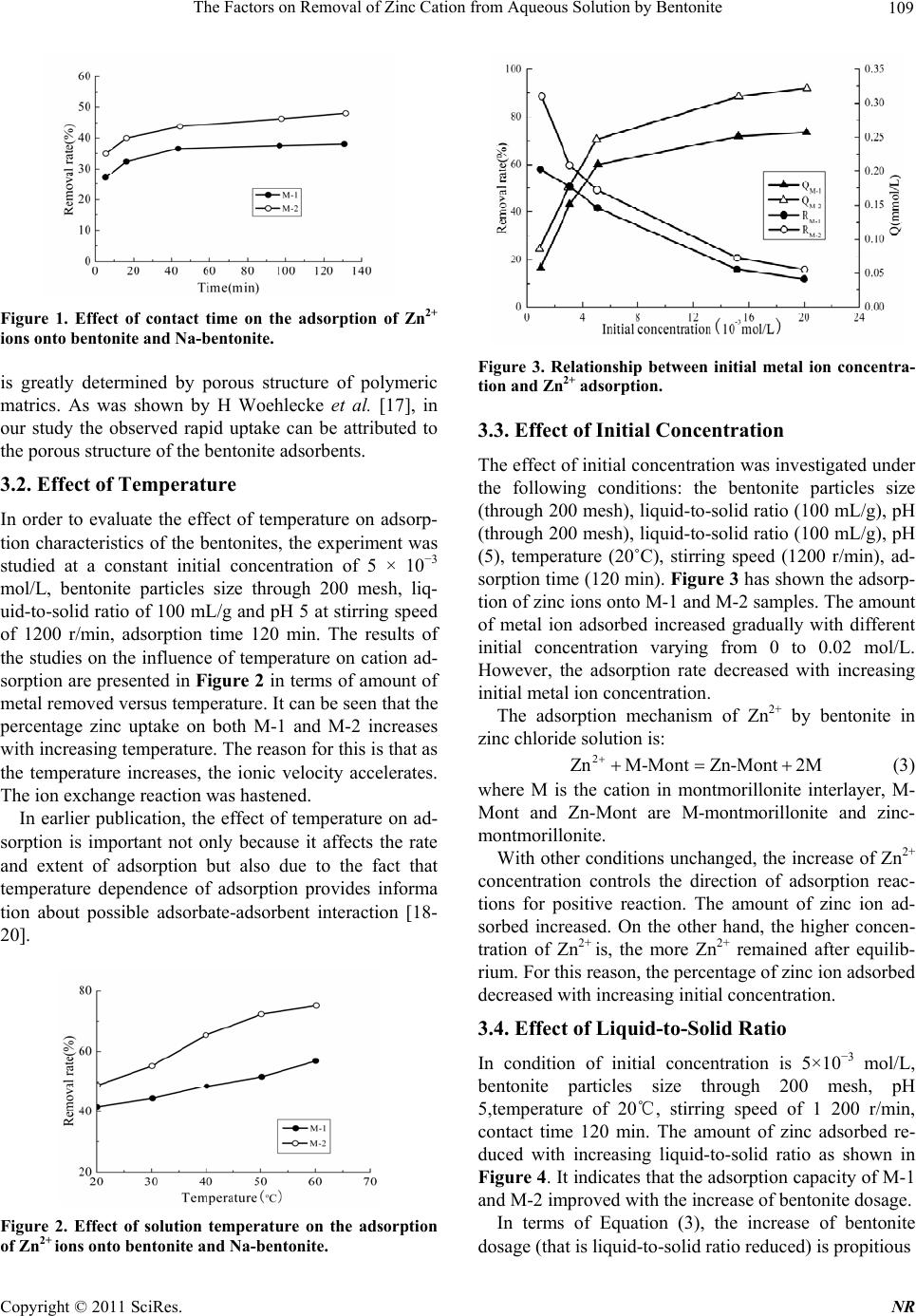 The Factors on Removal of Zinc Cation from Aqueous Solution by Bentonite 109 Figure 1. Effect of contact time on the adsorption of Zn2+ ions onto bentonite and Na-bentonite. is greatly determined by porous structure of polymeric matrics. As was shown by H Woehlecke et al. [17], in our study the observed rapid uptake can be attributed to the porous structure of the bentonite adsorbents. 3.2. Effect of Temperature In order to evaluate the effect of temperature on adsorp- tion characteristics of the bentonites, the experiment was studied at a constant initial concentration of 5 × 10⁻³ mol/L, bentonite particles size through 200 mesh, liq- uid-to-solid ratio of 100 mL/g and pH 5 at stirring speed of 1200 r/min, adsorption time 120 min. The results of the studies on the influence of temperature on cation ad- sorption are presented in Figure 2 in terms of amount of metal removed versus temperature. It can be seen that the percentage zinc uptake on both M-1 and M-2 increases with increasing temperature. The reason for this is that as the temperature increases, the ionic velocity accelerates. The ion exchange reaction was hastened. In earlier publication, the effect of temperature on ad- sorption is important not only because it affects the rate and extent of adsorption but also due to the fact that temperature dependence of adsorption provides informa tion about possible adsorbate-adsorbent interaction [18- 20]. Figure 2. Effect of solution temperature on the adsorption of Zn2+ ions onto bentonite and Na-bentonite. Figure 3. Relationship between initial metal ion concentra- tion and Zn2+ adsorption. 3.3. Effect of Initial Concentration The effect of initial concentration was investigated under the following conditions: the bentonite particles size (through 200 mesh), liquid-to-solid ratio (100 mL/g), pH (through 200 mesh), liquid-to-solid ratio (100 mL/g), pH (5), temperature (20˚C), stirring speed (1200 r/min), ad- sorption time (120 min). Figure 3 has shown the adsorp- tion of zinc ions onto M-1 and M-2 samples. The amount of metal ion adsorbed increased gradually with different initial concentration varying from 0 to 0.02 mol/L. However, the adsorption rate decreased with increasing initial metal ion concentration. The adsorption mechanism of Zn2+ by bentonite in zinc chloride solution is: 2 ZnM-MontZn-Mont 2M (3) where M is the cation in montmorillonite interlayer, M- Mont and Zn-Mont are M-montmorillonite and zinc- montmorillonite. With other conditions unchanged, the increase of Zn2+ concentration controls the direction of adsorption reac- tions for positive reaction. The amount of zinc ion ad- sorbed increased. On the other hand, the higher concen- tration of Zn2+ is, the more Zn2+ remained after equilib- rium. For this reason, the percentage of zinc ion adsorbed decreased with increasing initial concentration. 3.4. Effect of Liquid-to-Solid Ratio In condition of initial concentration is 5×10⁻³ mol/L, bentonite particles size through 200 mesh, pH 5,temperature of 20℃, stirring speed of 1 200 r/min, contact time 120 min. The amount of zinc adsorbed re- duced with increasing liquid-to-solid ratio as shown in Figure 4. It indicates that the adsorption capacity of M-1 and M-2 improved with the increase of bentonite dosage. In terms of Equation (3), the increase of bentonite dosage (that is liquid-to-solid ratio reduced) is propitious C opyright © 2011 SciRes. NR 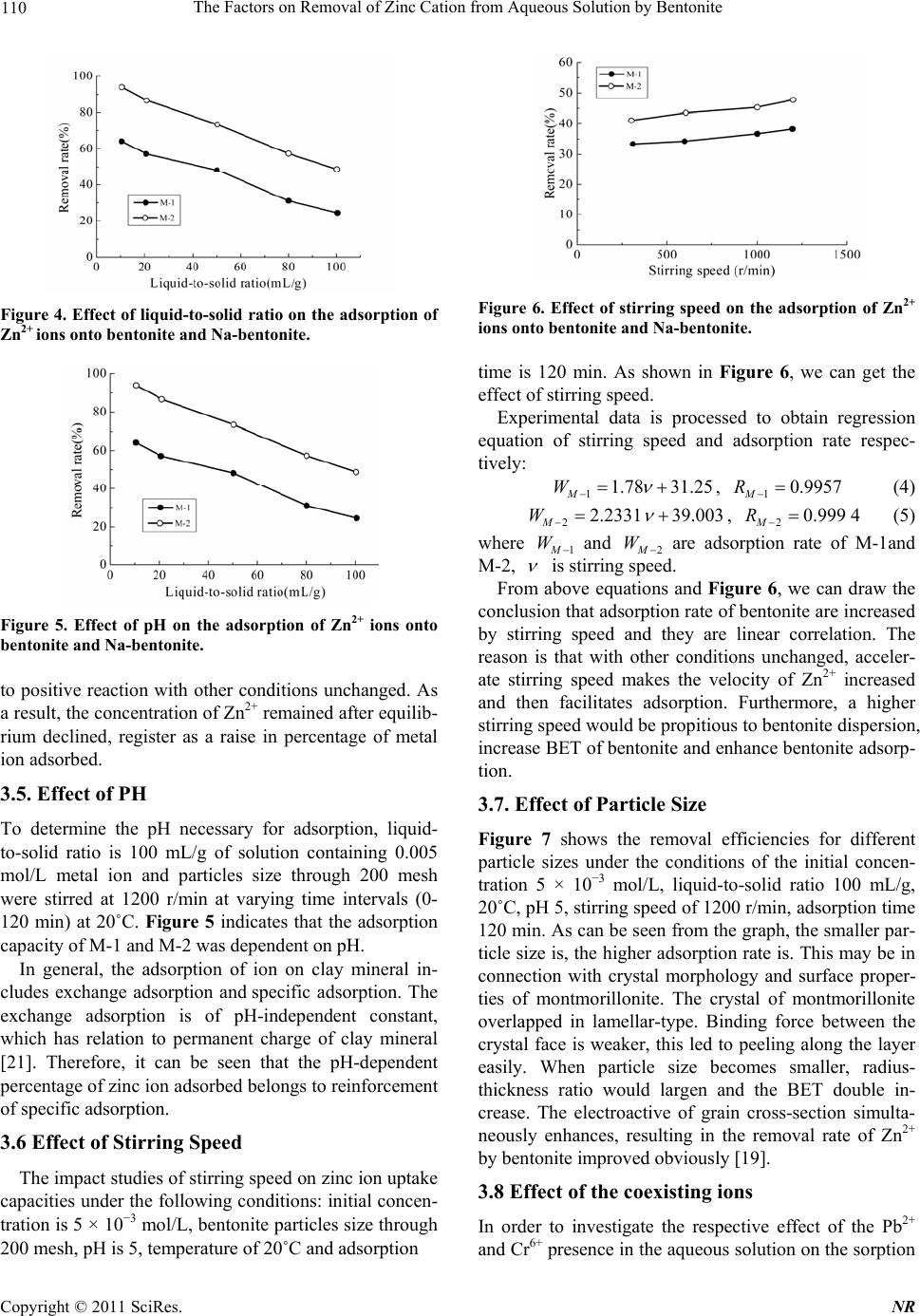 110 The Factors on Removal of Zinc Cation from Aqueous Solution by Bentonite Figure 4. Effect of liquid-to-solid ratio on the adsorption of Zn2+ ions onto bentonite and Na-bentonite. Figure 5. Effect of pH on the adsorption of Zn2+ ions onto bentonite and Na-bentonite. to positive reaction with other conditions unchanged. As a result, the concentration of Zn2+ remained after equilib- rium declined, register as a raise in percentage of metal ion adsorbed. 3.5. Effect of PH To determine the pH necessary for adsorption, liquid- to-solid ratio is 100 mL/g of solution containing 0.005 mol/L metal ion and particles size through 200 mesh were stirred at 1200 r/min at varying time intervals (0- 120 min) at 20˚C. Figure 5 indicates that the adsorption capacity of M-1 and M-2 was dependent on pH. In general, the adsorption of ion on clay mineral in- cludes exchange adsorption and specific adsorption. The exchange adsorption is of pH-independent constant, which has relation to permanent charge of clay mineral [21]. Therefore, it can be seen that the pH-dependent percentage of zinc ion adsorbed belongs to reinforcement of specific adsorption. 3.6 Effect of Stirring Speed The impact studies of stirring speed on zinc ion uptake capacities under the following conditions: initial concen- tration is 5 × 10⁻³ mol/L, bentonite particles size through 200 mesh, pH is 5, temperature of 20˚C and adsorption Figure 6. Effect of stirring speed on the adsorption of Zn2+ ions onto bentonite and Na-bentonite. time is 120 min. As shown in Figure 6, we can get the effect of stirring speed. Experimental data is processed to obtain regression equation of stirring speed and adsorption rate respec- tively: 11.78 31.25 M W , (4) 10.9957 M R 22.2331 39.003 M W , (5) 20.999 4 M R where 1M W and 2M W are adsorption rate of M-1and M-2, is stirring speed. From above equations and Figure 6, we can draw the conclusion that adsorption rate of bentonite are increased by stirring speed and they are linear correlation. The reason is that with other conditions unchanged, acceler- ate stirring speed makes the velocity of Zn2+ increased and then facilitates adsorption. Furthermore, a higher stirring speed would be propitious to bentonite dispersion, increase BET of bentonite and enhance bentonite adsorp- tion. 3.7. Effect of Particle Size Figure 7 shows the removal efficiencies for different particle sizes under the conditions of the initial concen- tration 5 × 10⁻³ mol/L, liquid-to-solid ratio 100 mL/g, 20˚C, pH 5, stirring speed of 1200 r/min, adsorption time 120 min. As can be seen from the graph, the smaller par- ticle size is, the higher adsorption rate is. This may be in connection with crystal morphology and surface proper- ties of montmorillonite. The crystal of montmorillonite overlapped in lamellar-type. Binding force between the crystal face is weaker, this led to peeling along the layer easily. When particle size becomes smaller, radius- thickness ratio would largen and the BET double in- crease. The electroactive of grain cross-section simulta- neously enhances, resulting in the removal rate of Zn2+ by bentonite improved obviously [19]. 3.8 Effect of the coexisting ions In order to investigate the respective effect of the Pb2+ and Cr6+ presence in the aqueous solution on the sorption C opyright © 2011 SciRes. NR 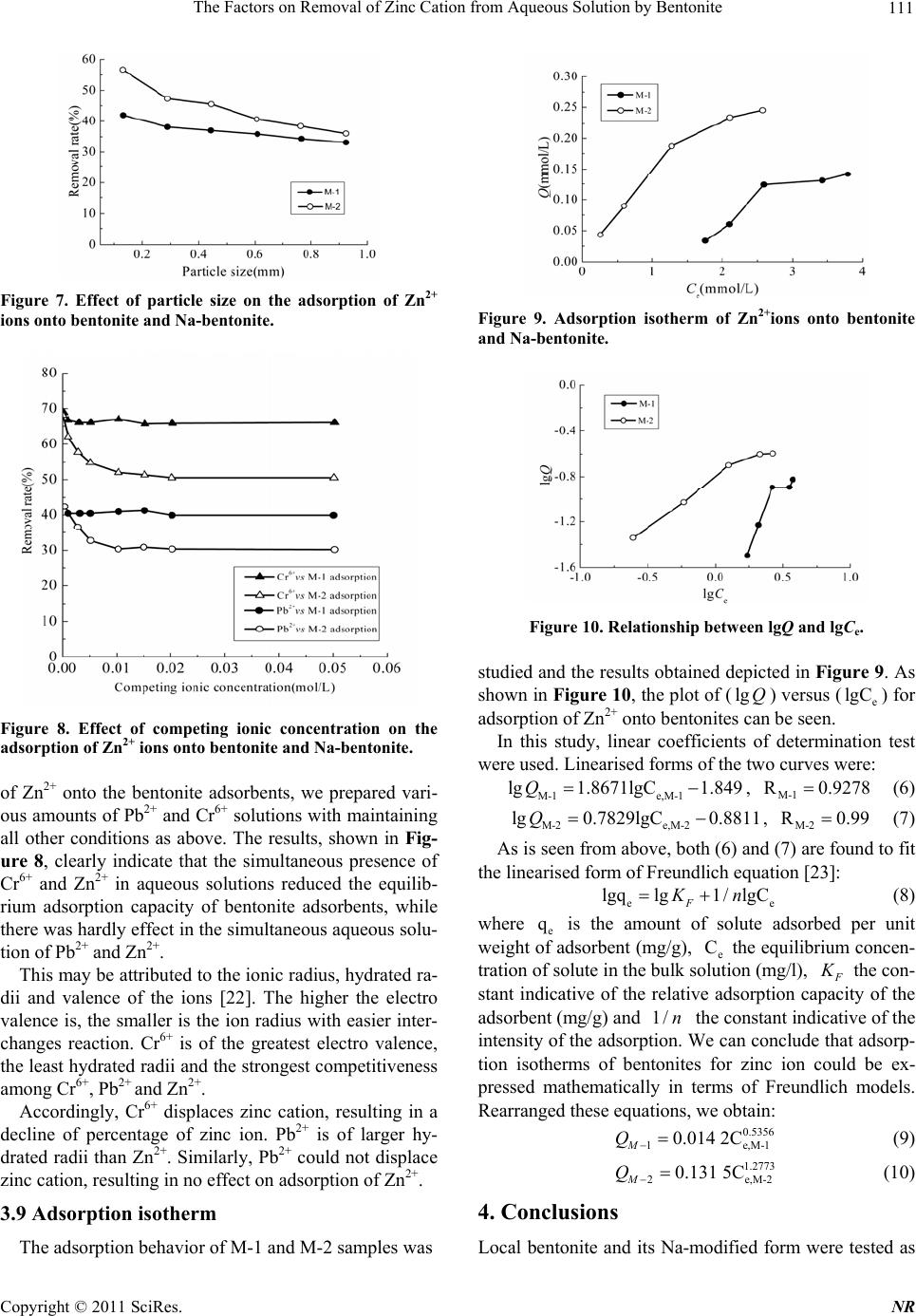 The Factors on Removal of Zinc Cation from Aqueous Solution by Bentonite 111 Figure 7. Effect of particle size on the adsorption of Zn2+ ions onto bentonite and Na-bentonite. Figure 8. Effect of competing ionic concentration on the adsorption of Zn2+ ions onto bentonite and Na-bentonite. of Zn2+ onto the bentonite adsorbents, we prepared vari- ous amounts of Pb2+ and Cr6+ solutions with maintaining all other conditions as above. The results, shown in Fig- ure 8, clearly indicate that the simultaneous presence of Cr6+ and Zn2+ in aqueous solutions reduced the equilib- rium adsorption capacity of bentonite adsorbents, while there was hardly effect in the simultaneous aqueous solu- tion of Pb2+ and Zn2+. This may be attributed to the ionic radius, hydrated ra- dii and valence of the ions [22]. The higher the electro valence is, the smaller is the ion radius with easier inter- changes reaction. Cr6+ is of the greatest electro valence, the least hydrated radii and the strongest competitiveness among Cr6+, Pb2+ and Zn2+. Accordingly, Cr6+ displaces zinc cation, resulting in a decline of percentage of zinc ion. Pb2+ is of larger hy- drated radii than Zn2+. Similarly, Pb2+ could not displace zinc cation, resulting in no effect on adsorption of Zn2+. 3.9 Adsorption isotherm The adsorption behavior of M-1 and M-2 samples was Figure 9. Adsorption isotherm of Zn2+ions onto bentonite and Na-bentonite. Figure 10. Relationship between lgQ and lgCe. studied and the results obtained depicted in Figure 9. As shown in Figure 10, the plot of (lg ) versus () for adsorption of Zn2+ onto bentonites can be seen. Qe lgC In this study, linear coefficients of determination test were used. Linearised forms of the two curves were: M-1 e,M-1 lg1.8671lgC 1.849Q , (6) M-1 R 0.9278 M-2 e,M-2 lg0.7829lgC 0.8811Q , (7) M-2 R0.99 e As is seen from above, both (6) and (7) are found to fit the linearised form of Freundlich equation [23]: e lgqlg1/ lgC F Kn (8) where e is the amount of solute adsorbed per unit weight of adsorbent (mg/g), e the equilibrium concen- tration of solute in the bulk solution (mg/l), q C F K the con- stant indicative of the relative adsorption capacity of the adsorbent (mg/g) and the constant indicative of the intensity of the adsorption. We can conclude that adsorp- tion isotherms of bentonites for zinc ion could be ex- pressed mathematically in terms of Freundlich models. Rearranged these equations, we obtain: 1/n 0.5356 1 0.014 2C M Qe ,M-1 e ,M-2 (9) 1.2773 2 0.131 5C M Q (10) 4. Conclusions Local bentonite and its Na-modified form were tested as C opyright © 2011 SciRes. NR 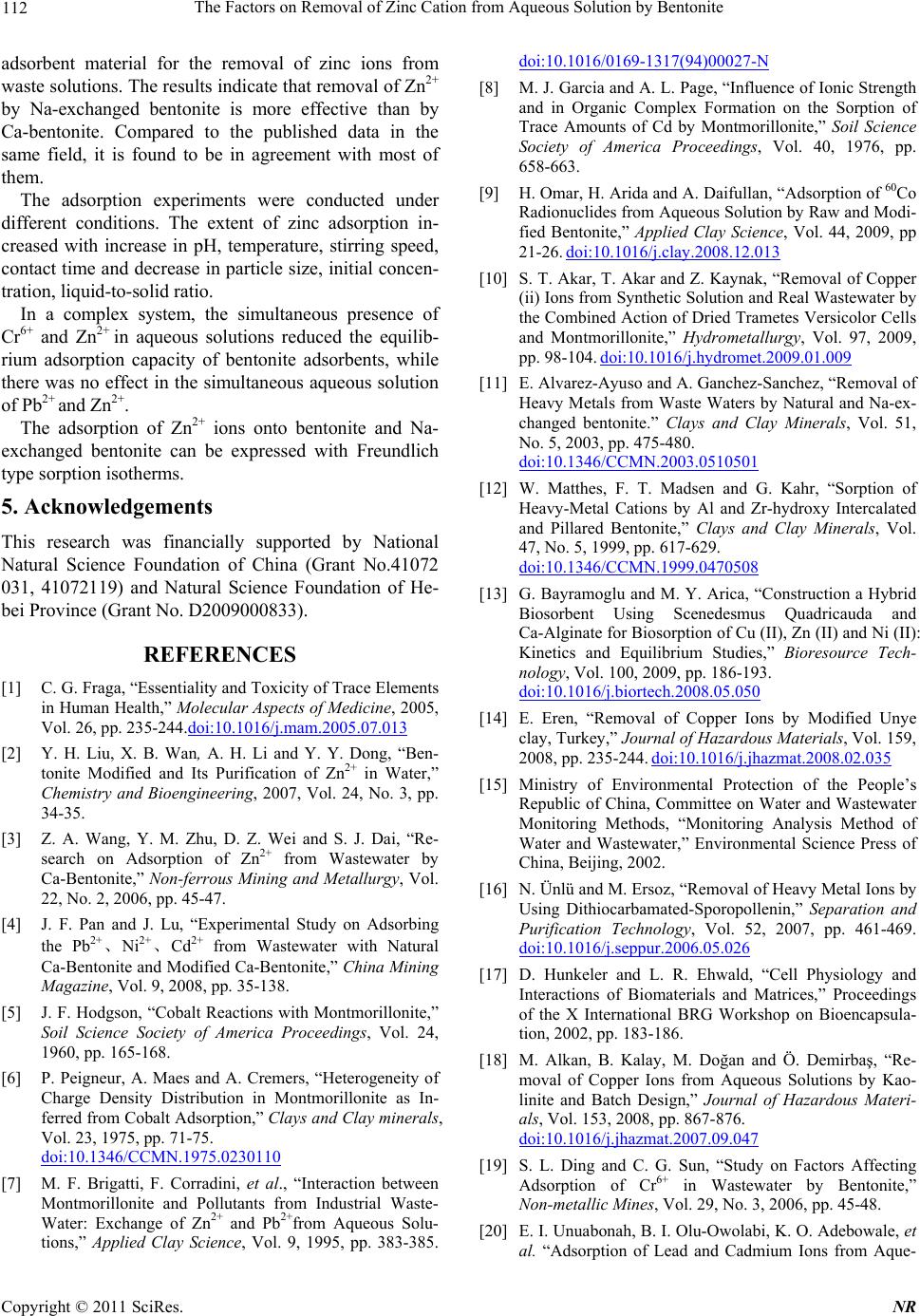 112 The Factors on Removal of Zinc Cation from Aqueous Solution by Bentonite adsorbent material for the removal of zinc ions from waste solutions. The results indicate that removal of Zn2+ by Na-exchanged bentonite is more effective than by Ca-bentonite. Compared to the published data in the same field, it is found to be in agreement with most of them. The adsorption experiments were conducted under different conditions. The extent of zinc adsorption in- creased with increase in pH, temperature, stirring speed, contact time and decrease in particle size, initial concen- tration, liquid-to-solid ratio. In a complex system, the simultaneous presence of Cr6+ and Zn2+ in aqueous solutions reduced the equilib- rium adsorption capacity of bentonite adsorbents, while there was no effect in the simultaneous aqueous solution of Pb2+ and Zn2+. The adsorption of Zn2+ ions onto bentonite and Na- exchanged bentonite can be expressed with Freundlich type sorption isotherms. 5. Acknowledgements This research was financially supported by National Natural Science Foundation of China (Grant No.41072 031, 41072119) and Natural Science Foundation of He- bei Province (Grant No. D2009000833). REFERENCES [1] C. G. Fraga, “Essentiality and Toxicity of Trace Elements in Human Health,” Molecular Aspects of Medicine, 2005, Vol. 26, pp. 235-244.doi:10.1016/j.mam.2005.07.013 [2] Y. H. Liu, X. B. Wan, A. H. Li and Y. Y. Dong, “Ben- tonite Modified and Its Purification of Zn2+ in Water,” Chemistry and Bioengineering, 2007, Vol. 24, No. 3, pp. 34-35. [3] Z. A. Wang, Y. M. Zhu, D. Z. Wei and S. J. Dai, “Re- search on Adsorption of Zn2+ from Wastewater by Ca-Bentonite,” Non-ferrous Mining and Metallurgy, Vol. 22, No. 2, 2006, pp. 45-47. [4] J. F. Pan and J. Lu, “Experimental Study on Adsorbing the Pb2+、Ni2+、Cd2+ from Wastewater with Natural Ca-Bentonite and Modified Ca-Bentonite,” China Mining Magazine, Vol. 9, 2008, pp. 35-138. [5] J. F. Hodgson, “Cobalt Reactions with Montmorillonite,” Soil Science Society of America Proceedings, Vol. 24, 1960, pp. 165-168. [6] P. Peigneur, A. Maes and A. Cremers, “Heterogeneity of Charge Density Distribution in Montmorillonite as In- ferred from Cobalt Adsorption,” Clays and Clay minerals, Vol. 23, 1975, pp. 71-75. doi:10.1346/CCMN.1975.0230110 [7] M. F. Brigatti, F. Corradini, et al., “Interaction between Montmorillonite and Pollutants from Industrial Waste- Water: Exchange of Zn2+ and Pb2+from Aqueous Solu- tions,” Applied Clay Science, Vol. 9, 1995, pp. 383-385. doi:10.1016/0169-1317(94)00027-N [8] M. J. Garcia and A. L. Page, “Influence of Ionic Strength and in Organic Complex Formation on the Sorption of Trace Amounts of Cd by Montmorillonite,” Soil Science Society of America Proceedings, Vol. 40, 1976, pp. 658-663. [9] H. Omar, H. Arida and A. Daifullan, “Adsorption of 60Co Radionuclides from Aqueous Solution by Raw and Modi- fied Bentonite,” Applied Clay Science, Vol. 44, 2009, pp 21-26. doi:10.1016/j.clay.2008.12.013 [10] S. T. Akar, T. Akar and Z. Kaynak, “Removal of Copper (ii) Ions from Synthetic Solution and Real Wastewater by the Combined Action of Dried Trametes Versicolor Cells and Montmorillonite,” Hydrometallurgy, Vol. 97, 2009, pp. 98-104. doi:10.1016/j.hydromet.2009.01.009 [11] E. Alvarez-Ayuso and A. Ganchez-Sanchez, “Removal of Heavy Metals from Waste Waters by Natural and Na-ex- changed bentonite.” Clays and Clay Minerals, Vol. 51, No. 5, 2003, pp. 475-480. doi:10.1346/CCMN.2003.0510501 [12] W. Matthes, F. T. Madsen and G. Kahr, “Sorption of Heavy-Metal Cations by Al and Zr-hydroxy Intercalated and Pillared Bentonite,” Clays and Clay Minerals, Vol. 47, No. 5, 1999, pp. 617-629. doi:10.1346/CCMN.1999.0470508 [13] G. Bayramoglu and M. Y. Arica, “Construction a Hybrid Biosorbent Using Scenedesmus Quadricauda and Ca-Alginate for Biosorption of Cu (II), Zn (II) and Ni (II): Kinetics and Equilibrium Studies,” Bioresource Tech- nology, Vol. 100, 2009, pp. 186-193. doi:10.1016/j.biortech.2008.05.050 [14] E. Eren, “Removal of Copper Ions by Modified Unye clay, Turkey,” Journal of Hazardous Materials, Vol. 159, 2008, pp. 235-244. doi:10.1016/j.jhazmat.2008.02.035 [15] Ministry of Environmental Protection of the People’s Republic of China, Committee on Water and Wastewater Monitoring Methods, “Monitoring Analysis Method of Water and Wastewater,” Environmental Science Press of China, Beijing, 2002. [16] N. Ünlü and M. Ersoz, “Removal of Heavy Metal Ions by Using Dithiocarbamated-Sporopollenin,” Separation and Purification Technology, Vol. 52, 2007, pp. 461-469. doi:10.1016/j.seppur.2006.05.026 [17] D. Hunkeler and L. R. Ehwald, “Cell Physiology and Interactions of Biomaterials and Matrices,” Proceedings of the X International BRG Workshop on Bioencapsula- tion, 2002, pp. 183-186. [18] M. Alkan, B. Kalay, M. Doğan and Ö. Demirbaş, “Re- moval of Copper Ions from Aqueous Solutions by Kao- linite and Batch Design,” Journal of Hazardous Materi- als, Vol. 153, 2008, pp. 867-876. doi:10.1016/j.jhazmat.2007.09.047 [19] S. L. Ding and C. G. Sun, “Study on Factors Affecting Adsorption of Cr6+ in Wastewater by Bentonite,” Non-metallic Mines, Vol. 29, No. 3, 2006, pp. 45-48. [20] E. I. Unuabonah, B. I. Olu-Owolabi, K. O. Adebowale, et al. “Adsorption of Lead and Cadmium Ions from Aque- C opyright © 2011 SciRes. NR 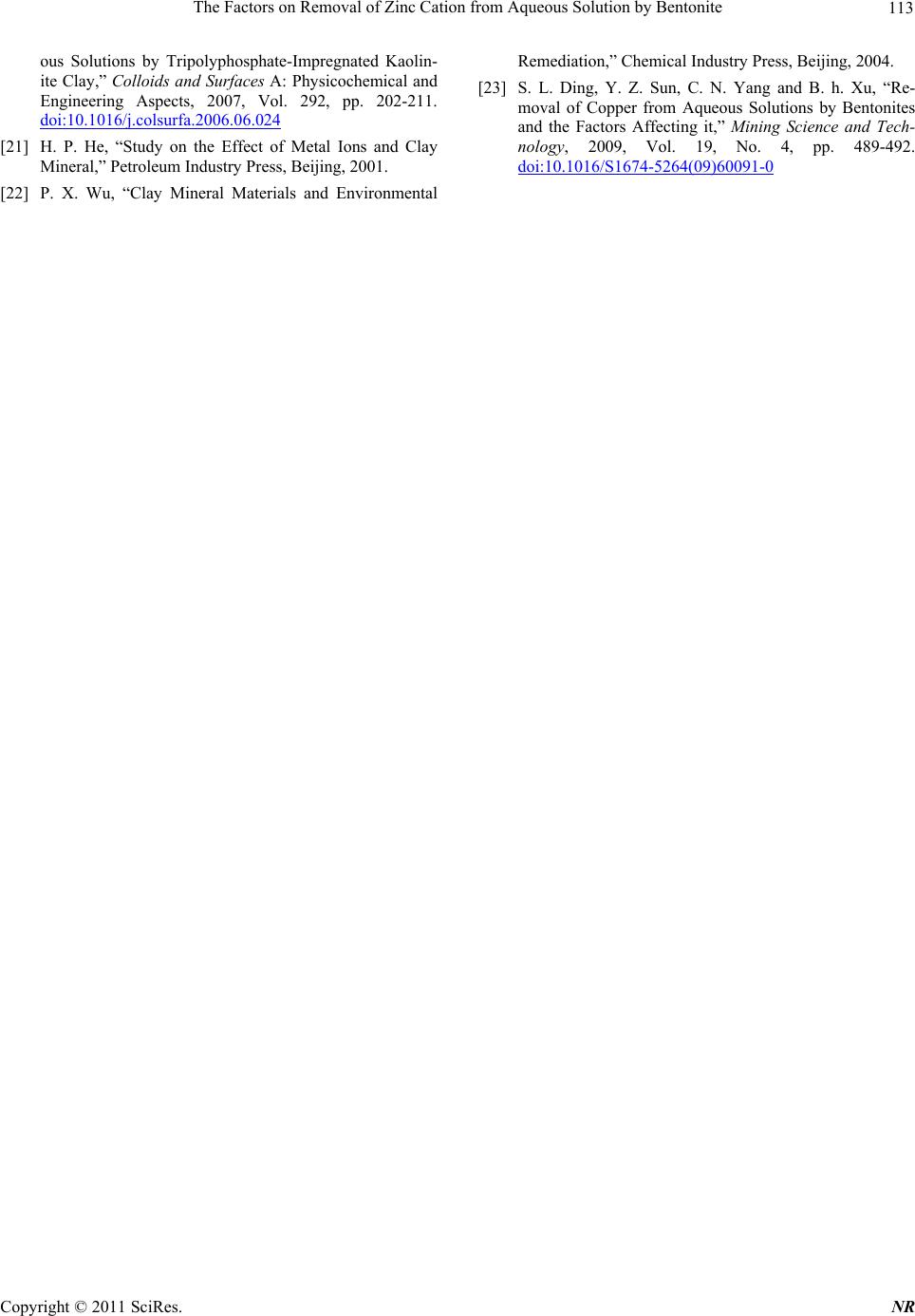 The Factors on Removal of Zinc Cation from Aqueous Solution by Bentonite Copyright © 2011 SciRes. NR 113 ous Solutions by Tripolyphosphate-Impregnated Kaolin- ite Clay,” Colloids and Surfaces A: Physicochemical and Engineering Aspects, 2007, Vol. 292, pp. 202-211. doi:10.1016/j.colsurfa.2006.06.024 [21] H. P. He, “Study on the Effect of Metal Ions and Clay Mineral,” Petroleum Industry Press, Beijing, 2001. [22] P. X. Wu, “Clay Mineral Materials and Environmental Remediation,” Chemical Industry Press, Beijing, 2004. [23] S. L. Ding, Y. Z. Sun, C. N. Yang and B. h. Xu, “Re- moval of Copper from Aqueous Solutions by Bentonites and the Factors Affecting it,” Mining Science and Tech- nology, 2009, Vol. 19, No. 4, pp. 489-492. doi:10.1016/S1674-5264(09)60091-0 |