

Paper Menu >>
Journal Menu >>
 Natural Resources, 2011, 2, 98-101 doi:10.4236/nr.2011.22013 Published Online June 2011 (http://www.scirp.org/journal/nr) Copyright © 2011 SciRes. NR Tannin-phenol Formaldehyde Resins as Binders for Cellulosic Fibers: Mechanical Properties A. S. Hussein1*, K. I. Ibrahim1, K. M. Abdulla2 Polymer Research Center, University of Basrah; State Company for Petrochemical Industries, Basrah , Iraq. E-mail: [email protected] Received December 21st, 2010; revised May 11th, 2011; accepted May 20th, 2011. ABSTRACT In this study Eucalyptus tannin (T) was isolated from outer bark of Eucalyptus trees; as sodium phenoxide salt and used as extender or copolymer into phenol formaldehyde (PF) resin at five percent (10, 20, 30, 40 and 50)% W/W. Tan- nin-phenol formaldehyde (TPF) and tannin formaldehyde-phenol formaldehyde (TFPF) resins that synthesized in this study were evaluated as adhesive material for cellulosic fibers by study the mechanical properties of the composite sheets. The results show that the substitu ting of (PF) with tannin at (10-50)% W/W give resins with mechanical proper- ties comparable or near to those of pure (PF), where the tensile strength at break (Tb) ranging from 15.15 Mpa to 22.27 Mpa as compared with 17.6 Mpa for pure (PF); while the impact strength properties (Im) of composites sheets in- creased with increased the (T) percents which were about 5.16 KJ/m2 for (TPF-10%) and 7.21 KJ/m2 for (TPF-50%) .On the other hand modification of (T) to tannin formaldehyde resin (TF) appear less performance at the results of this study, this effect probably to low p enetration of (TFPF) resins between the small vo ids of cellulose fibers when soaked it in resin solutions. In gene ral the results of this study ind icate that th e Eucalyptus tann in can be used for partial sub stitution of (PF) to produce resins with feas ible mechanical properties and can be used in so me applications of (PF) resins. Keywords: Tannin, Tannin-formaldehyde Resins, Phenol- formaldehyde Resins, Mechanical Properties 1. Introduction Tannins are one of the natural products which are widely distributed in plant kingdom, they are composed of dif- ferent phenolic compounds [1,2]. Tannins are generally classified into two major types: hydrolysable tannin s and condensed tannins, the hydrolysable tannins are mixture of simple phenols and it has had medicinal and cottage applications. Condensed tannins are polymeric phenolic compounds comprising from flavon-3-ol repeating units; Condensed tannins are known for their wide distribution in various softwood and hardwood, and it constitute about 90% of the total world production of commercial tannins [3]. Many studies show that the phenolic natural of tannin make it suitable for synthesis polymeric resins and adhe- sives; Hergert [4] stated that (30-50)% W/W tannin re- placement of the amino and phenolic resins have been formulated into wood adhesives. Saayman [5] reported tannin (Wattle tann in) utility i n PF resins fo r wood adh e- sives requiring up to 30% of PF fortification to obtain a fully water–resistant bond. Other studies deal with reac- tion of tannin (Wattle tannin) with formaldehyde to syn- thesis polymeric resins [6, 7]. The purpose of this study was to evaluate the per- formance of Eucalyptus tannin as tannin sodium salt (T) or as tannin-formaldehyde resin (TF) into PF as binders for cellulosic fibers to produce composites sheets by study their mechanical properties. 2. Experimental 2.1. Materials: Tannin was isolated from the outer bark of Eucalyptus tree, and used as crude without farther purification. Cel- lulose fibers (pulp) were used as sheets from National Company of Papers Industries, other chemicals used in this study were: Sodium hydroxide and phosphoric acid from Fluka Chemical Company Inc.; phenol, ethanol and formalin solution (37-41)% W/V from (H&W). 2. 2. Instruments: The tensile properties were measured by using tensile 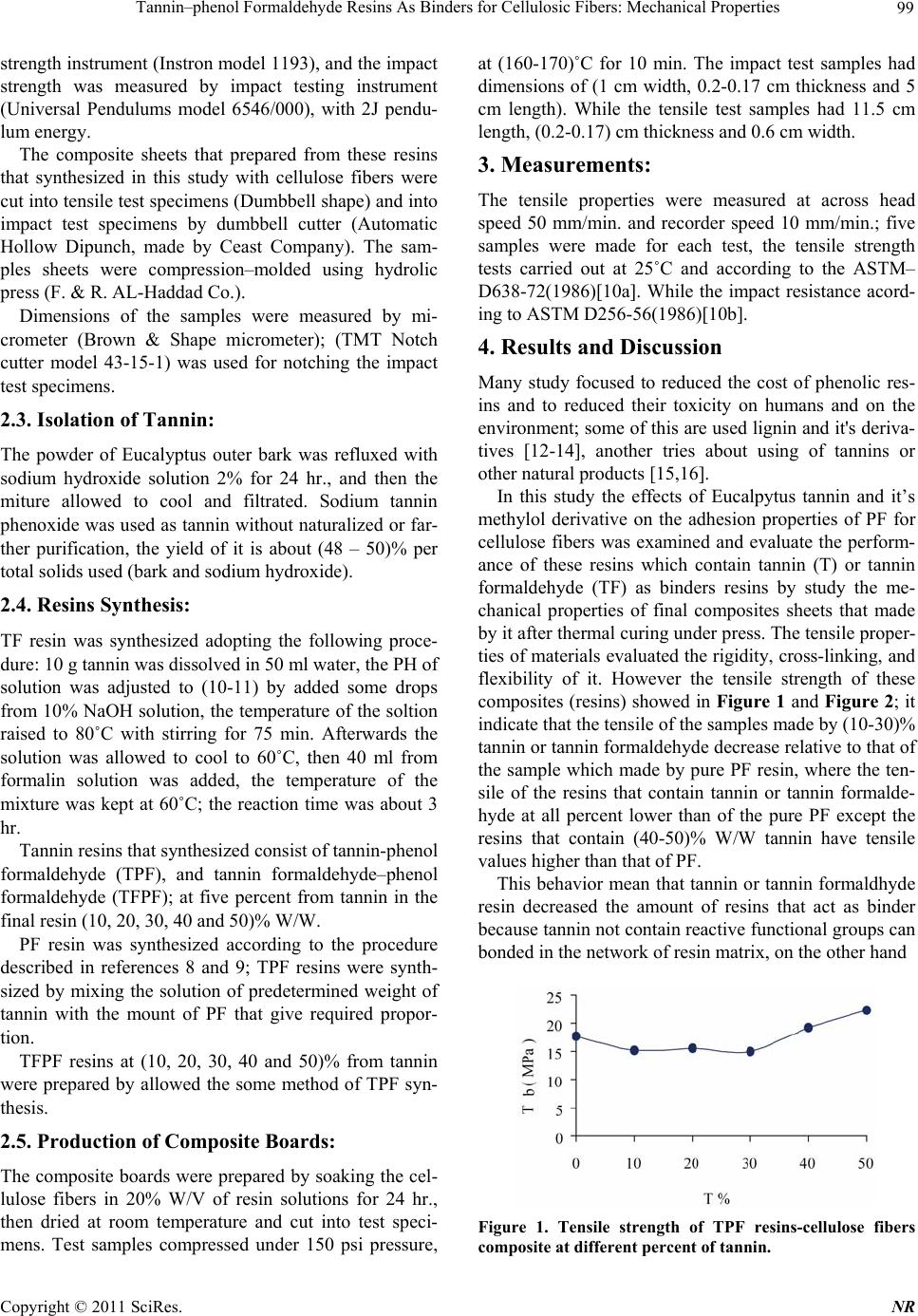 99 Tannin–phenol Formaldehyde Resins As Binders for Cellulosic Fibers: Mechanical Properties strength instrument (I nstron model 1193), an d the impact strength was measured by impact testing instrument (Universal Pendulums model 6546/000), with 2J pendu- lum energy. The composite sheets that prepared from these resins that synthesized in this study with cellulose fibers were cut into tensile test sp ecimens (Dumbbell shape) and in to impact test specimens by dumbbell cutter (Automatic Hollow Dipunch, made by Ceast Company). The sam- ples sheets were compression–molded using hydrolic press (F. & R. AL-Haddad Co.). Dimensions of the samples were measured by mi- crometer (Brown & Shape micrometer); (TMT Notch cutter model 43-15-1) was used for notching the impact test specimens. 2.3. Isolation of Tannin: The powder of Eucalyptus outer bark was refluxed with sodium hydroxide solution 2% for 24 hr., and then the miture allowed to cool and filtrated. Sodium tannin phenoxide was used as tannin without naturalized or far- ther purification, the yield of it is about (48 – 50)% per total solids used (ba rk and so di um hydroxid e). 2.4. Resins Synthesis: TF resin was synthesized adopting the following proce- dure: 10 g tannin was dissolved in 50 ml water, the PH of solution was adjusted to (10-11) by added some drops from 10% NaOH solution, the temperature o f the soltion raised to 80˚C with stirring for 75 min. Afterwards the solution was allowed to cool to 60˚C, then 40 ml from formalin solution was added, the temperature of the mixture was kept at 60˚C; the reaction time was about 3 hr. Tannin resins that synthesized consist of tannin-phenol formaldehyde (TPF), and tannin formaldehyde–phenol formaldehyde (TFPF); at five percent from tannin in the final resin (10, 20 , 30 , 40 and 50 )% W/W. PF resin was synthesized according to the procedure described in references 8 and 9; TPF resins were synth- sized by mixing the solution of predetermined weight of tannin with the mount of PF that give required propor- tion. TFPF resins at (10, 20, 30, 40 and 50)% from tannin were prepared by allowed the some method of TPF syn- thesis. 2.5. Production of Composite Boards: The composite boards were prepared by soaking the cel- lulose fibers in 20% W/V of resin solutions for 24 hr., then dried at room temperature and cut into test speci- mens. Test samples compressed under 150 psi pressure, at (160-170)˚C for 10 min. The impact test samples had dimensions of (1 cm width, 0.2-0.17 cm thickness and 5 cm length). While the tensile test samples had 11.5 cm length, (0.2-0.17) cm thickness and 0.6 cm width. 3. Measurements: The tensile properties were measured at across head speed 50 mm/min. and recorder speed 10 mm/min.; five samples were made for each test, the tensile strength tests carried out at 25˚C and according to the ASTM– D638-72(1986)[10a]. While the impact resistance acord- ing to ASTM D256-56(1986)[10b]. 4. Results and Discussion Many study focused to reduced the cost of phenolic res- ins and to reduced their toxicity on humans and on the environment; some of this are used lignin and it's deriva- tives [12-14], another tries about using of tannins or other natural products [15,16]. In this study the effects of Eucalpytus tannin and it’s methylol derivative on the adhesion properties of PF for cellulose fibers was examined and evaluate the perform- ance of these resins which contain tannin (T) or tannin formaldehyde (TF) as binders resins by study the me- chanical properties of final composites sheets that made by it after thermal curing under press. The ten sile proper- ties of materials evaluated the rigidity, cross-linking, and flexibility of it. However the tensile strength of these composites (resins) showed in Figure 1 and Figure 2; it indicate that the tensile of the samples made by (10-30)% tannin or tannin formaldehyde decrease relative to that of the sample which made by pure PF resin, where the ten- sile of the resins that contain tannin or tannin formalde- hyde at all percent lower than of the pure PF except the resins that contain (40-50)% W/W tannin have tensile values higher than that of PF. This behavior mean that tannin or tannin formaldhyde resin decreased the amount of resins that act as binder because tannin not contain reactive functional groups can bonded in the network of resin matrix, on the other hand Figure 1. Tensile strength of TPF resins-cellulose fibers composite at different percent of tannin. Copyright © 2011 SciRes. NR 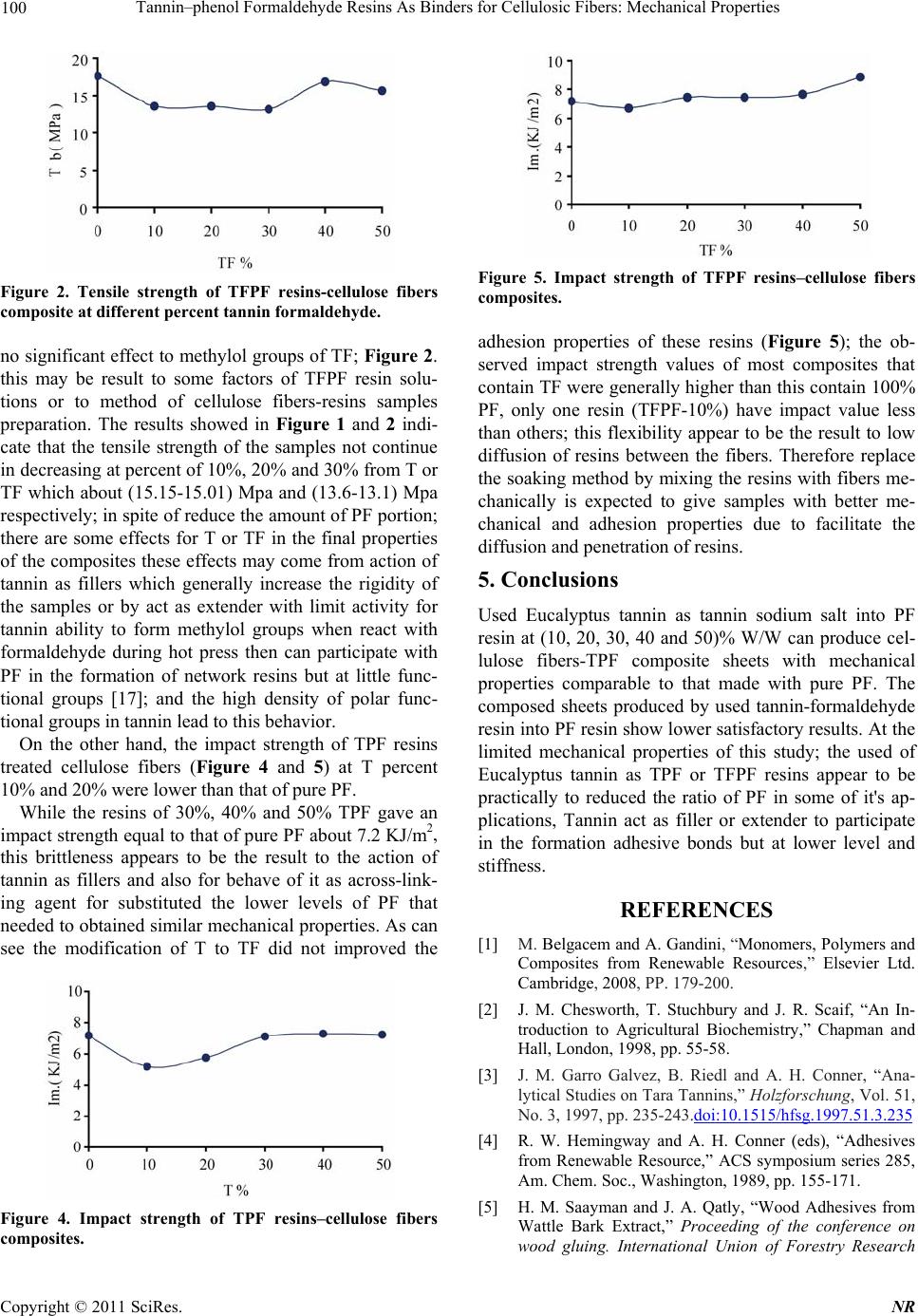 100 Tannin–phenol Formaldehyde Resins As Binders for Cellulosic Fibers: Mechanical Properties Figure 2. Tensile strength of TFPF resins-cellulose fibers composite at different percent tannin formaldehyde. no significant effect to methylol groups of TF; Figure 2. this may be result to some factors of TFPF resin solu- tions or to method of cellulose fibers-resins samples preparation. The results showed in Figure 1 and 2 indi- cate that the tensile strength of the samples not continue in decreasing at percent of 10%, 20% and 30% from T or TF which about (15.15-15 .01) Mpa and (13.6-13.1) Mpa respectively; in spite of reduce the amount of PF portion; there are some effects for T or TF in the final properties of the composites these effects may come from action of tannin as fillers which generally increase the rigidity of the samples or by act as extender with limit activity for tannin ability to form methylol groups when react with formaldehyde during hot press then can participate with PF in the formation of network resins but at little func- tional groups [17]; and the high density of polar func- tional groups in tannin lead to th is behavior. On the other hand, the impact strength of TPF resins treated cellulose fibers (Figure 4 and 5) at T percent 10% and 20% were lower than that of pure PF. While the resins of 30%, 40% and 50% TPF gave an impact strength equal to that of pure PF about 7.2 KJ/m2, this brittleness appears to be the result to the action of tannin as fillers and also for behave of it as across-link- ing agent for substituted the lower levels of PF that needed to obtained similar mechanical properties. As can see the modification of T to TF did not improved the Figure 4. Impact strength of TPF resins–cellulose fibers composites. Figure 5. Impact strength of TFPF resins–cellulose fibers composites. adhesion properties of these resins (Figure 5); the ob- served impact strength values of most composites that contain TF were generally higher than this contain 100% PF, only one resin (TFPF-10%) have impact value less than others; this flexibility appear to be the result to low diffusion of resins between the fibers. Therefore replace the soaking method by mixing the resins with fibers me- chanically is expected to give samples with better me- chanical and adhesion properties due to facilitate the diffusion and p enet rat i o n of re sins. 5. Conclusions Used Eucalyptus tannin as tannin sodium salt into PF resin at (10, 20, 30, 40 and 50)% W/W can produce cel- lulose fibers-TPF composite sheets with mechanical properties comparable to that made with pure PF. The composed sheets produced by used tannin-formaldehyde resin into PF resin show lower satisfactory results. At the limited mechanical properties of this study; the used of Eucalyptus tannin as TPF or TFPF resins appear to be practically to reduced the ratio of PF in some of it's ap- plications, Tannin act as filler or extender to participate in the formation adhesive bonds but at lower level and stiffness. REFERENCES [1] M. Belgacem and A. Gandini, “Monomers, Polymers and Composites from Renewable Resources,” Elsevier Ltd. Cambridge, 2008, PP. 179-200. [2] J. M. Chesworth, T. Stuchbury and J. R. Scaif, “An In- troduction to Agricultural Biochemistry,” Chapman and Hall, London, 1998, pp. 55-58. [3] J. M. Garro Galvez, B. Riedl and A. H. Conner, “Ana- lytical Studies on Tara Tannins,” Holzforschung, Vol. 51, No. 3, 1997, pp. 235-243.doi:10.1515/hfsg.1997.51.3.235 [4] R. W. Hemingway and A. H. Conner (eds), “Adhesives from Renewable Resource,” ACS symposium series 285, Am. Chem. Soc., Washington, 1989, pp. 155-171. [5] H. M. Saayman and J. A. Qatly, “Wood Adhesives from Wattle Bark Extract,” Proceeding of the conference on wood gluing. International Union of Forestry Research C opyright © 2011 SciRes. NR  Tannin–phenol Formaldehyde Resins As Binders for Cellulosic Fibers: Mechanical Properties Copyright © 2011 SciRes. NR 101 Organization, Madison, 22-23 September 1975, pp. 28-45. [6] S. Kim and H. -J. Kim, “Evaluation of Formaldehyde Emission of Pine and Wattle Tannin-Based Adhesives by Gas Chromatography,” Holz Roh Werkst, Vol. 62, No. 2, 2004, pp. 101-106. doi:10.1515/hfsg.1997.51.3.235 [7] M. T. Paridah and O. C. Musgrave, “Alkline Treatment of Sulfited Tannin-Based Adhesive from Mangrove to Increase Bond Integrity of Beech Slips,” Journal of Tropical Forest Science, Vol. 18, 2006, pp. 137-143. [8] G. A. Adam, “Chemistry and Technology of Methylolic Resins: Their Derivatives and IPNs,” National journal of Chemistry, Vol. 1, 2001, pp. 131-157. [9] A. K. Raheem, “Synthesis, Characterization and Study of Some New Epoxy Resins and Resinous Amines as Hard- ners,” Ph.D. Thesis, University of Basrah, Basrah, 1992. [10] A-Annual book of ASTM Standard, “Tensile Properties of Plastics,” Vol. 8.1, 1986, D638-84. B-Annual book of ASTM Standard, “Standard Test Methods for Impact Re- sistance of Plastics and Electrical Insulating Materials,” Vol. 8.1, 1986, D256-84. [11] M. Olivares, H. Aceituno, G. Neiman, E. Rivera and T. Sellers, “Ligin-Modified Phenolic Adhesives for Bonding Radiata Pine Plywood,” Forest product Journal, vol. 45, No. 1, 1995, pp. 63-67. [12] T. Sellers, “Survey Reveals Use of Lignin as Partial Sub- stitute for Phenol,” Panel World, Vol. 31, 1990, pp. 26-29. [13] R. W. Hemingway, A. H. Conner and S. J. Branham, “Adhesives from Renewable Resources,” ACS Sympo- sium, Washington, 1989, pp. 13-42. [14] A. Pizzi, “Advanceed Wood Adhesives Technology,” Marcel Dekker, New York, 1994, pp. 149-217. [15] M. D. Fabricio and A. R. L. Francisco, “Alternative Cas- tor Oil-Based Polyurthane Adhesives Used in Production of Plywood,” Materials Research, Vol. 7, No. 3, 2004, p. 413. doi:10.1590/S1516-14392004000300007 [16] D. J. Gardner, S. K. Waage and T. J. Elder, “Bonding Flakeboard with Filled and Extended Phe- nol-Formaldehyde Resin,” Forest Products Journal, Vol. 40, 1990, pp. 31-36. |