

Paper Menu >>
Journal Menu >>
 Journal of Environmental Protection, 2011, 2, 359-364 doi: 10.4236/jep.2011.24039 Published Online June 2011 (http://www.SciRP.org/journal/jep) Copyright © 2011 SciRes. JEP 359 Basement Data of the Terrestrial Radionuclide Level of Abuja Federal Capital Territory, (FCT), Nigeria Ayodeji Awodugba1, Adetayo Abioye1, Dauda Adekunle1, Omowumi Ologun1, Isiaka Oyekunle1, Ola- tunde Oni1, Pascal Tchokossa2 1Department of Pure & Applied Physics, Ladoke Akintola University of Technology, Ogbomoso, Nigeria; 2Centre for Energy Re- search and Development, Obafemi Awolowo University, Ile-Ife, Nigeria. Email: [email protected] Received October 18th, 2010; revised January 18th, 2011; accepted March 16th, 2011. ABSTRACT A total of 30 samples were collected from six different locations from of Abuja Federal Capital Territory (FCT), the administrative capital of Nigeria which is situated in the central part of the country. The samples which were thor- oughly prepared following known dosimetry procedures were analyzed for 40K, 238U and 232Th by the meth od of Gamm a ray spectrometry using NaI(TL) detector coupled to a multichannel analyzer. The activity concen tra tions in the top so ils in these locatio ns for 40K, 238U and 232Th range from 301 ± 26.52 to 928.84 ± 80.57, Not detectable (ND) value to 27.68 ± 8.21 and 4.65 ± 1.46 to 22.48 ± 5.26 respectively. The average absorbed dose rate and the annual effective dose equivalent were found to be 40.33 nGyh–1 and 49.46 µSv respectively. The value of annual effective dose equivalent is low compared to the world average of 70 µSv specified by UNSCEAR for an outdoor effective dose, hence the chances of radiological hazards to the health of the populace are generally low. Keywords: Gamma Ray Spectrometry, Soil, Radionuclide s , Abuja FCT, Nigeria 1. Introduction The occurrence of natural radionuclide in soil depends primarily on the geological and geographical conditions, and appears at different levels in the soil of each region in the world [1-5]. For example, higher levels of radia- tion are associated with igneous rock such as granite and lower levels with sedimentary rocks. However, some shales and phosphate rocks have relative high content of those radionuclides [6-7]. The composition of these soils and rocks in which the natural radionuclides which are primarily 238U, 232Th and 40K are contained are the major source of the terrestrial component of the natural back- ground radiation and contributes significantly to the total dose from natural sources. Abuja, the federal capital city of Nigeria which is home to about 800,000 people with ever increasing rural to urban migration rate is located between latitude 8o34′N, longitude 7o10′E and latitude 9o14′N, longitude 7o34′E and has a land area of 713 km2 and density of 1091.9 km–2. The city is also witnessing aggressive construction works to provide houses for this influx of people. ome papers have been published on the radioactivity level in some regions of Nigeria like [8-12] and more recently on the neutron activation analysis of soil and leaf samples from different parts of Abuja Metropolis [13-14] there is, however, no data is available for radionuclides content in soil samples in this city from the survey of literature and authors’ knowledge. This work therefore focuses on the measurement of decay products of the 238U and 232Th series as well as of the primordial radionuclide 40K. The baseline data of this type will certainly be of importance in making estimations of population exposures. The map of Abuja FCT showing the locations from where the soil samples were collected is shown in Figure 1 below. 2. Materials and Method 30 samples from the six districts of the Abuja Federal Capital territory were collected from top soil up to a depth of about 15 cm. The description of the samples is as below; 1-Municipal area council, 2-Kwali area council, -Abaji area council, 4-Kuje area council, 5-Gwagwal- 3 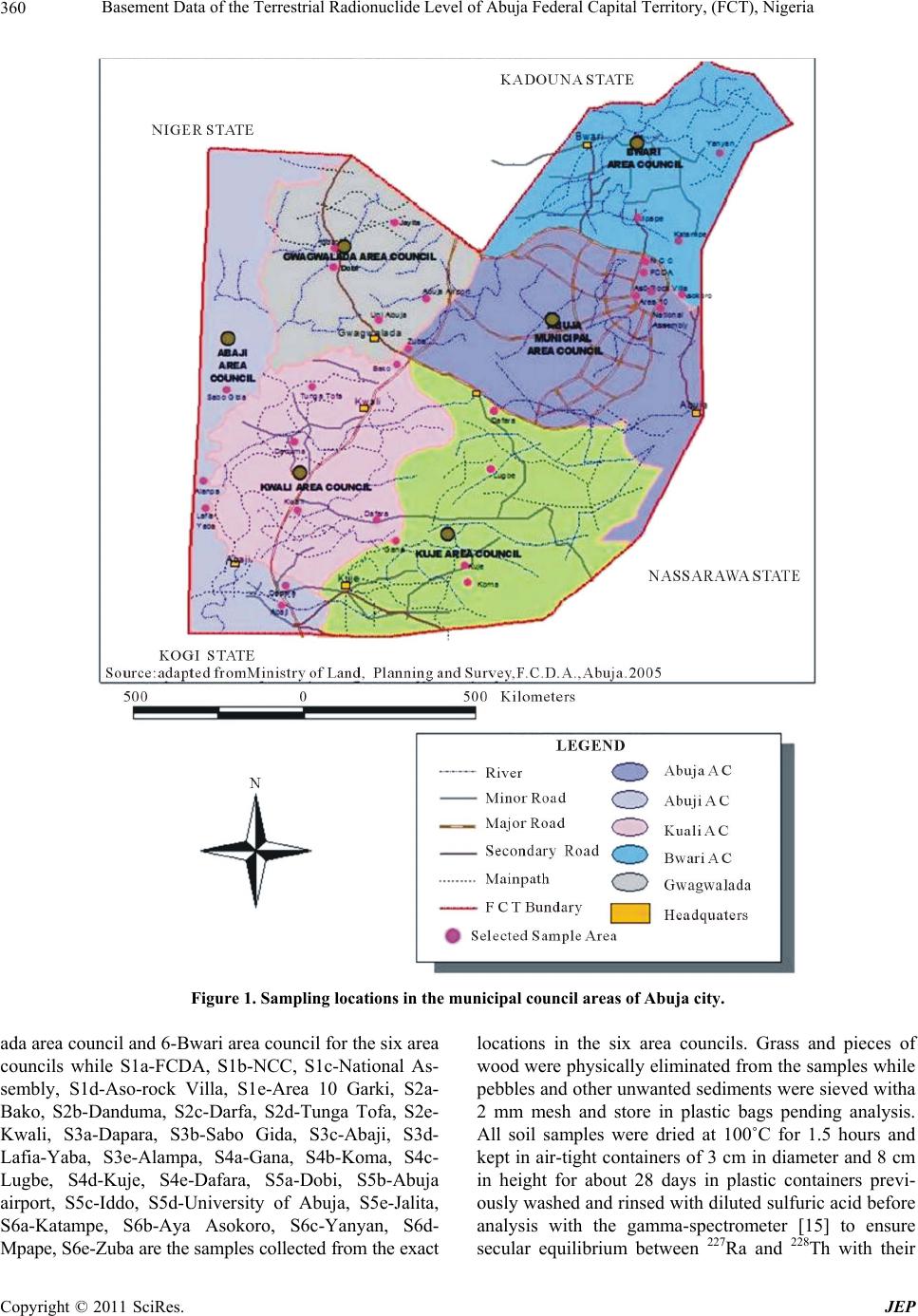 Basement Data of the Terrestrial Radionuclide Level of Abuja Federal Capital Territory, (FCT), Nigeria 360 Figure 1. Sampling locations in the municipal council areas of Abuja city. ada area council and 6-Bwari area council for the six area councils while S1a-FCDA, S1b-NCC, S1c-National As- sembly, S1d-Aso-rock Villa, S1e-Area 10 Garki, S2a- Bako, S2b-Danduma, S2c-Darfa, S2d-Tunga Tofa, S2e- Kwali, S3a-Dapara, S3b-Sabo Gida, S3c-Abaji, S3d- Lafia-Yaba, S3e-Alampa, S4a-Gana, S4b-Koma, S4c- Lugbe, S4d-Kuje, S4e-Dafara, S5a-Dobi, S5b-Abuja airport, S5c-Iddo, S5d-University of Abuja, S5e-Jalita, S6a-Katampe, S6b-Aya Asokoro, S6c-Yanyan, S6d- Mpape, S6e-Zuba are the samples collected from the exact locations in the six area councils. Grass and pieces of wood were physically eliminated from the samples while pebbles and other unwanted sediments were sieved witha 2 mm mesh and store in plastic bags pending analysis. All soil samples were dried at 100˚C for 1.5 hours and kept in air-tight containers of 3 cm in diameter and 8 cm in height for about 28 days in plastic containers previ- ously washed and rinsed with diluted sulfuric acid before analysis with the gamma-spectrometer [15] to ensure secular equilibrium between 227Ra and 228Th with their Copyright © 2011 SciRes. JEP 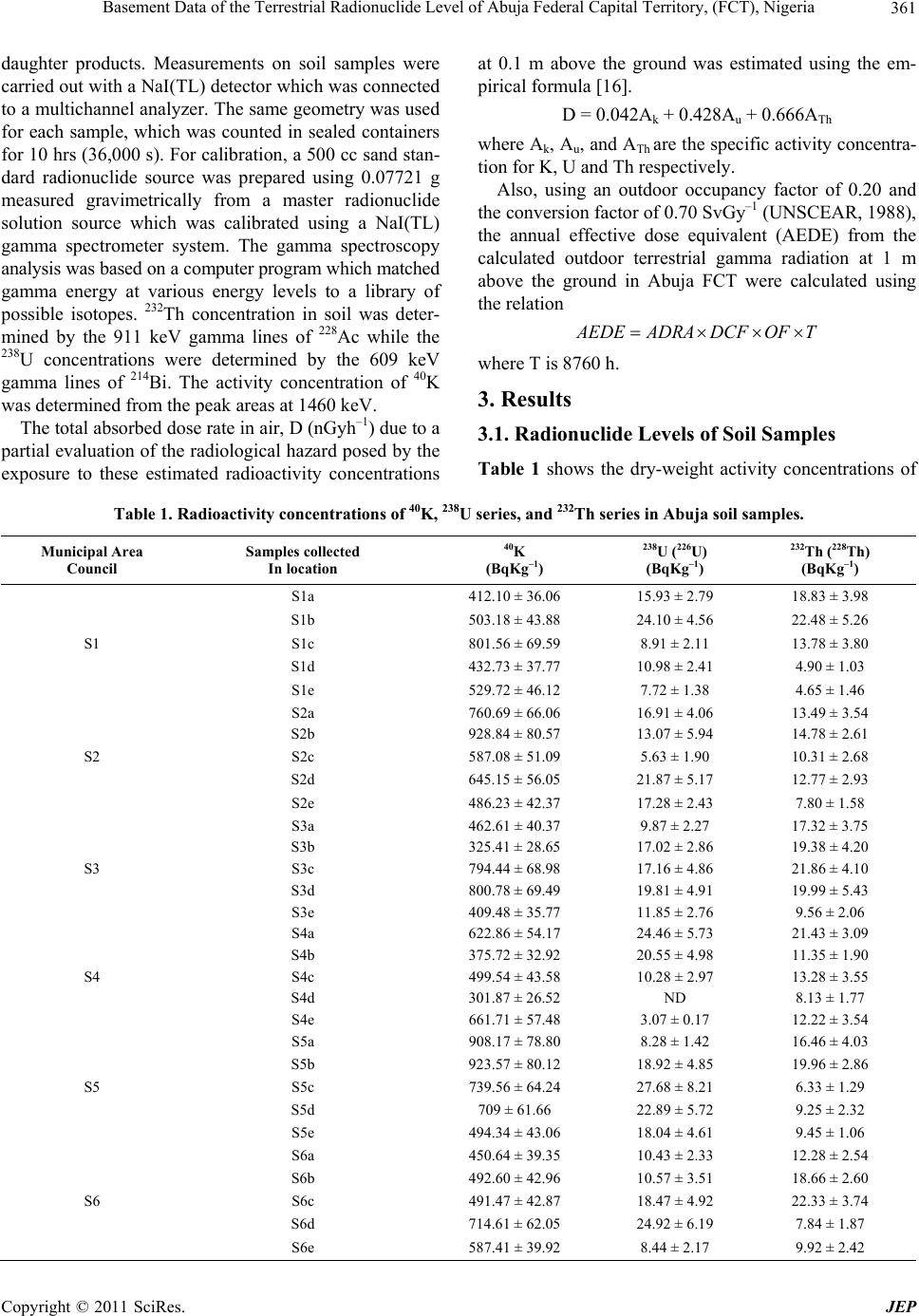 Basement Data of the Terrestrial Radionuclide Level of Abuja Federal Capital Territory, (FCT), Nigeria361 daughter products. Measurements on soil samples were carried out with a NaI(TL) detector which was connected to a multichannel analyzer. The same geometry was used for each sample, which was counted in sealed containers for 10 hrs (36,000 s). For calibration, a 500 cc sand stan- dard radionuclide source was prepared using 0.07721 g measured gravimetrically from a master radionuclide solution source which was calibrated using a NaI(TL) gamma spectrometer system. The gamma spectroscopy analysis was based on a computer program which matched gamma energy at various energy levels to a library of possible isotopes. 232Th concentration in soil was deter- mined by the 911 keV gamma lines of 228Ac while the 238U concentrations were determined by the 609 keV gamma lines of 214Bi. The activity concentration of 40K was determined from the peak areas at 1460 keV. The total absorbed dose rate in air, D (nGyh–1) due to a partial evaluation of the radiological hazard posed by the exposure to these estimated radioactivity concentrations at 0.1 m above the ground was estimated using the em- pirical formula [16]. D = 0.042Ak + 0.428Au + 0.666ATh where Ak, Au, and ATh are the specific activity concentra- tion for K, U and Th respectively. Also, using an outdoor occupancy factor of 0.20 and the conversion factor of 0.70 SvGy–1 (UNSCEAR, 1988), the annual effective dose equivalent (AEDE) from the calculated outdoor terrestrial gamma radiation at 1 m above the ground in Abuja FCT were calculated using the relation A EDEADRA DCFOF T where T is 8760 h. 3. Results 3.1. Radionuclide Levels of Soil Samples Table 1 shows the dry-weight activity concentrations of Table 1. Radioactivity concentrations of 40K, 238U series, and 232Th series in Abuja soil samples. Municipal Area Council Samples collected In location 40K (BqKg–1) 238U (226U) (BqKg–1) 232Th (228Th) (BqKg–1) S1a 412.10 ± 36.06 15.93 ± 2.79 18.83 ± 3.98 S1b 503.18 ± 43.88 24.10 ± 4.56 22.48 ± 5.26 S1 S1c 801.56 ± 69.59 8.91 ± 2.11 13.78 ± 3.80 S1d 432.73 ± 37.77 10.98 ± 2.41 4.90 ± 1.03 S1e 529.72 ± 46.12 7.72 ± 1.38 4.65 ± 1.46 S2a 760.69 ± 66.06 16.91 ± 4.06 13.49 ± 3.54 S2b 928.84 ± 80.57 13.07 ± 5.94 14.78 ± 2.61 S2 S2c 587.08 ± 51.09 5.63 ± 1.90 10.31 ± 2.68 S2d 645.15 ± 56.05 21.87 ± 5.17 12.77 ± 2.93 S2e 486.23 ± 42.37 17.28 ± 2.43 7.80 ± 1.58 S3a 462.61 ± 40.37 9.87 ± 2.27 17.32 ± 3.75 S3b 325.41 ± 28.65 17.02 ± 2.86 19.38 ± 4.20 S3 S3c 794.44 ± 68.98 17.16 ± 4.86 21.86 ± 4.10 S3d 800.78 ± 69.49 19.81 ± 4.91 19.99 ± 5.43 S3e 409.48 ± 35.77 11.85 ± 2.76 9.56 ± 2.06 S4a 622.86 ± 54.17 24.46 ± 5.73 21.43 ± 3.09 S4b 375.72 ± 32.92 20.55 ± 4.98 11.35 ± 1.90 S4 S4c 499.54 ± 43.58 10.28 ± 2.97 13.28 ± 3.55 S4d 301.87 ± 26.52 ND 8.13 ± 1.77 S4e 661.71 ± 57.48 3.07 ± 0.17 12.22 ± 3.54 S5a 908.17 ± 78.80 8.28 ± 1.42 16.46 ± 4.03 S5b 923.57 ± 80.12 18.92 ± 4.85 19.96 ± 2.86 S5 S5c 739.56 ± 64.24 27.68 ± 8.21 6.33 ± 1.29 S5d 709 ± 61.66 22.89 ± 5.72 9.25 ± 2.32 S5e 494.34 ± 43.06 18.04 ± 4.61 9.45 ± 1.06 S6a 450.64 ± 39.35 10.43 ± 2.33 12.28 ± 2.54 S6b 492.60 ± 42.96 10.57 ± 3.51 18.66 ± 2.60 S6 S6c 491.47 ± 42.87 18.47 ± 4.92 22.33 ± 3.74 S6d 714.61 ± 62.05 24.92 ± 6.19 7.84 ± 1.87 S6e 587.41 ± 39.92 8.44 ± 2.17 9.92 ± 2.42 Copyright © 2011 SciRes. JEP 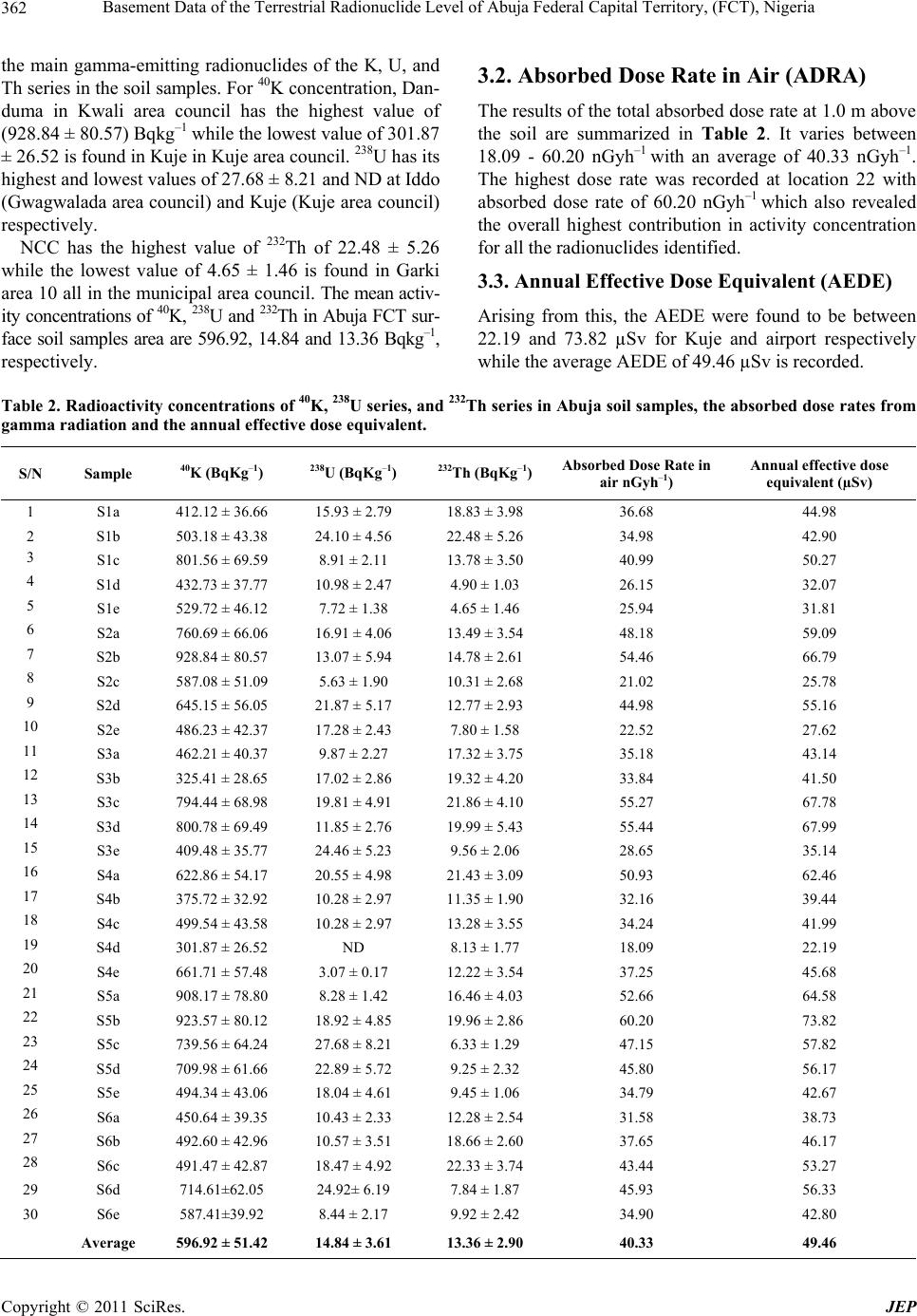 Basement Data of the Terrestrial Radionuclide Level of Abuja Federal Capital Territory, (FCT), Nigeria 362 the main gamma-emitting radionuclides of the K, U, and Th series in the soil samples. For 40K concentration, Dan- duma in Kwali area council has the highest value of (928.84 ± 80.57) Bqkg–1 while the lowest value of 301.87 ± 26.52 is found in Kuje in Kuje area council. 238U has its highest and lowest values of 27.68 ± 8.21 and ND at Iddo (Gwagwalada area council) and Kuje (Kuje area council) respectively. NCC has the highest value of 232Th of 22.48 ± 5.26 while the lowest value of 4.65 ± 1.46 is found in Garki area 10 all in the municipal area council. The mean activ- ity concentrations of 40K, 238U and 232Th in Abuja FCT sur- face soil samples area are 596.92, 14.84 and 13.36 Bqkg–1, respectively. 3.2. Absorbed Dose Rate in Air (ADRA) The results of the total absorbed dose rate at 1.0 m above the soil are summarized in Table 2. It varies between 18.09 - 60.20 nGyh–1 with an average of 40.33 nGyh–1. The highest dose rate was recorded at location 22 with absorbed dose rate of 60.20 nGyh–1 which also revealed the overall highest contribution in activity concentration for all the radionuclides identified. 3.3. Annual Effective Dose Equivalent (AEDE) Arising from this, the AEDE were found to be between 22.19 and 73.82 µSv for Kuje and airport respectively while the average AEDE of 49.46 µSv is recorded. Table 2. Radioactivity concentrations of 40K, 238U series, and 232Th series in Abuja soil samples, the absorbed dose rates from gamma radiation and the annual effective dose equivalent. S/N Sample 40K (BqKg–1) 238U (BqKg–1) 232Th (BqKg–1) Absorbed Dose Rate in air nGyh–1) Annual effective dose equivalent (µSv) 1 S1a 412.12 ± 36.66 15.93 ± 2.79 18.83 ± 3.98 36.68 44.98 2 S1b 503.18 ± 43.38 24.10 ± 4.56 22.48 ± 5.26 34.98 42.90 3 S1c 801.56 ± 69.59 8.91 ± 2.11 13.78 ± 3.50 40.99 50.27 4 S1d 432.73 ± 37.77 10.98 ± 2.47 4.90 ± 1.03 26.15 32.07 5 S1e 529.72 ± 46.12 7.72 ± 1.38 4.65 ± 1.46 25.94 31.81 6 S2a 760.69 ± 66.06 16.91 ± 4.06 13.49 ± 3.54 48.18 59.09 7 S2b 928.84 ± 80.57 13.07 ± 5.94 14.78 ± 2.61 54.46 66.79 8 S2c 587.08 ± 51.09 5.63 ± 1.90 10.31 ± 2.68 21.02 25.78 9 S2d 645.15 ± 56.05 21.87 ± 5.17 12.77 ± 2.93 44.98 55.16 10 S2e 486.23 ± 42.37 17.28 ± 2.43 7.80 ± 1.58 22.52 27.62 11 S3a 462.21 ± 40.37 9.87 ± 2.27 17.32 ± 3.75 35.18 43.14 12 S3b 325.41 ± 28.65 17.02 ± 2.86 19.32 ± 4.20 33.84 41.50 13 S3c 794.44 ± 68.98 19.81 ± 4.91 21.86 ± 4.10 55.27 67.78 14 S3d 800.78 ± 69.49 11.85 ± 2.76 19.99 ± 5.43 55.44 67.99 15 S3e 409.48 ± 35.77 24.46 ± 5.23 9.56 ± 2.06 28.65 35.14 16 S4a 622.86 ± 54.17 20.55 ± 4.98 21.43 ± 3.09 50.93 62.46 17 S4b 375.72 ± 32.92 10.28 ± 2.97 11.35 ± 1.90 32.16 39.44 18 S4c 499.54 ± 43.58 10.28 ± 2.97 13.28 ± 3.55 34.24 41.99 19 S4d 301.87 ± 26.52 ND 8.13 ± 1.77 18.09 22.19 20 S4e 661.71 ± 57.48 3.07 ± 0.17 12.22 ± 3.54 37.25 45.68 21 S5a 908.17 ± 78.80 8.28 ± 1.42 16.46 ± 4.03 52.66 64.58 22 S5b 923.57 ± 80.12 18.92 ± 4.85 19.96 ± 2.86 60.20 73.82 23 S5c 739.56 ± 64.24 27.68 ± 8.21 6.33 ± 1.29 47.15 57.82 24 S5d 709.98 ± 61.66 22.89 ± 5.72 9.25 ± 2.32 45.80 56.17 25 S5e 494.34 ± 43.06 18.04 ± 4.61 9.45 ± 1.06 34.79 42.67 26 S6a 450.64 ± 39.35 10.43 ± 2.33 12.28 ± 2.54 31.58 38.73 27 S6b 492.60 ± 42.96 10.57 ± 3.51 18.66 ± 2.60 37.65 46.17 28 S6c 491.47 ± 42.87 18.47 ± 4.92 22.33 ± 3.74 43.44 53.27 29 S6d 714.61±62.05 24.92± 6.19 7.84 ± 1.87 45.93 56.33 30 S6e 587.41±39.92 8.44 ± 2.17 9.92 ± 2.42 34.90 42.80 Average 5 9 6 .92 ± 51.42 14.84 ± 3.61 13.36 ± 2.90 40.33 49.46 Copyright © 2011 SciRes. JEP 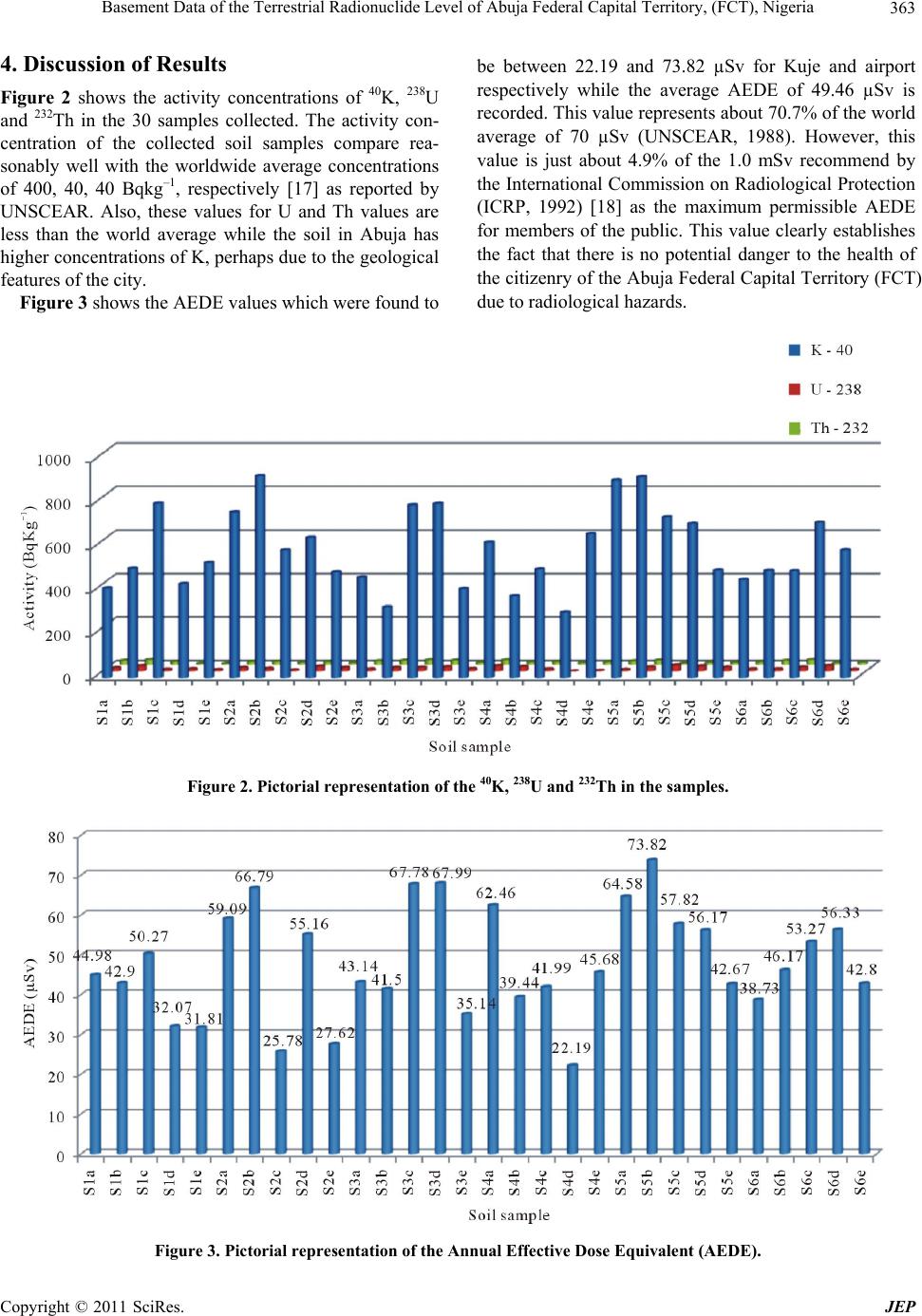 Basement Data of the Terrestrial Radionuclide Level of Abuja Federal Capital Territory, (FCT), Nigeria363 4. Discussion of Results Figure 2 shows the activity concentrations of 40K, 238U and 232Th in the 30 samples collected. The activity con- centration of the collected soil samples compare rea- sonably well with the worldwide average concentrations of 400, 40, 40 Bqkg–1, respectively [17] as reported by UNSCEAR. Also, these values for U and Th values are less than the world average while the soil in Abuja has higher concentrations of K, perhaps due to the geological features of the city. Figure 3 shows the AEDE values which were found to be between 22.19 and 73.82 µSv for Kuje and airport respectively while the average AEDE of 49.46 µSv is recorded. This value represents about 70.7% of the world average of 70 µSv (UNSCEAR, 1988). However, this value is just about 4.9% of the 1.0 mSv recommend by the International Commission on Radiological Protection (ICRP, 1992) [18] as the maximum permissible AEDE for members of the public. This value clearly establishes the fact that there is no potential danger to the health of the citizenry of the Abuja Federal Capital Territory (FCT) due to radiological hazards. Figure 2. Pictorial representation of the 40K, 238U and 232Th in the samples. Figure 3. Pictorial representation of the Annual Effective Dose Equivale nt (AEDE). Copyright © 2011 SciRes. JEP 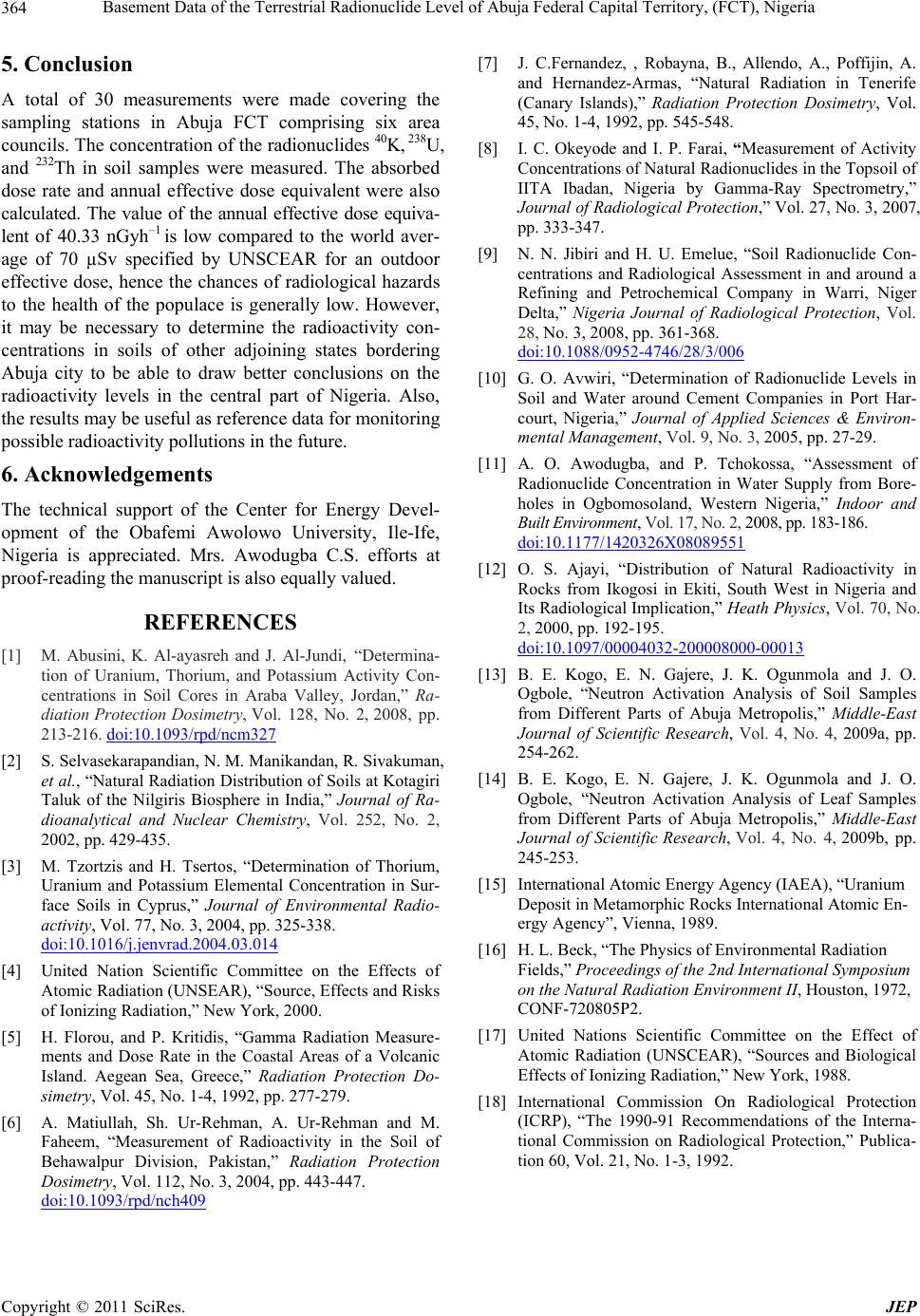 Basement Data of the Terrestrial Radionuclide Level of Abuja Federal Capital Territory, (FCT), Nigeria 364 5. Conclusion A total of 30 measurements were made covering the sampling stations in Abuja FCT comprising six area councils. The concentration of the radionuclides 40K, 238U, and 232Th in soil samples were measured. The absorbed dose rate and annual effective dose equivalent were also calculated. The value of the annual effective dose equiva- lent of 40.33 nGyh–1 is low compared to the world aver- age of 70 µSv specified by UNSCEAR for an outdoor effective dose, hence the chances of radiological hazards to the health of the populace is generally low. However, it may be necessary to determine the radioactivity con- centrations in soils of other adjoining states bordering Abuja city to be able to draw better conclusions on the radioactivity levels in the central part of Nigeria. Also, the results may be useful as reference data for monitoring possible radioactivity pollutions in the future. 6. Acknowledgements The technical support of the Center for Energy Devel- opment of the Obafemi Awolowo University, Ile-Ife, Nigeria is appreciated. Mrs. Awodugba C.S. efforts at proof-reading the manuscript is also equally valued. REFERENCES [1] M. Abusini, K. Al-ayasreh and J. Al-Jundi, “Determina- tion of Uranium, Thorium, and Potassium Activity Con- centrations in Soil Cores in Araba Valley, Jordan,” Ra- diation Protection Dosimetry, Vol. 128, No. 2, 2008, pp. 213-216. doi:10.1093/rpd/ncm327 [2] S. Selvasekarapandian, N. M. Manikandan, R. Sivakuman, et al., “Natural Radiation Distribution of Soils at Kotagiri Taluk of the Nilgiris Biosphere in India,” Journal of Ra- dioanalytical and Nuclear Chemistry, Vol. 252, No. 2, 2002, pp. 429-435. [3] M. Tzortzis and H. Tsertos, “Determination of Thorium, Uranium and Potassium Elemental Concentration in Sur- face Soils in Cyprus,” Journal of Environmental Radio- activity, Vol. 77, No. 3, 2004, pp. 325-338. doi:10.1016/j.jenvrad.2004.03.014 [4] United Nation Scientific Committee on the Effects of Atomic Radiation (UNSEAR), “Source, Effects and Risks of Ionizing Radiation,” New York, 2000. [5] H. Florou, and P. Kritidis, “Gamma Radiation Measure- ments and Dose Rate in the Coastal Areas of a Volcanic Island. Aegean Sea, Greece,” Radiation Protection Do- simetry, Vol. 45, No. 1-4, 1992, pp. 277-279. [6] A. Matiullah, Sh. Ur-Rehman, A. Ur-Rehman and M. Faheem, “Measurement of Radioactivity in the Soil of Behawalpur Division, Pakistan,” Radiation Protection Dosimetry, Vol. 112, No. 3, 2004, pp. 443-447. doi:10.1093/rpd/nch409 [7] J. C.Fernandez, , Robayna, B., Allendo, A., Poffijin, A. and Hernandez-Armas, “Natural Radiation in Tenerife (Canary Islands),” Radiation Protection Dosimetry, Vol. 45, No. 1-4, 1992, pp. 545-548. [8] I. C. Okeyode and I. P. Farai, “Measurement of Activity Concentrations of Natural Radionuclides in the Topsoil of IITA Ibadan, Nigeria by Gamma-Ray Spectrometry,” Journal of Radiological Protection,” Vol. 27, No. 3, 2007, pp. 333-347. [9] N. N. Jibiri and H. U. Emelue, “Soil Radionuclide Con- centrations and Radiological Assessment in and around a Refining and Petrochemical Company in Warri, Niger Delta,” Nigeria Journal of Radiological Protection, Vol. 28, No. 3, 2008, pp. 361-368. doi:10.1088/0952-4746/28/3/006 [10] G. O. Avwiri, “Determination of Radionuclide Levels in Soil and Water around Cement Companies in Port Har- court, Nigeria,” Journal of Applied Sciences & Environ- mental Management, Vol. 9, No. 3, 2005, pp. 27-29. [11] A. O. Awodugba, and P. Tchokossa, “Assessment of Radionuclide Concentration in Water Supply from Bore- holes in Ogbomosoland, Western Nigeria,” Indoor and Built En vironm ent, Vol. 17, No. 2, 2008, pp. 183-186. doi:10.1177/1420326X08089551 [12] O. S. Ajayi, “Distribution of Natural Radioactivity in Rocks from Ikogosi in Ekiti, South West in Nigeria and Its Radiological Implication,” Heath Physics, Vol. 70, No. 2, 2000, pp. 192-195. doi:10.1097/00004032-200008000-00013 [13] B. E. Kogo, E. N. Gajere, J. K. Ogunmola and J. O. Ogbole, “Neutron Activation Analysis of Soil Samples from Different Parts of Abuja Metropolis,” Middle-East Journal of Scientific Research, Vol. 4, No. 4, 2009a, pp. 254-262. [14] B. E. Kogo, E. N. Gajere, J. K. Ogunmola and J. O. Ogbole, “Neutron Activation Analysis of Leaf Samples from Different Parts of Abuja Metropolis,” Middle-East Journal of Scientific Research, Vol. 4, No. 4, 2009b, pp. 245-253. [15] International Atomic Energy Agency (IAEA), “Uranium Deposit in Metamorphic Rocks International Atomic En- ergy Agency”, Vienna, 1989. [16] H. L. Beck, “The Physics of Environmental Radiation Fields,” Proceedings of the 2nd International Symposium on the Natural Radiation Environment II, Houston, 1972, CONF-720805P2. [17] United Nations Scientific Committee on the Effect of Atomic Radiation (UNSCEAR), “Sources and Biological Effects of Ionizing Radiation,” New York, 1988. [18] International Commission On Radiological Protection (ICRP), “The 1990-91 Recommendations of the Interna- tional Commission on Radiological Protection,” Publica- tion 60, Vol. 21, No. 1-3, 1992. Copyright © 2011 SciRes. JEP |