

Paper Menu >>
Journal Menu >>
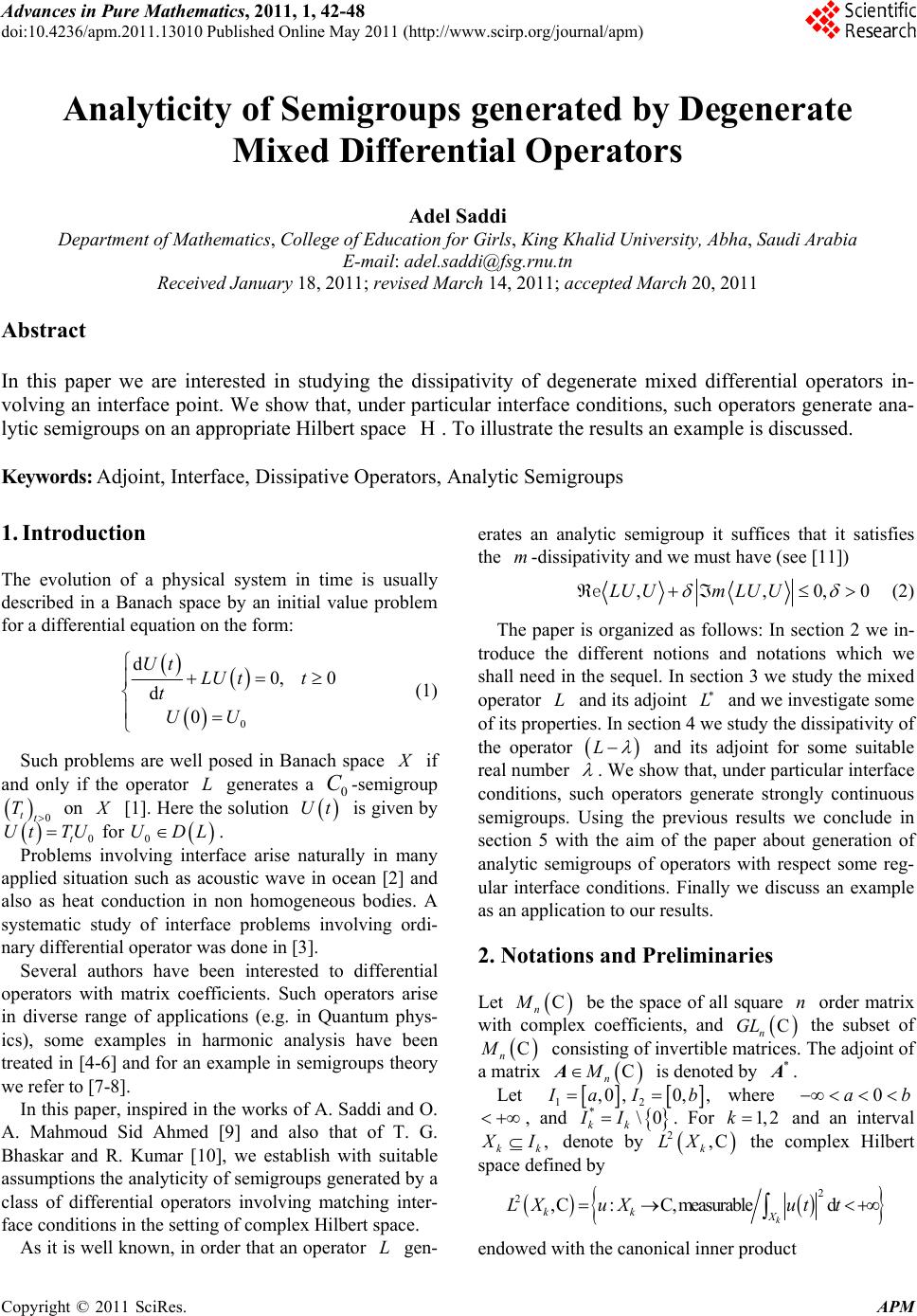 Advances in Pure Mathematics, 2011, 1, 42-48 doi:10.4236/apm.2011.13010 Published Online May 2011 (http://www.scirp.org/journal/apm) Copyright © 2011 SciRes. APM Analyticity of Semigroups generated by Degenerate Mixed Differential Operators Adel Saddi Department of Mat hematics, College of Education for Girls, King Khalid University, Abha, Saudi Arabia E-mail: [email protected] Received January 18, 2011; revised March 14, 2011; accepted March 20, 2011 Abstract In this paper we are interested in studying the dissipativity of degenerate mixed differential operators in- volving an interface point. We show that, under particular interface conditions, such operators generate ana- lytic semigroups on an appropriate Hilbert space H. To illustrate the results an example is discussed. Keywords: Adjoint, Interface, Dissipative Operators, Analytic Semigroups 1. Introduction The evolution of a physical system in time is usually described in a Banach space by an initial value problem for a differential equation on the form: 0 d0, 0 d0 Ut LU tt tUU (1) Such problems are well posed in Banach space X if and only if the operator L generates a 0 C-semigroup 0 tt T on X [1]. Here the so lution Ut is given by 00 for t Ut TUUDL. Problems involving interface arise naturally in many applied situation such as acoustic wave in ocean [2] and also as heat conduction in non homogeneous bodies. A systematic study of interface problems involving ordi- nary differential operator was done in [3]. Several authors have been interested to differential operators with matrix coefficients. Such operators arise in diverse range of applications (e.g. in Quantum phys- ics), some examples in harmonic analysis have been treated in [4-6] and for an example in semigroups theory we refer to [7-8]. In this paper, inspired in the works of A. Saddi and O. A. Mahmoud Sid Ahmed [9] and also that of T. G. Bhaskar and R. Kumar [10], we establish with suitable assumptions the analyticity of semigroups generated by a class of differential operators involving matching inter- face conditions in the setting of complex Hilbert space. As it is well known, in order that an operator L gen- erates an analytic semigroup it suffices that it satisfies the m-dissipativity and we must have (see [11]) ,,0,0LU UmLU U e (2) The paper is organized as follows: In section 2 we in- troduce the different notions and notations which we shall need in the sequel. In section 3 we study the mixed operator L and its adjoint L and we investigate some of its properties. In section 4 we study the dissipativity of the operator L and its adjoint for some suitable real number . We show that, under particular interface conditions, such operators generate strongly continuous semigroups. Using the previous results we conclude in section 5 with the aim of the paper about generation of analytic semigroups of operators with respect some reg- ular interface conditions. Finally we discuss an example as an application to our results. 2. Notations and Preliminaries Let n MC be the space of all square n order matrix with complex coefficients, and n GL C the subset of n MC consisting of invertible matrices. The adjoint of a matrix n MCA is denoted by * A . Let 12 ,0 ,0,, I aI bwhere 0ab , and *\0 kk II. For 1, 2k and an interval , kk X I denote by 2, k LXC the complex Hilbert space defined by 2 2, :,measurabled k kk X LXuXut t CC endowed with the canonical inner product 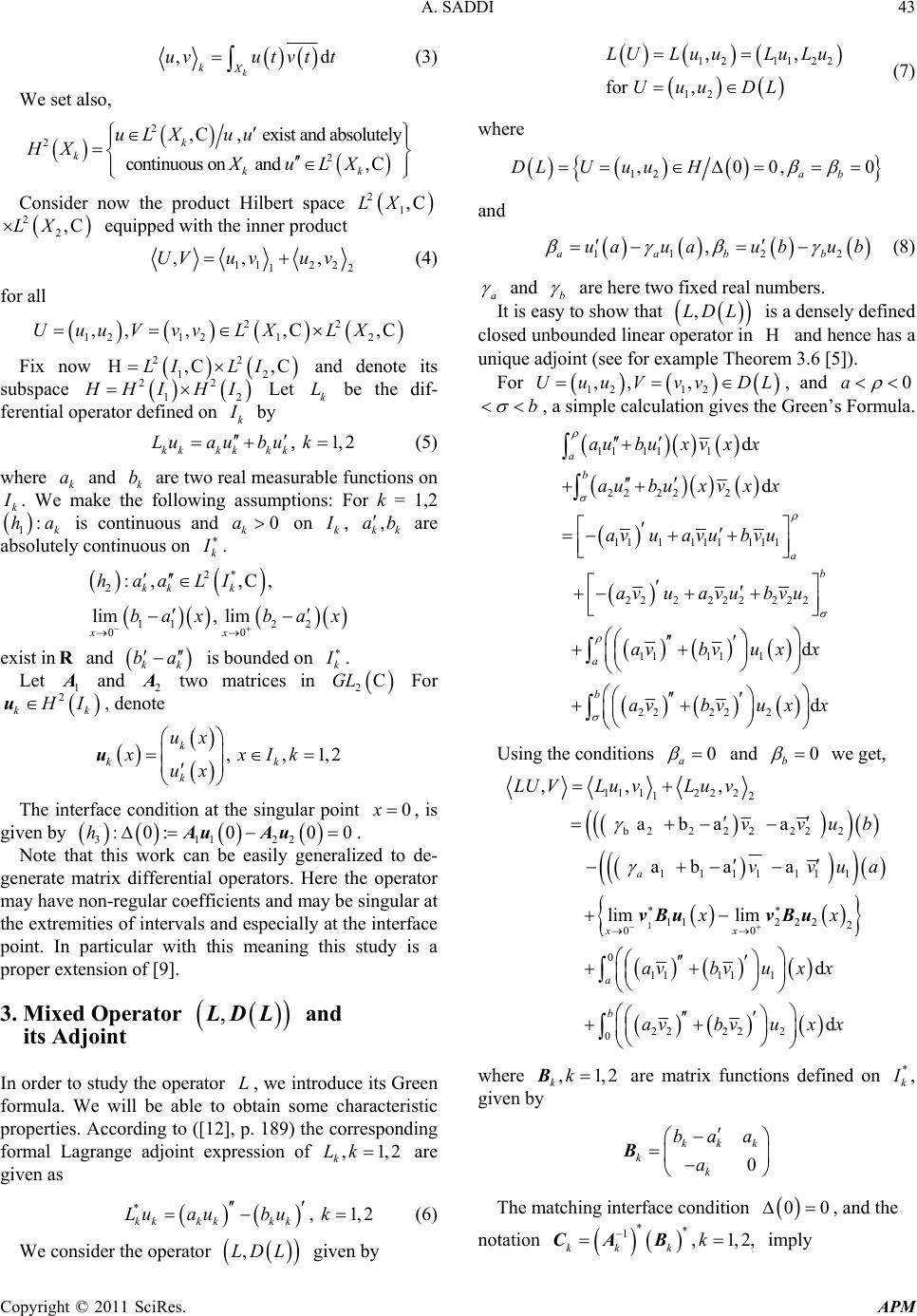 A. SADDI Copyright © 2011 SciRes. APM 43 ,d k kX uvutvt t (3) We set also, 2 22 ,,ex is t a n d a b s o l u te l y con tinuous on ,and k kkk uLX uu HX XuLX C C Consider now the product Hilbert space 21,LXC 22,LXC equipped with the inner product 112 2 12 ,, ,UVu vuv (4) for all 22 12 1212 ,, ,,,Uuu VvvLXLXCC Fix now 22 12 ,,LI LIHC C and denote its subspace 22 12 H HI HI Let k L be the dif- ferential operator defined on k I by , 1,2 kkkkkk Luaubu k (5) where k a and k b are two real measurable functions on k I . We make the following assumptions: For k = 1,2 1:k ha is continuous and 0 k a on k I , , kk ab are absolutely continuous on k I . 2* 2 10 122 0 :,, , llim i,m kk k xx haaLI baxbax C exist inR and kk ba is bounded on k I . Let 1 A and 2 A two matrices in 2 GL C For 2 kk H Iu, denote ,,,12 k k k k ux xxk ux I u The interface condition at the singular point 0x , is given by 12312 000:: 0hAuuA. Note that this work can be easily generalized to de- generate matrix differential operators. Here the operator may have non-regu lar co ef f icien ts an d may be sing u lar at the extremities of intervals and especially at the interface point. In particular with this meaning this study is a proper extension of [9]. 3. Mixed Operator , L DL and its Adjoint In order to study the operator L, we introduce its Green formula. We will be able to obtain some characteristic properties. According to ([12], p. 189) the corresponding formal Lagrange adjoint expression of ,1,2 k Lk are given as *, 1,2 kk kkkk Lu aubu k (6) We consider the operator ,LDL given by 12 1122 12 ,, for , LULu uLuLu Uuu DL (7) where 12 ,00,0 ab DLU uuH and 11 22 , aabb uubaua bu (8) a and b are here two fixed real numbers. It is easy to show that ,LDL is a densely defined closed unbounded linear operator in H and hence has a unique adjoint (see for example Theorem 3.6 [5]). For 12 12 ,, ,UuuVvv DL, and 0a b , a simple calculation gives the Green’s Formula. 11 1 2 11 1111 111 2222222 1111 1 22 11 22 22 22 222 d d d d b a b a a b abxvxx abxvxx av uavubvu av uavubvu avbvu xx avbvu u x u u x u Using the conditions 0 a and 0 b we get, 1 1112 22 12 b22 222 111111 12 2 22 22 1 122 00 0 1111 1 222 0 ,, a ba a a ba a , lim li d d m xx a b a LU Vuvuv vvu vvu avbv ux LL b a xx x xavbv ux vBuvBu where ,1,2 kk B are matrix functions defined on * k I , given by 0 kkk kk baa a B The matching interface condition 00, and the notation ** 1,1,2, kk k k CAB imply 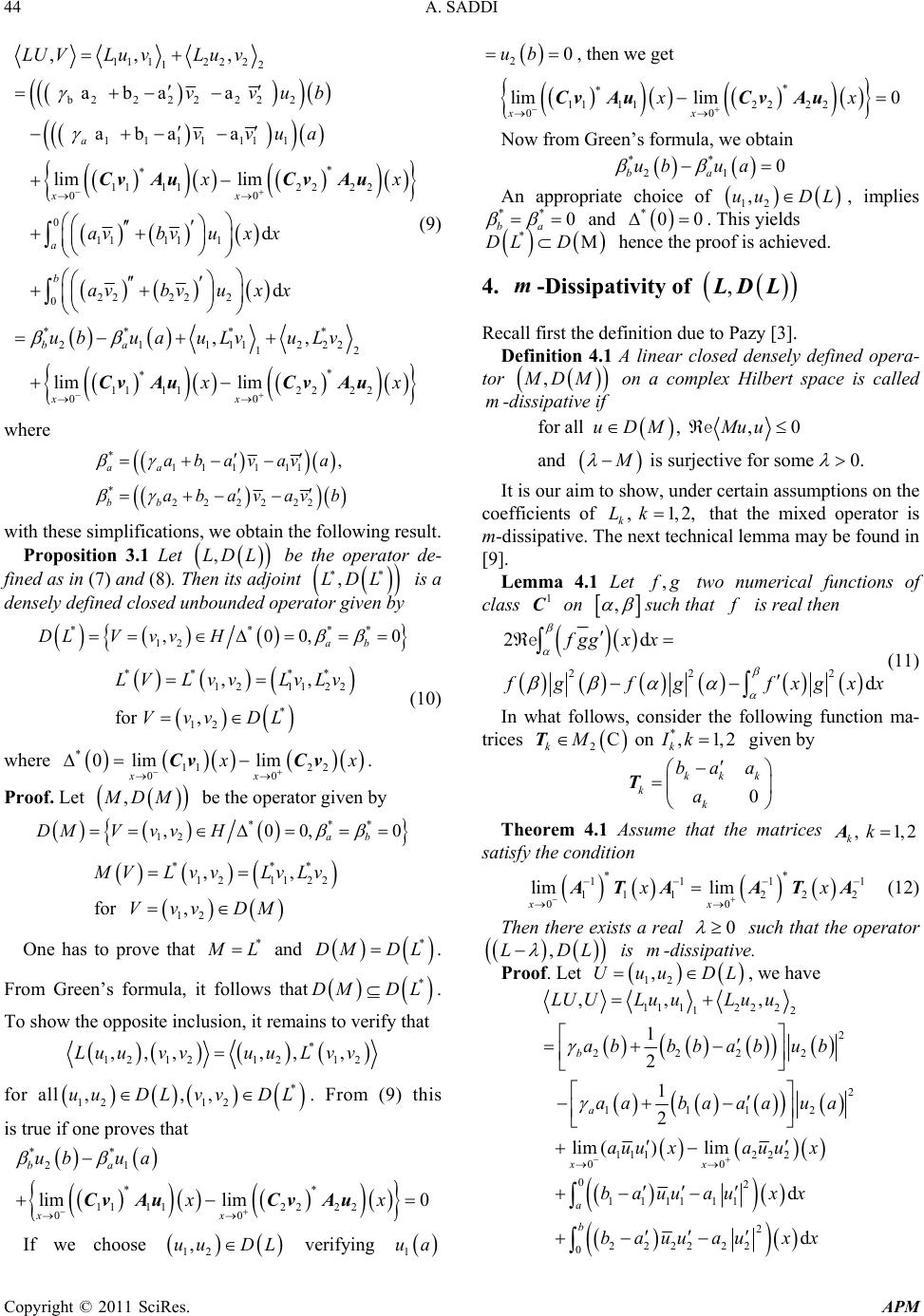 A. SADDI Copyright © 2011 SciRes. APM 44 1112 22 12 b2 * 1112 2 222222 1111111 122 11 2 00 0 1 22 11 0 ** 1 22 12 , lim lim ,, a ba a a ba d d a , xx a b ba a LU Vuvuv u u x x abuxx abuxx uu LL vvb vv a vv vv baLu Au ACvCvu ** 1122 2 12 * 11 121222 00 lim im , l xx vuv x x L Cvv ACAu u (9) where *111 2 11 1 *22222 , a bb aabaa a a v ba avb v v with these simplifications, we obtain the following result. Proposition 3.1 Let ,LDL be the operator de- fined as in (7) and (8 ). Then its adjoint ,LDL is a densely defined closed unbounded operator given by ** 1** 2 ,00,0 ab DLV vvH ** ** 121122 * 12 ,, for , LV LvvLvLv Vvv DL (10) where 12 *1 00 2 li0m lim xx x x CCvv. Proof. Let , M DM be the operator given by * 1** 2 ,00,0 ab DMV vvH *** 121122 12 ,, for , MVL vvLvLv Vvv DM One has to prove that * M L and * DM DL. From Green’s formula, it follows that * DM DL. To show the opposite inclusion, it remains to verify that * 12 121212 ,,,,, ,LuuvvuuLvv for all * 12 12 ,,,uuDL vvDL. From (9) this is true if one proves that ** 21 ** 11112 22 00 2 lim lim0 ba xx ub ua xx Cv uuACvA If we choose 12 ,uu DL verifying 1 ua 20ub , then we get * 11122 0122 0 lim lim0 xx xx CvAuvuCA Now from Gree n’s formula, we obtain ** 21 0 ba bauu An appropriate choice of 12 ,uu DL, implies ** 0 ba and *00 . This yields *MDL D hence the proof is achieved. 4. m-Dissipativity of , L DL Recall first the definition due to Pazy [3]. Definition 4.1 A linear closed densely defined opera- tor , M DM on a complex Hilbert space is called m-dissipative if for all , ,0 and is surjective for some 0. uDM Muu M e It is our aim to show, under certain assumptions on the coefficients of , 1,2, k Lk that the mixed operator is m-dissipative. The next technical lemma ma y b e f oun d in [9]. Lemma 4.1 Let , f g two numerical functions of class 1 C on , such that f is real then 22 2 2d d fggx x f gf fxgxxg e(11) In what follows, consider the following function ma- trices * 2on ,1,2 kk MIkCT given by 0 kkk kk baa a T Theorem 4.1 Assume that the matrices , 1,2 kkA satisfy the condition ** 11 1 11 1122 2 00 lim lim xx xx AT A AAT (12) Then there exists a real 0 such that the operator ,LDL is m-dissipative. Proof. Let 12 ,Uuu DL , we have 1112 22 12 2 22 2 2 2 11122 2 00 02 11111 2 22 2 111 1 222 02 ,, , 1 2 1 2 lim ()lim d d b xx b a a LUULuuLuu ab bbub ab u auu xa ab aaaaa uu x bauua xx bauua x u ux 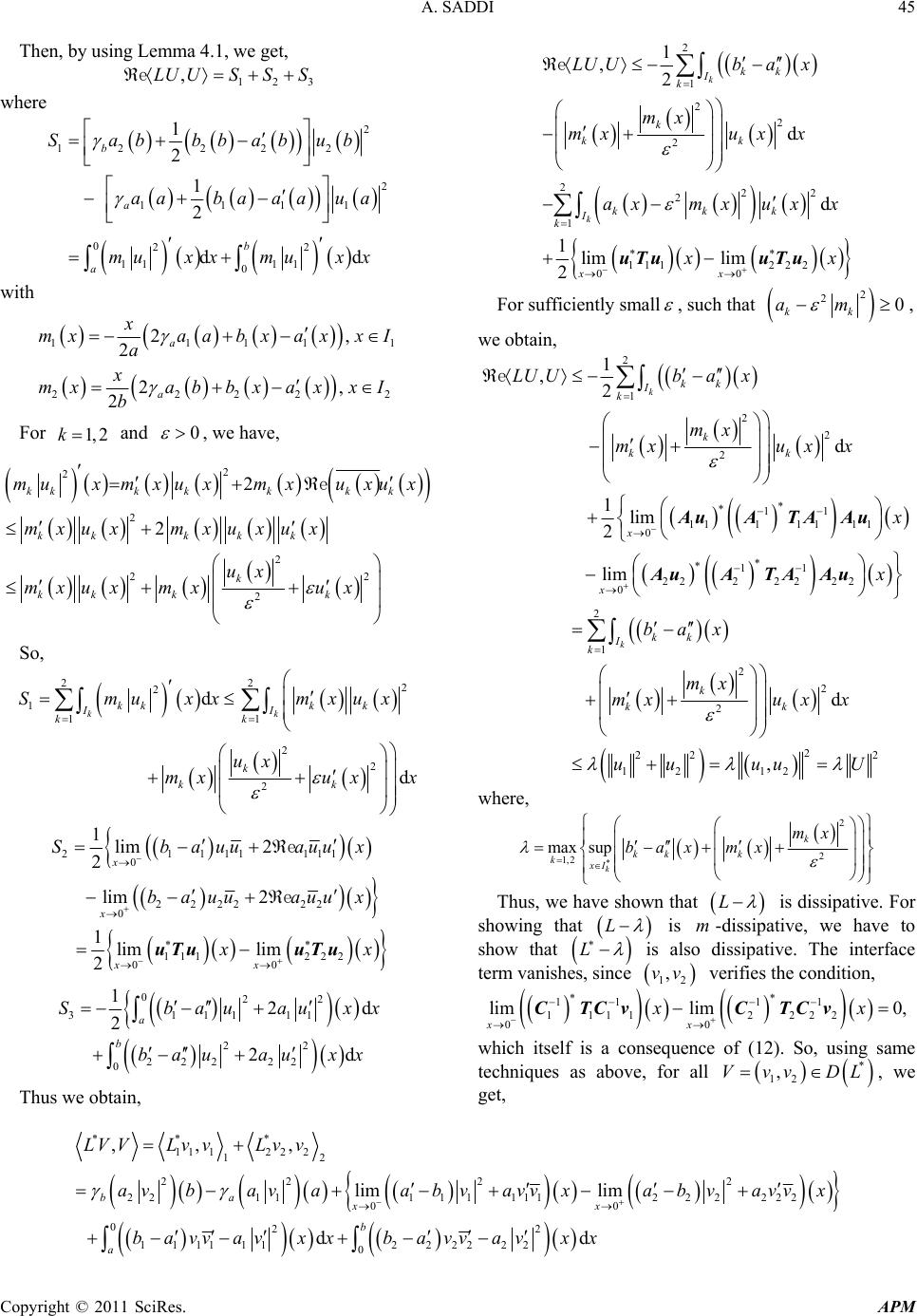 A. SADDI Copyright © 2011 SciRes. APM 45 Then, by using Lemm a 4.1, we get, 123 ,LU USSS e where 2 1222 2 2 11 0 1 22 11 11 0 1 1 2 1 2 dd b a b a Sabbbabub aa bau mux xm a x a x a u with 11111 222 22 2, 2 2, 2 a a x maabxaxxI a x mabxaxxI x b b x For 1,2k and 0 , we have, 2 2 2 2 22 2 2 2 kkkkkk k kk kkk k kk kk muxm xu xm xuxu x mxux mxuxux ux mxux mxux e So, 22 2 2 111 2 2 2 d d kk kkkk II kk k kk Smuxxmxux ux mxux x 211111 0 2 0 1 11 22222 12212 00 1lim 2 2 lim 2 1lim lim 2 x x xx Sbauaux bau u aux x u uu x e e uT Tuuu 022 311111 22 222 022 12d 2 2d a b Sbauauxx bauau xx Thus we obtain, 11 2 2 1 2 2 2 222 2 1 122 00 1 ,2 d d 1lim lim 2 k k kk I k k kk kkk I k xx LU Ubax mx mxux x axmx ux x x x e uuTTuu For sufficiently small , such that 2 20 kk am , we obtain, 1 11 111 1 2222 222 2 2 1 2 2 2 1 11 0 1 0 2 1 2 2 2 22 11 1 ,2 d 1lim 2 lim d k k kk I k k kk x x kk I k k kk LU Ubax mx mxux x x x bax mx mxux x uu u e Au AAu Au TA TAAAu 22 2 ,uU where, 2 2 1,2 max sup k k kk k kxI mx bax mx Thus, we have shown that L is dissipative. For showing that L is m-dissipative, we have to show that L is also dissipative. The interface term vanishes, since 12 ,vv verifies the condition, 11 1 12222 1 111 00 lim lim0, xx xx CT vCCTCv which itself is a consequence of (12). So, using same techniques as above, for all * 12 ,Vvv DL, we get, ** * 1112 22 12 22 221 11 00 0 11 22 1111122 2222 22 11 1222222 0 1 ,, , lim lim dd ba xx a b LVVLvvL vv avaavv xavvx avv bavbvabva bvaxxb vaxxavv 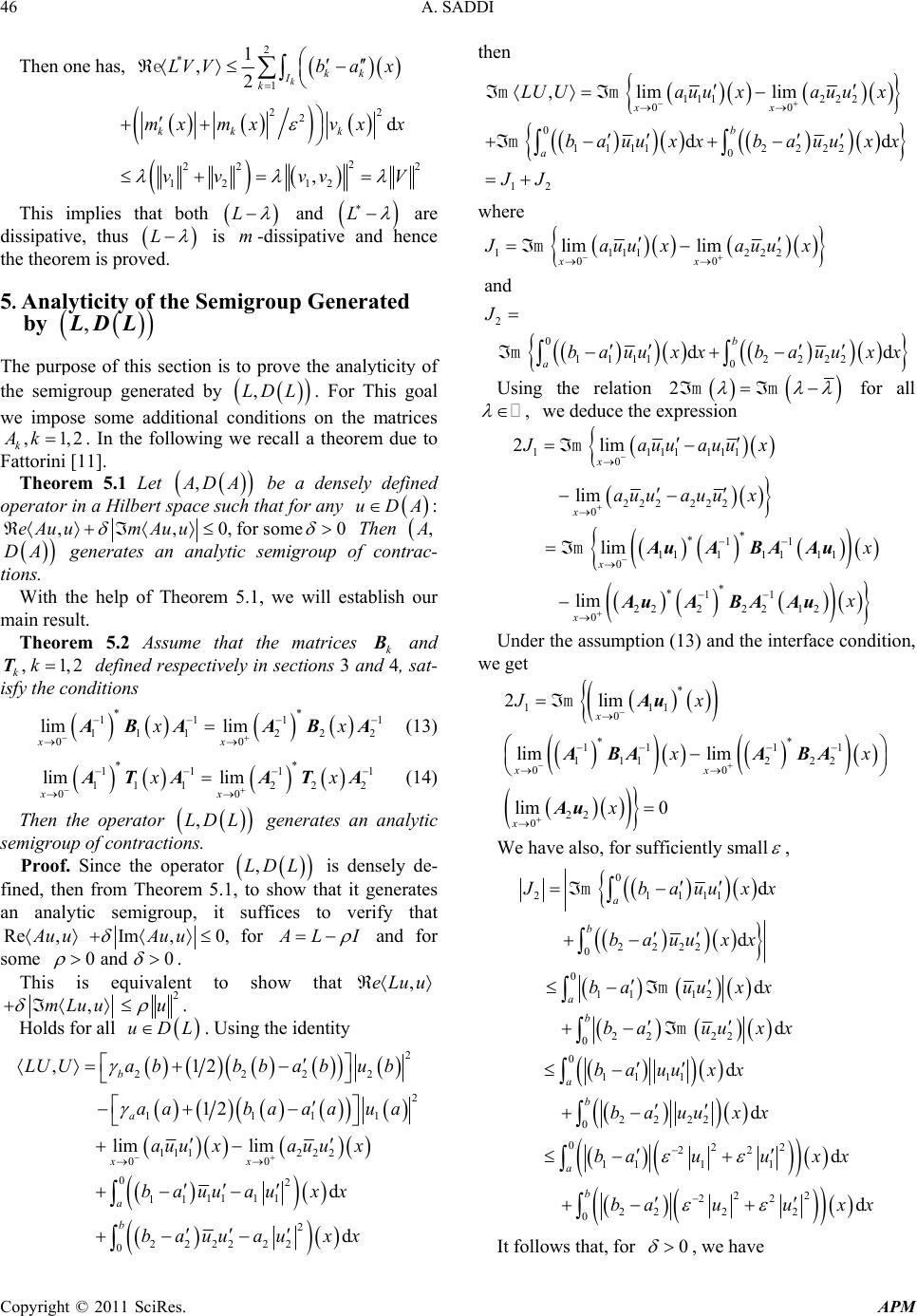 A. SADDI Copyright © 2011 SciRes. APM 46 Then one has, 2 * 1 1 ,2kkk I k LV Vbax e 22 2d kk k mx mxvxx 2 2 22 2 112 ,vv vVv This implies that both L and L are dissipative, thus L is m-dissipative and hence the theorem is proved. 5. Analyticity of the Semigroup Generated by , L DL The purpose of this section is to prove the analyticity of the semigroup generated by ,LDL . For This goal we impose some additional conditions on the matrices ,1,2 k Ak. In the following we recall a theorem due to Fattorini [11]. Theorem 5.1 Let , A DA be a densely defined operator in a Hilbert space such that for any uDA: ,,forso0me0,eAuu mAuu Then , A DA generates an analytic semigroup of contrac- tions. With the help of Theorem 5.1, we will establish our main result. Theorem 5.2 Assume that the matrices k B and ,1,2 kkT defined respectively in sections 3 and 4, sat- isfy the conditions ** 111 1 11 1222 00 lim lim xx xx AB AABA (13) ** 111 1 11 1222 00 lim lim xx xx A TA ATA (14) Then the operator ,LDL generates an analytic semigroup of contractions. Proof. Since the operator ,LDL is densely de- fined, then from Theorem 5.1, to show that it generates an analytic semigroup, it suffices to verify that Re , A uuIm ,0,Au u for A LI and for some 0 and 0 . This is equivalent to show that,eLuu ,mLuu 2 u . Holds for all uDL. Using the identity 2 1111 11 222 2 11 2 22 2 2 11 2 2222 0 1 00 0 11 22 1, liml m d 2 12 i d b xx a a b bbab aaaa uu uu uuau uu a LU Uabub ab ua axax ba xx ba xxu then 112 21 00 0 2 11 21 12 0 1222 ,limlim dd xx a b LuuUUa xax ba uu uu uu x xba xx JJ mm m where 11 00 2 0 1 11 2 1222 112 2 02 lim lim and dd x b x a Jaxax J baxxb uu uu uaxuxuu m m Using the relation 2 mm for all , we deduce the expression 111 0 0 * 11 1111 1 11 11 2 11 0 * 1 22 222 22 121 22 02 2lim lim lim lim x x x x uu uuJaax aax x x uu uu m mAuABA Au AuABA Au Under the assumption (13) and the interface condition, we get * 111 0 ** 111 1 111 00 2 222 2 0 2lim lim lim lim 0 x xx x x x J x x mAu u ABA ABA A We have also, for sufficiently small , 0 211 22 0 11 22 0 1111 2222 022 11 22 0 12 22 0 0 0 22 11 11 22 22 22 22 d d d d d d d d b b b b a a a a Jbauu uu xx ba xx ba xx ba xx bauu xx ba u uux x ba u u uux u x bauuxx m m m It follows that, for 0 , we have 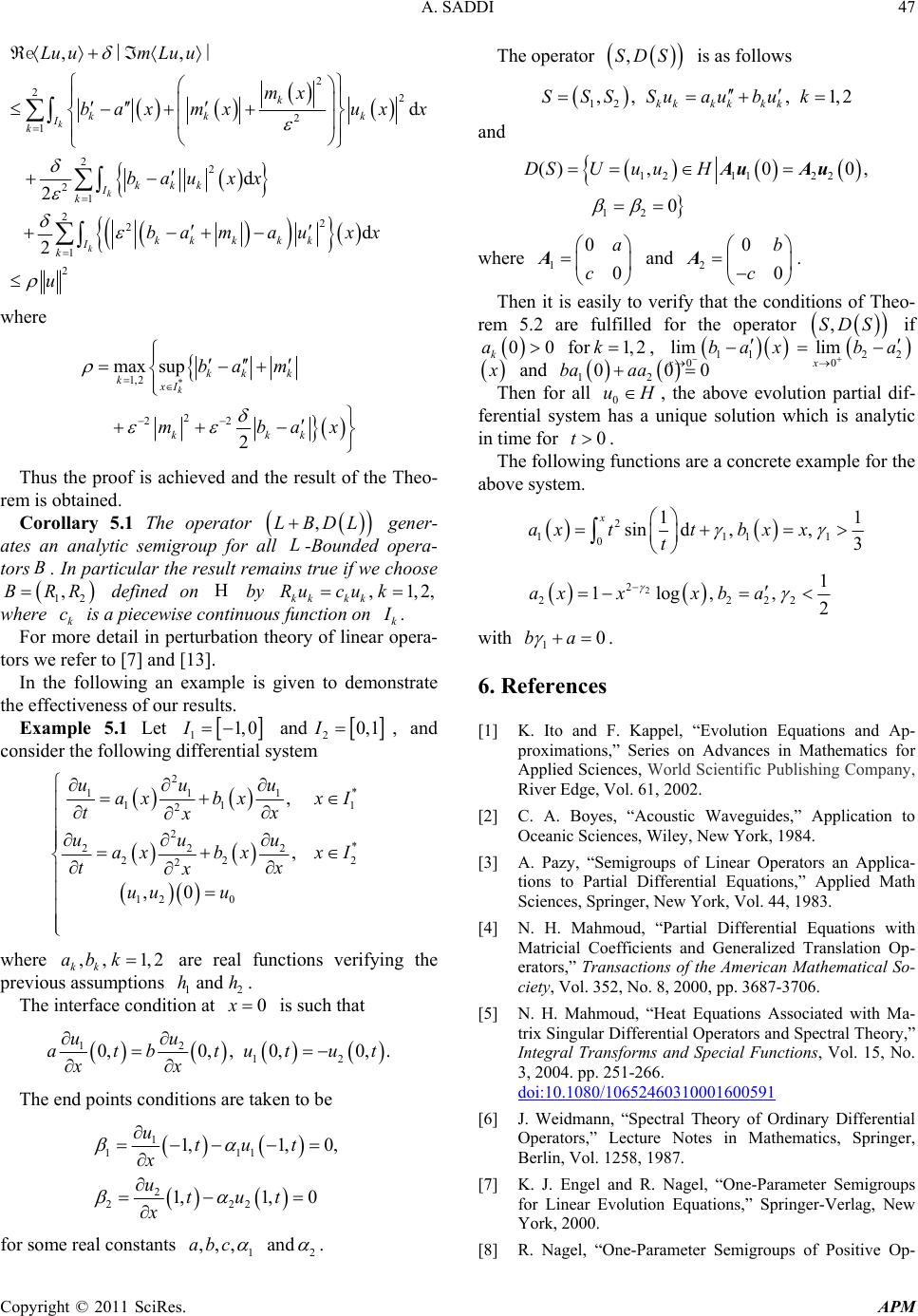 A. SADDI Copyright © 2011 SciRes. APM 47 2 22 2 1 22 21 22 2 1 2 ,, d d 2 d 2 k k k k kkk I k kkk I k kk kkk I k Lu umLuu mx baxmxuxx bau xx ba mauxx u e∣∣ where * 2 22 1,2supmax 2 k kkk k xI kkk ba m mbax Thus the proof is achieved and the result of the Theo- rem is obtained. Corollary 5.1 The operator ,LBDL gener- ates an analytic semigroup for all L-Bounded opera- tors B. In particular the result remains true if we choose 12 ,BRR defined on H by ,1,2, kk kk Rucu k where k c is a piecewise conti nuous function on k I . For more detail in perturbation theory of linear opera- tors we refer to [7] and [13]. In the following an example is given to demonstrate the effectiveness of our results. Example 5.1 Let 11, 0I and 20, 1I, and consider the following differential system 2* 111 11 2 2* 222 22 2 2 1 12 0 , , ,0 uuu axbxxI tx x uuu ax bx xI tx x uu u where ,, 1,2 kk abk are real functions verifying the previous assumptions 12 andhh. The interface condition at 0x is such that 12 12 0,0,,0,0, . uu atbtutut xx The end points conditions are taken to be 1 111 2 222 1,1, 0, 1,1, 0 utut x utut x for some real constants 1 ,,,abc and2 . The operator ,SDS is as follows 12 ,,, 1,2 kkkk kk SSSSuaubuk and 12 1 12 122 (),0 0, 0 DSUu uH uuAA where 1 0 0 a c A and 2 0 0 b c A. Then it is easily to verify that the conditions of Theo- rem 5.2 are fulfilled for the operator ,SDS if 00 k a for1, 2k , 11 0 lim xbax 22 0 lim xba x and 12 000ba aa Then for all 0 uH , the above evolution partial dif- ferential system has a unique solution which is analytic in time for 0t. The following functions are a concrete example for the above system. 2 1111 0 11 sin d,,3 x axttbx x t 2 2 2222 1 1log,, 2 axxxba with 10ba . 6. References [1] K. Ito and F. Kappel, “Evolution Equations and Ap- proximations,” Series on Advances in Mathematics for Applied Sciences, World Scientific Publishing Company, River Edge, Vol. 61, 2002. [2] C. A. Boyes, “Acoustic Waveguides,” Application to Oceanic Sciences, Wiley, New York, 1984. [3] A. Pazy, “Semigroups of Linear Operators an Applica- tions to Partial Differential Equations,” Applied Math Sciences, Springer, New York, Vol. 44, 1983. [4] N. H. Mahmoud, “Partial Differential Equations with Matricial Coefficients and Generalized Translation Op- erators,” Transactions of the American Mathematical So- ciety, Vol. 352, No. 8, 2000, pp. 3687-3706. [5] N. H. Mahmoud, “Heat Equations Associated with Ma- trix Singular Differential Operators and Spectral Theory,” Integral Transforms and Special Functions, Vol. 15, No. 3, 2004. pp. 251-266. doi:10.1080/10652460310001600591 [6] J. Weidmann, “Spectral Theory of Ordinary Differential Operators,” Lecture Notes in Mathematics, Springer, Berlin, Vol. 1258, 1987. [7] K. J. Engel and R. Nagel, “One-Parameter Semigroups for Linear Evolution Equations,” Springer-Verlag, New York, 2000. [8] R. Nagel, “One-Parameter Semigroups of Positive Op-  A. SADDI Copyright © 2011 SciRes. APM 48 erators,” Lecture Notes in Mathematics, Springer- Verlag, Berlin, Vol. 1184, 1986. [9] A. Saddi and O. A. Mahmoud Sid Ahmed, “Analyticity of Semigroups Generated by a Class of Differential Op- erators with Matrix Coefficients and Interface,” Semi- group Forum, Vol. 71, No. 1, 2005, pp. 1-17. doi:10.1007/s00233-004-0173-6 [10] T. G. Bhaskar and R. Kumar, “Analyticity of Semigroup Generated by a Class of Differential Operators with In- terface,” Nonlinear Analysis, Vol. 39, No. 6, 2000, pp. 779-791. doi:10.1016/S0362-546X(98)00237-5 [11] H. O. Fattorini, “The Cauchy Problem,” Addison Wesley, Massachusetts, Vol. 18, 1983. [12] H. Chebli, “Analyse Hilbertienne,” Centre de Publication Universitaire, Tunis, 2001. [13] T. Kato, “Perturbation Theory for Linear Operators,” Springer-Verlag, Berlin, 1966. |