

Paper Menu >>
Journal Menu >>
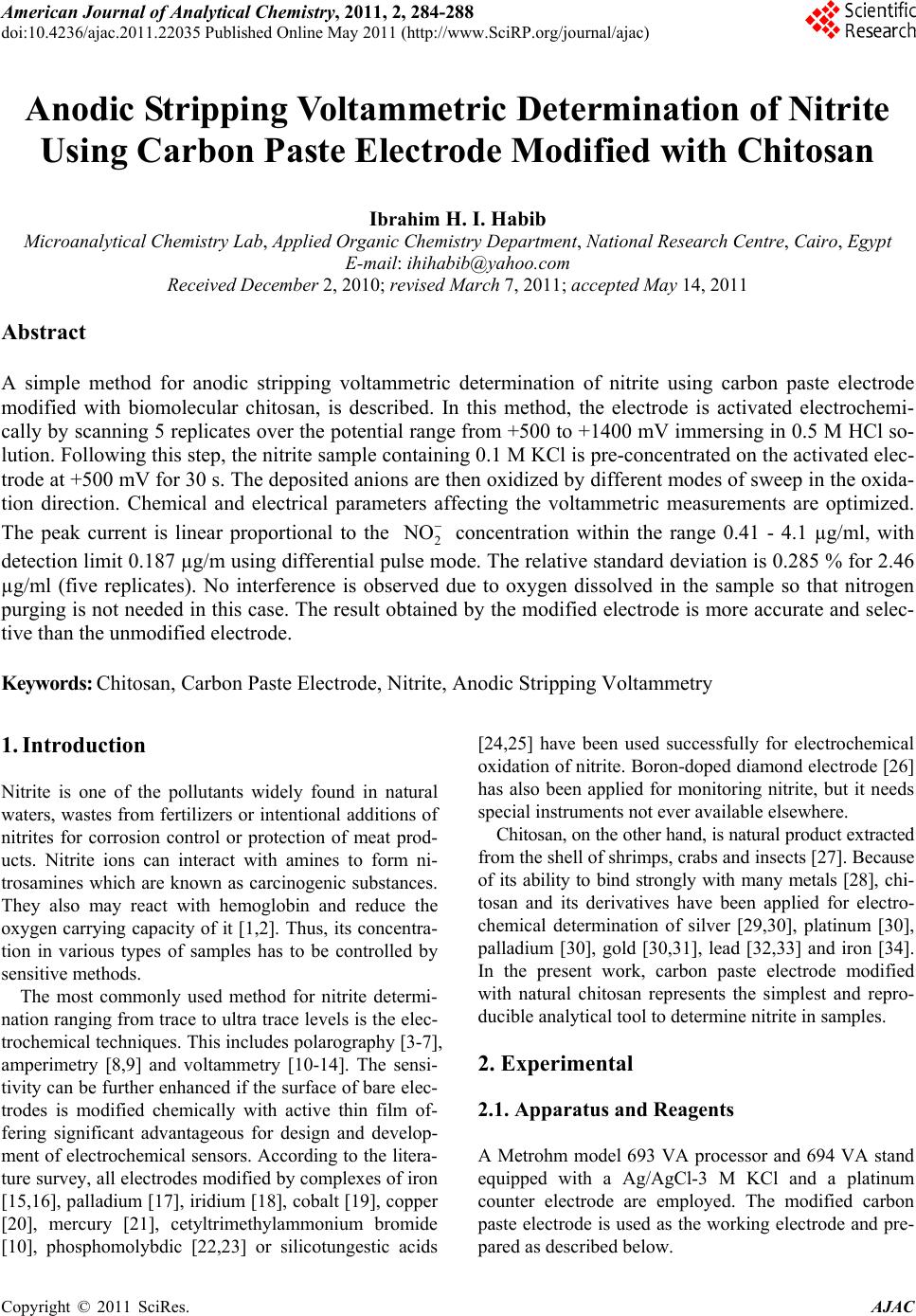 American Journal of Anal yt ical Chemistry, 2011, 2, 284-288 doi:10.4236/ajac.2011.22035 Published Online May 2011 (http://www.SciRP.org/journal/ajac) Copyright © 2011 SciRes. AJAC Anodic Stripping Voltammetric Determination of Nitrite Using Carbon Paste Electrode Modified with Chitosan Ibrahim H. I. Habib Microanalytical Chemistry Lab, Applied Organic Chemistry Department, National Research Centre, Cairo , Egypt E-mail: [email protected] Received December 2, 2010; revised March 7, 2011; accepted May 14, 2011 Abstract A simple method for anodic stripping voltammetric determination of nitrite using carbon paste electrode modified with biomolecular chitosan, is described. In this method, the electrode is activated electrochemi- cally by scanning 5 replicates over the potential range from +500 to +1400 mV immersing in 0.5 M HCl so- lution. Following this step, the nitrite sample containing 0.1 M KCl is pre-concentrated on the activated elec- trode at +500 mV for 30 s. The deposited anions are then oxidized by different modes of sweep in the oxida- tion direction. Chemical and electrical parameters affecting the voltammetric measurements are optimized. The peak current is linear proportional to the 2 NO concentration within the range 0.41 - 4.1 µg/ml, with detection limit 0.187 µg/m using differential pulse mode. The relative standard deviation is 0.285 % for 2.46 µg/ml (five replicates). No interference is observed due to oxygen dissolved in the sample so that nitrogen purging is not needed in this case. The result obtained by the modified electrode is more accurate and selec- tive than the unmodified electrode. Keywords: Chitosan, Carbon Paste Electrode, Nitrite, Anodic Stripping Voltammetry 1. Introduction Nitrite is one of the pollutants widely found in natural waters, wastes from fertilizers or intentional additions of nitrites for corrosion control or protection of meat prod- ucts. Nitrite ions can interact with amines to form ni- trosamines which are known as carcinogenic substances. They also may react with hemoglobin and reduce the oxygen carrying capacity of it [1,2]. Thus, its concentra- tion in various types of samples has to be controlled by sensitive methods. The most commonly used method for nitrite determi- nation ranging from trace to ultra trace levels is the elec- trochemical techniques. This includes polarography [3-7], amperimetry [8,9] and voltammetry [10-14]. The sensi- tivity can be further enhanced if the surface of bare elec- trodes is modified chemically with active thin film of- fering significant advantageous for design and develop- ment of electrochemical sensors. According to the litera- ture survey, all electrodes modified by complexes of iron [15,16], palladium [17], iridium [18], cobalt [19], copper [20], mercury [21], cetyltrimethylammonium bromide [10], phosphomolybdic [22,23] or silicotungestic acids [24,25] have been used successfully for electrochemical oxidation of nitrite. Boron-doped diamond electrode [26] has also been applied for monitoring nitrite, but it needs special instruments not ever available elsewhere. Chitosan, on the other hand, is natural product extracted from the shell of shrimps, crabs and insects [27]. Because of its ability to bind strongly with many metals [28], chi- tosan and its derivatives have been applied for electro- chemical determination of silver [29,30], platinum [30], palladium [30], gold [30,31], lead [32,33] and iron [34]. In the present work, carbon paste electrode modified with natural chitosan represents the simplest and repro- ducible analytical tool to determine nitrite in samples. 2. Experimental 2.1. Apparatus and Reagents A Metrohm model 693 VA processor and 694 VA stand equipped with a Ag/AgCl-3 M KCl and a platinum counter electrode are employed. The modified carbon paste electrode is used as the working electrode and pre- pared as described below. 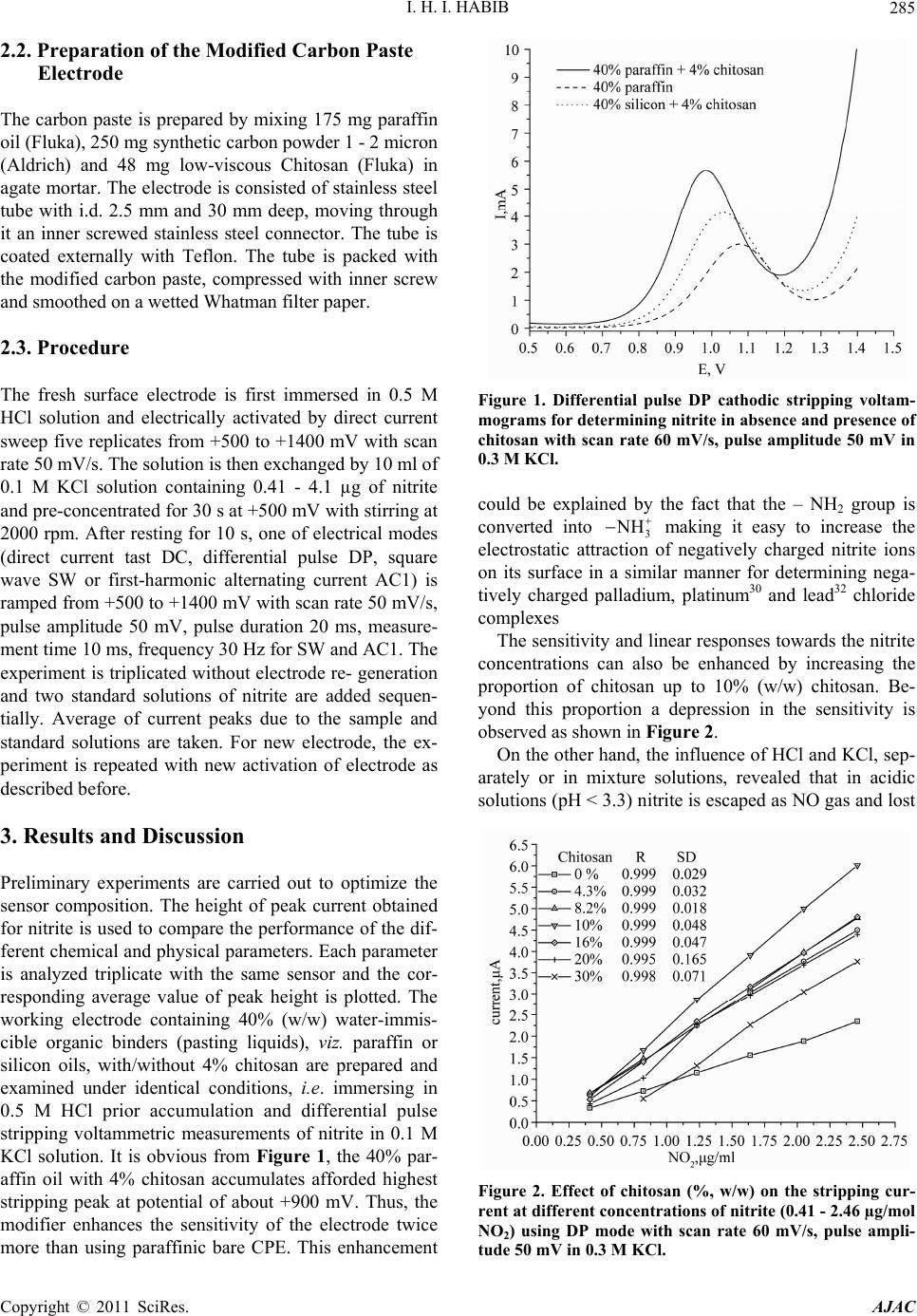 I. H. I. HABIB285 2.2. Preparation of the Modified Carbon Paste Electrode The carbon paste is prepared by mixing 175 mg paraffin oil (Fluka), 250 mg synthetic carbon powder 1 - 2 micron (Aldrich) and 48 mg low-viscous Chitosan (Fluka) in agate mortar. The electrode is consisted of stainless steel tube with i.d. 2.5 mm and 30 mm deep, moving through it an inner screwed stainless steel connector. The tube is coated externally with Teflon. The tube is packed with the modified carbon paste, compressed with inner screw and smoothed on a wetted Whatman filter paper. 2.3. Procedure The fresh surface electrode is first immersed in 0.5 M HCl solution and electrically activated by direct current sweep five replicates from +500 to +1400 mV with scan rate 50 mV/s. The solution is then exchanged by 10 ml of 0.1 M KCl solution containing 0.41 - 4.1 µg of nitrite and pre-concentrated for 30 s at +500 mV with stirring at 2000 rpm. After resting for 10 s, one of electrical modes (direct current tast DC, differential pulse DP, square wave SW or first-harmonic alternating current AC1) is ramped from +500 to +1400 mV with scan rate 50 mV/s, pulse amplitude 50 mV, pulse duration 20 ms, measure- ment time 10 ms, frequency 30 Hz for SW and AC1. The experiment is triplicated without electrode re- generation and two standard solutions of nitrite are added sequen- tially. Average of current peaks due to the sample and standard solutions are taken. For new electrode, the ex- periment is repeated with new activation of electrode as described before. 3. Results and Discussion Preliminary experiments are carried out to optimize the sensor composition. The height of peak current obtained for nitrite is used to compare the performance of the dif- ferent chemical and physical parameters. Each parameter is analyzed triplicate with the same sensor and the cor- responding average value of peak height is plotted. The working electrode containing 40% (w/w) water-immis- cible organic binders (pasting liquids), viz. paraffin or silicon oils, with/without 4% chitosan are prepared and examined under identical conditions, i.e. immersing in 0.5 M HCl prior accumulation and differential pulse stripping voltammetric measurements of nitrite in 0.1 M KCl solution. It is obvious from Figure 1, the 40% par- affin oil with 4% chitosan accumulates afforded highest stripping peak at potential of about +900 mV. Thus, the modifier enhances the sensitivity of the electrode twice more than using paraffinic bare CPE. This enhancement Figure 1. Differential pulse DP cathodic stripping voltam- mograms for determining nitrite in absence and presence of chitosan with scan rate 60 mV/s, pulse amplitude 50 mV in 0.3 M KCl. could be explained by the fact that the – NH2 group is converted into 3 NH making it easy to increase the electrostatic attraction of negatively charged nitrite ions on its surface in a similar manner for determining nega- tively charged palladium, platinum30 and lead32 chloride complexes The sensitivity and linear responses towards the nitrite concentrations can also be enhanced by increasing the proportion of chitosan up to 10% (w/w) chitosan. Be- yond this proportion a depression in the sensitivity is observed as shown in Figure 2. On the other hand, the influence of HCl and KCl, sep- arately or in mixture solutions, revealed that in acidic solutions (pH < 3.3) nitrite is escaped as NO gas and lost Figure 2. Effect of chitosan (%, w/w) on the stripping cur- rent at different concentrations of nitrite (0.41 - 2.46 µg/mol NO2) using DP mode with scan rate 60 mV/s, pulse ampli- tude 50 mV in 0.3 M KCl. Copyright © 2011 SciRes. AJAC 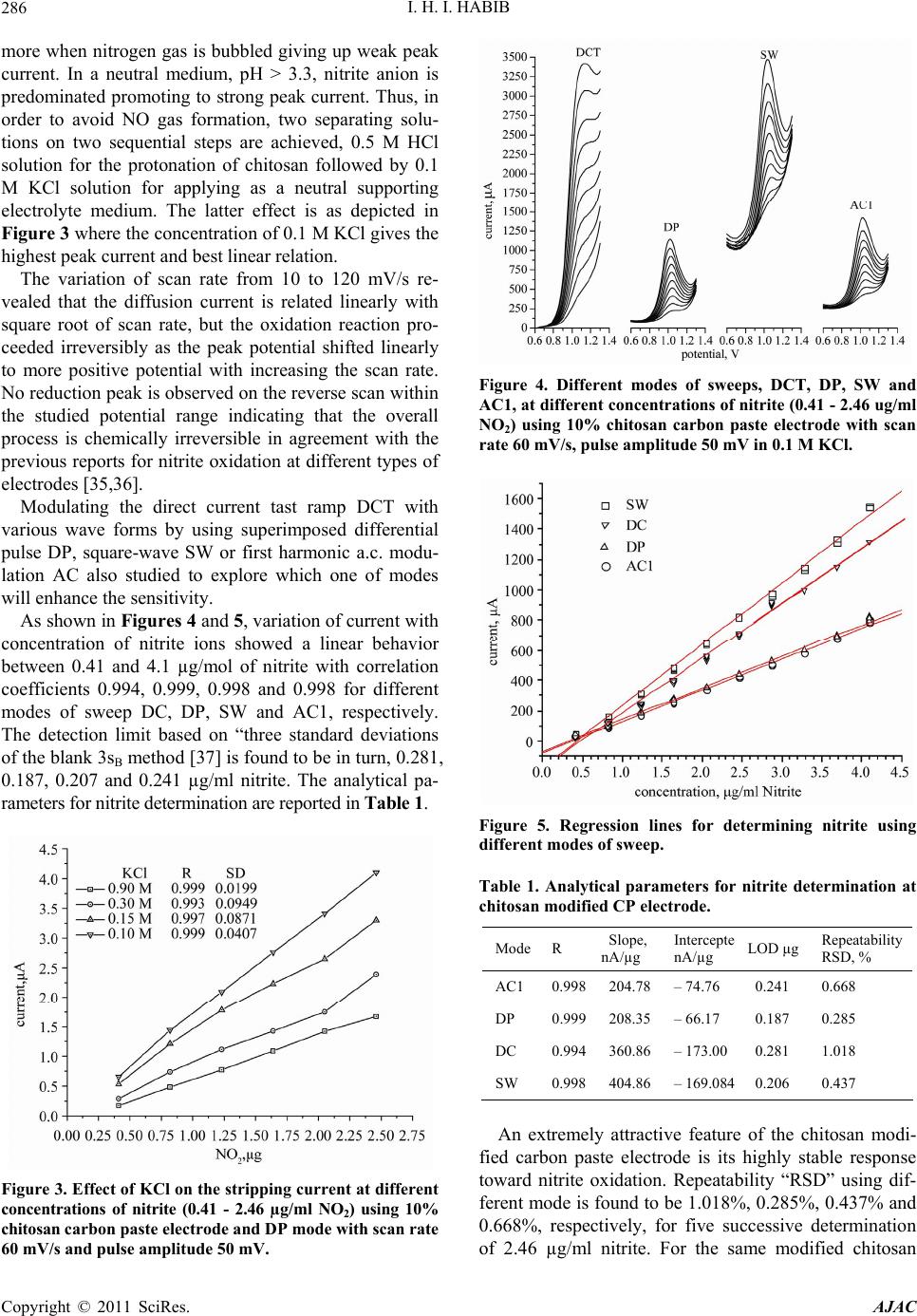 I. H. I. HABIB 286 more when nitrogen gas is bubbled giving up weak peak current. In a neutral medium, pH > 3.3, nitrite anion is predominated promoting to strong peak current. Thus, in order to avoid NO gas formation, two separating solu- tions on two sequential steps are achieved, 0.5 M HCl solution for the protonation of chitosan followed by 0.1 M KCl solution for applying as a neutral supporting electrolyte medium. The latter effect is as depicted in Figure 3 where the concentration of 0.1 M KCl gives the highest peak current and best linear relation. The variation of scan rate from 10 to 120 mV/s re- vealed that the diffusion current is related linearly with square root of scan rate, but the oxidation reaction pro- ceeded irreversibly as the peak potential shifted linearly to more positive potential with increasing the scan rate. No reduction peak is observed on the reverse scan within the studied potential range indicating that the overall process is chemically irreversible in agreement with the previous reports for nitrite oxidation at different types of electrodes [35,36]. Modulating the direct current tast ramp DCT with various wave forms by using superimposed differential pulse DP, square-wave SW or first harmonic a.c. modu- lation AC also studied to explore which one of modes will enhance the sensitivity. As shown in Figures 4 and 5, variation of current with concentration of nitrite ions showed a linear behavior between 0.41 and 4.1 µg/mol of nitrite with correlation coefficients 0.994, 0.999, 0.998 and 0.998 for different modes of sweep DC, DP, SW and AC1, respectively. The detection limit based on “three standard deviations of the blank 3sB method [37] is found to be in turn, 0.281, 0.187, 0.207 and 0.241 µg/ml nitrite. The analytical pa- rameters for nitrite determination are reported in Table 1. Figure 3. Effect of KCl on the stripping current at different concentrations of nitrite (0.41 - 2.46 µg/ml NO2) using 10% chitosan carbon paste electrode and DP mode with scan rate 60 mV/s and pulse amplitude 50 mV. Figure 4. Different modes of sweeps, DCT, DP, SW and AC1, at different concentrations of nitrite (0.41 - 2.46 ug/ml NO2) using 10% chitosan carbon paste electrode with scan rate 60 mV/s, pulse amplitude 50 mV in 0.1 M KCl. Figure 5. Regression lines for determining nitrite using different modes of sweep. Table 1. Analytical parameters for nitrite determination at chitosan modified CP electrode. ModeR Slope, nA/µg Intercepte nA/µg LOD µg Repeatability RSD, % AC10.998204.78– 74.76 0.241 0.668 DP 0.999208.35– 66.17 0.187 0.285 DC 0.994360.86– 173.00 0.281 1.018 SW 0.998404.86– 169.084 0.206 0.437 An extremely attractive feature of the chitosan modi- fied carbon paste electrode is its highly stable response toward nitrite oxidation. Repeatability “RSD” using dif- ferent mode is found to be 1.018%, 0.285%, 0.437% and 0.668%, respectively, for five successive determination of 2.46 µg/ml nitrite. For the same modified chitosan Copyright © 2011 SciRes. AJAC  I. H. I. HABIB287 electrode, reproducibility, without and with successive cut off/polishing five times, is found to be 0.285% and 0.347%, respectively, for 2.46 µg/ml nitrite and using DP mode. It is concluded that the new and simple carbon paste electrode modified with chitosan has been shown to offer comparable performance to the more expensive glassy carbon or diamond electrodes for the practical use to analysis 2ions at trace concentrations in real samples by anodic striping voltammetry with high sensitivity and selectivity. NO 4. Acknowledgements Thanks are due to Volkswagen Stiftung, Kastanienallee 35, 30519 Hannover, Germany, for the financial support of purchasing the Metrohm model 693 VA processor and 694 VA stand. 5. References [1] P. F. Swann, “The Toxicology of Nitrate, Nitrite and N-nitroso Compounds,” Journal of Agricultural and Food Chemistry, Vol. 26, No. 1, January 1975, pp. 1761- 1970. doi:10.1002/jsfa.2740261119 [2] S. S. Mirvish, “Role of N-nitroso Compounds (NOC) and N-Nitrosation in Etiology of Gastric, Esophageal, Naso- pharyngeal and Bladder Cancer and Contribution to Can- cer of Known Exposures to NOC,” Cancer Letters, Vol. 93, No. 1, June 1995, pp. 17-48. doi:10.1016/0304-3835(95)03786-V [3] P. Sharma and R. Sharma, “Sequential Trace Determina- tion of Nitrate and Nitrite in Natural Waters by Differen- tial Pulse Polarography,” International Journal of Environmental Analytical Chemistry, Vol. 82, No. 1, 2002, pp. 7-11. doi:10.1080/03067310290024049 [4] H. Walter and J. J. Specchio, “Determination of Nitrite and Nitrate by Differential Pulse Polarography with Si- multaneous Nitrogen Purging,” Analytical Chemistry, Vol. 64, No. 11, 1992, pp. 1313-1322. doi:10.1021/ac00035a021 [5] T. S. Sadallah and A. A. Banan, “Differential-Pulse Polarographic Determination of Nitrite,” Analyst, Vol. 109, No. 12, 1984, pp. 1545-1547. doi:10.1039/an9840901545 [6] Y. P. Cui, C. Z. Yang, W. Zeng, M. Oyama, W. H. Pu and J. D. Zhang, “Electrochemical Determination of Nitrite Using a Gold Nanoparticles-Modified Glassy Carbon Electrode Prepared by the Seed-Mediated Growth Technique,” Analytical Science, Vol. 23, No. 12, 2007, pp. 1421-1425. doi:10.2116/analsci.23.1421 [7] Ü. T. Yilmaz and G. Somer, “Determination of Trace Nitrite by Direct and Indirect Methods Using Differential Pulse Polarography and Application,” Journal of Elec- troanalytical Chemistry, Vol. 624, No. 1-2, 2008, pp. 59-63. doi:10.1016/j.jelechem.2008.07.025 [8] J. R. Caetano da Rocha, L. Angnes, M. Bertotti, K. Araki and H. E. Toma, “Amperometric Detection of Nitrite and Nitrate at Tetraruthenated Porphyrin-Modified Electrodes in a Continuous-Flow Assembly,” Analytica Chimica Acta, Vol. 452, No. 1, January 2002, pp. 23-28. doi:10.1016/S0003-2670(01)01440-4 [9] A. Salimi, A. Noorbakhash and F. S. Karonian, “Am- perometric Detection of Nitrite, Iodate and Periodate on Glassy Carbon Electrode Modified with Thionin and Multi-Wall Carbon Nanotubes,” International Journal of Electrochemcal Science, Vol. 1, No. 9 , 2006, pp. 435-446 [10] L. Guanghan, J. Hong and S. Dandan, “Determination of Trace Nitrite by Anodic Stripping Voltammetry,” Food Chemistry, Vol. 59, No. 4, 1997, pp. 583-587. doi:10.1016/S0308-8146(96)00290-7 [11] J. Markus and M. Fedurco, “Vitamin B12 as Coordinating Agent for the Voltammetric Determination of Nitrite in Natural Waters,” Analytica Chimica Acta, Vol. 248, No. 1, July 1991, pp. 109-115. doi:10.1016/S0003-2670(00)80875-2 [12] S. M. Silva and L. H. Mazo, “Differential Pulse Vol- tammetric Determination of Nitrite with Gold Ultra- microelectrode,” Electroanalysis, Vol. 10, No. 17, 1998, pp. 1200-1203. doi:10.1002/(SICI)1521-4109(199811)10:17<1200::AID- ELAN1200>3.0.CO;2-5 [13] C. M. G. Van den Berg and H. Li, “Potentiometric and Voltammetric Responses of Carbon Fibre Electrodes,” Analytica Chimica Acta, Vol. 212, 1988, pp. 31-41. doi:10.1016/S0003-2670(00)84126-4 [14] M. Badea, A. Amine, M. Benzine, A. Curulli, D. Moscone, A. Lupu, G. Volpe and G. Palleschi, “Rapid and Selective Electrochemical Determination of Nitrite in Cured Meat in the Presence of Ascorbic Acid,” Micro- chimica Acta, Vol. 147, No. 1-2, 2004, pp. 51-58. doi:10.1007/s00604-004-0220-8 [15] J. E. Toth and F. C. Anson, “Electrocatalytic Reducetion of Nitrite and Nitric Oxide to Ammonia with Iron-Subs- tituted Polyoxotungstates,” Journal of the American Chemical Society, Vol. 111, No. 7, March 1989, pp. 2444-2451. doi:10.1021/ja00189a012 [16] W. J. R. Santos, Ph. R. Lima, A. A. Tanaka, S. M. C. N. Tanaka and L. T. Kubota, “Determination of Nitrite in Food Samples by Anodic Voltammetry Using a Modified Electrode,” Food Chemistry, Vol. 113, No. 4, 2009, pp. 1206-1211. doi:10.1016/j.foodchem.2008.08.009 [17] W. Sun, S. Zhang, H. Liu, L. Jin and J. Kong, “Electro- catalytic Reduction of Nitrite at a Glassy Carbon Elec- trode Surface Modified with Palladium (II)-Substituted Keggin Type Heteropolytungstate,” Analytica Chimica Acta, Vol. 388, No. 1-2, May 1999, pp. 103-110. doi:10.1016/S0003-2670(99)00064-1 [18] W. Sun, F. Yang, H. Liu, L. Jin, J. Kong, S. Jin, G. Xie and J. Deng, “Electrochemical and Electrocatalytic Prop- erties of Iridium(IV)-Substituted Dawson Type Polyoxo- tungstate,” Journal of Electroanalytical Chemistry, Vol. 451, No. 1-2, July 1998, pp. 49-57. doi:10.1016/S0022-0728(97)00511-1 Copyright © 2011 SciRes. AJAC  I. H. I. HABIB Copyright © 2011 SciRes. AJAC 288 [19] M. Thamae and T. Nyokog, “Cobalt (II) Porphyrazine Catalysed Reduction of Nitrite,” Journal of Electroana- lytical Chemistry, Vol. 470, No. 2, July 1999, pp. 126- 135. doi:10.1016/S0022-0728(99)00224-7 [20] C. S. Fung and K. Y. Wong, “Electrocatalytic Reduction of Nitrite by Copper Complexes of 1, 10-Phenanthroline and 2,2′:6′,2″-Terpyridine,” Journal of Electroanalytical Chemistry, Vol. 401, No. 1-2, January 1996, pp. 263-268. doi:10.1016/0022-0728(95)04414-0 [21] L. Ruhlmann and G. Genet, “Wells–Dawson-derived Tetrameric Complexes {K28H8[P2W15Ti3O60.5]4} Electro- chemical Behaviour and Electrocatalytic Reducetion of Nitrite and of Nitric Oxide,” Journal of Electroanalytical Chemistry, Vol. 568, July 2004, pp. 315-321. doi:10.1016/j.jelechem.2004.02.020 [22] S. Liu, Z. Shi and S. Dong, “Preparation of a Composite Film Electrode Containing 12-Tungstosilicic Acid and Its Electrocatalytic Reduction for Nitrite,” Electroanalysis, Vol. 10, No. 13, 1998, pp. 891-896. [23] S. Dong, X. Xi and M. Tian, “Study of the Electrocata- lytic Reduction of Nitrite with Silicotungstic Heter- opolyanion,” Journal of Electroanalytical Chemistry, Vol. 385, No. 2, 1995, pp. 227-233. doi:10.1016/0022-0728(94)03770-4 [24] L. Cheng and S. Dong, “Electrochemical Behavior and Electrocatalytic Properties of Ultrathin Films Containing Silicotungstic Heteropolyanion SiW12O404–,” Journal of the Electrochemical Society, Vol. 147, No. 2, 2000, pp. 606-612. doi:10.1149/1.1393241 [25] X. Wang, E. Wang and C. Hu, “Hybrid Inorganic- Or- ganic Material Containing 12-Molybdophosphate Bulk-Modified Carbon Paste Electrode,” Chemistry Let- ters, Vol. 30, No. 10, 2001, pp. 1030-1031. doi:10.1246/cl.2001.1030 [26] N. Spataru, T. N. Rao, D. A. Tryk and A. Fujishima, “Determination of Nitrite and Nitrogen Oxides by Anodic Voltammetry at Conductive Diamond Electrodes,” Jour- nal of Electrochemical Society, Vol. 148, No. 3, 2001, pp. E112-E117. [27] A. J. Varma, S. V. Deshpande and J. F. Kennedy; “Metal Complexation by Chitosan and its Derivatives: A Re- view,” Carbohydrate Polymers, Vol. 55, No. 1, January 2004, pp. 77-93. doi:10.1016/j.carbpol.2003.08.005 [28] E. Guibal; “Interactions of Metal Ions with Chitosan- Based Sorbents: A Review,” Separation and Purification Technology, Vol. 38, No. 1, July 2004, pp. 43-74. [29] Q. H. Yang, X. Z. Ye and Z. C. Hong, “LihuaJianyan, Huaxue-Fence,” Analytical Abstracts, Vol. 36, No. 161, 2000. [30] X. Z. Ye, Q. H. Yang; Y. Wang and N. Q. Li, “Electro- chemical Behaviour of Gold, Silver, Platinum and Palla- dium on the Glassy Carbon Electrode Modified by Chi- tosan and its Application,” Talanta, Vol. 47, No. 5, De- cember 1998, pp. 1099-1106. doi:10.1016/S0039-9140(98)00189-1 [31] Q. H. Yang, X. Z. Ye and H. Wang, “Fenxi-Shi-yanshi,” Analytical Abstracts, Vol. 17, 1998, p. 5. [32] R. A. Y. Hassan, I. H. I. Habib and H. N. A. Hassan, “Voltammetric Determination of Lead (II) in Medical Lotion and Biological Samples Using Chitosan-Carbon Paste Electrode,” International Journal of Electrochem- cal Science, Vol. 3, No. 8, 2008, pp. 935-945. [33] J. R. Xu and B. Liu, “Preconcentration and Deter- mination of Lead Ions at a Chitosan-Modified Glassy Carbon Electrode,” Analyst, Vol. 119, No. 7, 1994, pp. 1599-1601. doi:10.1039/an9941901599 [34] G. H. Lu, X. Yao, X. G. Wu and T. Zhan, “Determination of the Total Iron by Chitosan-Modified Glassy Carbon Electrode,” Microchemical Journal, Vol. 69, No. 1, May 2001, pp. 81-87. doi:10.1016/S0026-265X(01)00066-2 [35] J. A. Cox and P. J. Kulesza, “Oxidation and Determina- tion of Nitrite at Modified Electrodes,” Journal of Elec- troanalytical Chemistry, Vol. 175, No. 1-2, September 1984, pp. 105-118. doi:10.1016/S0022-0728(84)80349-6 [36] R. B. Almeida, S. S. S. Borges and M. G. Gomes, “De- termination of Nitrite in Aqueous Solutions Using the Linear Sweep Voltammetry Technique,” Analytical Let- ters, Vol. 32, No. 6, 1999, pp. 1203-1210. doi:10.1080/00032719908542889 [37] J. C. Miller and J. N. Miller, “Statistics for Analytical Chemistry,” 2nd Edition, 1988, Ellis Horwood Ltd., Chichester, p. 115. |